
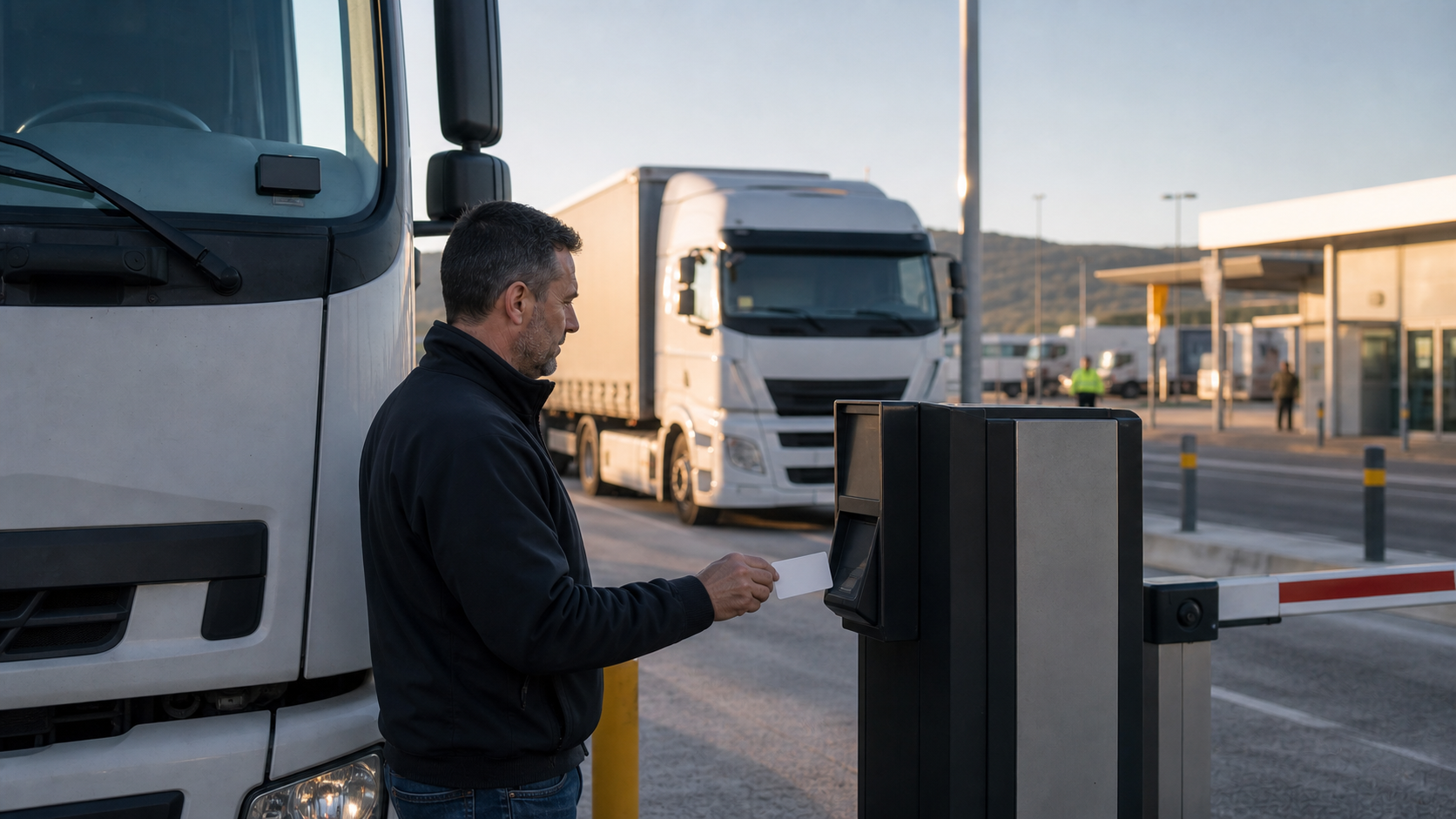
Summary
- Andamur is not an access-network provider or a cloud-service company on the public evidence. Its strategic importance sits in the more prosaic but very sticky business of fleet fuel cards, toll devices, secure-parking access, tax-recovery services and digital account tools for road transport operators.
- The public routing record for AS211262, held by andamur GP Limite Andamur SL, is still meaningful. It shows that a fuel-card and mobility-account provider with physical sites and European payment dependencies also operates visible internet numbering, which makes network-resource evidence a useful signal of service continuity rather than a category change.
- The DKV Mobility acquisition of a majority stake in Road Solution PRO, Andamur's fuel-card, toll and VAT-refund business vehicle, confirms the institutional reading: this is a B2B mobility-payments and transport-services platform whose customers may face operational friction if account access, card authorization, toll settlement or station acceptance breaks during a route.
The company is easier to misread than to categorize
Andamur can look like several different businesses depending on which public record is opened first. Its website presents a transport-services brand serving professional drivers and fleets across Europe. Its legal notice presents G.P. Limite Andamur, S.L. as a Spanish company based in Lorca, Murcia, with registered-company details, tax identification and a long list of contact channels. Its fuel-card page emphasizes payment control, invoices by license plate, restrictions, card security and coverage across a European station network.
Its toll page emphasizes devices that let international fleets move through many national tolling systems without stopping at each administrative boundary. Its private-account page presents Andamur Connect as the customer's digital area for prices, balances, consumption, invoices, tickets, cards, transits and contracts. Its mobile-service conditions for airCODE show a card-number and mobile-phone login pattern tied to authorization, geolocation, data security and account management.
RIPEstat then adds a very different-looking record: AS211262 is held by andamur GP Limite Andamur SL and is announced with an IPv4 prefix and two IPv6 prefixes.
Those public signals do not contradict each other. They describe different layers of one operating model. Andamur's paid unit is not consumer broadband, wholesale transit or generic cloud hosting. Its paid unit is the ability of a fleet to keep moving, fuelling, parking, crossing toll systems, reconciling invoices and controlling spend while trucks travel through a fragmented European road economy.
The network evidence matters because the account and payment layer is digital; the company has a visible autonomous system; and a fleet-services institution that depends on card authorization, customer portals, geolocation-enabled refuelling tools and toll-device administration needs communications resilience even when it is not selling connectivity as a product.
That is why the category should remain institutional. A Regional ISP classification would overstate the case: the evidence does not show that Andamur sells last-mile access, broadband, enterprise circuits or transit as its first product. A Cloud Service classification would also stretch the evidence: Andamur operates digital account software and service authorization tools, but the public pages do not show a customer-facing hosting, VPS, managed-cloud or cybersecurity-subscription business.
The more accurate reading is that Andamur is an institutional fleet-service operator whose public internet-numbering footprint is a dependency signal inside a transport-payment business.
This distinction is important for monitoring. Fuel cards are often treated as procurement instruments: a way to buy diesel, control discounts and simplify invoices. Toll devices are often treated as vehicle accessories. Customer portals are often treated as administrative convenience. In practice, for a small or mid-sized haulier, these instruments can become the control surface for route continuity. A blocked card, a failed toll device, an inaccessible private account, a missing invoice or a rejected secure-parking authorization can interrupt a working route even if the truck, driver and customer cargo are all ready.
Andamur's public materials show it selling exactly that bundle: payment, tolling, parking, tax recovery, account information and a station network. The value proposition is not a single pump or a single device. It is the reduction of route friction.
The legal and institutional base is visible
The legal notice on Andamur's website identifies G.P. Limite Andamur, S.L. as the owner of the site and gives its address at Centro de Negocios Andamur 3, Poligono Industrial Saprelorca, Lorca, Murcia. The same notice lists Spanish tax identification B30424162 and registration data in the Commercial Registry of Murcia. That is the first institutional anchor: the brand is not merely a reseller page or an unverified marketing wrapper.
The public site binds the operating brand to a Spanish corporate entity and supplies direct customer-contact channels, including phone numbers and email addresses for customer service, administration and data protection.
The airCODE conditions add a second institutional layer because they are not only marketing copy. They describe a service owned by G.P. Limite Andamur, S.L.; state that airCODE is free and voluntary; explain that it requires geolocation information to work properly; and define the main purpose of data processing as the authorization and use of the service. They also describe login by card number and phone number for clients of G.P. Limite Andamur, S.L. or Andamur Europe, S.A. This matters because it ties a mobile workflow to customer identity, payment credentials and route activity.
It also shows that the service depends on controlled authorization rather than anonymous pump access.
The third institutional layer is external corporate activity. DKV Mobility announced an agreement in 2023 to acquire a majority stake in Road Solution PRO, described as a subsidiary of Spanish service-station operator Andamur that managed the entire fuel-card business. DKV later announced that it had completed the acquisition of a 70 percent majority stake. The European Commission's merger case materials describe the Road business as a fuel-card, toll-device and VAT/fuel-tax refund business incorporated in 2022 through the spin-off of certain Andamur activities.
Those records are useful because they confirm that a larger European B2B mobility platform saw Andamur's payment and settlement business as separable, valuable and strategically adjacent to its own network.
The acquisition also helps explain why Andamur should be read through the payments-and-account lens rather than the physical-station lens alone. Service areas are visible assets, but the business that attracted the DKV transaction was not just a roadside footprint. It was the card, toll and tax-recovery operating surface around that footprint. A fleet customer can fuel at many pumps, but a trusted card program that centralizes discounts, restrictions, invoices, toll data and tax documentation is harder to replace than an individual stop.
The institutional dependency is built from the interaction between physical acceptance points and the account rails behind them.
External registry-style sources are less detailed than the company's own documents, but they reinforce the same location and corporate-identity picture. Infoempresa, for example, lists GP Limite Andamur SL in Lorca, Murcia, and identifies its activity in the trade of fuel and similar products. That does not prove every operational claim on its own, but it supports the legal-entity continuity behind the Andamur brand and is consistent with the company's own public filings and service copy.
The economic unit is route authorization
The most useful way to understand Andamur is to start with what a haulier actually needs on a working route. A truck needs fuel, but a company does not only need the liquid product. It needs the fuel purchase to be authorized for the correct vehicle, recorded against the correct license plate, controlled by the right limit, billed to the correct account, reconciled with the right invoice and accepted in enough places that the driver does not have to negotiate a new supplier relationship at every stop. The payment instrument becomes a coordination device.
Andamur's fuel-card page is explicit about this control logic. It promotes restrictions on cards according to customer needs, detailed invoices by license plate, purchase control, card cancellation and security mechanisms around airCODE. Its Andamur ProEurope card is presented for transport companies and is tied to a network of more than 900 petrol stations in nine European countries on that page, while the broader service-area page describes more than 1,400 petrol stations across Europe.
The numbers appear in different product contexts and reflect a site whose pages have been updated at different times, but the strategic point is stable: the card is sold as a multi-country acceptance and administration tool, not simply a discount coupon.
That matters because the route-authorization layer creates switching costs. A fleet can move from one diesel supplier to another in a narrow physical sense. It can instruct a driver to stop at a different station. It can pay by bank card in an emergency. But if the fleet is using Andamur cards to control driver spend, receive license-plate-level invoices, obtain tax documentation, manage toll-device billing and handle secure-parking access, the substitute is no longer a pump. The substitute is a whole back-office operating model. A bank card replaces payment but not fleet restrictions.
A toll-operator account replaces one national toll channel but not multi-country administration. Manual procurement replaces neither route-level data nor clean invoice reconciliation.
This is the first network-dependency signal in the non-technical sense. Andamur's network is a commercial acceptance network: own service areas, partner stations, card-acceptance points, toll-device services, private-account tools and support channels. The customer is not locked in by a formal monopoly. The customer is bound by workflow integration. The card and account become part of how the fleet schedules, controls and documents work.
The dependency is strongest for small and mid-sized fleets because they have less administrative slack. A very large fleet can maintain multiple card programs, internal tax-recovery staff, custom ERP integrations and direct relationships with tolling bodies. A smaller operator often buys a bundle from a specialist because it reduces overhead. The specialist becomes valuable precisely because it hides complexity. That is also why service interruption matters: the more operational complexity a provider absorbs, the more visible its absence becomes when a credential, portal, invoice or device fails.
The toll business adds cross-border complexity
Tolling is where the Andamur model moves beyond fuel procurement into route governance. European road transport is stitched together from national toll systems, tunnel charges, bridges, emissions rules, vehicle classes and country-specific device requirements. The practical need for a fleet is not just to pay tolls. It is to keep the truck compliant and moving through jurisdictions without turning every border or tolling zone into a separate administrative process.
Andamur's toll page presents this as a device-and-service problem. It advertises Toll4Europe 4G as a single device for travel across 16 European countries and 19 toll services. It also advertises K1 Telepass for international fleets, with coverage in 18 European countries and 22 toll services, including countries and specific bridge or tunnel systems. The page emphasizes fast device delivery, management through an app and access to secure parking networks through associated arrangements.
The exact device lineup may change over time, but the page shows the type of service Andamur is selling: multi-jurisdiction toll access attached to fleet administration.
For monitoring purposes, tolling is more revealing than a simple card discount. A fuel card can be read as a payment instrument. A toll device is also a compliance instrument. If a vehicle enters a road system without the correct toll account, device or authorization status, the fleet may incur penalties, detours or delays. If a device has to be activated, deactivated, assigned to a plate, set for emissions category or reconciled after use, the customer is relying on the provider's account system and support workflow. The provider is a translation layer between the fleet and multiple tolling authorities.
That translation role is where the dependency surface widens. The fleet depends on Andamur or its partner infrastructure for device procurement, configuration, account visibility, transaction data and invoicing. The toll operator still controls the public road toll. The bank still settles money. The driver still moves the truck. Andamur sits in between those actors and reduces coordination work. If that middle layer fails, the customer can still find alternatives, but not without friction at precisely the point where transport work is time-sensitive.
The DKV acquisition reinforces that interpretation. DKV did not need Andamur to prove that Europe has roads, fuel stations or tolls. It acquired a majority stake in Road Solution PRO because fleet payment, toll and VAT-refund services are scalable institutional rails. When such a business becomes part of a larger mobility-services group, its importance is no longer only local. It becomes a regional integration point for customer accounts, accepted stations, toll services and tax-recovery workflows.
Andamur's own service footprint remains Spanish and road-transport-focused, but its account layer participates in a broader European B2B mobility ecosystem.
Digital account tools convert services into continuity infrastructure
Andamur Connect is the clearest public example of the company's digital account layer. The page describes it as a private client area where customers can consult information and documentation for fleet management. The visual and text cues list prices, balances, consumption, invoices, tickets, cards, transits and contracts. Those categories show why the platform matters even though it is not a general-purpose cloud product.
It is where a customer sees the operational state of the relationship: what fuel costs, what has been consumed, what has been billed, which cards exist, which movements have occurred and which contracts bind the account.
That information flow is part of the product. A driver can make a purchase at a service area, but the customer organization needs to understand the purchase afterward. The back office needs to allocate cost, detect misuse, reconcile invoices and maintain compliance records. For fuel and tolls, that documentation is not decorative. It touches tax recovery, customer billing, payroll or subcontractor settlement, dispute management and route profitability.
The private-account model also changes the meaning of downtime. If a public website is unavailable for an hour, the commercial effect might be small. If the client area that exposes balances, cards, invoices or transit data becomes unavailable during an operational window, the effect depends on how the fleet uses it. A company that relies on the portal for daily consumption checks, card management or invoice retrieval may see a short outage as a back-office disruption. A company trying to unlock a card, investigate a transaction or confirm a toll-device status may see the same outage as a route problem.
The airCODE conditions point to an even more immediate digital dependency. airCODE is presented as a mobile service, and its conditions say it requires geolocation information to work properly. Customers log in with a card number and phone number associated with the client. The conditions discuss authorization and use of the service, customer service, economic and commercial management, geolocation, and security of personal data. In other words, at least one Andamur workflow links vehicle payment credentials, mobile devices, location data and service authorization. That does not make Andamur a telecom company.
It does make the network and application layer operationally relevant.
The Google Play listings for airCODE and Andamur Gestores reinforce the same picture from outside the company's own website. They show Andamur-branded mobile applications in the public app ecosystem and connect the brand to account-oriented or driver-oriented workflows. App-store pages are not deep technical audits, but they are useful evidence that the service model is not purely paper-based or station-counter-based. The customer experience includes mobile software.
This is where AS211262 becomes analytically useful. RIPEstat shows the autonomous system held by andamur GP Limite Andamur SL and marks it as announced. RIPEstat announced-prefix data shows one IPv4 prefix, 37.252.220.0/24, and two IPv6 prefixes, 2a05:5180::/48 and 2a05:5180:1::/48, visible in the two-week window checked on July 9, 2026. The RIPE whois data lists imports and exports involving upstream ASNs, and BGP.tools describes the network as having one IPv4 and two IPv6 prefixes. This public routing footprint should not be overread as a product category.
It should be read as a dependency marker: a fleet-services firm with card, toll, account and mobile services has its own visible internet-numbering surface.
The physical network still matters
A payment rail without accepted places is only a ledger. Andamur's physical and partner network is therefore central to the story. The service-area page describes a European network with more than 1,400 petrol stations in nine countries, while the page footer describes Andamur as having eight own service areas in Spain and more than 1,400 partner service areas on main international transport routes. The stations-network page presents a map and lists own Andamur service areas such as La Junquera, La Junquera-Llers, Pamplona, San Roman, San Roman II, Guarroman, Lorca, El Limite and La Junquera AP-7. These are not abstract marketing labels.
They are route nodes on freight corridors.
The own-service-area pages are useful because they show the company operating at the roadside, not only in the back office. The San Roman II page, for example, describes a Spanish service area with truck-oriented facilities, refuelling products, parking-related services and driver amenities. El Limite, Lorca and La Junquera are placed in geographies that matter for Spanish freight movement. A haulier's dependency is not just on a card database. It is on whether accepted infrastructure exists where routes actually pass.
This is why Andamur's service model should be assessed as a hybrid of physical and account infrastructure. The physical footprint creates trust and route relevance. The account layer makes the footprint scalable. A driver can recognize an Andamur station or accepted partner station, but the fleet office cares about what happens after the purchase: card controls, invoice quality, tax recovery, toll transits and account visibility. The value is the combined system.
The public pages also show Andamur selling secure-parking access or parking-related services through its toll and service products. For road transport, parking is not merely a convenience. It affects cargo security, driver rest, route timing and insurance expectations. A provider that joins fuel, toll and parking access is moving closer to a route-continuity bundle. Even if each component has substitutes, the integrated package changes daily operations.
There is a useful limit to draw here. A service-area network is not the same thing as ownership of national transport infrastructure. Andamur is not the state road operator, the toll authority or the oil supply chain. Its influence comes from aggregation. It sits between fleets and multiple underlying suppliers, then packages access, payment and documentation. That aggregation role can be strategically meaningful precisely because it is quieter than owning the road. The provider becomes the trusted administrative interface for many small operational decisions.
DKV makes the institutional signal stronger
DKV Mobility's move into Road Solution PRO provides one of the strongest external signals about how to value Andamur's payment and toll business. The DKV press release described the target as a subsidiary of Andamur and highlighted a fuel-card business connected to a substantial Spanish and European filling-station network. The later DKV completion announcement described a 70 percent majority stake. MobilityPlaza and other industry coverage presented the transaction in the same B2B mobility-services frame.
The European Commission's merger decision provides the competition-law version: DKV would acquire joint control over Road, and Road's activities included cash-free refuelling cards, toll-device rental and management, and VAT/fuel-tax refund services.
That language is important because it translates Andamur's public-facing service pages into institutional market categories. "Cash-free refuelling cards" is not simply a discount product. It is a settlement mechanism. "Toll-device rental and management" is not only a gadget. It is delegated compliance and account administration. "VAT/fuel-tax refund services" are not marketing extras. They are finance and documentation workflows that matter for cross-border fleets.
DKV's interest and the Commission's review both point to the same conclusion: the relevant market is not a single station forecourt, but the organized account services that connect fleets to many mobility costs.
The transaction also affects how substitution should be assessed. A customer that dislikes an individual station can stop elsewhere. A customer that dislikes a card-and-toll provider has to migrate credentials, devices, invoicing processes, tax documentation workflows and driver habits. DKV itself is one of the substitutes in the broad sense because it offers its own fleet-card and mobility-services platform. Oil-major cards, bank products, toll operator accounts and manual procurement are also substitutes. But each alternative replaces a different slice of the bundle.
The more Andamur is embedded in a customer's route-administration routine, the less cleanly any one substitute maps to the whole service.
The DKV deal may also change the competitive and resilience story over time. Integration into a larger mobility group can improve acceptance reach, product development and account tooling. It can also make customers more dependent on a platform family rather than a local supplier. The public record reviewed here does not require a judgment that this is good or bad. It shows that Andamur's payment-and-toll business was valuable enough to be partially acquired by a larger specialist, and that this business sits in a market where account scale, acceptance coverage and administrative breadth are important.
AS211262 is a dependency signal, not a category switch
The public routing data is concise but revealing. RIPEstat's AS overview identifies AS211262 as held by andamur GP Limite Andamur SL and shows it as announced. RIPEstat whois data lists the AS name as "andamur", the organization as ORG-GLAS3-RIPE, created and last modified on May 27, 2021, with routing-policy entries for upstream relationships. RIPEstat announced-prefix data for the July 2026 check window shows 37.252.220.0/24, 2a05:5180::/48 and 2a05:5180:1::/48. BGP.tools independently lists the network as GP Limite Andamur SL, with one IPv4 and two IPv6 prefixes originated and two upstreams.
For a telecom-directory article, it would be tempting to classify any entity with an AS number as a network operator. That would be too blunt here. The paid product evidence points to fleet services, not connectivity sales. Andamur's own pages lead with fuel cards, tolls, tax recovery, secure parking, service areas and private account software. The AS number is therefore best treated as network-resource evidence: a public, verifiable indicator that the company operates or controls a visible routing resource associated with its digital and institutional footprint.
Why does that still matter? Because companies that handle route authorization and payment settlement need digital continuity. The customer portal has to be reachable. Mobile authorization services have to work well enough to support refuelling flows. Card and toll account administration has to interact with internal systems and partners. Customer support has to diagnose account or security issues. The exact application architecture is not public from the routing records alone, and the prefixes do not prove which systems sit behind them.
But visible routing resources attached to the legal entity make network monitoring relevant to a service-continuity assessment.
This is the right level of inference. The AS record supports the article's "network dependency signal" thesis, but it does not prove the company sells network access. It shows that a fleet-payment institution has public network resources. If a future incident affected those resources, the right question would not be "is Andamur an ISP?" The right question would be "which account, authorization, support, mobile or station systems depend on this network surface, and what does that mean for fleets using the service?" That is a more precise and more useful monitoring posture.
It also helps separate strong evidence from suggestive evidence. Strong evidence: Andamur publicly offers cards, toll devices, Connect, airCODE, service areas and tax-related services. Strong evidence: DKV and the European Commission describe a fuel-card, toll and VAT/fuel-tax business. Strong evidence: RIPEstat assigns andamur GP Limite Andamur SL to AS211262 and shows announced prefixes. Suggestive evidence: the presence of visible prefixes may indicate infrastructure used by customer-facing systems, but the public records do not map every prefix to a named application.
The article's conclusion therefore stops at the dependency signal and does not claim a hidden telecom product.
Substitutes exist, but they replace different functions
The assignment's substitute set is useful: oil-major fleet card, bank payment rail, toll operator account and manual procurement. Each is real. Each can keep a truck moving in some circumstances. None is a perfect one-for-one replacement for the full Andamur bundle.
An oil-major fleet card may offer strong fuel acceptance and discounts, especially where the oil company has a dense station network. It may also offer invoices, restrictions and route tools. The tradeoff is neutrality. A provider such as Andamur, especially when linked to multi-brand partner networks and toll services, can position itself around the professional driver's route rather than the oil major's own fuel estate. Whether that is better depends on route geography, pricing and back-office needs. The point is that the competitive unit is the bundle of acceptance, control and administration, not the fuel molecule.
A bank payment rail is a powerful emergency substitute. A corporate card or bank transfer can pay for fuel, parking or service in many contexts. But bank payment is usually weaker at vehicle-level restrictions, license-plate invoicing, fuel-specific tax documentation and toll-device management. It provides liquidity and settlement, not necessarily route governance. For small fleets, that difference can be large. The cost of a cheaper or more flexible bank rail may appear later in manual reconciliation, exception handling and tax recovery.
A toll operator account is a strong substitute for one jurisdiction or road system. It may be the most direct and resilient option for a fleet concentrated in a single country. The weakness appears when routes span several countries, tunnels, bridges and emissions frameworks. A multi-country provider reduces the administrative overhead of dealing with separate toll bodies. Again, the substitute exists, but it changes the work the customer must do.
Manual procurement is always possible at the edge. Drivers can buy fuel locally. Fleet managers can collect receipts. A company can negotiate with station operators, toll providers and tax-recovery providers one by one. But manual procurement is an operating model, not a like-for-like technical fallback. It is slower, harder to control and more prone to missing documentation. It may be acceptable for exceptional loads or very small fleets; it is less attractive as a standing system for multi-country professional transport.
Those substitutes explain why Andamur's dependency is meaningful but not absolute. The company does not control all transport access. It does not prevent customers from using other suppliers. Its power is the power of workflow convenience, accepted routes and administrative compression. Customers become dependent because the provider makes a complex operating environment manageable. If the provider performs well, that dependence looks like efficiency. If a service breaks, the same dependence becomes operational exposure.
What to monitor from here
The most useful monitoring questions for Andamur are not the usual ones for a telecom network or a pure software platform. The first question is service coverage: does the accepted station network, own-station footprint or toll-device portfolio expand, contract or change in a way that affects international routes? New country coverage, the loss of a partner network, changes in toll-device support or updates to secure-parking access would all be more material than ordinary brand news.
The second question is account continuity. Andamur Connect, airCODE and card-control services are the digital interfaces through which customers manage a physical transport service. Changes in login methods, security requirements, app availability, data-protection notices, customer-support channels or portal functionality may signal shifts in how the company manages risk and customer dependence. A private account area that becomes more central to daily operations raises both service value and service-continuity stakes.
The third question is corporate integration. DKV's majority stake in Road Solution PRO means the Andamur payment and toll business no longer sits only inside a local Spanish group context. Future changes in DKV integration, branding, acceptance agreements, customer migration, VAT-refund processing or card network alignment could alter the customer dependency map. Integration can reduce friction by broadening coverage, but it can also move decision-making and failure domains into a larger platform family.
The fourth question is network-resource posture. AS211262 should be watched as a signal, not as a standalone category. Changes in announced prefixes, upstreams, routing visibility, RPKI status or WHOIS organization data would not automatically change the business classification, but they could inform service-continuity assessment. For a company whose public materials involve payment credentials, geolocation-enabled mobile authorization and private account documents, network-resource changes are relevant context.
The final question is evidence quality. Andamur's public pages are rich, but not every page is updated at the same cadence. One page may emphasize more than 900 accepted stations for a specific ProEurope product, while another describes more than 1,400 stations across Europe. The site footer and service pages may carry slightly different own-area counts as the network changes. These differences do not undermine the basic thesis; they show why monitoring should rely on multiple public records, with transaction documents, app pages and routing data used to check the direction of travel.
Evidence notes
The following public sources support the assessment.
- https://www.andamur.com/en/legal-notice/ identifies G.P. Limite Andamur, S.L., its Lorca address, tax identifier, registry information and public contact channels.
- https://www.andamur.com/en/andamur-services/fuel-cards/ supports the fuel-card analysis, including card restrictions, purchase control, invoices by license plate, ProEurope card positioning and European station coverage.
- https://www.andamur.com/en/andamur-services/tolls/ supports the toll-device analysis, including Toll4Europe 4G, K1 Telepass, country coverage, toll-service counts and app/device management claims.
- https://www.andamur.com/en/andamur-services/andamur-connect/ supports the digital-account analysis by listing customer-area functions such as prices, balances, consumption, invoices, tickets, cards, transits and contracts.
- https://www.andamur.com/en/andamur-services/aircode/conditions-of-use/ supports the mobile-authorization and data-security analysis by describing airCODE ownership, geolocation use, card-number and phone-number login, authorization purposes and customer security obligations.
- https://www.andamur.com/en/service-areas/ and https://www.andamur.com/en/service-areas/stations-network/ support the physical-network analysis, including European station coverage and named Andamur service areas.
- https://www.andamur.com/en/news/andamur-and-dkv-mobility-establish-a-long-term/ and https://www.dkv-mobility.com/uk/en/company/news-and-press/news-detail-page/2023/9472-strategic-partn support the corporate-transaction analysis around Road Solution PRO and the DKV majority stake.
- https://ec.europa.eu/competition/mergers/cases1/202338/M_11134_9520360_109_3.pdf supports the competition-law description of Road's cash-free refuelling card, toll-device and VAT/fuel-tax refund activities.
- https://stat.ripe.net/AS211262 and https://stat.ripe.net/data/announced-prefixes/data.json?resource=AS211262 support the network-resource evidence, including the holder, announced status and visible IPv4/IPv6 prefixes.
- https://bgp.tools/as/211262 independently supports the same routing picture by listing GP Limite Andamur SL, originated prefixes and upstream count.
Bottom line
Andamur's strategic significance is not that it owns a large public communications network. The evidence does not support that claim. Its significance is that it packages many small but essential transport functions into a managed account relationship: fuel payment, tolling, station access, secure parking, tax recovery, mobile authorization and fleet documentation. Those functions sit close to the daily continuity of freight movement. Once a fleet embeds them into its operations, Andamur becomes more than a vendor for diesel. It becomes part of the route-control layer.
That is why the ASN evidence is valuable without changing the category. AS211262 is a public network-resource signal attached to the same legal entity that offers fleet cards, toll devices and digital account tools. It tells an analyst that the company has visible internet infrastructure worth monitoring, while the business evidence tells the analyst what kind of dependency to look for. The dependency is not consumer access. It is the continuity of payment, authorization, account visibility and administrative settlement for trucks moving through a European route network.