
Summary
- The operating unit is the Alif wallet and bank account, not the whole Alif brand. Its economic claim is that customers and merchants will keep balances with Alif when one app can pay bills, move money, manage cards, settle merchant payments, support installments and reduce branch visits.
- Public evidence supports a large customer-facing surface: Alif says it has 2.2 million active customers in Tajikistan, 2,000 active merchant acquiring partners, more than 1,000 corporate clients in Alif Business, and a wallet app that pays more than 3,500 services. Those figures are useful, but they do not prove account profitability or retained deposit behavior.
- The strongest public proof is not a growth slogan. It is the overlap of Alif's National Bank of Tajikistan listing as a licensed bank, its own product pages for deposits, settlement accounts, merchant acquiring and Alif Business, and national payment-system data showing rapid growth in QR, POS and cashless payments. The missing private proof is cohort-level retained balances after support, compliance and fraud costs.
- Alif's advantage, if it exists, comes from converting customer assistance and merchant onboarding into deposit retention. Its vulnerability is the same mechanism: every failed transfer, delayed settlement, blocked account, app outage, disputed installment or compliance request can turn growth into support load.
- The commercial hypothesis remains testable rather than settled: public sources support Alif's relevance in Tajikistan's digital-payment transition, suggest a plausible deposit-retention flywheel, and leave unproven whether unit economics stay attractive once service reliability, payment acceptance, customer support and compliance are fully priced.
The buyer is choosing who carries the daily friction
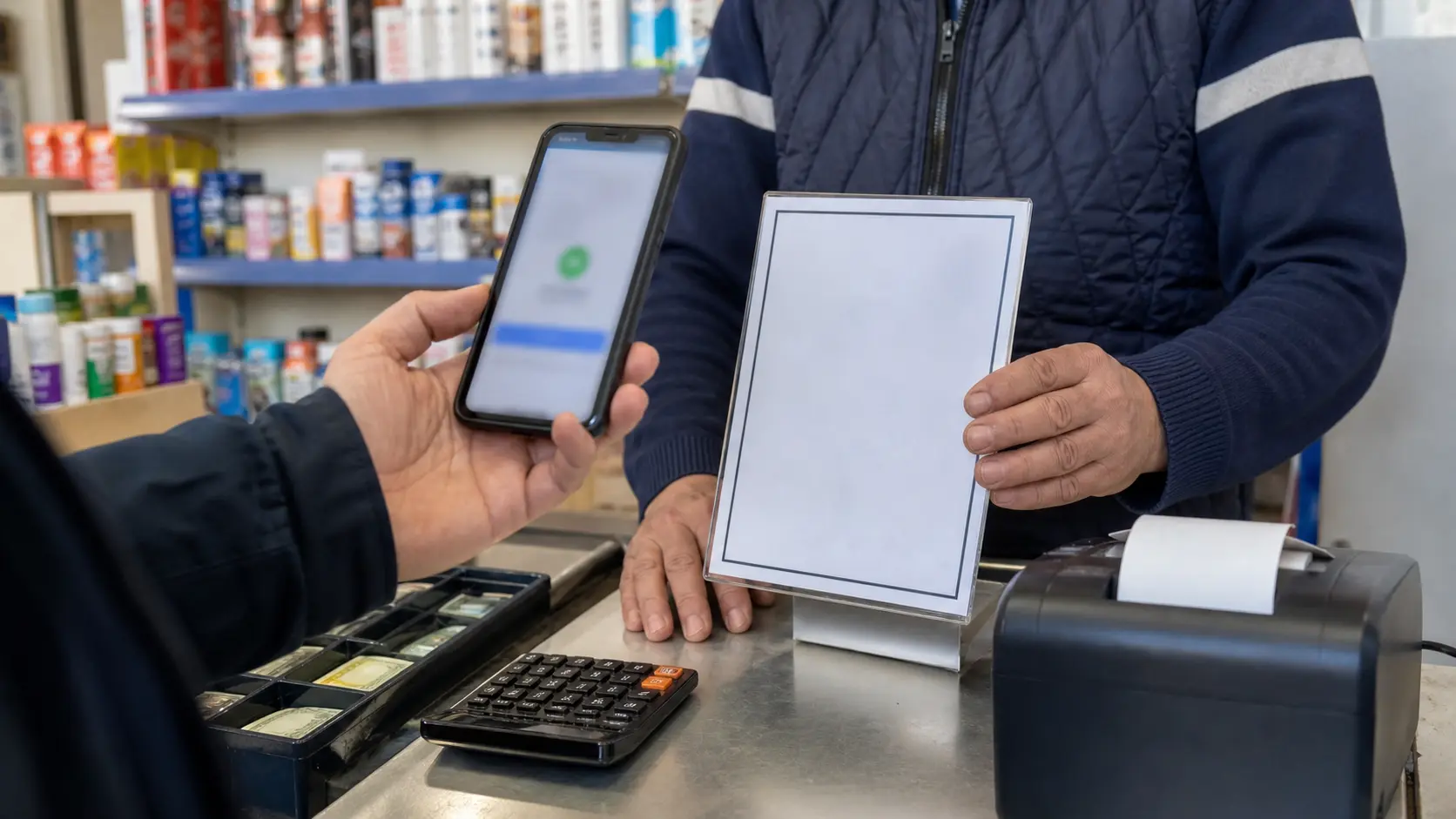
A Dushanbe shopkeeper deciding how to take a payment is not really choosing between a green icon, a plastic card reader and a stack of somoni notes. She is deciding who will carry the operating burden after the customer leaves. Cash clears instantly but brings counting, change, theft risk, end-of-day reconciliation and the need to leave the shop to deposit money. A traditional bank account gives formal settlement but may push the merchant back toward paper, branches, cut-off times and separate terminals.
A card-only account can accept Visa, Mastercard or Korti milli at the counter, but it may not solve wallet top-ups, QR payments, salary flows, supplier transfers, installments, refunds, app support or customer education. A standalone money-transfer app may move funds between relatives, but it does not necessarily give the merchant a settlement account, acquiring records and a reason to retain balances after the transfer.
The operating unit in this article is therefore the Alif wallet and bank account: the customer-facing Alif app, the current or settlement account behind it, the cards and deposits connected to it, and the merchant acceptance layer that can turn a buyer's wallet balance into a seller's bank balance. Alif's own Alif app page describes service payments, QR payments, internet, mobile and utility payments, cards, transfers, deposit management and account transfers in one interface (https://alif.tj/en/mobi). Its deposit page advertises deposits and a free settlement account in TJS, USD, RUB and other currencies (https://alif.tj/en/deposit). Its merchant acquiring page says businesses can accept Korti milli, Visa, Mastercard and other cards through POS terminals or QR code, receive money the next day after payment, reduce accounting workload and monitor sales from any device (https://alif.tj/en/business/merchant-acquiring). Those are product claims, but they show the shape of the bargain.
The substitutes discipline the price. Cash sets the zero-fee benchmark. The incumbent bank account sets the trust and compliance benchmark. The card-only account sets the acceptance benchmark. The money-transfer app sets the speed benchmark. A merchant POS provider sets the settlement and hardware benchmark. Alif earns the right to hold balances only if the combined account is cheaper in total friction than switching among those substitutes. That total price is not just the visible fee.
It is app uptime, speed of settlement, merchant acceptance, card availability, chargeback or refund handling, customer support response, document collection, account blocking risk, fraud prevention, compliance work and the opportunity cost of idle balances.
The strongest public source proving that Alif is not merely an app wrapper is the National Bank of Tajikistan's bank list, which includes OJSC "Alif Bank" with its Dushanbe address, chairman and website (https://www.nbt.tj/en/banking_system/banks.php). Alif's own pages add that the bank operates under NBT licence number 0000114 from January 3, 2020 and is a member of the Deposit and Savings Insurance Fund of Tajikistan. The licensing fact matters because the thesis depends on deposit retention, not only payments traffic. A wallet that cannot retain trusted balances is a convenience layer; a bank wallet that can move balances into deposit, card and merchant-settlement products has a different economic ceiling.
The private metric that would settle the thesis is not app downloads. It is retained wallet and account balance by customer cohort after subtracting support contacts, failed-payment handling, compliance review, fraud loss, merchant servicing, cash-in/cash-out cost and funding cost. If a cohort of merchants and customers keeps higher average balances as acceptance density rises, and if the extra support load grows more slowly than gross contribution, the wallet account is valuable.
If balances leave after promotions, if merchants use Alif only as a settlement pass-through, or if every new product produces a proportional rise in support and exception handling, the flywheel is weaker than the public growth surface suggests.
Alif's public surface is broad enough to make the wallet credible
Alif presents itself as a bank and technology company rather than as a narrow payments brand. Its history page says Alif started in 2014, offers financial and technological solutions, operates the Alif app, Alif Shop, Salom installment card, online banking for entrepreneurs and other services, and has more than 1,100 coworkers helping customers in Tajikistan (https://alif.tj/en/bank/about-us). The same page lists 2.2 million active customers in Tajikistan, 2,000 active merchant acquiring partners, more than 1,000 employees in Tajikistan, more than 3,000 partners accepting Salom card, and more than 1,000 corporate clients in Alif Business. These are self-reported figures, so they should be treated as management claims, not audited unit-level proof. But they are still useful because they show which parts of the cost structure Alif itself thinks are material: customers, merchants, staff, corporate accounts and installment partners.
The Alif app page is more important than the headline numbers because it shows the breadth of daily use cases. Alif says the app lets users pay for more than 3,500 services, make QR payments in stores, pay for internet, mobile, utilities and other services, order multi-currency cards, transfer to more than 190 countries, manage deposits and transfer between accounts (https://alif.tj/en/mobi). The Google Play listing adds an independent public-surface signal: "Alif: payments and transfers" shows a 4.7 star rating, roughly 318,000 reviews, 10 million plus downloads, an update on June 25, 2026, service payments, wallet top-ups, international transfers, account transfers, Alif Shop access, deposits, card management, transaction history, online support and multiple languages (https://play.google.com/store/apps/details?id=tj.alif.mobi&hl=en&pli=1). That store page is not a Tajikistan-only retained-user measure because app distribution spans more than one market. It does, however, demonstrate that Alif is a real consumer app at scale, with a large review surface and recurring feature updates.
The business side turns the wallet from a consumer convenience into a two-sided acceptance proposition. Alif Business is described as online banking for legal entities and individuals, with payroll, merchant acquiring, settlement and cash services, installment sales and business cards in the product set (https://alif.tj/en/business/alif-business). The merchant acquiring page specifically sells POS and QR acceptance, next-day receipt of funds, lower accounting workload and 24/7 monitoring (https://alif.tj/en/business/merchant-acquiring). The online acquiring page goes further: it says businesses can accept online payments from cards, wallets and mobile balances; use standard checkout, marketplace splitting, card-linked payments and payment links; and access technical documentation (https://alif.tj/en/business/acquiring). A wallet account can retain balances when these surfaces reinforce each other: consumers need merchants that accept the wallet; merchants need consumers who can pay; both need support and settlement records that make the system dependable enough to replace cash.
The deposit and account surface closes the loop. Alif lists deposit products such as Maqsad, Muhlatnok and Dilkhoh vaqt, as well as a settlement account with free service and multi-currency support (https://alif.tj/en/deposit). A deposit rate is a price for money, but the larger question is whether the wallet can make the money sticky. A user may open a deposit because the headline rate is attractive. She keeps using Alif if salary, utility, card, transfer, installment and merchant payments all run through the same service with tolerable support. The public pages show the product adjacency; they do not reveal how much of the deposit base is operational float, rate-seeking savings or funds temporarily parked before a transfer.
Merchant acceptance turns convenience into a balance-retention test
A wallet is rarely strong because a customer can top it up. It becomes stronger when the customer can spend from it without thinking. In Tajikistan, this is a practical rather than abstract question. The National Bank of Tajikistan's payment-card market page says credit financial institutions had installed 9,141 POS terminals at trade and service points and 31,090 QR codes in trade and service enterprises as of the reporting date, while the share of cashless payments for goods and services using electronic payment instruments reached 42.4 percent overall (https://www.nbt.tj/en/payment_system/rushdi-bozori-kort-oi-pardokhtii-bonk.php). The same page says cashless transactions using electronic means of payment, including cards and electronic wallets, increased by 158.4 percent in number and 74.3 percent in volume. Those are national figures, not Alif figures. They still matter because Alif's wallet has more economic value in a market where QR and POS acceptance are expanding quickly.
For the merchant, Alif's proposition is that payment acceptance is also workflow reduction. Alif's acquiring page claims that after a customer scans the establishment's QR code and pays through the Alif app, the merchant receives a payment notification by SMS; it also advertises next-day fund receipt, less accounting work and sales monitoring from any device (https://alif.tj/en/business/merchant-acquiring). If those claims work consistently, the merchant has a reason to accept a digital payment even when cash is familiar. The cost is not just the fee schedule. It includes the time to connect, the confidence that staff can explain the QR code, the ability to prove a payment to a customer, and the burden of resolving a transaction when either side says the money did not arrive.
This is where the wallet-account economics become more subtle than payment volume. A merchant that accepts Alif because customers ask for it may still sweep funds out every day. A merchant that uses Alif Business for payroll, supplier payments, settlement records and online banking may keep more operating balances inside the bank. Alif's Alif Business page highlights payroll processing, corporate banking from any device, merchant acquiring and settlement services (https://alif.tj/en/business/alif-business). The commercial question is whether merchant acceptance deepens account use or merely creates pass-through volume. A payment company can report fast transaction growth while retaining little balance. A bank-account ecosystem needs evidence that the same merchant uses the account after settlement.
Alif's public customer testimonials on its business pages mention French retailer Shiver Tajikistan, Normeca International, RSM Tajikistan, Babylon-M and Babylon-T, but these are marketing references rather than independent financial records (https://alif.tj/en/business/alif-business). They are useful mainly as examples of the kind of corporate client Alif wants to win: retailers, medical organizations, audit firms and service providers that care about accepting payments, payroll and remote banking. They do not prove the profitability of Alif's merchant book. They do, however, fit the thesis that merchant-service continuity is part of the wallet account. The merchant does not buy a brand story; the merchant buys fewer queues, fewer manual reconciliations, fewer failed receipts and a cleaner path from customer payment to usable bank balance.
Uptime is priced through the alternatives customers keep nearby
The price of app uptime is easy to understate because it does not always appear as a line item. A wallet can be nominally free and still expensive if a failed payment forces a customer back to cash, a branch, another bank card or a money-transfer counter. Alif's own pages make reliability a commercial issue because they ask customers to trust the app with many everyday functions: service payments, account transfers, card ordering, deposit management, international transfers, installments, flight tickets, currency exchange and merchant payments (https://alif.tj/en/mobi). The wider the app surface, the more each outage or confusing exception can affect customer trust across unrelated products.
Public sources cannot prove Alif's uptime. They can only show that Alif itself treats reliability as operationally important. The official news archive includes technical-work notices, including a September 2024 notice that services would undergo technical work at night from 00:30 to 4:30 a.m. and a February 2024 notice for technical work from midnight to 6 a.m. on February 29, both visible in Alif's news list (https://alif.tj/en). Such notices are ordinary for digital financial services; they are evidence of scheduled maintenance communication, not proof of outage frequency. Alif also announced PCI DSS certification in April 2026, saying the audit was conducted by Compliance Control Ltd and that its infrastructure, processes and technologies met international cardholder-data protection requirements (https://alif.tj/en/bank/news/we-obtained-pci-dss-certification). That is evidence of a payment-security certification claim, not a guarantee of consumer app availability.
The Google Play review surface is a weak but relevant market signal because it shows where support load becomes visible. The app listing contains positive reviews about replacing a physical wallet and negative reviews about call-center waiting, notification quality and being "forced to use it" because other people receive money through the app (https://play.google.com/store/apps/details?id=tj.alif.mobi&hl=en&pli=1). Individual reviews should not be treated as verified operational facts. They are useful because they describe the burden customers feel when the app becomes necessary infrastructure. A bank can tolerate a few complaints if balances and transactions keep growing. It cannot ignore the support economics if customer frustration increases faster than the value of retained deposits.
The key point is that uptime and support are priced by the customer's fallback options. In a cash-heavy merchant context, a failed wallet payment does not only lose the digital transaction; it teaches the shopkeeper to keep cash as the primary method. In a multi-bank card context, a failed card or app transfer moves the next salary account or merchant settlement to a rival bank. In a remittance context, a failed cross-border transfer pushes the family back to a specialist money-transfer provider. Alif's public pages show that the app tries to sit across all these use cases.
That breadth raises the value of success and the cost of failure.
Compliance is not overhead; it is part of the account product
A bank wallet earns trust partly by taking compliance burdens away from ordinary users and merchants. That does not make compliance invisible. It makes compliance a product feature when it is smooth, and a support problem when it is not. Alif's public terms and document pages show a regulated structure around the app and bank. The documents page links corporate governance, financials, complex banking services, settlement and cash services, deposit terms, electronic money, payment terminals, compliance policy and other legal documents (https://alif.tj/en/bank/documents). The Alif app page links tariffs, payment-card service terms, funds-transfer agreements, personal-data policy, public offers, electronic-money transfer rules and a software licence agreement (https://alif.tj/en/mobi). These documents do not reveal internal compliance cost, but they show the formal surface a customer or merchant enters when a wallet becomes a bank-account relationship.
Cross-border features make the compliance burden more explicit. Alif's September 2025 U.S. transfer announcement says users can send money from Tajikistan to the United States through the app without commission, but all transfers are subject to currency control and require a supporting document such as a passport, invoice, contract or other proof of purpose (https://alif.tj/en/bank/news/for-the-first-time-in-tajikistan-commission-free-online-transfers-to-the-u-s). Its August 2025 China transfer announcement says direct transfers to Alipay and WeChat are available with zero fees and no double conversion, but limits apply and transfers are available only to recipients with Chinese citizenship in line with Chinese regulations (https://alif.tj/en/bank/news/money-transfers-to-china-now-available-in-the-alif-app). These features may attract active users, but they also import document review, customer explanation, transaction monitoring and exception handling.
The April 2026 PCI DSS announcement is another form of compliance-as-product. For merchants, certification can reduce concern about taking card or wallet payments online; for Alif, it adds audit, monitoring, access-control and testing obligations (https://alif.tj/en/bank/news/we-obtained-pci-dss-certification). Compliance can be a moat when smaller rivals struggle to meet the same requirements. It can also compress margins when growth requires more staff, more automation, more controls and more customer education. The commercial test is not whether Alif can say it is compliant. It is whether the compliance workload per active wallet, active account and active merchant falls as the customer base grows.
Alif's support contacts make this workload concrete. The official pages list short number 900 for calls within Tajikistan, +992 48 888 1111 for international calls, support@alif.tj for online assistance, and Alif's branch and service-center pages show office services including Alif app identification, card and wallet replenishment, cash withdrawal, deposit and account opening, money transfer and installment services (https://alif.tj/en/bank/contacts/offices/dushanbe?city=1). Identification and document collection are not back-office abstractions here. They are part of the customer's route into the product. Every additional customer who moves from cash into a digital account must be identified, served, reassured and sometimes corrected.
The support burden is the asset if it lowers switching
The assignment's central phrase, "converts deposits into support load," can sound negative. It is better read as a test. A deposit franchise creates liabilities for the bank: the bank must safeguard customer funds, answer questions, honor withdrawals, process payments, maintain records, satisfy regulators and keep the app available. But that support load can be valuable if it creates habitual account use.
The customer who calls Alif about a card, pays a utility bill, repays an installment, receives a transfer, opens a deposit and later accepts a merchant QR code is costly to serve, but also harder to win with a single rival promotion.
Alif's own product breadth suggests this is the intended strategy. The app listing says customers can add money to the wallet by transfers, terminals or Alif offices; move money between accounts, deposits and cards; shop at Alif Shop; manage installments; order Visa and Mastercard cards online; see transaction history; use online support; and open deposits (https://play.google.com/store/apps/details?id=tj.alif.mobi&hl=en&pli=1). The Alif app website adds QR payments, more than 3,500 service payments and easy service autopayments (https://alif.tj/en/mobi). The deposit page adds rate-bearing accounts (https://alif.tj/en/deposit). The merchant acquiring page adds POS and QR acceptance (https://alif.tj/en/business/merchant-acquiring). The combined product is a switching-cost machine if it works.
Switching cost, however, is not the same as lock-in. Customers can keep cash, use a rival card, open another bank account or try a different transfer service. Merchants can keep multiple acceptance methods because their customers arrive with different wallets and cards. The support load becomes an asset only when it teaches Alif more about customer routines, improves service resolution and makes the next transaction easier. If a customer has to repeat documents, wait for a call center, explain a failed transaction or travel to a branch, support becomes the reason to keep alternatives ready.
The strongest wallet franchises make support less visible over time. Weak ones make support the main memory of the product.
Alif's office page is revealing because it does not pretend digital service eliminates physical service. The head office lists card issuance, installments, Alif app identification, replenishment and cash withdrawal from cards and Alif app, installment repayment, money transfer, deposit and bank-account opening, car purchase financing and currency purchase and sale (https://alif.tj/en/bank/contacts/offices/dushanbe?city=1). It also shows office foot-traffic information and an option to book without leaving home. A purely digital story would miss this hybrid cost structure. In Tajikistan, the account may be digital, but customer acquisition, trust and problem resolution still involve offices, cash desks, terminals and human support.
This hybrid model can be powerful in a market moving away from cash. The National Bank's payment-card market page says automatic self-service terminals equaled 7,470 units, ATMs and electronic terminals at cash supply points grew from the prior year, and QR codes at trade and service enterprises grew 42.9 percent year over year (https://www.nbt.tj/en/payment_system/rushdi-bozori-kort-oi-pardokhtii-bonk.php). Alif can ride that national shift only if it helps users bridge the old and new rails. The most valuable customer is not the one who downloads an app once. It is the one who uses the app because the merchant accepts it, keeps a balance because bills and cards are linked, and trusts Alif enough not to return immediately to cash.
Deposits are sticky only when the account has daily reasons to live
Alif's deposit page advertises somoni and dollar income rates on several deposits and a settlement account with free service (https://alif.tj/en/deposit). Rates matter. In a banking system, customers compare yields, withdrawal terms, currency exposure and deposit-insurance comfort. But rate alone can be expensive funding. A bank wallet is more attractive if deposits are attached to payments, cards, business flows and merchant settlements. That is the difference between renting balances with a high rate and retaining balances with daily utility.
Public data do not show Alif's deposit mix. The National Bank publishes a financial indicators page for banks with a linked file for OJSC "Alif Bank" (https://www.nbt.tj/en/banking_system/nishondihandaho/finance_bank_pokazatel.php). That page proves the regulator makes bank-level financial indicators available, but the public article should not infer unextracted private ratios. The better public inference is structural: Alif has the licence and product set to compete for deposits, and the app/account surfaces create plausible reasons for customers to keep some balances inside the bank. Profitability remains unproven without the split between rate-seeking deposits, transactional balances and merchant settlement float.
The currency dimension matters in Tajikistan. Alif's deposit page lists somoni and dollar income rates, and its settlement-account page offers multiple currencies for business accounts (https://alif.tj/en/deposit; https://alif.tj/en/business/scs). Its currency-exchange announcement says users with Visa and Mastercard cards and foreign-currency accounts can exchange currency in the Alif app, set their own rate within bank-defined limits, keep requests active for three days, exchange up to $10,000 and pay a 0.1 percent fee (https://alif.tj/en/bank/news/you-can-now-exchange-currency-in-the-alif-app). A wallet that handles currency exchange can be more useful to customers who receive, save or spend across currencies. It also adds liquidity, compliance, pricing and support complexity.
Deposit retention is therefore a result, not a feature. It requires customers to believe that Alif is safe enough, available enough and useful enough to hold money after the immediate transaction. Alif's membership statement in the Deposit and Savings Insurance Fund, visible on its own pages, supports the formal trust layer. Its app and merchant pages support the utility layer. Its regulatory listing supports the licence layer. None of those proves a low-cost deposit franchise.
The public evidence supports the hypothesis that daily wallet/account use can support retained balances; it does not prove that retained balances are cheap or durable.
The more demanding test is whether balance retention survives the end of a single event. A merchant may leave money in the account overnight because settlement arrives there. A household may keep a wallet balance because utility bills, school payments, transfers and card spending are easier from the app. A saver may keep a deposit because the rate is acceptable and withdrawal back into the everyday account is convenient. These are different behaviors with different economics. Only the second and third create a stronger wallet-account franchise; the first can disappear as soon as another acquirer offers lower fees or faster settlement.
Cash still disciplines the wallet more than fintech rhetoric admits
Cash is not a backward rival in this analysis. It is the baseline that keeps wallet economics honest. Cash does not require app uptime, smartphone battery, mobile data, SMS confirmation, card scheme acceptance, bank identification or a support queue. It is weak at remote payments, large-value security, transaction history, online shopping and formal merchant records, but it remains a powerful fallback for daily commerce. When Alif or any digital wallet asks a merchant to accept QR or POS payments, it must beat the total convenience of a banknote at the counter.
Alif's merchant acquiring proposition directly addresses this. It tells merchants that customers can pay through POS terminals or QR code, that the merchant can receive money the next day, reduce accounting workload and monitor sales online (https://alif.tj/en/business/merchant-acquiring). These are cash-displacement arguments. The merchant does not need a philosophical case for cashless payments; she needs better sales conversion, fewer mistakes, cleaner records, faster settlement and confidence that customers will not abandon the purchase when the app stumbles. If those benefits are reliable, a small merchant will tolerate some service cost. If they are not, cash remains the default.
The incumbent bank account also disciplines Alif. Tajikistan's NBT bank list shows a crowded formal banking market, with OJSC "Alif Bank" listed among established banks such as Amonatbank, Eskhata Bank, Spitamen Bank, International Bank of Tajikistan and others (https://www.nbt.tj/en/banking_system/banks.php). A merchant can maintain more than one account. A salary customer can receive money in one bank and spend through another card. A family can use one app for remittances and another bank for deposits. Alif must therefore win by reducing the compound burden, not by being the only formal option.
Card-only accounts are another comparator. Alif's card page offers Mastercard Platinum, Visa Gold, Visa Platinum, Visa Infinite, Visa Business and Korti milli cards, with app management and multi-currency features for several products (https://alif.tj/en/cards). That breadth helps Alif compete against card-first banks, but it also exposes Alif to the same acceptance, fraud, dispute and scheme-dependence costs as the rest of the card market. The more Alif relies on Visa and Mastercard acceptance, the more it needs to earn enough from accounts, balances, interchange, fees or customer lifetime value to cover scheme, compliance and servicing costs.
Cross-border reach adds value but also imports exception handling
International transfers can make a domestic wallet more useful, especially in a country where migration, trade, education and family support create frequent cross-border needs. Alif's app page says users can send money to more than 190 countries (https://alif.tj/en/mobi). Its Google Play listing repeats the 190-plus-country claim and describes transfers to the USA, China, Europe, the Middle East and Asia (https://play.google.com/store/apps/details?id=tj.alif.mobi&hl=en&pli=1). Its 2025 news flow adds concrete products: U.S. bank-account transfers subject to currency-control documentation, China transfers to Alipay and WeChat with limits and recipient restrictions, and business transfers abroad through Alif Business (https://alif.tj/en/bank/news/for-the-first-time-in-tajikistan-commission-free-online-transfers-to-the-u-s; https://alif.tj/en/bank/news/money-transfers-to-china-now-available-in-the-alif-app; https://alif.tj/en/business/vda).
These products can increase wallet relevance because they connect the local account to family and business obligations beyond Tajikistan. They may also generate low or zero visible fees as customer-acquisition tools. But cross-border payments are not free to operate. They require correspondent or scheme relationships, screening, currency-control checks, customer documentation, customer support and exception resolution when the receiving side rejects or delays a payment. The public pages show the product claims and some limits.
They do not show revenue share, foreign-exchange spread, compliance headcount, partner pricing or failed-transfer rates.
For deposit retention, cross-border features can cut both ways. A user who receives foreign-currency income or needs to pay abroad may keep more balances in the Alif account because the app handles exchange, cards and transfers. A user who sees Alif primarily as a transfer pipe may move funds out as soon as the transfer is complete. The same product can be a balance-retention engine for one cohort and a thin-margin payment rail for another. Public data cannot separate those cohorts.
A serious investor or competitor would want to see average balance by customer type, frequency of cross-border use, fee and spread revenue, compliance exceptions and churn after failed transfers.
The China and U.S. transfer announcements also show why support is not optional. A customer who must attach a document, choose a purpose, enter recipient details or understand a citizenship restriction is no longer simply tapping "send." She is using a regulated financial service. Alif can create loyalty if the app makes that regulated action easier than the bank branch. It can create frustration if the customer discovers the document burden only after a failed attempt. The support cost is part of the price of the expanded wallet.
Public technical evidence should be kept modest
Alif's public technical and resource footprint is visible enough to identify the service surfaces but not enough to draw conclusions about internal architecture. The acquiring page links technical documentation for online acquiring (https://docs.acquiring.alif.tj), and the Google Play listing points to a public website and privacy-policy host for app support and data handling (https://play.google.com/store/apps/details?id=tj.alif.mobi&hl=en&pli=1). Alif's website and app pages expose customer, merchant, document and support channels. These records prove public reachability and product routing. They do not prove uptime, data residency, system design, security governance, cloud vendor exposure, fraud performance or customer outcomes.
That distinction matters because bank-wallet analysis often overreads technical artifacts. A public app listing with 10 million plus downloads is evidence of distribution, not active Tajikistan balances. A technical-docs host is evidence of merchant integration support, not merchant success. A PCI DSS announcement is evidence of a certification claim, not a guarantee that every customer payment experience will be smooth. A DNS record, app endpoint or website status could show a public surface, but it would not establish where customer data live or how the bank handles internal incidents.
The article's network/resource evidence is therefore deliberately bounded to public surfaces and product dependencies.
The more useful resource evidence is procurement and operational notices. Alif's news archive includes tenders for terminals, ATMs, UPS units, spare parts, canopies, cash-acceptance equipment, printed products, air conditioners and other office or service infrastructure (https://alif.tj/en). These notices suggest that the digital account still depends on physical devices, branches, power continuity, card stock, terminals and field service. They are not financial statements, and they do not reveal quantities beyond specific notices. They do remind us that "digital" does not eliminate the cost base. It moves part of the cost from branch teller time into devices, software, power, security, call centers, compliance, merchant service and exception handling.
This is also why the word "wallet" can be misleading. The customer sees an app. The bank operates a regulated account, card issuance, deposits, acquiring, money transfers, customer identification, office service, documents, support channels, merchant onboarding and payment security. If Alif's scale lowers average servicing cost, the wallet account is powerful. If every layer needs proportional manual intervention, the app becomes a high-maintenance front end.
Competition is a portfolio of specific frictions
Alif's competition is not one company. It is a portfolio of frictions solved by different providers. For bill payment, the substitute is cash at a counter, a bank app or another wallet. For merchant acceptance, the substitute is cash, a card terminal from another bank, a QR standard or a separate POS provider. For savings, the substitute is a deposit at an incumbent bank, cash in hard currency or a non-bank investment. For transfers, the substitute is a specialist transfer service, a bank wire, card-to-card transfer or informal family movement of cash.
For online shopping and installments, the substitute is direct merchant credit, cash-on-delivery, a card loan or not buying at all.
Alif has chosen breadth rather than narrow specialization. Its own pages place Alif app, Alif Business, Salom, Alif Shop, cards, deposits, money transfers, currency exchange and acquiring within the same public ecosystem (https://alif.tj/en/bank/about-us). This can be an advantage in a market where customers want fewer separate interfaces. It can also create management complexity. Each extra use case brings a different failure mode: a salary file can fail, a merchant settlement can be disputed, an installment schedule can confuse a buyer, a currency exchange request can expire, an international transfer can require documents, a card can be blocked, a customer can lose a phone, or a branch queue can lengthen.
The official app listing's customer-review surface illustrates both sides. Some users describe time saving, QR payments, card-to-card transfers and all transaction history in one place; others complain about call-center waiting or push notifications (https://play.google.com/store/apps/details?id=tj.alif.mobi&hl=en&pli=1). Reviews are not audited evidence, but they are a public market signal of what customers value and what irritates them. A wallet-account franchise does not need perfect reviews. It needs the negative experiences to be small enough, resolved fast enough and outweighed by enough daily utility that balances stay.
Alif's public numbers imply that this is already a material support operation. More than 2.2 million active customers, 2,000 active merchant acquiring partners and more than 1,000 corporate clients, if taken at face value, would require substantial customer service, merchant onboarding, compliance review and product maintenance (https://alif.tj/en/bank/about-us). The same scale can produce network effects. More customers make merchants more willing to accept Alif; more merchants make the wallet more useful; more account activity can deepen deposits; more data can improve product design. But network effects do not cancel support costs. They only make those costs worth carrying if balances, fees, spreads and customer lifetime value rise faster.
The cost base is hidden in the promises
The public pages show Alif's revenue opportunities more clearly than its cost base. Deposits can generate interest margin if funding is used profitably. Cards can generate interchange, fees or customer stickiness. Merchant acquiring can generate merchant service revenue or settlement balances. Online acquiring can generate integration fees, payment processing revenue or marketplace services. Currency exchange can generate explicit fees and spread. Transfers can generate fees, spread or partnership economics. Installments and consumer finance can generate financing income. Alif Shop can support installment and merchant relationships.
Alif Business can hold corporate balances and salary flows.
The costs appear indirectly. The app has to be built, updated, translated and supported. The Google Play listing shows the app is updated and available in multiple languages (https://play.google.com/store/apps/details?id=tj.alif.mobi&hl=en&pli=1). The office page shows physical service, queues, cash desk hours, app identification and account opening (https://alif.tj/en/bank/contacts/offices/dushanbe?city=1). The PCI DSS announcement points to security audits, monitoring and testing (https://alif.tj/en/bank/news/we-obtained-pci-dss-certification). The merchant-acquiring pages imply POS terminals, QR onboarding, merchant notifications and dedicated contacts (https://alif.tj/en/business/merchant-acquiring). The documents and terms pages imply legal, compliance and policy maintenance (https://alif.tj/en/bank/documents). The national payment-system data imply a fast-expanding infrastructure market where banks and payment providers keep investing in terminals, QR codes and self-service equipment (https://www.nbt.tj/en/payment_system/rushdi-bozori-kort-oi-pardokhtii-bonk.php).
The open question is operating leverage. A digital bank can scale well if incremental users require little manual work. It scales poorly if each user needs repeated human intervention. Alif's hybrid model may have a middle shape: digital self-service for routine payments, office or call-center support for identification and exceptions, merchant service for acceptance, and regulatory controls around deposits and transfers. That can still be attractive in Tajikistan if cash displacement is early enough, customer acquisition cost is low enough and Alif's brand trust is high enough. But the cost base cannot be inferred from app features.
It must be measured in support contacts per active account, failed-payment rate, merchant churn, fraud loss, compliance-review time, cash-in/cash-out cost and balance duration.
What would change the judgement
Several facts would materially change the view of Alif's wallet account. The first is cohort retained balance. If Alif showed that customers who use three or more daily services keep materially higher low-cost balances for longer, the public product thesis would be much stronger. If those balances are mostly rate-sensitive deposits that move when competitors raise rates, the wallet story would matter less. The second is merchant behavior. If merchants that adopt Alif acquiring also keep settlement balances, use payroll, hold business accounts and expand acceptance, merchant acquiring would look like an account-deepening channel.
If they sweep funds out and keep Alif only as one more QR option, the economics are thinner.
The third is support efficiency. Public reviews and office queues are only signals. The decisive numbers would be response time, first-contact resolution, support tickets per 1,000 active users, failed transactions per 10,000 payments, average time to resolve blocked accounts, and merchant onboarding time. A wallet account that can handle growth with flat or falling support intensity is valuable. One that needs constant manual rescue is fragile. The fourth is compliance efficiency. The useful data would include cross-border transfer rejection rates, document-review time, fraud losses, false positives, chargeback rates, and audit exceptions.
Alif's PCI DSS announcement supports a seriousness about payment data security, but it does not settle these operational metrics.
The fifth is competition. If Tajikistan's incumbent banks and other digital players match QR, card, transfer and deposit features while offering stronger branch trust or lower merchant pricing, Alif's breadth may become table stakes. If Alif's merchant and customer base remains denser than rivals, the wallet's acceptance value compounds. NBT's national payment-system data show the market itself is growing fast, which can support multiple winners (https://www.nbt.tj/en/payment_system/rushdi-bozori-kort-oi-pardokhtii-bonk.php). Fast market growth is not the same as Alif outperformance.
The sixth is macro and regulatory context. Deposit rates, currency preference, remittance flows, payment-system rules, consumer-protection enforcement and data-handling expectations can all change wallet economics. Alif's own U.S. and China transfer announcements show that product usefulness is constrained by currency control, recipient restrictions and transfer limits (https://alif.tj/en/bank/news/for-the-first-time-in-tajikistan-commission-free-online-transfers-to-the-u-s; https://alif.tj/en/bank/news/money-transfers-to-china-now-available-in-the-alif-app). A stricter rule can raise support and compliance cost. A more favorable digital-payment policy can increase acceptance and account use.
The commercial hypothesis remains plausible but unproven
Alif Bank's wallet account is commercially interesting because it sits at the junction of Tajikistan's cash-to-digital shift, merchant acceptance, deposit gathering, cards, cross-border transfers and support-heavy financial inclusion. The public evidence supports that Alif is a real licensed bank in Tajikistan, that its app and business products cover many daily use cases, that it claims a large active customer and merchant base, and that national payment infrastructure is expanding quickly.
The evidence also supports the idea that Alif has deliberately linked app payments, QR acceptance, cards, deposits, merchant settlement and support into one operating surface.
The same evidence suggests the central risk. Alif's product breadth means the bank is not only acquiring users; it is absorbing the work that users and merchants previously carried themselves or split among cash, incumbent banks, money-transfer shops and POS providers. That work includes uptime, settlement, identification, payment confirmation, compliance documents, customer reassurance, office service, merchant onboarding, refunds, fraud prevention and data-security controls. If Alif can standardize and automate that work while retaining balances, the support load is an investment in a defensible account franchise.
If the work remains manual and grows in line with customers, it becomes a drag on every deposit, transfer and merchant payment.
The conclusion should therefore use evidence-strength verbs. The public record supports Alif's relevance in Tajikistan's digital wallet and account market. The product surface suggests a plausible mechanism for converting payment adoption into retained deposits. The national payment data are consistent with a market where QR, POS and wallet acceptance can expand further. The app-store and review surface suggests both scale and visible support pressure.
What remains unproven without private metrics is whether retained balances, merchant settlement behavior and service revenue exceed the full cost of app uptime, payment acceptance, customer support, compliance review, cash handling, fraud prevention and merchant service. That is the economic test behind the wallet account.