
Summary
- 9PSB has a genuine regulated-bank foundation, an active Bank9ja consumer surface, USSD, merchant collection, virtual account, wallet and payout products, and public evidence of Nigerian operations across Lagos, Abuja and Kano. The question is not whether it exists; it is whether the cash-out, KYC, support, settlement and capital costs behind low-value transactions can be spread across enough durable users.
- The strongest public financial evidence is sobering. The 2023 abridged statement shows customer deposits of about N2.58 billion, total assets of about N10.25 billion, accumulated losses of about N14.31 billion, a 2023 loss of about N3.44 billion, and an auditor note that the bank did not meet the N5 billion minimum capital requirement at year-end before a subsequent capital injection.
- Nigeria's payment market is enormous, but that does not automatically make every inclusion wallet economic. CBN data show tens of billions of electronic transactions and more than N2 quadrillion in 2023 e-payment value; 9PSB still has to convert market volume into repeat users, funded balances, merchant acceptance, working cash counters, fraud discipline and low-cost support.
- Public app reviews, job postings, web infrastructure traces and product terms should be treated as signals rather than proof. They point to the right hinge: durable inclusion economics would be clearer if 9PSB disclosed active customers, transaction value, cash-out outlet liquidity, unit fraud losses, support turnaround and 2024/2025 capital performance.
A useful wallet is a claim on a cash desk, a phone signal and a settlement window
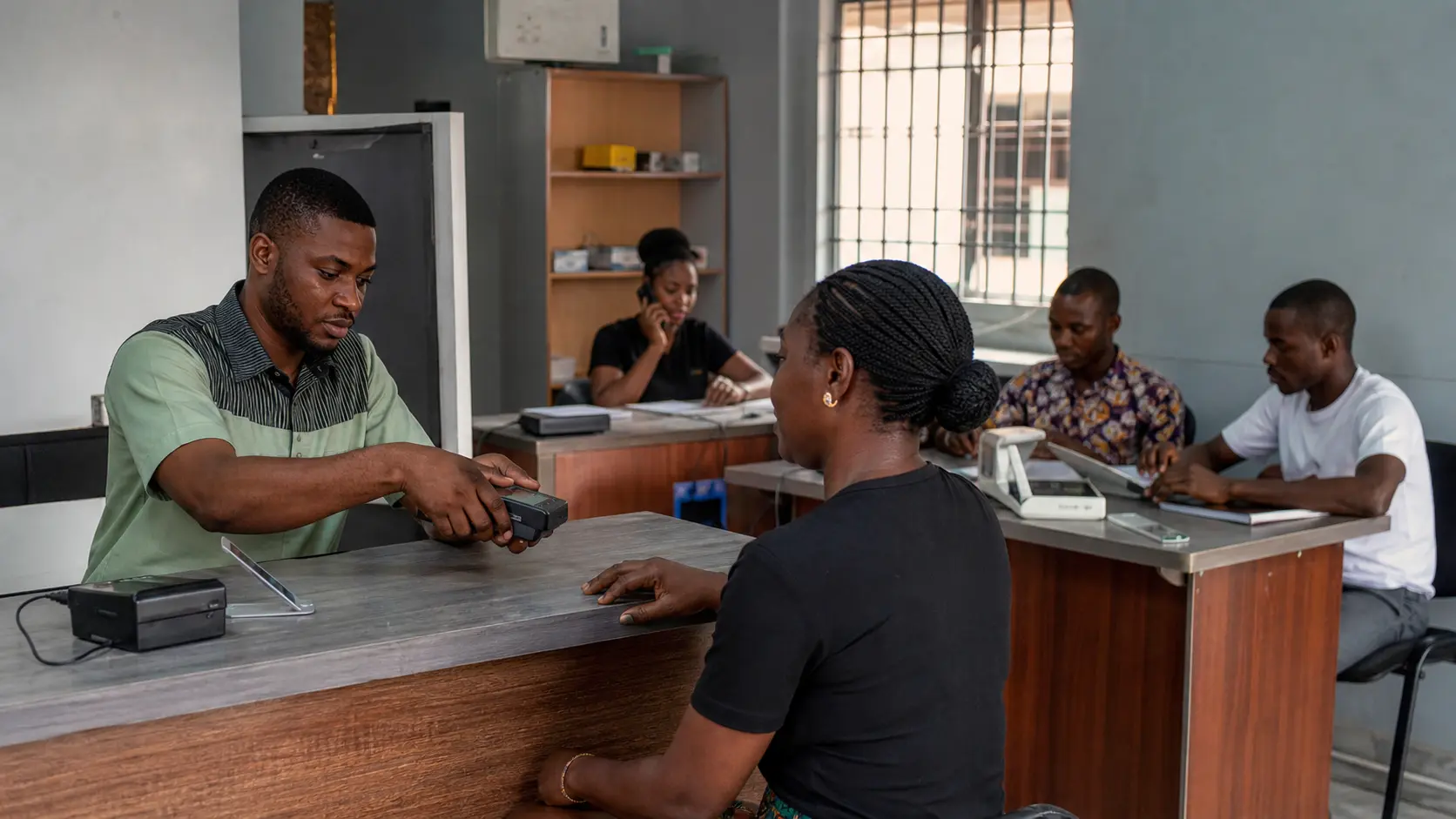
Start with a household in Kano or a small trader in Lagos deciding whether a Bank9ja balance is real money or merely a number on a screen. If the trader can receive a transfer, buy airtime, pay a supplier, move money into a bank account and cash out nearby without losing half a day, the wallet earns trust. If the phone session fails, an upgrade stalls, the nearby cash counter has no float, the receiving institution delays credit, or a complaint sits unanswered, the same wallet becomes a reminder that financial inclusion is not created by an app icon. It is created by a chain of working institutions.
9PSB's public language fits the inclusion mission. Its about page says the bank was founded in 2020 as Nigeria's first payment service bank licensed by the Central Bank of Nigeria, and says it was created to serve the unbanked and underbanked through a digital model with offline reach (https://9psb.com.ng/about-9psb/). Its Bank9ja page sells everyday transactions, bill payment, transfers, scheduled transfers, a web channel, app-store downloads, discounts, low transfer charges, phone-number transfers and 2FA protection (https://9psb.com.ng/bank9ja/). The USSD page is even more important for the assignment's economic lens: it tells users to dial 9900# to open and fund an account, transfer funds, top up airtime or data, check balances, pay bills, view transaction history and block an account without internet, while onboarding asks for date of birth, residence state and BVN or NIN verification (https://9psb.com.ng/ussd/).
Those product statements sound like convenience. Economically, they are a list of costs. A no-internet channel depends on telecom session quality and short-code availability. Phone-number account usage must map into NUBAN standards and bank settlement. BVN and NIN verification requires identity-data handling, failure processes and exception support. Bill payment requires biller integration. Wallet balances require ledger integrity. The FAQ sharpens the point by saying that a user's phone number is the account number on 9PSB and follows a NUBAN standard, while account upgrades require BVN, date of birth, passport photo and a means of identification, raising limits up to N500,000 or more (https://9psb.com.ng/faq/). That is inclusion with a regulated back office attached.
The cash-in/cash-out part is the hardest piece to see from a website, yet it is the part that makes the wallet useful to households and traders whose income still arrives partly in cash. A small payment service bank can advertise free or low-fee transfers, but someone must finance float at counters, reconcile transactions, handle failed withdrawals, train outlet staff, answer calls, inspect exceptions and absorb fraud attempts. A wallet that is not reliably convertible into goods, bank credit or cash will struggle to hold balances. The most important unit is therefore not a download or even a registered customer.
It is the repeat transaction that clears cleanly at low cost, with enough trust for the user to come back.
This is why 9PSB is a better case than a generic fintech story. It is not only a mobile app. It is a licensed deposit-taking payment service bank operating under a specific Nigerian regime. It can accept deposits from individuals and small businesses, run payments and remittances, issue debit and prepaid cards in its name, operate electronic wallets, invest in government and CBN securities, and participate in payment and settlement systems, but the PSB rule set also prevents lending, foreign-currency deposit-taking, broad foreign-exchange dealing and insurance underwriting in the ordinary course (https://usercontent.one/wp/www.acaebin.org/wp-content/uploads/2023/07/Guidelines20for20the20Licensing20and20regulation20of20Payment20Services.pdf?media=1711622973). That makes the business cleaner for inclusion but tougher for economics: 9PSB cannot turn every customer wallet into a lending franchise.
The licence grants public trust and removes several easy profit pools
The CBN's payment service bank rules were designed to close a specific gap. The guidelines say the objective of PSBs is to increase access to deposit products and payment/remittance services for small businesses, low-income households and financially excluded people through high-volume, low-value transactions in a secure technology-driven environment. They also require PSBs to operate mostly in rural areas and unbanked locations, with not less than 25 percent of financial-service touchpoints in such rural areas as defined by the CBN from time to time, and to use electronic channels, coordinating centres and consumer help desks (https://usercontent.one/wp/www.acaebin.org/wp-content/uploads/2023/07/Guidelines20for20the20Licensing20and20regulation20of20Payment20Services.pdf?media=1711622973).
That mandate explains both the promise and the strain. A PSB has the legitimacy of a bank-like deposit institution without becoming a full commercial bank. The same licence narrows the profit map. The guidelines set a minimum capital requirement of N5 billion, bar loans and advances, require risk-based KYC, apply consumer-protection expectations, and instruct PSBs to place not less than 75 percent of deposit liabilities in CBN securities, Treasury Bills and other short-term federal government debt instruments, with excess operational float placed with deposit money banks (https://usercontent.one/wp/www.acaebin.org/wp-content/uploads/2023/07/Guidelines20for20the20Licensing20and20regulation20of20Payment20Services.pdf?media=1711622973). In plain economic terms, the bank is asked to solve a rural-and-low-income access problem with scale, fees, float income and operational discipline, not with high-yield credit.
The 2021 supervisory discussion of PSBs, prepared by PwC around the CBN framework, underlines the same institutional weight. It describes a regime focused on corporate governance, risk management including KYC, and the safety of customer funds, with board approvals, board composition rules, reporting obligations, cyber and information-security expectations, and records of domestic and international transactions retained for at least five years (https://www.pwc.com/ng/en/assets/pdf/cbn-supervisory-framework-for-payment-service-banks.pdf). This matters because the smallest Bank9ja action is never only a software call. It carries records, identity controls, customer-fund safeguarding and eventual regulator visibility.
CBN's wider Payments System Vision 2025 places PSBs inside a larger payments-modernisation push. The CBN says the roadmap aims to strengthen electronic payment adoption, safety, reliability and resilience, include new products and participants, foster inclusion and support economic growth. Its recommendations include reviewing core payments infrastructure, open banking, financial-inclusion channels, BVN use for fraud control, swifter dispute resolution and interoperability as a core principle (https://www.cbn.gov.ng/PaymentsSystem/PSV2025.html). The word "interoperability" is the hinge for a firm like 9PSB. Bank9ja is more valuable if transfers, bill payments, NUBAN-based accounts, settlement and identity checks work across the Nigerian system. It is less defensible if the user experiences it as a closed wallet.
The CBN's public payment-service-provider list shows how crowded the wider payment ecosystem already is. It names card schemes, mobile-money operators, switching and processing companies, payment-solution service providers, terminal-service providers, super-distribution licence holders, a holding category and NIBSS as the payment terminal service aggregator (https://www.cbn.gov.ng/PaymentsSystem/PSPs.html). That list is not a list of identical competitors, but it tells the reader that 9PSB operates among many regulated and semi-specialised payment participants. The user can see only a transfer button. Behind it sit bank accounts, switches, billers, terminal operators, mobile operators, risk databases, card networks, identity checks and merchant systems.
That crowded ecosystem changes how one should read 9PSB's "first PSB" status. Being first gave the bank a place in Nigeria's financial-inclusion story. It did not create an exclusive channel to users. Telecom-backed peers, mobile-money operators, fintech wallets, neobanks, merchant terminal networks and ordinary bank apps can all attack parts of the same daily transaction. The licence is a trust asset, but it is also a regulated cost base.
9PSB has built more than a consumer wallet, but each product adds another operating promise
Bank9ja is the consumer face. Google Play lists the Bank9ja Android app with 100,000-plus downloads, a June 15, 2026 update, a description aimed at employees, students, farmers, traders and everyday users, and features such as profile setup, passcode and biometric login, bank or phone-number transfers, discounted data, bill payment, rewards, cards, digital address verification, referrals and push notification (https://play.google.com/store/apps/details?hl=en_US&id=com.psbcustomer). Apple's App Store listing shows the iPhone app, gives a low sample rating of 2.7 from nine ratings in the U.S. storefront, and carries a version history with account-upgrade fixes, scheduled transfers, card management, fixed deposit wording, regional sending and general optimisation (https://apps.apple.com/us/app/bank9ja/id1623785886).
The consumer app is only one layer. 9PSB's Merchant Collect page positions Bank9ja Merchant Collect as a cardless payment collection tool for QR code, USSD or direct transfers, with no POS terminal required, instant settlement into a 9PSB wallet or account, lower fees, bank-agnostic acceptance and a claim that payments are final once made (https://9psb.com.ng/bank9ja-merchant-collect/). The terms of service are more sober. They say merchants must complete KYC, authorize 9PSB to receive, hold and process payments on their behalf, allow settlement of collections less applicable fees to a nominated bank account, and accept possible reversals or settlement adjustments in disputes, chargebacks, refunds or errors. The terms also say fees and commission structures may be revised, and referral commissions may be withheld or reversed for fraud, self-referral, collusion or legal violation (https://9psb.com.ng/bmcterms/).
That difference between the marketing page and the terms is not hypocrisy. It is the true shape of payment economics. Public copy has to make acceptance feel effortless to a small merchant. Contract language has to preserve KYC, settlement control, dispute handling and fraud flexibility. A small trader hears "instant settlement." The bank hears "net settlement after fees, compliance and reconciliation." The more 9PSB enters merchant acceptance, the more it must make every "instant" promise sit safely inside settlement and dispute controls.
The B2B surface is broader still. The virtual-account page offers unique account numbers, transparency, integration, instant processing and settlement, real-time notifications, a dashboard and competitive fees for fintechs, startups and organisations (https://9psb.com.ng/virtual-account/). The wallet-as-a-service page says financial and non-financial institutions can integrate 9PSB's wallet service into their platforms (https://9psb.com.ng/wallet-as-a-service/). The payout page says financial and non-financial institutions can integrate robust and scalable payout capability to beneficiaries across banks in Nigeria (https://9psb.com.ng/payout-with-9psb/). These are sensible products for a PSB because they spread infrastructure costs across partners and merchant use cases, not just individual wallet users.
They also deepen dependency on uptime and support. A consumer wallet can disappoint one person at a time. A payout interface or virtual-account service can disappoint another platform's users, merchants or employees all at once. The system has to process transactions, update balances, send notifications, manage exceptions, answer support and keep identity controls consistent. That is the route to operating leverage, but only if the platform earns enough volume per integration to cover security, customer support and settlement risk.
The official contact page supports the idea that the business is not only an app-store shell. 9PSB lists a contact centre, head office at 16 Adeola Odeku Street, Victoria Island, Lagos, an Abuja office in Wuse II, a Kano office at a 9Mobile office address, and distinct customer-support, media, corporate-banking, fintech-support and document-verification emails (https://9psb.com.ng/contact/). That footprint is useful for trust and local support. It also says there are desks, people, escalation paths and location-specific operating costs behind the wallet.
The 2023 accounts show the toll booth before the traffic has fully arrived
The sharpest evidence is the 2023 abridged audited statement. It reports total assets of about N10.25 billion at 31 December 2023, down from about N10.65 billion a year earlier. Cash and balances with banks fell to about N3.15 billion from about N7.78 billion, while investment securities held at amortised cost were about N1.03 billion. Customer deposits rose modestly to about N2.58 billion from about N2.34 billion. Other liabilities rose to about N3.16 billion from about N355 million. Total equity fell to about N4.51 billion from about N7.95 billion, with accumulated losses of about N14.31 billion against share capital of N5.10 billion and share premium of about N13.72 billion (https://9psb.com.ng/wp-content/uploads/2025/03/Abridged-Financial-Statement-9-Payment-Service-Bank-Limited-2023.pdf).
The income statement puts the operating challenge in a simpler form. Interest income rose to about N870.9 million in 2023 from about N253.2 million in 2022, and fee and commission income rose to about N192.7 million from about N51.4 million. But the bank still reported a loss for the year of about N3.44 billion, after a 2022 loss of about N4.36 billion. Publicly visible income improved; the cost base still outweighed it. Personnel expenses, depreciation and amortisation, operating expenses and credit-loss expense consumed the spread between inclusion promise and profitable scale (https://9psb.com.ng/wp-content/uploads/2025/03/Abridged-Financial-Statement-9-Payment-Service-Bank-Limited-2023.pdf).
That pattern is not unusual for a young payments institution, but it is especially important in a PSB because the natural revenue ceiling is lower than in a full-service bank. A commercial bank can cross-sell credit, overdrafts, trade finance and other balance-sheet products once deposits arrive. A payment service bank is deliberately narrower. Its public task is to make money movement and basic deposit access safer and wider, while the rules keep it away from the easiest high-yield lending story.
This means 9PSB has to get the mundane economics right: low onboarding failure, low fraud loss, cheap customer support, high transaction frequency, good partner revenue, adequate treasury income and enough wallet balances to matter without becoming expensive idle money.
The cost base also has a timing problem. Cash-out reach, USSD integration, app maintenance, identity verification, risk systems, support desks, merchant onboarding and settlement operations have to exist before the last mile of demand is proven. A trader will not trust a wallet because the bank promises to build support after scale arrives; the support has to be present when the first failed transfer happens. That front-loaded cost is why the financial statement matters. The 2023 loss is not merely a backward-looking accounting result.
It is evidence that the bank was paying for the operating surface before the public numbers showed enough revenue to carry it.
There is a second timing problem on the customer side. Inclusion users often test a service with small balances and small transfers before they leave meaningful money inside it. A high-income digital user may tolerate a failed transaction if card, bank app and cash alternatives are abundant. A low-income trader has less room for delay. A failed transfer can block inventory purchase. A frozen upgrade can limit receipts. A cash desk without float can turn a useful wallet into a stranded balance. That means trust is earned through repeat reliability before the account becomes economically attractive.
The operator pays for trust first and monetises it later, if it monetises at all.
The 2023 balance sheet should therefore be read as a bridge between two possible futures. In the favourable version, the early losses reflect an investment phase: fixed costs are already in place, products are broadening, deposits are rising, fee income is accelerating, and the post-year-end capital injection gives the bank time to absorb more volume. In the weaker version, the same numbers show a structural mismatch: inclusion users and merchants like the idea of low-cost access, but the bank has to keep paying for people, systems, cash-out reach and compliance faster than revenue arrives.
The public statement does not settle which future is true. It simply makes the hinge visible.
The auditor's note is more important than any single line item. EY's report section states that 9PSB did not meet the minimum capital requirement of N5 billion as at 31 December 2023, and that subsequent to year-end there was a capital injection to regularise the equity position above the minimum capital requirement (https://9psb.com.ng/wp-content/uploads/2025/03/Abridged-Financial-Statement-9-Payment-Service-Bank-Limited-2023.pdf). That sentence does not mean the bank ceased to operate. It means the inclusion machine needed balance-sheet repair. The stated capital injection is a positive follow-on event, but it also confirms that the public inclusion thesis cannot be judged from product pages alone.
The deposit number is the other hard hinge. Customer deposits of about N2.58 billion are meaningful for a young PSB, but small against the fixed costs implied by a national inclusion mission, app maintenance, USSD, merchant products, compliance, support and cash-out reach. Deposits are not pure funding for growth either: PSB rules steer a large share of deposits into safe short-term government and CBN instruments. That protects customer funds and the system, but it limits how aggressively the bank can convert balances into yield.
If deposits remain modest, the bank has to earn more from fees, partners, treasury income, merchant acceptance and operational efficiency.
The 2023 statement therefore makes 9PSB a study in a common inclusion paradox. The customers most in need of low-cost payment access tend to generate small tickets. The regulatory system rightly demands safety, KYC, support and capital. The company has to put a toll booth inside a journey it wants to make cheaper. If the toll is too visible, users churn to cash, bank apps or rival wallets. If the toll is hidden through subsidies, rewards or low fees, shareholders have to fund the difference until volume catches up.
The public record shows improvement in revenue lines, but not yet a stable proof that the transaction base has overtaken the fixed cost.
Nigeria's payment market is huge enough to attract everyone and unforgiving enough to punish weak rails
One reason 9PSB remains strategically interesting is that the Nigerian payment market is far larger than its own balance sheet. CBN e-payment statistics show 38.73 billion total e-payment transactions in 2023 with value of about N2.24 quadrillion, including 21.75 billion internet or web transfers, 10.77 billion mobile-money-operator transactions, 9.85 billion POS transactions, 5.26 billion mobile-app transfers, 630.6 million USSD transfers and 133.6 million direct debits. For January to June 2024, the CBN reported 22.42 billion total e-payment transactions and value of about N1.56 quadrillion, with web transfers, POS, mobile apps and MMOs all material (https://www.cbn.gov.ng/PaymentsSystem/ePaymentStatistics.html).
CBN's payment-mode page describes the same structural shift from another angle. As of June 30, 2024, it says cash remained relevant but non-cash payment channels had surged, with internet transfers accounting for 51.91 percent of e-payment transaction volume, POS 28.53 percent, mobile 15.58 percent and ATM 2.21 percent (https://www.cbn.gov.ng/PaymentsSystem/modes.html). For a PSB, this is opportunity and warning. Electronic payments are not fringe behaviour. But web transfers and bank apps are already massive, meaning a small PSB must show why its wallet, USSD, cash-out network or merchant services deserve a place in the customer's routine.
NIBSS is central to that routine because it operates the rails most Nigerians experience as instant transfer. NIBSS describes NIP as an account-number based, online real-time electronic funds-transfer platform that guarantees instant value to beneficiaries, runs across mobile, internet, POS, ATM, USSD, web and third-party channels, and uses deferred net settlement with funds available online in real time before settlement. It also says there are currently 12 settlement sessions for institutions on NIP (https://nibss-plc.com.ng/nibss-instant-payment/). That design is powerful for a wallet user: a trader sees value instantly. It is demanding for the bank: liquidity, exceptions, reconciliation and settlement exposure sit behind the visible credit.
The inclusion problem has not disappeared despite the transaction boom. EFInA's 2023 Access to Financial Services work, reported by A2F, said formal financial inclusion in Nigeria rose from 56 percent in 2020 to 64 percent in 2023, with non-bank formal adoption rising from 5 percent to 12 percent and significant work still needed to reach the CBN's long-term ambition of 95 percent formal inclusion (https://a2f.ng/formal-financial-inclusion-in-nigeria-soars-to-64-driven-by-non-banking-channels-report/). EFInA's survey highlight deck also points to the changed behaviour of Nigerians using local financial-service outlets and identity documents, including NIN and BVN, as part of the inclusion story (https://efina.org.ng/wp-content/uploads/2024/03/A2F-2023-Event-Day-Presentation-Version4-1.pdf).
This macro evidence makes 9PSB's case neither obviously bullish nor obviously weak. The demand pool is real. Users need cheap payment, bill, airtime, transfer and cash services. Yet large national payment volume can hide hard unit economics. A company can process a meaningful number of transactions and still lose money if incentives, support costs, failed-session handling, fraud, cash-out liquidity, outlet commissions or customer acquisition costs are too high.
In a market where ordinary banks, mobile-money operators and fintech wallets all chase daily payments, the question is not "Will Nigerians use digital payments?" They already do. The question is whether 9PSB's particular rails earn repeat use without relying too heavily on rewards, free transfers and capital injections.
KYC, location data and support labour make low-touch banking less low-cost than it looks
Digital banking copy often implies that removing branches removes most cost. 9PSB's public materials show a more nuanced picture. The Bank9ja app says users can set up a profile in two minutes and avoid visiting a bank branch, but the FAQ and USSD onboarding still point to BVN, NIN, date of birth, state, photo ID and limit upgrades (https://9psb.com.ng/faq/; https://9psb.com.ng/ussd/). Apple's App Store reviews should not be treated as a scientific sample, but they do expose the kinds of friction that matter. One negative review complains about account upgrading being stuck for more than a month; another says document approval for KYC level upgrade had taken more than three days. The developer response says document verification is usually completed within 24 hours, but digital address verification is required for a Tier 3 upgrade and location services should be enabled (https://apps.apple.com/us/app/bank9ja/id1623785886).
That is exactly the kind of semi-public signal a reader should handle carefully. It does not prove systemic failure. Nine App Store ratings are a small sample, and angry users overrepresent themselves. But it does show the economic work hidden inside KYC. Someone has to design the upgrade path, collect documents, verify addresses, respond to complaints, explain location requirements and reduce false rejections. KYC is not a one-time compliance word.
It is a recurring labour and data-quality burden that sits right where inclusion customers are most likely to have incomplete documentation, unstable addresses or limited patience for opaque app screens.
9PSB's privacy policy supports the same reading. It says the bank collects personal data, usage data, cookies, location data with permission, device identifiers and other information; identifies legal grounds for processing; names a data-protection officer function; says information from people outside Nigeria may be transferred to and processed in Nigeria; uses contractors and service providers; does not store or collect payment-card details directly when third-party processors handle paid products; and warns that no internet transmission or electronic storage method is 100 percent secure (https://9psb.com.ng/privacy-policy/). The Nigerian Data Protection Commission says the Nigeria Data Protection Act provides the legal framework for data privacy and that the Commission is mandated to safeguard rights and promote data-processing practices that protect personal data and privacy (https://ndpc.gov.ng/about-us/).
This is the data-sovereignty part of the case. A PSB serving low-income and underbanked customers accumulates identity, location, transaction and support data that can be more sensitive than the balance in a small wallet. The fact that 9PSB says data from outside Nigeria may be transferred to Nigeria is relevant for Nigerians abroad and for diaspora-facing features. The fact that app data-safety declarations on Google Play list location data sharing and collection for Bank9ja is also relevant, though app-store privacy labels are developer declarations rather than independent audits (https://play.google.com/store/apps/details?hl=en_US&id=com.psbcustomer). Inclusion banking is therefore not only a question of access; it is also a question of who stores local identity and payment data, under what controls, with what vendor exposure and what recourse when a user wants correction or deletion.
The support-labour evidence is scattered but consistent. LinkedIn lists 9PSB in Lagos with a 201-to-500 company-size band and 141 visible employees, while Great Place to Work's Nigeria profile lists a company size of 87 and says 71 percent of employees surveyed said it was a great place to work (https://ng.linkedin.com/company/9psb; https://www.greatplacetowork.com.ng/en/certifications/certified-company/9-payment-service-bank-9psb). These are different public surfaces, not a settled headcount. MyJobMag lists 9PSB recruitment postings in 2025 for roles such as network engineer, internal audit officer, facilities and security management lead, network and security engineer, and lead for IT infrastructure (https://www.myjobmag.com/jobs-at/9-payment-service-bank). Those postings are a useful signal because they map to the cost base: network, security, audit, facilities and infrastructure are exactly the functions a small-payment bank cannot avoid.
Network-resource evidence points to hosted dependence, not a self-contained technology estate
9PSB's public internet traces are modest but useful. DNS-over-HTTPS results from Cloudflare's public resolver on July 5, 2026 showed 9psb.com.ng resolving to A records 45.223.164.155 and 45.223.176.155, no AAAA answer, an SOA pointing to Azure DNS name servers, and an MX record routing mail through Trend Micro's tmes filtering domain (https://cloudflare-dns.com/dns-query?name=9psb.com.ng&type=A). The website headers returned nginx, PHP 8.2.30, HSTS, X-Frame-Options, X-Content-Type-Options, Referrer-Policy, a WordPress REST API link and Imperva cookies with an X-CDN header identifying Imperva. Certificate transparency results on crt.sh showed recent certificates for 9psb.com.ng and wildcard 9psb.com.ng under Imperva/GlobalSign, along with subdomains such as app.9psb.com.ng, click.9psb.com.ng and clicks.9psb.com.ng (https://crt.sh/?q=9psb.com.ng&output=json).
This is not evidence about the core ledger or transaction-processing environment. It is evidence about public web dependency. The reader should not infer that the bank's transaction core sits on the public WordPress host or behind the same web stack. The safer conclusion is narrower: the public digital surface depends on hosted DNS, WAF/CDN, web software, mail filtering, certificate issuance and subdomain hygiene.
For a payment bank, that matters because customer trust can be damaged by public-site downtime, phishing confusion, fake app links, broken contact pages, vulnerable plugins or mail-delivery failures even when the regulated ledger remains healthy.
The public app and product footprint adds a similar lesson. The Bank9ja app is updated and distributed through Google Play and Apple's App Store. The website offers a separate APK download for Android version 3.1.1 (https://9psb.com.ng/bank9ja-apk/). That can improve reach where users have store-access issues, but it also increases the importance of authenticity, update discipline and user education. A payment app distributed outside an official app store must make it easy for users to distinguish the real package from lookalikes. The public article cannot evaluate the APK's code or signing chain, but it can state the economic implication: every added distribution channel increases support and security obligations.
The network-resource evidence therefore supports the article's larger thesis. 9PSB's value proposition is not owning every layer. It is making a regulated service feel coherent across layers it partly controls and partly rents: telecom reach, DNS, app stores, web hosting, mail filtering, bank settlement, identity databases, merchant systems and cash-out counters. That is normal in modern banking. It is also why a low-value payment can be expensive. The visible transaction is small; the vendor, risk and resilience stack is not.
Competitors can copy features, so reliability and float become the product
The competitive question is not whether Bank9ja has features. It does. It is whether those features are distinct enough and reliable enough to survive a market where rivals can match the surface. MoneyMaster PSB's public site, for example, advertises a digital bank account with no document requirement, no minimum balance, no hidden charges, no queues, safe service and 24/7 availability (https://moneymasterpsb.com/). Smartcash PSB, Airtel's payment-bank arm, has published financial statements showing a similar pattern of early scale costs: its 2023 report listed gross earnings of about N1.14 billion and a loss before tax of about N7.39 billion, according to the financial highlights in its annual statement (https://assets.airtel.in/static-assets/cms/investor/docs/annual_results_2023_24/Smartcash_Payment_Service_Bank_Limited.pdf). MoMo PSB, tied to MTN, publishes investor material and customer-resolution contacts through its public site (https://www.momo.ng/investors/).
The point is not that these firms are identical. Their ownership, telecom reach, user base and product choices differ. The point is that Nigeria's PSB model attracts sponsors with distribution and balance-sheet resources, and the economics of inclusion are hard even for large telecom-linked entrants. 9PSB's first-mover label may help trust, but it does not protect a small trader who simply wants the payment to clear, the cash desk to have money, the biller to confirm payment, and support to resolve a failed transaction.
This is where merchant acceptance becomes strategically important. Bank9ja Merchant Collect promises QR, USSD and direct-transfer acceptance without a terminal, instant settlement, lower fees and bank-agnostic payments (https://9psb.com.ng/bank9ja-merchant-collect/). If that works at scale, 9PSB can move from "a wallet a user opens for a reward" to "a collection rail a merchant wants because the money arrives and reconciliation is easy." Merchant Collect terms, however, show the same control needs that can create friction: KYC, fee changes, settlement adjustments, fraud handling and referral-commission controls (https://9psb.com.ng/bmcterms/). Reliability is therefore the product. Fees matter, but a slightly lower fee will not save a payment service if exceptions are slow or cash-out is unreliable.
The same is true for public-sector continuity. A payment service bank can become useful in social payments, school payments, bill collections, local-market digitisation and emergency transfers only if the service stays up during stress. CBN's Payments System Vision 2025 makes reliability, resilience, interoperability, BVN fraud control and dispute resolution system goals rather than marketing preferences (https://www.cbn.gov.ng/PaymentsSystem/PSV2025.html). If PSBs are to carry more public or quasi-public payment flows, they need more than downloads. They need capital, tested recovery, reliable support, auditable settlements and local data governance.
For 9PSB, the durable path is likely a bundle of small advantages rather than one breakthrough. USSD keeps the bank relevant where smartphones or data are unreliable. Phone-number accounts reduce friction. Merchant Collect attacks small-business pain. Virtual accounts, wallet services and payout interfaces can spread costs through partners. Physical support addresses in Lagos, Abuja and Kano help with trust. But each advantage becomes a liability if it is underfunded.
A cash counter without float, an app upgrade without support, a merchant collection without clear settlement and a payout interface without uptime can all turn inclusion language into churn.
The weakest evidence hinge is whether repeat use is organic or being purchased
The hardest question cannot be answered from the public record available for this article: how much of 9PSB's usage is durable, organic repeat behaviour and how much is being bought through promotions, free transfers, rewards, referral payments and balance-sheet support. Bank9ja's public pages advertise discounts, low charges, freebies, cashback, airtime bonuses and referral benefits (https://9psb.com.ng/bank9ja/; https://play.google.com/store/apps/details?hl=en_US&id=com.psbcustomer). Those tools are normal in consumer finance. They can seed habits. They can also mask weak willingness to pay.
The 2023 accounts make the hinge measurable. If customer deposits, transaction fees, merchant revenue, partner integrations and treasury income accelerate while support cost per active user falls, the inclusion economics improve quickly. If deposits stay near the 2023 level, rewards remain necessary to generate activity, support queues rise, cash-out liquidity remains uneven, and capital injections are needed simply to keep regulatory capital comfortable, the model looks more like subsidised access than self-funding inclusion. The public balance sheet showed a capital repair event after 2023 year-end.
The next audited statements would matter enormously.
Several specific facts would change the judgement. First, verified active monthly users and 90-day retained users would distinguish app curiosity from habit. Second, gross transaction value and count split by USSD, app, merchant collection, virtual accounts and payout interfaces would show whether volume is coming from retail inclusion or B2B rails. Third, cash-in/cash-out outlet count, average float availability and failed cash-out rate would test the physical utility of the wallet. Fourth, fraud loss, chargeback and failed-settlement ratios would show whether low fees are sustainable.
Fifth, average support-resolution time for KYC upgrades, failed transfers and merchant settlement would reveal whether the labour model is working. Sixth, 2024 and 2025 capital, deposits and loss figures would show whether the capital injection was a bridge to scale or a recurring need.
Until those facts are public, the honest view is balanced. 9PSB is not a paper institution. It has a licence, a consumer app, USSD, merchant products, API-style business products, offices, leadership, jobs, support channels and a public financial statement. It operates in a Nigerian market where non-cash payments are already huge and where formal inclusion still leaves work to do. But the visible unit, the small payment, is not the economic unit that decides the business.
The economic unit is the all-in cost of making that payment repeatable: identity, phone session, fraud control, settlement, cash-out liquidity, support labour, data protection, hosted web security and regulatory capital.
That is the cash-out toll inside financial inclusion. The best version of 9PSB spreads the toll over many repeat users and merchants until each transaction pays only a tiny share. The weak version hides the toll with rewards and shareholder money until users leave or cash desks run short. The public evidence leans neither to dismissal nor triumph. It says the company has built the right surface for Nigeria's inclusion problem, while its 2023 accounts show that the cost of keeping that surface trustworthy had not yet been fully absorbed by revenue. The next proof is not another slogan about banking everyone.
It is whether a trader can leave value in the wallet because the nearest cash counter, phone link, KYC desk and settlement rail work again tomorrow.