
Summary
- The public record for 360 Internet Inc Ltd. is narrow but useful: APNIC's transfer log shows it as the Bangladesh source organization in a September 2025 transfer of AS140068 and 103.148.14.0/23 to Code For Host Inc Ltd.
- Current public routing views now identify AS140068 as Code For Host, not 360 Internet; the network records therefore show public routing and administrative surface only, not a live 360 retail network.
- Bangladesh's broadband market makes the support ticket the economic unit because tariff ceilings compress monthly prices while outage rules, contention limits, field labour and upstream dependency determine whether the cheap line is usable.
- Pricing proxies point to a tight business model: Tk 500 bought 10 Mbps after ISPAB's April 2025 speed pledge; BTRC later moved the minimum 5 Mbps tariff to Tk 400, with 10 Mbps at Tk 700 and 20 Mbps at Tk 1,100; Dot Internet publishes Dhaka fibre offers from Tk 890 for 50 Mbps to Tk 4,200 for 300 Mbps.
- The cost side is not just bandwidth. A provider must pay for licensed status, IIG and NTTN dependence, CPE replacement, power backup, rooftop and stairwell repairs, payment collection and the staff time needed to close faults.
- The unresolved question is whether 360 Internet remains an access operator after the 2025 resource transfer, has become only a former resource holder, or sits inside a commercial arrangement that is not visible in public records.
The ticket is the product
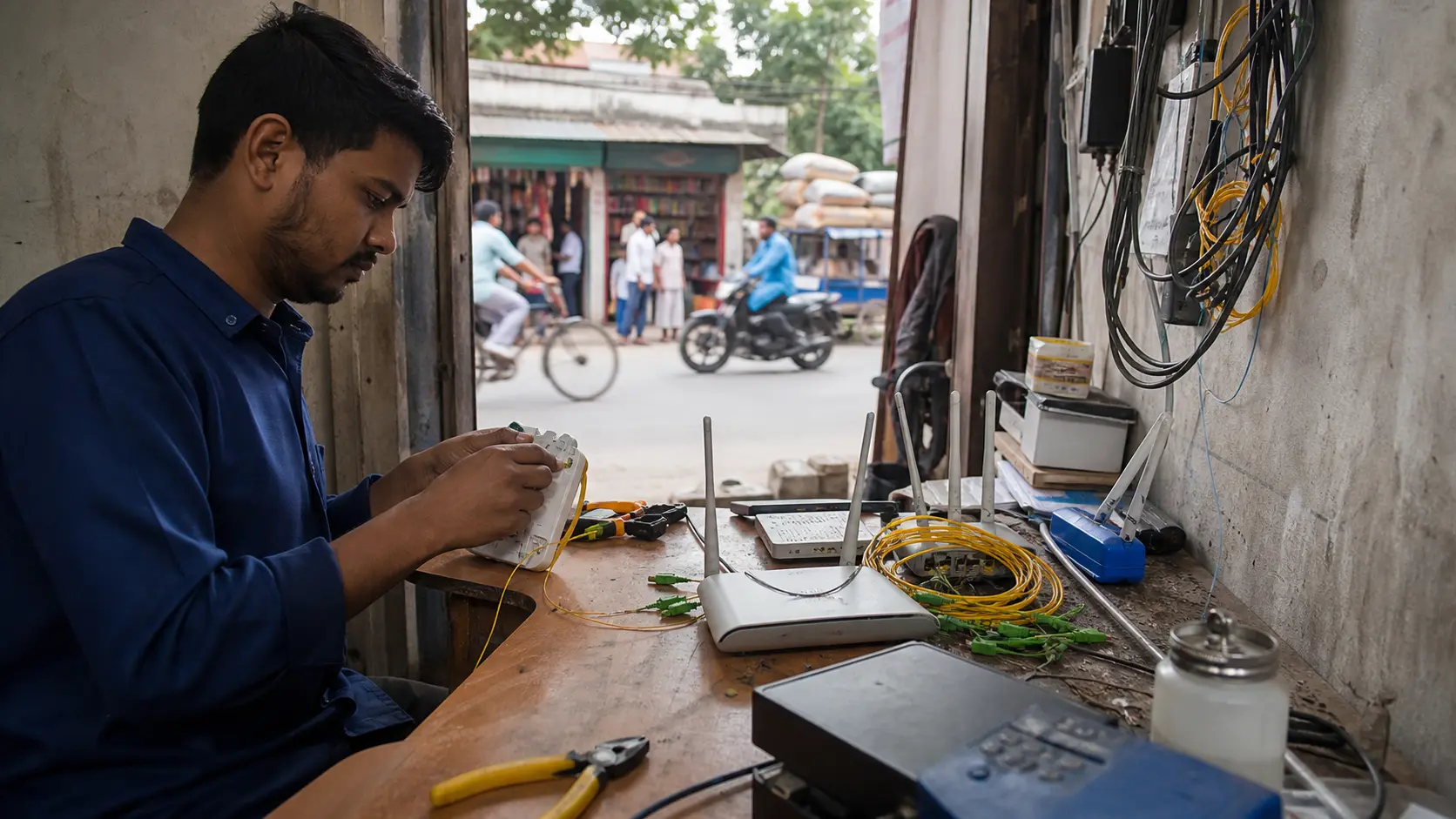
Start with the call, not with the speed plan. A small office in Dhaka or Khilkhet loses its link at 10:20 in the morning. The router still has lights, one laptop can see the Wi-Fi name, another cannot, the accounts clerk has a VAT portal open, and the owner has decided that the line is bad because yesterday a video call froze twice. The customer opens a support ticket, maybe through a phone call, maybe through a Facebook message, maybe through a self-care page if the provider has one. In that moment the bill is no longer a price for Mbps. It is a price for attention.
That attention has a supply chain. Someone must check whether the account is paid. Someone must decide whether the ONU or home router is alive. Someone must see whether the customer's optical receive power has drifted, whether a rooftop drop cable has been bent, whether a switch has lost power, whether an upstream gateway is congested, whether a route is unstable, whether a domestic cache path is fine but international bandwidth is impaired, or whether the customer has simply bought a shared plan and is meeting the arithmetic of contention at the busiest hour. If the answer is not obvious, a field worker must be dispatched.
If a field worker is dispatched, the bill starts consuming labour, transport, replacement connectors, ladder time, splicing time, and the goodwill of the building caretaker.
That is the economics behind 360 Internet Inc Ltd., even though the company's own public footprint is unusually thin. The record does not let us write a confident story about a glossy brand, named directors, current retail packages or subscriber counts. It does show a Bangladesh company name attached to public internet-number resources, and then to a transfer of those resources in 2025. It also sits inside a Bangladesh access market where the state has pushed retail tariffs down, customers have learned to expect a working broadband line for a few hundred taka, and providers cannot survive by selling raw bandwidth alone.
They survive, if they survive, by making enough support tickets cheap to close.
The distinction matters because a support ticket is where a small ISP's promises become cash costs. Advertising can say fibre, unlimited, BDIX, gaming, corporate, public IP or 24-hour support. The customer pays the recurring bill because the provider can turn those words into restored service quickly enough. If the ticket is ignored, the customer does not need to read an APNIC record or a BTRC guideline. A mobile hotspot, a second fibre drop from a rival, a building-level reseller or a better-known Dhaka operator becomes the substitute. In a tariff-capped market, the difference between survival and churn is not the headline speed.
It is the operating discipline behind repair.
This article therefore treats 360 Internet as a narrow evidence case and Bangladesh broadband as the market frame. The question is not whether a public routing record proves a retail network. It does not. The question is what a Bangladesh company named in those records would have had to earn from customers if it was selling or supporting access links, and what the 2025 transfer says about the value, limits and possible disposability of that network-resource position.
What can be verified about 360 Internet
The strongest company-specific evidence is APNIC's public transfer log. In the July 2026 version of that log, a record dated 9 September 2025 lists 360 Internet Inc Ltd. as the source organization, country code BD, in a resource transfer to Code For Host Inc Ltd. The transferred resources were AS140068 and the IPv4 range 103.148.14.0 through 103.148.15.255, a /23. That is a real administrative event. It ties the 360 Internet name to Bangladesh and to a block of internet-number resources large enough to matter for a small provider but not large enough to imply national scale.
The same evidence also limits the conclusion. Querying APNIC by the 360 Internet name now returns no current entry. APNIC whois for AS140068 identifies Code For Host Inc Ltd. as the current autonomous-system holder, with the as-name CFHIL-AS-AP and a Bangladesh country code. APNIC whois for 103.148.14.0/23 also identifies Code For Host, and shows route records for the two /24s under that range. RIPEstat's public overview for AS140068, checked on 5 July 2026, likewise identifies the holder as Code For Host and marks the AS as announced.
RIPEstat's announced-prefix data shows 103.148.14.0/24 and 103.148.15.0/24 visible, along with several other prefixes under the current Code For Host routing surface.
That means the resource evidence is not a live map of 360 Internet's current network. It is a record that 360 Internet had a role as the source of a transfer, and that the resources now sit under another Bangladesh company's public routing administration. Network records show public routing and administrative surface only. They do not prove subscriber count, service area, customer experience, ownership, revenue, corporate continuity, retail pricing, upstream contracts or whether 360 Internet still operates access links under another arrangement.
The absence of a rich public trail is itself part of the story. Normal search did not surface a current 360 Internet website, tariff card, active customer-support page, BTRC licence summary row, ISPAB profile, Google-review page or social channel that could be confidently tied to the same legal name. That absence should not be overread. Bangladesh has many small providers whose web presence is weak, local, multilingual, moved between domains, or dependent on Facebook pages that do not index cleanly. But absence changes the evidentiary posture.
A careful article cannot say that 360 Internet sells a named 50 Mbps plan in a named neighbourhood today. It can say that the company appears in public network-resource evidence, that those resources moved to Code For Host in September 2025, and that any access business around such a company would be judged by the economics of low-price support.
For a customer, that distinction is invisible until there is trouble. The invoice may carry one brand, the technical contact may answer under another, the route may be originated by a third administrative name, and the building technician may be a local contractor. The customer only sees whether the ticket gets solved. For the analyst, the same fragmentation is the point. Regional ISP economics often hide behind thin records. An ASN, a prefix, a licence row, a tariff card, a support phone number and a review thread may each show only one face of the business. None should be turned into the whole company.
The regulatory box around a cheap line
Bangladesh is a difficult country in which to separate broadband price from broadband policy. BTRC's ISP licensing guideline says an ISP licensee must hold the relevant permission to build and operate ISP systems, that the licence classes include nationwide, divisional, district and upazila or thana tiers, and that licensees take transmission from NTTN operators and internet bandwidth from licensed IIG operators. The same guideline says the regulator has the right to determine tariffs and requires licensees to follow approved tariff directives.
In other words, the access provider is not simply a retailer buying capacity and adding a margin. It sits inside a state-designed wholesale and retail stack.
The visible fee schedule makes the formal cost concrete. Under the 2020 ISP guideline, a divisional ISP licence carries a Tk 10,000 evaluation charge, Tk 200,000 acquisition fee, Tk 100,000 annual fee, Tk 200,000 renewal fee and Tk 200,000 bank guarantee or pay order. A district licence is cheaper, with a Tk 100,000 acquisition fee and Tk 50,000 annual fee. An upazila or thana licence is cheaper again, with a Tk 25,000 acquisition fee and Tk 10,000 annual fee. A nationwide licence is more expensive, with a Tk 500,000 acquisition fee and Tk 250,000 annual fee.
The numbers are not large compared with a serious network build, but they matter to a neighbourhood operator whose retail price is politically compressed.
The tariff side tightened further in 2025. In April, ISPAB announced that the Tk 500 broadband plan would deliver 10 Mbps instead of 5 Mbps, and officials framed the shift as a step toward making 20 Mbps the minimum. In May, The Business Standard reported that BTRC had lowered the minimum monthly charge for a 5 Mbps broadband connection to Tk 400 from Tk 500, with 10 Mbps and 20 Mbps tariffs reduced to Tk 700 and Tk 1,100 from 1 July. The same report said BTRC was pushing quality obligations, including bill reductions when service remains disconnected for five, ten or fifteen consecutive days.
This is why the support ticket is not a side issue. If a customer pays Tk 400, Tk 500, Tk 700 or Tk 1,100 for a shared broadband line, there is not much money left after upstream capacity, local distribution, collection, CPE, field labour and overhead. Yet the regulator and the market both ask the provider to deliver a usable line.
The customer is not sympathetic to the fact that international bandwidth is bought from an IIG, metro transmission may be leased from another network, domestic traffic may depend on exchange paths, power failure may sit outside the ISP's building, and a rooftop cable may have been damaged by someone else's repair crew. The customer has one bill and one complaint.
The price cap therefore creates two businesses inside one line. The first is the visible sale of a speed tier. The second is the hidden sale of fault resolution. The first is easy to compare. The second determines whether the provider keeps the account. When BTRC says that prolonged disconnection can cut the customer's bill, it is effectively putting a price on unresolved tickets. Five days of disconnection is not only reputational damage. It is revenue leakage. Ten or fifteen days turns a monthly fee into a penalty against the provider. The cheap plan becomes viable only if faults are closed quickly enough that those rules rarely bite.
Pricing proxies: what the market will pay
Because no confirmed 360 Internet tariff card was found, the pricing has to be triangulated. The first proxy is the national retail floor. The public policy record says Tk 500 became the psychologically important broadband price point, first as a 5 Mbps plan under the earlier one-country-one-rate structure and then, after ISPAB's April 2025 announcement, as a 10 Mbps shared connection. BTRC's later tariff move pushed 5 Mbps to Tk 400 and placed 10 Mbps at Tk 700 and 20 Mbps at Tk 1,100. Those numbers define the customer's anchor: a basic fixed line should cost a few hundred taka, not a few thousand.
The second proxy is competitor pricing in Dhaka. Dot Internet's public pricing page lists 50 Mbps at Tk 890, 80 Mbps at Tk 1,050, 100 Mbps at Tk 1,260, 150 Mbps at Tk 1,575, 200 Mbps at Tk 2,100, 250 Mbps at Tk 3,150 and 300 Mbps at Tk 4,200. The same page advertises optical fibre, high-speed domestic connectivity, a 1:8 contention ratio, public IPv6, public-IP availability, multiple upstreams and 24-hour phone and online support. Dot is a larger and more visible Dhaka competitor, not a measure of 360 Internet.
But its tariff ladder shows the commercial expectation around which smaller providers must compete: a higher-speed residential plan is still priced in low thousands of taka, and support is bundled into the monthly fee rather than sold as a separate callout every time the line fails.
The third proxy is the price of support failure. The May 2025 tariff report says users may pay half the bill after five consecutive days without service, a quarter after ten days, and nothing after fifteen days. That rule turns outage duration into an explicit discount schedule. On a Tk 700 line, five days of unresolved failure can cost the provider Tk 350 of monthly billing. On a Tk 1,100 line, it can cost Tk 550. The amount is small in absolute terms, but the signal is large: the state has decided that a broadband bill is not payable in full when the repair function has failed for long enough.
The fourth proxy is upstream and wholesale pressure. The Business Standard reported a planned 20 percent reduction at the ISP and IIG levels from July 2025. That tells us two things at once. Bandwidth remains important enough for a public price intervention, and policymakers expect some of the wholesale reduction to flow to customers. A provider cannot simply pocket the entire upstream saving if retail prices are also being pressed down and competitors advertise more speed for the same money.
The fifth proxy is formal status. BTRC's licence fees and APNIC's fee schedule are small compared with payroll and plant, but they do not disappear. APNIC's 2026 member fee schedule sets a base formula for annual fees, no annual charge for one or two ASNs, a transfer fee tied to the annual fee applicable to transferred resources, and a discount for least-developed-country account holders. The 360 Internet transfer record shows that the resource position itself had administrative value: somebody maintained the resources long enough to transfer them, and the recipient took them into its own public routing estate.
That does not price 360's retail business, if any. It does show that address resources and an AS number were worth administering as assets.
Put those proxies together and the customer bill starts to look very different. A cheap line does not buy a pure commodity. It buys a share of upstream bandwidth, a contention model, a place in the payment system, a right to call support, a probability that a field worker will arrive, and the provider's ability to manage its own upstream and regulatory dependencies. When a customer argues over a Tk 500 or Tk 700 plan, the argument is really about how much attention can be embedded in a recurring bill that low.
The business model implied by a small access provider
If 360 Internet was operating as a small access ISP before the 2025 transfer, the likely model was not complex. It would have needed a licensed or partner-enabled route into Bangladesh's regulated internet stack, access to IIG bandwidth, some form of local transmission, and a last-mile network close enough to customers to install and repair economically. It would have monetized residential accounts, small-business accounts, public-IP needs, possibly local caching or domestic traffic expectations, and perhaps wholesale or reseller relationships. None of those lines can be confirmed for 360 by a public product page.
They are the model implied by the market category and by the type of resource evidence.
The arithmetic is unforgiving. A residential customer paying Tk 500 to Tk 1,100 per month cannot support many truck rolls. The installation charge, if any, usually cannot cover the full cost of a fibre drop, an ONU, connectors, customer education, router configuration and the first support calls. The provider recovers that cost over time, which makes early churn expensive. If the first three months include multiple visits, the account may be loss-making even before upstream capacity is counted. The value of the customer begins only when the line becomes boring.
Small businesses change the calculation. The customer with a billing terminal, a point-of-sale device, a remote worker, a cloud accounting account or a daily video-call habit is not buying only speed. The customer is buying continuity. It may pay for a higher tier, a static or public address, quicker support, a backup path, or simply the relationship with a provider whose technician knows the building. That is where local providers defend themselves against larger competitors. A national brand can advertise. A local provider can remember that the third-floor switch is behind a locked grill and the landlord leaves at 6 pm.
The support ticket is the bridge between the two customer types. Residential support teaches the provider where the physical weak points are. SME support monetizes the knowledge. If a provider knows which rooftop cable is exposed to rain, which neighbourhood switch needs backup power, which upstream starts to congest at night, and which building caretaker answers the phone, it has a form of local information that does not appear in the routing table. The question is whether that information is worth enough to cover the low-margin mass of residential accounts.
For 360 Internet, the absence of a visible current product page makes the scale question unanswerable. A /23 of IPv4 space can support many more customers behind address translation than its 512 addresses imply, but it is still a modest resource footprint. The transfer of that /23 and AS140068 to Code For Host could mean resource sale, business transition, restructuring, customer migration, hosting-market reuse, or a simple administrative cleanup. Public records do not choose among those explanations. Economically, each explanation points to the same constraint: small provider assets are separable.
Customers, licence position, address space, local loops, brand and support labour can drift apart when margins are thin or when another operator can use the resources more productively.
The cost base behind the ticket
The first visible cost is formal operation. BTRC licence fees, renewal fees, bank guarantees, tariff approvals, compliance with rollout and quality terms, and recurring regulatory reporting all take management time. The smallest licence tier is cheap enough to encourage formalisation, but even a cheap licence creates obligations. A provider that wants to sell to SMEs must also look credible: trade licence, tax registration, bank account, invoices, support contacts, and enough documentary discipline to satisfy a business buyer. The ticket may begin with a customer complaint, but the provider has already paid for the right to be called.
The second cost is upstream. BTRC's guideline says ISP licensees are to connect to licensed IIGs for internet bandwidth and to a national exchange for domestic inter-operator traffic. That architecture gives small providers access to the national internet market, but it also makes them dependent. If the IIG sector has billing stress, if a gateway is capped, if domestic traffic shifts, if an NTTN link is congested, or if a wholesale price change is delayed, the access provider absorbs the customer's anger before it can resolve the upstream cause.
The Daily Star's reporting on IIG arrears shows that the gateway layer is not a frictionless utility. In February 2025, it reported that 29 IIG operators still owed BTRC about Tk 205 crore, with disputes around regular payments and undisclosed bandwidth charges. That is supplier-side risk for every small access seller below the gateway layer.
The third cost is field labour. Broadband is local physical infrastructure. A technician's time is not infinitely divisible. If one worker can close six simple tickets in a day, a rainstorm, power outage or fibre cut can turn a normal queue into a backlog. The customer sees waiting time; the provider sees payroll. Every extra support promise embedded in a cheap plan has to be funded by monthly revenue that may already be allocated to upstream, CPE and collection. The most valuable repair is the one avoided through better installation, better cable routing and more resilient local power.
But those preventive investments compete with the pressure to keep installation cheap.
The fourth cost is equipment and power. Customer-premises equipment breaks, power adapters fail, low-cost routers overheat, connectors get dirty, and backup batteries age. In Bangladesh's dense urban access market, a provider may also carry small switches, splitters, patch cords, drop cables, tools and spare ONUs. Some costs are one-time; others recur because customers move, churn, upgrade or blame the ISP for Wi-Fi problems inside the room. Power is a separate burden.
A support ticket opened during a local power problem may require the provider to know whether its own active equipment has backup, whether the customer's ONU is powered, and whether the upstream path is still alive.
The fifth cost is payment collection. A low monthly bill is not free to collect. Prepaid behaviour lowers bad debt but creates disconnection and reconnection labour. Postpaid behaviour reduces service interruption but creates credit risk. Mobile financial services help, and many Bangladeshi ISPs now push digital bill payment, but payment questions still reach support desks. A ticket may be technical; it may also be a billing dispute in disguise. The customer who says the line is down may be unpaid. The customer who is unpaid may still expect support.
The support queue becomes a credit-control tool, which is dangerous for reputation but often unavoidable in low-margin access.
The sixth cost is triage. A cheap provider cannot send a technician to every complaint, yet it cannot let too many customers feel ignored. That creates an operations problem that is more subtle than bandwidth procurement. The first support worker must sort calls into categories: account unpaid, Wi-Fi-only complaint, device failure, drop-cable fault, local distribution fault, upstream impairment, general outage or ambiguous. A wrong decision wastes money. Sending a field worker for a customer-router problem consumes labour that should have gone to a real cable fault.
Refusing a visit when the drop line is broken converts a repairable account into a churn risk. The value of experience is therefore high. The worker who has seen the same building, same splitter, same old router model and same evening congestion pattern can solve the ticket faster than a generic call centre reading from a script.
The seventh cost is documentation. Support work gets cheaper when the provider remembers what happened last time: which fibre core served the flat, which ONU serial was installed, which customer insisted on placing the router behind a concrete wall, which upstream ticket was opened, which pole was repaired after rain, and which invoice adjustment was promised. In a very small network this memory may live in a technician's phone. In a more disciplined provider it lives in a CRM or ticketing system. Either way, the customer is paying for institutional memory.
If the company loses the worker, changes the billing name, migrates customers to another operator or transfers its visible resource position, that memory can fracture. The physical line may remain in place, but the next ticket becomes more expensive because the new support desk has to rediscover the local facts from scratch.
These costs explain why a small provider's economic health may not be visible in headline speed. A 100 Mbps plan can be profitable if customers mostly use domestic caches, if contention is managed honestly, if upstream is bought at scale, if the support load is low and if the customer stays for years. A 10 Mbps plan can be unprofitable if it creates many support calls, requires repeated field visits and churns after a subsidized install. Mbps is not the unit that breaks the business. Tickets are.
Upstream reliance and the limits of routing evidence
The APNIC and RIPEstat records around AS140068 are useful because they show administrative continuity after the transfer. Code For Host now appears as the current holder; the transferred 103.148.14.0/24 and 103.148.15.0/24 are among the prefixes visible in RIPEstat's announced-prefix view for the AS. That tells us the resources did not vanish into a dead record. They moved into a current routing surface.
It does not tell us who answers a residential customer's phone. Routing evidence is powerful but narrow. It can show that an AS is announced, which prefixes are visible to enough route collectors, and which name is attached to registry records. It cannot show whether an end user in Bangladesh is buying from 360 Internet, Code For Host, a reseller, a building operator or another access brand. It cannot show whether a complaint is caused by international transit, local fibre, Wi-Fi, underpowered CPE, customer misuse or upstream filtering.
It cannot show whether a transferred resource sale was part of a distressed exit or an ordinary commercial decision.
That limitation is not a weakness of network records; it is why they must be read properly. Public routing data is a map of reachability and administration. It is not a customer ledger. In a regional ISP analysis, the routing map answers one question: does the company name appear in the infrastructure record, and if so, how? For 360 Internet, the answer is that the name appears as a former source organization for a concrete transfer. The current routing surface belongs to Code For Host. The live customer story remains unproved.
The transfer still matters economically. IPv4 addresses are scarce, and a /23 is not meaningless in a market where public addresses can support business products, infrastructure, CGNAT pools, hosting, remote access, gaming needs, surveillance deployments and enterprise services. AS140068 also carries value as a routing identity. Even if the AS itself has no large standalone price, it reduces friction for an operator that wants to originate its own prefixes, peer, manage upstream policy or present itself as a real network. The fact that those resources were transferred, rather than simply abandoned, suggests administrative value.
There is also an upstream-clue angle. Current RIPEstat data for AS140068 shows more prefixes than the 360-sourced /23 alone. That indicates Code For Host has a broader resource and routing estate than the transferred block. For 360, the implication is modest: its visible resource position was likely a small part of another operator's larger administrative surface after the transfer. If 360 still has a customer-facing operation, its current network role may be hidden behind another AS, another supplier or another brand. If it does not, the transfer may be evidence of the end of its independent routing identity.
Either way, the support-ticket thesis survives. A customer cannot buy "AS140068" as a lived service. The customer buys the working line. The AS helps the provider buy, route and troubleshoot capacity. The customer's support ticket prices whether those hidden technical choices become reliable service.
Customer dependence and substitute pressure
The Bangladesh fixed-broadband customer is more powerful than the monthly price suggests. On one hand, fixed broadband can be essential. Offices need it for payment systems, government portals, remote work, design files, IP cameras, cloud accounting and video calls. Households need it for education, entertainment and work from home. The line is no longer a luxury. BSS reporting in April 2025 carried the policy language that internet service would be treated as a citizen-right direction, and that the old shutdown approach should end. That political framing strengthens customer expectations: the line should be cheap, fast and reliable.
On the other hand, the customer's substitutes are real. Mobile data is always present, even if it is not a perfect replacement for fixed broadband. A second local ISP may already have fibre in the same building. A building reseller may offer a cheaper line. A national or better-known Dhaka provider may advertise a richer speed tier. Dot Internet's public page, for example, markets direct BDIX connection, multiple upstreams, low latency, public-IP availability and 24-hour support alongside published prices. A smaller provider cannot assume that a low price alone will hold customers.
The customer does not need to understand the entire substitute set. A household experiencing repeated evening slowdowns can switch to a neighbour's recommendation. An SME suffering repeated outages can buy a backup SIM, then route important work over the backup, then stop renewing the fixed line. A building owner can allow another provider's cable into the stairwell. Each act is small, but the economic effect is cumulative. The provider loses not only one account but the density that made the local network cheap to maintain.
That density is the hidden asset of a local ISP. A technician can serve a neighbourhood efficiently when many customers sit within the same few streets. Spare parts can be stocked for known equipment. Field workers know which roofs are accessible, which splitters are overloaded, which apartment committees are hostile to cabling, and which customers pay late but stay loyal. If density falls, the same support promise costs more per subscriber. A cheap line becomes expensive to maintain because each ticket is farther from the next.
For 360 Internet, the customer-dependence question is unresolved because no current retail footprint is visible. But the market lesson is clear. If a company like 360 retained a local access book, its value would not be the old AS number after transfer. It would be the customer relationships, local repair knowledge and payment habits. If it did not retain a customer book, the transfer suggests the more liquid piece of the business was the resource position. In either case, customer continuity is worth more than a speed label.
Regulation, politics and operational risk
Bangladesh broadband operators face regulatory risk from both price policy and service obligations. The 2025 debate over fixed-telecom licensing is central. The Daily Star reported in October 2025 that BTRC proposed a framework requiring broadband operators and fixed-line telephone providers to share 5.5 percent of annual revenue with the regulator and contribute another 1 percent to the Social Obligation Fund. ISPAB warned that those levies would land on thin margins.
The Business Standard later reported ISPAB's estimate that internet prices could rise by 18.4 percent under the proposed guidelines and that smaller local ISPs could be threatened by the cost shift and wider fixed-wireless privileges.
For a small provider, a revenue share changes the logic of formality. A flat licence fee can be treated as an overhead. A percentage of revenue grows with the customer base and penalizes low-margin scale. If the provider earns most of its profit from a small set of higher-paying business customers, a gross-revenue levy bites before support cost, bad debt, CPE replacement or upstream variability are considered. If the provider's residential book is already close to break-even, the levy may push it toward consolidation or exit.
Policy can also change the competitive field. BSS reported in April 2025 that officials discussed reducing licensing categories and separating fixed broadband from wireless service rights. TBS reporting on the later draft says operators worried about mobile operators entering fixed-connectivity roles. That matters because a small access ISP's main advantage is local density and support memory. If larger operators gain more freedom to bundle fixed, mobile, wireless and content services, the local provider's support-ticket edge must be sharper.
A customer may accept a slightly slower repair from a provider that offers a cheaper bundle or a recognized brand.
Political risk is not abstract. Freedom House's Bangladesh report noted throttling during political events before 2024 and, in a note on the July 2024 protests after its coverage period, said authorities cut internet access and blocked social platforms. The same report records other operational shocks, including Cyclone Remal's impact on telecom infrastructure and the Khawaja Tower fire that disrupted internet services after affecting IIG offices. These risks sit above any individual provider.
A small ISP can buy backup power and multiple upstreams; it cannot fully hedge a national shutdown, a policy order, a gateway-sector payment crisis or a major shared-building incident.
That creates a credibility problem in customer support. The support desk may know that the outage is upstream or political, but the customer has one provider. The worker answering the phone must translate national infrastructure risk into a local explanation without sounding evasive. The longer the disruption lasts, the less customers care whose fault it is. They want a route, a backup, a bill adjustment or a credible time to repair. The cheap line again becomes a ticket.
Informal market signals
The informal signals around 360 Internet are mostly negative in the evidentiary sense: not negative about the company, but sparse. No strong current website, public tariff card, social-review page or regulator licence row surfaced under the exact name. The APNIC transfer is the strongest public clue. A current APNIC query for the name returns no records. Search results do not show a customer-facing brand with a clear match. That makes it risky to describe 360 as an active retail ISP without qualification.
Sparse signals are common in the layer of the market where formal and informal practices meet. A provider may be legally incorporated but locally marketed under a different spelling. A neighbourhood operator may rely on a Facebook page, a WhatsApp number, a banner, a bill-payment intermediary and word of mouth instead of a maintained website. A network-resource holder may not be a retail operator at all. A hosting company may hold resources used by access partners. A local access provider may buy from another AS and never show up in BGP under its customer-facing name. The public record is not the same as the operating reality.
The useful informal signal is therefore not the absence of a review page but the structure of what would have had to be true. If 360 Internet had a live customer base, customers would judge it on wait time, repeat faults, payment flexibility, installation speed, evening congestion and how well support distinguishes Wi-Fi problems from upstream problems. If it had no live customer base, the resource transfer becomes the stronger signal: a small administrative asset moved to a company that now publicly originates related prefixes.
If it sat between those two states, perhaps as a small provider whose resources were absorbed by another operator, the decisive question would be whether the customer ticket queue moved cleanly with the network.
That last point is underappreciated in small-ISP economics. Network assets can be transferred on paper. Customers cannot be transferred without trust. A subscriber who has the same cable, same router and same technician after an administrative change may never notice. A subscriber who gets a new biller, new support number and slower repair may churn even if the BGP route is cleaner than before. In a market where customer acquisition is cheap only when neighbourhood density is high, botched support migration can destroy the value of the acquired base.
What would change the view
Several facts would materially change the reading of 360 Internet. The first is a current BTRC licence record under the exact company name, especially if it identifies licence tier, service area and renewal status. That would move the company from former resource holder to confirmed regulated access participant. The second is a current public tariff card, customer-support page or verified social channel tied to the same legal name. That would allow a direct comparison between 360's own prices and Bangladesh's broader tariff caps.
The third is a corporate registry or tax record that confirms directors, registered address, capital and status. The APNIC transfer proves that the name appeared in a network-resource event, but it does not settle ownership or whether the legal entity continues active trading. The fourth is a public statement from Code For Host or 360 explaining the September 2025 transfer: sale of resources, acquisition, restructuring, customer migration, hosting expansion or another commercial reason. Each explanation carries a different implication for value.
The fifth is customer evidence. A dated review thread, outage complaint, support response, installation invoice or local forum discussion tied clearly to 360 Internet would matter more than another generic market article. The target here is not gossip. It is a way to price support labour. How long did customers wait? Did support blame upstream? Were bills adjusted? Were technicians dispatched? Did customers report evening speed collapse, router problems, cable cuts or payment confusion? Those are the facts that turn a theoretical support-ticket economy into a measured one.
The sixth is routing history before and after the transfer. A clean timeline showing when AS140068 first appeared, which prefixes it originated under 360, what upstreams were used, when the Code For Host change occurred, and whether origin changes coincided with customer-facing notices would sharpen the network reading. Without that, the article should remain conservative: 360 Internet is visible as a Bangladesh source organization in an APNIC transfer, while the current public routing surface belongs to Code For Host.
The conclusion, then, is deliberately modest. 360 Internet is not yet a company whose current retail business can be described with confidence from public records. But its trace in APNIC's transfer log is enough to put it inside a Bangladesh regional-ISP economics question: what is the value of a cheap link when the customer is really buying attention? The answer is that the link is cheap only if the provider's support system is disciplined. A Tk 500 or Tk 700 plan can carry a household when the network is stable and the ticket queue is light.
It becomes expensive the moment one technician has to spend half a day proving that the customer's problem is not the router, not the roof cable, not the IIG, not the payment status and not the provider's own oversold upstream.
That is why the support ticket is the most honest unit of analysis. It captures the entire stack: customer patience, local labour, upstream dependency, regulatory price ceilings, scarce address resources, equipment failure, power risk and substitute pressure. A company can transfer an AS number. It can transfer an IPv4 block. It can hide behind a thin web footprint. It cannot hide from the economics of repair. In Bangladesh's low-price broadband market, the company that notices the ticket first, diagnoses it cheaply and restores the line before the customer switches is the company that owns the margin.
The public record is thin but still useful if it is read with limits. APNIC's transfer log is the anchor for the 360 Internet source-organization trace: https://ftp.apnic.net/stats/apnic/transfers/transfers_latest.json. APNIC WHOIS views for AS140068 and 103.148.14.0 show the public resource surface and its administrative language: https://wq.apnic.net/apnic-bin/whois.pl?searchtext=AS140068 and https://wq.apnic.net/apnic-bin/whois.pl?searchtext=103.148.14.0. A direct APNIC name search is important precisely because it shows how thin exact-name evidence can be: https://wq.apnic.net/apnic-bin/whois.pl?searchtext=360%20Internet%20Inc%20Ltd. RIPEstat's AS overview and announced-prefix views provide public routing context without proving service quality: https://stat.ripe.net/data/as-overview/data.json?resource=AS140068 and https://stat.ripe.net/data/announced-prefixes/data.json?resource=AS140068. BTRC's ISP guideline frames licensing obligations and the cost of formality: https://lims.btrc.gov.bd/uploads/service_guideline/Regulatory%20and%20Licensing%20Guideline%20for%20Internet%20Service%20Provider%20%28ISP%29%20in%20Bangladesh.pdf. BSS reporting on fixed-service policy shows the broader regulatory transition: https://www.bssnews.net/news-flash/264670. TBS reporting on minimum broadband bills and IIG/ISP price cuts gives the tariff-pressure backdrop: https://www.tbsnews.net/bangladesh/telecom/btrc-lowers-minimum-broadband-bill-tk400-1149416 and https://www.tbsnews.net/bangladesh/telecom/internet-price-drop-20-isp-iig-levels-july-1143381. Daily Star and TBS reports on proposed revenue sharing show how policy can hit small-operator margins: https://www.thedailystar.net/business/news/btrc-wants-55-revenue-broadband-operators-4021556 and https://www.tbsnews.net/bangladesh/telecom/internet-prices-likely-rise-184-under-proposed-btrc-guidelines-ispab-1275961. Reporting on IIG arrears helps explain upstream payment risk: https://www.thedailystar.net/business/economy/news/29-iig-operators-still-owe-tk-205cr-btrc-3825121. APNIC's fee schedule supplies a proxy for number-resource carrying cost: https://www.apnic.net/about-apnic/corporate-documents/documents/membership/member-fee-schedule/. Dot Internet and Polash Nagor offers show the local buyer's price alternative: https://dotinternetbd.com/, https://polashnagor.net/ and https://polashnagor.net/wp-content/uploads/2022/10/Polas-Nagar-Dot-Net.pdf. Freedom House's Bangladesh internet report is used only for national disruption context, not as 360-specific evidence: https://freedomhouse.org/country/bangladesh/freedom-net/2024.