
Institution Profiling / Internet infrastructure institution

What is a Regional Internet Registry?

What is a Regional Internet Registry? is tracked as a internet infrastructure institution within the internet infrastructure ecosystem.

What is a Regional Internet Registry?

Evidence Pack

Source records grounding the claims in this article.

CategoryInstitution Type

What is a Regional Internet Registry? is tracked as a internet infrastructure institution within the internet infrastructure ecosystem.

RegionAfrica

What is a Regional Internet Registry? has public-source relevance to network operations, governance, dependency mapping, or market structure.

Signal FocusInternet infrastructure institution

What is a Regional Internet Registry? has public-source relevance to network operations, governance, dependency mapping, or market structure.

Content TypeProfile

What is a Regional Internet Registry? is tracked as a internet infrastructure institution within the internet infrastructure ecosystem.

Primary DomainGovernance

Public-source signals support medium-impact monitoring for infrastructure visibility and dependency analysis.

TopicInternet infrastructure institution

What is a Regional Internet Registry? is profiled by BTW Media because public-source evidence links it to internet infrastructure, governance, operational dependencies, or market visibility.

ImpactMedium

Public-source signals support medium-impact monitoring for infrastructure visibility and dependency analysis.

Confidence?Confidence Grade
0.90–1.00AHigh — direct sources
0.75–0.89A/BStrong
0.55–0.74B/CMedium
0.35–0.54C/DWeak–medium
0.10–0.34DWeak signal
0.00–0.09DInternal monitoring
C · 0.80

Mixed-source

What is a Regional Internet Registry? is profiled by BTW Media because public-source evidence links it to internet infrastructure, governance, operational dependencies, or market visibility.

  • Regional Internet Registries (RIRs) allocate and manage IP addresses and Autonomous System numbers across distinct global regions.
  • There are five RIRs, each responsible for a specific geographic area, ensuring fair distribution of internet resources.
  • RIRs face challenges like IPv4 exhaustion and advocate for IPv6 adoption to meet growing internet connectivity demands.

In today’s digital age, the management of internet resources, such as IP addresses and Autonomous System (AS) numbers, is crucial for the seamless operation of the global network. At the forefront of this management are entities known as Regional Internet Registries (RIRs).

A Regional Internet Registry (RIR) is an organization responsible for allocating and managing IP addresses and related resources within a specific region of the world. The primary goal of an RIR is to ensure fair and efficient distribution of these resources, which are vital for the operation of the internet.

The global structure of RIRs

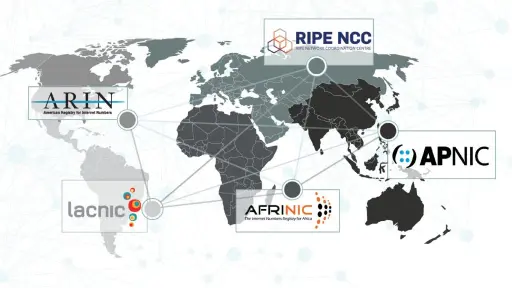
There are five RIRs globally, each overseeing a distinct geographic area:

1. American Registry for Internet Numbers (ARIN) – Covers North America.

2. Réseaux IP Européens Network Coordination Centre (RIPE NCC) – Manages Europe, the Middle East, and parts of Central Asia.

3. Asia-Pacific Network Information Centre (APNIC) – Responsible for Asia and the Pacific region.

4. Latin American and Caribbean Internet Addresses Registry (LACNIC) – Oversees Latin America and the Caribbean.

5. African Network Information Centre (AFRINIC) – Manages IP resources in Africa.

Also read: Randy Bush honoured at RIPE 87 after calling RIRs a ‘monopoly’
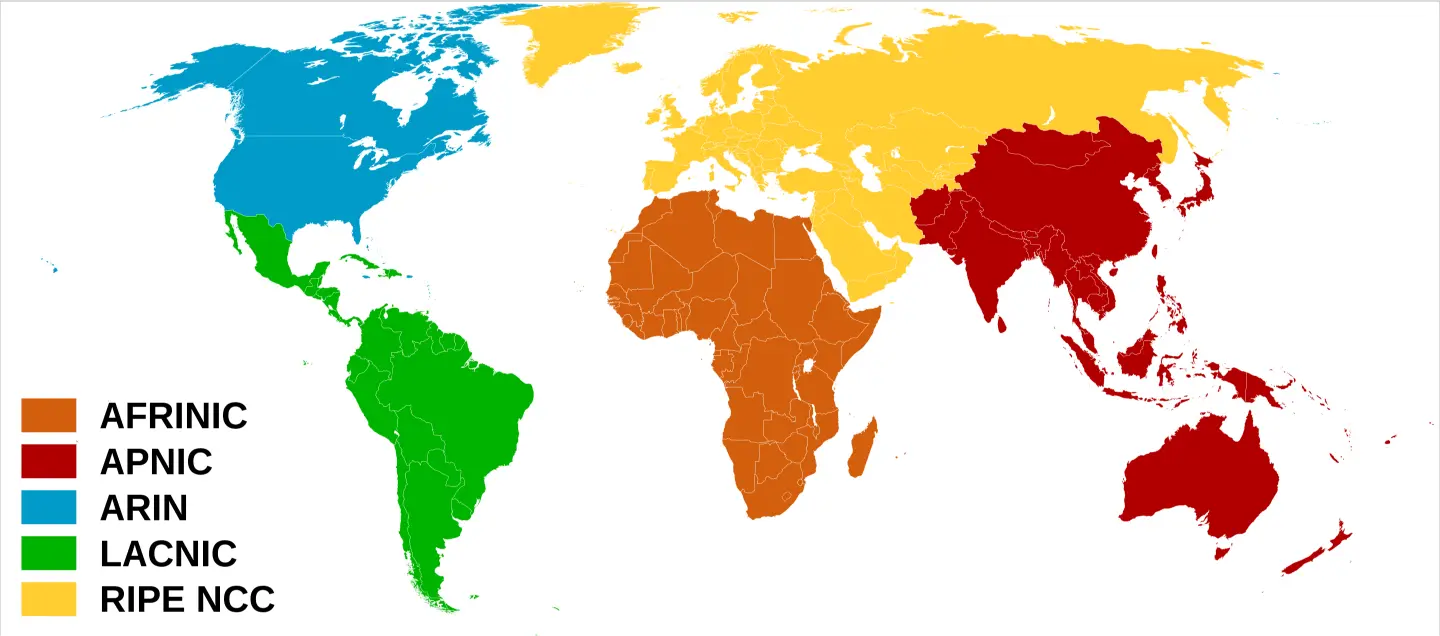
Regional_Internet_Registries_world
Regional Internet Registries world

Functions of RIRs

– Allocation and Management of IP Addresses: RIRs allocate IP address blocks to Internet Service Providers (ISPs), large organizations, and sometimes to end users. They manage both IPv4 and IPv6 addresses.

– Autonomous System Numbers Management: RIRs assign AS numbers used for routing internet traffic.

– Policy Development: RIRs develop policies regarding the allocation and management of internet resources. These policies are created through a community-driven process, ensuring transparency and representation of various stakeholders.

– Technical Services: They provide services such as reverse DNS delegations and maintain WHOIS databases for their regions, offering information about IP address allocations.

– Education and Outreach: RIRs conduct training and workshops to educate stakeholders about internet resources management and best practices.

Also read: ICANN’s Africa DNS report barely mentions the AFRINIC problem

Importance in the internet ecosystem

RIRs play a critical role in the global internet ecosystem. They ensure that IP resources are used efficiently and are available for future needs. By facilitating fair and stable distribution, RIRs contribute to the resilience and growth of the internet.

Challenges and future outlook

With the exhaustion of IPv4 addresses, RIRs are actively encouraging the adoption of IPv6 to meet the growing demand for internet connectivity. They also face challenges like ensuring equitable access to resources across diverse regions and addressing issues related to internet governance.In conclusion, Regional Internet Registries are pivotal in managing key internet resources, maintaining operational stability, and shaping the future of global internet connectivity.

Core Entity Brief

  • Entity: What is a Regional Internet Registry?
  • Subject Type: Internet infrastructure institution
  • Region: Africa
  • Classification: Institution Type

Service Surface / Control Surface

  • Public records support monitoring of governance, service, and infrastructure control surfaces.

Governance and Policy Surface

  • Public-source signals support medium-impact monitoring for infrastructure visibility and dependency analysis.
  • Operational criticality: Medium
  • Time horizon: Quarter (30-120d)

Decision Trigger Matrix

  • Monitoring focuses on verified service continuity, governance changes, and relationship signals.
NowMedium priority

Current state favours active tracking due to infrastructure relevance.

QuarterMedium policy sensitivity

Public-source signals support medium-impact monitoring for infrastructure visibility and dependency analysis.

YearQuarter (30-120d) continuity dependency

Long-cycle infrastructure decisions likely to remain path-dependent.

Member Unlock

Restricted Profile Intelligence

Login is required to unlock full profile briefings and deep-dive sections.

Only for Strategy Circle

Strategic Circle Access

Open to all readers. Unlock profile briefings after joining and logging in.

Join Strategic Circle

Only for Leadership Alliance

Leadership Alliance Access

For owners and management of IP-holding companies. Login required to unlock.

Join Leadership Alliance
← BackAll Companies