
Summary
- YOU SOLUÇÕES LTDA should not be read as the owner of the ten ASNs in the public directory record. Registro.br records show separate registrants for those ASNs while repeatedly listing the same YOU SOLUÇÕES abuse/NOC handle. That is accountability evidence, not proof of customer contracts, revenue, assets or control.
- The strongest bridge from public resource evidence to a real operating unit is the YouISP surface: the public site at https://www.youisp.com.br/ sells IT, telecom and digital-services consulting for ISPs and technology customers; Registro.br lists YOU SOLUÇÕES LTDA as the technical contact on https://rdap.registro.br/domain/youisp.com.br; and the IP record for https://rdap.registro.br/ip/189.127.160.0/22 shows reverse DNS nameservers under
dns.youisp.com.brwhile also naming YOU SOLUÇÕES as the abuse contact. - The customer appears to buy outsourced technical continuity: help with documentation, support, monitoring, automation, integrations, network administration and escalation. The cost is skilled labour available outside normal hours, tool discipline, vendor coordination, incident response and trust. Public records can show visible responsibility, but they cannot show whether that support is profitable or durable.
- The economic judgement must stay split three ways: official evidence confirms a consulting/service proposition and public accountability roles; inferred economics explain why regional ISPs might pay for specialist technical coverage; market chatter is thin and should be treated only as a warning that buyer proof, renewal proof and quality proof are still missing.
The Cost Stack Hidden Behind a Quiet NOC Handle
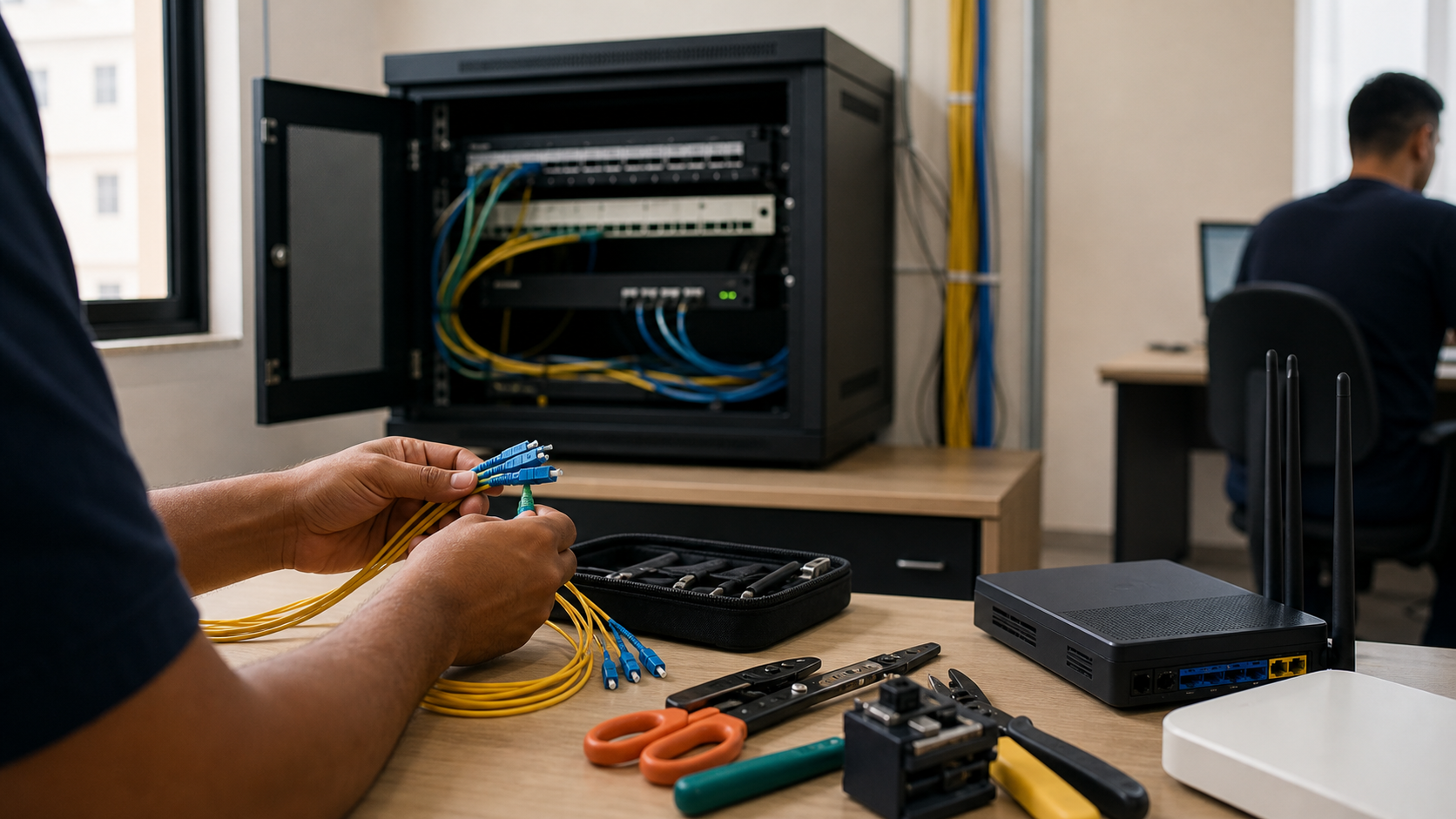
The first thing a buyer usually sees is not an autonomous-system record. It is a support promise. A regional Brazilian internet provider may have a few thousand customers, a small field team, a stack of routers from different generations, billing and ticket software, DNS zones that nobody wants to touch, WhatsApp pressure from subscribers, a few upstream links, and the nightly fear that a routing mistake or unresolved ticket will turn into a local reputation problem by morning. The value of a specialist support provider is not a generic technology label.
It is the ability to make that operator look steadier than its internal staff depth would otherwise allow.
That is why YOU SOLUÇÕES LTDA is interesting. Public number-resource evidence makes the company visible, but not in the simple way a reader might expect. The records do not say that YOU SOLUÇÕES owns ten networks. They say that a YOU SOLUÇÕES contact is present in the abuse or technical layer around other networks. That difference matters. If the contact is attached because YouISP provides real NOC, DNS, routing or abuse-response services, the business could be an outsourced operating layer for small and mid-sized providers.
If the contact is historical, administrative or loosely maintained, then the resource footprint is a much weaker signal.
The public site gives the economic opening. YouISP describes itself as a consulting company for internet providers of all sizes and for companies that need resilient, scalable technology with a qualified 24/7 technical team at https://www.youisp.com.br/. It says it works in IT, telecom and digital services, with national reach, experience serving ISPs, government bodies and technology companies, and technical specialists across areas, vendors and platforms. It presents services around automation, online conferences, software integration, documentation and support. The language is broad, but it is not random. It maps to the operational problems that small access networks actually face: not enough senior technical staff, too many systems, too much on-call fragility and a customer base that judges the provider by the next outage rather than by the elegance of its network.
The resource-record evidence is narrower and harder. Registro.br's domain record for youisp.com.br lists the registrant as an individual, not YOU SOLUÇÕES, while listing the handle YOSLT2, named in the domain record as YOU SOLUÇÕES LTDA, in the technical role at https://rdap.registro.br/domain/youisp.com.br. The same YOSLT2 handle appears as the abuse contact on multiple ASNs. On AS270708, the official record at https://rdap.registro.br/autnum/270708 names WEBNET GLOBAL TELEFONIA E COMUNICACAO EIRELI as registrant, links the ASN to 189.127.160.0/22 and 2804:7024::/32, and lists YOU SOLUÇÕES LTDA as the abuse contact. The IP network record at https://rdap.registro.br/ip/189.127.160.0/22 adds a stronger technical clue: the reverse-delegation nameservers for that range are a.dns.youisp.com.br and b.dns.youisp.com.br, while the registrant remains Webnet and the abuse role remains YOU SOLUÇÕES.
That is a real bridge, but it has to be priced carefully. A customer can pay a firm such as YouISP to run DNS, handle abuse contact workflows, monitor infrastructure, maintain support tools, document configuration, coordinate with upstreams and keep a small network from depending on one overworked internal technician. The public evidence can show that such a firm is present in contact records and technical naming. It cannot show the invoice, the service level, the number of customers, the response time, the margin or the renewal rate.
The right lens, then, is not "how large is the footprint?" It is "what operating unit would explain this footprint, what would that unit cost to deliver, and what evidence would prove it is worth paying for?" The answer starts with a support account that the end subscriber never sees: a retainer, project contract or managed-operations relationship sold to an ISP or technology customer. The customer is not buying an ASN. The customer is buying a lower probability that its own network staff, documentation gaps, DNS mistakes or support burden will break the business.
Official Evidence: What the Company Says It Sells
The official YouISP site is the strongest public description of the operating proposition. It calls YouISP an IT, telecom and digital-services integrator with national reach and more than 15 years of expertise in services to ISPs. It says its main clients operate in ISP, cloud computing, streaming and telecom segments. It emphasizes resilient and documented computer networks, qualified 24/7 technical support, scalable solutions, and costs sized to a customer's project, operation or needs.
It also offers a customer-area link to Monday.com, which suggests an organized client-workspace habit, although the public page does not prove what is behind that login.
That official page matters because it transforms the RDAP evidence from a list of names into a plausible product. If the same organization presents itself as a support and consulting provider for ISPs, then an abuse contact on third-party ASN records is not surprising. Small providers often need help with the unglamorous middle layer between physical access networks and customer service: recursive and authoritative DNS, ticket intake, monitoring alerts, IP address plans, router configuration, automation, software integration, incident notes and vendor escalation. Those activities are commercially real even when they leave little public trace.
The page also imposes a limit. It does not publish audited customer names, revenue, employee count, contract terms, availability statistics or a full legal-entity profile. Its public proof is sales language. Sales language can identify the unit being sold; it cannot validate that the unit is consistently delivered. For YOU SOLUÇÕES, that distinction is central. The site supports an operating hypothesis. It does not prove the economics.
The domain record adds a second official layer. Registro.br's youisp.com.br domain record shows the domain as active, with Cloudflare nameservers, DNSSEC data and an expiration date in 2030 at https://rdap.registro.br/domain/youisp.com.br. It also lists YOU SOLUÇÕES LTDA in the technical role, while the registrant field is an individual. That means the domain record should not be used to say that YOU SOLUÇÕES legally owns the domain. It can be used to say that Registro.br exposes YOU SOLUÇÕES as a technical contact for the domain whose public site markets the YouISP service.
The public site contains one more practical clue. Its HTML references a support-form script under http://189.127.160.13:8080/assets/form/form.js, an address inside the 189.127.160.0/22 range linked by Registro.br to AS270708 and to the reverse DNS nameservers under dns.youisp.com.br. When checked for this article, that support-form host did not respond over port 8080. That failure should not be turned into an outage claim about the company, because public web access to a script host is not a formal service-level test. It does, however, show how the official website and the resource records touch a real support surface: a contact form, a routed address block, reverse DNS under the YouISP domain and a repeated abuse contact. That is the narrowest responsible connection between resource records and operating value.
Resource Evidence: Ten Records, Ten Registrants and One Repeated Contact
The public number-resource file is the temptation. The directory preflight says the entity has ten supporting public references. A quick reader might see ten ASNs and infer a broad owned network. That would be too strong. The official Registro.br records show ten separate ASN records where the registered network holder is a different organization in each case, while YOU SOLUÇÕES appears in the abuse role.
The ten records are useful precisely because they are repetitive:
| ASN | Registro.br record | Registrant shown in public record | What YOU SOLUÇÕES evidence supports |
|---|---|---|---|
| AS270708 | https://rdap.registro.br/autnum/270708 | WEBNET GLOBAL TELEFONIA E COMUNICACAO EIRELI | YOU SOLUÇÕES LTDA appears as abuse contact; related IPv4 range has reverse DNS under dns.youisp.com.br. |
| AS265382 | https://rdap.registro.br/autnum/265382 | CIOTEC TELECOM LTDA ME | YOU SOLUÇÕES LTDA appears as abuse contact, not registrant. |
| AS271099 | https://rdap.registro.br/autnum/271099 | N.K. FIBER LINK LTDA | YOU SOLUÇÕES LTDA appears as abuse contact, not registrant. |
| AS270511 | https://rdap.registro.br/autnum/270511 | Ultra Cabo | YOU SOLUÇÕES LTDA appears as abuse contact, not registrant. |
| AS267016 | https://rdap.registro.br/autnum/267016 | FIBERNET SERVICOS DE COMUNICACAO LTDA | YOU SOLUÇÕES LTDA appears as abuse contact, with visible routing-policy data in the record. |
| AS266493 | https://rdap.registro.br/autnum/266493 | R. L. HOFFMANN | YOU SOLUÇÕES LTDA appears as abuse contact, not registrant. |
| AS264046 | https://rdap.registro.br/autnum/264046 | GEORGE ALEXANDRE DIAS DE SOUSA ME | YOU SOLUÇÕES LTDA appears as abuse contact, with visible routing-policy data in the record. |
| AS263532 | https://rdap.registro.br/autnum/263532 | VIAR TELECOMUNICAÇÕES LTDA | YOU SOLUÇÕES LTDA appears as abuse contact, with visible routing-policy data in the record. |
| AS263443 | https://rdap.registro.br/autnum/263443 | L R DA FONSECA ME | YOU SOLUÇÕES LTDA appears as abuse contact, not registrant. |
| AS262872 | https://rdap.registro.br/autnum/262872 | DIGICONTROL SERVIÇOS DE PROVEDORES LTDA | YOU SOLUÇÕES LTDA appears as abuse contact, not registrant. |
NIC.br's public origin file at https://ftp.registro.br/pub/numeracao/origin/nicbr-asn-blk-latest.txt corroborates the same core registrant pattern. The lines for these ASNs list the registered holders and their IPv4 and IPv6 blocks: AS262872 with DIGICONTROL SERVIÇOS DE PROVEDORES LTDA and 177.11.64.0/21; AS263443 with L R DA FONSECA ME and 177.91.132.0/22; AS263532 with VIAR TELECOMUNICAÇÕES LTDA and 191.5.48.0/21; AS264046 with GEORGE ALEXANDRE DIAS DE SOUSA ME and 143.137.216.0/22; AS265382 with CIOTEC TELECOM LTDA ME and 170.254.224.0/22; AS266493 with R. L. HOFFMANN and 170.244.84.0/22; AS267016 with FIBERNET SERVICOS DE COMUNICACAO LTDA and 45.227.56.0/22; AS270511 with Ultra Cabo and 187.49.180.0/22; AS270708 with WEBNET GLOBAL TELEFONIA E COMUNICACAO EIRELI and 189.127.160.0/22; and AS271099 with N.K. FIBER LINK LTDA and 179.48.208.0/22.
This is not weak evidence. It is strong evidence for a limited proposition. The recurring contact says that public abuse or technical accountability points toward YOU SOLUÇÕES across a cluster of Brazilian networks. It does not say that YOU SOLUÇÕES owns those networks. It does not say that the registrants are customers. It does not say the relationship is current in a commercial sense, even though several records have recent change dates. It does not say that YouISP is a carrier, nor that it sells broadband to end users. The evidence should be used to ask a business question rather than to answer one prematurely.
The AS270708 link is the special case because the official site and the resource record overlap in a concrete way. The IP record for 189.127.160.0/22 names Webnet as registrant, but it also shows the YOU SOLUÇÕES abuse role and reverse delegation to a.dns.youisp.com.br and b.dns.youisp.com.br. RIPEstat's AS overview for AS270708 at https://stat.ripe.net/data/as-overview/data.json?resource=AS270708 shows the AS announced and labels the holder as Webnet. RIPEstat's announced-prefix view at https://stat.ripe.net/data/announced-prefixes/data.json?resource=AS270708 lists visible prefixes from the same IPv4 and IPv6 space in late June and early July 2026. RIPEstat's neighbours view at https://stat.ripe.net/data/asn-neighbours/data.json?resource=AS270708 shows one visible neighbour, AS263073, which RIPEstat identifies as DTEL TELECOM at https://stat.ripe.net/data/as-overview/data.json?resource=AS263073.
That tells a cautious story. There is a routed network. The public site references a host inside the IPv4 block. The reverse delegation uses YouISP nameservers. The abuse role is YOU SOLUÇÕES. The registrant is Webnet. A buyer or analyst can infer technical involvement, but not asset ownership. The operating value, if any, is likely in management, support, DNS, incident handling or technical continuity rather than in the legal possession of the number resources.
Inferred Economics: What the Customer Is Probably Buying
The economic unit is outsourced operating continuity for small and mid-sized networks or technology operations. That unit may be sold as a monthly support retainer, a project fee, a managed-service contract, a monitoring-and-escalation arrangement, a documentation engagement or a bundle of recurring NOC work plus one-off remediation. The public YouISP site does not publish pricing, so the article should not invent plan values. But the service categories allow a practical reading of what the customer actually buys.
First, the customer buys senior attention without hiring a full senior team. A local ISP might need BGP, DNS, Linux, virtualized services, monitoring, ticketing, billing integrations, router configuration and vendor-specific knowledge. Hiring that internally is expensive. Retaining it is hard. The market for good telecom technicians is tight because the work is half network engineering, half emergency response and half customer-service psychology. A small provider cannot always justify a full bench of specialists. A provider like YouISP can sell fractional access to those skills.
Second, the customer buys a documented operating memory. The official site emphasizes well-documented networks and process automation. That is not cosmetic. In small networks, undocumented router changes, ad hoc DNS entries, forgotten access credentials, unknown fibre routes and poorly described customer premises equipment can turn a routine incident into a day-long failure. Documentation is a cost because someone has to write it, maintain it and make it accurate enough that another person can act on it under pressure. It is also a retention device.
The provider that documents a customer's network becomes part of the customer's operating memory.
Third, the customer buys response capacity. The phrase 24/7 appears in the site's public description. Around-the-clock support is expensive even when call volume is low. The cost is not only the person answering the phone. It is the rotation, training, escalation tree, permissions model, monitoring thresholds, ticket hygiene and judgement needed to know when to wake someone up. For a small ISP, the value is that an outage, abuse complaint or DNS problem does not have to wait for one local technician to be available.
Fourth, the customer buys supplier coordination. The public ASN records point to different registrants and, in some cases, routing-policy data. Regional networks depend on upstream transit, IX connections, equipment vendors, tower or pole access, domain and number-resource registries, DNS operators, billing platforms and field contractors. A support provider can create value by knowing which supplier to call, which route to change, which abuse desk to answer and which configuration should not be touched without a maintenance window.
Fifth, the customer buys a more professional face to the outside world. Abuse contacts matter because they are public accountability endpoints. If the contact is stale or unattended, the network looks careless and may suffer slower incident resolution, escalated complaints or reputational damage with upstreams. A recurring YOU SOLUÇÕES abuse contact across multiple records suggests a role in external-facing technical accountability. Again, it does not prove the contract. But it does identify a business problem that someone pays to solve.
This unit is costly because the work is discontinuous but must be ready all the time. A customer may need very little help for weeks, then need rapid action during a routing leak, DNS outage, upstream failure, abuse complaint, equipment fault or billing-system disruption. That creates a difficult margin profile. The provider must carry idle capacity, senior skill and tool access without knowing exactly when the next incident will arrive. If it prices too low, one messy customer can consume the profit from several quiet accounts.
If it prices too high, small ISPs compare it with one more internal hire, a cheaper consultant, a friendly upstream engineer or doing nothing.
Why Public Records Are Helpful but Incomplete
Public records are best at proving responsibility surfaces. They are poor at proving value. Registro.br can show who is the registrant, who is the administrative contact, who is the technical or abuse contact, which prefixes are related, when records changed and which reverse-DNS delegations exist. RIPEstat can show whether routes are visible to enough collectors and which neighbours appear in its public view. Anatel can show the broader regulated market for fixed-broadband access through its official dashboard at https://informacoes.anatel.gov.br/paineis/acessos/banda-larga-fixa and open-data downloads such as https://www.anatel.gov.br/dadosabertos/paineis_de_dados/acessos/acessos_banda_larga_fixa.zip. None of those sources can show a private contract between YOU SOLUÇÕES and a network registrant.
The distinction is not academic. A public abuse contact can mean several things. It can mean the named firm actively handles abuse and NOC work under a contract. It can mean the named firm configured the original record and remains listed after the operational relationship weakened. It can mean the named firm acts as a technical consultant without owning the network. It can mean the contact is used as a shared mailbox for a group of related operators. It can also mean that public data has not caught up with internal changes. A responsible article cannot collapse those possibilities into one ownership claim.
That is why the AS270708 IP record is valuable but not decisive. The 189.127.160.0/22 record ties together Webnet as registrant, YOU SOLUÇÕES as abuse contact, YouISP nameservers for reverse delegation and a public site reference to a host in that block. That is better than a simple name match. It shows the YouISP operating surface touching a resource range in a public technical way. But it still leaves open the central economic questions: who pays whom, under what service terms, with what renewal history, and with what operational responsibility when something breaks?
The same caution applies to routing-policy fields on some Registro.br ASNs. They indicate public routing relationships or policies at the registry level. They do not identify the commercial price of transit, the quality of the link, the exact backup plan, the customer's dependence on YOU SOLUÇÕES, or the margin in any support contract. Routing evidence can strengthen the case that a network is operationally real. It cannot prove the vendor's economics.
Why the Customer Pays Before the Outage
The strongest commercial case for a company such as YOU SOLUÇÕES is that the customer pays before the failure is visible. A small ISP can run for months with fragile documentation, weak escalation rules and one person who remembers how everything is wired. That fragility is cheap until the wrong person is unavailable, the wrong route is changed, the wrong DNS entry expires, or the wrong customer complaint reaches an upstream provider. Then the cost appears all at once. The external support provider sells preparation against a failure that may not happen this month but could be very expensive when it does.
That makes the sales motion different from selling bandwidth or equipment. A router has a visible price and a visible use. A support retainer has to be justified through avoided incidents, faster recovery and less dependence on scarce internal staff. The buyer may not be the technician who feels the daily pain; it may be the owner who sees only the monthly bill. To keep that buyer, YouISP would need to translate technical work into business outcomes: fewer repeat tickets, cleaner handovers, fewer late-night escalations, faster provisioning, more stable DNS, better abuse-response hygiene and less management time lost to avoidable incidents.
This is also why the public record matters even though it is incomplete. A provider willing to be listed as an abuse contact is taking on a visible responsibility surface. External parties will not know the private service contract; they will know where the record points. If that contact is monitored and supported by real process, it can be part of the value proposition. If it is stale or loosely managed, it becomes reputational risk. The difference is invisible in the public record and decisive in the business.
For YOU SOLUÇÕES, the article's operating test is therefore practical rather than grand. Does the company reduce the customer's avoidable technical risk by enough to justify a recurring payment? Does it make public accountability records more trustworthy? Does it keep knowledge available when the customer's internal staff is unavailable? Does it help a small operator act like a more mature network without carrying a full internal engineering bench? Those are the questions that connect a resource-record footprint to operating value.
The Buyer Problem in Brazil's Regional ISP Market
The buyer context is Brazil's fragmented broadband market. Anatel's public broadband access panel and data downloads expose a market where fixed-broadband service is tracked by provider, geography, technology and access counts. The public market includes national carriers, consolidated regional groups and many smaller providers. For the small-provider segment, the operational problem is not only selling fibre. It is staying reliable while handling growth, regulation, equipment choices, customer support and supplier dependence.
A small ISP's economics are often unforgiving. Customer revenue arrives as a monthly subscription. Costs arrive as fibre deployment, CPE, Wi-Fi support, customer acquisition, truck rolls, pole attachment, taxes, upstream capacity, equipment replacement, energy, rent, finance charges, support staffing, billing software, fraud control, regulatory reporting and churn. The provider competes against national operators with brand recognition and against local rivals that may cut prices or bundle installation. The customer usually sees only the monthly price and the speed tier.
The provider sees the cost of every support message and every second visit.
That is the market where an outsourced technical-support unit can make sense. A provider that does not have enough internal engineering depth can outsource parts of the complexity. The support provider might help keep monitoring useful, configure routers, maintain DNS, integrate software, answer external abuse reports, document the network, handle changes after hours and advise on supplier choices. The buyer pays because downtime, misconfiguration and support overload are more expensive than the retainer. Or at least that is the theory.
The proof would be retention. If small ISPs keep paying YouISP through quiet periods, that suggests the service is embedded and trusted. If they pay only for emergencies, revenue may be lumpy. If they churn after one project, the business is closer to consulting than managed operations. Public RDAP records cannot distinguish these cases. The repeated contact role suggests that YOU SOLUÇÕES may remain attached to multiple operators' public responsibilities, but it does not reveal whether those operators are current paying customers.
The competitive substitute is also clear. A customer can hire internally, use a larger telecom integrator, rely on its upstream provider, pay a local freelance network engineer, use managed cloud and network tools, or delay the purchase until something breaks. In a market where many operators are cost-sensitive, a provider like YouISP must justify why external support is cheaper than the combination of internal improvisation and occasional emergency help.
That justification depends on preventing expensive failures. A misrouted prefix can affect reachability. A stale DNS setup can slow recovery. A poorly handled abuse complaint can lead to pressure from upstreams or blocklists. A weak ticket flow can turn field problems into churn. A missing network map can make every equipment replacement slower. A small provider may not price those risks explicitly, but it feels them when an incident consumes management time. YouISP's pitch is economically plausible because it targets those hidden costs.
Cost Base: Skilled Labour, Tool Discipline and Trust
The cost base for a YouISP-style service is mostly people and discipline, not just servers. The website's imagery and service language point to software integration, automation, support and consulting. Those activities require technicians who can understand a customer's environment quickly and avoid making it worse. The labour cost includes senior diagnosis, routine monitoring, customer-facing explanation, after-hours coverage, documentation and follow-up. The provider also needs internal standards so that one technician's work can be understood by another technician later.
Tooling matters, but tools alone do not create margin. A support company can use ticketing, monitoring, remote access, documentation, DNS management, automation and project boards. The YouISP site's customer-area link to Monday.com hints at client coordination, and the site embeds a contact/support form mechanism. Yet the economic value is not the mere existence of a ticket tool. It is whether tickets are triaged correctly, whether repeated faults are fixed at the root, whether alerts are tuned, whether access is controlled, and whether the customer trusts the provider enough to let it touch production infrastructure.
That trust is expensive to acquire. A small ISP may hesitate to expose credentials, routing policy, customer data, billing systems or network maps to an outside firm. Once it does, the outside firm becomes hard to replace if it performs well, because it accumulates knowledge. That can create retention. It can also create risk. If documentation sits mainly with the outside firm, the customer may become dependent. If the outside firm loses a senior person, service quality can fall. If the outside firm underprices support, it may prioritize urgent customers and let quieter documentation work decay.
The abuse-contact role increases trust requirements. Abuse reports can involve spam, compromised devices, customer behaviour, law-enforcement requests, upstream complaints or other sensitive matters. A public contact has to be reachable, consistent and careful. Listing YOU SOLUÇÕES as abuse contact across multiple ASNs suggests external parties are directed to that role for network trouble. That role is valuable only if someone monitors it and knows how to act.
The cost base also includes availability. A 24/7 claim is not the same as a 24/7 audited service level, but it does indicate what the seller wants the buyer to believe it can cover. Availability requires redundancy in people, not just machines. A single technician with a phone is not the same as a managed support operation. Public records cannot tell which model YouISP actually runs. A buyer would need escalation charts, staffing, customer references, ticket metrics and incident examples.
Supplier and Upstream Dependence
YOU SOLUÇÕES' own dependency profile is harder to see than the dependencies of the networks around it. The public site uses Cloudflare nameservers for the domain. The domain record shows that clearly at https://rdap.registro.br/domain/youisp.com.br. The AS270708 IP network has reverse DNS under YouISP-controlled names, but its registrant is Webnet. RIPEstat shows AS270708 announced, with public neighbour evidence pointing to AS263073. Several other ASNs in the ten-record set have their own registrants, administrative contacts and routing-policy information.
If YouISP is a technical-support provider rather than a facilities-based carrier, that supplier dependence may be normal. It may rely on customer networks, upstream carriers, cloud services, remote-access tools, ticket platforms, domain registries and third-party monitoring. Its value would be coordination across those suppliers, not ownership of every component. That can be a good business model because it is less capital-intensive than building access networks. It can also be fragile because the provider's success depends on access to customer systems and cooperation from other vendors.
The AS270708 support-host clue illustrates the ambiguity. The public site references an address in a block whose official registrant is Webnet. If that host is or was used for a support form, YouISP may have operational access to infrastructure in that network. But the host was not reachable during the check for this article, and the public record does not identify who controlled the application behind it. A buyer should treat the clue as proof of technical proximity, not as proof of owned infrastructure or current service quality.
Reverse DNS also has value but must be bounded. The IP record lists a.dns.youisp.com.br and b.dns.youisp.com.br for reverse delegation. That is a meaningful operational signal: reverse DNS is a real network-administration function, and it sits closer to daily technical work than a marketing page does. But reverse DNS can remain after a relationship changes. It can be delegated to a service provider. It can be forgotten. The record is evidence of a public configuration, not a contract.
The supplier-risk question for YOU SOLUÇÕES is therefore this: can it create value without owning the customer's network? The answer can be yes if it owns the process, documentation, technical judgement and response discipline. It can be no if customers see it as replaceable emergency labour. The public record shows the surface of dependence; private contract data would show whether the dependence is economically durable.
Customer Dependence and Retention
Customer dependence is the positive case for the company. If a provider like YouISP manages DNS, monitoring, support integrations, abuse responses and documentation across a group of regional ISPs, then it may sit inside the customer's operating routine. The customer may not want to replace it because replacement would require transferring knowledge, access, history and responsibility. That kind of embedded support can produce recurring revenue and renewal leverage.
The negative case is that the public footprint may be thin because the actual business is small, episodic or informal. The site says more than 15 years of expertise, national reach and 24/7 support, but it does not publish named case studies or performance data. The public directory record had no known website before this research connected youisp.com.br through the domain and contact trail. The contact form host visible in the site HTML did not respond during the check. There is little independent public chatter. That means the article cannot treat customer dependence as proven.
For an investor, acquirer or large customer, the diligence list is straightforward. Ask for the current customer roster, with legal entities mapped to technical contacts. Ask which of the ten ASN registrants are current customers, former customers, related parties or one-off support cases. Ask for monthly recurring revenue by customer, project revenue, churn, gross margin by service type, after-hours incident volume, ticket resolution times, and the number of customers where YouISP is listed as a public contact. Ask for evidence that contact roles are updated when relationships end.
Ask how credentials are stored and how customers retrieve documentation if they leave.
Those private facts would determine whether the public resource surface is economically powerful or merely noisy. If most of the ASN contacts correspond to active recurring support contracts, the value case improves. If they are historical listings with little current revenue, the value case weakens. If YouISP handles reverse DNS, DNS operations, support tooling and NOC escalation for paying networks, it could be a small but important service layer. If it only appears in records because a technician once helped configure them, the records overstate the business.
Retention also depends on buyer pain. A small ISP will keep paying for external help when it believes the help prevents churn, reduces outages, speeds repairs or substitutes for expensive hiring. It will cut the expense if it sees the provider as passive overhead. The article's thesis therefore cannot be "YOU SOLUÇÕES has many records." It has to be "YOU SOLUÇÕES must connect those records to a measurable operating benefit."
Competition: Internal Staff, Larger Integrators and Doing Nothing
The most important competitor may be inertia. Small providers often continue with imperfect systems because the cost of professionalization is visible and the cost of fragility is intermittent. A support retainer looks expensive every month; the avoided outage is invisible until the outage happens. That makes the sales job hard. YouISP has to convert technical risk into a budget line.
The first substitute is an internal hire. A provider can hire one experienced network technician, pay overtime, and accept key-person risk. That may be cheaper than an outside retainer if the provider has enough work to keep the person productive. It may be more expensive if the provider needs many specialist skills only occasionally. YouISP's value rises when the customer needs BGP, DNS, Linux, automation, monitoring, software integration and abuse handling, but not enough of each to hire separate specialists.
The second substitute is a larger telecom or IT integrator. Larger firms can offer process depth, brand confidence and broader staffing. They may also be too expensive or too slow for smaller ISPs. A small provider may prefer a specialized firm that understands the practical realities of Brazilian regional networks. YouISP's site language is targeted at ISPs and technology companies, which helps position it against generic IT support.
The third substitute is a supplier-led model. Upstream carriers, equipment vendors, billing platforms and cloud providers may offer support around their own products. The problem is that each supplier sees only its slice. An outside operations consultant can add value by seeing the whole environment. That value is highest when the customer has multiple suppliers and no internal person who can coordinate them.
The fourth substitute is the informal technician market. Many small networks rely on trusted individuals, WhatsApp groups and ad hoc consulting. That can be cheap and fast. It can also fail on documentation, continuity, security and accountability. A company such as YOU SOLUÇÕES has to prove that a more formal service is worth the premium. Public abuse-contact roles and reverse DNS records help show formal presence. They do not prove that the service beats informal alternatives.
The fifth substitute is no active dependency. Some operators may decide that the risk is tolerable until something breaks. This is the hardest competitor because it is not a company; it is delayed spending. YouISP's pitch needs evidence that technical debt becomes more expensive than prevention. That evidence would come from case studies, ticket reduction, outage reduction, faster provisioning, better documentation and fewer escalations. Public records cannot provide that evidence.
Regulation and Accountability
Brazilian telecom regulation makes the accountability surface more important than it would be in a pure software business. Anatel's official broadband access pages and open data make fixed-broadband access a measured regulated market. Operators have reporting, consumer-service and authorization obligations depending on service type and scale. A technical consultant that supports ISPs may not be the regulated service provider, but it can influence how well the provider handles obligations, customer complaints, security incidents and public contacts.
That creates an economic role for firms that understand both network operations and regulatory-facing hygiene. Abuse contact data, domain contacts, reverse DNS, incident records and customer support flows may look like details. In a regulated telecom environment, details become evidence of seriousness. A provider with stale records and weak support processes may struggle when a complaint escalates or when an upstream asks for action. A provider with clean records, known contacts and documented processes looks more professional.
The caution is legal responsibility. A public abuse contact does not make YOU SOLUÇÕES the regulated operator for the ASN. The registrant remains the organization named in each Registro.br record. If Webnet is the registrant for AS270708, Webnet is the registered holder in that record. If Fibernet is the registrant for AS267016, Fibernet is the registered holder in that record. YOU SOLUÇÕES' visible role is contact and likely technical support. The article must not shift the legal identity of those networks.
The value of an outsourced support firm is that it may help the regulated operator behave better. It may keep records reachable, answer incidents, maintain DNS, help prepare documentation, or coordinate with suppliers. But it cannot turn another company's authorization, network or customer base into its own asset through public contact fields. That is why this article treats ASNs, IP blocks, route views and handles as evidence only.
Market Chatter: Thin, Unofficial and Useful Mostly as a Gap
Market chatter around YouISP is thin. The public site includes testimonials and sales claims, but those are official marketing signals, not independent proof. Searchable third-party material is limited. That absence is not proof of weakness. Many small B2B support providers have little public consumer-review footprint because they sell by referral, direct relationship and technical reputation rather than by mass-market advertising. But the absence does raise the burden on private evidence.
The official site itself gives mixed signals. It presents a focused ISP-support and technology-consulting proposition. It also contains some unfinished-looking public copy in one section and social links that do not provide much independent corroboration. The embedded support-form host was not reachable when checked. None of those details should be exaggerated into a failure claim. They are better read as market-signal risk: a company selling operational discipline should make its public service surface feel maintained and current.
There is also no public pricing. That is normal for bespoke support and consulting, but it limits external analysis. Without pricing, the economic unit has to be inferred from the service promise. Without customer names, the demand base has to be inferred from the resource-contact footprint. Without independent reviews, quality has to be inferred from the persistence of public contact roles and any future case evidence. That is a lot of inference.
The most responsible use of market chatter is therefore negative: it identifies what cannot be known. The public record does not show how many ISPs pay YouISP. It does not show how long they stay. It does not show whether the ten ASN registrants are satisfied customers, historical customers, related operators or merely records with a shared contact. It does not show whether the 24/7 claim is staffed by a team, by a rota, or by informal on-call coverage. It does not show whether the support-form host's unreachability affected any customer process.
That thinness does not erase the opportunity. In fact, the opportunity may be precisely that a small support provider can be important without being publicly loud. But for a public article, the thinness forces discipline. Official evidence gets the highest weight. Inferred economics explain the business mechanism. Market chatter only colours the risk.
The AS270708 Bridge Is the Best Evidence, but It Still Has a Ceiling
If one record has to carry the most analytical weight, it is AS270708 and the associated 189.127.160.0/22 IP range. The ASN record names Webnet as registrant and YOU SOLUÇÕES as abuse contact. The IP record names Webnet as registrant, shows AS270708, repeats the YOU SOLUÇÕES abuse contact and delegates reverse DNS to a.dns.youisp.com.br and b.dns.youisp.com.br. The YouISP website references a support-form script from an address inside that range. RIPEstat shows AS270708 announced and shows public prefix visibility.
That combination moves the evidence beyond a mere contact-field coincidence. It suggests that YouISP has or had an operational role touching DNS and support-facing infrastructure around a routed Webnet block. It makes the economic story more concrete: YouISP may be selling operational support that includes public-contact handling, DNS administration and support tooling for ISP networks. That is exactly the kind of invisible unit that a small operator might buy.
But the ceiling remains. AS270708 is not registered to YOU SOLUÇÕES. The public site does not say "Webnet is our customer." The support-form host did not respond during the check. The reverse DNS delegation does not publish a contract. The RIPEstat view shows route visibility, not service quality. A careful analyst can say the records connect a YouISP operating surface to one resource range. A careful analyst cannot say the records prove YouISP's revenue, ownership or customer dependence.
The ceiling is especially important because public network records are sticky. Contacts and reverse DNS can survive after commercial relationships change. A small provider may forget to update a field. A consultant may stay listed because nobody else wants the responsibility. Conversely, a real active support relationship may be underrepresented in public records because the provider handles work through private access and customer systems. The record is a clue, not a contract.
That is why future verification should start from AS270708 but not end there. The key private questions are whether YouISP currently administers reverse DNS for the block, whether the 189.127.160.13 support endpoint is intentionally offline, replaced or internal, whether Webnet pays for support, and whether similar technical roles exist for the other ASN registrants. Answering those questions would turn a public clue into a business conclusion.
What Would Change the Judgement
The positive facts that would materially improve the judgement are straightforward. A current customer list showing active support retainers with several of the ASN registrants would be the strongest. Contract terms showing monthly recurring fees, scope, response times, renewal history and termination rights would prove whether the resource contact surface corresponds to revenue. Ticket data showing incident volume, average response time, repeat-incident reduction and after-hours coverage would prove operating value.
Documentation samples, access-control policies and customer sign-off would show whether the service is professionalized rather than informal.
Network-specific proof would also matter. For AS270708, current confirmation that YouISP administers reverse DNS, support tooling or NOC functions for Webnet would strengthen the bridge. For the other ASNs, current confirmation that the abuse role is intentionally delegated to YOU SOLUÇÕES, and not merely left over from past assistance, would raise confidence. Evidence that contact records are updated when relationships end would show operational discipline.
Pricing evidence would clarify the economics. If YouISP charges a recurring amount that scales with customer size, incident load or service scope, the business could have durable revenue. If it relies mainly on one-off emergency work, revenue may be harder to predict. If it underprices 24/7 support, margins may be vulnerable. If it prices by project without ongoing contact responsibility, then the repeated abuse-contact footprint would need another explanation.
Quality evidence would be decisive. Independent customer references, complaint history, uptime claims backed by incident records, and examples of prevented failures would help answer whether customers are better off paying. In a service like this, the buyer does not pay for a website, a handle or a route. It pays for fewer surprises. The proof is whether the customer's network becomes more stable, better documented and easier to operate.
Negative facts would change the judgement in the other direction. If most listed contacts are stale, the public footprint would overstate current relevance. If customers use YOU SOLUÇÕES only for occasional emergency help, the recurring-value thesis would weaken. If support is concentrated in one or two individuals, key-person risk would rise. If documentation is poor, the company would not be solving the problem it claims to solve. If the support-form host was a forgotten remnant rather than an active service surface, the AS270708 bridge would lose weight.
Final Assessment: A Useful Surface Waiting for Business Proof
YOU SOLUÇÕES LTDA is worth tracking because its public surface sits in a meaningful place: the accountability layer around Brazilian regional networks. The company-branded YouISP site sells the kind of support that small ISPs and technology customers plausibly need. Registro.br links the domain's technical role to YOU SOLUÇÕES. Ten ASN records list the same company name and NOC email in the abuse role while naming other registrants. The AS270708 IP record ties a Webnet block to YouISP reverse-DNS nameservers, and the public YouISP site references a support endpoint inside that block.
Those facts are enough to identify a real operating hypothesis.
They are not enough to close the business case. The customer does not buy a public record. The customer buys technical continuity: fewer outages, faster escalation, better documentation, cleaner DNS, monitored infrastructure, supported systems and a calmer management day. That unit is costly because it requires skilled people, on-call discipline, tools, trust and knowledge of each customer's environment. It is worth paying for only if it prevents more pain than it costs.
The public evidence can prove that YOU SOLUÇÕES is present in the places where accountability shows up. It cannot prove that the company captures a durable share of the value created by that presence. The strongest official evidence supports a consulting and support proposition. The strongest resource evidence supports recurring external-contact responsibility. The strongest operating bridge is AS270708's YouISP-linked reverse DNS and site-referenced support host. The weakest area is customer proof.
That makes the final judgement deliberately conditional. YOU SOLUÇÕES LTDA may be a practical outsourced operations layer for Brazilian ISPs that need senior technical coverage without building a full internal team. It may also be a smaller consulting shop whose public records make it look more embedded than the underlying contracts justify. The difference will be found in current customer relationships, ticket and incident data, support scope, renewal behaviour and evidence that public contact roles are actively managed.
Until those private facts are visible, the resource records should be treated as a map of responsibility, not as a valuation model. They show where outside parties would send technical trouble. They show that YouISP has a public service proposition and a measurable connection to at least one routed support surface. They do not show whether the customers keep paying, whether the service is excellent, or whether the economics scale. YOU SOLUÇÕES has to connect its resource-record evidence to operating value because that connection is the whole business question.