
Summary
- What it says: X86 Network is not a consumer broadband brand with a mass-market story. It is a Malaysia-based connectivity operator whose value depends on whether a modest routing footprint, data-centre presence, open peering, clean enough number resources, and visible network-operator communit
- Main topic: Regional ISP economics; Cloud service dependency; Network-resource evidence; Peering and transit
- Context: market / company research report / Global
The abstract name hides a very specific business
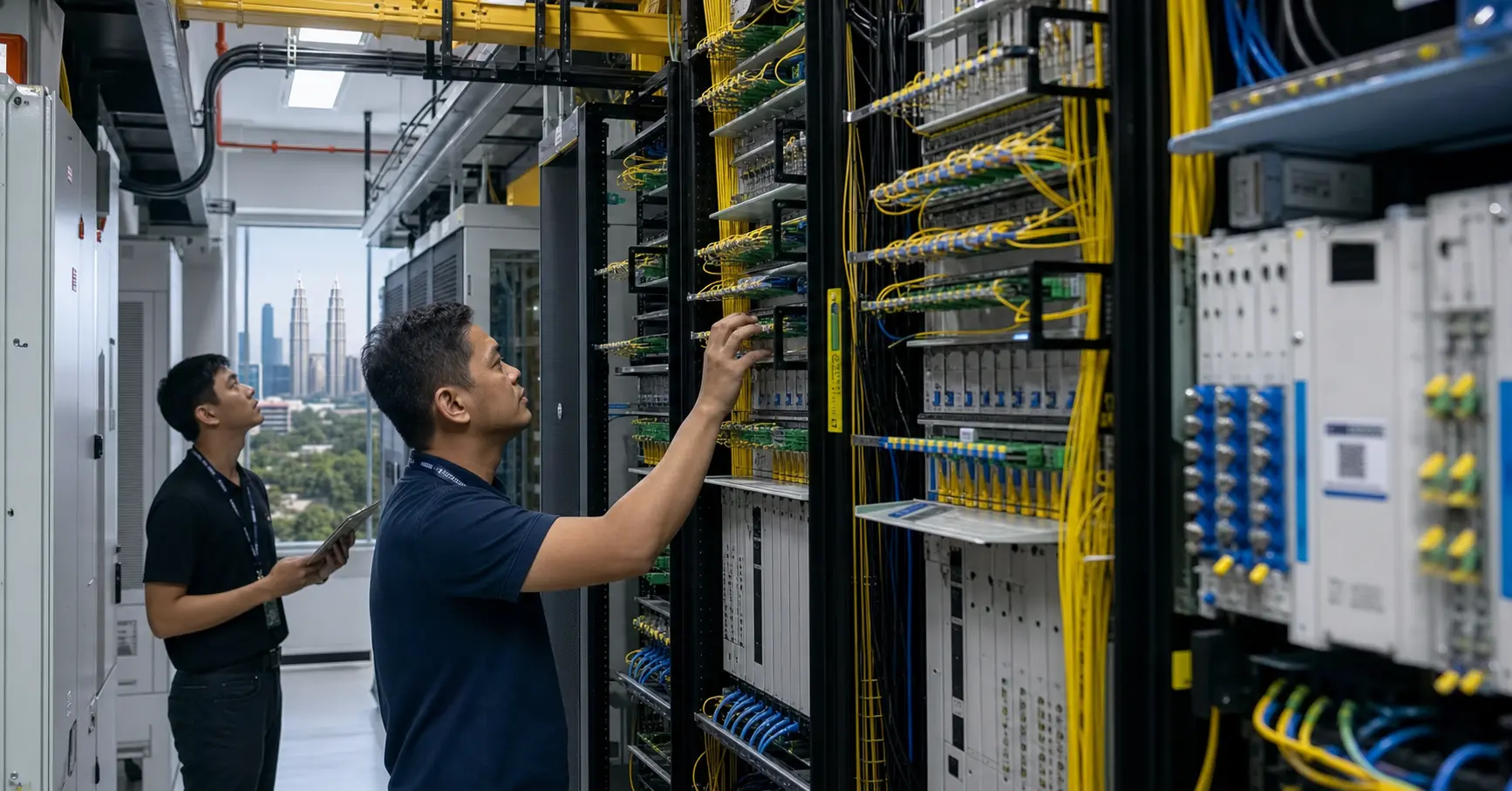
X86 Network sounds like a generic technology label. In public records it is more concrete: X86 Network Sdn. Bhd., a Kuala Lumpur company with a Cyberjaya operations centre, an APNIC autonomous system, visible address resources, MyIX and JPNAP presence, data-centre interconnect marketing, and a founder who speaks publicly in the Malaysian network-operator community about high-capacity DCI buildouts. The name is broad, but the business problem is narrow. X86 is trying to prove that a mid-sized operator can sell reliable connectivity without being one of Malaysia's legacy giants.
That distinction matters. A local access ISP can win household customers through installation speed, neighbourhood technicians and cheap broadband plans. X86 is playing a different game. Its website presents Data Centre Interconnect, Dedicated Internet Access, Ethernet Private Line, colocation and Network Operation Centre support. Its LinkedIn profile describes the company as a connectivity service provider offering Data Centre Interconnect, Metro Ethernet, Dedicated Internet Access and managed connectivity for businesses in Malaysia and globally.
The company's own about page says it is licensed by the Malaysian Communications and Multimedia Commission as an Application Service Provider and Network Service Provider and operates under AS133936. APNIC RDAP confirms AS133936 as active, registered in January 2015, with the description X86 Network Sdn Bhd and a Malaysia country code.
The economic lens is therefore not "how many homes can this ISP wire?" It is whether X86 has enough proof to persuade technical buyers that it can carry business-critical traffic between data centres, clouds, carriers, hosting platforms and enterprise nodes. The proof is scattered across different surfaces. The website says the company connects more than 100 data centres globally, offers up to 100 Gbps DCI, provides 24/7 support, and can activate some connectivity quickly.
PeeringDB shows a much smaller but verifiable public footprint: AS133936, network type NSP, 5-10 Gbps self-reported traffic, open peering policy, 20 IPv4 prefixes, 5 IPv6 prefixes, a 10G port at MyIX and a 1G port at JPNAP Tokyo. BGP tools show 11 originated IPv4 /24s and one originated IPv6 /32, with visible upstreams from NTT America, IP ServerOne and SG.GS. Salcon's 2022 annual report names X86 Network as one of Volksbahn Technologies' existing enterprise business customers in the context of enterprise sites delivered across a Klang Valley fibre corridor.
MYNOG materials show X86 as a recurring technical participant and sponsor in the Malaysian network-operator scene.
None of that proves audited revenue, churn, customer concentration or margin. It does prove that X86 is not just a dormant brand. It has public routing identity, data-centre and exchange footprints, a named management presence, and a service offer aligned with Malaysia's data-centre boom. The open question is whether those pieces add up to durable market power or only a nimble operator's proof pack in a market where many buyers can choose larger carriers.
The website is selling control, not cheap access
X86's public services page is organized around enterprise connectivity rather than consumer broadband. Data Centre Interconnect is described as a high-speed way to link two or more data centres across local, regional or global locations. The page names cloud providers, carriers and ISPs, multi-data-centre operators and globally expanding businesses as intended users. It advertises more than 100 global data centres, up to 100 Gbps bandwidth, next-business-day activation and a low-latency self-healing network.
The language is ambitious, but the target buyer is clear: a customer that already has infrastructure in more than one location and needs predictable private or semi-private transport.
Dedicated Internet Access is the internet-facing companion. X86 markets DIA as secure, high-speed business access with up to 99.9 percent SLA, scalable bandwidth and support for sustained performance. Ethernet Private Line is framed as dedicated Layer 2 point-to-point and point-to-multipoint connectivity for business sites, data centres and cloud platforms. The EPL page says private lines avoid the public internet, carry mission-critical traffic and can scale across local, national, regional or global routes.
Colocation is offered around flexible power and space, redundant infrastructure, carrier-neutral access and Cyberjaya's role as a major Malaysian telecom hub. The Network Operation Centre page emphasizes 24/7 monitoring, Cyberjaya hands-and-feet support, optical and performance test tools, fibre diagnostics and fast technical response.
This is a control business. X86 is selling route control, speed of provisioning, optical know-how, monitoring, and reduced dependence on slow incumbent workflows. The buyer is not paying for a generic internet line alone. The buyer is paying to solve a coordination problem: which building, which carrier room, which cross-connect, which path, which NNI partner, which SLA, which support number and which engineer will answer when latency or packet loss appears between two facilities.
That explains the company's emphasis on "designed to scale" and "self-healing infrastructure." It also explains why the website's claimed capacity is more important than its lack of consumer tariffs. Retail ISPs can publish 100 Mbps or 1 Gbps monthly packages because the product is standardized. DCI, DIA and EPL prices are usually shaped by route, bandwidth, term, fibre availability, port cost, cross-connect fees, protection class, service level and the buyer's urgency. The absence of a public price list is not a defect by itself.
It does make outside valuation harder, because a 10G service between two Cyberjaya data centres and a protected cross-border route into Singapore have different margin structures.
The company also markets a trusted-client strip with recognizable names in the telecom and data-centre orbit. Public website logo strips are useful signals, not contract evidence. They show which ecosystem X86 wants to be associated with: IP ServerOne, SG.GS, Telin, ViewQwest, Redtone, China Mobile-linked brands, data-centre operators and other connectivity names. They do not reveal whether each logo is a customer, supplier, partner, past event participant or marketing relationship. A serious buyer would still ask for references, service histories and route diagrams.
But the logo selection fits the service thesis: X86 is trying to occupy the carrier and data-centre interconnect layer, not a neighbourhood retail layer.
The routing footprint is modest, but real
The strongest public proof starts with AS133936. APNIC RDAP lists the autonomous system as X86NETWORK-AS-AP, active, registered on 28 January 2015 and described as X86 Network Sdn Bhd. The registrant contact is X86 Network Sdn Bhd at Plaza Mont Kiara, matching the company's public address and phone number. APNIC also shows 103.49.24.0/24 as an active allocated non-portable block under X86NETWORK-MY, registered in February 2015, and 2401:f880::/32 as an active allocated portable IPv6 block, registered in January 2015.
The IPv6 registration carries older Damansara address text, which is not unusual for legacy registry objects, but it is a reminder that number records can preserve earlier operational addresses.
BGP visibility supports the same identity. BGP.tools lists X86 Network Sdn Bhd, AS133936, website x86.com.my, active APNIC status, 11 originated IPv4 prefixes and one originated IPv6 prefix. The IPv4 route list includes four 103.49.24.0/24 through 103.49.27.0/24 prefixes described as X86 Network Sdn Bhd, plus additional Malaysia prefixes associated in the route view with names such as Ark Data, Spanlogic, Advantt Solutions and XRS Technology.
Hurricane Electric's BGP Toolkit gives a similar picture: country of origin Malaysia, two internet exchanges, 12 originated prefixes, 16 announced prefixes, 2,816 originated IPv4 addresses, all originated prefixes RPKI valid, and no originated RPKI invalids in its view.
The resource base is not huge. Eleven /24s means the visible IPv4 base is meaningful for hosting, interconnect and customer assignments, but not large enough to make X86 a top-tier national carrier by address scale. The IPv6 /32 is large in address space terms, but the commercial question is not how many IPv6 addresses exist on paper. It is whether customers and downstreams actually use them. APNIC Labs' AS-level IPv6 sample for AS133936 in Malaysia was extremely small on 1 July 2026: two raw observations and no IPv6 capable observations, with a 30-day average sample below two. That is too small to infer customer adoption.
It does, however, show that AS133936 is not a large eyeball network in APNIC's ad-based measurement system. X86 is better read as an infrastructure, hosting, carrier or enterprise network than as a mass consumer access network.
PeeringDB is useful because it shows how the company presents itself to other networks. X86's PeeringDB record lists the network type as NSP, geographic scope Asia Pacific, traffic level 5-10 Gbps, traffic ratio mostly outbound, open policy, no ratio requirement, and no contract requirement. The public exchange points are MyIX at 10G in Kuala Lumpur and JPNAP Tokyo at 1G. The MyIX record includes IPv4 218.100.44.58 and IPv6 2001:de8:10::d4. The JPNAP record includes IPv4 210.173.177.162 and IPv6 2001:7fa:7:1:0:13:3936:1.
PeeringDB also lists facilities at AIMS Kuala Lumpur, multiple Cyberjaya facilities including CSF CX1, CX2/MY01, CJ1 and Equinix KL1, plus Equinix SG1 in Singapore and Equinix HK1 in Hong Kong.
This footprint is exactly the scale at which the business becomes interesting. It is too small to treat X86 as a global backbone. It is too developed to dismiss as a reseller. A 10G MyIX port gives local interconnection credibility in Malaysia. A JPNAP Tokyo presence, even at 1G, provides a public signal of regional peering ambition. Facilities in Malaysia, Singapore and Hong Kong fit the routes a Malaysian DCI provider would need to discuss with serious customers. The visible upstream set, especially NTT America for both IPv4 and IPv6 in BGP.tools, gives a global transit backbone relationship.
IP ServerOne and SG.GS give local and regional ecosystem ties. This is a small carrier's proof structure: not a vast map, but enough public coordinates for a buyer to begin due diligence.
Global reach is probably partner reach plus selected own nodes
X86's global claim needs careful reading. The website says its Data Centre Interconnect provides up to 100 Gbps connectivity to more than 100 data centres across the globe. The about and service pages include a long "Pop List" with facilities across APAC, EMEA and the Americas, including Kuala Lumpur, Cyberjaya, Johor Bahru, Singapore, Hong Kong, Tokyo, Jakarta, Bangkok, Ho Chi Minh City, Manila, Taipei, Phnom Penh, Seoul, Perth, Sydney, London, Amsterdam, Frankfurt, Paris, Marseille, Johannesburg, New York, Ashburn, Chicago, Miami, Los Angeles, San Jose, Sao Paulo and Guam.
A 2025 MYNOG presentation by Raja Akmal, X86's founder and managing director, makes the distinction more explicitly. It describes X86's journey from an idea to a domestic DCI network linking key data hubs across Malaysia, then says the company has its own operating PoPs and more than 100 data centres across the globe through NNI arrangements.
That wording is important. "Via NNI arrangement" is not the same as owning equipment in every listed facility. In carrier economics, this is normal. A Tier-2 connectivity provider can combine owned metro nodes, leased dark fibre or wavelengths, partner NNIs, reseller capacity and cross-connect arrangements to give customers a broader service map than its own physical footprint alone would imply. The commercial question is not whether every point is owned. It is whether the operator can quote, provision, monitor, troubleshoot and repair the promised path with enough control to meet the buyer's risk tolerance.
The MYNOG deck is revealing because it acknowledges the constraints behind the business. X86 described Malaysia's fibre infrastructure politics as a challenge: limited dark-fibre and wholesale lambda providers, high licensing and council-permit costs, and exclusive arrangements that can restrict access. It also discussed geopolitics in infrastructure-gear procurement, including scrutiny of Chinese vendors, limitations on US vendors, export controls and the need for a multi-vendor strategy. That is not generic marketing. It is the operational reality of a small carrier trying to build enough direct control without owning a national telco.
The same deck describes a plan that began with Kuala Lumpur to Cyberjaya, extended toward Singapore, uses outer and inner ring design, combines multi-vendor metro and long-haul segments, leases dark fibre over different terms, collaborates with domestic fibre owners and uses NNI partnerships with international DCI operators for rapid node expansion. It says some short-haul setup moved to 400ZR, reducing the need for traditional DWDM systems. It also says 90 percent of the team is in technical roles, with strict internal SLA discipline and regular fibre path audit.
Those statements support the strongest version of the X86 thesis. The company is not pretending that a small operator can simply declare a global network into existence. It is arguing that technology shifts, open line systems, coherent optics, leased fibre, partner NNIs and a technical team can let a mid-sized carrier assemble a useful interconnect product without legacy telco capital depth. That is plausible. It is also fragile. Partner reach can expand a service map quickly, but each partner hop introduces dependency, margin sharing and fault-domain complexity.
X86's economic asset is therefore less "global network ownership" than "route assembly competence around Malaysia, Singapore and selected global interconnect points."
Pricing power depends on urgent, specific routes
X86 does not publish standard tariffs for DCI, DIA or EPL. That is typical for bespoke enterprise connectivity, but it forces an outside assessment to infer pricing logic from the product. The company can earn attractive gross margin when it controls a difficult route, has pre-positioned ports, can reuse capacity across customers, and can provision faster than a large carrier. It earns weaker margin when it is simply reselling another operator's path or competing on commodity DIA against carriers with greater scale.
The highest-value use case is a buyer with a specific path problem. A cloud provider, hosting company, systems integrator, financial-services user, healthcare platform, content provider, data-centre tenant or regional enterprise may need to connect two facilities quickly, increase bandwidth for a migration, build redundancy away from an incumbent, or avoid the public internet for sensitive traffic. If X86 already has a node, NNI or partner route that fits, speed and engineering confidence can matter more than the absolute lowest price.
The MYNOG deck's "next business day" style of provisioning and API-driven future vision point directly at this source of value: lower the friction of turning a route request into a live circuit.
The weaker use case is generic internet access. DIA can be profitable when bundled with SLA, monitoring, static addressing, DDoS options, support and enterprise billing. But DIA is also easy for larger carriers to price aggressively, especially in dense Klang Valley and Cyberjaya facilities where many providers can reach the same buyer. X86's routing table shows NTT, IP ServerOne and SG.GS as upstreams, so X86 can offer internet reach. The differentiation has to come from service quality, multihoming design, support, local interconnect and private-network options. If a customer only wants cheapest Mbps, a small operator is exposed.
The other revenue line is wholesale or network-to-network service. BGP.tools lists downstreams including ControlVM, CSF Advisers, IP ServerOne, GB Network Solutions, SG.GS and TM Technology Services in its public view, while IPinfo lists a smaller downstream set including ControlVM, CSF Advisers and EXA TECH. These views do not prove revenue contracts; route-collector relationships can reflect complex peering, transit and customer arrangements. Still, they indicate that AS133936 is not a single-purpose network. It participates in a mesh where some other networks may use it for reach, or at least appear behind it in route data.
For a small carrier, even a few stable technical customers can matter because they buy capacity in larger increments than household users.
The price of this opportunity is constant cost erosion. X86's own MYNOG presentation warns not to sign long-term IRU or contracts without accounting for fast-running-rate erosion, and argues that 400G per lambda can lower cost per Gbps. That is a sophisticated warning. Bandwidth prices fall. Optical gear changes. Data-centre customers ask for more capacity at lower unit cost. Long contracts that look protective can become a burden if market prices fall faster than expected or if the route architecture becomes obsolete. X86's margin depends on staying agile enough to ride that erosion rather than be crushed by it.
Costs sit in fibre, ports, people and failure readiness
The cost base for X86 is not visible in public accounts, but the technical surfaces show where the money goes. First is fibre or wavelength access. The MYNOG deck says dark-fibre supply and wholesale lambda availability are limited, with licensing, council permits and build costs adding up. A small carrier that does not own every duct has to lease, buy IRUs, partner with domestic fibre owners, or use wholesale Ethernet. Each option changes both control and margin. Dark fibre gives more engineering control and long-term unit-cost potential, but it requires optics, monitoring, protection design, spares and operational competence.
Wholesale Ethernet can be faster and simpler, but it leaves more of the service in someone else's hands and usually leaves less margin.
Second is facility cost. Data-centre interconnect is a business of ports, cross-connects, rack space, power, remote hands and physical access. PeeringDB's facility list gives X86 strong anchors in Cyberjaya and Kuala Lumpur, plus Singapore and Hong Kong. Those anchors are valuable only if the company can bear the recurring charges and win enough services through them. A port at an exchange or a rack in a carrier hotel is an option on future revenue. It can also become stranded cost if customer demand does not arrive or if a larger operator undercuts the same route.
Third is equipment and spares. The MYNOG deck's lesson to maintain a 4:1 sparing ratio for equipment, optics and cables is a practical indicator of operating culture. DCI customers do not tolerate slow restoration because a single bad optic is stuck in procurement. But spares consume cash before they produce revenue. Multi-vendor design reduces lock-in and geopolitics risk, yet it increases test burden and interoperability work. Open line systems and 400ZR can lower capex and simplify some short-haul routes, but they also require engineers who understand optical budgets, OSNR, dispersion, fibre quality and coherent optics.
Fourth is people. LinkedIn lists X86 as an 11-50 employee company and displays 18 employees. The MYNOG deck says 90 percent of the team is technical. If true, that is exactly what a small DCI operator needs: engineering density rather than a heavy sales or bureaucracy layer. It also creates key-person risk. The founder's technical reputation and the operational team's tacit knowledge may be central to customer trust. A larger carrier can absorb staff churn more easily.
A small operator must retain the engineers who know which route actually fails during rain, which building access process delays repairs, which partner NOC responds quickly, and which circuit diagram is reliable.
Fifth is abuse and reputation management. X86's IP space appears in hosting and data-centre classifications. IP2Location describes sample 103.49.25.12 and 103.49.27.225 addresses as data-centre, web-hosting or transit usage and shows low fraud scores of 3 in those sample pages. IPinfo, however, tags the ASN with at least one VPN-associated IP. These are not contradictions. Hosting and transit networks often carry mixed customers. The asset is "clean enough" if X86 maintains abuse contacts, route hygiene, customer vetting and rapid response.
It becomes less valuable if reputation deteriorates and customers face blocked mail, fraud-score friction or cloud access challenges.
Supplier dependency is the hidden balance sheet
Small interconnect carriers live or die by supplier dependency. X86's visible upstreams are NTT America, IP ServerOne and SG.GS. That is a credible mix: one global backbone and regional/local connectivity providers. But upstreams are only one layer. X86 also depends on data-centre operators, cross-connect teams, fibre owners, building access, international NNI partners, equipment vendors, optics supply, local permitting and power availability. The customer sees an X86 quote. The service may require a chain of other companies to deliver.
This is why Malaysia's data-centre boom cuts both ways. MDEC and the Digital Investment Office present Malaysia as a digital hub for ASEAN, citing cloud-first strategy, global cloud provider expansion and strong data-centre take-up. The same demand creates a better market for X86's DCI proposition: more facilities, more tenants, more route diversity, more need to link Cyberjaya, Kuala Lumpur, Johor, Singapore and global cloud regions. Google announced a US$2 billion Malaysia data-centre and cloud-region investment in 2024. Microsoft announced a US$2.2 billion investment in cloud and AI infrastructure.
AWS, Microsoft, Google, Alibaba and others are repeatedly cited by Malaysian digital-investment sources as part of the country's cloud and data-centre expansion story.
But boom markets stretch suppliers. AP reporting on Johor's data-centre surge highlighted power and water pressure, with Johor on track for at least 1.6 GW of data-centre capacity from nearly nothing in 2019 and potential Malaysian data-centre power demand rising further by 2035. Other reporting said Johor data-centre investors were asked to delay water-cooled expansion projects for at least 18 months. These issues are not direct claims about X86's operations, and X86's main public base is Kuala Lumpur and Cyberjaya rather than only Johor. Still, the lesson applies.
Data-centre growth does not automatically make every connectivity provider safer. It can increase demand while making power, space, cooling, construction, cross-connect scheduling and fibre routes more contested.
Supplier dependency also shapes bargaining. A large incumbent can negotiate better long-haul capacity, spread facility costs across many customers and absorb delayed payments. A smaller operator must be more precise. It needs customers who value agility and customization enough to pay for them. It needs supplier terms that do not lock it into over-priced routes while the market falls. It needs enough redundancy to survive an incident, but not so much idle capacity that the balance sheet becomes heavy.
X86's public messaging acknowledges this. It argues that being a Tier-2 telco can mean more agility, faster provisioning, multi-site customization and lower bureaucracy. That is the positive version of supplier dependency: because X86 is not a legacy carrier, it can assemble routes creatively. The negative version is that the company may not control the whole chain and may have limited leverage when a facility, fibre owner or upstream partner becomes a bottleneck.
Customer dependency is probably concentrated
The public record does not show X86's customer list, revenue split or churn. The likely customer base is concentrated in a few categories. The first is carriers, ISPs and hosting platforms that need Malaysian or regional transport. The company explicitly names carriers and ISPs as DCI users, appears in route views with other networks, and is present in MyIX, JPNAP and PeeringDB. The second is data-centre tenants and enterprises that need private links among Cyberjaya, Kuala Lumpur, Johor, Singapore and cloud-adjacent facilities. The third is business internet customers buying DIA with SLA and support.
The fourth is colocation or remote-hands customers around Cyberjaya.
There is one useful third-party customer/supplier signal. Salcon's 2022 annual report says Volksbahn Technologies had existing enterprise business customers including Allo Technology and X86 Network, and that VBT secured 17 enterprise business sites and delivered 10 in FY 2022. This does not tell us what X86 bought, how much it paid, or whether the relationship continues. It does show X86 participating in the enterprise fibre and metro Ethernet ecosystem from the buyer side. That supports the idea that X86 assembles routes through domestic infrastructure partners rather than owning every segment.
The company also has public customer and community signals on LinkedIn. Its page showed around 650 followers during this research, company size 11-50 employees, and posts around MYNOG 13 that drew modest but real engagement. Student and attendee posts thanked X86 staff for booth discussions about advanced network infrastructure and connectivity solutions. The Facebook page is smaller, with hundreds of likes and service-assistance positioning. These are not customer-satisfaction surveys. They are signals of technical visibility and community presence, which matter in a market where engineers often influence carrier selection.
The customer-risk question is concentration. A small DCI provider can look healthy with a few large circuits, but that means one churn event can hurt. Conversely, too many tiny customers can overload support without producing enough margin. The ideal X86 customer is sticky because its route is hard to replace: a multi-site enterprise, a carrier needing Malaysian reach, a hosting provider requiring stable upstream and peering, or a data-centre tenant with cross-border dependencies. The least attractive customer is a price-only DIA buyer with no loyalty and high support demand.
What would prove customer quality? Public case studies with route type, bandwidth class, deployment time and performance outcomes would help. So would anonymized customer mix by segment, renewal rates, mean time to repair, SLA credits, and the percentage of services delivered over owned or controlled infrastructure versus pure partner resale. The public record has the shape of a customer base, not its strength.
Competition is larger, denser and not asleep
X86 competes in a crowded hierarchy. At the top are Telekom Malaysia, TIME dotCom, Maxis, CelcomDigi-related infrastructure, international carriers, data-centre operators with connectivity ecosystems, and global cloud on-ramps. In the middle are Malaysian and regional networks such as IP ServerOne, SG.GS, ViewQwest, Redtone, AIMS ecosystem players, GB Network Solutions, ControlVM and other carrier or hosting operators. At the edge are systems integrators, managed-service providers and resellers that can package connectivity without owning much network.
The incumbents have scale advantages. TM and TIME have broader fibre assets, brand recognition, enterprise sales teams and established carrier relationships. International networks have global backbones. Data-centre operators can shape customer purchasing through meet-me rooms and ecosystems. Cloud providers increasingly offer direct connectivity products with standardized partner programs. A customer that wants a single global procurement path may prefer a larger name even if X86 can solve the local route more elegantly.
X86's counter-position is agility. It can claim faster provisioning, fewer layers of corporate process, technical customization, direct engineer involvement, and a willingness to combine partner NNIs, leased fibre and open systems. That is meaningful in DCI. Large carriers can be slow or rigid when a customer needs an unusual route, a short-term migration, a hybrid topology, or a path that crosses multiple facilities with different operational quirks. A smaller operator can win by knowing the buildings and answering quickly.
The risk is that agility can be copied or priced away. If the Malaysia data-centre market keeps expanding, larger operators will add more PoPs, more partner routes and more automated quoting. If optical costs keep falling, customers will expect lower prices. If Singapore-Johor-Cyberjaya routes become heavily contested, the premium for early route assembly will fall. X86 therefore needs more than a map. It needs repeatable delivery, customer trust, route transparency and a reputation for solving the problem after the sale.
This is where the company's MYNOG participation is commercially useful. Sponsorship and technical talks do not prove revenue, but they place X86 in front of the engineers who can validate or challenge its claims. A carrier selling to engineers cannot rely only on glossy web copy. It needs credibility among people who know what MyIX, JPNAP, 400ZR, dark fibre, route servers and fibre path audits mean. X86 has some of that visibility. The next step is turning visibility into documented performance.
Regulation can help and hurt
X86 says it is licensed by MCMC as an Application Service Provider and Network Service Provider. That matters because Malaysian telecom services sit in a licensing and access-pricing environment, not a free-for-all. MCMC's 2020 industry report, mirrored in public extracts, listed X86 Network Sdn Bhd as an NSP individual licensee implementing broadband services within 12 months of license issuance. The company's website footer links to the Consumer Forum Malaysia, which fits a regulated-service posture.
Regulation can help a company like X86 by giving buyers confidence that it is not an informal operator. It can also open access through rules and market liberalization. Malaysia's Mandatory Standard on Access Pricing has been used to lower wholesale broadband access costs and pressure incumbents. Any policy that makes wholesale access fairer or reduces bottleneck pricing can improve the economics for smaller service providers.
But regulation also adds cost and uncertainty. The MYNOG deck explicitly lists licensing and council permits as part of fibre infrastructure cost. Local councils and state-level exclusive arrangements can limit access. Compliance, reporting, consumer protection, lawful-interception expectations, data-handling obligations and complaints processes all require management attention. A small technical team can handle many things, but regulatory work consumes time that otherwise goes to building and operating routes.
There is also an indirect regulatory risk from the data-centre sector. If Malaysia tightens energy, water, sustainability or data-centre approval rules, interconnect demand may shift geographically or slow in particular corridors. That does not necessarily hurt X86; a constrained market can make route expertise more valuable. But it changes customer timing. Data-centre projects that slip by 18 months delay connectivity demand. Power or water premiums can change where customers deploy. AI chip export controls and geopolitics can change which tenants build in Malaysia and how urgently they need DCI.
Operationally, route security is a bright spot. BGP.he and BGP.tools show X86-originated routes as RPKI valid in their views. That is not a complete security audit, but it is a positive public sign. In small-carrier economics, route hygiene is reputational capital. A carrier that leaks routes, ignores abuse or leaves stale records will find that technical buyers remember. X86's public route hygiene looks respectable from the available sources. It must remain so as customer complexity grows.
Market chatter is a signal, not a verdict
The public chatter around X86 is mostly technical-community visibility, not mass customer review. MYNOG's 2026 site listed Raja Akmal of X86 Network as a speaker for a talk on building scalable networks with flexible open line DWDM systems, and X86 appeared as a Diamond Sponsor. MYNOG-10 in 2023 also listed Raja Akmal of X86 Network with a sponsored talk on future-proofing data centres from a connectivity perspective and included X86 Network in peering-personal context as AS133936. LinkedIn posts after MYNOG 13 described X86's booth activity and the managing director's presentation.
Facebook snippets position the company around Cyberjaya and business connectivity.
This is useful because DCI buyers are not only procurement departments. Network engineers talk. They attend NOG events, test routes, compare NOC responsiveness and remember which operators know their own infrastructure. X86's participation suggests the company is trying to win in that arena. It is not hiding behind a landing page.
The limitation is that social proof is thin. LinkedIn engagement counts are modest, Facebook scale is modest, and public customer testimonials are not deep enough to prove service quality. The company's website uses broad claims such as global coverage and trusted clients, but it does not publish uptime reports, customer case studies, anonymized SLA performance, route diagrams, or independent audits. For a business that sells trust, that is the biggest public gap.
The reputation signal is therefore mixed but constructive. X86 looks like a real technical operator with community standing and a credible founder story. It does not yet look like a fully transparent infrastructure platform with hard public operating metrics. That may be normal for a private mid-sized carrier. It still affects how much value an outside analyst can assign from public evidence alone.
What would change the judgement
Several facts would materially change the assessment. The first is audited or management-disclosed revenue by service line: DCI, DIA, EPL, colocation, NOC, transit and resale. Without that split, it is impossible to know whether X86's margin comes from high-value interconnect or lower-margin commodity access.
The second is route control. A list separating owned equipment, leased dark fibre, leased wavelengths, wholesale Ethernet, partner NNIs and resale reach would show how much of the 100-plus data-centre map X86 can directly operate. Customers do not always need direct ownership, but they need clarity on who controls each failure domain.
The third is customer concentration. Five large circuits can make a company look busy; five lost circuits can change the business. Renewal rates, average contract term, customer segment mix, and top-customer revenue share would be more valuable than a logo strip.
The fourth is performance. SLA history, outage summaries, mean time to repair, packet-loss and latency baselines, route-diversity proof and fibre-path audit evidence would turn the company's technical narrative into underwritable evidence.
The fifth is number-resource governance. X86's originated routes show RPKI validity and sample fraud scores look low, but hosting and transit networks must constantly manage abuse. Clear abuse-response data, customer-vetting rules and route-object discipline would strengthen the "clean network asset" case.
The sixth is expansion economics. X86's deck discusses East Malaysia, Johor-Singapore, API-driven provisioning and 400ZR simplification. Evidence that these plans produced actual services, revenue and lower unit cost would raise confidence. Evidence that routes remained partner-dependent, delayed or underused would lower it.
Public evidence that anchors the reading
The strongest identity evidence is APNIC's RDAP record for AS133936, which confirms the active Malaysia ASN, registration date, X86 Network Sdn Bhd description and registrant details. APNIC RDAP for 103.49.24.0/24 and 2401:f880::/32 supports address-resource control. CreditScan and CTOS-style company pages support the company registration number 1107175X / 201401031091 and incorporation in 2014.
The strongest routing evidence is PeeringDB, BGP.tools, BGP.he.net and IPinfo. PeeringDB supports the NSP classification, MyIX and JPNAP exchange points, facility list, open policy and 5-10 Gbps self-reported traffic. BGP.tools supports upstreams, originated prefixes, peers and downstream visibility. BGP.he.net supports RPKI-valid originated routes, observed peer counts, internet-exchange count and announced prefixes. IPinfo adds hosted-domain, peer, upstream, downstream, activity and traceroute context, while also reminding readers that third-party classifications can differ.
The strongest service evidence is X86's own website: home, about, DCI, DIA, EPL, colocation, NOC and contact pages. These define the business offer, addresses, support contacts, MCMC license claim, services, PoP list and claimed global data-centre reach. The MYNOG 2025 presentation adds technical self-description, build challenges, route strategy, dark-fibre dependence, NNI arrangements, team composition, 400ZR direction and lessons learned.
The strongest ecosystem evidence is MYNOG's 2023 and 2026 agendas, X86's LinkedIn page and Salcon's annual report. MYNOG shows X86 in the operator community and its founder speaking on DCI and DWDM. LinkedIn shows company size, followers, employee visibility and event chatter. Salcon shows X86 appearing as an existing enterprise business customer of a Klang Valley fibre/metro Ethernet provider, which supports domestic infrastructure dependency and participation in the enterprise connectivity market.
The strongest market-context evidence is MDEC and Digital Investment Office material on Malaysia's data-centre and cloud growth, Google and Microsoft investment announcements, and independent reporting on data-centre power and water constraints. These sources explain why a Malaysian interconnect provider has an opportunity and why the same opportunity comes with infrastructure stress.
Core source URLs for the public record include X86's official pages at https://x86.com.my/, https://x86.com.my/about-us/, https://x86.com.my/data-centre-interconnect/, https://x86.com.my/dedicated-internet-access/, https://x86.com.my/global-ethernet-network-solutions/, https://x86.com.my/data-centre-co-location/, https://x86.com.my/network-operation-centre/ and https://x86.com.my/contact-us/. The main internet-number and routing records are APNIC RDAP for AS133936 at https://rdap.apnic.net/autnum/133936, APNIC RDAP for 103.49.24.0 at https://rdap.apnic.net/ip/103.49.24.0, APNIC RDAP for 2401:f880:: at https://rdap.apnic.net/ip/2401:f880::, PeeringDB at https://www.peeringdb.com/net/7911, PeeringDB API records at https://www.peeringdb.com/api/net?asn=133936, https://www.peeringdb.com/api/netixlan?asn=133936 and https://www.peeringdb.com/api/netfac?net_id=7911, BGP.tools at https://bgp.tools/as/133936, Hurricane Electric at https://bgp.he.net/AS133936, IPinfo at https://ipinfo.io/AS133936 and APNIC Labs at https://stats.labs.apnic.net/cgi-bin/json-table-v6.pl?x=MY133936. The operating-community and market-context sources include MYNOG at https://www.mynog.org/, MYNOG 10 at https://www.mynog.org/mynog-10/, the MYNOG 2025 presentation at https://www.mynog.org/wp-content/uploads/2025/presso/BT%202.00%20PM%20X86.pdf, Salcon's annual report at https://www.salcon.com.my/sites/default/files/annual-report/pdf/Salcon%20IAR%202022.pdf, Malaysia's Digital Investment Office at https://mydigitalinvestment.gov.my/data-centre-cloud, MDEC's data-centre analysis at https://mydigitalinvestment.gov.my/resources/articles/malaysia-the-rise-of-data-centre-hub, Google's Malaysia investment release at https://www.googlecloudpresscorner.com/2024-05-30-Advancing-Malaysia-Together-Google-Announces-US-2-Billion-Investment-in-Malaysia%2C-Including-First-Google-Data-Center-and-Google-Cloud-Region and Microsoft's Malaysia investment release at https://news.microsoft.com/apac/2024/05/02/microsoft-announces-us2-2-billion-investment-to-fuel-malaysias-cloud-and-ai-transformation/.
A sellable asset, if the proof keeps improving
X86 Network's public record supports a specific conclusion: it is a small but real Malaysia-based interconnect and connectivity operator with more technical proof than a generic reseller, but less public evidence than a mature carrier platform. Its value is not in consumer scale. It is in being close to Malaysia's data-centre corridors, visible at exchanges, credible in the network-operator community, and flexible enough to assemble routes across owned nodes, leased fibre and partner NNIs.
The bullish case is that Malaysia's data-centre expansion creates exactly the market X86 was built for. More cloud regions, more Cyberjaya and Johor demand, more Singapore spillover, more AI and enterprise workloads, and more need for private connectivity all increase the value of operators that can move traffic among facilities quickly. X86 has APNIC resources, AS133936, MyIX, JPNAP, PeeringDB facilities, a DCI-focused service stack, technical leadership and public engineering-community presence.
The bearish case is that the public footprint is still modest and partner-dependent. A 5-10 Gbps PeeringDB traffic level, 11 visible IPv4 /24s, small APNIC Labs samples and limited public customer proof do not justify treating X86 as a major global carrier. Its 100-plus data-centre claim appears to include NNI partner reach, which is commercially legitimate but operationally different from owned network control. Larger carriers can undercut commodity routes, data-centre projects can be delayed by power and water constraints, and a small operator can be squeezed by fibre owners, facilities and upstreams.
The balanced reading is that X86 is an option on Malaysia's interconnect growth. The option has real assets: routing identity, regional PoPs, exchange points, technical community standing and service focus. It also has real unanswered questions: revenue quality, customer concentration, route control, public SLA performance and supplier leverage. For the next 6-18 months, the most important watchpoint is whether X86 can turn its proof surfaces into repeatable customer evidence. If it publishes clearer route maps, case studies, performance metrics and partner boundaries, the abstract name becomes a bankable network brand.
If it remains mostly a website, a route table and conference visibility, the public record will continue to say "credible small carrier" rather than "priced infrastructure asset."