
Summary
- What it says: WightFibre is a regional ISP whose market is unusually legible: one island, one local brand, a visible fibre build, a small business base, ferry-dependent logistics and a customer base that can punish service misses quickly.
- Main topic: Regional ISP economics; SME service continuity; Local support labour; WHOIS/RDAP accountability
- Context: market / company research report / United Kingdom / Isle of Wight / Europe
The island map is the cost model
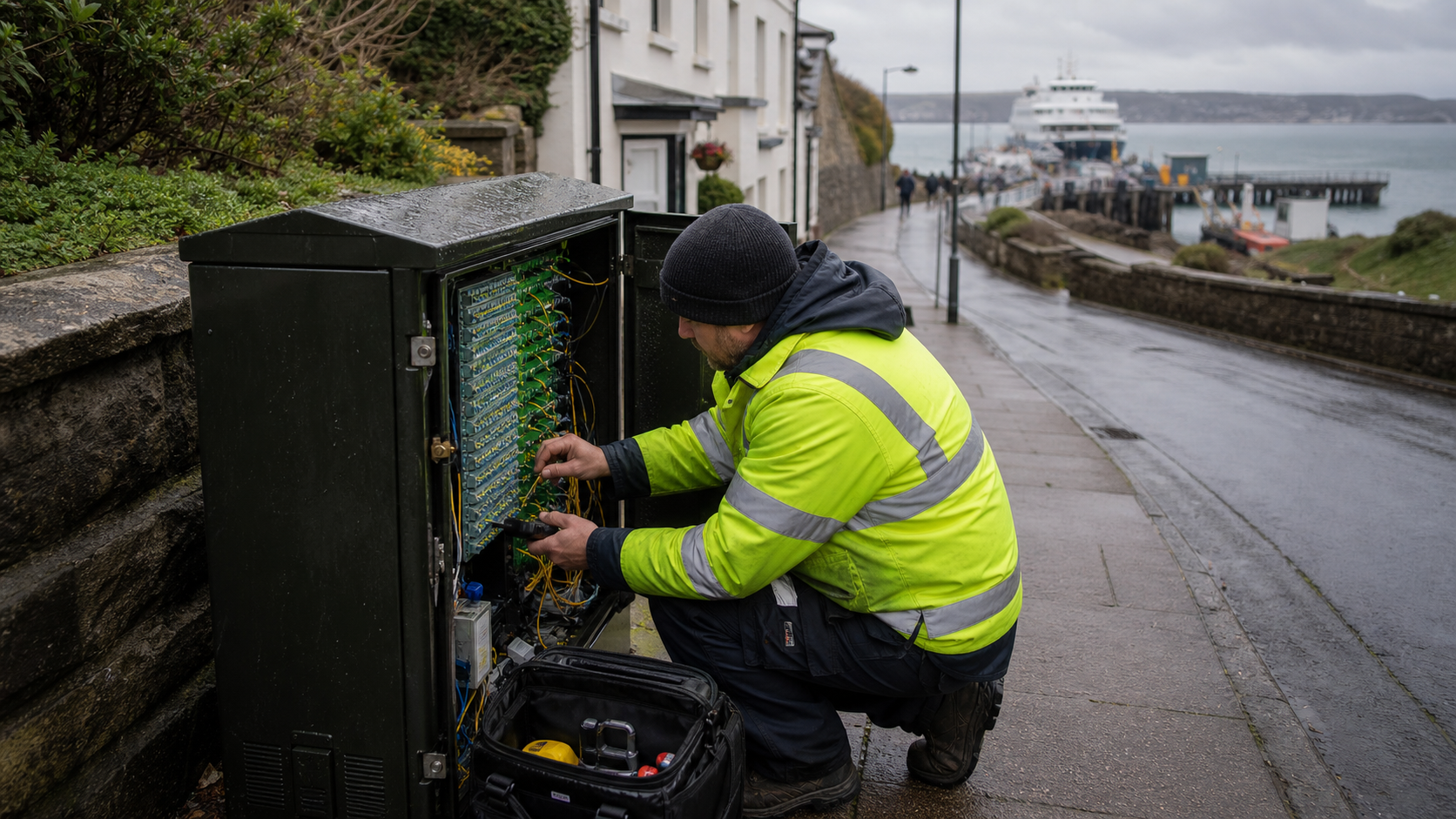
Start with the map. The Isle of Wight is not a suburb that can be appended to a national broadband plan after the crews finish the easy streets on the mainland. It is a contained customer basin, separated by water, served by ferry links, with its own roads, councils, resorts, care demand, manufacturing pockets, rural lanes, seasonal tourism and public-service needs. For WightFibre, every trench has to make sense inside that map. Every supplier visit that needs mainland equipment or specialist labour carries extra time risk. Every missed appointment is remembered in a smaller community.
Every take-up target is sharper because there is no next county to smooth the numbers. The geography is the sales pitch and the cost model at the same time.
That is why WightFibre is more interesting than a simple alternative-network story. The company says that since 2001 it has owned and operated telecommunications infrastructure independently of BT Openreach, and that its Gigabit Island project has deployed full fibre to more than 74,000 homes and businesses, with an ultimate network goal above 80,000 premises (https://www.wightfibre.com/about-wightfibre/). Its public offer in July 2026 was deliberately aggressive for a local island operator: 30-day rolling contracts, no upfront costs, free installation and symmetric full-fibre packages advertised from GBP20.95 per month for 150Mbps after a voucher code, GBP21.95 for 300Mbps, GBP25.95 for 500Mbps and GBP31.95 for 900Mbps, with the discount removed after 12 months and annual price-rise language applying from April 2027 (https://www.wightfibre.com/). The social tariff stood at GBP19.95 for 100Mbps. The retail message is simple: local fibre, short commitment, symmetric speed and a lower switching-friction promise than the 24-month contracts common in the national market.
The financial message is less simple. WightFibre says the project has received more than GBP110 million from Infracapital Partners, including funding from HM Treasury, and NatWest Bank, and that Building Digital UK support is helping reach harder premises (https://www.wightfibre.com/about-wightfibre/). Companies House lists WightFibre Limited as an active private company at 56 Love Lane, Cowes, with wired and wireless telecommunications activities, last accounts made up to 30 September 2025, and an outstanding NatWest charge created on 12 May 2026 (https://find-and-update.company-information.service.gov.uk/company/05470659 and https://find-and-update.company-information.service.gov.uk/company/05470659/charges). Telecompaper reported from the filed accounts that revenue for the 12 months to 30 September 2025 rose 27 percent to GBP9.16 million from GBP7.20 million, that adjusted EBITDA was positive at GBP951,124, and that losses after tax and net liabilities were still large at GBP19.32 million and GBP75.97 million respectively (https://www.telecompaper.com/news/wightfibre-posts-fy-positive-adjusted-ebitda-as-revenue-grow-27--1573441).
Those numbers put the island map into financial form. A fibre network can reach a high share of premises before the income statement fully catches up. The civil works, ducts, cabinets, backhaul, customer premises equipment, call-centre labour, debt service and marketing spend arrive before the last household decides to switch. The public tariff is not just a price; it is an attempt to convert sunk construction into recurring cash quickly enough that the capital stack does not become the story. WightFibre can plausibly claim a local advantage because the island is bounded, the brand is visible and the use case is easy to understand.
It also has less room to miss: if a contained geography makes fibre easier to sell, how many paying premises, at what ARPU, with what churn and support burden, are needed before the build pays back without requiring a rescue from equity, lenders, price rises or public subsidy?
Containment makes construction clearer, not necessarily cheaper
The bullish case for WightFibre begins with containment. A mainland fibre builder can spend years choosing which towns to enter, where to avoid overbuild, which local authority will cooperate, and how to sequence crews across a wide operating footprint. WightFibre has a cleaner story. The island is the footprint. The brand can present itself as the island's own network. Its office, call-centre identity and engineer presence are part of the product.
A household in Ryde, Newport, Cowes, Sandown or Ventnor is not deciding whether a distant national ISP happens to serve a street; it is deciding whether the local independent network has reached that address and whether the household trusts it more than an Openreach-based alternative.
That has real economic value. Marketing can be local. Word of mouth travels. A roadworks sign in one part of the island is both an annoyance and a visible asset-under-construction advertisement. WightFibre's 25th-anniversary timeline says it had 119 employees in 2025, all based at its Cowes headquarters, and that fibre had been laid to 74,000 premises (https://25.wightfibre.com/). The company announced in August 2025 that it had connected its 25,000th customer and that its full-fibre network reached more than 72,000 homes and businesses, or 87 percent of homes and businesses on the island, with a goal of 96 percent coverage by the end of 2027 (https://www.wightfibre.com/wightfibre-celebrates-25000th-customer-milestone-with-a-special-surprise/). In June 2026, SwitcherMate Business, citing latest accounts, described coverage above 74,000 premises and more than 28,000 active connections (https://switchermatebusiness.com/news/article-broadband?id=wightfibre-8217-s-broadband-gigabit-island-project-slowly-ne-1781006442961). Treat the last figure as a secondary-market report rather than audited disclosure, but it is consistent with the direction of travel: coverage is mature; customer conversion is the battleground.
Containment also changes the construction physics. WightFibre says its network is built around point-to-point fibre and resilient ring architecture, with each home receiving a dedicated fibre optic cable rather than sharing the local loop with neighbours; it says the ring design can survive cable cuts without interrupting customer service, and that microduct technology can reduce trench size and allow fibre to be blown through 7mm microducts (https://www.wightfibre.com/about-wightfibre/). Ofcom's Connected Nations 2023 England report recorded WightFibre as a smaller operator helping the UK full-fibre rollout, noted that the company migrated legacy cable customers to the new full-fibre network in 2021, switched off its HFC-based cable network in August 2022, and by August 2023 had 57,000 premises able to access full-fibre broadband with more than 560 km of trenches dug out of an expected 600 km (https://www.ofcom.org.uk/siteassets/resources/documents/research-and-data/multi-sector/infrastructure-research/connected-nations-2023/connected-nations-2023-england).
The words "only" and "small" do a lot of work here. A thinner trench, existing duct reuse and a dedicated local footprint all help. They do not make civil engineering cheap. A 600 km trenching plan in a community with rural lanes, tourist traffic, conservation sensitivities and private roads still produces disruption, permissions work and customer irritation. The island also has a transport constraint that mainland rollouts do not face in the same way. Isle of Wight Council's Island Transport Plan 4 says ferries carried around 7.6 million passenger journeys in 2024 and about 500,000 freight movements across all routes; the plan also notes roughly 3,000-3,500 residents commuting regularly to mainland jobs (https://iow.moderngov.co.uk/documents/s20874/5a%20-%20Appendix%201.pdf). A specialist part, contractor or replacement cabinet is not moving in the same way it would between Hampshire towns. WightFibre's geography lowers some marketing uncertainty while adding logistics friction.
The final-premises problem is the same, only more visible. WightFibre's 2022 BDUK announcement said GBP9 million of voucher support had been allocated to extend rural rollout, but also noted that some homes requiring landowner permission, including private unadopted roads, may take longer if permission is not forthcoming (https://www.wightfibre.com/government-allocates-9m-to-wightfibre-for-rural-broadband-rollout/). Its later update said it had claimed more than GBP3.1 million in BDUK voucher subsidies and was working with landlords, local authorities and landowners to connect hard-to-reach premises (https://www.wightfibre.com/over-21000-island-homes-and-business-are-already-using-wightfibre/). That is the capital-recovery risk in plain language. The last ten percent is not merely the remainder; it is often the highest-friction part of the map.
Take-up is the real product-market fit test
A fibre network is not finished when the road is reinstated. It is finished, economically, when enough households and businesses stop treating it as a nice option and start paying every month. WightFibre's own milestones show the gap between premises passed and paying lines. More than 72,000 homes and businesses reached by June 2025 and 25,000 customers implies a large base of addressable premises that had not yet converted at that point. If the later 28,000-plus active-connection report is directionally right, the company is still in the zone where customer acquisition is not a side activity; it is the decisive phase of the project.
This is where the 30-day rolling contract matters. National broadband promotions often hide retention economics inside long commitments, gift cards and renewal events. WightFibre advertises the opposite: "pay what you see, leave at any time" with just 30 days notice (https://www.wightfibre.com/). For customers, that reduces risk. For WightFibre, it makes the service promise sharper. If a customer can leave quickly, the company cannot rely on contract friction to mask installation problems, Wi-Fi dissatisfaction, billing confusion or competitor offers. The 30-day model is a confidence signal, but also a churn exposure.
The tariffs show the tension. At a discounted GBP20.95 for symmetric 150Mbps and GBP31.95 for symmetric 900Mbps, WightFibre is close enough to national promotional pricing to compete on headline price, while still claiming the local-service and symmetric-speed premium. BT's July 2026 offers on broadbandchoices.co.uk included a 145Mbps full-fibre-only plan at GBP23.99 per month on a 24-month contract, rising to GBP27.99 from 31 March 2027 and GBP31.99 from 31 March 2028, and a 900Mbps plan at GBP31.99, also on a 24-month contract with scheduled increases (https://www.broadbandchoices.co.uk/providers/bt/bt-infinity-fibre-optic-broadband). The comparison is not perfect because availability, upload speeds, rewards, routers, phone options and contract terms differ. But it explains WightFibre's strategy. The company needs to be cheap enough that national operators cannot frame it as a local luxury, flexible enough to draw switchers out of contracts, and differentiated enough that symmetrical fibre and local support create stickiness once the first 12-month discount ends.
That strategy is rational, but it compresses the payback problem. A GBP10 discount for 12 months is a cost of acquisition, even if it is presented as a voucher. Free installation is a cost of acquisition. A free router and Plume Home app are costs of acquisition and retention. Local call-centre access is a wage bill. The shorter the contract, the faster the customer has to become profitable or the more confidence the company must have in low churn. If WightFibre's average customer takes the lowest discounted plan and leaves after a service disappointment, the economics are harsh.
If the customer stays, adds TV, phone, whole-home Wi-Fi, support services, business-grade connectivity or a higher speed tier, the island footprint starts to look powerful.
Customer signals suggest that local service is both an asset and a liability. Trustpilot listed WightFibre at 4.6 with more than 4,000 reviews at retrieval, with 83 percent five-star reviews, 420 reviews in the previous 12 months, and the company replying to 96 percent of negative reviews, typically within 48 hours (https://www.trustpilot.com/review/wightfibre.com). Recent reviews praised local people, installation crews and quick fixes, while some negative reviews complained about Wi-Fi performance, speed consistency, installation mess or handover problems. Broadband.co.uk carries smaller-volume comments, including a February 2024 complaint about five broadband and landline dropouts in 11 days after a good first month (https://www.broadband.co.uk/providers/wight-fibre/broadband/reviews). A Reddit thread from 2020 mixed strong recommendations with frustration about sign-up responsiveness and coverage timing (https://www.reddit.com/r/isleofwight/comments/iwh6ek/wightfibre_internet_recommendations_good_or_bad/). These are not audited metrics, and individual reviews are a poor substitute for churn and repair data. They are useful because in a contained geography the same stories can affect the next sale.
Support labour is not overhead when the brand is local
Many fibre models treat support as a cost centre to be scaled down after construction. WightFibre cannot do that so easily because the support model is part of the proposition. The company writes about "Island staff, Island call centres, Island engineers" on its Trustpilot company page and gives simple local contact numbers on its site (https://www.trustpilot.com/review/wightfibre.com and https://www.wightfibre.com/press-media/). The pitch is not only that packets move quickly; it is that a local person will answer when the router, garden route, switching date, Wi-Fi, phone line or billing record does not behave.
That has two economic effects. First, it can lower churn. A customer who can speak to a local team and get an engineer who understands the street may tolerate a teething issue better than a customer trapped in a national call-centre script. WightFibre's best reviews are not mainly about the physics of fibre; they are about technicians listening, installations being tidy, changeovers being smooth, and support being reachable. In a market where Ofcom and consumer groups have trained customers to expect poor broadband service, that local labour can be a competitive moat.
Second, it raises operating leverage risk. The more the company sells local support, the more every growth milestone increases the support obligation. Twenty-five thousand customers is not just recurring revenue; it is also installations, returns, router swaps, speed complaints, whole-home Wi-Fi trouble, landline-over-fibre questions, vulnerable-customer needs and disputes with old providers. A 30-day contract reduces switching friction for the customer and raises the cost of poor handling for the operator. The company cannot quietly stretch response times without damaging its central message.
This is especially important on an ageing island. Council material notes the Isle of Wight population is ageing, with older age groups expected to keep rising, and the local strategy describes the challenge of retaining young people and sustaining public services in a physically separated island economy (https://iow.moderngov.co.uk/documents/s20236/5c%20-%20Appendix%201%20Isle%20of%20Wight%20Growth%20and%20Prosperity%20Strategy%20final%20draft.pdf). Older customers may be more dependent on phone support, engineer visits and clear migration handling. Small businesses may be more dependent on card payment, booking, cloud accounting and remote work. Tourism businesses may experience service failures at precisely the wrong seasonal moments. Support labour is therefore not only a brand cost; it is part of the island resilience product.
The Wi-Fi layer complicates the story. WightFibre's access network may be full fibre to the premises, but many customer complaints are likely to be experienced as "the broadband is bad" when the problem is in-home Wi-Fi, device placement, building layout or power. The company tries to close that gap with Plume Home, whole-home Wi-Fi offers and a GBP100 credit promise if the upgraded whole-home Wi-Fi guarantee does not meet stated conditions (https://www.wightfibre.com/broadband/). That is a sensible commercial move because it reduces the difference between the network WightFibre built and the experience the customer judges. But it also means the company is accepting more responsibility for the messy final metres inside homes. The margin on a broadband line can disappear quickly if the support desk and engineer team spend repeated time fixing the customer's actual lived connection rather than the clean fibre segment on a network diagram.
Capital structure makes the build a race against time
The strongest public argument for WightFibre is that the company appears to be moving out of the pure-build phase toward a revenue-growth and EBITDA-positive phase. The 2025 numbers reported from accounts, if read narrowly, are encouraging: revenue up 27 percent, positive adjusted EBITDA under GBP1 million, and coverage nearing maturity (https://www.telecompaper.com/news/wightfibre-posts-fy-positive-adjusted-ebitda-as-revenue-grow-27--1573441). That is exactly what a lender or infrastructure equity owner wants to see after years of construction. The network is no longer just ducts and promises; it is converting.
The same accounts report also underlines why timing matters. Loss after tax remained around GBP19.32 million and net liabilities rose to about GBP75.97 million, according to Telecompaper's account summary. Companies House confirms the 2025 accounts were filed on 5 June 2026 and that WightFibre registered a new outstanding charge in favour of National Westminster Bank PLC in May 2026 (https://find-and-update.company-information.service.gov.uk/company/05470659/filing-history and https://find-and-update.company-information.service.gov.uk/company/05470659/charges). None of that proves distress. Fibre builds routinely carry high depreciation, interest, construction funding and deferred revenue effects before mature penetration. But it does show that WightFibre is not a simple cash retailer. It is an infrastructure asset with a balance sheet that needs the customer curve to keep improving.
The investor context matters. Infracapital's original 2017 involvement was presented as a GBP35 million investment in WightFibre to fund the island full-fibre rollout, supported by the UK government's Digital Infrastructure Investment Fund (https://www.infracapital.co.uk/news/2018/infrastructure-investor-awards-2017-telecoms-and-broadband-investor-of-the-year-europe and https://pressreleases.responsesource.com/news/94346/wightfibre-announces-ground-breaking-investment-to-roll-out-full-fibre-future/). WightFibre's own current about page now speaks of more than GBP110 million from Infracapital Partners, HM Treasury-linked funding and NatWest Bank, with BDUK assistance for the final expansion (https://www.wightfibre.com/about-wightfibre/). That is a substantial amount of capital relative to an island population around 141,000 and an addressable premise base near 80,000.
The obvious back-of-the-envelope test is brutal but useful. If more than GBP110 million of funding is attached to an eventual 80,000-premise network, the capital intensity is above GBP1,300 per premise before considering customer acquisition, operating costs and financing effects. The exact number is not a regulated cost allocation and should not be treated as a formal build-cost figure; the funding also covers timing, refinancing, equipment, working capital and broader project items. But it helps explain why penetration matters.
At 25,000 customers, a GBP9.16 million revenue figure implies a business still scaling toward the steady-state income needed to support the asset. At 40,000 customers, with higher ARPU and business revenue, the same network looks different. At low penetration, it remains a long-duration bet on conversion.
This is the island paradox. The contained market protects WightFibre from the scattershot expansion mistakes seen in some mainland alternative networks. It gives the company a clear brand and a finite completion target. It also caps the upside. WightFibre cannot solve a shortfall on the Isle of Wight by entering Bristol next month under the same local brand. The island either converts, or the financial story depends on price increases, enterprise services, refinancing, investor patience, public-support extension or consolidation. That is why the tariff sheet, the charge register and the customer milestones belong in the same paragraph.
Regulation and overbuild define the competitive boundary
The Isle of Wight is not a competition-free island. Openreach-based providers compete. BT, EE, Sky, Vodafone, TalkTalk, Plusnet and other retailers can serve addresses where the underlying wholesale network is present. Mobile and fixed wireless can matter in some cases. Satellite is a backstop for hard-to-reach or resilience-conscious customers. But the local economics of duplicating full-fibre infrastructure are different from the economics of competing for customers over existing wholesale networks.
WightFibre's Ofcom response to the Telecoms Access Review 2026-31 is unusually revealing because it tells the regulator exactly how the company wants the island understood. WightFibre said its full-fibre network had reached 72,000 premises ready for service, or 87 percent coverage, and should reach around 80,000 homes by the end of 2027, or 98 percent coverage. It argued that its point-to-point architecture has no contention in the access network, guarantees symmetrical headline speeds, can provide services up to 10Gbps, and can support leased-line equivalent services for businesses (https://www.ofcom.org.uk/siteassets/resources/documents/consultations/category-1-10-weeks/consultation-telecoms-access-review-2026-31/main-documents/stakeholder-responses-to-our-march-2025-consultation/wightfibre.pdf?v=402092).
The same response also made a commercial fear explicit. WightFibre objected to Ofcom's treatment of the Isle of Wight in leased-line access market definitions and warned that if BT were allowed to introduce geographic discounting and other terms without restrictions, BT could target the island with bespoke offers to prevent WightFibre from gaining share or to win back customers. WightFibre also said neither Virgin Media O2 nor CityFibre had entered the Isle of Wight market, because of the island setting, the small number of large businesses and WightFibre's established presence (https://www.ofcom.org.uk/siteassets/resources/documents/consultations/category-1-10-weeks/consultation-telecoms-access-review-2026-31/main-documents/stakeholder-responses-to-our-march-2025-consultation/wightfibre.pdf?v=402092).
This is the competitive boundary. WightFibre wants credit for building an alternative access network on an island where several mainland infrastructure rivals have not built. It also wants protection against the incumbent using national scale and targeted pricing to blunt that investment after the expensive construction phase. From a consumer standpoint, targeted discounting can look attractive: lower bills are lower bills. From an infrastructure standpoint, a national incumbent with a large asset base can damage a smaller network's payback if it selectively attacks a dense pocket where the smaller network has already sunk the cost.
The policy problem is not abstract. It decides whether WightFibre's point-to-point island build is rewarded as durable competition or squeezed after completion.
Overbuild risk also changes WightFibre's own pricing behaviour. If the company raises prices too fast after discount periods, it invites Openreach retailers to undercut. If it keeps prices low, it stretches payback. If it leans heavily on flexibility and local support, it must keep service levels high. If it sells enterprise-grade reliability from a point-to-point architecture, it must prove response times and continuity in contracts, not just in marketing. Regulation does not solve those tradeoffs; it frames the space in which they play out.
The business market is small but strategically important. WightFibre told Ofcom the Isle of Wight has approximately 10 large businesses, 70 medium-sized businesses, around 550 smaller businesses and about 6,700 registered businesses including many SOHO businesses; it said it was regularly adding business customers for specific business connections (https://www.ofcom.org.uk/siteassets/resources/documents/consultations/category-1-10-weeks/consultation-telecoms-access-review-2026-31/main-documents/stakeholder-responses-to-our-march-2025-consultation/wightfibre.pdf?v=402092). Those numbers show why the company cannot depend only on a handful of large enterprise accounts. It needs broad SME and residential adoption, but the business layer can raise ARPU, justify service-level upgrades and make the network more central to the island economy.
Backhaul and routing are the hidden half of island fibre
An island fibre network is often discussed as if the key asset is the strand into the home. That is only half true. For a customer, the useful product is the whole path: home or office to street cabinet, cabinet to aggregation, island network to mainland interconnection, upstream transit, peering and application destination. WightFibre can build a dedicated local fibre and still disappoint a customer if backhaul, routing, power, support or content paths are weak. Conversely, a strong off-island architecture does not rescue a bad installation or weak in-home Wi-Fi.
The public internet-routing record gives partial comfort without proving private resilience. PeeringDB lists WightFibre as AS60426, organization WightFibre Limited, network type Cable/DSL/ISP, 50 IPv4 prefixes, two IPv6 prefixes, 50-100Gbps traffic levels, heavy inbound traffic and European geographic scope. It lists public peering at LINX LON1, LINX LON2 and LONAP, each shown with 100G capacity, and interconnection facilities at Equinix LD8 in London Docklands and Telehouse London Docklands East (https://www.peeringdb.com/asn/60426). BGP.Tools shows AS60426 registered in 2013, with nine originated IPv4 prefixes, two IPv6 prefixes, four upstreams and 44 peers at retrieval, and also shows 100Gbps presence at LINX LON1, LONAP and LINX LON2 (https://bgp.tools/as/60426).
Those are evidence of a real network, not just a reseller storefront. They do not disclose the exact fibre routes between the island and mainland, the cable ownership model, the capacity contracts, power autonomy, repair commitments, route-diversity maps or disaster-recovery terms. The public network record should therefore be used carefully. It shows that WightFibre has London exchange presence and visible BGP operations. It does not prove that every Isle of Wight business customer has an independently resilient path under a simultaneous local fault and off-island transport event.
The transport geography makes that distinction important. Transport for the South East's Solent ferry report describes the island's heavy reliance on privately run ferry links and calls ferry services a vital regional transport issue; it notes residents face natural-monopoly characteristics because choices are limited (https://transportforthesoutheast.org.uk/app/uploads/2025/11/IOW-Solent-Ferries-Report-EconomicSense.pdf). That report is about people and goods, not internet transit. But the economic analogy is relevant: an island economy depends on a small number of crossing systems, and resilience is not the same thing as nominal availability. A hotel, manufacturer, care provider, school, home worker or card-payment-dependent shop experiences connectivity as part of a wider island logistics system.
This makes customer dependency the most important private evidence a buyer would want. WightFibre says it serves more than 1,000 businesses on the Isle of Wight through its business site, offering flexible packages for broadband and phones (https://business.wightfibre.com/). It also argues to Ofcom that its architecture can offer leased-line equivalent characteristics, with service levels negotiated for individual customers. The underwriting question is not whether the homepage says "resilient". It is whether the largest local customers have contracts, route diversity, support commitments, spare equipment and escalation processes that match their operational dependence. Public sources cannot answer that question. They can show why it matters.
The island economy gives WightFibre more than household broadband to sell
The Isle of Wight's demand map is not just homes streaming video. The Growth and Prosperity Strategy describes a GBP3.1 billion economy, over two million visitors to high-profile events and festivals, manufacturing that contributes more than GBP250 million per year, advanced manufacturing in materials for aviation, motor racing and wind energy, a creative sector, foundational care economy, food and farming, forestry, nature conservation and inshore fisheries (https://iow.moderngov.co.uk/documents/s20236/5c%20-%20Appendix%201%20Isle%20of%20Wight%20Growth%20and%20Prosperity%20Strategy%20final%20draft.pdf). The Island Transport Plan 4 reports around 1.9 million visitors in 2024, around 7.6 million ferry passenger journeys and about 500,000 freight movements (https://iow.moderngov.co.uk/documents/s20874/5a%20-%20Appendix%201.pdf). The local economy is seasonal, distributed and service-sensitive.
That matters for WightFibre because the value of symmetric, reliable broadband differs by customer. A household may value download speed, video streaming, gaming, remote work and price flexibility. A holiday park may value guest Wi-Fi, card payments and seasonal support. A small manufacturer may value upload capacity, cloud systems, design files and remote monitoring. A care provider may value continuity and phone reliability. A council service may value remote work, digital citizen access and secure connectivity. The council digital strategy says it aims to create conditions for digital technologies to improve service delivery, digital inclusion, digital public realm and digital intelligence (https://digitalservices.iow.gov.uk/documents/view/digital-strategy-2022-2027). WightFibre is selling into that public and private dependency stack.
This is where the company's point-to-point architecture could be economically meaningful. Many fibre builds in the UK are PON-based; WightFibre repeatedly describes its dedicated fibre architecture as offering no local-loop contention and symmetric performance. For normal households, the difference may be felt only during heavy usage or upload-heavy work. For businesses, the ability to create leased-line equivalent services over a widespread access network could change procurement.
It may let a business avoid a traditional leased line for some use cases, or let WightFibre sell a ladder from consumer broadband to enhanced business service to bespoke SLA. That ladder matters because the island does not contain unlimited large enterprise accounts. A broad access network has to convert ordinary premises into a range of revenue tiers.
Tourism adds a further wrinkle. WightFibre can benefit from visitor-facing businesses needing dependable Wi-Fi and payments, but seasonal demand also stresses support and installation timing. A hotel or holiday park that cannot tolerate a broken service in July may demand faster response than a household. A restaurant's card terminal, booking tablet and guest Wi-Fi are small systems, but together they make connectivity feel mission-critical. Customer service miss one of these accounts and the story does not stay inside a corporate procurement file; it can become local reputation.
That is why WightFibre's local support brand is not decorative. It is the mechanism by which a regional ISP turns island density into retention.
The counterargument is that enterprise upside is bounded. A council strategy can say digital services matter, but public bodies are price-sensitive. Manufacturers may need resilience, but only some will pay for premium service. Tourism businesses can be seasonal and cost-conscious. Small businesses often use residential-grade broadband even when their dependence is high. WightFibre's Ofcom response itself describes a limited number of large and medium businesses. The most optimistic version of the economics assumes that the company can lift a meaningful share of the island from cheap household broadband into paid reliability.
The cautious version assumes many customers will buy on price, praise local engineers, and still churn if a national competitor offers a cheaper contract.
The failure scenario is not a dramatic outage; it is a slow squeeze
The easiest failure story would be an island-wide outage. Public status surfaces did not show such a current event at retrieval. WightFibre's service update page said all systems were operational, Downdetector showed no current problems, and WightFibre's Freshstatus page presented a live status and incident-history surface (https://www.wightfibre.com/help/service-update/, https://downdetector.co.uk/status/wightfibre/ and https://wightfibre.freshstatus.io/incidents-history). There has been historical local reporting of a major full-fibre outage, including a 2023 OnTheWight item, but individual outage reports are not enough to define current reliability (https://onthewight.com/major-outage-on-wightfibres-full-fibre-broadband/).
The more important failure scenario is a slow squeeze. Imagine WightFibre reaches more than 90 percent physical coverage, but the last rural and permission-heavy premises cost more than expected. The 30-day contract model keeps customer trust high but makes churn more sensitive to support misses. A national provider targets the island with aggressive 24-month promotions and switching credits. A run of messy installations damages local word of mouth. Interest costs and refinancing terms stay harder than expected. Customer acquisition slows after the most obvious switchers are won.
The company can report revenue growth and still face a payback curve that is too shallow for the capital already committed.
In that scenario, no single line in the public evidence would announce crisis. Prices would inch up. Discounts would change. More bundles would appear. Whole-home Wi-Fi, TV and phone would become more important to ARPU. The business team would push leased-line equivalent services. The company would continue to emphasise local support. Lenders and owners would focus on penetration, churn, installation cost per customer, ARPU mix, support cost per account, bad debt, interest cover and capex-to-completion. Customers would see only some of that, mostly as price letters, engineer availability and competitive offers.
The opposite scenario is also plausible. WightFibre may already have crossed the hardest construction threshold. If 74,000-plus premises are passed, 28,000-plus active connections are right, revenue is growing 27 percent and adjusted EBITDA is positive, then incremental customers should be materially more profitable than the early build. The public 30-day contract model could become a moat if customer satisfaction remains high. A local engineer base could win against national support frustration. Public digital strategy and ferry-constrained island economics could make connectivity a civic priority.
In that version, WightFibre becomes an infrastructure case study: a bounded regional build where local identity, full-fibre symmetry and disciplined completion produce a valuable utility-like asset.
The private evidence needed to distinguish these scenarios is specific. A lender or acquirer should ask for monthly gross additions and churn by town, cohort, product tier and acquisition channel; installation cost by premise type; fault and repeat-visit rates; Wi-Fi support hours per account; ARPU split between residential, business, TV, phone and add-ons; debt maturity and interest-rate exposure; final-premises capex; supplier contracts for CPE, cabinets, optical equipment and backhaul; route-diversity evidence; and customer concentration in business accounts. The public record makes the question clear, but it does not answer it.
Evidence register
The company identity and legal anchors are Companies House pages for WightFibre Limited, company number 05470659, and charge records showing two outstanding charges including the May 2026 NatWest charge: https://find-and-update.company-information.service.gov.uk/company/05470659 and https://find-and-update.company-information.service.gov.uk/company/05470659/charges. The current public tariff anchor is WightFibre's home page: https://www.wightfibre.com/. The network and funding anchor is the WightFibre about page: https://www.wightfibre.com/about-wightfibre/. The rural-subsidy and permission anchor is the BDUK voucher announcement: https://www.wightfibre.com/government-allocates-9m-to-wightfibre-for-rural-broadband-rollout/. The customer-milestone anchors are WightFibre's 25,000-customer release and 25-year timeline: https://www.wightfibre.com/wightfibre-celebrates-25000th-customer-milestone-with-a-special-surprise/ and https://25.wightfibre.com/.
The regulatory anchors are Ofcom's Connected Nations 2023 England report and WightFibre's 2025 Telecoms Access Review response: https://www.ofcom.org.uk/siteassets/resources/documents/research-and-data/multi-sector/infrastructure-research/connected-nations-2023/connected-nations-2023-england and https://www.ofcom.org.uk/siteassets/resources/documents/consultations/category-1-10-weeks/consultation-telecoms-access-review-2026-31/main-documents/stakeholder-responses-to-our-march-2025-consultation/wightfibre.pdf?v=402092. The network-routing anchors are PeeringDB and BGP.Tools for AS60426: https://www.peeringdb.com/asn/60426 and https://bgp.tools/as/60426. The local economic anchors are Isle of Wight Council's Growth and Prosperity Strategy, Island Transport Plan 4 and digital strategy: https://iow.moderngov.co.uk/documents/s20236/5c%20-%20Appendix%201%20Isle%20of%20Wight%20Growth%20and%20Prosperity%20Strategy%20final%20draft.pdf, https://iow.moderngov.co.uk/documents/s20874/5a%20-%20Appendix%201.pdf and https://digitalservices.iow.gov.uk/documents/view/digital-strategy-2022-2027. The ferry-dependence anchor is Transport for the South East's Solent ferry report: https://transportforthesoutheast.org.uk/app/uploads/2025/11/IOW-Solent-Ferries-Report-EconomicSense.pdf.
The customer-signal anchors are Trustpilot, Broadband.co.uk reviews, Reddit local discussion, WightFibre's service status page, Freshstatus and Downdetector: https://www.trustpilot.com/review/wightfibre.com, https://www.broadband.co.uk/providers/wight-fibre/broadband/reviews, https://www.reddit.com/r/isleofwight/comments/iwh6ek/wightfibre_internet_recommendations_good_or_bad/, https://www.wightfibre.com/help/service-update/, https://wightfibre.freshstatus.io/incidents-history and https://downdetector.co.uk/status/wightfibre/. These customer surfaces are market signals, not audited performance records. The competitor-price anchor used for comparison is BT offer data carried by Broadbandchoices: https://www.broadbandchoices.co.uk/providers/bt/bt-infinity-fibre-optic-broadband. The financial-summary anchors beyond Companies House filing existence are Telecompaper and Fibre Provider reports tied to the 2025 filed accounts: https://www.telecompaper.com/news/wightfibre-posts-fy-positive-adjusted-ebitda-as-revenue-grow-27--1573441 and https://www.linkedin.com/posts/fibre-provider_wightfibre-revenues-swell-by-27-in-fy-2025-activity-7470823387087593472-pfAH.
What BTW should watch next
WightFibre should be tracked as a contained geography test case. The most important public signals over the next 12 to 36 months are not simply whether coverage reaches the last target. They are whether customers connect at a pace that matches the build, whether ARPU improves without producing churn, whether the 30-day contract promise survives maturity, whether local support scales, whether business services gain enough traction to lift margins, whether national competitors use island-specific discounts, whether final-premises permissions create capital drag, and whether financing terms remain manageable.
The island is the reason WightFibre can look unusually coherent. It is also the reason the downside is concentrated. If the network works, the company has a local utility-like position with a brand that national rivals cannot easily copy. If the economics slip, the same map becomes a constraint: a finite market, visible service failures, ferry-dependent logistics, a small number of business accounts and limited room to outrun a balance sheet by expanding somewhere else. WightFibre is therefore not just a broadband provider on an island. It is an island payback question written in fibre, trenches, contracts, customer service and time.