
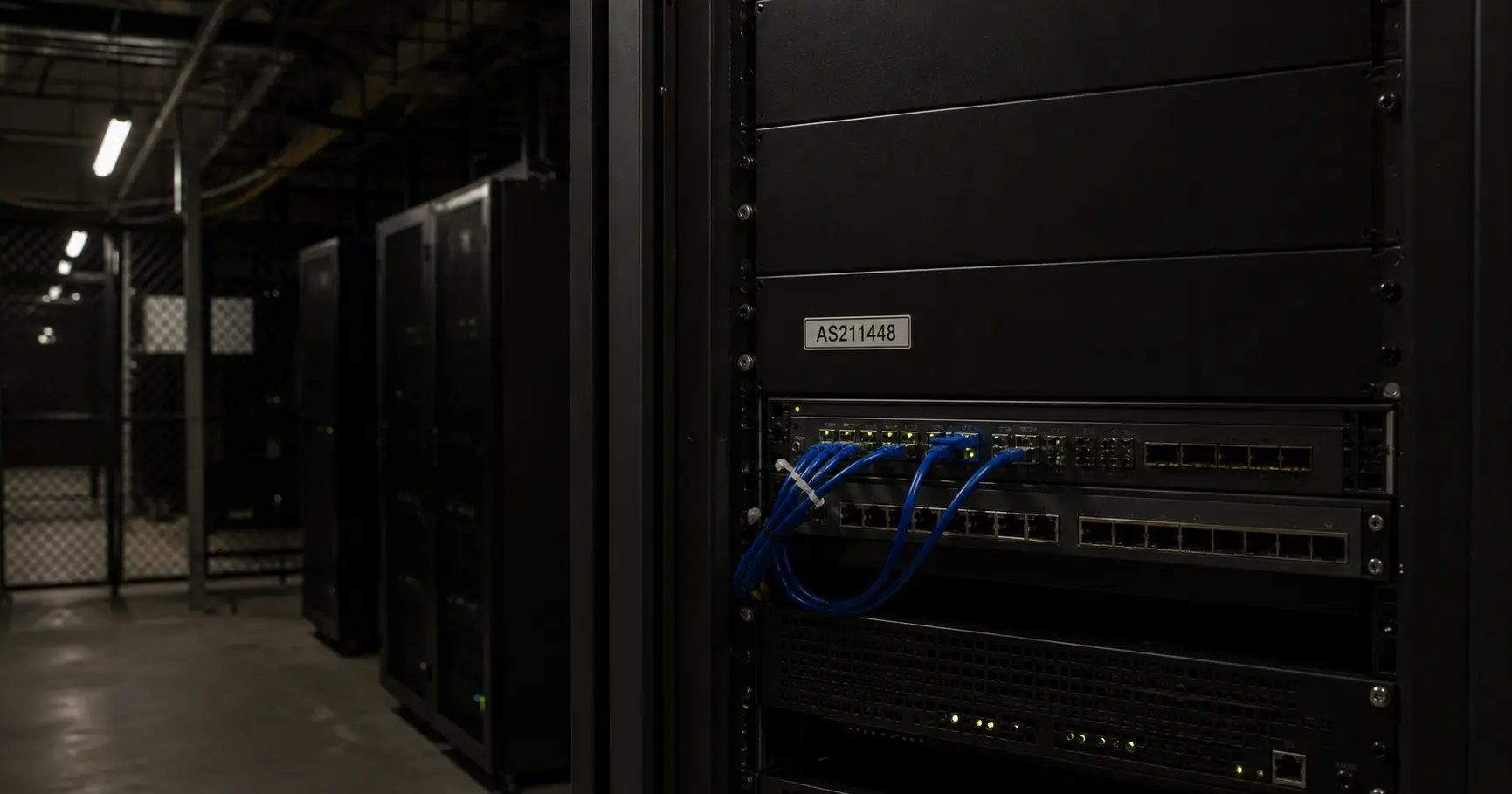
WEBCONEX-SAS WEBCONEX SAS is a barely visible RIPE registry entity holding AS211448. All evidence is limited to public registry and routing data; no corporate, contact, or operational activity exists. The entity’s importance hinges entirely on whether it begins announcing prefixes or updates its registry footprint. Analysts should treat this as a latent routing actor: high uncertainty, low current impact, but a single announcement would shift its profile from dormant registration to active infrastructure. Gaps include missing contact details, country, website, and commercial purpose. Watchpoints: any announced prefix for AS211448, changes to RDAP/WHOIS records, or appearance of a company website.
WEBCONEX-SAS WEBCONEX SAS
WEBCONEX-SAS WEBCONEX SAS holds autonomous system number AS211448 in the RIPE registry, granting it a formal identity in the global routing system. Without announced prefixes, its current operational role is latent; it retains the ability to originate routes and influence traffic paths but has no visible network footprint.
Why It Matters
If WEBCONEX-SAS begins announcing IP prefixes, it could redirect traffic, alter BGP paths, and become a dependency or risk for neighboring networks. Its existence as a registered but inactive AS also introduces uncertainty for routing security monitoring, as no reputation or policy history exists.
What Public Sources Show
WEBCONEX-SAS WEBCONEX SAS is the registered holder of autonomous system number AS211448 in the RIPE NCC registry. The registration provides a formal BGP identity, but the entity announces no IP prefixes and operates no visible internet services. It remains a latent routing actor—administratively real, operationally dormant—that could become an active entity in global routing at any time.
Public RIPE NCC data confirm the ASN assignment and the complete absence of announced routes. The RIPEstat AS overview and RDAP records identify WEBCONEX-SAS as the registrant, while the announced-prefixes endpoint returns zero results. No administrative, technical, or abuse contacts are listed. No company website, PeeringDB entry, or corporate registration has been found outside the RIPE registry.
The entity controls the AS211448 registration, enabling it to update WHOIS/RDAP records, create RPKI Route Origin Authorizations, and originate BGP announcements if it obtains IP prefixes. Because no prefixes are currently announced and no upstream providers or peers are known, its control surface is limited to registry administration. Any future acquisition and announcement of prefixes would expand its influence over traffic paths and routing policy.
A future prefix announcement by AS211448 would insert the entity into the global routing system. Networks that accept its routes could experience changed BGP path selection, new traffic flows, and routing dependencies. Even in its dormant state, the ASN registration represents a potential vector for unauthorized route origination or prefix hijacking. The lack of operational history means adjacent networks would have no basis to evaluate its trustworthiness.
Corporate structure, physical location, management, and business intent are entirely unknown. The absence of contacts and any independent verification outside the RIPE registry means the entity cannot be reliably assessed. No person is publicly associated with WEBCONEX-SAS WEBCONEX SAS, preventing evaluation of the individuals who control the ASN. This opacity is a material gap for any future interaction or dependency.
Analysts should monitor for the first IP prefix announcement by AS211448, which would signal operational activation. Changes to the WHOIS/RDAP entry—such as added contacts, a website, or an organization name update—would reduce uncertainty. The appearance of a PeeringDB entry, corporate website, or national business register listing would provide external validation. Disclosure of any individual contact would enable person-level assessment.
Operating Surface
WEBCONEX-SAS WEBCONEX SAS is the registrant of AS211448 and a dormant autonomous system holder with no announced prefixes. Its public role is limited to registry administration with the latent capability to become a BGP routing entity if it acquires IP addresses.
The ASN registration provides a foothold in internet routing that could become operationally significant if the entity begins announcing IP prefixes. Its current dormancy makes it a watch item; any routing activity would shift its relevance from a dormant registry entry to active infrastructure with potential peering and traffic implications.
Watchpoints
WEBCONEX-SAS WEBCONEX SAS represents a dormant internet routing registration with the potential to become an active network operator. Its lack of announced prefixes and absence of contact information create a high degree of uncertainty. For routing-security analysts, the ASN is a latent entry point that could be used for peering, transit, or malicious activity.
Monitoring its activation is strategically important for early detection of new routing actors in the RIPE region.
Key observable events that would change the strategic assessment include: (1) origination of any IP prefix by AS211448; (2) addition of administrative, technical, or abuse contacts to the WHOIS/RDAP record; (3) appearance of a company website or PeeringDB entry; (4) registration in a national corporate registry; (5) any linking of named individuals to the entity. Each event would reduce uncertainty and allow a more precise evaluation of intent and capability.
The primary data gaps are the lack of corporate registration details, operational contact information, announced IP prefixes, and any external verification of the entity's existence outside RIPE records. Without these, it is impossible to assess the entity's business model, geographic location, or the motivations of its controllers. Filling these gaps requires monitoring for changes in the RIPE registry, BGP routing tables, and public corporate databases.
Sources
- Internet registry record - public-source identity and registry context for WEBCONEX-SAS WEBCONEX SAS.
- Registry RDAP / WHOIS record - evidence-led registry, routing, or network context for WEBCONEX-SAS WEBCONEX SAS.
- Internet registry record - evidence-led routing visibility context for WEBCONEX-SAS WEBCONEX SAS via AS211448.
Signal Brief
- Signal: WEBCONEX-SAS WEBCONEX SAS
- Region:
- Market Class: Global Regional ISP Trends
Operating Footprint
- public operating records
- official service pages
- documented relationships updates
Market Context
- If WEBCONEX-SAS begins announcing IP prefixes, it could redirect traffic, alter BGP paths, and become a dependency or risk for neighboring networks. Its existence as a registered but inactive AS also introduces uncertainty for routing security monitoring, as no reputation or policy history exists.
- Operational relevance: Medium
- Time Horizon: Next quarter
What To Watch
- official company sources
- public registries
- operator-published records
Member Briefing
Deeper Trend Context
Sign in with the right membership level to unlock the full briefing and source notes.
Only for Strategic Circle
Strategic Circle
Open to all readers. Unlock trend briefings after joining and signing in.
Join Strategic CircleOnly for Leadership Alliance
Leadership Alliance
For operators, investors, and policy teams that need relationship evidence, failure paths, and source notes. Sign in to unlock.
Join Leadership AllianceSnapshot
Category
Global Regional ISP TrendsWEBCONEX-SAS WEBCONEX SAS is the registrant of AS211448 and a dormant autonomous system holder with no announced prefixes. Its public role is limited to registry administration with the latent capability to become a BGP routing entity if it acquires IP addresses.
Content Type
EventPrimary Domain
MarketTopic
Internet InfrastructureImpact
MediumIf WEBCONEX-SAS begins announcing IP prefixes, it could redirect traffic, alter BGP paths, and become a dependency or risk for neighboring networks. Its existence as a registered but inactive AS also introduces uncertainty for routing security monitoring, as no reputation or policy history exists.
Confidence
Good confidence (70%)Confidence score guide
Several public sources