
Summary
The event and its human consequences are established, but individual histories remain private. In May 2000, pathogens entered Walkerton's municipal water through Well 5. Seven people died, more than 2,300 became ill and 27 developed hemolytic uremic syndrome. The official Part One summary is the controlling concise account; aggregate counts do not establish any unrecorded person's diagnosis or outcome.
The source pathway was a physical finding, not a general accusation against farming. Heavy rain moved contamination from manure spread near Well 5 through shallow soil and fractured bedrock. The Inquiry's physical-cause chapter identified that manure as the primary, if not the only, source, preserved another-source possibility and did not fault the farmer, who followed accepted practices.
Chlorine was both treatment and warning. Operators routinely dosed below the amount intended to maintain a 0.5 mg/L total residual after 15 minutes under normal conditions. The fixed under-dose being used could not prove protection during the May 12 contamination load. Continuous residual and turbidity monitors could have stopped Well 5; daily manual checks would probably have revealed the failed barrier and reduced exposure.
Operating records concealed whether the barrier worked. Residual values were often entered without measurement; on May 13 and 14, Frank Koebel recorded untested Well 5 values. Bottles were routinely mislabelled and too few distribution samples were taken. The operator chapter shows that a required number is evidence only when someone actually measures, locates and records it.
The laboratory found decisive evidence but sent it through an incomplete route. On May 17, A&L told Stan Koebel and faxed results showing E. coli and total coliforms in six samples, including one grossly contaminated result. It did not notify public authorities. The notification chapter tied that omission to the government's failure to make direct laboratory notification mandatory after testing left government laboratories.
The public-health delay was not simple inaction. The health unit learned of an illness cluster on May 19, contacted the PUC repeatedly and received misleading safety assurances without the May 17 results. The public-health findings did not fault the May 21 timing of the boil-water advisory, but found that its distribution should have been broader.
PUC accountability extended beyond operators. Commissioners controlled policy and senior management and received a serious 1998 inspection report. They focused on finance, relied on Stan Koebel and did not verify correction. The Inquiry called that a lost opportunity, while finding they did not know of false records or intend to endanger residents.
Provincial responsibility arose from approval, inspection, enforcement, training and notification design. Well 5's approval lacked continuous-monitoring conditions despite known vulnerability. Inspectors later identified sampling, residual and training failures, but the Ministry accepted assurances without verified closure. The oversight chapter found that effective provincial action could have prevented the event or substantially reduced it.
Inquiry findings, criminal sentencing, settlement and later law answer different questions. The Inquiry found causes and made recommendations; it did not award damages or determine criminal guilt. Later operator pleas and sentencing addressed common nuisance, while a 2001 court-supervised, Ontario-funded settlement compensated qualifying claims on agreed terms. The monitor's final compensation report records administration, not a civil judgment adopting every Inquiry conclusion.
Ontario replaced a guidance-dependent regime with enforceable duties. The Safe Drinking Water Act, 2002 established duties for safe supply, testing, adverse-result reporting, municipal ownership and oversight; regulations added detailed standards and records. These are post-Walkerton requirements, not rules that governed the PUC or A&L in May 2000.
Reform used multiple barriers. Part Two recommended source protection, treatment and monitoring standards, competent operators, quality management, municipal licensing, sustainable finance, inspection and public reporting. Its overview and recommendations make prevention a system able to withstand source, equipment, human and communication failures.
Later performance evidence does not prove permanent prevention. Ontario's 2024-2025 inspector report says 99.87 percent of 528,852 municipal residential results met standards, 653 systems received annual inspections and three laboratory infractions were identified. Those aggregate indicators cannot prove every sample, notice or corrective action worked.
Reading the record without collapsing its legal boundaries
Walkerton attracts strong moral language because the consequences were severe and several safeguards failed at once. That does not permit every document to be treated as the same kind of authority. This analysis distinguishes a confirmed event, an Inquiry finding, a supported inference, a settlement term, a legal requirement enacted after the outbreak and a later implementation claim. Each answers a different question.
A confirmed event can be anchored in contemporaneous operations, laboratory, hospital or public records. An Inquiry finding is Commissioner Dennis O'Connor's conclusion after the Part One evidentiary process; it should be stated with the qualifications he supplied. A supported inference is an accountability conclusion drawn from several records, such as the need for an independent stop authority, but not presented as the Commissioner's own wording. A settlement resolves litigation on agreed terms and may expressly avoid admissions.
A statute or regulation creates duties from its own commencement and cannot be applied backward merely because it addresses a prior failure. A government implementation report shows what the government says it has put in place; it is not an independent guarantee of control effectiveness.
The official Part One contents file maps the report's separate chapters on impact, chronology, physical cause, operators, commissioners, public health, the Ministry, notification, budgets and the governing framework. The Ontario publication record confirms the report's identity, Commissioner and publication status, but its catalogue description is not evidence for chapter-level facts. Several legacy Archives PDF addresses responded inconsistently on July 17, 2026, sometimes through a retired-site or automated-access page.
Where direct retrieval was limited, this analysis uses only text available through the official index and the accessible official summary. It does not invent missing testimony or infer what an inaccessible page might say.
That discipline matters especially for causation. The Inquiry could decide what probably happened and what institutional omissions contributed within its mandate. It was not a prosecution. The compensation plan could pay qualifying claims without trying every allegation. Later legislation could repair identified gaps without proving that every official who worked under the earlier regime committed an offence. Keeping those categories separate produces a stronger accountability account, not a softer one.
A small groundwater system with a large source-protection obligation
Walkerton had about 4,800 residents and drew municipal water from wells. In May 2000, Wells 5, 6 and 7 were part of the operating picture, but they were not interchangeable. Well 5 was shallow. Its casing extended only about five metres below the surface, and it drew water from fractured bedrock between roughly five and eight metres deep. Thin overburden and fractures created a fast route by which surface contamination could reach the aquifer and the well.
That vulnerability was not discovered only after the outbreak. Evidence considered by the Inquiry showed that concern existed when Well 5 was developed in the late 1970s. The approval process did not translate the concern into durable operating conditions on the certificate. Later knowledge also did not reliably travel into governance. A 1992 engineering needs study referred to the shallow well's susceptibility to surface activity, but the PUC commissioners who later testified did not retain a working understanding of that risk.
The accountability point is not that every shallow groundwater source must be closed. It is that source characterization has to determine the treatment, monitoring and shutoff controls around that source. A well influenced by surface water needs barriers that can detect a rapid change, not only periodic bacteriological results received days later. The absence of visible dirt, taste complaints or previous catastrophe is not evidence that fractured rock has stopped transporting microbes.
Source ownership was also distributed. The PUC operated the waterworks. Municipal land-use powers had limits, and the Inquiry did not blame the farmer whose manure was identified as the primary source. The province approved facilities, set objectives, certified operators and inspected systems. Public health protected residents when water posed a health hazard. Accountability therefore depended on the interfaces: who characterized the source, who converted the hazard into conditions, who measured the barrier, who received adverse evidence and who could order or initiate protective action.
May 8-12: weather turned vulnerability into exposure
The Inquiry's day-by-day event chapter should be read alongside its physical analysis. Rain accumulated over several days, with an extraordinary downpour on May 12. A later hydrology study estimated 72.4 millimetres that day, including about 60 millimetres in six evening hours. The water moved through the shallow subsurface and fractured bedrock toward Well 5. Residents were probably first exposed on May 12 or shortly afterward.
The manure had been spread in late April on a farm near the well. Strain evidence linked E. coli O157:H7 and Campylobacter from the farm environment to organisms prevalent in human cases. O'Connor nevertheless used careful language: the manure was the primary, if not the only, source, and another possible source could not be excluded. He also separated source from fault. The farmer had used accepted agricultural practices and was not blamed.
This distinction prevents a common analytical mistake. A contaminant origin is not automatically the control failure that made the contaminant a public exposure. Agricultural material in a rural watershed was a foreseeable hazard class. The drinking-water system's job was to understand how that hazard could reach the intake, impose treatment and monitoring appropriate to the route, and stop supply when operating evidence showed that protection had collapsed.
Samples before the outbreak had already shown an unstable picture. Well 5 raw water was positive for total coliforms on several April dates, and treated water was also positive on some dates. Results from May 1 showed total coliforms in samples labelled as Well 5 raw and treated water, although not E. coli. Those results did not by themselves prove that the May 12 contamination had already occurred. They did show that source and treatment performance required accurate location records and disciplined follow-up. Because PUC sampling labels were unreliable, even a laboratory result could lose much of its diagnostic value before analysis began.
Chlorination was not a number to copy into a log
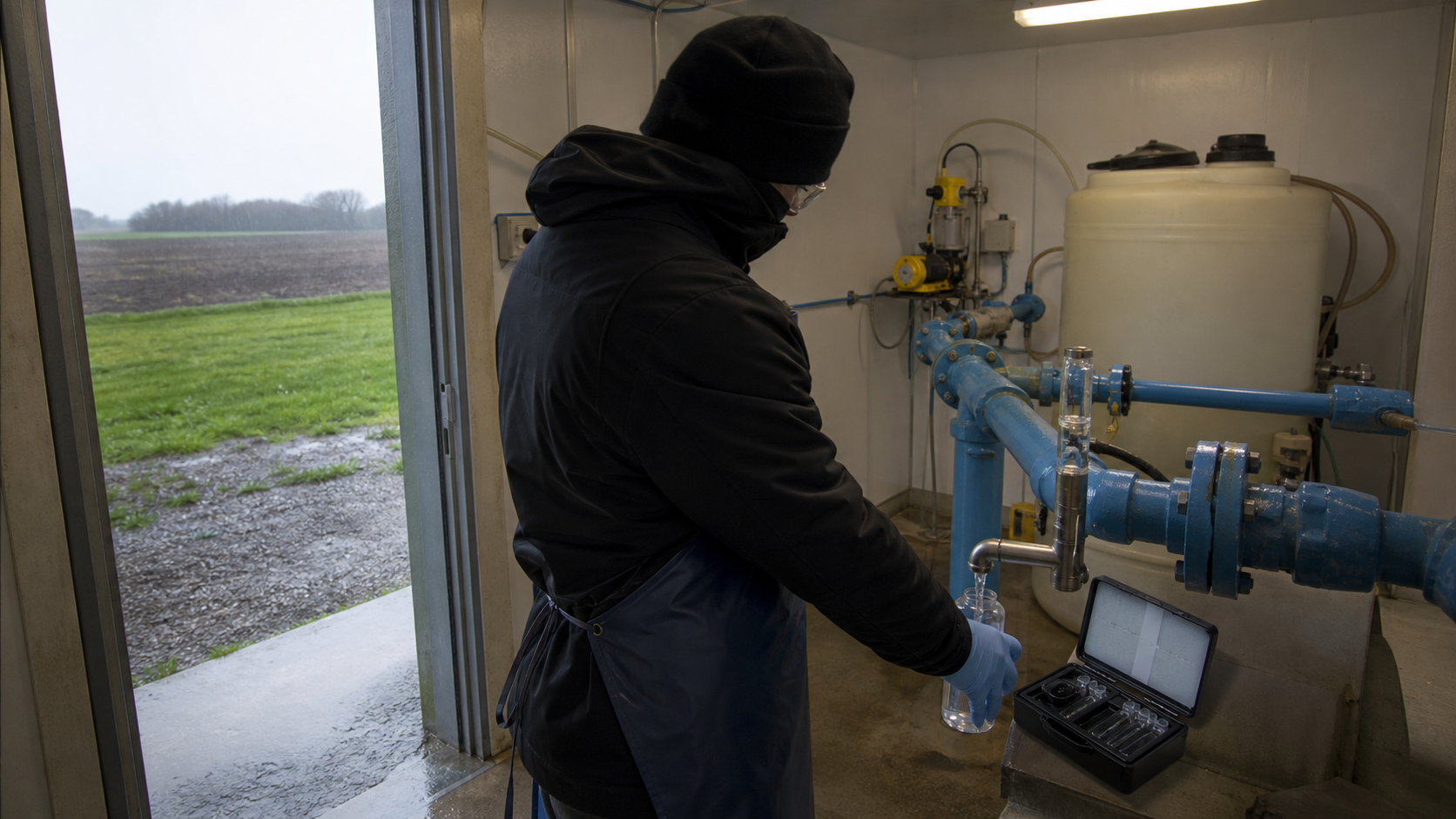
At Well 5, sodium hypochlorite was injected into pumped water. Provincial guidance called for enough treatment to maintain a total chlorine residual of 0.5 mg/L after 15 minutes of contact under normal conditions. A residual is the disinfectant remaining after chlorine demand has been met. It therefore performs two functions. It contributes continued protection, and a sudden low or absent reading can reveal that contamination or another process change is consuming the available chlorine.
The PUC's practice defeated both functions. Operators generally set the dose below the required level. More seriously, they often did not measure the residual at all. For many years, daily sheets commonly displayed 0.5 or 0.75 mg/L even when no test supported the entry. On May 13 and May 14, when Well 5 was in the critical contamination period, Frank Koebel followed that practice. The record looked compliant while the physical barrier was unverified.
It would be inaccurate, however, to treat a written feed setting as equivalent to a measured residual. The Inquiry's summary says that the outbreak would have been prevented if the proper amount of chlorine had been added and a 0.5 mg/L residual had been maintained, while later public-health synthesis notes that the chlorine feed being applied during the event was insufficient for the large contamination load.
The operational point is measurement: a continuous residual monitor, paired with a turbidity monitor and an alarm or automatic pump shutdown, could have detected the abnormal condition in time to prevent contaminated water from continuing into distribution. A competent operator performing the required daily manual check would probably also have found little or no residual and could have taken action that substantially reduced the outbreak.
This is the central engineering accountability lesson. A target value is not a barrier unless four things are true: the dose is appropriate, contact conditions are real, the residual is actually measured, and a failed measurement triggers a defined response. A copied value satisfies none of them. Nor is a residual device useful if an alarm can be ignored, if no one has authority to stop a well, or if restart can occur without documented clearance.
The Inquiry allocated different parts of this failure to different owners. Operators were responsible for dosing, checking and recording. PUC management was responsible for supervision and competence. Commissioners had to oversee management and respond to major external warnings. The Ministry had to recognize the source vulnerability, attach or update operating conditions, inspect practice and require correction. The failure to install continuous monitors was not attributed to operator misconduct alone; the Inquiry placed that omission within provincial approvals and oversight.
Sampling integrity determines what a laboratory result can prove
Microbiological testing was the slower verification barrier. Under the Ontario Drinking Water Objectives then in use, a system Walkerton's size was expected to submit weekly raw and treated samples and at least 13 distribution samples each month. The PUC took too few distribution samples. It also routinely put location labels on bottles that did not identify where the water had actually been collected.
That was not clerical untidiness. Location and time determine whether a result points to a source well, treatment failure, distribution problem, construction contamination or isolated tap condition. If a bottle labelled raw water was filled at the workshop, an analyst could accurately detect bacteria while the utility and regulator drew a false conclusion about where the bacteria were present. Mislabelled samples also made trend analysis and corrective resampling less reliable.
On May 15, Allan Buckle collected bottles labelled Well 7 raw, Well 7 treated and a distribution address. The Inquiry concluded that the samples were most likely taken at the PUC workshop, near and immediately downline from Well 5. Three of the regular system samples later tested positive for total coliforms and E. coli. The bottle labelled Well 7 treated produced the most extreme result, yet the apparent combination of clean raw water and grossly contaminated treated water made no physical sense. The label concealed the likely connection to Well 5.
Separate samples came from a Highway 9 watermain construction site. Those also tested positive. Their significance was not that the construction caused the outbreak; the Inquiry rejected construction and several other proposed origins. Their significance was that water drawn from the municipal distribution system carried the organisms and that several independent bottles converged on an urgent adverse condition.
A defensible sampling control therefore requires more than a calendar. It needs qualified collectors, fixed or documented sites, tamper-resistant time and location records, chain of custody, enough distribution coverage, comparison with operational residual data and escalation rules for implausible combinations. Laboratory competence cannot repair a false collection location after the fact.
May 15-17: decisive evidence reached the utility but not public authorities
A&L received the May 15 samples on May 16. Microbiological analysis required at least a day. On May 17, laboratory representative Robert Deakin telephoned Stan Koebel. Three construction-site samples and three municipal-system samples were positive for total coliforms and E. coli. The laboratory also faxed the results to the PUC. One result showed gross contamination.
At that point, the evidence had crossed from suspicion to an adverse laboratory finding. It had not crossed into a public-health decision. A&L reported to its client, the PUC. It did not directly notify the Ministry or the local Medical Officer of Health. The then-current Ontario Drinking Water Objectives described a notification protocol, but it was guidance rather than an enforceable regulation. The laboratory was unaware of it. The municipal contract did not close the gap.
Stan Koebel did not report the findings onward. He did not tell the PUC commissioners at their May 18 meeting. When residents began calling with questions, staff who consulted him said the water was fine. He directed that a chlorinator be installed at Well 7, which had been pumping without one since early May 15, and he began flushing and increasing chlorination in the distribution system. Those actions show that he was reacting to a water problem, but they did not substitute for notifying the health unit or disclosing the evidence needed to protect consumers.
Well 7 must be kept in its proper causal place. Operating it without chlorination was a serious breach, and the later alteration of its operating sheet was serious concealment. But the Inquiry found no evidence that the May outbreak contamination entered through Well 7. The physical entry point was Well 5. Accountability can include a dangerous concurrent practice without rewriting that practice as the proven source.
Had direct notification been legally required and performed on May 17, the Medical Officer of Health would have had the result while exposure was continuing. The Inquiry concluded that an advisory would then have been issued by May 19 at the latest, probably preventing 300 to 400 illnesses, although probably not the deaths. That is a bounded Inquiry counterfactual, not a claim that every later illness can be assigned to one phone call.
May 18-23: illness signals, misleading assurance and the boil-water advisory
By May 18, residents were reporting illness and asking the PUC whether water was safe. On May 19, the Bruce-Grey-Owen Sound Health Unit learned of an unusual cluster involving bloody diarrhea and severe abdominal symptoms. Staff considered food and water. E. coli O157:H7 was more commonly associated with food, illnesses were appearing outside Walkerton, and a treated municipal system had not been an obvious North American source. Those facts made investigation necessary rather than making water impossible.
Health staff called Stan Koebel twice on May 19 and again on May 20. They asked about operational problems and recent sample results. He gave assurances that the water was safe and did not reveal the May 17 call and fax. Those assurances were materially important because the health unit did not yet possess direct laboratory evidence from the water system. On the Inquiry's findings, staff investigated diligently and were entitled in the circumstances to rely on the utility manager's representations while they pursued the outbreak source.
Meanwhile, the PUC flushed mains and increased chlorine. Those actions may have reduced organisms in much of the network, but they also made later samples an imperfect picture of earlier exposure. A reactive purge cannot answer how many consumers already received contaminated water, and it should never precede preservation and disclosure of the adverse record.
On May 21, with cases rising rapidly and water still a serious concern, Medical Officer of Health Dr. Murray McQuigge issued a boil-water advisory. The health unit used local radio and contacted institutions. Some residents did not hear the warning that day. The Inquiry did not blame the health unit for failing to issue earlier given the information withheld from it, but it concluded that the May 21 advisory should have been distributed more broadly. Effective warning needed more channels, including television and direct local distribution.
Health staff collected samples from 20 distribution locations on May 21 and sent them to a Ministry of Health laboratory. On May 22, Ministry of the Environment officials began investigating at the health unit's urging. Stan Koebel then produced the May 15 adverse results but still did not volunteer the full story of Well 7. On May 23, the health unit learned that two of its own samples were positive for E. coli. Only then did Koebel disclose the earlier adverse results directly to health officials. The PUC also supplied an altered Well 7 operating sheet intended to hide its period without a chlorinator.
The warning chain had therefore required public-health investigators to rediscover what the utility already knew. A resilient system does the opposite. It sends adverse evidence simultaneously to independent recipients, records acknowledgements, escalates non-response and gives a health authority enough information to warn before a second sampling cycle finishes.
Death, illness and the limits of aggregate counts
The first death occurred on May 22. A second followed on May 23 and two more on May 24. Seven people ultimately died. More than 2,300 people became ill in a community of roughly 4,800. Twenty-seven developed hemolytic uremic syndrome, a severe complication that can damage kidneys and other organs. Hospitals, clinics, ambulance services and families carried an intense medical burden while the community also faced loss of safe water, business disruption and fear about long-term health.
Health Canada's later guidance on waterborne pathogens records an estimated 2,300 cases, 163 confirmed E. coli O157 cases, 27 hemolytic uremic syndrome cases and seven deaths. Those figures are useful for public-health scale. They do not mean that 2,300 people had identical laboratory confirmation, that E. coli was the only organism, or that every later gastrointestinal or renal condition in a resident was legally caused by the outbreak.
The Inquiry gave the impact its own chapter because control analysis can become bloodless if it treats illness only as a lagging indicator. The harm was not limited to a count. Parents cared for critically ill children. Patients were transferred to larger centres. Residents lost trust in a basic service. Businesses lost trade. Public agencies incurred emergency, investigation, treatment and recovery costs. Some people faced lasting effects, while the public record could not predict every individual outcome.
For accountability, this means consequence measurement should include deaths, confirmed and estimated cases, severe complications, hospital transfers, exposure duration, warning reach, water disruption, economic loss, compensation progress and long-term follow-up. It also means protecting medical privacy and refusing to convert an aggregate estimate into a personal diagnosis.
The operators controlled daily barriers and the truthfulness of the record
Stan Koebel was the PUC's general manager; Frank Koebel was foreman. They had long practical experience and held class 3 operator certificates obtained through experience-based grandfathering. They had not been required to pass examinations or complete an initial course for that certification. The Inquiry did not condemn grandfathering in all circumstances. It found that such certification needed effective mandatory training, and that the brothers did not complete the required amount or receive enough water-safety education.
Their accountability did not rest only on limited formal education. They knew the required chlorination and residual practices, repeatedly disregarded them, made or participated in false records, misrepresented sampling locations and concealed material facts during the outbreak. Stan received the adverse results and withheld them from commissioners, health officials and the Ministry. Frank was not involved in withholding the May 15 results from public health, but he failed to perform critical residual checks and altered the Well 7 sheet on Stan's instruction.
The Inquiry also found that they did not intend to make people ill and probably did not understand that deaths could result. That finding is not an excuse. It marks the boundary between an operational and institutional finding and an unsupported assertion of homicidal intent. Safe-water competence requires understanding why procedures exist, recognizing that low residual can indicate dangerous demand, and treating adverse microbiology as an emergency even when water looks clear.
This is where personal and institutional accountability meet. Individuals must perform and report their duties honestly. The institution must not depend on unverified trust in one manager. Independent review of logs, automatic residual records, laboratory copies sent outside the utility, recurring competency assessment, unannounced inspection and direct board reporting would have made concealment harder and detection earlier.
The PUC commissioners owned oversight, not valve-by-valve operation
The Inquiry's commissioner chapter draws a useful line. Commissioners were responsible for policy and control. Senior management and staff administered the waterworks. Elected commissioners were not expected to become microbiologists or operate chlorinators, but they could not surrender their supervisory role.
In practice, the commissioners focused mostly on financial matters and relied almost completely on Stan Koebel for water safety. There was no meaningful job description, periodic evaluation or operational reporting requirement for the general manager. Consultants were engaged for some infrastructure work, but not to independently assess operating practice and report directly to the board.
The 1998 Ministry inspection report was the clearest governance test. It described repeated indicators of unsafe water quality, inadequate distribution sampling, failure to maintain the required residual and deficient training records. Commissioners received it and accepted Koebel's assurance that the issues would be corrected. They did not ask for evidence, establish deadlines or verify closure. The practices continued.
O'Connor concluded that this response was inadequate and represented a lost opportunity. More active oversight might have led to proper chlorination and monitoring and very probably reduced the outbreak's scope. He also preserved uncertainty: it was not certain that greater board pressure would have changed Koebel's practices. Commissioners were unaware of the false residual entries and did not intend harm. The accountability failure was failure to exercise the minimum oversight expected after a serious external warning, not proof that commissioners knew the water was contaminated in May 2000.
Provincial approval and inspection left known risk unenforced
The Ministry of the Environment set standards, approved facilities, certified operators, inspected municipal systems and could pursue abatement or enforcement. Its responsibility therefore differed from the PUC's. The Ministry did not operate Well 5 each morning, but it controlled the framework within which a vulnerable well could remain in service.
When Well 5 was approved in 1979, no operating conditions were attached to its certificate despite recognized susceptibility to surface influence. By the 1990s, the Ministry commonly attached treatment and monitoring conditions to new approvals. The 1994 revision of provincial drinking-water objectives called for continuous disinfectant-residual and turbidity monitoring where groundwater was under direct surface influence. The Ministry did not maintain a systematic program to revisit older certificates and add necessary conditions. Well 5 remained outside that control.
Inspection presented another opportunity. Reports in the 1990s identified under-sampling, inadequate residuals, deficient training records and adverse bacteriological history. The 1998 inspector called for corrective action. Ministry management chose voluntary abatement and accepted Stan Koebel's written assurances. It did not return promptly to verify that practices had changed. The Inquiry concluded that mandatory measures were warranted by then and could have taken the form of an order or amended approval conditions.
The regulatory failure was therefore not merely an absent rule. It was a failure of closure. A finding entered a report, a utility promised correction, and the Ministry lacked verified evidence that the hazard was gone. In a high-consequence service, a response letter is not closure. Closure requires measurements, records, physical inspection and consequences when commitments are not met.
The Inquiry also considered provincial staffing and budgets. Its budget-reduction chapter found that reductions made proactive oversight less likely and reduced time devoted to communal water. It did not find direct evidence that budget reductions were the reason the Owen Sound office failed to conduct a follow-up inspection after 1998. Workloads rose, planned and completed inspections fell, and capacity to revisit old approvals was constrained. The careful conclusion is that cuts weakened the conditions for prevention; it is not that one budget line mechanically caused seven deaths.
Laboratory privatization and the missing notification duty
Ontario stopped routine municipal drinking-water testing in government laboratories in 1996. Most municipalities then relied on private laboratories. O'Connor expressly declined to judge whether that policy choice was inherently right or wrong. His finding concerned implementation: when testing moved outside government, the province should have imposed a legally enforceable duty requiring laboratories to report adverse results promptly and directly to the Ministry and local Medical Officer of Health.
The province knew direct notification mattered. Its drinking-water objectives described a chain in which laboratories reported unsafe indicators to environmental officials, who alerted public health. Municipal guidance recommended contract clauses for direct reporting. The Walkerton PUC apparently did not request or receive that guidance, and there was no province-wide system ensuring that private laboratories knew and followed it. Officials received warnings that adverse reports were not always reaching health units, yet no binding regulation was enacted before May 2000.
A&L's call and fax to the PUC were consistent with reporting to its client. They were insufficient for public protection. Because the sector was not then licensed for municipal drinking-water work and the notification protocol was non-binding, the laboratory had not informed itself of the additional route. The Inquiry found that the government's failure to enact a regulation led to A&L's failure to notify public authorities. That allocation should not be rewritten as a finding that the laboratory deliberately hid results.
Ontario enacted a notification requirement after the outbreak and later placed the duty within the broader statutory regime. The present technical bulletin on adverse-result reporting states that every prescribed adverse result must be reported immediately, subject to defined exemptions. The comparison is instructive, but the current bulletin is not evidence of the legal text or laboratory duties in May 2000.
Accountability belongs to a chain of control owners
An explanation that stops at operator misconduct is incomplete. An explanation that blames only provincial policy is also incomplete. Walkerton's controls were distributed, and the Inquiry's causal findings show how responsibilities can overlap without becoming identical.
Source protection ownership requires landowners to meet applicable duties, public authorities to use land-use and approval powers, and the water owner to design for source failure. The farmer near Well 5 followed accepted practice; the system still needed protection against the hazard.
Treatment ownership rests with the owner, operating authority and qualified operators, who must maintain dosing, verify contact and residual, recognize abnormal demand and stop unsafe supply. The province must impose adequate conditions for vulnerable sources, while the board must oversee management and material exceptions.
Sampling ownership spans site selection, collection, operation and laboratory receipt. It requires credible location data, enough samples, chain of custody and reconciliation with well status and residuals. Inspection must test the truth of locations, not only count bottles.
Laboratory ownership includes approved methods, quality control, timely result authorization and immediate notice to every designated recipient. Public protection cannot depend on a client deciding whether to disclose adverse evidence.
Public-health ownership begins before certainty. Health officials investigate clusters, obtain operating and laboratory evidence, decide on advisories and reach affected residents. In Walkerton, reasonable warning timing and inadequate distribution were separate findings.
Regulatory ownership covers current approvals, certification, inspection, enforcement, laboratory oversight and verified correction. Moving testing into a private market does not remove the state's duty to preserve direct reporting and confirm compliance.
Emergency ownership requires a named lead, authority to warn, alternate safe water, health-care coordination, public updates and evidence preservation. Local officials must be able to amplify a health warning without improvising roles during the event.
Recovery ownership includes medical follow-up, system restoration, compensation, institutional learning and public proof. It cannot erase exposure, but it can distribute costs and turn findings into controls that remain inspectable.
Inquiry findings were not the criminal case or class-action settlement
A later criminal proceeding answered a narrower question about operator conduct. The publicly indexed R. v. Koebel sentencing record identifies an Ontario Superior Court proceeding for common nuisance. A National Academies public-health synthesis hosted by NCBI Bookshelf summarizes that Stan and Frank Koebel pleaded guilty to common nuisance, that more serious charges were dropped, and that Stan received a one-year jail sentence while Frank received a nine-month conditional sentence.
Those legal outcomes do not replace the Inquiry's wider findings about provincial approval, inspection, laboratory notification, board oversight and public-health warning. They also should not be converted into a finding that the operators alone caused every injury.
Ontario established a compensation approach soon after the outbreak, and the Walkerton class action was resolved through a court-supervised plan approved on March 19, 2001. The current Ontario Works settlement-policy record confirms that legal status and describes a minimum payment of $2,000, with additional compensation available for proven eligible loss above that amount.
The plan covered defined residents and non-residents affected by drinking the water, illness exposure and related losses. Ontario undertook to fund administration and awards. The court supervised implementation through designated judicial and monitoring arrangements. By May 2011, the Attorney General's official compensation statement reported more than $72 million distributed, 10,189 claims made and 9,275 qualifying for compensation, with a small remainder still being resolved.
Those numbers should not be presented as a damages verdict against every defendant. The settlement order operated without admissions of liability by defendants and third parties. Eligibility rules, medical evidence and plan categories governed individual payments. A qualifying claim was not the same as an Inquiry finding against a named official, and a person harmed by the outbreak was not necessarily made whole by a standardized plan.
The Inquiry and settlement also ran on different clocks. The class settlement was approved before the Part One report was published. Its purpose was to deliver redress without waiting for every institutional issue to be litigated. The Inquiry then supplied the authoritative public reconstruction and recommendations. Treating the settlement as if it adopted all later findings would reverse the chronology and overstate the court record.
Part Two turned the event into a province-wide prevention architecture
Part One explained Walkerton. Part Two asked how Ontario should organize safe drinking water across the province. Its recommendations treated protection as a sequence from watershed to tap: source protection, adequate treatment, standards, monitoring, competent operations, strong municipal ownership, independent inspection, clear provincial leadership, sustainable finance and public transparency.
The report rejected reliance on end-point testing alone. A bacteriological sample is a delayed snapshot from one place. It cannot make an unsafe source safe, guarantee the chlorinator worked between collection dates or warn before exposure when analysis takes at least 24 hours. The prevention architecture therefore required multiple barriers and operational control at points where action could still stop contaminated water.
Part Two also made governance concrete. Municipal systems were to operate under licences supported by approved operational and financial plans and accredited operating authorities. Owners needed quality-management duties, public reporting and a standard of care for those exercising municipal oversight. Operators needed certification and training tied to drinking-water safety. Provincial inspectors needed clear authority, competence and follow-up requirements.
The report's legislative framework chapter connected these elements to a dedicated safe-drinking-water statute. It is a recommendation source, not proof that the legislature adopted every sentence exactly. Enacted provisions and regulations must be read on their own terms.
The Inquiry also commissioned technical and institutional studies. The CH2M HILL-led paper on total-quality water management discussed transparency, competent operations, critical controls, verification, documentation, governance and audit. The paper states that it was prepared for discussion and did not represent the Commissioner's findings or recommendations. It can illuminate available management ideas, but it cannot be cited as O'Connor's conclusion unless the final report independently adopted the point.
Enacted reform: duties, standards, testing and source protection
The Safe Drinking Water Act created a dedicated statutory foundation for regulated drinking-water systems. Its current consolidation includes owner duties, licensing, accreditation, laboratory requirements, immediate reporting of prescribed adverse results and a standard of care for municipal oversight. Commencement dates and amendments differ across provisions. A present consolidation is therefore evidence of current structure, not a verbatim copy of the law on every date since 2002.
Ontario Regulation 170/03 supplies detailed requirements for drinking-water systems, including treatment, operational checks, sampling, adverse-result reporting, corrective action and records. The exact schedule that applies depends on system type and circumstances. This article does not offer case-specific legal advice or assume that every current schedule applies to every well.
Ontario Regulation 248/03 governs drinking-water testing services. It addresses licensing conditions, sample handling, accepted methods, reports and record retention. Together with the Act, it makes laboratory competence and reporting part of an enforceable public system rather than a matter left only to a municipal contract.
Ontario Regulation 169/03 prescribes drinking-water quality standards. For E. coli, the standard is non-detection in the specified microbiological schedule. A standard still requires a valid sample, a competent test, immediate reporting and corrective action. The number alone is not a control if the bottle came from the wrong location or the result waits in one office.
Ontario's current laboratory testing requirements describe immediate adverse-result notice after qualified laboratory staff accept a result, written notice within the applicable period and separate reporting of test data to provincial information systems. Administrative instructions can change and do not replace the Act or regulation. Their value here is to show how the legal duty has been translated into a present reporting chain with multiple recipients and records.
Source protection took a separate statutory route. The Clean Water Act, 2006 provides for source-protection areas, assessment reports and plans, with duties for public bodies concerning significant-threat policies. Ontario's current source-protection overview reports that all 121 Walkerton recommendations have been implemented and describes a source-to-tap framework. That is the province's implementation position. It should be assessed against legislation, plan updates, inspections and outcomes rather than treated as self-proving.
Quality management became another barrier. Ontario's Drinking Water Quality Management Standard guide explains requirements for municipal operating authorities to maintain documented processes for risk assessment, operations, incidents, competencies, communications, records, audits and continual improvement. The guide is a summary and tells readers to consult governing law and instruments. Accreditation is useful only when audits test real practice and exceptions reach the owner.
Later implementation evidence: strong aggregate results, a continuing duty to inspect exceptions
Ontario reports that more than 99.8 percent of regulated water-quality results have met standards since reporting began in 2004. The 2024-2025 inspector report gives the current detailed snapshot: 653 municipal residential systems, 49 licensed laboratories, more than half a million municipal results, annual municipal inspections, repeated laboratory inspections and thousands of certified operators.
The same report shows why a high pass rate cannot close the accountability question. It recorded 489 microbiological adverse results and 179 chemical or radiological adverse results among municipal residential tests. An adverse result is not proof of a Walkerton-scale failure; the legal system is designed to detect and correct such results. But those observations are where assurance should concentrate. The relevant measures are how quickly notice was made, whether corrective samples were valid, whether treatment or supply was stopped when required, whether consumers were warned, and whether the event recurred.
Inspection ratings also need careful interpretation. A score above 90 percent is not a statement that every critical control was perfect. The province reported three laboratory infractions in 2024-2025 and issued orders addressing unauthorized testing and loss of accreditation. That demonstrates active enforcement and also confirms that licensing does not eliminate deviation.
Implementation claims should therefore be tested at three levels. The first is existence: is the law, equipment, plan or trained position present? The second is operation: did the person perform the check, did the alarm transmit, and did recipients acknowledge the result? The third is effectiveness: did the control stop exposure or shorten it under realistic adverse conditions? Walkerton had guidance, sample bottles, chlorinators, certified operators and inspection reports. Its tragedy was the distance between formal presence and actual performance.
What a verifiable drinking-water accountability system must prove
The first proof is source awareness: a current well-vulnerability assessment tied to land use, hydrogeology, extreme weather and raw-water evidence. Material change must trigger review of treatment and monitoring, including on older approvals.
The second is treatment state: recorded feed, flow, contact time, turbidity and residual, with independent manual checks. Low residual, abnormal turbidity or equipment failure must produce an alarm, a documented response and required shutdown.
The third is sampling identity: a unique bottle identifier, collector, time, precise site, preservation record and chain of custody. Laboratories should qualify incomplete submissions; owners and inspectors should challenge convenience locations and physically implausible patterns.
The fourth is independent adverse-result routing: immediate direct notice from the licensed laboratory to the operating authority, Ministry, public health and every other prescribed recipient, with acknowledgement deadlines and escalation for silence.
The fifth is a stop rule: named authority to stop a well, issue an advisory, increase monitoring, provide alternate water and approve restart. Restart must rest on treatment, flushing, sampling and health evidence, not elapsed time.
The sixth is competence and challenge: continuing education, observed practice and periodic assessment, supported by supervision that detects copied values and missing checks. Boards need exception reports; inspectors must compare records with instruments, chemical use and laboratory submissions.
The seventh is warning reach: several channels, direct contact with hospitals and other vulnerable facilities, accessible language, confirmation of geographic reach and equally deliberate cancellation.
The eighth is public evidence: understandable disclosure of compliance, adverse incidents, corrective action, inspections and unresolved risk. Retained records must support reconstruction despite staff changes, and high aggregate performance must not hide repeat exceptions.
The ninth is recovery continuity: alternate water, mutual aid, laboratory surge capacity, health support, public information and finance, with named owners for compensation and follow-up. Exercises should combine failures rather than rehearse only routine events.
The tenth is independent verification: accreditation audits, provincial inspections, public-health review, calibration, proficiency testing and transparent incident analysis. Correction closes only when evidence shows that the underlying condition changed and stayed changed.
Remaining uncertainty
The Inquiry provides unusually detailed findings, but it does not eliminate every uncertainty. It could not establish the exact moment contamination first entered Well 5, the precise dose every consumer received or a single source beyond all possibility. Its physical finding preserved a narrow possibility of other contamination sources. Its illness estimate combined surveillance and epidemiological work rather than laboratory confirmation for every person.
The counterfactual effects of earlier action are also estimates. Continuous monitors were found capable of preventing the outbreak by detecting the failed barrier and stopping supply. Daily manual checks would very likely have reduced its scope. Notification on May 17 would likely have produced an advisory by May 19 and prevented hundreds of illnesses. Those are carefully reasoned findings, not time travel. They cannot identify with certainty which named person would not have become ill under each scenario.
Some legal and compensation records remain distinct from the Inquiry evidence. Settlement administration proves that claims were processed under court-approved terms, not that every disputed act was tried. Current statutes prove present legal duties, not the content of every earlier rule. Government reports provide broad performance evidence, not raw proof for every facility or incident.
Finally, published aggregate performance cannot prove that institutional memory will survive staff turnover, fiscal pressure, new contaminants, extreme weather and changing technology. The present accountability question is not whether Ontario adopted many reforms; it plainly did. It is whether each local and provincial owner can produce current evidence that source risk, treatment, residuals, sampling, notification, warning and corrective action remain connected under stress.
Conclusion
Walkerton became catastrophic because a vulnerable well admitted pathogens, disinfection and residual monitoring failed, records and labels obscured the failure, and adverse evidence did not reach an independent authority soon enough. The Inquiry allocated distinct operating, board, regulatory, notification and public-health responsibilities. The settlement addressed compensation on different terms; later law created a new enforceable regime.
The lasting test is practical: verified source controls, real residual measurements, truthful samples, direct adverse-result notice, authority to stop supply, broad warning and proof that correction lasted. Accountability remains too fragile whenever one person can prevent bad news from reaching everyone empowered to act.