
Summary
- What it says: Vupt Provedora de Internet is not a story about whether a small Brazilian town can be wired with fibre; that part of the market has already happened.
- Main topic: Regional ISP economics; Peering and transit; Wholesale access economics
- Context: Regional ISP
The payback problem in a town that already has fibre
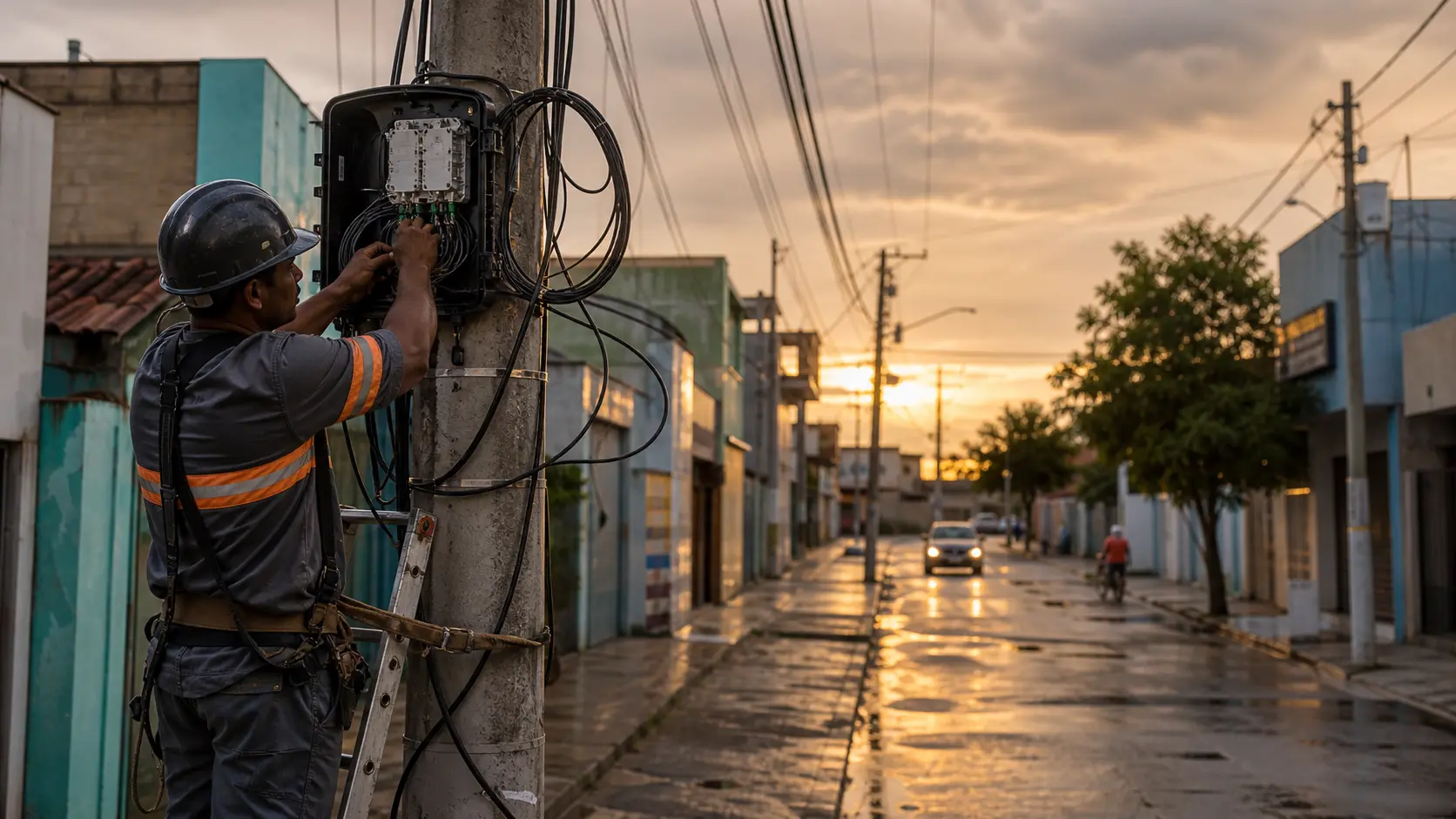
The useful way to read Vupt Provedora de Internet is to start with payback, not coverage. Brazil's fibre story has moved beyond the period when simply building optical access in an underserved town could generate obvious growth. In many interior markets, the first fibre pass created customers quickly because DSL, radio and distant national operators left room for a local challenger. The harder phase is the one Vupt now inhabits: the streets are already served, competing offers are visible, customers expect high speeds at low monthly prices, and each new home can add a support obligation as much as a revenue stream.
Vupt's own public site positions the company as a pioneer in Ita, Santa Catarina, saying it has offered high-performance internet and customer service for more than 20 years and now works with fibre-optic internet (https://www.vupt.com.br/). That history matters. A provider that has stayed visible for two decades in a small municipality is not a transient reseller. It has survived technology migration, regulatory change, customer churn and the operational grind of maintaining outside plant through weather, road work, power interruptions and household equipment failures. But longevity by itself does not solve the economics of a low-ticket fibre base. It can even make the problem sharper: an old local ISP may carry legacy customer expectations, older network segments, personal-service promises and a support culture that customers value but that is expensive to scale.
The strongest public evidence points to Vupt as a real, small, access-focused operator rather than a paper entity. Corporate records show VUPT PROVEDORA DE INTERNET LTDA under CNPJ 05.501.178/0001-30, active since 11 February 2003, with its matrix in Ita and a primary economic activity of internet access providers (https://casadosdados.com.br/solucao/cnpj/vupt-provedora-de-internet-ltda-05501178000130). The company received an Anatel authorization in 2010 to provide Multimedia Communication Service, or SCM, for an indefinite period and without exclusivity across Brazil (https://www.gov.br/mme/pt-br/arquivos/do-01-11-2010-s1.pdf). Its network resources are also visible: AS52986 is registered to Vupt Provedora de Internet Ltda, with Registro.br/NIC.br data tying the ASN to the same CNPJ and to the 177.52.208.0/22 and 2804:9844::/32 resources (https://bgp.tools/as/52986 and https://ftp.registro.br/pub/numeracao/origin/nicbr-asn-blk-latest.txt).
Those facts establish identity and operating substance. They do not establish a large growth story. Radar da Telecom's public profile shows Vupt with 875 fixed broadband accesses in Ita in April 2026 and a footprint summary based on one municipality (https://www.radardatelecom.com/empresa/vupt-provedora-de-internet-ltda and https://www.radardatelecom.com/empresa/vupt-provedora-de-internet-ltda/locais-de-risco). Ita itself is small: IBGE's 2022 census page gives the municipality 7,067 residents and a density of 42.50 people per square kilometre (https://www.ibge.gov.br/cidades-e-estados/sc/ita.html). In that setting, a provider can be important to the local economy without having much room to grow unless it expands to neighbouring towns, wins business accounts, improves pricing, lowers churn or becomes a target in someone else's consolidation strategy.
That is the payback test. If Vupt's 300 to 600 Mbps retail plans are mainly a way to keep a loyal local base and defend against rivals, the company is a durable utility-like access business with constrained upside. If the same network can extract better revenue from business customers, municipal accounts, managed Wi-Fi, voice, monitoring, local support and high-quality service, then the small-town position can produce resilient cash. The public facts lean toward the first reading with some option value in the second.
Vupt has enough infrastructure evidence to matter, but not enough public evidence of premium ARPU, multi-city scale or deep peering independence to call it a compounding regional platform.
Identity, registration and the trading-name reconciliation
The company's identity is unusually clean for a small regional ISP because the main operating name, corporate name and public network name all converge. The directory-facing name is Vupt Provedora de Internet. Casa dos Dados lists the corporate name as VUPT PROVEDORA DE INTERNET LTDA, the CNPJ as 05.501.178/0001-30, the cadastral status as active, the opening date as 11 February 2003, and the matrix address at Rua 01, 155, Centro Comercial Azaleia, Centro, Ita, Santa Catarina (https://casadosdados.com.br/solucao/cnpj/vupt-provedora-de-internet-ltda-05501178000130). Econodata repeats the same CNPJ, active status, Ita location and CNAE J-6190-6/01 for internet access providers (https://www.econodata.com.br/consulta-empresa/05501178000130-vupt-provedora-de-internet-ltda). The public site uses the commercial brand "Vupt", lists an Ita branch at Rua Um, 155, Centro, and publishes the email atendimento@vupt.com.br plus the phone numbers (49) 3458-2003 and (49) 9 8808-8287 (https://www.vupt.com.br/).
There is no obvious conflict between the live trading brand and the legal name. Casa dos Dados shows the "Nome Fantasia" field as blank or unavailable, but that absence does not mean the public Vupt brand is unsupported. It means the tax registry mirror does not expose a separate fantasy-name field. The stronger reconciliation is cross-source: the website, PeeringDB, BGP.Tools, Registro.br-derived records and public CNPJ mirrors all connect Vupt, Vupt Provedora de Internet Ltda, the domain vupt.com.br, AS52986 and CNPJ 05.501.178/0001-30.
In public analysis, that is enough to treat Vupt Provedora de Internet as the company profile's subject without inventing a different trading identity.
The branch history is less important operationally but useful as a signal of past regional ambition. Econodata lists a Seara branch under CNPJ 05.501.178/0002-10, opened on 26 March 2003, but also shows that unit as closed since 21 December 2006 after voluntary liquidation (https://www.econodata.com.br/consulta-empresa/05501178000210-vupt-provedora-de-internet-ltda). Seara is not a trivial adjacent market. IBGE's 2022 census page gives it 18,620 residents, materially larger than Ita (https://www.ibge.gov.br/cidades-e-estados/sc/seara.html). The old branch does not prove current coverage in Seara, and it should not be treated as live footprint. It does, however, frame Vupt as a company that once registered beyond its Ita base and then appears to have concentrated the formal operating centre back on the matrix.
The ownership data also support a local operating profile. Casa dos Dados lists Milton Aureo Martiori as socio-administrador from 12 June 2009 and Eva Rozangela Lemes as socio from 11 December 2015 (https://casadosdados.com.br/solucao/cnpj/vupt-provedora-de-internet-ltda-05501178000130). BGP.Tools' Registro.br whois block also names Milton Aureo Martiori as the responsible contact for AS52986 (https://bgp.tools/as/52986). That overlap matters because many tiny ISPs have confusing public footprints: one person in the corporate record, another in the network registry, a third in the social profile and an unrelated brand on the customer-facing site. Vupt's public record is more coherent. The same company name and CNPJ sit behind the legal entity, ASN and site.
The corporate activity list is broad. Casa dos Dados and Econodata expose a principal CNAE for internet access providers and secondary activities that include electrical installation and maintenance, retail of computing and telecommunications equipment, STFC, SCM, mobile telephony, cable and microwave pay-TV, VoIP, other telecom activities, software licensing, technical support, hosting or data treatment, portals, security monitoring and equipment rental (https://casadosdados.com.br/solucao/cnpj/vupt-provedora-de-internet-ltda-05501178000130 and https://www.econodata.com.br/consulta-empresa/05501178000130-vupt-provedora-de-internet-ltda). That does not mean Vupt actively sells every listed service. Brazilian company records often preserve broad authorizations to avoid future amendments. But the breadth is still economically meaningful: the company has kept optionality around voice, IT support, equipment, monitoring and business services, which are precisely the add-ons that can protect a small ISP from becoming only a cheap broadband pipe.
The service offer: fibre plans priced for household affordability
Vupt's current site is a retail broadband site, not an enterprise-carrier site. Its homepage data show three internet plans: 300 Mega at R$110, 400 Mega at R$140, and 600 Mega at R$160. Each plan is presented with a Giga router on loan, free installation, 150 Mega upload and advanced technical support, with WhatsApp links for contracting (https://www.vupt.com.br/). The marketing language emphasizes routine use, ease, entertainment, and the company's role as a high-performance local internet provider. The site also links to a subscriber centre at vupt.sgp.net.br, a speed test, webmail, Facebook and Instagram channels (https://www.vupt.com.br/).
Those plan points explain the margin problem better than any abstract market chart. A R$110 monthly plan can be commercially powerful in a town of 7,067 people because it is affordable enough for households, students, small shops and home workers. But the same price also limits the amount of operational friction the provider can absorb. If a customer requires a truck roll for a drop cable, a replacement router, an in-home Wi-Fi complaint, a late-payment collection sequence, a long support call and a retention discount, a low monthly fee can turn from attractive revenue into thin cash.
The 150 Mbps upload claim across all three packages is a particularly interesting clue. It gives the entry 300 Mbps plan a 2:1 download-to-upload ratio, the 400 Mbps plan a 2.67:1 ratio, and the 600 Mbps plan a 4:1 ratio. From a retail perspective, the uniform upload simplifies the portfolio and gives even the low plan enough upstream for video calls, cloud backup, gaming and social media. From an engineering and economic perspective, it suggests the price ladder is mostly about download headline speed and willingness to pay, not a fully differentiated service class.
That can work if most households buy on download number while actual peak usage remains manageable. It becomes more difficult if customers increasingly use high-bitrate video, home cameras, cloud storage and multiple simultaneous streams while refusing to move to a higher plan.
The public-sector contract evidence anchors pricing from a different angle. A January 2024 extract from the Camara de Vereadores de Ita states that Vupt, under CNPJ 05.501.178/0001-30, was contracted to implement, operate and maintain a dedicated internet link at the chamber, with 100 Mbps download, 30 Mbps upload, Wi-Fi, 24-hour availability, required equipment and technical support, for R$98.66 per month and a 2024 total of R$1,183.92 (https://s3cache.dom.sc.gov.br/atos/2024/01/1705431084_extrato__contrato__internet_extrato.pdf). That is not a full enterprise SLA in the global carrier sense. It is a local government connectivity contract. But it is still evidence that Vupt sells practical institutional service, including equipment and support, at a very low monthly ticket.
The low public-contract price should not be overread. Municipal contracts can be small, competitive, structured around existing local access, or designed for a specific bandwidth and support obligation. The chamber link may have strategic value beyond its fee because public-sector presence reinforces local credibility. Still, the number is a useful warning: even institutional service can be priced close to residential broadband. If that is representative of local willingness to pay, Vupt's profit depends on operational discipline more than pricing power.
The company's retail offer does include one margin-friendly element: the router is in comodato, or loaned by the provider, rather than simply sold to the customer. That helps standardize support and keeps the device inside the provider's control. It also puts capital and replacement risk on Vupt. Free installation is similar. It lowers customer acquisition friction, but it means Vupt must earn back the activation cost through months of service. In a growing market with low churn, free installation can be rational. In a saturated market where customers switch for promotions, it becomes a payback trap.
That is why the headline speed is not the main economic variable. The main variable is how many customers stay long enough, pay on time, use support moderately and accept plan upgrades or adjacent services. A 600 Mbps plan at R$160 is not unattractive in a small Brazilian town, but it is not a premium ARPU platform either. The company needs customers who value reliability, local support and quick repair more than the absolute lowest price. The website's emphasis on service and more than 20 years of presence is therefore not decorative.
It is the only defensible margin story available to a small ISP facing the commodity logic of fibre speed.
The network evidence: real resources, limited scale, two visible upstreams
Vupt's network record is stronger than a generic reseller's. BGP.Tools identifies AS52986 as Vupt Provedora de Internet Ltda, registered on 26 April 2011, active and allocated under NIC.br. It shows four originated IPv4 prefixes and seven IPv6 prefixes, plus a Registro.br whois block tying the ASN to owner ID 05.501.178/0001-30 (https://bgp.tools/as/52986). Registro.br's public NIC.br origin file lists AS52986, Vupt Provedora de Internet Ltda, the same CNPJ, 177.52.208.0/22 and 2804:9844::/32 (https://ftp.registro.br/pub/numeracao/origin/nicbr-asn-blk-latest.txt). PeeringDB lists Vupt Provedora de Internet Ltda with company website https://www.vupt.com.br, ASN 52986, network type Cable/DSL/ISP, one IPv4 prefix, 5-10Gbps traffic level, balanced traffic ratio and no disclosed public exchange or facility entries (https://www.peeringdb.com/net/40723).
These signals establish that Vupt is not merely buying a retail connection and rebilling households. It has its own autonomous system, address resources, routing visibility and public network identity. In a small-town context, that is significant. It gives the company more control over routing, upstream choice, abuse handling, customer address management and service quality than a pure white-label reseller would have. It also creates technical obligations: route hygiene, RPKI, abuse response, capacity planning, IPv6 configuration, monitoring and vendor coordination.
The same records show scale limits. BGP.Tools lists Vupt as an "eyeball" network with four /24s of IPv4 and 65,536 /48s of IPv6, while PeeringDB reports 5-10Gbps traffic. The exact capacity behind those public fields is not the same as revenue, customer count or owned fibre mileage. Still, it fits the pattern of a local access provider rather than a state-wide backbone operator. In Brazil, a national or acquisitive regional platform would usually show more extensive peering fabric, more facilities, more public traffic disclosures, more geographic breadth and larger retail base evidence.
Vupt's public network footprint is credible but compact.
The upstream picture is central to risk. BGP.Tools shows two upstreams for AS52986: AS53062, labelled ALT | Grupo Brasil TecPar, and AS28146, MHNET Telecom (https://bgp.tools/as/52986). That combination is both sensible and strategically revealing. MHNet is a strong regional connectivity name in the South, and Brasil TecPar has become a major consolidator in Brazilian broadband. Teletime's 2026 coverage of 2025 broadband results says Brasil TecPar added 512,000 broadband customers in 2025 largely through acquisitions and reached 1.344 million customers, while MHNet ended 2025 around 330,500 accesses (https://teletime.com.br/02/02/2026/vivo-brasil-tecpar-claro-starlink-os-destaques-na-banda-larga-em-2025/). If Vupt buys transit or connectivity from such upstreams, it benefits from their scale, routes and regional infrastructure. It also sits downstream of larger actors whose strategic decisions can reshape local wholesale economics.
Two visible upstreams are better than one, but not the same as broad independence. If one path degrades, the second can preserve reachability. If both are commercial or regional dependencies rather than neutral exchange diversity, Vupt may still be exposed to price increases, routing congestion, contract renegotiation or consolidation-related changes. The public PeeringDB profile does not show public peering exchange points or interconnection facilities (https://www.peeringdb.com/net/40723). That absence does not mean Vupt lacks private arrangements, but it means public evidence does not support a thesis of deep peering optionality.
For customers, this upstream architecture is invisible until something breaks. A household in Ita buys Vupt, not AS paths. But for investor or strategic analysis, upstream dependency defines the ceiling on independent value. A compact ISP with local last-mile control and reasonable upstream contracts can generate steady cash. A compact ISP with high wholesale costs, weak redundancy or little bargaining power can look profitable at the subscriber line and disappoint at the cash line.
The available evidence suggests Vupt has enough technical capability to operate its own access network, but not enough public interconnection depth to treat upstream as a solved problem.
The network also needs to be read against Brazilian IPv4 scarcity and IPv6 migration. Vupt's Registro.br-listed /22 gives it roughly 1,024 IPv4 addresses in the aggregate block, while some route databases show more specific announcements. A small access base can operate within that resource envelope, especially with CGNAT, but customer expectations, gaming, cameras, remote access and business services can create support complexity when private addressing or shared public IP models are used. Vupt has visible IPv6 resources, which is positive.
The commercial question is whether IPv6 is fully deployed and used enough to reduce IPv4 pressure and customer pain. Public BGP evidence shows capability; it does not prove customer-side adoption quality.
Customer dependency in Ita: local importance without a large addressable base
Ita is the right scale for Vupt's brand but the wrong scale for an easy growth story. IBGE's 2022 population figure of 7,067 people implies a small universe of homes and businesses (https://www.ibge.gov.br/cidades-e-estados/sc/ita.html). Radar da Telecom's 875-access figure for Vupt in April 2026 implies that the company is meaningful inside that universe but not dominant enough, on public evidence, to own the whole municipality (https://www.radardatelecom.com/empresa/vupt-provedora-de-internet-ltda). The same Radar risk page treats the footprint base as one municipality and lists Ita as the served market in the public extract (https://www.radardatelecom.com/empresa/vupt-provedora-de-internet-ltda/locais-de-risco).
This creates a dual dependency. Local customers depend on Vupt because a town's connectivity market needs providers that answer phones, understand local addresses, repair lines after storms and can work directly with small businesses and public bodies. Vupt depends on those same customers because there is limited room to replace them. A customer lost in a major city is one of many potential replacements. A customer lost in a town of 7,067 people may be a neighbour, a shopkeeper, a municipal department or a household that speaks to many other households. Churn has reputational weight.
The public website's contact and support posture supports this local-service reading. It displays phone, WhatsApp, email, a subscriber centre and social links (https://www.vupt.com.br/). The Facebook page snippets indexed by search engines show outage-style language apologizing for inconvenience and giving contact numbers, while Instagram snippets point to storm-care and fibre reliability posts around Ita. Those social snippets are not evidence of chronic outages or service quality. They are weak operational signals. They show that Vupt communicates in the ordinary language of a local ISP: weather, support, customer equipment, fibre stability, apologies, phone numbers and social presence. That is exactly the operating surface where local value is won or lost.
The municipal chamber contract also reinforces customer dependency. A 100 Mbps by 30 Mbps link with Wi-Fi, equipment and support for the Camara de Vereadores is not a large revenue line, but public-sector service has signalling value in a small town (https://s3cache.dom.sc.gov.br/atos/2024/01/1705431084_extrato__contrato__internet_extrato.pdf). If the chamber connection performs well, it strengthens the idea that Vupt is a trusted local utility. If a public customer has visible issues, the reputational damage can spread quickly. The economics of small-town ISP work are therefore not just technical. They are civic and relational.
The customer base likely includes a mix of households, small shops, professional offices, local public entities and possibly rural or peri-urban users. The corporate registration's secondary activities around equipment retail, technical support, VoIP, hosting, monitoring and telecom services create room for customer-specific work, but the public site does not foreground a sophisticated enterprise portfolio. That means the main public product remains broadband. If Vupt wants to defend cash flow, it needs to convert locality into paid service differentiation, not simply friendliness.
Examples would include managed Wi-Fi for small hospitality venues, priority business support, fixed voice bundles where still relevant, security monitoring, camera connectivity, static-IP packages, municipal or school links and better home-network installation. Public records show permission and plausibility; they do not yet show enough evidence of that monetization at scale.
The size of Ita also changes how to think about competition. A national carrier's brand can enter or discount; a nearby regional provider can expand; wireless or satellite can cover pockets; informal networks can undercut prices. But Vupt's advantage is proximity. It can respond faster, know which streets have troublesome plant, and maintain relationships that remote call centres cannot. The disadvantage is that proximity is labour-intensive. If every differentiation claim is delivered through human support, the company must either charge enough to pay for it or keep operations extremely efficient.
A low-price plan set makes that difficult.
Cost base: poles, support, customer equipment, collections and capacity
The article's core judgement turns on costs that customers do not see. A fibre ISP's public offer is a speed number and a monthly fee. The cash cost underneath includes backhaul and transit, poles or ducts, optical line terminals, distribution fibre, splitters, drops, ONTs or routers, installation labour, vehicles, tools, spares, billing systems, customer service, payment processing, bad debt, taxes, regulatory compliance, office rent and network monitoring. In a small market, many of those costs are lumpy. One extra technician, vehicle or upstream commit can change margins quickly.
Pole access is one of the hardest variables in Brazil's local fibre economics. The general regulatory debate has been intense because telecom networks depend heavily on utility poles, while energy distributors, telecom providers and regulators have disagreed over access, pricing, safety and management. Developing Telecoms summarized the Anatel-Aneel dispute in 2024 by noting Anatel's position that poles are essential infrastructure for cable installation, especially internet access (https://developingtelecoms.com/telecom-business/telecom-regulation/17062-dispute-between-brazilian-agencies-sets-back-pole-sharing-plans.html). Teletime reported in December 2025 that Aneel approved a new version of the pole-sharing regulation, still needing Anatel review, with debate around third-party pole managers and conditions for commercial exploitation (https://teletime.com.br/02/12/2025/aneel-aprova-nova-versao-do-regulamento-de-compartilhamento-de-postes/). Lefosse's 2026 telecom newsletter noted that Brazil's Senate approved Bill No. 3,220/2019 on utility-pole sharing in April 2026 and sent it to the Chamber of Deputies (https://lefosse.com/en/news/telecommunications-newsletter-may-2026/).
For Vupt, the point is not to predict the final rule. The point is that neighbourhood fibre economics are exposed to pole discipline. If a provider has regularized pole use and clean plant, it can reduce legal, safety and repair risk. If a provider faces higher pole fees, forced rearrangements, make-ready costs or disputes, the same R$110 plan can become less attractive. Vupt's own public site and the municipal contract confirm fibre operations; they do not disclose pole counts, pole contracts or make-ready exposure (https://www.vupt.com.br/ and https://s3cache.dom.sc.gov.br/atos/2024/01/1705431084_extrato__contrato__internet_extrato.pdf). A public CELESC spreadsheet is indexed as listing VUPT PROVEDORA DE INTERNET LTDA among companies with infrastructure-sharing contracts, but without a parsed row in this review it is best treated as a lead rather than a decisive fact. The economic risk remains real either way: local aerial fibre depends on access to shared physical infrastructure.
Support cost is the second major variable. Vupt's plans include "Suporte Tecnico Avancado" across all speed tiers, according to the site payload (https://www.vupt.com.br/). That is a promise. In a market where a 300 Mbps plan costs R$110, the provider cannot afford unlimited in-home troubleshooting. Many customer complaints about "internet" are actually Wi-Fi placement, old phones, congested home routers, streaming app issues, power cycling, storm-damaged equipment or unrealistic speed-test expectations. The provider still receives the support call. The router-on-loan model helps because Vupt can standardize equipment, but it also means the company owns device lifecycle and replacement economics.
Collections and payment behaviour are the third variable. The 2024 chamber contract specifies monthly payment by invoice and bank slip (https://s3cache.dom.sc.gov.br/atos/2024/01/1705431084_extrato__contrato__internet_extrato.pdf). Residential billing will differ, but Brazilian ISPs commonly manage boleto, Pix, automatic systems and suspension-reconnection workflows. A small ISP has to balance strict collection with relationship risk. Cut off too quickly and reputation suffers; tolerate too much delinquency and cash flow weakens. In low-ticket plans, even small bad-debt percentages can erase the margin created by an incremental subscriber.
Capacity planning is the fourth variable. PeeringDB's 5-10Gbps traffic field suggests a compact traffic scale relative to larger operators (https://www.peeringdb.com/net/40723). If Vupt buys wholesale capacity efficiently and the customer base is stable, that is manageable. If streaming growth, higher plan uptake or peak-hour congestion require step changes in upstream, aggregation or equipment, the company must fund capacity ahead of revenue. The low ladder between R$110, R$140 and R$160 leaves only R$50 difference between entry and top published plan. That gives limited room to recover a major network upgrade solely through upsell unless many customers move upward.
The fifth variable is field labour. Free installation can be an effective acquisition lever, but it creates upfront payback risk. Fibre drops in older streets, rural edges or storm-prone areas can require return visits. When a national operator runs a promotion, the local provider may have to defend the base with discounts or service gestures. That is not a technology problem. It is unit economics. Vupt's most valuable asset may be local knowledge of plant and customers, but that asset has to translate into fewer truck rolls, faster first-time fixes and lower churn.
The Anatel context: regulation is tightening around the very market Vupt represents
Vupt belongs to the Brazilian fixed-broadband world that Anatel increasingly frames around small providers, regularization and data quality. Anatel's June 2025 action plan for unfair competition and regularization of fixed broadband said small providers had become responsible for more than 53% of fixed-broadband accesses in 2023, especially in lower-IDH and lower-PIB regions, while informal and clandestine operations created risks to competition, infrastructure, cybersecurity and consumers (https://www.gov.br/anatel/pt-br/assuntos/noticias/anatel-aprova-plano-de-acao-para-combate-a-concorrencia-desleal-e-regularizacao-da-banda-larga-fixa). The same Anatel communication said more than 41% of companies habilitated to provide SCM had not submitted mandatory access information, and the rate exceeded 55% among those dispensed from authorization (https://www.gov.br/anatel/pt-br/assuntos/noticias/anatel-aprova-plano-de-acao-para-combate-a-concorrencia-desleal-e-regularizacao-da-banda-larga-fixa).
That context has two opposite effects for Vupt. On the positive side, a long-registered company with a 2010 SCM authorization, an active CNPJ and visible ASN is better placed than an informal operator when regulators tighten. The DOU authorization record shows Vupt's formal SCM status long before the 2025 regularization push (https://www.gov.br/mme/pt-br/arquivos/do-01-11-2010-s1.pdf). The public Registro.br and BGP records further support regular network identity (https://bgp.tools/as/52986). If Anatel enforcement reduces illegal undercutting, formal small ISPs could gain pricing relief.
On the negative side, tighter regulation raises compliance overhead. Anatel's resolution page for Internal Resolution No. 449 says the action plan targets authorized providers, providers that had operated under authorization exemption rules, infrastructure holders and any other actors in the SCM value chain, especially clandestine providers (https://informacoes.anatel.gov.br/legislacao/resolucoes-internas/2030-resolucao-interna-449). Even compliant operators must keep data, authorizations, consumer obligations, cybersecurity expectations, station licensing where applicable and sector reporting current. For a 875-access provider, the administrative burden is not trivial. It consumes management attention that a larger group can spread across a bigger base.
Brazil's access data collection environment also matters. Anatel says access data collection moved from DICI to the Coleta de Dados Anatel system from 1 June 2022 (https://www.gov.br/anatel/pt-br/regulado/universalizacao/coletas-de-dados-de-acessos). Base dos Dados describes the fixed broadband access dataset as originating from Anatel and covering total fixed-broadband accesses, also known as SCM (https://basedosdados.org/dataset/4ba41417-ba19-4022-bc24-6837db973009). Radar da Telecom builds company views from Anatel data and shows Vupt's public access count, but small-provider reporting delays and data quality issues mean any monthly number should be treated as a strong indicator, not a fully audited financial base (https://www.radardatelecom.com/empresa/vupt-provedora-de-internet-ltda).
The regulatory direction also affects valuation. A small ISP with formal licensing, clean pole contracts, accurate data reporting, homologated equipment, documented customer terms and tax discipline is easier to finance or sell. A provider with undocumented plant, messy data or informal customer practices may still have subscribers but will be discounted heavily by buyers. Vupt's public record gives positive signals on formal identity and network registration.
The missing pieces are the ones buyers would diligence privately: pole inventory, customer contracts, churn, ARPU, delinquency, customer concentration, network topology, backhaul contracts, equipment age, tax status, labour liabilities and quality-of-service history.
Consolidation pressure: Vupt sits downstream of the consolidators' logic
Brazil's broadband market still looks fragmented, but the strategic direction is consolidation. Teletime reported that the market ended 2025 with 53.88 million fixed-broadband accesses, up 2.5% from 2024, and that Vivo, Brasil TecPar, Claro, Starlink, Brisanet, Desktop, TIM, Unifique, Alares and others shaped the main access movements (https://teletime.com.br/02/02/2026/vivo-brasil-tecpar-claro-starlink-os-destaques-na-banda-larga-em-2025/). The same report described Brasil TecPar as the main consolidator of the broadband market in the previous two years, adding 512,000 accesses in 2025 mainly through acquisitions (https://teletime.com.br/02/02/2026/vivo-brasil-tecpar-claro-starlink-os-destaques-na-banda-larga-em-2025/). Opensignal's 2025 fixed broadband report said Anatel data showed fibre at 78% of connections in July 2025 and noted that as tax differentiation between broadband access and underlying fibre infrastructure is phased out, owning underlying fibre may become more appealing (https://insights.opensignal.com/reports/2025/10/brazil/fixed-broadband-experience).
Vupt is not publicly presented as a consolidation target. There is no public evidence in the sources reviewed of a sale process, acquisition discussion or buyer approach. The pressure is structural rather than specific. A provider with fewer than 1,000 reported accesses in one municipality can be valuable to a consolidator only if it brings clean local plant, loyal customers, low churn, good poles, a local team, useful routes or an attractive adjacency to an existing network. It is unlikely to move a large buyer's national share. Its value would be operational, not headline-making.
The upstream list is the reason consolidation pressure should be taken seriously. One visible upstream is ALT | Grupo Brasil TecPar, a group publicly associated with rapid in-market expansion by acquisition (https://bgp.tools/as/52986 and https://teletime.com.br/02/02/2026/vivo-brasil-tecpar-claro-starlink-os-destaques-na-banda-larga-em-2025/). That does not imply any relationship beyond connectivity. But it shows that Vupt's network is already commercially connected to a larger consolidation actor. MHNet, the other visible upstream, is itself a large regional operator in the South (https://bgp.tools/as/52986). In markets like this, the same companies that supply capacity, compete nearby or acquire neighbours can shape the wholesale-retail balance for small ISPs.
There are three plausible strategic paths. The first is local endurance: Vupt remains independent, focuses on Ita, protects service quality, keeps capex modest and uses add-on services to improve ARPU. That is plausible if the owners value local control and the business generates satisfactory cash. The second is selective expansion: Vupt uses its brand and network knowledge to win nearby pockets, business accounts or public-sector links without building a wide regional platform. The old Seara branch history makes regional ambition imaginable, but not current.
The third is eventual absorption: a larger operator values the customer base and local plant enough to buy or partner, especially if pole and customer records are clean.
The risk is that Vupt gets stuck between those paths. Staying independent without premium pricing can make the business a job more than an asset. Expanding without scale capital can stretch support and backhaul. Selling without clean documentation can leave value on the table. The public facts do not let us choose the path. They do let us identify the hinge: Vupt's future depends less on whether fibre demand exists and more on whether the company can prove that each serviced customer produces durable cash after real local costs.
Unofficial signals: useful colour, not established fact
For a small ISP, public chatter can be analytically useful because formal disclosures are thin. It also has to be handled cautiously. Search-indexed Facebook snippets for Vupt Provedor de Internet in Ita show customer-facing outage or maintenance language, including apologies for inconvenience and contact numbers. Instagram snippets for Vupt Provedor or Vupt Provedor de Internet show marketing around fibre, storm care, equipment precautions, routine internet stress and local service in Ita. These are weak signals, not verified service-quality metrics.
They should not be used to claim that Vupt has frequent outages, poor support or superior support. They do show the texture of the business: the provider communicates as a local household-facing fibre operator whose support relationship includes weather, equipment and routine customer education.
The same caution applies to third-party market pages. Radar da Telecom gives a useful public Anatel-derived view of access count and municipality exposure (https://www.radardatelecom.com/empresa/vupt-provedora-de-internet-ltda). Casa dos Dados and Econodata mirror Receita Federal data and are useful for CNPJ, address, CNAE and ownership facts (https://casadosdados.com.br/solucao/cnpj/vupt-provedora-de-internet-ltda-05501178000130 and https://www.econodata.com.br/consulta-empresa/05501178000130-vupt-provedora-de-internet-ltda). Network databases such as BGP.Tools and PeeringDB are strong for routing and self-published network profile data, but they are not financial statements (https://bgp.tools/as/52986 and https://www.peeringdb.com/net/40723). The public record is enough for a company-research judgement, not enough for a lender's underwriting model.
The best unofficial signal for Vupt may be what is absent. There is no obvious public wave of national press coverage, major acquisition announcements, multi-state expansion, large-scale outage news or consumer scandal in the sources reviewed. For a small local ISP, that absence is mildly positive. It suggests the company is ordinary in the best and worst sense: a local operator doing the work without becoming a major public controversy. But absence is not proof. Small-town complaints often live in private WhatsApp groups, local conversations, unindexed comments or customer service logs.
Serious diligence would need live customer interviews, invoice samples, churn cohorts and network-performance data.
What would change the judgement
The current judgement is deliberately restrained: Vupt is an important local fibre operator with real network substance, but its economics look constrained unless operational quality and add-on services lift cash generation above commodity broadband pricing. Several facts could change that view.
The first would be evidence of a materially larger active footprint than the public Radar extract shows. If Vupt has meaningful active customers beyond Ita, or if April 2026 access reporting understates the base because of reporting delays or corporate grouping, the scale thesis improves. The second would be ARPU evidence. A customer base paying materially above the website's residential plan ladder through business links, managed services, static-IP products, voice, monitoring, hospitality Wi-Fi or municipal contracts would make the company more resilient. The third would be proof of low churn and low delinquency.
A small ISP with loyal, current customers can be more valuable than a bigger provider with constant promotional churn.
The fourth would be clean pole and plant documentation. If Vupt can show regularized pole access, mapped outside plant, low make-ready exposure, good network documentation and no major physical-infrastructure disputes, the risk discount falls. The fifth would be upstream and capacity optionality: more diverse upstreams, local cache arrangements, exchange participation, strong IPv6 deployment and favourable long-term capacity pricing. The sixth would be evidence of superior support efficiency, not just support effort. Fast first-time fixes, low repeat calls and standardized equipment would support the local-service thesis.
The seventh would be credible consolidation optionality: an adjacent buyer, integration logic, or partnership that values Vupt's local position without crushing its service reputation.
Negative facts would also change the view. High customer concentration in low-priced plans, high delinquency, frequent truck rolls, unpaid pole obligations, informal plant, weak reporting, old equipment, rising upstream prices, customer churn to national competitors or satellite, and dependence on owner labour would all make the business less attractive. The most damaging combination would be low ARPU plus high support cost. That is the small-ISP trap: customers love a local provider until the provider has to price service at its real cost.
Evidence register
- Corporate identity and CNPJ: Casa dos Dados page for VUPT PROVEDORA DE INTERNET LTDA, CNPJ 05.501.178/0001-30, active status, opening date, address, CNAE and partners: https://casadosdados.com.br/solucao/cnpj/vupt-provedora-de-internet-ltda-05501178000130
- Corporate corroboration: Econodata page for the Ita matrix and CNPJ 05.501.178/0001-30: https://www.econodata.com.br/consulta-empresa/05501178000130-vupt-provedora-de-internet-ltda
- Branch history: Econodata page for CNPJ 05.501.178/0002-10 in Seara, opened 26 March 2003 and closed 21 December 2006: https://www.econodata.com.br/consulta-empresa/05501178000210-vupt-provedora-de-internet-ltda
- Company site, service offer, plans, contact details, branch and self-description: https://www.vupt.com.br/
- SCM authorization: Diario Oficial da Uniao PDF containing Ato No. 6.965 of 25 October 2010 for Vupt Provedora de Internet Ltda - ME, CNPJ 05.501.178/0001-30: https://www.gov.br/mme/pt-br/arquivos/do-01-11-2010-s1.pdf
- Network evidence: BGP.Tools page for AS52986, including ASN, registration date, prefixes, upstreams and whois block: https://bgp.tools/as/52986
- NIC.br origin file: AS52986 with Vupt Provedora de Internet Ltda, CNPJ, IPv4 and IPv6 resources: https://ftp.registro.br/pub/numeracao/origin/nicbr-asn-blk-latest.txt
- PeeringDB network profile for Vupt Provedora de Internet Ltda, ASN 52986, traffic band and company website: https://www.peeringdb.com/net/40723
- Anatel-derived market profile: Radar da Telecom page for Vupt, including public access-count context: https://www.radardatelecom.com/empresa/vupt-provedora-de-internet-ltda
- Radar risk and municipality page: one-municipality footprint and Ita access signal: https://www.radardatelecom.com/empresa/vupt-provedora-de-internet-ltda/locais-de-risco
- Municipal contract evidence: Camara de Vereadores de Ita contract extract for 100 Mbps/30 Mbps fibre internet, Wi-Fi, equipment and support at R$98.66 monthly in 2024: https://s3cache.dom.sc.gov.br/atos/2024/01/1705431084_extrato__contrato__internet_extrato.pdf
- Ita demographics: IBGE Cidades e Estados page for Ita, Santa Catarina: https://www.ibge.gov.br/cidades-e-estados/sc/ita.html
- Seara demographics: IBGE Cidades e Estados page for Seara, Santa Catarina: https://www.ibge.gov.br/cidades-e-estados/sc/seara.html
- Anatel data collection context: Coletas de Dados de Acessos page: https://www.gov.br/anatel/pt-br/regulado/universalizacao/coletas-de-dados-de-acessos
- Anatel fixed-broadband regularization plan and unfair-competition context: https://www.gov.br/anatel/pt-br/assuntos/noticias/anatel-aprova-plano-de-acao-para-combate-a-concorrencia-desleal-e-regularizacao-da-banda-larga-fixa
- Anatel Internal Resolution No. 449 legal text: https://informacoes.anatel.gov.br/legislacao/resolucoes-internas/2030-resolucao-interna-449
- Brazilian broadband market and consolidation context: Teletime coverage of 2025 fixed-broadband access movements: https://teletime.com.br/02/02/2026/vivo-brasil-tecpar-claro-starlink-os-destaques-na-banda-larga-em-2025/
- Fibre market context: Opensignal Brazil fixed broadband report, October 2025: https://insights.opensignal.com/reports/2025/10/brazil/fixed-broadband-experience
- Pole-sharing regulatory context: Developing Telecoms on the Anatel-Aneel dispute: https://developingtelecoms.com/telecom-business/telecom-regulation/17062-dispute-between-brazilian-agencies-sets-back-pole-sharing-plans.html
- Pole-sharing regulatory update: Teletime on Aneel's December 2025 approval of a new pole-sharing text: https://teletime.com.br/02/12/2025/aneel-aprova-nova-versao-do-regulamento-de-compartilhamento-de-postes/
- 2026 pole-sharing legislative context: Lefosse telecom newsletter on Bill No. 3,220/2019: https://lefosse.com/en/news/telecommunications-newsletter-may-2026/