
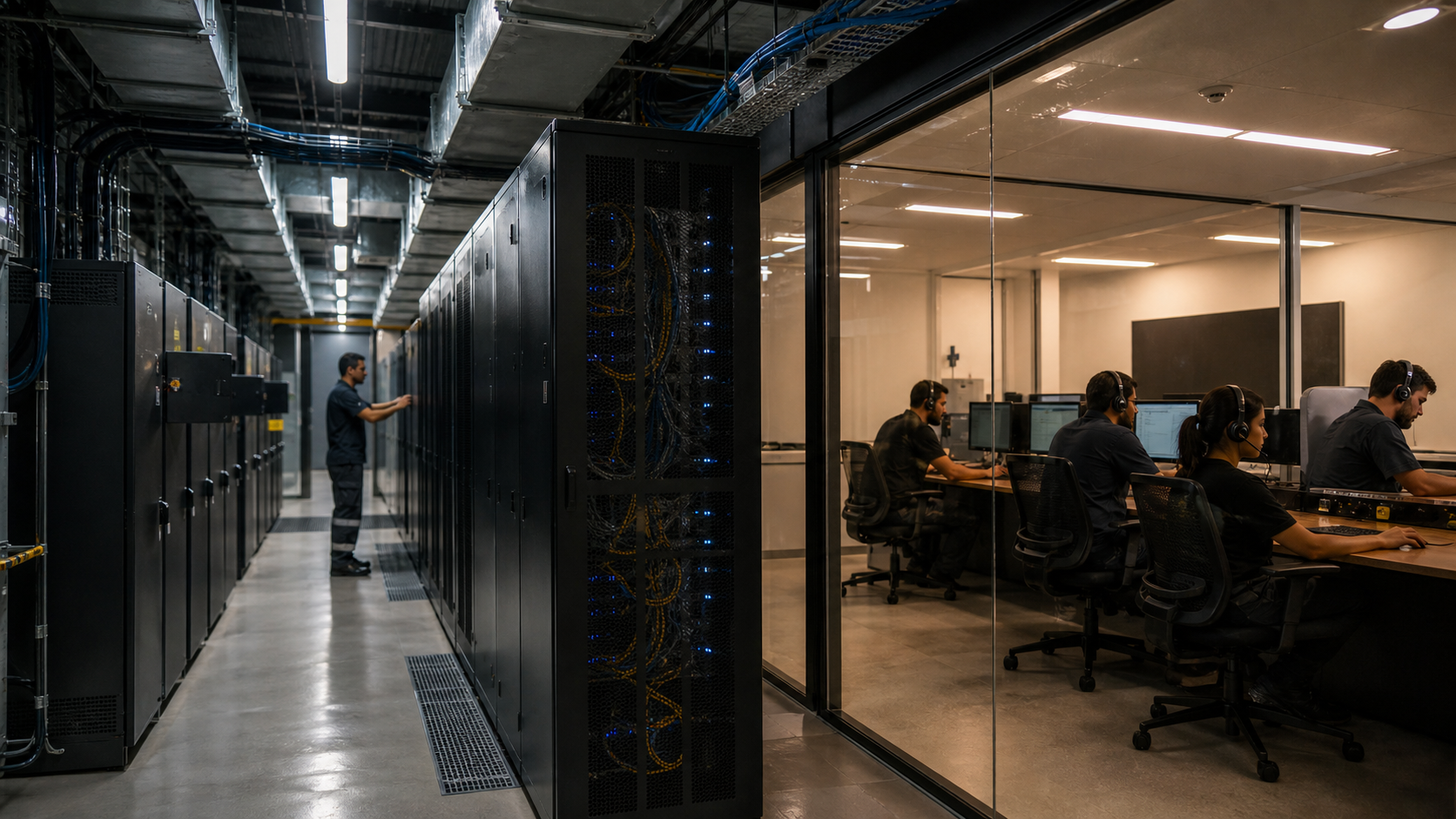
A BRL 149.90 VPS turns local hosting into a measurable operating choice
Start with the customer rather than the company. A Brazilian software house in the interior of Santa Catarina is running a billing portal, a customer records store, a support desk and a marketing site for merchants that do not want every screen load to travel through a foreign account team, a dollar invoice and an English-language ticket queue. The workload is not spectacular. It needs predictable monthly cost, a local phone number, a Portuguese-speaking support path, a data location the customer can explain, and enough network reliability that the owner does not have to become a routing engineer.
That is the economic unit in Visao Datacenter's case: not a national cloud region, but a monthly server plan with a 100 Mb link, SSD storage, IPv4 and IPv6, backup language and human support wrapped around it.
On Visao's own VPS page, the "Cloud Server 5" plan is listed at R$149.90 with 6 GB RAM, 4 vCore, 120 GB SSD NVMe, 100 Mb link, unlimited traffic, included backup, IPv4 and IPv6, root access and scalability language; lower and higher VPS plans run from R$59.90 to R$329.90. https://visaodatacenter.com.br/servidor-cloud-vps/ That price point is small enough to look like commodity hosting, yet it carries promises that are not commodity at all. A 100 Mb access commitment needs upstream capacity, switch ports, routing, monitoring and abuse handling. SSD NVMe capacity needs capital, replacement discipline and failure response. Backup language needs a clear boundary between included convenience and actual recovery guarantee. Root access shifts responsibility to the customer, but support quality still determines whether a small business experiences the service as infrastructure or as a lonely rented machine.
The same unit appears in a more specialized form on the provider plans. Visao sells an IXC Provedor ladder from R$249.90 to R$1,990.90, with stated subscriber bands from 1,000 to 150,000, 100 Mb links, NVMe storage, backup, IPv4 and IPv6, and different RAM and vCore allocations. https://visaodatacenter.com.br/servidor-cloud-ixc-soft/ That is a revealing product family because IXC is not a generic web page workload. It is an operations system for internet providers. A regional ISP considering that plan is not only buying compute; it is weighing whether billing, subscriber management and support-facing tools should sit with a local host that understands provider routines. In that room, latency, billing currency and support rhythm become part of the infrastructure bill.
The hidden bill is visible as soon as the plan is translated into obligations. At R$149.90, Visao must recover some share of hardware depreciation, licenses, IP address scarcity, energy, cooling, rack space, upstream transit, peering, monitoring, payment processing, support labor, abuse handling, tax and customer acquisition. At R$1,990.90 for the largest IXC plan, the gross monthly envelope is larger, but the customer expectation is also larger because the plan is framed around up to 150,000 subscribers. https://visaodatacenter.com.br/servidor-cloud-ixc-soft/ The business is therefore not a simple resale of virtual machines. It is a wager that local hosting can command a premium because customers want a known Brazilian counterparty when operations matter.
Visao's home page makes the promise explicit. It says the company delivers colocation, VPS, dedicated server, backup, website hosting and corporate email from its own structure, with specialized support, low-latency connectivity, multiple IP transits, direct IX.br connection and a 24x7 Network Operation Center. https://visaodatacenter.com.br/ Those claims are the start of the underwriting case, not the end. If they are true in operational practice, Visao can occupy a useful middle ground between global cloud abstraction and small reseller hosting. If they are weak, the same claims become reputational exposure because a customer paying for local trust will punish the provider more harshly than it would punish a faceless commodity server.
The article's central question is therefore narrow and economic: can a young Brazilian hosting company turn local support, fixed-reais products, an autonomous network, IX.br reach and a claimed physical operating base into durable trust before hyperscalers, large Brazilian platforms and better-capitalized data-centre operators compress the easy margin? The answer is not fully public. But the visible evidence is enough to map the bill behind the promise.
The legal company is young, while the brand story reaches backward
The legal identity is clearer than the brand history. Public CNPJ API records list VISAO DATACENTER LTDA, CNPJ 51.470.964/0001-34, as an active limited liability company in Xaxim, Santa Catarina, with the trade name VISAO DATACENTER, primary activity "data processing, application service providers and internet hosting services," activity start date July 18, 2023, micro-enterprise size, Simples tax option and R$100,000 of stated capital. https://brasilapi.com.br/api/cnpj/v1/51470964000134 A second public CNPJ mirror reports the same legal name, active status, Xaxim address, primary activity, micro-enterprise size, R$100,000 capital and last update in June 2026. https://publica.cnpj.ws/cnpj/51470964000134
Those records matter because Visao's public site speaks with the confidence of an infrastructure operator, not a new reseller. Its "Quem Somos" page says Visao Datacenter offers more than infrastructure, describes robust and reliable cloud and connectivity services, and says it has more than 20 years of experience serving companies in different segments. https://visaodatacenter.com.br/quem-somos/ The site footer and contact page repeatedly give the same Xaxim address and CNPJ used by the registry records. https://visaodatacenter.com.br/contato/ The best reading is that the current legal company is young while the team, assets, predecessor commercial activity or associated hosting operation may be older. The weaker reading is that the website is borrowing maturity language that is not fully reconciled with the legal record.
That uncertainty is sharpened by third-party facility listings. Data Center Map lists "VISÃO DATACENTER LTDA" in Xaxim, Santa Catarina, and describes a colocation provider headquartered there. https://www.datacentermap.com/c/viso-datacenter-ltda/ Its specifications page lists the address as Av Giacomo Lunardi, Alvorada 194, Xaxim, with 1 MW of built-out and live power, 5,382 square feet of whitespace, maximum 15 kW per rack, 2N+2 UPS redundancy, N+1 cooling and standby power, Tier 3 design, PCI DSS, ISO 27001 and ISO 9001 certifications, physical security controls and 24x7 onsite security and technical staff. https://www.datacentermap.com/brazil/xaxim/viso-datacenter/specs/ The listing also says "Est. 2004," which does not fit the 2023 CNPJ start date unless one treats the listing as brand, site or team history rather than legal-company age.
The company itself uses a Tier III/Tier III+ vocabulary. The home page says its data centre has physical and logical protection, redundancy designed for maximum Tier III+ availability, sustainability planning and staff following international security and operating standards. https://visaodatacenter.com.br/ The NOC page repeats the infrastructure language with 24x7 security, redundant Tier III structure and sustainable operation. https://visaodatacenter.com.br/noc/ The important distinction is that these are company and listing claims. They are useful evidence of positioning and sales promise. They are not the same as a full public engineering audit, certified design package, customer list, utility bill, generator maintenance log or uptime history.
The named people are partly visible. BrasilAPI lists partners including Daniel Pegoraro, Erick Andrade Costa, Joao Virgilio Moreira Castro Junior, Oilson Jose Pegoraro and Ozias Pesqueira Narciso, with several partner-administrator roles. https://brasilapi.com.br/api/cnpj/v1/51470964000134 Registro.br whois material reproduced by BGP tools names Erick Andrade Costa as responsible contact for AS273508. https://bgp.tools/as/273508 MANRS lists Visao Datacenter as a participant for ASN 273508 and attributes a short support statement to Erick Andrade Costa as network engineer. https://manrs.org/participant/6668/ That does not prove day-to-day management depth, but it anchors the network identity to a public technical person and not only to a sales site.
There is one more identity signal: the customer area linked from Visao's own pages goes to a cactoshospedagem.com.br subdomain, and one public IPIP record describes the IPv6 block with "Cactos Hospedagem LTDA" while the autonomous-system owner is Visao Datacenter LTDA. https://visaodatacenter.com.br/ and https://whois.ipip.net/AS273508 This does not by itself show a problematic relationship. It does show that the public brand perimeter includes more than one historical or operational naming layer. For a buyer, the practical question is whether the contract, invoice, support path, IP abuse contact and service responsibility all point to the same accountable counterparty when something fails.
The product ladder sells fixed-reais convenience before it sells data-centre romance
Visao's revenue logic is visible in its menu. The company is not presenting itself only as a colocation house. It sells small business hosting, reseller hosting, corporate email, VPS, dedicated servers, colocation and specialized cloud plans for ISP software and network functions. https://visaodatacenter.com.br/ That mix is commercially coherent. Low-ticket hosting and email plans create a wide lead funnel. VPS and specialized provider plans create higher monthly recurring revenue. Colocation and dedicated-server language gives the brand a physical-infrastructure aura even when many customers may buy virtual products.
The small plans are priced for local businesses that want simplicity. Website hosting starts at R$29.90 for one hosted domain, SSL, 10 GB SSD NVMe, LiteSpeed Web Server, CloudLinux, included backup, IPv4 and IPv6, unlimited traffic and scalability language; the higher shared-hosting plans are R$59.90 and R$115.90. https://visaodatacenter.com.br/hospedagem-whm-cpanel/ Corporate email starts at R$39.90 for four accounts, anti-spam protection, 15 GB SSD NVMe, multi-device access, unlimited traffic, backup, IPv4 and IPv6, IMAP and POP3; higher plans list six and ten accounts at R$59.90 and R$105.90. https://visaodatacenter.com.br/e-mail-empresarial/ Reseller hosting starts at R$75.99 for five cPanel accounts and rises to R$395.99 for thirty cPanel accounts. https://visaodatacenter.com.br/revenda-de-hospedagem-whm-cpanel/
The revenue logic is not hard to see. These products allow Visao to monetize the same support, network and hosting stack at several customer sizes. A tiny retailer may begin with one hosting account. A web designer may become a reseller. A provider or software integrator may buy a more specialized virtual server. A company with heavier needs may move to VPS, dedicated hardware or colocation. That ladder reduces customer acquisition waste because the brand can keep the customer as complexity rises.
The provider-specific products are more revealing than the generic hosting. Quaza Tecnologia plans run from R$44.90 to R$299.90 with 2 GB to 16 GB RAM, vCore allocations, NVMe storage, 100 Mb link, unlimited traffic, backup, IPv4 and IPv6, root access and scalability language. https://visaodatacenter.com.br/servidor-cloud-quaza-tecnologia/ TopSapp plans run from R$249.90 to R$799.90 and use the same pattern of 100 Mb link, traffic, backup, IPv4 and IPv6, root access and scalable plan language. https://visaodatacenter.com.br/servidor-cloud-topsapp/ Opa! Suite plans range from R$200.90 to R$980.90 and are framed around atendimento or subscriber volumes. https://visaodatacenter.com.br/servidor-cloud-opa-suite/ These are verticalized hosting offers, not just a generic CPU/RAM table.
That specialization has an upside. It gives Visao a better story with regional ISPs and service providers than a hyperscaler console can easily give. The customer can buy a server sized to a known operational system, pay in reais, get a local phone and email path, and use the provider's claimed experience with the same software context. But specialization also creates supplier and reputation exposure. If IXC, TopSapp, Opa! Suite, Quaza, RouterOS, cPanel, LiteSpeed, CloudLinux or other software terms shift, the hosting provider has to adjust. The margin is not only power and bandwidth.
It is also licensing, compatibility, patching and support knowledge.
The terms of service make the revenue model more explicit. Visao says payments are accepted through credit card, boleto and PIX, that services are prepaid, that automatic renewal applies unless cancellation is requested, and that accounts more than 72 hours late may be suspended. https://visaodatacenter.com.br/termos-de-servico/ This is important because it keeps cash collection close to the service period. A small hosting provider cannot carry long receivable delays if it must pay transit, licenses, power and staff in the present. Prepaid billing and rapid suspension are harsh from a customer view, but they are also how low-ticket hosting avoids becoming a credit business.
The same terms say Visao may modify service prices with 30 days' notice. https://visaodatacenter.com.br/termos-de-servico/ That clause belongs in the economics because many costs behind a local hosting plan are not fixed. Imported hardware is exposed to currency. Software licenses can reprice. IPv4 scarcity can raise the implicit value of addresses. Energy and cooling costs move. Transit prices and peering transport costs can change. The local-currency sticker is useful to the customer, but it does not eliminate cost volatility for the provider.
The network footprint is stronger than the marketing headline, but still modest
The best public evidence for Visao is not the homepage slogan. It is the autonomous-system footprint. PeeringDB lists Visao Datacenter LTDA as AS273508, with website override https://visaodatacenter.com.br/, looking glass https://lg.visaodatacenter.com.br/, network types Enterprise and NSP, 10-20 Gbps traffic level, balanced traffic ratio, global geographic scope, RIR status ok, an open peering policy, no ratio requirement, no contract requirement, a health-check URL, abuse, technical and NOC contact emails, and a public IX.br Sao Paulo peering point at 10G with IPv4 and IPv6 addresses. https://www.peeringdb.com/net/36056 That is a meaningful network operator profile for a small hosting company.
BGP tools also identifies AS273508 as Visao Datacenter LTDA, registered April 25, 2024, active and allocated under NIC.br, with four IPv4 prefixes, one IPv6 prefix, three listed upstreams, 47 peers and an IX.br Sao Paulo 10 Gbps presence. https://bgp.tools/as/273508 IPregistry reports the same organization, domain visaodatacenter.com.br, 1,024 IPv4 addresses, LACNIC registry, AS type hosting and allocation on April 25, 2024. https://ipregistry.co/AS273508 IPinfo shows the same ASN name, Brazil as the country of origin, 100% Brazil share for the IPv4 footprint, four IPv4 /24 ranges, RPKI-valid prefix indications, 37 peers, four upstreams and hosted-domain observations. https://ipinfo.io/AS273508
The differences between tools are themselves informative. BGP tools lists three upstreams, while IPinfo lists four including Hurricane Electric; BGP tools counts 47 peers, while IPinfo shows 37. https://bgp.tools/as/273508 and https://ipinfo.io/AS273508 Those counters are snapshots from different data methods, not a scandal. But they remind the buyer that network evidence is live and changing. The stronger point is common across the tools: Visao is not merely a web-hosting storefront without public routing. It has its own ASN, IPv4 and IPv6 resources, RPKI-related signals, upstream relationships and IX.br presence.
PeeringDB's interconnection-facility entries are also important. The AS273508 record lists Ascenty SPO02 in Osasco and Equinix SP4 in Barueri as facilities associated with the network. https://www.peeringdb.com/net/36056 The Ascenty SPO02 PeeringDB page describes a facility with 99 networks and three local exchanges, including IX.br Sao Paulo, Global Peer Exchange and NetIX, plus carriers such as Cirion, NetIX, Telxius and V.tal. https://www.peeringdb.com/fac/7580 The Equinix SP4 PeeringDB page lists 585 networks and six local exchanges, including IX.br Sao Paulo, Equinix Internet Exchange Sao Paulo, DE-CIX Sao Paulo, Global Peer Exchange and NetIX. https://www.peeringdb.com/fac/165
Those facility records matter more than a generic "low latency" claim. They show that Visao's network identity touches dense Sao Paulo interconnection locations even if the company address and own facility story are centered in Xaxim. That is commercially plausible: a regional operator may run a physical or office base in Santa Catarina while using Sao Paulo interconnection for reach, transit diversity and peering economics.
It also means the customer should distinguish between "hosted in Visao's own Xaxim facility," "routed through Sao Paulo facilities," and "served by infrastructure reachable through Visao's network." Those are not identical promises.
Visao's peering page says direct interconnection is essential for performance, reliability and efficient data traffic, says the company operates AS273508, and lists requirements such as public routable ASN, BGP equipment, IPv4 and IPv6 sessions, PeeringDB information, 24x7 NOC contact, IX compliance, IRR records, RPKI ROAs and anti-spoofing filtering. https://visaodatacenter.com.br/peering/ The NOC page adds public claims of AS273508 presence at IX.br, BGP IPv4 and IPv6 sessions, direct connection with Apple, Meta and Cloudflare, and multiple-operator transit. https://visaodatacenter.com.br/noc/ The most defensible public claim is the IX.br and ASN presence. The direct-connection names are company claims that should be useful to customers but would be stronger with public session proof.
The network story therefore supports the article's thesis, but it does not make Visao a national carrier. A 10G IX.br port and 10-20 Gbps PeeringDB traffic band can be meaningful for a specialized hosting provider. They are not the same as the backbone of a hyperscaler, a national telecom or a large content network. Visao's advantage is local specificity, not sheer scale.
Facility proof is the largest gap between sales promise and underwriting proof
Visao sells a physical-infrastructure story. Its home page uses "Infraestrutura referencia na America Latina," says it has its own structure, and describes security, redundancy, sustainability and team discipline around a data-centre premise. https://visaodatacenter.com.br/ Its Data Center Map specifications go further by listing one Xaxim facility with 1 MW of live power, 5,382 square feet of live whitespace, 15 kW maximum per rack, PUE 2, 2N+2 UPS modules totaling 320 kVA, N+1 precision cooling, diesel-generator standby power, Tier 3 design, PCI DSS, ISO 27001, ISO 9001, biometric access, CCTV, 24x7 onsite security and technical staff, a meet-me room and other amenities. https://www.datacentermap.com/brazil/xaxim/viso-datacenter/specs/
If that specification is a faithful description of the operating site, Visao has a more substantial asset base than the micro-enterprise label alone would imply. A 1 MW live-power claim is not a casual website feature. It implies utility capacity, distribution design, generator maintenance, cooling plant, spare parts, fire systems, access control, monitoring and staff coverage. It also changes how one reads the R$149.90 VPS. The plan is not just CPU and RAM. It is a fractional claim on power, cooling, redundancy and people.
But the facility evidence ceiling is real. The public company site does not publish a full technical data sheet comparable to the PeeringDB facility detail for Equinix SP4 or the official facility pages large operators publish. It does not publish photographs with independently verifiable equipment labels, utility-feed diagrams, energy contracts, certification certificates, generator maintenance schedules or a public uptime log. The Data Center Map page is useful, but third-party facility listings can contain provider-supplied, stale or uneven fields.
The article therefore treats the Xaxim 1 MW and Tier 3 details as important secondary facility evidence, not as independently audited fact.
The contrast with Sao Paulo facilities is instructive. Equinix's SP4 page describes a named Barueri facility, and PeeringDB's SP4 page gives address, ownership, diverse serving substations, local exchanges and network density. https://www.equinix.com/data-centers/americas-colocation/brazil-colocation/sao-paulo-data-centers/sp4 and https://www.peeringdb.com/fac/165 Ascenty SPO02's PeeringDB page gives the Osasco address and exchange/network ecosystem around the facility. https://www.peeringdb.com/fac/7580 Visao's network presence at those facilities is public through PeeringDB, but that does not mean all customer workloads are hosted in those facilities. It means Visao has interconnection presence there.
This matters because the buyer's hidden bill depends on which physical promise is being bought. A customer buying colocation in Xaxim cares about building power, generator autonomy, physical access, remote hands, fire suppression and local security. A customer buying VPS cares about virtualization density, storage redundancy, backup boundary, packet loss, support response and upstream routes. A customer buying a provider-software plan cares about application support, data-store performance, backups, abuse reputation and whether the 100 Mb link is enough during peak events.
The sales word "datacenter" can cover all three, but the risk is different in each case.
The terms of service help clarify part of the boundary. Visao states that shared hosting backups are internal daily and weekly copies, not a complete backup service; it says the company does not guarantee recovery from those copies unless the customer provides a valid backup, and it says it does not perform backups for Mikrotik CHR, VPS, Zabbix servers or dedicated servers. https://visaodatacenter.com.br/termos-de-servico/ That is economically rational because storage backup is expensive. It is also a hidden bill for the customer. "Backup incluso" in a plan card and "your responsibility to keep your own backup" in the terms can coexist legally, but the customer must understand the difference.
The dedicated-server terms are similarly clear. Visao says a dedicated server will be mounted and configured after payment, but that it does not administer the server and provides support only for hardware problems. https://visaodatacenter.com.br/termos-de-servico/ That is another hidden bill: a local dedicated server may solve locality and control, but it does not buy managed operating-system security, application tuning, backup architecture or incident response unless those are separately contracted. A mid-market buyer that wants local hosting because support matters must ask whether it is buying infrastructure support, application support or only hardware support.
Supplier exposure hides inside the local-hosting promise
Local hosting can sound sovereign, but no hosting company is an island. Visao's product cards show a stack of dependencies. Shared hosting is sold with WHM/cPanel, LiteSpeed Web Server and CloudLinux. https://visaodatacenter.com.br/hospedagem-whm-cpanel/ Reseller hosting uses WHM/cPanel, LiteSpeed and CloudLinux. https://visaodatacenter.com.br/revenda-de-hospedagem-whm-cpanel/ Mikrotik CHR plans depend on RouterOS licensing and KVM virtualization constraints, according to Visao's own terms. https://visaodatacenter.com.br/cloud-mikrotik-chr/ and https://visaodatacenter.com.br/termos-de-servico/ The provider-app clouds depend on external software ecosystems such as IXC, TopSapp, Opa! Suite and Quaza, as implied by the product names and plan descriptions. https://visaodatacenter.com.br/servidor-cloud-ixc-soft/ https://visaodatacenter.com.br/servidor-cloud-topsapp/ https://visaodatacenter.com.br/servidor-cloud-opa-suite/ https://visaodatacenter.com.br/servidor-cloud-quaza-tecnologia/
That supplier chain is not a weakness by itself. Customers want known control panels and known provider software precisely because they reduce migration risk. But the economics of a R$59.90 hosting plan or a R$249.90 provider cloud plan can change if license prices move, if a vendor changes support policy, if a security issue requires emergency patching, or if a control-panel dependency becomes a customer complaint. The local hosting provider absorbs the first shock through support labor even when the root cause belongs elsewhere.
Network supply is another dependency. BGP tools lists Visao upstreams including Ferenz Networks, ENTRENANET Telecom and Polli Telecom. https://bgp.tools/as/273508 IPinfo lists Hurricane Electric, Chapeco Tecnologia em Telecomunicacoes, Polli Telecom and Ferenz Networks as upstreams. https://ipinfo.io/AS273508 Visao's NOC page says it has transit with multiple operators. https://visaodatacenter.com.br/noc/ Diversity is positive. But upstream diversity is still a bill. Transport into Sao Paulo, ports, cross-connects, route management and troubleshooting all cost money. A small provider can offer better locality than a pure offshore host, yet still be exposed to metropolitan transport and upstream concentration.
IPv4 is also a hidden supplier problem. IPregistry and IPinfo both show four IPv4 /24 ranges, or 1,024 IPv4 addresses, for AS273508. https://ipregistry.co/AS273508 and https://ipinfo.io/AS273508 The terms of service say dedicated IPv4 addresses are scarce globally and will only be assigned when need is proven, with Visao reserving the right to refuse insufficient justification. https://visaodatacenter.com.br/termos-de-servico/ That clause is good operational discipline. It also proves that "IPv4 included" on a plan card cannot mean unlimited IPv4 growth. Address reputation, spam control and allocation policy are central to hosting economics.
Power and hardware are the least visible dependencies. The company can list NVMe storage, RAM, vCores and dedicated servers, but the public record does not disclose procurement terms, hardware vendors, refresh cycles, spare-parts inventory or energy contract structure. https://visaodatacenter.com.br/servidor-cloud-vps/ If the Data Center Map 1 MW facility listing is accurate, energy and cooling are material. https://www.datacentermap.com/brazil/xaxim/viso-datacenter/specs/ If more workloads sit in third-party Sao Paulo facilities, colocation and cross-connect charges are material. Either way, the local hosting bill is partly a pass-through of assets and suppliers the customer rarely sees.
The payment and cancellation terms show how Visao protects itself from that mismatch. Prepaid billing, automatic renewal, quick suspension after overdue invoices and service removal after defined non-payment periods keep the provider from carrying unpaid compute. https://visaodatacenter.com.br/termos-de-servico/ Customers may experience those clauses as strict. The economic reason is that virtual infrastructure creates real costs every hour, while low monthly plan prices leave little room for bad debt.
Brazil's local-demand story is real, but it does not guarantee Visao's share
The market context supports Visao's thesis. Brazil has enough digital demand to justify local infrastructure decisions. The U.S. International Trade Administration's Brazil e-commerce guide says the sector was expected to reach US$36.3 billion in revenue in 2025 and that 94 million Brazilians were expected to make online purchases. https://www.trade.gov/country-commercial-guides/brazil-ecommerce That demand creates thousands of small and mid-market workloads: retail sites, payment plug-ins, fiscal systems, ERPs, customer portals, provider billing tools, WhatsApp-driven sales funnels and support platforms.
Internet exchange density supports the same point. NIC.br said in March 2026 that IX.br hit 50 Tbit/s of aggregated traffic, with Sao Paulo reaching 32 Tbit/s and more than 2,500 networks directly connected in Sao Paulo. https://nic.br/noticia/releases/ix-br-hits-record-50-tbit-s-of-aggregated-internet-traffic-driven-by-content-and-digital-services/ IX.br's Sao Paulo traffic page is a live public reminder of the scale and movement of that exchange fabric. https://ix.br/trafego/pix/sp The Internet Society Pulse IXP tracker reports active IXPs and members in Brazil and explains that IXPs can reduce reliance on international traffic and improve resilience during disruptions. https://pulse.internetsociety.org/en/ixp-tracker/country/BR/
This is why the 10G IX.br Sao Paulo presence in Visao's PeeringDB record matters. https://www.peeringdb.com/net/36056 For a small hosting buyer, the perceived value may be simple: pages load quickly for Brazilian users and support answers in Portuguese. Underneath, the economic value comes from route control, local exchange density, transit-cost reduction and the ability to avoid sending domestic traffic through inefficient paths. That is a real advantage against offshore budget hosting.
But Brazil's local-demand story also attracts much larger competitors. CBRE's 2025 global data-centre trends report says Sao Paulo remained the largest Latin American market at 493 MW of inventory in Q1 2025, with vacancy falling to 9.5%, occupied capacity rising, and the market facing tariff and energy-procurement uncertainty. https://www.cbre.com/insights/reports/global-data-center-trends-2025 Large operators, hyperscalers, national telecoms and private-cloud specialists are all chasing the same locality premium. The question for Visao is whether it can own a narrow enough segment: Xaxim and regional business trust, Brazilian provider-software workloads, local support and affordable fixed plans.
Hyperscalers are not absent from Brazil. AWS documentation lists sa-east-1, South America Sao Paulo, with three availability zones. https://docs.aws.amazon.com/global-infrastructure/latest/regions/aws-regions.html Microsoft lists Brazil South and Brazil Southeast in its Azure regions material. https://learn.microsoft.com/en-us/azure/reliability/regions-list Google Cloud's location material includes South America and Brazil-region infrastructure. https://cloud.google.com/about/locations A customer that only needs cloud features, managed data services, object storage, global identity, analytics and automation may choose the hyperscaler directly.
That is why Visao should not be evaluated as a miniature AWS. Its likely opportunity is in customers that find hyperscale too abstract, too variable, too foreign-currency exposed, too self-service or too distant from their existing software stack. OPEN Datacenter's own public pitch to Brazilian businesses uses the same market pain points: ERP dependence, predictable performance, human 24x7 Portuguese support, payment in reais, fixed monthly cost and LGPD comfort. https://www.opendatacenter.com.br/ Locaweb also sells Brazilian cloud and VPS products with low entry prices and support reach. https://www.locaweb.com.br/cloud/ Those examples show the competitive set. Visao is competing for a recognizable Brazilian need, not inventing one.
Regulation and data-residency concerns create demand for accountable hosts
Brazilian data-protection rules do not require every workload to sit inside Brazil, but they do make data handling explainable. ANPD's international-transfer page says Resolution CD/ANPD No. 19 of August 23, 2024 establishes procedures and rules for international transfers of personal data under the LGPD. https://www.gov.br/anpd/pt-br/assuntos/assuntos-internacionais/transferencia-internacional-de-dados/international-affairs The International Trade Administration summarizes those rules as new requirements for how companies legally transfer personal data from Brazil to other countries. https://www.trade.gov/market-intelligence/brazils-new-rules-international-data-transfers
That regulatory context does not automatically hand Visao a market. A hyperscaler Brazil region can also support data-residency arguments. A large colocation provider can support formal audits. A managed-service integrator can design compliant architecture. But a local host has a practical sales advantage with smaller buyers: it can speak in concrete terms about address, CNPJ, phone, local support, contract language, payment method and where the customer's systems are expected to run. Visao's privacy policy names Visao Datacenter LTDA, its Xaxim address, LGPD email, phone number and personal-data categories it collects. https://visaodatacenter.com.br/politica-de-privacidade/ That kind of page does not prove compliance excellence, but it gives the buyer a named counterparty.
The terms of service also speak to lawful-use and abuse obligations. Visao bans illegal content, copyright violations, phishing, malware, spam and other abusive use, gives an abuse email, says it may suspend or cancel violating accounts, and says it may provide customer data to competent authorities under applicable law. https://visaodatacenter.com.br/termos-de-servico/ Hosting companies live or die by this discipline. If abuse is poorly handled, IP ranges lose reputation, email deliverability suffers, upstreams complain and good customers experience collateral damage. If abuse handling is too blunt, legitimate customers may see service interruptions. The local trust premium depends on getting that balance right.
Support boundaries are part of the same accountability story. Visao's contact page gives a Xaxim address, phone number and contact email. https://visaodatacenter.com.br/contato/ Its NOC page gives NOC and peering emails, phone and INOC-DBA contact. https://visaodatacenter.com.br/noc/ PeeringDB gives abuse, technical and NOC contact emails and phone. https://www.peeringdb.com/net/36056 Those public paths are valuable. A customer can see how to reach the operator. A network peer can see how to request coordination. An abuse reporter can see where to complain.
But accountability has a cost. A 24x7 support promise is not a graphic on a page. It is staffing, rota design, escalation, documentation, training, burnout management and authority to fix issues at night. Visao's site repeatedly says it offers immediate answers, precise solutions and 24x7 support. https://visaodatacenter.com.br/servidor-cloud-vps/ The NOC page says continuous monitoring and specialized support keep companies connected. https://visaodatacenter.com.br/noc/ Those claims may be true, but the public record does not disclose headcount, ticket response times, incident history or customer churn. Support is therefore the biggest operating-cost variable after infrastructure itself.
The customer testimonials on the home page point in the same direction. They praise attentiveness, robustness, agility, trust, efficient support and VPS speed. https://visaodatacenter.com.br/ These are company-hosted testimonials, not independent review data, so they are weak market signals. They still show what the company wants the buyer to value: support and confidence, not only a low CPU price.
Competition compresses the easy margin from every side
Visao's threat map has several layers. At the low end, budget VPS and hosting platforms compete on price, automation and brand familiarity. Locaweb advertises cloud from R$20 per month and VPS from R$15.90 per month, with Brazilian infrastructure positioning and support channels. https://www.locaweb.com.br/cloud/ HostGator and other mass-market hosts play similar price and brand games. https://www.hostgator.com.br/servidor-vps At that level, Visao cannot win only by being cheap. It has to win by being local, specialized, responsive or technically credible.
At the high end, hyperscalers compete on breadth. AWS, Microsoft and Google offer Brazil-region or Brazil-relevant cloud infrastructure, global services, automation, managed data services, security tooling and partner ecosystems. https://docs.aws.amazon.com/global-infrastructure/latest/regions/aws-regions.html https://learn.microsoft.com/en-us/azure/reliability/regions-list https://cloud.google.com/about/locations A mid-market buyer may complain about foreign-currency exposure, support abstraction and operational complexity, but developers often prefer hyperscale services when they need queues, managed data services, analytics, identity, object storage or global deployment. Visao cannot match that catalog. It can only make the case that many Brazilian workloads do not need the whole catalog and do need accountable support.
In the middle, private-cloud and regional infrastructure companies compete directly on the thesis. OPEN Datacenter explicitly promises Brazilian infrastructure, ERP and critical-operation focus, human 24x7 Portuguese support, payment in reais, fixed monthly cost and LGPD-friendly language. https://www.opendatacenter.com.br/ That is close to Visao's value proposition, but OPEN presents a broader enterprise-critical narrative with multiple data centres and managed offerings. Visao's narrower provider-software plans may be a defensible wedge, but the competition shows that "Brazilian, human support, fixed reais" is not unique.
Data-centre operators and interconnection platforms create another pressure. If a customer or integrator has the skill to colocate directly at Equinix SP4, Ascenty SPO02 or another Sao Paulo facility, it can bypass a smaller hosting provider for some use cases. PeeringDB's Equinix SP4 page shows very high network density, multiple exchanges and carrier options. https://www.peeringdb.com/fac/165 Ascenty SPO02 shows a smaller but still meaningful facility ecosystem. https://www.peeringdb.com/fac/7580 Visao's network presence in those places helps it buy reach, but those same places expose customers to larger alternatives.
National carriers and local ISPs are competitors and potential customers at the same time. Visao's IXC, TopSapp, Opa! Suite and Mikrotik CHR plans suggest a provider-facing business. https://visaodatacenter.com.br/servidor-cloud-ixc-soft/ https://visaodatacenter.com.br/servidor-cloud-topsapp/ https://visaodatacenter.com.br/servidor-cloud-opa-suite/ https://visaodatacenter.com.br/cloud-mikrotik-chr/ A regional ISP may host its billing and support stack with Visao because it wants someone who understands the software and networking context. The same ISP may later bring the workload in-house, colocate elsewhere or move to a competing private cloud if it grows. Customer dependency can therefore be both sticky and fragile.
The strongest defense is reputation, not feature count. A customer that values Visao because the NOC answers, the routes are stable, invoices are predictable and migrations are painless will not move for a tiny monthly saving. A customer that experiences outages, unclear backup boundaries or slow support will compare Visao against every cheap VPS and every larger Brazilian cloud. The company's public terms already limit certain obligations. https://visaodatacenter.com.br/termos-de-servico/ That makes expectation-setting central to retention.
Reputation risk comes from the gap between human support and visible polish
The public reputation signals are mixed but useful. Visao's own site hosts positive customer testimonials and repeatedly foregrounds support quality. https://visaodatacenter.com.br/ Search visibility for external complaints is limited; searches around Visao Datacenter and Reclame Aqui more readily surface unrelated or similarly named companies than a clear Visao Datacenter complaint page. https://www.reclameaqui.com.br/empresa/visao-net/ That absence should not be treated as proof of customer satisfaction. It may simply reflect company size, customer base, complaint channel preference or search-index limits. But it does mean the public negative-review footprint is not the first thing a prospective customer sees.
The more concrete reputation risk is the company's own web polish. The "Quem Somos" page contains strong Visao-specific paragraphs, but it also includes generic English marketing filler and profile-card style content that does not match the rest of the site. https://visaodatacenter.com.br/quem-somos/ For a low-cost hosting buyer, this may not matter. For a mid-market buyer considering colocation, critical provider software or a dedicated server, it can matter because operational trust is built from details. If the public website mixes serious infrastructure claims with generic filler, the buyer may wonder whether documentation, incident reporting and contract follow-through have the same unevenness.
There is also a tension between "backup included" product cards and the service terms. The VPS page lists backup included on cloud-server plans. https://visaodatacenter.com.br/servidor-cloud-vps/ The terms say Visao does not perform backups or security copies for Mikrotik CHR, VPS, Zabbix servers or dedicated servers, and that customers are responsible for their own backup. https://visaodatacenter.com.br/termos-de-servico/ The charitable reading is that plan-card backup language may refer to a limited or optional mechanism while the legal terms define responsibility. The risk reading is that customers may misunderstand the protection they are buying. For a local host selling trust, that ambiguity can become a support incident before it becomes a legal dispute.
The SLA language has a similar tension. The NOC page advertises "SLA de 99.9999%" for guaranteed network availability. https://visaodatacenter.com.br/noc/ The terms of service say Visao has technical conditions and is willing to maintain a 99.9% monthly SLA for specified services, with credit tiers of 5%, 10%, 20% and 30% depending on availability, and exclusions for customer ISP failure, maintenance, code failure, emergency security intervention, authority orders, unsuitable service choice, external conditions, corrupted operating systems and malware. https://visaodatacenter.com.br/termos-de-servico/ Both can be true if they refer to different scopes, but the customer must know which SLA governs the product being bought.
Reputation risk also comes from service exclusions. Visao says reseller customers are responsible for supporting their own end clients and that Visao does not maintain contractual ties with reseller end customers. https://visaodatacenter.com.br/termos-de-servico/ That is standard in hosting, but it means Visao's reputation can still be affected by reseller behavior. If a reseller's end customer experiences an outage, the blame may travel up to Visao even where the formal support responsibility does not.
The visible positives should not be dismissed. MANRS participation, RPKI language, PeeringDB completeness, public NOC contacts and a looking glass are real credibility signals in the networking world. https://manrs.org/participant/6668/ https://www.peeringdb.com/net/36056 https://visaodatacenter.com.br/noc/ Many small hosting providers do not publish that much network posture. The risk is not that Visao lacks all proof. The risk is that operational proof, legal terms and marketing polish are unevenly mature. Buyers should reward the network work while asking more questions about facility certification, backup scope, SLA scope and support metrics.
The judgment turns on utilization, proof and whether local support can stay human
The most important facts that would change the judgment are straightforward. Public revenue by product line, churn, customer concentration, support-ticket response times, incident history, facility certification documents, energy and generator details, backup architecture, virtualization platform design and split of workloads between Xaxim and Sao Paulo facilities would all materially improve confidence. None of those are visible in the public record. The current case must therefore be built from company pages, CNPJ records, network records, third-party facility listings, public market context and weak reputation signals.
On that record, Visao Datacenter LTDA looks like a young Brazilian legal company with a serious network footprint for its size, a local hosting product ladder, a provider-software niche, visible IX.br Sao Paulo presence, public NOC channels, MANRS participation and a strong pitch around local support. https://brasilapi.com.br/api/cnpj/v1/51470964000134 https://www.peeringdb.com/net/36056 https://manrs.org/participant/6668/ It does not look like a hyperscaler, a national telecom or a fully transparent large data-centre operator. The right comparison is with regional and private-cloud providers that sell trust, not with global cloud catalogs.
The upside is that Brazil's mid-market has many workloads that do not want pure hyperscale abstraction. A regional ISP may want IXC or Mikrotik hosting with someone who speaks its operational language. A software house may want cPanel, VPS and reseller accounts without managing every layer. A retailer may want fixed monthly cost, PIX/boleto payment and a Brazilian support path. A small enterprise may want a local CNPJ and phone number for LGPD discussions. Those are real buying motives, and Visao's product pages are built around them. https://visaodatacenter.com.br/servidor-cloud-ixc-soft/ https://visaodatacenter.com.br/cloud-mikrotik-chr/ https://visaodatacenter.com.br/hospedagem-whm-cpanel/ https://visaodatacenter.com.br/contato/
The downside is that the same customers are unforgiving when local trust fails. If a hyperscaler disappoints, customers may blame complexity. If a local provider disappoints, customers blame the provider. Visao's service terms place meaningful responsibility on the customer for backups, dedicated-server administration, software compatibility, security and monitoring proof for SLA credits. https://visaodatacenter.com.br/termos-de-servico/ Those boundaries are commercially necessary, but they need plain communication. The more the company sells "we are close and human," the less tolerance customers will have for discovering limits only after an incident.
The facility claim is the largest unresolved underwriting item. The Data Center Map Xaxim specification, if accurate, would make Visao a more asset-backed story than many small hosts. https://www.datacentermap.com/brazil/xaxim/viso-datacenter/specs/ The CNPJ and website address line up with Xaxim. https://publica.cnpj.ws/cnpj/51470964000134 The network record lines up with Sao Paulo interconnection at Ascenty SPO02 and Equinix SP4. https://www.peeringdb.com/net/36056 What is not public is the operating split: which products run in which facility, how redundancy is engineered, where backups sit, how much power is contracted, how much capacity is spare, and how incident communication works. That is where a serious buyer should focus diligence.
The commercial judgment is therefore balanced but not neutral. Visao has enough public network and product evidence to be treated as a real Brazilian cloud-hosting and data-centre services operator, not merely a name in an address registry. It also has enough gaps and uneven public presentation that high-criticality buyers should demand product-specific proof before relying on the company for regulated or revenue-critical workloads.
The company matters because it represents a real Brazilian infrastructure pattern: smaller local operators trying to monetize sovereignty, support and fixed-reais predictability while depending on the same software, power, network and facility markets as everyone else.
That is the hidden bill behind sovereign local hosting. Locality is valuable, but it is not magic. It must be paid for through energy, racks, IP addresses, transit, exchange ports, support labor, software licenses, abuse discipline, backup design, documentation and customer trust. Visao Datacenter's opportunity is to make those costs feel simpler and more accountable than a foreign cloud bill. Its risk is that the public promise outruns the proof a mid-market buyer needs before putting production systems on the platform.