
Summary
- What it says: UAB Porenta is economically interesting because its public value appears first as an ASN and number-resource estate, not as a clear retail telecom story.
- Main topic: Regional ISP economics; Network-resource evidence; Public-sector continuity; Cross-border connectivity
- Context: market / company research report / Lithuania / Ukraine-facing Europe & Middle East
The first price is a registry bill
The most useful price in UAB Porenta's public record is not a broadband tariff, a hosting plan or a wholesale transit quote. It is the EUR 1,800 annual contribution that a RIPE NCC member pays per Local Internet Registry account in 2026, plus the EUR 50 annual fee the same charging scheme attaches to each ASN assignment and the EUR 75 fee for certain independent number-resource assignments (https://www.ripe.net/publications/docs/ripe-848/). That bill is small beside a national carrier's capital budget. For a one-person Lithuanian micro-company with reported 2024 sales of EUR 122,029 and a net loss of EUR 43,925, it is large enough to be a deliberate choice rather than administrative background (https://rekvizitai.vz.lt/en/company/porenta/).
That is the opening economic clue. UAB Porenta is visible in public routing records before it is visible as an ordinary telecom brand. The RIPE organisation object identifies ORG-GI12-RIPE as UAB Porenta, country LT, registration number 303436447, org type LIR, with a Greek contact address, Interlink maintainer references and an abuse contact under the Interlink name (https://rest.db.ripe.net/ripe/organisation/ORG-GI12-RIPE.json?unfiltered). RIPEstat identifies AS3266 as "INTERLINK UAB Porenta" and shows it announced; the same service identifies AS43586 as "INTERLINK UAB Porenta" and shows it announced, while AS201260 "ARIES UAB Porenta" is assigned but not currently announcing prefixes (https://stat.ripe.net/data/as-overview/data.json?resource=AS3266; https://stat.ripe.net/data/as-overview/data.json?resource=AS43586; https://stat.ripe.net/data/as-overview/data.json?resource=AS201260). PeeringDB, meanwhile, lists an organisation named UAB Porenta and a network record for INTERLINK, ASN 3266, but with no website, no traffic level and no public exchange attachment disclosed in that profile (https://www.peeringdb.com/net/42295).
The public company record makes the riddle sharper. Lithuanian business directories identify Porenta, UAB, company code 303436447, founded on October 24th 2014, registered at Varėnos g. 29-106 in Alytus, with share capital of EUR 28,960 and VAT number LT100009130212 (https://www.lursoft.lv/en/companies/lt/company/uab-porenta/303436447). Okredo names Svitlana Matvieienko as director and classifies the business under wholesale of information and communication technology equipment; Rekvizitai says the company has one shareholder and one employee and assigns the main activity to electronic equipment and parts (https://okredo.com/lt-lt/imone/uab-porenta-303436447; https://rekvizitai.vz.lt/en/company/porenta/). None of that reads like a mass-market access ISP. Yet the routing table does not care whether a company has a glossy tariff page. It cares whether the resource holder can maintain route objects, keep abuse contacts alive, sign route-origin authorisations, pay registry bills, manage upstreams and persuade counterparties that the addresses are usable.
Porenta should therefore be valued as an ambiguity machine. That phrase is not meant as an accusation. It describes a business whose public record does not yet tell the reader whether the company is mainly an operating network, a route-services shell, a LIR sponsor, a wholesale niche, an equipment trader with address resources, or a custodian of interconnection options for related Ukrainian-facing networks. The economic question is not whether one can force a single label onto the file. It is what a buyer, lender, customer or regulator should pay for when the rights are visible but the commercial story is not.
A Lithuanian company with a Greek desk and Ukrainian gravity
Porenta's identity is spread across several geographies. The legal company is Lithuanian. Its RIPE organisation object gives Lithuania as the country and company number 303436447, but lists the postal address as Nirvana str. 1 A2, Athens, Voula, Greece, and uses [email protected] for network contact (https://rest.db.ripe.net/ripe/organisation/ORG-GI12-RIPE.json?unfiltered). The RIPE person object attached to the Interlink maintainer has a Frankfurt Equinix FR5 address and the same Greek phone number, a signal that the operating surface is not simply Alytus office paper (https://apps.db.ripe.net/db-web-ui/lookup?key=IS2444-RIPE&source=ripe&type=person). The AS records then pull the story east: BGP.tools labels several AS3266 IPv4 prefixes as Interlink IPv4 Ukraine, Attiki, Germany and Russia, while identifying the AS itself as UAB Porenta (https://bgp.tools/as/3266).
That mix matters because number-resource businesses often live between legal domicile, physical interconnection, engineering labour and customer geography. A small LIR can be registered in one country, use a technical address in another, route from data centres in a third and sponsor resources for networks in a fourth. That does not make it fraudulent. It does mean the value cannot be read from a single company address. A lender who asks only "where is Porenta based?" misses the operating question. A more useful question is where the routers, route rights, maintainer access, customer contracts and abuse obligations actually sit.
The Ukrainian gravity is especially visible in the related RIPE records. AS44628, UAProstir, is registered to UAProstir Ltd. in Odesa, but its aut-num object lists UAB Porenta as sponsoring organisation and uses the Interlink abuse contact; its route policy imports from AS3266 and AS201260 and exports to them, among other networks (https://rest.db.ripe.net/search.json?query-string=AS44628&source=ripe&type-filter=aut-num&flags=no-filtering). AS199491, South Communications Ltd., is likewise an Odesa record sponsored by ORG-GI12-RIPE, with the Interlink maintainer present in the record (https://rest.db.ripe.net/search.json?query-string=AS199491&source=ripe&type-filter=aut-num&flags=no-filtering). AS48674, also tied to UAProstir Ltd., imports from AS43586 and AS3266, and AS48696, a separate individual-network record, lists UAB Porenta as sponsoring organisation (https://rest.db.ripe.net/search.json?query-string=AS48674&source=ripe&type-filter=aut-num&flags=no-filtering; https://rest.db.ripe.net/search.json?query-string=AS48696&source=ripe&type-filter=aut-num&flags=no-filtering).
Those records should be handled carefully. They do not prove that Porenta owns each related business, sells service to each customer, or controls every router that appears near the Interlink maintainer. They do show that Porenta's LIR status and maintainer role sit inside a web of Ukrainian and cross-border route arrangements. In ordinary commercial prose, that is a weak branding story. In infrastructure finance, it is exactly the type of hidden administrative power that can carry value, liability or both.
AS3266 is small, but not decorative
AS3266 is the cleanest operating anchor. Hurricane Electric's public BGP page for AS3266 shows 11 originated and announced prefixes, seven IPv4 and four IPv6, all RPKI-originated valid and none invalid, with 1,792 originated IPv4 addresses and observed peers including Cogent, UAProstir and Maksim Denisov (https://bgp.he.net/AS3266). RIPEstat's announced-prefixes endpoint lists the seven IPv4 /24s under 78.24.72.0/24, 78.24.73.0/24, 78.24.74.0/24, 78.24.75.0/24, 78.24.77.0/24, 78.24.78.0/24 and 78.24.79.0/24, alongside IPv6 announcements including 2a00:1909::/32 and 2a00:190a::/32 (https://stat.ripe.net/data/announced-prefixes/data.json?resource=AS3266). BGP.tools adds useful labels: some IPv4 prefixes are tagged Ukraine, some Attiki, one Germany and one Russia, while the IPv6 /32s are labelled to UAB Porenta and smaller IPv6 routes to Attiki and Germany (https://bgp.tools/as/3266).
This is not a national access network. A seven-/24 IPv4 footprint is modest. It is, however, economically non-trivial. Public IPv4 addresses are scarce enough that cloud providers now charge for them explicitly. AWS announced that from February 1st 2024 it would charge USD 0.005 per IP per hour for all public IPv4 addresses, attached or not (https://aws.amazon.com/blogs/aws/new-aws-public-ipv4-address-charge-public-ip-insights/). IPv4 leasing platforms put a monthly value on small blocks: IPXO's pricing page shows an estimated USD 65.54 per month per /24 and USD 0.269 per IP per month before platform fees in its current calculator display (https://www.ipxo.com/pricing/). IPv4.Global's 2025 market reports describe a market in which large-block prices weakened but demand and transaction volume remained strong into 2026 (https://www.ipv4.global/all-ipv4-pricing-data/).
Those figures do not mean AS3266 is worth a simple multiple of seven /24s. Address value depends on registry status, reputation, history, transfer restrictions, customer contracts, RPKI validity, route stability, abuse records and whether the addresses are already earning service revenue. Still, the numbers explain why a small routing estate can matter. A company that can keep 1,792 IPv4 addresses clean, routable and documented is holding a scarce operating input. If those addresses support customers, they generate service revenue. If they are underused, they carry optionality.
If their reputation is poor or control is unclear, the same addresses become a compliance cost.
The RPKI signal is useful but not decisive. All AS3266 originated prefixes shown by Hurricane Electric were RPKI valid at the time of review (https://bgp.he.net/AS3266). That suggests someone has done basic route-origin hygiene. It does not prove that the network has strong security operations, high uptime or a full customer-support function. In a resource-estate valuation, RPKI validity is closer to a vehicle's registration and roadworthiness certificate than to evidence that the driver knows every route. It lowers a diligence concern, but it does not answer the commercial question.
The second AS shows a different shape of dependency
AS43586 changes the picture. Hurricane Electric shows AS43586 with four originated and announced prefixes, one IPv4 and three IPv6, all RPKI valid, no invalids and one observed peer, Point of Trade Co. General Trading LLC, AS50475 (https://bgp.he.net/AS43586). RIPEstat lists AS43586 as announced, with 78.24.76.0/24 and IPv6 blocks under 2a00:1908:c000::/35 and related more-specifics (https://stat.ripe.net/data/announced-prefixes/data.json?resource=AS43586). The RIPE aut-num object says AS43586 imports from AS50475 and exports AS-LINK to AS50475; its contact and organisation are again UAB Porenta and Interlink (https://rest.db.ripe.net/search.json?query-string=AS43586&source=ripe&type-filter=aut-num&flags=no-filtering).
AS201260 is different again. RIPEstat marks ARIES UAB Porenta as not announced and shows no announced prefixes (https://stat.ripe.net/data/as-overview/data.json?resource=AS201260; https://stat.ripe.net/data/announced-prefixes/data.json?resource=AS201260). The RIPE object was created in 2014 and imports from AS28917, AS43103 and AS44628, but public routing visibility in this review did not show active origination (https://rest.db.ripe.net/search.json?query-string=AS201260&source=ripe&type-filter=aut-num&flags=no-filtering). That makes it an option, not an operating proof. In a normal company profile, inactive assets are a footnote. In an ASN portfolio, an assigned but quiet AS can still matter as a reserve for future segmentation, a legacy customer, a testbed, a transfer question or a dormant relationship.
The AS-LINK route set adds another clue. Hurricane Electric's mirror of the RIPE as-set shows AS-LINK as "Interlink AS Member", with members AS3266, AS43586 and AS47603, maintained by INTER-MNT and last modified on February 2nd 2026 (https://bgp.he.net/irr/as-set/AS-Link). A buyer would not treat an as-set as a customer ledger. It is a routing-intent object. But it is also a map of what the operators expect other networks to accept under the Interlink name. The value lies in whether that map matches contracts and live routing reality.
The portfolio's economics are therefore lumpy. AS3266 looks like the main active estate. AS43586 looks like a smaller, more dependent route. AS201260 looks dormant. UAProstir and other Ukrainian records look related through sponsorship or route policy rather than direct legal identity. The combined picture is more valuable than a bare ASN count, but less bankable than a conventional provider with public tariffs, named facilities and disclosed customers.
The Ukrainian exposure is real even when the company is Lithuanian
The Ukrainian connection should not be overstated, but it should not be ignored. AS3266's active peer and policy relationships include UAProstir. AS44628's policy exports and imports with AS3266 and AS201260, and AS44628 itself announces a larger set of Ukrainian-looking prefixes including 195.42.136.0/23, 46.17.240.0/22, 185.80.152.0/22 and several /24s (https://stat.ripe.net/data/announced-prefixes/data.json?resource=AS44628). The UAProstir organisation record gives an Odesa address and country UA (https://rest.db.ripe.net/ripe/organisation/ORG-UL163-RIPE.json?unfiltered). South Communications, another sponsored Odesa record, appears in the same maintainer environment (https://rest.db.ripe.net/ripe/organisation/ORG-SCL55-RIPE.json?unfiltered).
Ukraine changes the meaning of small-route infrastructure. The country's internet has had to absorb military damage, energy attacks and physical repairs since 2022. RIPE Labs described Ukraine as a laboratory of internet resilience, noting damaged telecom infrastructure, power-system stress and the importance of decentralised network repair (https://labs.ripe.net/author/eliza-rohotska/ukraine-as-a-laboratory-of-internet-resilience/). Cloudflare's one-year war review recorded large traffic drops after energy attacks in October 2022 and described regional effects including Kharkiv, while later Cloudflare disruption reporting tied internet traffic reductions to attacks on Ukrainian energy infrastructure (https://blog.cloudflare.com/one-year-of-war-in-ukraine/; https://blog.cloudflare.com/q1-2026-internet-disruption-summary/). Internet Society Pulse gives Ukraine an Internet Resilience Score of 62 out of 100 in its public country report (https://pulse.internetsociety.org/en/reports/ua/).
Porenta is not proved by those country-level sources to be resilient or fragile. The point is more specific: any LIR, sponsor or route-services business with Ukrainian dependencies is exposed to a market in which the physical and administrative job of staying reachable is harder than in a stable capital-city data-centre market. Route diversity, paid registry status, valid ROAs, abuse responsiveness and clear maintainer access become more valuable when power, fibre, data-centre access and customer payments are less predictable.
The hidden risk is that the public records may show the administrative skeleton while the reader cannot see who is staffing the repair work, who holds the contracts and who pays when a route needs emergency replacement.
Sponsorship is a product, and also a liability
The sponsorship trail is one of the most important parts of the file because it converts Porenta from a small company with its own ASN into a possible service provider for others. RIPE NCC's public transfer and resource-management pages make clear that number resources can move between parties under defined procedures, and that holdership, sponsorship and transfer restrictions are not casual commercial promises (https://www.ripe.net/manage-ips-and-asns/resource-transfers-and-mergers/transfer-of-ip-addresses-and-as-numbers/; https://www.ripe.net/manage-ips-and-asns/resource-transfers-and-mergers/transfer-of-ip-addresses-and-as-numbers/transfers-in-the-ripe-ncc-service-region/). In that world, a sponsoring LIR or maintainer relationship can be a paid administrative service. It can help a smaller network keep resources registered, reachable and routable without becoming a full RIPE member itself. It can also create liability if the sponsored party is slow to answer abuse complaints, mismanages route objects or loses legal control of its own customer relationships.
The economics are similar to a trustee business, except the trust property is not a building or a bank account. It is the ability to keep addresses and ASNs recognised by the global internet. That ability has an operating cost, but the larger cost is care. Someone must know which end user has which prefix, who is entitled to request a route change, which maintainer can edit which object, who receives abuse mail, who pays the registry invoice, and which upstream filters have to be updated before a route announcement will work. A well-run sponsor turns those chores into dependable service. A poorly run sponsor turns them into stranded assets.
Porenta's public record leaves both outcomes possible. On the positive side, the Interlink environment shows repeat administrative patterns: ORG-GI12-RIPE, INTER-MNT, active abuse contacts, RPKI-valid AS3266 and AS43586 routes, and related Ukrainian records that have not simply vanished from public routing (https://rest.db.ripe.net/ripe/organisation/ORG-GI12-RIPE.json?unfiltered; https://bgp.he.net/AS3266; https://bgp.he.net/AS43586). On the negative side, the commercial disclosure is thin. PeeringDB's AS3266 profile does not tell a buyer how many customers exist, what traffic level is carried, which facilities are used, or whether the relationship to each sponsored record is revenue-bearing (https://www.peeringdb.com/net/42295). That makes the sponsor hypothesis economically plausible but not yet financeable.
The distinction matters because a resource-sponsorship business can look small in annual revenue and still matter to customers. A company using a sponsored ASN may not pay much each month, but the service becomes critical the day an upstream refuses a route, an abuse mailbox is ignored, a route-origin authorisation expires, or a merger requires clean transfer paperwork. The more obscure the customer, the more valuable a competent sponsor can be. But the same obscurity creates diligence risk.
A future buyer would want to see not only the public RIPE objects but also signed authorisations, customer identity records, payment history and clear termination rights.
The economics of a resource estate
A small number-resource estate has three possible sources of value. The first is operating revenue: customers pay for hosting, transit, IP use, BGP service, colocation cross-connects or managed routing. The second is resource rent: scarce IPv4 addresses earn lease income or support higher-margin services. The third is control value: a network with valid registry status and useful route relationships can help a customer or related operator get online faster than starting from scratch.
Porenta's public evidence is strongest on the second and third categories. The company has visible ASNs and prefixes. It is a RIPE LIR. It sponsors or maintains records around related Ukrainian networks. It has RPKI-valid routes on its main ASNs. Public evidence is weaker on the first category. There is no well-developed public product site in PeeringDB, no disclosed traffic level, no retail price list found in this review and no customer base that can be confidently attributed from public pages. IPinfo presents AS3266 as hosting, shows 1,792 IPv4 addresses and reports 12 hosted domains across a small number of IPs, but that is a market-data signal rather than an operator disclosure (https://ipinfo.io/AS3266). PeeringDB's AS3266 profile has "Not Disclosed" for traffic ratios and omits detailed interconnection information (https://www.peeringdb.com/net/42295).
The revenue figures are consistent with that ambiguity. Rekvizitai and Okredo both show 2024 sales of EUR 122,029 and net loss of EUR 43,925, with one employee according to Sodra data displayed on those pages (https://rekvizitai.vz.lt/en/company/porenta/; https://okredo.com/lt-lt/imone/uab-porenta-303436447). A EUR 122,000 revenue line could support a small support-and-resource business, a trading company that also carries network assets, or a thin legal shell around activity booked elsewhere. The reported loss does not by itself prove weakness. It may reflect costs, investment, timing, group accounting or non-network trading. It does, however, limit the case for a large stand-alone operating ISP unless other contracts are found.
The RIPE fee arithmetic is a useful lower-bound discipline. A single LIR account at EUR 1,800 plus ASN fees is not ruinous, but maintaining the estate also means engineering labour, data-centre ports, transit bills, abuse handling, domain control, accounting, compliance and possibly payments to counterparties. A firm with one listed employee cannot personally do every physical task across Athens, Frankfurt, Ukraine and any other operating site. Either the estate is much more outsourced than the legal record suggests, or the public employee count is a poor proxy for the people who actually operate the routes.
Both possibilities are common in small infrastructure businesses. Both require diligence.
The balance sheet misses the option value
The temptation is to look at the Lithuanian financial signal and conclude that Porenta is too small to matter. That would be too quick. Network-resource economics often place valuable rights outside the ordinary revenue line. A clean /24 may not produce obvious service revenue if it is reserved, leased through a private agreement, assigned to an affiliated customer, used as routing glue or held for a future migration. A dormant ASN may look useless until a customer needs separation from another upstream, a new regional route, a test environment, or a transferable identity.
These are not large-company assets, but they are options with operational value.
The option value is clearest in IPv4. IPXO's public calculator display values a /24 at about USD 65.54 per month before platform deductions, while its market-statistics page frames lease pricing by region, year and prefix size rather than as a single commodity price (https://www.ipxo.com/pricing/; https://www.ipxo.com/market-stats/). IPv4.Global's market reports show that even when large-block prices softened in 2025, transaction volume and buyer demand remained meaningful (https://www.ipv4.global/all-ipv4-pricing-data/). AS3266's seven visible IPv4 /24s are therefore not a fortune, but they are not decorative. They can lower customer cloud costs, support bring-your-own-address strategies, enable regional hosting, or be monetised if control and reputation are clean.
This is also where the market punishes mess. Two /24s with the same size can have different economic value because one has clear registry history, valid ROAs, clean abuse reputation, reverse-DNS control and stable upstream acceptance, while another carries old spam history, disputed authority or weak paperwork. Porenta's public RPKI state is encouraging for the visible routes, but the commercial record does not answer the reputation question. A buyer would run blacklist checks, request abuse logs, review historical BGP changes and test whether upstreams accept the routes without manual exception.
If any of those tests fail, the address estate is still usable, but its price falls.
The same optionality appears in geography. BGP.tools labels AS3266 prefixes across Ukraine, Attiki, Germany and Russia, while the RIPE records show Lithuanian legal identity, Greek contact address and Ukrainian-related sponsored networks (https://bgp.tools/as/3266; https://rest.db.ripe.net/ripe/organisation/ORG-GI12-RIPE.json?unfiltered). To a customer, that can be a feature if it means useful regional reach. To a lender, it is a question: whose law governs the contract, where is the equipment, where is the route actually handed off, and which country risk is being taken? The option value survives only if those answers are written down.
That is why the right valuation method is not a simple EBITDA multiple. A buyer would separate cash-flow value from resource value. Cash flow depends on customers and margins that public records do not disclose. Resource value depends on addresses, ASNs, sponsorship rights, transferability and reputation. Operating value depends on people and counterparties. Porenta's visible footprint supports all three categories in outline, but only the resource category is strongly visible from outside.
The field work is in the handoff, not the billboard
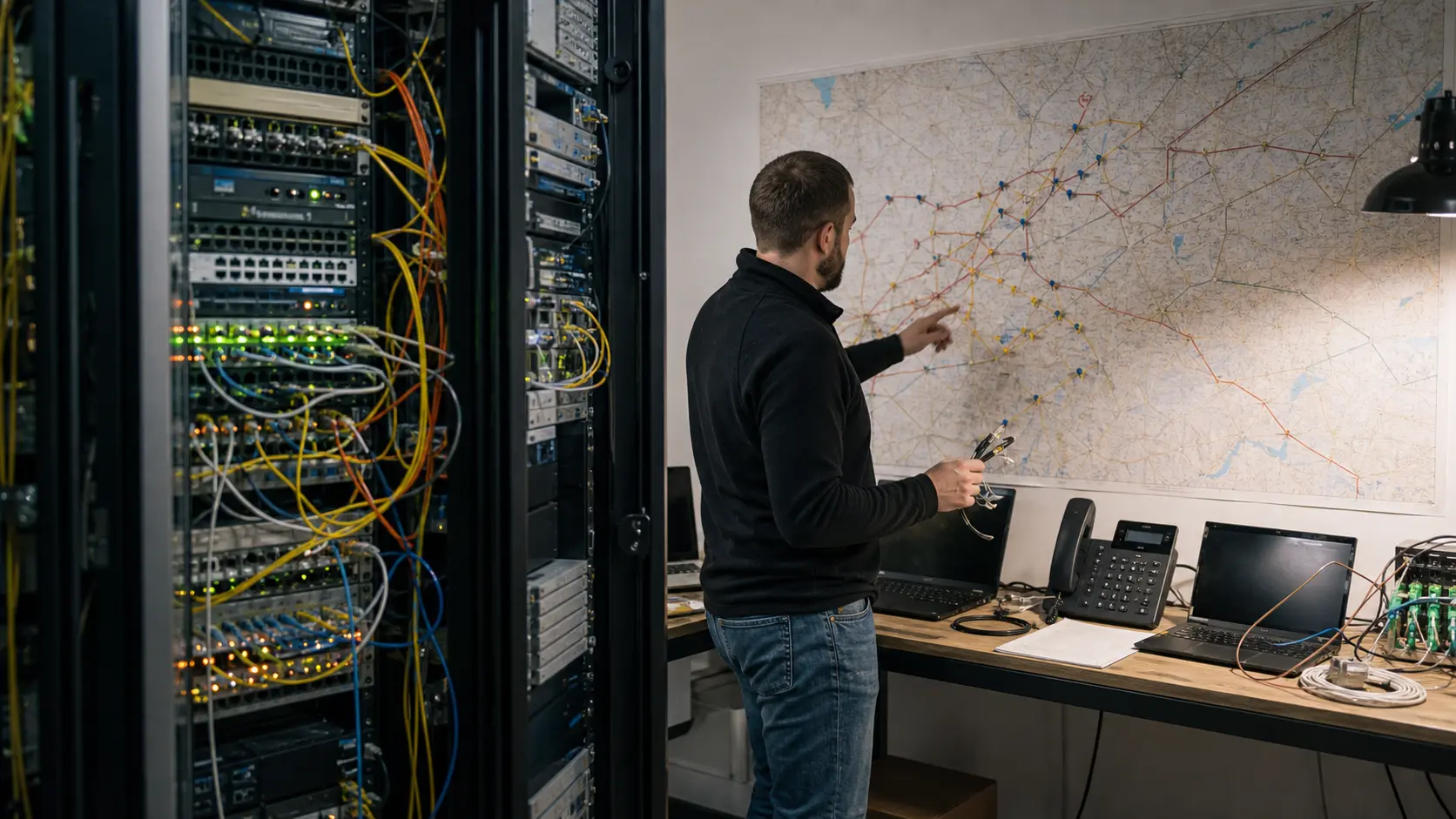
If Porenta is an access or regional-network business in any practical sense, the work is probably not door-to-door consumer installation. It is the less visible physical work of wholesale networking: rack space, cross-connect orders, router replacement, optical modules, upstream handoffs, remote hands, power feeds, IPMI access, spare equipment and emergency changes when a session drops. The RIPE contact trail pointing to Equinix FR5 in Frankfurt and the Greek address in the Porenta organisation record are not marketing copy; they are hints about where physical interconnection and engineering administration may be anchored (https://apps.db.ripe.net/db-web-ui/lookup?key=IS2444-RIPE&source=ripe&type=person; https://rest.db.ripe.net/ripe/organisation/ORG-GI12-RIPE.json?unfiltered).
Those mechanics change the cost structure. A transit session is not only a line in a database. Someone orders the port, arranges a cross-connect, keeps optics and router capacity available, handles reverse DNS and route filters, opens a ticket when a provider rejects a prefix, and makes sure the abuse mailbox does not poison relationships with upstreams. If a Ukrainian-related route needs a new handoff because fibre, power or a local partner changes, the economic cost is not merely a new BGP statement. It is remote-hands time, port fees, courier delay, engineering judgement and sometimes a customer who cannot wait.
That is why the absence of a polished retail service page does not make the estate worthless. Wholesale network control often sells quietly. But it also means public investors cannot borrow the comforting imagery of an ISP truck or call centre. The relevant assets are contracts, credentials, router access, clean addresses and people who know how the route estate was assembled. Without those proofs, the public record can only say that a technical estate exists, not how efficiently it earns.
A failure scenario that would change the economics
Consider the simplest failure case: AS3266 loses or suspends its Cogent relationship while its UAProstir-related path is also unstable. The public RIPE and BGP records show AS3266 importing from AS174 Cogent, AS44628 UAProstir and AS215805 Maksim Denisov, with IPv6 import/export through Cogent and the smaller neighbouring routes (https://rest.db.ripe.net/search.json?query-string=AS3266&source=ripe&type-filter=aut-num&flags=no-filtering; https://bgp.tools/as/3266). If the Cogent path disappears, AS3266 does not necessarily vanish. But the commercial meaning changes immediately. IPv6 reachability is less diverse, route quality for customers may deteriorate, and any customer using the Porenta estate for stable Ukrainian, Greek or German reach could ask whether it should move to a larger carrier, announce its own addresses through a national provider, or park workloads at a global host.
The cost of that failure is not a neat technical outage only. It becomes a repricing event. Porenta would have to buy replacement transit, reroute through a partner, reassure customers, update filters, defend the reputation of the prefixes and possibly offer discounts or migration help. If the route change coincides with an abuse complaint or a payment delay, upstreams may demand stronger documentation before accepting announcements. In a company whose public revenue base is small, even a few urgent cross-connect or transit decisions can erase the economic value of a year's registry optionality.
The same logic applies to AS43586, where public BGP evidence shows a single observed peer, Point of Trade Co. General Trading LLC, and only 256 IPv4 addresses originated (https://bgp.he.net/AS43586). A single-peer estate is not useless. It can be a deliberate customer or partner route. But its resilience and bargaining power are lower unless private redundancy exists. In diligence, that route would be valued differently from AS3266 because the visible dependency is narrower.
When a customer would leave
A customer does not buy from a small route estate for the same reason it buys from a hyperscale cloud. It buys when it needs specific addresses, BGP flexibility, a relationship with a regional operator, latency to a particular market, a sponsored resource arrangement, local support or a migration path that a giant platform will not customise cheaply. It leaves when the job becomes generic.
A website, SaaS node, mail relay or small server that only needs a public address and acceptable uptime can move to Hetzner, OVH, AWS, Google Cloud, a Ukrainian national carrier or an internal IT environment if the price, abuse reputation or ticket handling of the small provider becomes worse than the friction of migration.
Hyperscale pricing cuts both ways. AWS's USD 0.005 per IP per hour charge makes public IPv4 visible as a cost, but it also gives customers a predictable, automated alternative with mature billing and documentation (https://aws.amazon.com/blogs/aws/new-aws-public-ipv4-address-charge-public-ip-insights/). A customer using a small provider for IPv4 addresses might tolerate some opacity if the relationship is cheaper or more flexible. It will not tolerate unclear control of the addresses, invalid ROAs, sudden route withdrawals, poor reverse DNS, slow abuse resolution or surprise dependence on a single upstream. The substitution pressure is therefore brutally practical: the smaller provider must be more flexible, cheaper, more local or more responsive than the big substitutes, because it cannot be more institutionally reassuring.
For Porenta, the retention question is harder because the public customer proposition is not stated. If the business is mostly route sponsorship, customers leave when they can become RIPE members themselves, transfer resources to another sponsor, or attach their prefixes to a larger transit provider. If the business is mostly hosting, they leave for commodity cloud or regional data-centre competitors. If the business is mainly address leasing, they leave when IPXO-style platforms, brokers or direct market alternatives offer cleaner reputation, clearer paperwork or better price.
In each case, the same public weakness appears: the routing estate is visible, but the customer bargain is not.
Competition is not only another ISP
The competitive set is broader than "other Ukrainian ISPs". Cogent is an upstream and a substitute. Hetzner, OVH, Leaseweb, Velia, Hurricane Electric, RETN, local Ukrainian networks and regional data-centre operators can all replace parts of what a small route estate provides, depending on the customer's need. IPv4 brokers and leasing platforms compete for the address-monetisation layer. RIPE itself sets the membership and transfer framework that makes some of the estate's value tradable but also constrains how quickly resources can be moved (https://www.ripe.net/manage-ips-and-asns/resource-transfers-and-mergers/transfer-of-ip-addresses-and-as-numbers/; https://www.ripe.net/manage-ips-and-asns/resource-transfers-and-mergers/transfer-of-ip-addresses-and-as-numbers/transfers-in-the-ripe-ncc-service-region/).
The strongest competitive defence for Porenta would be relationship knowledge. If it controls specialised interconnections, knows the histories of Ukrainian-related prefixes, maintains trusted abuse and registry contacts, and can move faster than a larger provider for a niche customer, it has a business. The weakest defence would be passive ownership. Passive IPv4 value is real, but it is increasingly professionalised. Marketplaces publish lease prices. Brokers know how to value reputation. Cloud buyers know the cost of public IPv4.
A small company cannot assume scarcity alone will create high margins if it cannot document clean control and service quality.
There is also a reputational competition. Address space with clean RPKI and low abuse history is easier to sell, lease or route. Address space with spam, malware or opaque control is discounted. The public record reviewed here did not establish a major abuse problem for Porenta, but it also did not establish a deep compliance operation. The burden would fall on the company in any transaction: show tickets, complaints, remediation, upstream notices, blacklist status and internal authority over who can announce what. Without that, a buyer buys the resource and the unknown history together.
What a buyer, lender or regulator should demand
A buyer should pay for three things: legally controlled number resources, live customer contracts and operational know-how. It should discount almost everything else until proved. For AS3266 and AS43586, it would demand RIPE portal authority, route-origin authorisation records, transfer history, invoice history, contracts with upstreams, port and cross-connect evidence, customer assignments, reverse-DNS control, abuse mailbox logs, IP reputation reports and proof that the Interlink domains and maintainer credentials are under current company control.
It would also ask why a Lithuanian company is using a Greek address, which work is done from Frankfurt or elsewhere, and how the Ukrainian-related sponsored networks fit legally and commercially.
A lender would go further. It would refuse to underwrite an address estate purely on a screenshot of BGP prefixes. It would want to know whether the addresses can be sold or transferred, whether any resources are subject to restrictions, whether counterparties have rights to continue using them, whether any customers prepay, whether the 2024 loss is one-off or recurring, and whether the one-employee public profile understates outsourced engineering. The public revenue number is too small to support a generous cash-flow valuation on its own (https://rekvizitai.vz.lt/en/company/porenta/). The address estate might justify collateral value, but only after legal control and reputation are verified.
A regulator or large customer would care about different proof. It would ask whether abuse contacts work, whether sanctioned or high-risk users touch the estate, whether customer identity checks exist, whether Ukrainian-related routing creates resilience or risk, and whether the organisation can respond during outage or conflict conditions. The fact that AS3266 has valid RPKI is positive. The fact that PeeringDB discloses little and the public service proposition is thin is negative. Neither should decide the case alone.
The silence is a market signal
The most striking unofficial signal is absence. There are public ASN pages, RIPE objects, business-directory entries and sparse PeeringDB records. There is no obvious body of customer reviews, retail plan pages, outage reports, job postings or product announcements that would normally surround a consumer ISP or managed-infrastructure brand. In some infrastructure niches, that is normal. Wholesale network operators often stay quiet. In valuation, though, silence changes the burden of proof.
If the thesis is that Porenta is an operating network, one wants service evidence: customers, facilities, product terms, support channels and incidents handled. If the thesis is that Porenta is a LIR sponsor, one wants sponsorship contracts and resource obligations. If the thesis is that it is a resource estate, one wants transferability, reputation and utilisation. If the thesis is that it is a trading company with incidental network assets, one wants to know why the AS estate exists at all. Public data does not settle which thesis is right.
It only shows that "small Lithuanian company with active ASNs and Ukrainian-facing route relationships" is a real thing rather than a database mirage.
That uncertainty is not an excuse to dismiss the company. The internet is full of small resource holders whose quiet administrative work matters more than their brand. It is a reason to value Porenta with a narrow instrument. A polished ISP article would be too confident. A fraud article would be unsupported. The right instrument is a portfolio note: here are the rights, here are the route dependencies, here are the costs, here is the legal scale, here is what is missing.
The one fact that would change the judgement
The single most important missing fact is the customer and contract map behind AS3266 and AS43586. If Porenta can show paying customers, upstream contracts, clean resource assignments, current invoices and operational control over routers and route objects, the public ambiguity becomes a defensible niche business. Its small revenue base would still matter, but the company would look like a lean network-resource operator with optionality in IPv4, BGP and Ukrainian-facing connectivity.
If, instead, the assets are mostly dormant, informally used by related parties, or dependent on arrangements that are not documented under Porenta's legal control, the valuation falls sharply. In that case the ASNs and prefixes are not a platform. They are a maintenance obligation with possible resale value and reputational risk. The same routing table supports both interpretations. Only contracts decide which one is true.
Public evidence register
- RIPE NCC charging scheme: establishes the 2026 EUR 1,800 LIR annual contribution, EUR 50 ASN fee and EUR 75 independent-resource fee that frame the carrying cost of registry status (https://www.ripe.net/publications/docs/ripe-848/).
- RIPE organisation record for ORG-GI12-RIPE: identifies UAB Porenta as a Lithuanian LIR, company number 303436447, with Greek address, Interlink maintainer references and abuse contact (https://rest.db.ripe.net/ripe/organisation/ORG-GI12-RIPE.json?unfiltered).
- Lithuanian company records: support legal identity, registration date, Alytus address, share capital, VAT number, director, 2024 revenue, net loss, one-employee signal and business classification (https://www.lursoft.lv/en/companies/lt/company/uab-porenta/303436447; https://rekvizitai.vz.lt/en/company/porenta/; https://okredo.com/lt-lt/imone/uab-porenta-303436447).
- AS3266 evidence: supports active announced status, 11 announced prefixes, 1,792 IPv4 addresses, RPKI-valid originated routes and upstream/peer relationships (https://stat.ripe.net/data/as-overview/data.json?resource=AS3266; https://stat.ripe.net/data/announced-prefixes/data.json?resource=AS3266; https://bgp.he.net/AS3266; https://bgp.tools/as/3266).
- AS43586 and AS201260 evidence: supports the distinction between a smaller active AS with a single observed peer and a currently unannounced assigned AS (https://bgp.he.net/AS43586; https://stat.ripe.net/data/as-overview/data.json?resource=AS201260).
- Related Ukrainian-facing route records: support UAProstir, South Communications and other relationships through sponsoring organisation, maintainer, abuse contact and import/export policies, without proving ownership of those businesses (https://rest.db.ripe.net/search.json?query-string=AS44628&source=ripe&type-filter=aut-num&flags=no-filtering; https://rest.db.ripe.net/search.json?query-string=AS199491&source=ripe&type-filter=aut-num&flags=no-filtering).
- PeeringDB: supports the sparse public interconnection profile for INTERLINK AS3266 and the UAB Porenta organisation record, including the lack of disclosed traffic and website fields (https://www.peeringdb.com/net/42295).
- IPv4 market comparables: support the idea that small IPv4 blocks carry leasing and sale value, while cautioning that price depends on reputation, block size and market conditions (https://www.ipxo.com/pricing/; https://www.ipv4.global/all-ipv4-pricing-data/).
- Cloud IPv4 pricing: supports the broader market signal that public IPv4 addresses are now a direct line-item cost even at hyperscale providers (https://aws.amazon.com/blogs/aws/new-aws-public-ipv4-address-charge-public-ip-insights/).
- Ukraine resilience context: supports the geopolitical and operational backdrop for Ukrainian-facing routes, while not proving any specific Porenta incident or performance level (https://labs.ripe.net/author/eliza-rohotska/ukraine-as-a-laboratory-of-internet-resilience/; https://blog.cloudflare.com/one-year-of-war-in-ukraine/; https://pulse.internetsociety.org/en/reports/ua/).