
Summary
- What it says: TWR and the second truck roll in Brazil's local broadband economy
- Main topic: Regional ISP economics; Local support labour
- Context: Regional ISP
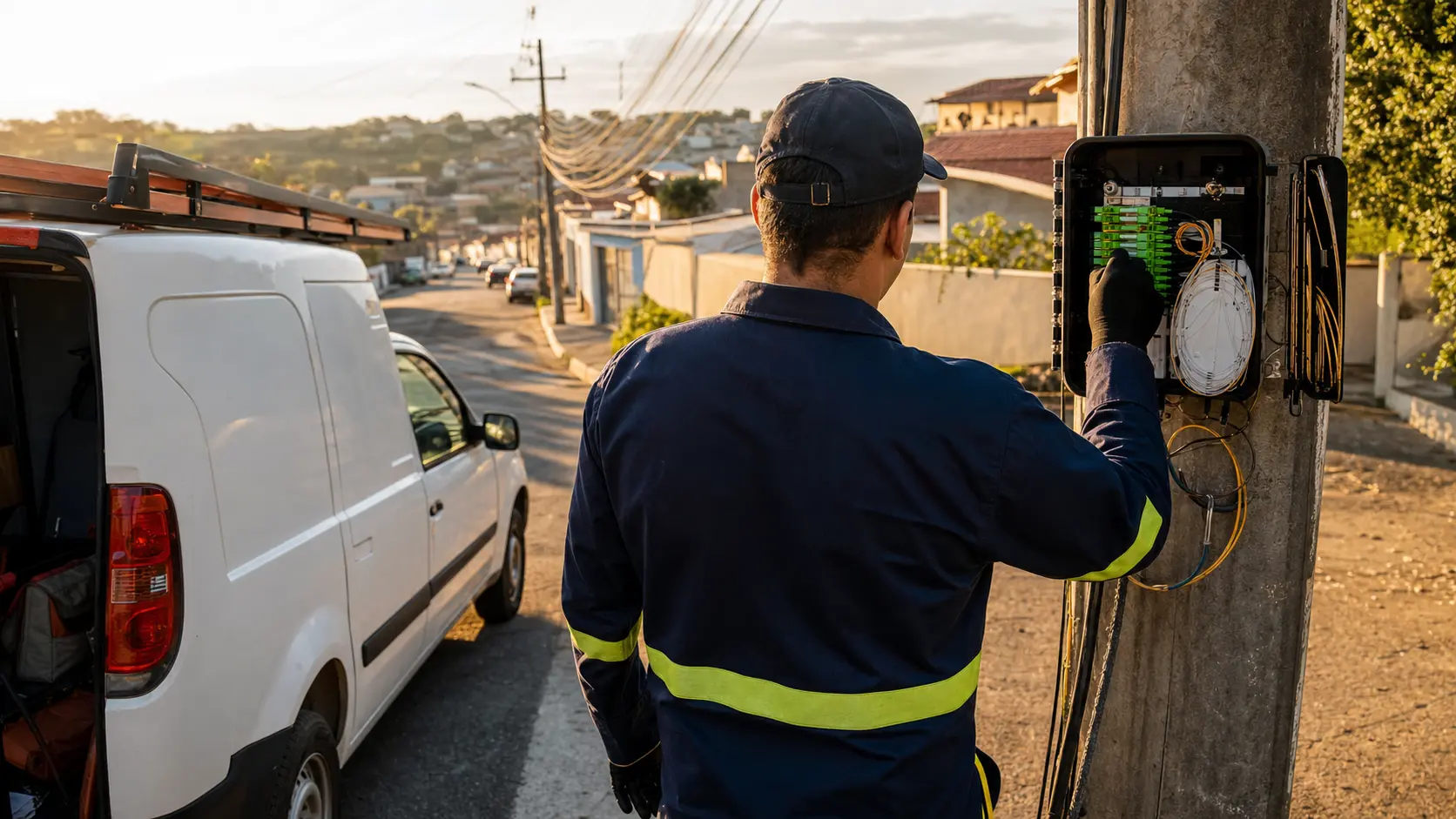
In a neighbourhood access business like TWR TELECOMUNICACOES LTDA, the decisive scene is not the first installation. It is the service van returning to the same street after a low-price broadband customer loses service, or says the Wi-Fi is weak, or refuses to pay until the connection feels perfect again. The first visit can look like growth: a new household, a new monthly fee, a new optical drop, a modem placed in a room where the family can stream television. The second visit is where the economics become unforgiving.
Fuel, technician time, a replacement connector, a CPE swap, a ladder, a call-center exchange and a delayed invoice can absorb the margin that the original sale seemed to promise.
That is the useful way to read TWR. The company is not publicly visible as a national telecom story. It is a small Brazilian internet operator, trading to consumers as Revo Net, with public traces in Nova Londrina, Parana, and with number-resource evidence that places it inside the formal internet-routing system (https://revonetinternet.com.br/) (https://rdap.registro.br/autnum/274587). Its commercial question is therefore not whether it can invent a new telecom model. It is whether a local ISP can keep enough discipline around installation quality, field maintenance, pole access, equipment cost, upstream dependence and payment collection to earn back every extra visit after offering broadband at prices that look intentionally accessible to households.
The evidence points to a company operating in the hard middle of Brazil's fixed-broadband cycle. Regional providers helped push fiber beyond the cities where large operators wanted to spend first. Anatel itself has described small providers as important to the interiorization of digital access, while also tightening the rules on outorgas, data reporting, pole sharing and regularity (https://informacoes.anatel.gov.br/legislacao/component/content/article/149-resolucoes-internas/2030-resolucao-interna-449). OpenSignal's 2025 Brazil fixed-broadband report described a market moving from rapid expansion and fragmentation toward tighter regulation, consolidation and service-quality competition (https://insights.opensignal.com/reports/2025/10/brazil/fixed-broadband-experience). TWR is a local version of that transition: enough public infrastructure to be real, enough retail presence to compete, but not enough disclosure to let an outsider assume scale, resilience or durable profitability.
The judgment is therefore cautious but not dismissive. TWR appears to be a legitimate local access operator with a consumer offer built around fiber, local support and bundled streaming television. Its strongest public signals are an Anatel-authorized SCM contract, a Revo Net website with live plan pricing, CNPJ listings tying the trade name to TWR, Registro.br RDAP entries tying the same CNPJ to AS274587 and an active IPv6 allocation, and pole-contract traces connected to Copel Distribuicao in Parana (https://revonetinternet.com.br/contratos/Contrato%20SCM%20REVONET%20-%20REGISTRADO.pdf) (https://casadosdados.com.br/solucao/cnpj/twr-telecomunicacoes-ltda-41913973000107) (https://rdap.registro.br/ip/2804:9668::/32) (https://www.radardatelecom.com/postes-anatel/prestadora/41913973000107). Its weakness is that the public evidence does not reveal subscriber count, churn, collection quality, wholesale bandwidth cost, route redundancy, outage record, real attachment-point payments or the density of overbuild around each street it serves. For a local ISP, those missing facts are not trivia. They are the business.
A small company with enough public footprint to be taken seriously
TWR's public identity is unusually useful because the company appears in several independent surfaces that line up with one another. Public CNPJ mirrors list TWR TELECOMUNICACOES LTDA under CNPJ 41.913.973/0001-07, with the trade name Revo Net, active status, opening date of 12 May 2021, microenterprise indicators and a principal economic activity for multimedia communication service, the Brazilian SCM category used for fixed broadband (https://casadosdados.com.br/solucao/cnpj/twr-telecomunicacoes-ltda-41913973000107). CNPJa shows the same company identity and also lists the Revo Net trade name, the R$425,000 capital figure and the Nova Londrina address context (https://cnpja.com/office/41913973000107). These are not audited accounts, but they are important boundary conditions. They make TWR look less like a stray routing label and more like a local telecom operator with a formal company shell, tax identity and consumer-facing brand.
The company's own Revo Net website reinforces that identity. It markets "100% fibra optica", local support, free installation, free modem and television streaming attached to broadband plans (https://revonetinternet.com.br/). It also gives Nova Londrina contact details, support and finance phone numbers, and a public address on Avenida Juscelino Kubitscheck. The registered SCM contract gives a Rua Joao Antonio address and names TWR as the service provider, with CNPJ 41.913.973/0001-07, Anatel authorization act 5578 of 23 July 2021, the Revo Net website and the same consumer-service posture (https://revonetinternet.com.br/contratos/Contrato%20SCM%20REVONET%20-%20REGISTRADO.pdf). The address difference is not in itself a red flag: small operators often separate a registered address, a service counter, a technical base and a retail point. It does, however, remind the reader that the business is grounded in local operations, not in a distant brand platform.
The company contract matters because it reveals the legal and operational posture behind the advertising. It is a registered SCM service contract, electronically recorded in December 2023, and it defines the service as capacity for transmission, emission and reception of multimedia information, including internet connection (https://revonetinternet.com.br/contratos/Contrato%20SCM%20REVONET%20-%20REGISTRADO.pdf). It also makes clear that service installation depends on technical feasibility, that services may use the provider's network or third-party networks, that the customer relationship is governed by an adhesion term, and that maintenance, customer equipment and customer duties sit inside the commercial agreement. This is the dull language of telecom contracting, but for TWR it is more valuable than promotional copy: it confirms that the company has built a standard private-regime broadband contract around the same identity and brand seen in its public website.
The available public record also gives a people signal without turning the article into a personality profile. Registro.br RDAP lists Marcos Roberto Silva in administrative, technical and abuse roles around the number resources, and public CNPJ mirrors list Marcos Roberto Silva as socio-administrator, with Gustavo Martins Marques Luiz as a later partner (https://rdap.registro.br/autnum/274587) (https://cnpja.com/office/41913973000107). That combination suggests a small operator where management and technical-responsibility functions may be close together. It does not prove ownership control beyond the public company listings, nor does it prove operational capacity. It does explain why the company's risk profile should be read through small-business execution: a local access provider can survive with tight owner-operator discipline, but it has less room for process mistakes than a national carrier.
The geography is equally important. Nova Londrina is not Sao Paulo, Curitiba or a dense metropolitan broadband battlefield. IBGE's 2022 census places Nova Londrina at about 12,923 residents (https://www.ibge.gov.br/cidades-e-estados/pr/nova-londrina.html). That does not mean TWR serves only that municipality, but it is the clearest public base for the Revo Net brand. In a municipality of that size, street-by-street reputation matters. A single fibre break, a slow repair, a confusing bill or a visible competitor's sign on the same pole can circulate faster than a national marketing campaign. The company has to sell the promise of fast fiber, but it also has to defend the mundane credibility of answering the phone, sending the technician and keeping the invoice relationship calm.
The retail ladder shows the margin problem
Revo Net's advertised plan ladder is simple and commercially revealing. The website shows a 400 MB plan with TV for R$89.90 per month, a 600 MB plan with TV for R$129.90, a 1 GB plan with TV for R$139.90, and a 1.5 GB plan with TV for R$179.90 (https://revonetinternet.com.br/). The advertising also says installation is free, the modem is free and support is local. In Brazilian retail broadband shorthand, those speed labels are used as product tiers rather than engineering guarantees, but the commercial message is clear: Revo Net is offering households a fiber-plus-entertainment bundle at monthly prices that require volume discipline.
The ladder is interesting because the price steps are uneven. Moving from 400 to 600 costs R$40. Moving from 600 to 1 GB costs only R$10. Moving from 1 GB to 1.5 GB costs R$40. That kind of ladder can be read in several ways. It may be a promotional choice. It may indicate that the provider wants to pull customers away from the middle tier and toward the psychologically attractive 1 GB plan. It may reflect local competitive pressure where a gigabit headline has become a defense against nearby operators even if many households will never use sustained gigabit throughput.
The important point is that the company is monetizing not just bandwidth, but perception: a household is buying the feeling that fiber is abundant enough for streaming, phones, gaming and home work without interruption.
That perception can be expensive to maintain. A free modem is not free to the operator. A free installation is a capital advance. A support-local promise creates a cost expectation that differs from a national carrier's remote ticket queue. For TWR specifically, the R$89.90 entry offer means that one avoidable return visit can consume a meaningful share of the first several months of gross customer cash before bandwidth, tax, pole, CPE and administration are considered (https://revonetinternet.com.br/). If the customer churns after a few months, stops paying, moves house, damages equipment or requires a second visit, the economics turn sharply.
The registered contract shows why payment discipline matters to this model. It describes customer duties, service conditions and the possibility of interruption or suspension in specific circumstances such as nonpayment, always within the legal framework (https://revonetinternet.com.br/contratos/Contrato%20SCM%20REVONET%20-%20REGISTRADO.pdf). This is not harshness; it is the cash logic of local access. A small operator cannot fund an indefinite queue of unpaid households while continuing to buy transit, pay technicians, maintain vehicles and replace CPE. The business is not only about signing up customers. It is about collecting enough valid monthly payments from enough stable households to amortize the field work already done.
The retail ladder also points to the service-quality trap. Once a provider advertises 1 GB and 1.5 GB tiers, the customer expectation rises even if the bottleneck is in Wi-Fi, device capability, streaming server behavior or in-home placement. OpenSignal's Brazil report is useful here because it separates network speed from reliability, consistent quality and user experience (https://insights.opensignal.com/reports/2025/10/brazil/fixed-broadband-experience). A household does not care whether the problem is the optical line, the router, the customer's phone, the content platform or the upstream route. It calls the provider it pays. Revo Net's promise of local support is commercially necessary, but it also means TWR owns the emotional part of faults that may not be purely its network's fault.
The network evidence is real, but narrow
TWR's routing evidence is stronger than many small-company writeups get, but it should be read narrowly. LACNIC's member list includes TWR TELECOMUNICACOES LTDA in Brazil (https://www.lacnic.net/1009/2/lacnic/members-list/1000). Registro.br RDAP shows autnum 274587 as a direct allocation in Brazil, with TWR TELECOMUNICACOES LTDA as registrant and CNPJ 41.913.973/0001-07 (https://rdap.registro.br/autnum/274587). Registro.br RDAP also shows IPv6 network 2804:9668::/32 as active, with the same company as registrant and AS274587 attached (https://rdap.registro.br/ip/2804:9668::/32). RIPE Stat's announced-prefixes view showed seven IPv6 announcements for AS274587 between 20 June and 4 July 2026, and the RIPE RPKI validator returned a valid state for 2804:9668::/32 originated by AS274587 (https://stat.ripe.net/data/announced-prefixes/data.json?resource=AS274587) (https://rpki-validator.ripe.net/api/v1/validity/AS274587/2804:9668::/32).
That says several important things. It says the company has moved beyond merely reselling under someone else's public name: it has its own autonomous-system number and IPv6 number resources. It says the routing identity aligns with the same CNPJ used by Revo Net's public commercial footprint. It says there is a recent visible BGP announcement set, not only an inert allocation. It also says the company has some RPKI hygiene for its IPv6 route, which is a positive signal in an ecosystem where route security often lags at small providers.
But the network evidence also has limits. Public lookups show IPv6 activity far more clearly than IPv4. DB-IP lists no IPv4 addresses for the AS and seven IPv6 prefixes, while RIPE Stat's visible recent set is IPv6-only (https://db-ip.com/as274587-twr-telecomunicacoes-ltda) (https://stat.ripe.net/data/announced-prefixes/data.json?resource=AS274587). Hurricane Electric's public toolkit also frames the visible evidence around TWR's IPv6 announcements rather than a broad disclosed network estate (https://bgp.he.net/AS274587) (https://bgp.he.net/net/2804%3A9668%3A%3A/33). That does not prove TWR lacks IPv4 service to customers; small ISPs can use upstream-provided IPv4, carrier-grade NAT, delegated arrangements or records that are not visible in the same way. The prudent conclusion is that TWR has formal internet-number evidence and visible IPv6 routing, not that it owns a large, fully transparent dual-stack footprint.
The absence of a PeeringDB entry is also useful if handled carefully. A PeeringDB API query for AS274587 returned no entity (https://www.peeringdb.com/api/net?asn=274587). That does not mean the network is weak. Many small local ISPs do not maintain a PeeringDB profile, and a missing profile says nothing by itself about actual transit or private interconnection. It does, however, suggest that TWR's public posture is not that of an operator marketing a broad interconnection fabric to peers. The more likely commercial model is local access plus upstream connectivity, with the economics tied to buying capacity, managing customer demand peaks and keeping field costs under control.
The registered contract's wording fits that picture. It says services may be provided through the company's own network or through third-party networks (https://revonetinternet.com.br/contratos/Contrato%20SCM%20REVONET%20-%20REGISTRADO.pdf). For a local ISP, that is not a small clause. It is the legal surface of supplier dependence. A company can own the customer, the last drop, the optical terminal and the billing relationship, while still depending on other networks for transport, transit, upstream redundancy or reaching content ecosystems. The customer sees Revo Net. The operator must manage a chain of dependencies behind that name.
The cost base starts on the pole and ends in the living room
The public pole evidence is one of the most commercially important pieces in TWR's file. Radar da Telecom, which presents public Anatel pole-contract data and states that it is not an official Anatel position, shows TWR Telecomunicacoes Ltda under CNPJ 41.913.973/0001-07 as a prestadora SCM with seven Anatel records, one state, Copel Distribuicao S.A. as the distribution company, and seven Parana records under process 53500.053700/2021-65 (https://www.radardatelecom.com/postes-anatel/prestadora/41913973000107). It does not show active or expired status because the public file did not include validity dates for those records. It also lists an average score of 60/100 based on its own method.
The exact score is less important than the commercial fact that pole sharing appears in the public evidence. For a fiber ISP in a Brazilian municipality, the pole route is not background scenery. It is the cost spine. Every aerial route has to deal with attachment points, distributor coordination, technical compliance, safety rules, regularization and the risk that irregular networks crowd the same physical space. When Anatel and Aneel discuss poles, they are not discussing a distant regulatory abstraction. They are discussing the path between a provider's optical distribution network and a paying household.
Teletime's reporting on Anatel's national pole-contract collection shows the direction of policy. Anatel began a national collection of information on contracts between broadband operators and electricity distributors, asking for the SCM provider CNPJ, the distributor CNPJ, process numbers, contract references, signature and validity dates, number of billed attachment points, value paid per point, adjustment index and any dispute (https://teletime.com.br/02/12/2025/anatel-inicia-coleta-de-dados-sobre-contratos-de-postes-na-banda-larga/). That list reads like a cost-accounting template. It also reveals why local operators worry about regularization. A network that looked profitable when attachment costs were informal, incomplete or delayed can look very different once every pole point is counted and billed.
For TWR, the public evidence does not show the actual monthly payment per point, the number of physical attachment points used, whether the seven records correspond to distinct documents or repeated rows under the same process, or the scale of any network regularization work. Those missing facts are material. A local ISP can be profitable on paper with low retail prices if the pole route is dense, the drop lengths are short and the attachment base is predictable.
The same retail prices can become thin if poles are contested, if a route must be rebuilt, if competitors duplicate fiber on the same streets, or if the provider has to fund a clean-up after irregular installations by others.
The living-room side of the cost base is just as important. Revo Net's free modem promise puts CPE into the business equation. The Magalu listing that shows "Revonet" as a seller since 2022 and ties the same CNPJ and Rua Joao Antonio address to a retail router listing is not evidence of the broadband service equipment installed at customers' homes (https://www.magazineluiza.com.br/roteador-wireless-multilaser-re072-150mbps-1-antena-5-portas-suporta-3g/p/cebe7d6caf/in/rtdr/?seller_id=revonet). It is, however, a useful signal that the brand sits close to consumer network equipment commerce. For a small ISP, routers, optical terminals and Wi-Fi troubleshooting are not optional accessories. They are the daily place where the customer judges whether the monthly broadband plan is worth paying for.
The second truck roll is an accounting event
The repair-van image is more than a narrative device. It is the right unit of analysis for TWR. A low-price fixed-broadband customer pays in small monthly pieces, while Revo Net's entry plan is publicly advertised below R$100 a month (https://revonetinternet.com.br/). A field visit is paid in larger chunks: labor time, vehicle cost, opportunity cost, part replacement, routing of the technician's day and the administrative back-and-forth that comes with a complaint. If a technician returns to the same street because of a connector, a fibre bend, a pole issue, water ingress, a router placement problem or a customer misunderstanding, the operator has not merely spent time. It has lengthened the payback period of the account.
This is why installation quality is a margin strategy, not just an engineering virtue. A clean drop, labeled equipment, realistic Wi-Fi expectations, well-placed CPE and clear customer onboarding can prevent future visits. A rushed installation can book revenue sooner but move cost into the future. TWR's advertised installation-free offer raises the stakes (https://revonetinternet.com.br/). If the first visit is free to the household, the company has to recover the install through monthly ARPU. If the second visit is also absorbed to protect reputation, the recovery period stretches again. A small provider's best customer is not simply the one on the highest plan; it is the one whose connection stays quiet and whose invoice clears.
The contract's treatment of technical feasibility is therefore commercially meaningful. It gives the provider space to evaluate whether service can be installed at the customer's location. In a local market, saying no to a technically awkward customer can be hard because every account matters and competitors may say yes. But accepting a weak install, a long drop, a difficult building, a route with poor pole conditions or a customer likely to churn can destroy margin. Thin-margin broadband often fails by accretion: one underpriced install, one unpaid invoice, one avoidable revisit, one unbilled pole segment, one CPE replacement.
None is dramatic alone; together they determine whether the operator is financing its customers more than serving them.
The same logic applies to support calls. Revo Net markets humanized, local support. That is a strength against national carriers whose service is often perceived as impersonal. Yet local support also invites customers to treat every video freeze as a provider problem. In the streaming household, the broadband operator becomes the first call for issues that may begin elsewhere. That is why network reliability, home Wi-Fi performance and customer education are part of revenue defense. The cheapest support ticket is the one that never becomes a truck roll.
There is a strategic upside if TWR executes well. Local support can make churn lower because customers know who answers. A technician who understands the exact street, pole route and customer history can resolve faults faster than a remote national process. Local trust can help collection because the provider is not anonymous. The same factors that make a small ISP vulnerable can also give it a defensible niche. The condition is discipline. Without route discipline, support discipline and payment discipline, locality becomes a cost center rather than an advantage.
Customer dependence: households, streaming and cash discipline
Revo Net's website makes the household customer visible. The hero message connects fiber to streaming, and every listed retail plan includes television (https://revonetinternet.com.br/). The support promise is personal rather than enterprise-like. The prices sit in the range of mass-market residential broadband rather than corporate connectivity. That matters because residential broadband has a different risk pattern from enterprise circuits. It can generate scale quickly, but it also exposes the provider to consumer price sensitivity, seasonal household cash pressure, device complaints, moves, informal referrals and aggressive competitor promotions.
The TV component is commercially useful and risky at the same time. It gives the household a reason to perceive the plan as more than a pipe. It may reduce churn if the customer associates entertainment with the broadband bundle. It also increases the experiential burden on the provider. A household that buys the internet for streaming will judge the service when the game, church service, soap opera, music video or children's program buffers. Even if the congestion is outside TWR's immediate network, the household's complaint returns to Revo Net.
This is why OpenSignal's emphasis on real-world experience is relevant: the broadband business is no longer won by a speed label alone.
Payment discipline is another core issue. Public contracts in this sector routinely set duties around payment, suspension, equipment, customer conduct and service conditions. TWR's contract is no exception. For a small ISP, collection quality may be as important as marketing. If a customer pays late, the provider still pays upstream suppliers and employees on schedule. If many customers pay late, the provider's working capital begins to fund the entire local network. If a customer stops paying but keeps the equipment, the CPE cost becomes a loss. If an operator is too aggressive in suspension, it risks reputation and churn.
If it is too lenient, it risks becoming a credit provider without pricing the credit.
The company's microenterprise context sharpens that point. A local ISP with R$425,000 of listed capital and a modest public footprint cannot be assumed to have deep financing capacity (https://casadosdados.com.br/solucao/cnpj/twr-telecomunicacoes-ltda-41913973000107). That does not mean it is financially weak; capital listed in CNPJ mirrors is not the same as cash, debt capacity or operating profit. It does mean outsiders should not treat TWR as if it can absorb every cost shock that a national carrier can absorb. The retail model's success depends on a narrow operational loop: sell, install correctly, keep the customer satisfied, collect, avoid repeated visits, maintain network regularity and reinvest enough to keep quality acceptable.
Customer dependence also has a local competitive dimension. In a small municipality, a customer's choice may be influenced by a neighbour's experience, a technician's reputation, a social-media post, a local news item or a sign on a storefront. National brand trust matters less if the local provider arrives faster and speaks the customer's language. But the reverse is also true. One visible service failure can travel through the same network of informal trust. For TWR, the customer base is not a spreadsheet abstraction; it is a local memory system.
Competition is now street-level and policy-level at once
Brazil's fixed-broadband market has produced a paradox for companies like TWR. Small providers helped create the competitive pressure that customers now take for granted. They built fiber into cities and towns that large operators had not prioritized, and they proved that local last-mile operations could win household accounts. But that success also generated overbuild, price compression and consolidation pressure. OpenSignal cites Anatel and market sources showing more than 52.5 million fixed-broadband lines at the end of 2024, 78% fiber connections by July 2025, and small providers combining for a majority share of the market (https://insights.opensignal.com/reports/2025/10/brazil/fixed-broadband-experience). Those facts describe a vibrant sector, but also one where the easy land-grab phase is fading.
The competitive threat to TWR does not have to come from a national operator alone. Another local ISP can overbuild the same street. A regional consolidator can buy a nearby operator and improve its marketing; public M&A analysis has tracked regional ISP consolidation as a recurring Brazilian broadband theme (https://resources.telegeography.com/deal-or-no-deal-meet-the-regional-isps-driving-ma-in-brazil). A wholesale fiber platform can make it easier for a new retail brand to enter without building everything from scratch. The customer only sees a better price, a faster headline speed or a promise of a new streaming bundle. The incumbent local ISP sees the return on sunk field work shrinking.
This is why TWR's 1 GB pricing is strategically important. If the website's R$139.90 1 GB tier is current, it sits only R$10 above the 600 MB tier. That suggests that the gigabit label has become a competitive anchor. The company may be using it to keep households from defecting to a competitor with a similar headline. But the more the market normalizes gigabit tiers at low prices, the harder it becomes to charge directly for quality. Customers can compare speed labels more easily than they can compare route redundancy, pole compliance, technician training or CPE quality.
The provider has to finance the hidden quality layer while competing on visible numbers.
Anatel's own 2026 language about consolidation is relevant. The agency said the advance of consolidation in fixed broadband did not, at that moment, represent a relevant competition risk, and described consolidation as compatible with a still-fragmented sector's search for efficiency (https://www.gov.br/anatel/pt-br/assuntos/noticias/anatel-ve-consolidacao-de-mercado-como-etapa-natural-da-banda-larga-fixa). It also emphasized monitoring, case-by-case action and the need to combat unfair competition. For TWR, consolidation is not an abstract M&A story. It is a signal that scale matters. A small provider can remain independent if its local density, service reputation and cost control are good enough. If not, it becomes either a target, a marginal competitor or a business whose founder capital is tied up in a network that is harder to monetize than it was to build.
Street-level overbuild also changes the meaning of customer acquisition. In a less competitive market, a free install may be a sensible investment because the household is likely to stay. In an overbuilt street, free install can become a bidding instrument. Each provider pays to move the household, and the household learns to treat installation and modem equipment as free. That is good for consumer bargaining power, but it can hollow out local ISP economics. The danger is not simply low prices. It is low prices combined with high churn and repeated field work.
Regulation is becoming part of the profit-and-loss statement
The Brazilian regulatory environment has turned from a growth enabler into a discipline test. Anatel's Internal Resolution 449 of 27 June 2025 approved a plan to combat unfair competition and regularize the provision of fixed broadband SCM (https://informacoes.anatel.gov.br/legislacao/component/content/article/149-resolucoes-internas/2030-resolucao-interna-449). The resolution explicitly covers authorized providers, providers that had operated under the dispensation mechanism, infrastructure holders and clandestine participants. It directs areas of the agency to work on outorga regularization, data-reporting consistency, BDTA information, access data, infrastructure sharing, consumer awareness and measures against relationships with non-regularized providers. In plain terms, the regulator wants a cleaner market.
For compliant operators, that can be good. If irregular competitors are forced to regularize, pay for poles, report data and meet authorization duties, the unfair price advantage may shrink. For small operators, it can also be painful. Compliance takes time, administration and money. The Anatel notice on the fifth edition of the small-provider obligations guide said that the fixed-broadband regularization plan suspended the outorga dispensation for SCM and required companies to regularize by 28 October 2025 (https://www.gov.br/anatel/pt-br/assuntos/noticias/anatel-publica-nova-edicao-do-guia-de-obrigacoes-para-pequenas-prestadoras-de-telecomunicacoes). It also highlighted station licensing, sector data submission, fund payments, consumer rights, cybersecurity and accessibility. A small provider that grew through field improvisation now needs administrative maturity.
TWR's public contract and authorization reference are positive in that context. The company presents itself as an Anatel-authorized SCM provider, not merely as an informal internet reseller (https://revonetinternet.com.br/contratos/Contrato%20SCM%20REVONET%20-%20REGISTRADO.pdf). The public CNPJ is active, the routing resources are tied to the same company and pole data traces exist (https://casadosdados.com.br/solucao/cnpj/twr-telecomunicacoes-ltda-41913973000107) (https://rdap.registro.br/autnum/274587) (https://www.radardatelecom.com/postes-anatel/prestadora/41913973000107). None of that proves full compliance across every Anatel reporting duty, every station, every pole point or every consumer interaction. It does suggest the company is positioned within the formal layer that Anatel is trying to strengthen. That matters because upstream providers, distributors and customers may increasingly ask whether a local ISP is regular, not only whether it is cheap.
The pole-regularization push can be especially material. Anatel's pole data collection requires details that were once easier to leave blurry: how many points are used, what value is paid, which process authorizes the contract, whether there is a dispute, and which distributor owns the infrastructure (https://teletime.com.br/02/12/2025/anatel-inicia-coleta-de-dados-sobre-contratos-de-postes-na-banda-larga/). When those facts become more visible, accounting becomes more exact. If TWR's actual attachment base is small and well regularized, the company may benefit from a cleaner competitive field. If the attachment base is larger than the public traces suggest, or if regularization adds cost, the margin picture changes.
There is also a geopolitical and supply-chain layer, even for a local ISP. Broadband equipment, optical components, routers and network electronics sit in a global hardware market. TWR's own contract mentions the possibility of revising values if conditions such as exchange-rate changes, tax changes or broader economic shifts threaten contractual balance (https://revonetinternet.com.br/contratos/Contrato%20SCM%20REVONET%20-%20REGISTRADO.pdf). That clause is standard, but it is commercially real. A small Brazilian ISP earns revenue in reais from households and buys many inputs whose prices are influenced by the dollar, imported equipment markets, taxes and supplier availability. The customer sees a stable monthly fee. The operator sees a cost base that can move.
Regulation, supply cost and competition converge in the same place: the ability to keep investing while keeping prices acceptable. If the market demands free installation, free modem, local support and gigabit-like tiers, the provider needs enough scale and cost control to finance those promises. If regulation raises compliance cost but also removes irregular competitors, the net effect can be positive. If it raises cost faster than it improves competitive fairness, small operators feel squeezed. TWR's future depends on which version of that transition reaches Nova Londrina's streets.
Supplier dependence sits behind the local brand
A local ISP can feel self-contained to its customers because the van, bill, WhatsApp number and technician are local. The network, however, is never fully local. TWR's contract acknowledges that service may rely on its own network or third-party networks (https://revonetinternet.com.br/contratos/Contrato%20SCM%20REVONET%20-%20REGISTRADO.pdf). That phrase opens the supplier-dependence question. The company may depend on wholesale transport, upstream IP transit, electrical-pole infrastructure, equipment distributors, streaming-bundle arrangements, billing systems and support tools. Public evidence does not name the upstream carriers, the capacity contracts or the redundancy design, so the analysis has to stay structural.
The first dependency is physical. Pole access through a distributor such as Copel determines where aerial fiber can go and how regular that route is; Radar da Telecom's TWR page names Copel Distribuicao in the visible Parana pole-contract traces (https://www.radardatelecom.com/postes-anatel/prestadora/41913973000107). A clean pole relationship reduces legal and operational uncertainty. A contested or incomplete one can create service risk. If a route has to be rearranged after inspection, the operator can face field cost without new revenue. If a competitor uses the same poles with lower discipline, the compliant provider can face both visual clutter and price competition.
The second dependency is upstream connectivity. Owning an AS and IPv6 allocation gives TWR a stronger technical identity, but it does not eliminate the need to reach the rest of the internet (https://rdap.registro.br/autnum/274587) (https://rdap.registro.br/ip/2804:9668::/32). Without public PeeringDB presence or disclosed transit suppliers, an outsider cannot judge route diversity (https://www.peeringdb.com/api/net?asn=274587). A single upstream path can be cheap and operationally simple, but it makes service vulnerable to supplier outages, price changes or congestion. Multiple upstreams and better interconnection improve resilience but increase cost and management complexity. For a small ISP, redundancy is an investment decision, not merely a technical ideal.
The third dependency is customer equipment. The website's modem-free message makes the provider responsible for placing a device that customers experience as "the internet" (https://revonetinternet.com.br/). Poor equipment raises complaints. Good equipment raises upfront cost. Replacements are expensive because they combine hardware and a visit. The Magalu listing connected to Revonet is not proof of service inventory, but it shows the brand in consumer router commerce, which fits the operational reality of small broadband (https://www.magazineluiza.com.br/roteador-wireless-multilaser-re072-150mbps-1-antena-5-portas-suporta-3g/p/cebe7d6caf/in/rtdr/?seller_id=revonet). The household does not distinguish between fiber access and Wi-Fi performance; the provider must.
The fourth dependency is content and bundle perception. Revo Net sells broadband with TV. The economics of that bundle are not disclosed. The key risk is that the bundle trains customers to evaluate a network through entertainment performance while the provider may not control every part of the streaming chain. A bundle can reduce churn when it works and increase complaints when it does not. In a market where speed labels are commoditized, the bundled experience becomes a differentiator. It can also become another support burden.
Unofficial signals point to visibility, not scale
The unofficial signals around Revo Net should be used modestly. A local Instagram post from 2024 described Revo Net Nova Londrina plans starting at R$89 (https://www.instagram.com/p/C-5Gx44pYS_/). A Magalu product page shows Revonet as a marketplace seller since 2022, with the same TWR CNPJ and Nova Londrina address (https://www.magazineluiza.com.br/roteador-wireless-multilaser-re072-150mbps-1-antena-5-portas-suporta-3g/p/cebe7d6caf/in/rtdr/?seller_id=revonet). Public business mirrors repeat the Revo Net trade name, address and SCM classification (https://casadosdados.com.br/solucao/cnpj/twr-telecomunicacoes-ltda-41913973000107). These traces suggest that the brand is visible to consumers and has touched retail channels beyond a bare corporate registry. They do not prove subscriber count, revenue, service quality, customer satisfaction or geographic coverage.
That distinction matters because small-ISP analysis often overreads weak signals. A social-media promotion can indicate marketing activity, but not conversion. A marketplace listing can indicate commerce, but not the economics of broadband installation. A public address can indicate local presence, but not the size of the field team. A routing allocation can indicate technical identity, but not the resilience of the network. The correct use of these unofficial signals is to show that Revo Net is not invisible in its local market, while refusing to turn visibility into scale.
Market chatter about Brazilian small providers also needs discipline. In forums, comments and industry conversations, one recurring fear is that pole regularization, the end of easier outorga treatment and tax changes will squeeze the smallest operators and accelerate consolidation. That fear is commercially plausible, and Teletime's comments section around pole data collection shows at least one reader expressing exactly that concern (https://teletime.com.br/02/12/2025/anatel-inicia-coleta-de-dados-sobre-contratos-de-postes-na-banda-larga/). A Reddit discussion of the under-5,000-subscriber outorga change shows similar anxiety in informal market talk, but it is not evidence about TWR's own condition (https://www.reddit.com/r/InternetBrasil/comments/1lm9bqe/anatel_permitia_que_provedores_abaixo_de_5_mil/?tl=en). For TWR, the actionable point is not that every small provider will fail; it is that cost formalization and overbuild make execution quality more important than growth rhetoric.
The positive unofficial signal is local recognizability. A neighbourhood ISP does not need national fame to create value. It needs enough local trust to keep households paying and enough operational discipline to keep the van from returning too often. The negative signal is the fragility of such visibility. If customer acquisition depends on low prices and social promotion, a better-funded overbuilder can imitate the offer. If customer retention depends on local support, the operator must keep response times credible even as it grows. Visibility wins the first call; reliability wins the renewal.
What would change the judgment
The biggest missing fact is subscriber count by municipality and speed tier. If TWR serves a dense base around Nova Londrina with low churn, the current retail prices could be sustainable because drops are short, support knowledge compounds and marketing costs are low; if the base is scattered across long routes, the same pricing becomes much riskier (https://revonetinternet.com.br/) (https://www.ibge.gov.br/cidades-e-estados/pr/nova-londrina.html). Density is the difference between a profitable local access network and a series of expensive promises strung along poles.
The second missing fact is churn and collection quality. The website's prices only matter if customers stay and pay. A high share of 1 GB customers at R$139.90 might look attractive, but not if promotion-driven churn forces repeated installs. A lower-speed customer who stays for years, pays on time and never calls support may be more valuable than a high-tier customer who demands repeated visits. The company needs cohort economics, not only plan economics.
The third missing fact is the real pole and route cost. The public pole traces are helpful, but they do not reveal billed attachment points, payment values, route length, regularization backlog or disputes (https://www.radardatelecom.com/postes-anatel/prestadora/41913973000107). If TWR's pole position is clean and compact, formalization could protect it against irregular rivals. If regularization adds cost or forces network work, the second truck roll is only one part of the margin squeeze; the pole route itself becomes the larger bill.
The fourth missing fact is upstream resilience. AS274587 and 2804:9668::/32 are meaningful, and recent IPv6 announcements plus valid RPKI are positive (https://rdap.registro.br/autnum/274587) (https://rpki-validator.ripe.net/api/v1/validity/AS274587/2804:9668::/32). But the public internet does not reveal whether TWR has one upstream, multiple upstreams, local caching, content partnerships or meaningful redundancy. A local ISP with one brittle upstream can look fine until an outage exposes the dependence. A small ISP with sensible redundancy can defend quality even without national scale.
The fifth missing fact is equipment policy. Free modem offers can be sustainable if the provider uses reliable CPE, installs it well, recovers units on cancellation and educates customers about Wi-Fi limitations. They can become costly if equipment is underpowered, frequently swapped or treated as disposable by customers. Router economics are not glamorous, but they decide how often the van returns.
The final judgment is therefore conditional. TWR is worth tracking because it shows the economic spine of Brazil's neighbourhood broadband market: formal enough to have company, authorization, routing and pole traces; local enough that service reputation matters; retail enough that household pricing is visible; and exposed enough that regulation, overbuild and field cost can alter the profit picture quickly. The company does not need to become a national operator to be important.
It only needs to show whether a small, formal, fiber-oriented provider in an interior Brazilian market can price aggressively without letting the second truck roll consume the business.