
Summary
- What it says: TWF Internet and the payback clock of local fibre
- Main topic: Regional ISP economics
- Context: market / company research report / Latin America
TWF Internet is a small Brazilian fibre provider in a market where small providers have already done much of the hard work. The company is not trying to invent a new broadband category. It is selling a familiar regional-ISP promise: local fibre, local support, phone contact, TV and fixed-line options, public-sector links, and a network that the customer can associate with a place rather than a national call centre. Its commercial question is sharper than its brand language.
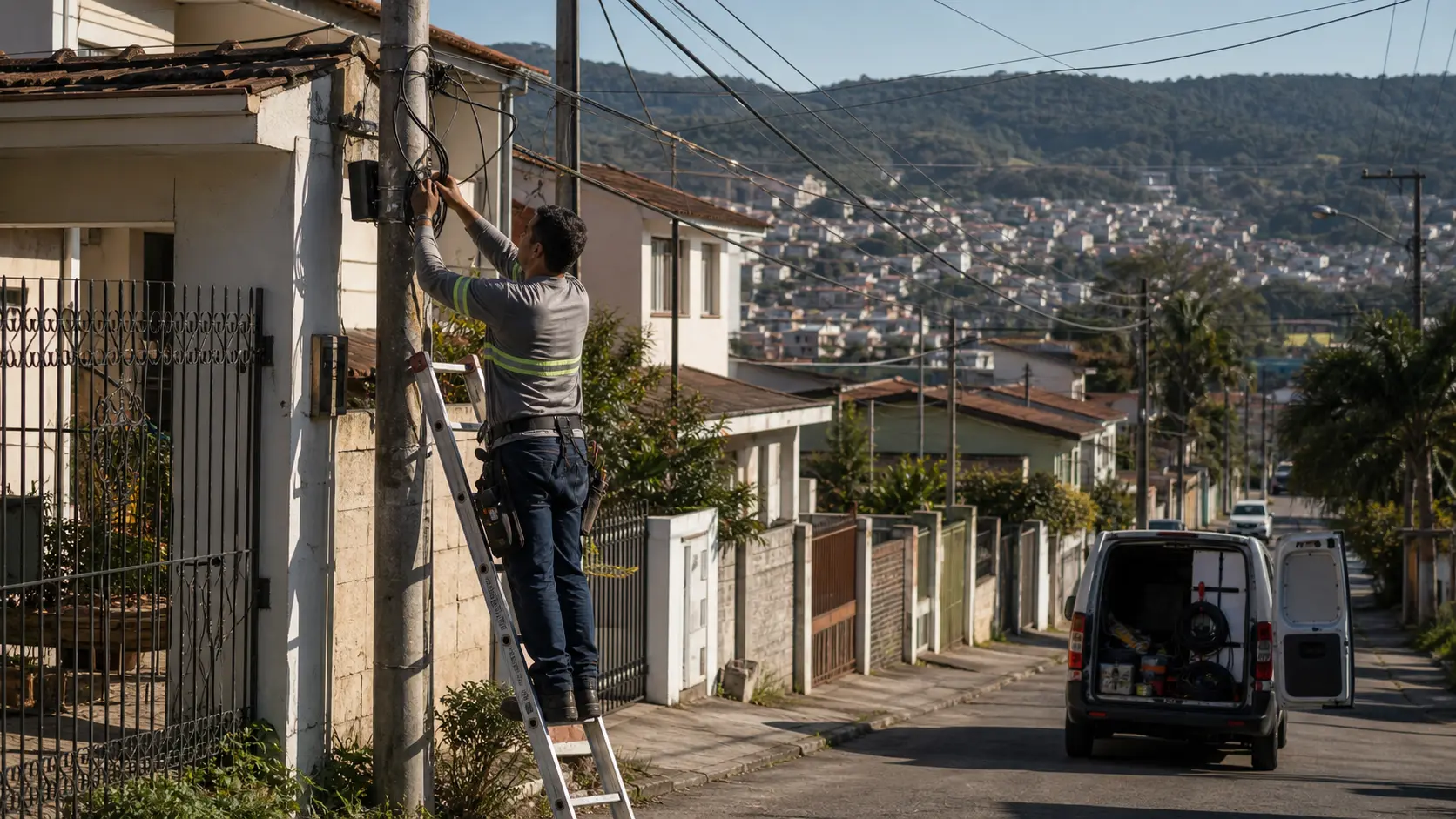
In western Santa Catarina, a fibre line is only valuable if the operator can recover the cost of construction, customer equipment, pole access, backhaul, support labour and bad-debt risk before a larger rival, satellite substitute or frustrated customer compresses the margin.
That is the payback clock behind TWF Internet. The legal company behind the brand is TWF NET PROVEDOR DE INTERNET LTDA, CNPJ 26.578.190/0001-12. Public CNPJ-derived records show the registered trade name TWF NET, active status, micro-company size, an opening date of 22 November 2016, and a headquarters address on Avenida 18 de Fevereiro in Piratuba, Santa Catarina. The official TWF website also lists an office on Rua do Comercio in Peritiba and another on Avenida 18 de Fevereiro in Piratuba. Older customer-contract documents use the former legal form TWF NET PROVEDOR DE INTERNET EIRELI ME and show the same CNPJ.
The public identity therefore needs to be read as one operating business that has changed formal company form while keeping the TWF Internet brand.
TWF's own explanation of the name is disarmingly literal. It says TWF comes from telefone, TV, Wi-Fi and fibra optica. That is not a decorative acronym. It describes the bundle a small-town provider wants to own: the internet line into the house, the Wi-Fi experience inside the house, the fixed voice line where it still matters, and the TV relationship that can keep an account sticky even when broadband prices fall. The company says it works with its own fibre, offers 24-hour monitoring, has trained local staff, provides 24-hour phone support, and sells plans from a basic 30 Mbps range up to 600 Mbps.
Its highlighted retail plans on the site are 150 Mbps, 300 Mbps and 500 Mbps, all presented as fibre plans with a 100 percent speed-guarantee claim. The site does not publish a full tariff table with monthly prices for those TWF plans, which limits direct ARPU analysis, but the product shape is clear.
The place is as important as the product. TWF's visible service geography is not Sao Paulo, Rio de Janeiro or a national overbuild map. Its public materials and social profiles point to Piratuba, Ipira, Peritiba, Concordia and Alto Bela Vista in Santa Catarina. Those are not equal markets. Concórdia is a much larger city by the standards of the region; Peritiba, Ipira, Piratuba and Alto Bela Vista are small municipalities where a few thousand residents, municipal offices, schools, farms, local businesses, hotels and public services can make the difference between a line extension that pays back and one that becomes stranded capital.
IBGE and municipal materials put Piratuba at 5,769 residents in the 2022 census, Ipira at about 4,578, Peritiba around 2,992, and Alto Bela Vista below 2,000 in the preliminary 2022 table. A provider working these towns is not buying anonymous national scale. It is buying the chance to become the known network in a small operating surface.
Small can be an advantage in broadband, but only when the route is dense enough. A local fibre build has a brutal first principle: the drop that reaches a paying customer is useful; the fibre that passes a low-take-up street is a claim on future demand. Every pole attachment, optical splitter, vehicle visit, customer router, splice, support call and billing exception draws cash before the provider knows whether the subscriber will remain long enough to recover it. TWF's official language about own fibre and local support implies a vertically involved operation rather than a pure resale brand.
That can improve control of outages and installation timing. It also means the company carries the expense and operational discipline of being present on the ground.
The Brazilian market makes this both attractive and dangerous. Brazil has one of the world's most fragmented and active ISP markets. Regional providers have been central to the expansion of fibre outside the largest cities, and public market summaries based on Anatel data show fibre dominating fixed broadband. Opensignal cited Anatel data indicating that 78 percent of Brazil's fixed broadband connections were fibre by July 2025. Radar da Telecom's Anatel-based national broadband page showed 56.0 million fixed-broadband accesses and a 79.40 percent fibre share in April 2026.
That context matters because TWF is not competing in an empty market where any fibre is extraordinary. It is competing in a country where fibre is already the default growth technology and where thousands of providers are trying to defend neighbourhood economics.
Santa Catarina is not a weak broadband state. Apronet, citing Anatel data, described Santa Catarina as leading Brazil in fixed-broadband access per inhabitant, with 35.2 fixed accesses per 100 inhabitants against a national average of 23.6. That is a strong market for digital demand, but it also means customers are less likely to be starved of alternatives. In Peritiba, MelhorPlano lists Unifique fibre plans at 500 Mbps for R$119.90 per month and 800 Mbps for R$149.90, alongside Starlink as a satellite substitute.
In Concórdia, the same comparison environment shows Claro, Vivo, Mhnet and Unifique as visible competitors, with large headline speeds and aggressive prices. TWF can win local trust, but it cannot assume that rural or small-city customers will accept a permanently inferior price-speed proposition.
The public network record confirms that TWF is a real operator. Registro.br RDAP lists AS266546 as a direct allocation in Brazil, with TWF NET PROVEDOR DE INTERNET LTDA as registrant and CNPJ 26.578.190/0001-12 as the public identifier. The same record connects the autonomous system to IPv4 space at 160.238.196.0/22 and IPv6 space at 2804:3dac::/32. RIPEstat's routing data on 2 July 2026 showed AS266546 announced, first seen in route views on 3 June 2017, visible from 322 of 323 IPv4 RIS peers and 321 of 321 IPv6 RIS peers. It showed six IPv4 prefixes, 1,024 IPv4 addresses, three IPv6 prefixes and 24 observed neighbours.
PeeringDB lists TWF Internet as an NSP with seven IPv4 prefixes, three IPv6 prefixes and a traffic level in the 10-20Gbps band. These are not the traces of a pure marketing label.
The same routing evidence also sets expectations. A /22 of IPv4 space is enough to support a serious small access network, especially with CGNAT and IPv6, but it is not a national resource base. RIPEstat's active prefix list is compact. BGP.Tools shows one upstream in its summary view and a broader set of peers in the observed policy page. Hurricane Electric and GIBIRNet show the familiar 160.238.196.0/22 family and the 2804:3dac IPv6 family. The business reading is that TWF has real network resources but still depends on upstream reach, peering arrangements and regional transport economics.
For a small ISP, the cost and reliability of those upstream relationships can decide whether a subscriber on a cheap plan is profitable.
The most revealing evidence is not only technical. Public contracts show TWF serving municipal customers. A Peritiba municipal contract from 2017 names TWF NET PROVEDOR DE INTERNET EIRELI ME as the contractor and lists a total value of R$31,920 for internet services to municipal locations, including health-related addresses. An Ipira contract from 2021 is even more useful because it shows the operating detail. TWF was contracted to provide GPON fibre links to schools, municipal offices, health units, CRAS, cultural spaces and other public locations.
Many listed links were 50 Mbps download and 20 Mbps upload or 100 Mbps download with 20 Mbps or 50 Mbps upload, with public IP or fixed IP language, no installation fee, equipment in comodato, maintenance included and 24-hour support. Monthly line items around R$56.80 or R$64.39 are strikingly low by the standards of dedicated public connectivity, although the contract structure, local procurement context and package obligations matter.
Those public-sector links matter for two reasons. First, they create anchor demand. A small provider that connects schools, health units, municipal offices and local cameras gets predictable recurring revenue and a public reference account. Second, they create service discipline. Municipal contracts can require response times, documentation, equipment replacement, support channels and proof that the network performs.
The Ipira contract required assistance at all contracted sites within one hour after a request, a minimum 90 percent bandwidth guarantee, 24-hour service, support every day of the week, public or fixed IP features, and included maintenance. Those obligations turn the provider's local presence into both asset and cost. The same technician who solves a municipal fault quickly is valuable; the labour cost of being that responsive in multiple small towns is also real.
TWF's customer contract reveals the same tension. The SCM contract identifies an Anatel authorization act, number 1159, dated 24 February 2017. It defines multimedia communication service, states that installation should begin within 10 business days after adhesion subject to technical viability, and says service is to be provided 24 hours a day, seven days a week, except for interruptions outside the provider's control. It also identifies the company as a Prestadora de Pequeno Porte, a small provider category that exempts it from certain obligations under Brazilian telecom rules.
The customer-rights section includes familiar consumer protections: information, privacy, complaint handling, cancellation rights and Anatel recourse. The provider-obligation section says TWF must maintain customer service, respond to complaints, give proportional discounts for interruption or degradation, and cannot prevent a subscriber from being served by other telecom networks.
That last clause is commercially important. In local broadband, customer lock-in can be soft rather than formal. A household may technically be free to choose another provider, but the practical choices depend on whether another fibre operator passes the address, whether installation is quick, whether the building allows entry, whether mobile or satellite alternatives are acceptable, and whether a family wants to risk downtime during a switch. TWF's contractual language does not create exclusivity.
Its economic opportunity is instead to make the local alternative feel unnecessary: fast installation, reliable Wi-Fi, a human support contact, and a bill that is not so high that the customer shops every month.
The unit economics are therefore the article's centre of gravity. If TWF sells a residential fibre plan near the local market band, the reference price is not its unpublished retail price but the competitive set around it: Unifique's listed Peritiba offers at R$119.90 for 500 Mbps and R$149.90 for 800 Mbps, Starlink as a higher-cost but independent substitute, and larger-city offers from Claro, Vivo and Mhnet in nearby Concórdia. Suppose a local fibre subscriber produces monthly revenue in the low hundreds of reais or below, after tax and payment friction.
Against that, TWF must recover the feeder and distribution fibre, pole access and make-ready work, optical splitters, ONT or router equipment, installation labour, customer acquisition, billing, support, backhaul or transit, power, monitoring, truck rolls, replacement hardware, network maintenance and churn. The municipal contracts show another pricing layer: public links can be won at very low monthly prices when installation fee, equipment, maintenance and support are bundled. That can be rational if the route already exists and the account anchors a public footprint.
It is dangerous if the contract forces expensive response obligations without enough density around it. The payback clock stops being generous when a customer leaves after a year, a router has to be replaced, or a competitor offers a faster plan before the original build cost is earned back.
This is where TWF's own-fibre claim carries weight. Owning or controlling the last-mile fibre gives a provider more ways to improve margin over time. The same cable can serve homes, schools, commercial premises and public services. A new drop in a street already passed by fibre is much cheaper than the first build. A network that has already reached Peritiba, Piratuba, Ipira and Alto Bela Vista can deepen rather than constantly expand. But own fibre also has a maintenance burden. Storms, trees, pole moves, construction damage, power issues and customer-premises problems do not care that the provider is small.
The company must have enough technicians, spares and monitoring to prevent its local reputation from becoming a liability.
The pole and infrastructure interface is a watchpoint. Radar da Telecom's page for TWF, based on public Anatel pole-use data, identifies the company as an SCM provider with regular status, positive data delivery as of 29 June 2026, seven pole-use records, one state and CELESC Distribuicao as the energy-distribution context. It also lists process 53500.079537/2017-84. The page says its data is drawn from public Anatel collections and does not represent an official Anatel position, so it should be treated as a public-data interpretation rather than a regulator's endorsement.
Still, it tells us the obvious: a small fibre ISP in Santa Catarina lives with the utility-pole bureaucracy. Pole access, rental, safety, coordination with the distributor and remediation of irregular attachments all affect cost and expansion speed.
TWF's official website points to a customer experience built around direct contact rather than digital self-service alone. It lists business hours from Monday to Friday and Saturday morning, plus 24-hour phone support, a landline, an 0800 number and WhatsApp. It links to a customer centre, boleto update, telephone-bill support and TV Play. Its FAQ says new customers pay after 30 days by bank slip, with credit and debit options, and that payment recognition may take up to 48 hours after settlement. That is prosaic, but it matters.
Regional ISP churn often starts with billing friction: the customer says the bill was paid, the system says open debt, the support queue grows, the line is suspended, and the household starts comparing alternatives. A provider that handles payment exceptions quickly protects revenue as much as goodwill.
The product bundle also reflects an attempt to hold more of the household relationship. The SeAC contract and the official site show TV alongside internet and fixed voice. In many markets, TV is a declining anchor, but in small-town Brazil it can still support retention when bundled with broadband and local support. Fixed voice is similar. It may not be the growth engine, but it can matter to small businesses, public offices, older households and customers who want a familiar contact point. The danger is that each extra service adds operational complexity.
TV support, telephone issues, Wi-Fi troubleshooting and fibre faults require different skills even when the customer sees one brand.
The company's public performance signals are mixed but generally constructive. MelhorPlano and Minha Conexao pages present TWF as a local speed, stability or gaming-latency winner in several of its visible towns. In Peritiba, the page says TWF had the fastest average measured download at 67 Mbps in 2024, the best stability index and a 28 ms gaming ping. In Piratuba, the page presents TWF as a top performer, with one section citing a 71 Mbps average and another ranking snippet citing 122.52 Mbps, plus a 39 ms ping signal.
In Alto Bela Vista, the page recognizes TWF for speed and gaming in 2023, although one speed value is blank and should not be overused. In Concórdia, TWF appears as a stability and gaming-latency recognition signal in a market where larger rivals dominate the visible offer tables.
Those pages are not audited engineering reports. They are consumer-comparison and lead-generation environments that depend on measured tests, user behaviour and the site's methodology. But they are still useful market signals. They suggest that TWF's local brand is not invisible and that its network can produce competitive latency in the towns it serves. They also show the company's limit. In the same comparison pages, Unifique, Claro, Vivo, Mhnet, Starlink, SKY and other substitutes appear depending on municipality. A small provider can be loved in one town and squeezed in another.
It can win stability in Concórdia without having the scale or price position to dominate Concórdia. The investor question is not whether TWF can deliver a good line. It is where it can deliver enough good lines close together.
Unofficial signals add texture without settling the case. TWF's official social profiles are active, local and sports-oriented, using World Cup themes and claims of being the best connection in its cities. Facebook and Instagram snippets show the company presenting itself as the best internet in its served towns in 2023 and 2024. MelhorPlano's award pages echo that reputation in specific categories. A Brazilian broadband forum snippet mentions a user taking a plan from a relatively new local provider, TWF Internet, inside a broader regional-fibre discussion.
Reclame Aqui search results do not show a large public set of consumer complaints against TWF in the way one often sees with larger operators; instead, they show TWF as a complainant in disputes involving a supplier or vendor, Huge Networks, over cancellation, invoice and billing issues. None of those signals proves service quality.
Together they suggest a provider whose public reputation risk is less about a visible wave of household complaints and more about the ordinary fragility of a small operator: if support slips, supplier billing becomes messy, or a competitor markets harder, the reputation can turn quickly because the community is small.
The supplier-friction signal is worth reading carefully. A complaint by a TWF representative about Huge Networks is not evidence of TWF mistreating subscribers. It is evidence that a small ISP can itself be a customer in a chain of telecom services, billing platforms, wholesale products, software, voice services or other operational inputs. When the supplier relationship is smooth, customers never see it. When it fails, the operator's cash flow, invoices, cancellation rights or service features can be affected. Small providers do not escape supplier concentration just because they own fibre.
They still need upstream connectivity, routers, ONTs, software, payment systems, support tools, domain/DNS operations, utility-pole access, and sometimes third-party voice or TV inputs. Each dependency shortens the margin for error.
TWF's relationship with public customers gives it a trust base but not immunity. A municipal contract can signal competence and create recurring cash, yet the same customer can be demanding. The Ipira contract required public IPs or fixed IPs at several locations, equipment at no extra charge, included maintenance, 24-hour support, and one-hour assistance after requests. A school or health unit outage is more visible than a residential complaint. The provider that can satisfy those accounts gains credibility with local households and businesses. The provider that misses them risks political and community attention.
In small municipalities, B2G revenue and local reputation are tied together.
The strategic alternative for a company like TWF is not simply "grow" or "do not grow." It is whether to deepen density in known towns, move into adjacent streets and public accounts, push into larger nearby markets such as Concórdia, or become a target for consolidation by a regional platform. Each path has different economics. Deepening a known town can produce the best payback because crews, offices and fibre routes already exist. Expanding into a larger city offers a bigger addressable market but invites stronger competitors and higher customer-acquisition cost.
Selling or partnering can crystallize value if the buyer wants local fibre, customers, routes or municipal relationships. Staying independent preserves local control but requires continued reinvestment as customer speed expectations rise.
Pricing power is likely narrow. If Unifique can list 500 Mbps at R$119.90 and 800 Mbps at R$149.90 in Peritiba, TWF cannot rely on a high headline monthly fee unless its service is plainly better or its address-level availability is unique. If Starlink is available as a fallback, remote customers have a non-local option, even if equipment cost and latency make it imperfect. If Claro, Vivo and Mhnet compete in Concórdia, the larger-market reference price becomes more aggressive. TWF's defensible price is therefore tied to trust: answer the phone, install quickly, keep latency low, fix faults, explain bills, and be physically present.
That is a labour-intensive moat, not a software moat.
The company's IPv6 footprint is a positive sign. Many very small access providers lag in IPv6 visibility, yet AS266546 has 2804:3dac::/32 and related /40 announcements visible in RIPEstat and other routing tools. IPv6 does not by itself prove consumer activation quality, but it suggests the company has a resource base and routing configuration that can support future access growth without relying only on scarce IPv4. The IPv4 side remains compact at 1,024 addresses. In an access network, that increases the importance of address management, CGNAT quality, abuse handling and customer segments that need public or fixed IPs.
The Ipira contract's fixed-IP references show that public-sector and business customers can demand more than a generic residential address behind translation.
Abuse and reputation are under-discussed costs in local ISP economics. A network with 1,024 IPv4 addresses and a growing IPv6 pool has to handle infected customer devices, spam complaints, compromised routers, illegal redistribution, payment abuse, and customer claims about service quality. TWF's SCM contract explicitly tells subscribers not to cede or redistribute the service to third parties and requires certified equipment where applicable. It also says the provider can use third-party infrastructure or contractors while remaining responsible to Anatel and subscribers.
These clauses are ordinary, but they show the operational boundary: TWF must police enough behaviour to protect the network without becoming so heavy-handed that customers leave.
Brazil's regulatory direction may raise the bar for the smallest providers. Opensignal's 2025 Brazil fixed-broadband report noted that new rules require licences for very small ISPs with fewer than 5,000 subscribers, which had previously been exempt, and that broader tax and regulatory changes are likely to pressure small providers. TWF already has Anatel authorization language in its contract and appears as an SCM provider in Anatel-derived public datasets, so the issue is not basic legality. The issue is compliance overhead.
As reporting, pole-use regularization, consumer rights, tax treatment and quality obligations become more demanding, a micro-company has less room to absorb back-office cost than a scaled regional consolidator.
The best argument for TWF is that the company has been visible for a long time by small-ISP standards. Its CNPJ began activity in 2016. Its Anatel authorization act in the contract is from February 2017. Its AS registration is from May 2017, with routing first seen in June 2017. It had a Peritiba municipal contract in 2017 and an Ipira municipal contract in 2021. It has official contracts, a current website, social profiles, customer support contacts, BGP visibility and local ranking signals. That is a real operating history.
The company has survived the early years when many small fibre projects either fail to regularize, remain informal or get absorbed.
The best argument against overvaluing TWF is that almost all crucial financial numbers are private. There is no public subscriber count, churn rate, ARPU, capex per home passed, take-up by town, enterprise revenue share, gross margin, debt profile, pole-rental bill, support headcount, NOC cost, wholesale transit contract, or customer mix. Public documents show the contours of the business, not the income statement.
The municipal prices visible in the Ipira contract are low enough to raise questions about margin if similar economics applied widely, though public procurement links can be strategically valuable and may sit on already-built routes. The retail plan speeds are visible, but not TWF's own monthly prices. The network resources are visible, but not utilization.
The watchpoints are therefore practical. First, does TWF continue to appear in public routing with stable prefixes and diverse enough upstream reach? Second, do its served towns keep showing positive speed and latency signals relative to substitutes? Third, does the company publish or expose clearer retail pricing, installation terms and service-level expectations, or does pricing remain mainly a sales-contact exercise? Fourth, do public contracts continue after their initial terms, and are new municipal or business accounts added without unsustainably low pricing?
Fifth, does the pole-use and utility-interface record stay clean as Anatel's data collections become more visible? Sixth, do consumer complaints stay modest, or does a small-town reputation problem surface in social channels, Reclame Aqui, Anatel complaints or local press?
TWF Internet matters because it is a compact version of the Brazilian regional-ISP story. Brazil's fibre expansion was not only a story of national incumbents. It was also a story of thousands of local providers willing to build where large operators were slow, expensive or absent. That model is now entering a harder phase. Fibre is common. Customers expect hundreds of megabits. Big regional players and national brands can enter small towns with sharp pricing. Starlink changes the fallback calculation in rural areas. Regulators want cleaner data and more formal compliance.
The easy growth from being first with fibre gives way to the harder work of being better with support, billing, reliability and cost.
For TWF, the company-specific judgement is cautiously constructive but not expansive. The evidence supports a real, locally embedded fibre operator with valid network resources, Anatel-facing authorization traces, municipal customers and a public service footprint in western Santa Catarina. It does not support a claim that TWF is a broad national platform or a high-growth consolidator.
The company looks more like a dense local access business whose value depends on how many customers it can serve from already-built routes, how well it can defend those customers from larger substitutes, and how disciplined it is about not extending fibre where the payback clock is too long.
That may be enough. A local ISP does not need to become a national champion to be economically meaningful. It needs to know which streets, schools, businesses, farms and public offices can be served profitably, and it needs to keep those customers through the long middle years after the initial installation excitement has passed. TWF's public record shows that it has built the basic pieces: company registration, Anatel authorization language, customer contracts, local offices, support channels, fibre claims, autonomous system resources, IPv4 and IPv6 routing, municipal contracts and public reputation signals.
The unanswered question is whether those pieces compound into durable local density or remain a fragile collection of small obligations.
The answer will show up less in slogans than in repeat behaviour. If customers in Peritiba, Piratuba, Ipira and Alto Bela Vista keep seeing TWF as the fast local choice while bills clear cleanly and technicians arrive quickly, the fibre payback clock works in the company's favour. If larger competitors push higher speeds at lower prices, if support calls outrun labour capacity, if pole and regulatory costs rise, or if municipal contracts are priced too thinly, the same local fibre becomes a demanding asset. TWF Internet is therefore not a mystery company. It is a payback test.
The facts that would most change the judgement are specific and measurable. A current subscriber count by municipality would show whether TWF has density or only scattered service points. A home-passed figure would show whether the fibre plant has room for low-cost incremental growth. A split between residential, business and public-sector revenue would show whether municipal contracts are helpful anchors or a large part of the revenue base. Churn by town would show whether local performance rankings translate into retention. Average monthly revenue per account would show whether the company can price above the regional commodity floor.
A list of upstream and transport suppliers, with committed capacity and contract tenor, would show whether routing visibility is backed by resilient commercial terms. A support log showing mean time to repair and truck-roll frequency would show whether the local-service promise is profitable or merely expensive.
The most bullish version of TWF is a company with high household penetration on streets it already passes, a loyal public-sector base, enough small-business accounts to lift average revenue, and a support operation that fixes problems before customers look at Unifique, Claro, Vivo, Mhnet or Starlink. In that version, the company's small size is not a weakness. It is a focus advantage. The office is close to the customer. The technician knows the route. The customer can send a message to a local number. The network is small enough to understand and dense enough to monetize.
Fibre capex is front-loaded, but each additional subscriber on an existing route carries better incremental economics.
The bearish version is also easy to imagine. The operator builds too far beyond its densest pockets, wins public accounts at prices that do not cover one-hour support obligations, relies too heavily on one upstream or one utility-pole interface, and then faces a larger rival offering higher speeds and bundled content at prices the small provider cannot match. In that version, the brand remains locally known but the margin disappears. The support team becomes a permanent subsidy.
IPv4 scarcity, replacement equipment, tax changes, billing disputes, bad-debt risk and regulatory reporting create costs that a micro-company cannot spread over enough customers. The network still works, but it stops compounding.
The realistic case sits between those extremes. TWF has enough evidence of substance to deserve attention and enough missing economics to resist a grand claim. Its strongest lane is likely not to chase every nearby municipality. It is to defend the places where its routes, offices, municipal references and customer reputation already overlap. That means careful expansion street by street, not just city by city. It means selling business and public-service reliability where the network is already strong, not using those customers to justify uneconomic extensions.
It means publishing clearer price and installation expectations as customers become more comparison-driven. It means keeping IPv6, routing hygiene, support staffing and pole-use compliance ahead of the minimum required level, because a small provider cannot afford a reputation shock.
The conclusion is therefore conditional but useful. TWF Internet should be read as a local infrastructure company with a small but real operating surface. Its future value will not be decided by the national count of Brazilian ISPs or by the headline share of fibre in Brazil. It will be decided by a narrower question: how many paying customers can be attached to each kilometre of useful local fibre, and how long can those customers be kept after the first installation? In western Santa Catarina, that question is concrete.
It lives in a school connection, a health-unit link, a tourist-town household, a small business that needs fixed IP service, a rural customer comparing satellite, and a gamer watching latency. TWF has built enough of a footprint to make the question worth asking. The next proof would be whether the footprint is dense enough to keep paying for itself.
Evidence register
- https://brasilapi.com.br/api/cnpj/v1/26578190000112 - Public CNPJ-derived record supporting the current legal name, CNPJ, active status, Piratuba headquarters, micro-company classification, opening date, CNAE, secondary telecom activities, capital social and administrator names.
- https://www.twf.net.br/ - Official company site supporting the TWF Internet brand, product bundle, own-fibre claim, 24-hour monitoring/support, local offices in Peritiba and Piratuba, contact channels, plan-speed range and highlighted 150 Mbps, 300 Mbps and 500 Mbps fibre plans.
- https://www.twf.net.br/contratos/contrato_TWF_scm.pdf - Official SCM contract supporting the older EIRELI ME legal form, same CNPJ, Anatel authorization act 1159 of 24 February 2017, SCM service terms, small-provider status, installation timing, customer rights, support obligations and interruption-credit language.
- https://www.twf.net.br/contratos/contrato_TWF_seac.pdf - Official SeAC contract supporting the TV side of the telephone, TV, Wi-Fi and fibre bundle.
- https://peritiba.sc.gov.br/uploads/sites/469/2021/12/937005_CT_33_2017___TWF_Internet.pdf - Peritiba public contract supporting early local municipal demand and a listed contract value of R$31,920.
- https://ipira.sc.gov.br/uploads/sites/425/2022/05/2248916_124___TWF_Net_Provedor___06102021___Internet.pdf - Ipira public contract supporting GPON fibre service to schools, health units, municipal offices and public facilities, with pricing, public/fixed IP language, equipment, maintenance and support obligations.
- https://rdap.registro.br/autnum/266546 - Registro.br RDAP record supporting AS266546, direct allocation, TWF NET PROVEDOR DE INTERNET LTDA, CNPJ public ID, related IPv4 and IPv6 resources and legal representative.
- https://stat.ripe.net/data/routing-status/data.json?resource=AS266546 - RIPEstat routing status supporting current visibility, first-seen routing, IPv4 and IPv6 announced space and observed neighbours.
- https://stat.ripe.net/data/announced-prefixes/data.json?resource=AS266546 - RIPEstat prefix data supporting the current announced IPv4 and IPv6 route set.
- https://www.peeringdb.com/asn/266546 - PeeringDB profile supporting ASN 266546, TWF Internet identity, NSP classification, seven IPv4 prefixes, three IPv6 prefixes and traffic-level estimate.
- https://bgp.tools/as/266546 and https://bgp.he.net/AS266546 - Secondary BGP sources supporting the route set, peer/upstream context and prefix descriptions.
- https://www.radardatelecom.com/postes-anatel/prestadora/26578190000112 - Anatel-derived pole-use page supporting SCM regular status, recent positive data delivery, CELESC context, one-state footprint and process number, with the caveat that the site is not an official Anatel position.
- https://insights.opensignal.com/reports/2025/10/brazil/fixed-broadband-experience - Brazil fixed-broadband context, including Anatel-based fibre share and regulatory pressure on very small providers.
- https://www.radardatelecom.com/servico/banda-larga - Anatel-based Brazil broadband market context, including April 2026 total fixed accesses and fibre share.
- https://www.apronet.com.br/informativo-detalhe/117/santa-catarina-lidera-ranking-de-acesso-a-banda-larga-fixa-por-habitante-no-brasil - Santa Catarina context for high fixed-broadband penetration.
- https://melhorplano.net/internet-banda-larga/sc/peritiba - Third-party Peritiba market signal for TWF speed, stability and gaming latency, plus Unifique and Starlink substitute pricing.
- https://melhorplano.net/internet-banda-larga/sc/piratuba - Third-party Piratuba market signal for TWF local performance and substitute offers.
- https://melhorplano.net/internet-banda-larga/sc/concordia - Third-party Concórdia market signal showing TWF recognition in a more competitive nearby city and the presence of Claro, Vivo, Mhnet and Unifique.
- https://melhorplano.net/internet-banda-larga/sc/alto-bela-vista - Third-party Alto Bela Vista market signal for TWF recognition in speed and gaming categories.
- https://www.ibge.gov.br/cidades-e-estados/sc/ipira.html, https://www.ibge.gov.br/cidades-e-estados/sc/peritiba.html and https://ftp.ibge.gov.br/Censos/Censo_Demografico_2022/Previa_da_Populacao/SC_POP2022.pdf - Municipality population and density context for the small-town payback argument.
- https://www.reclameaqui.com.br/huge-networks/solicitacao-de-cancelamento-contratual-e-correcao-de-cobranca-abusiva-da-huge-networks_u83FASOdK8qjIBGV/ - Supplier-friction signal involving TWF as complainant, used only to illustrate vendor-dependency risk.