
Summary
- What it says: TSTT and the island bill for telecom redundancy
- Main topic: Network-resource evidence
- Context: National Telecom
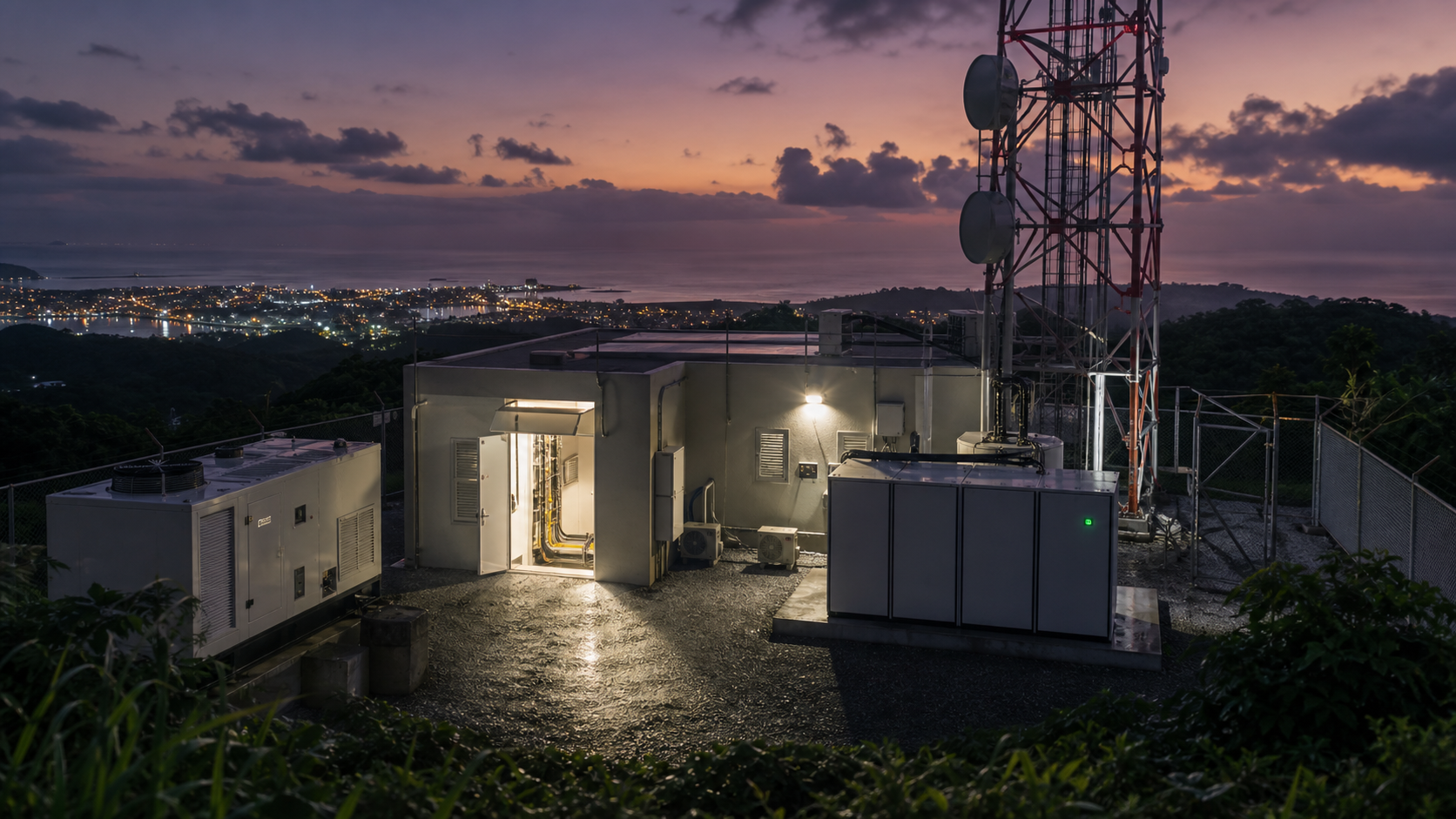
The hardest hour for a Trinidad and Tobago telecom operator is not the hour when everyone wants more speed. It is the hour when a cable fault, a power interruption, a storm warning and a public-service deadline arrive together. In that moment, mobile data is no longer a product, fixed broadband is no longer a household convenience, and a cloud contract is no longer an enterprise upsell. The network becomes a national operating surface.
Schools, banks, government portals, call centres, Tobago households, oil-and-gas suppliers, police stations and small retailers all discover that the same island geography that makes connectivity valuable also makes backup expensive.
That is the correct frame for Telecommunications Services of Trinidad and Tobago, better known through the bmobile brand and through the residential fibre arm Amplia. The company is often discussed as an incumbent, a state-linked operator, a competitor to Digicel and Flow, or a legacy fixed-line business trying to complete its migration away from copper. Those descriptions are all partly true. None is sufficient. TSTT's central economic problem is that Trinidad and Tobago needs redundancy more than a larger mainland market would, but does not give the operator a larger mainland revenue pool from which to pay for it.
The public evidence points to a company with national importance, visible commercial pressure and a balance sheet that leaves little room for lazy capital allocation. TSTT's own audited statements for the year ended March 31, 2025 show revenue from contracts with customers of TT$1.983 billion, operating profit of TT$486 million, finance costs of TT$333 million and profit after tax of TT$106 million. Yet the same statement records a total comprehensive loss of TT$82 million after a large defined-benefit pension remeasurement. The balance sheet is more revealing than the profit line: total liabilities were TT$4.508 billion against total equity of TT$299 million, with borrowings of about TT$3.211 billion when current and non-current borrowings are combined. This is not a sleepy public utility. It is a capital-intensive national network operator carrying old obligations while being asked to build the new infrastructure that will keep the country online. Evidence: https://papers.ttparliament.org/wp-content/uploads/2026/01/The-Consolidated-Audited-Financial-Statements-of-the-Telecommunications-Services-of-Trinidad-and-Tobago-Limited-for-the-year-ended-March-31-2025.pdf
The incumbent is now a resilience company
TSTT describes itself as the country's largest provider of communications solutions to residential and commercial markets, with products built around an IP-based core and marketed under bmobile. Evidence: https://www.tstt.co.tt/ The 2026 State Enterprises Investment Programme gives the cleaner institutional version: TSTT is 51 percent owned by National Enterprises Limited and 49 percent by Cable and Wireless West Indies Limited; it offers mobile, fixed-line, broadband, entertainment, security, cloud, digital services and digital infrastructure across customer segments. Amplia, a 100 percent TSTT subsidiary, is described in the same programme as the residential fibre arm, selling high-speed internet, entertainment, voice and security over a 100 percent fibre optic network. Evidence: https://www.finance.gov.tt/wp-content/uploads/2025/12/SEIP-2026-for-Smartphone.pdf
The line between telecom service and public infrastructure is therefore not theoretical. The state-enterprise programme says TSTT's business sales unit serves corporate customers, government accounts and the Tobago House of Assembly, with hosted solutions that include private cloud, public cloud, software as a service, IP PABX and data storage for business continuity applications. Evidence: https://www.finance.gov.tt/wp-content/uploads/2025/12/SEIP-2026-for-Smartphone.pdf A January 2026 Ministry of Planning item on the NOBIS electronic know-your-customer platform said TSTT would provide secure telecommunications and cloud infrastructure for the national rollout, with the technology intended to support online access to services across ministries and state agencies. TSTT is not merely selling connectivity to the state; parts of the state are building digital service delivery on top of TSTT. Evidence: https://www.planning.gov.tt/newsite/tt-moves-closer-to-fully-online-public-services/
That dependence changes the investment judgment. A consumer mobile operator can lose a promotion war and recover. A national provider carrying government, Tobago and business-continuity workloads has a harder problem: the same customer set that gives it strategic relevance also raises the reputational cost of failure. A public outage becomes a political event. A failed enterprise platform becomes an administrative problem. A missed resilience investment can be framed as neglect of national capacity rather than a private commercial mistake.
The revenue pool is shifting under its feet
Trinidad and Tobago's telecom market is not collapsing, but it is changing in ways that are awkward for a legacy operator. The Telecommunications Authority of Trinidad and Tobago's 2024 Annual Market Report says the telecommunications sector generated TT$4.3 billion in 2024, up 2.9 percent from 2023. Internet, combining fixed and mobile, produced 56.4 percent of sector revenues. Mobile voice produced 19.9 percent, fixed voice 6.7 percent, leased lines 3.1 percent and international voice only 0.7 percent. The direction is unmistakable. Voice is becoming a shrinking layer; broadband and data are the business. Evidence: https://tatt.org.tt/wp-content/uploads/2025/07/Annual-Market-Report-AMR-2024-Final.pdf
Subscription data sharpen the point. TATT reported about 3.67 million subscriptions across mobile voice, fixed voice, fixed internet, mobile internet and subscription TV in 2024, down 2.3 percent from 2023. Mobile voice subscriptions fell from 2.02 million in 2023 to 1.79 million in 2024. Fixed voice continued to decline, from 310,700 subscriptions to 297,700. Subscription TV also declined, to 209,900. The growth was in internet: fixed internet edged up to 407,700 subscriptions, while mobile internet rose to 965,200. Mobile internet penetration climbed from 59.1 per 100 inhabitants to 70.5, and fixed internet household penetration reached 96.4 per 100 households. Evidence: https://tatt.org.tt/wp-content/uploads/2025/07/Annual-Market-Report-AMR-2024-Final.pdf
For TSTT, this creates a classic incumbent squeeze. The old fixed voice base is not dead, but it is not where value is expanding. Mobile voice still generates cash, but its subscription count fell sharply at the market level and TATT separates mobile internet from voice precisely because the economic centre has moved. Fixed broadband is attractive, yet household penetration is already high. A high-penetration market can still upgrade, but upgrades come from speed, reliability, bundling and customer capture, not from a simple first-time connection wave.
That is why the company's access strategy matters more than any single tariff. The public bmobile internet page shows wireless broadband offers at modest speeds, including 6 Mbps and 10 Mbps prepaid options, and points heavy users toward Amplia fibre with speeds up to 1 Gbps. Evidence: https://bmobile.co.tt/internet/ Amplia's public site advertises fibre bundles in the 300 Mbps to 500 Mbps range, with TV and voice options layered around the broadband line. This is not just segmentation. It is a capital-allocation map. TSTT is trying to use fixed wireless where fibre economics are weaker or speed requirements are lower, and fibre where the household or bundle economics can justify heavier access investment. Evidence: https://amplia.co.tt/
Pricing is a map of the network, not just a menu
The bmobile and Amplia offers reveal a company trying to avoid the trap of treating every household as the same kind of broadband customer. A 6 Mbps or 10 Mbps wireless broadband plan looks modest beside a 300 Mbps or 500 Mbps fibre bundle. Evidence: https://bmobile.co.tt/internet/ Evidence: https://amplia.co.tt/ That does not automatically make it obsolete. In a small-island market with rural pockets, legacy copper replacement, variable household income and uneven installation economics, a lower-speed fixed wireless plan can be a rational answer for a customer who needs email, messaging, light streaming and basic home connectivity without the cost and civil works of fibre. The commercial danger is that customers do not think in engineering constraints. They compare monthly fees, speed claims, installation time and service experience.
That makes TSTT's pricing ladder a test of trust. If wireless broadband is sold to locations where the radio layer has enough capacity, the product can protect revenue while retiring copper. If it is sold into congested cells or households with fibre-grade expectations, it becomes a churn machine. A customer disappointed by a low-speed wireless experience may not politely upgrade inside the TSTT group; they may move to Flow, Digicel, Starlink or another local provider. The same is true of Amplia. A 300 Mbps fibre bundle is not only a speed product.
It is a promise that installation quality, Wi-Fi support, international capacity and evening performance will match the household's higher monthly spend.
The market data make that promise expensive. Fixed broadband household penetration is already above 96 per 100 households, so TSTT is rarely selling the idea of internet for the first time. It is selling a better version of internet. That shifts the economics from acquisition to upgrade and retention. Upgrade economics are less forgiving because the customer already knows the pain points: buffering at night, weak Wi-Fi, call-centre delay, technician scheduling, contract lock-in, and whether a neighbour gets better service from another provider.
The operator that overpromises speed or underinvests in customer experience gives competitors the easiest possible sales script.
The revenue mix also explains why bundles matter. Fixed voice and subscription TV are declining markets, but they can still add value when wrapped around broadband for households that want one bill or older users who continue to value home voice. The goal is not to revive legacy voice as a growth engine. It is to keep the household inside the group while the economics migrate to data. Amplia's bundles and bmobile's wireless broadband offers are therefore two different answers to one question: how does a national operator keep customers while moving the network away from old copper and old voice economics?
TSTT's answer will work only if internal transfer points are clean. A household that starts on fixed wireless and later needs fibre should feel guided, not trapped. A mobile customer who buys home broadband should see one company, not fragmented brands. A business customer should be able to add backup access, cloud storage and voice without negotiating with separate silos. In a market this small, friction is expensive. Every handoff that feels bureaucratic makes it easier for a competitor to claim the customer.
Copper is the ghost in the cost base
TATT's 2024 market report makes one line especially important: one fixed operator, TSTT, indicated that it is phasing out twisted-pair copper cables for fixed broadband internet and fixed telephony, with fixed wireless replacing the existing copper access network for those services. That sentence explains much of TSTT's capital problem. Copper retirement is not a marketing campaign. It is an operating migration in which the company must maintain legacy service, move customers to new access methods, preserve voice reachability, manage premises equipment, and avoid turning a technical transition into a customer-defection opportunity. Evidence: https://tatt.org.tt/wp-content/uploads/2025/07/Annual-Market-Report-AMR-2024-Final.pdf
The 2026 State Enterprises Investment Programme shows the scale of the work. TSTT's consumer sales line of business includes mobile and fixed wireless access network services. Its broadband strategy is described as a two-pronged approach using wired fibre, or FTTx, and wireless, or WTTx, to serve urban and rural areas. The programme says TSTT continues to make significant capital investment in wireless broadband infrastructure, expanding sites, capacity and coverage throughout Trinidad and Tobago. It also says TSTT continued investment in more cell sites and capacity improvements across wireless networks, improving mobile voice, prepaid, postpaid, roaming, SMS and mobile data services. Evidence: https://www.finance.gov.tt/wp-content/uploads/2025/12/SEIP-2026-for-Smartphone.pdf
The cost figures are material. The consumer sales project cost was revised from TT$2.358 billion to TT$2.384 billion, with estimated expenditure of TT$184.7 million for April to September 2025 and TT$95.8 million for fiscal 2026. The business sales project cost was revised from TT$498.1 million to TT$507.4 million. Cost centres, covering finance, administration, service delivery, assurance, customer experience, marketing, legal and human resources, were revised from TT$1.239 billion to TT$1.462 billion. Amplia's project cost was revised from TT$665.5 million to TT$699.2 million, with TT$89.1 million expected for April to September 2025 and TT$65.0 million for fiscal 2026. Evidence: https://www.finance.gov.tt/wp-content/uploads/2025/12/SEIP-2026-for-Smartphone.pdf
Those numbers do not mean all spending is wasteful. They mean the company is trying to run several transitions at once. Mobile capacity must improve. Fixed wireless must replace copper in enough locations to matter. Fibre must carry the premium residential and bundle story. Business and government ICT must be credible. Support functions must keep up with a more digital product set. A larger market can spread this over tens of millions of customers. TSTT has to do it in a twin-island market where every duplicated system is visible in the balance sheet.
The hidden cost is operational duplication. During a transition, the old network does not disappear on the day the new network is announced. Copper faults still need attention. Wireless sites still need power, backhaul and spectrum planning. Fibre drops still need installation crews. Customer databases, billing rules, modems, routers, field tools and contact-centre scripts all have to support customers who are on different generations of access. The public sees a broadband plan. The company sees inventory, spares, training, truck rolls, rights of way, tower leases, fault queues and service credits.
This is where TSTT's national role can either help or hurt. Local knowledge, legacy ducts, existing towers and a long customer history should make migration easier. Yet those same features can slow simplification if old obligations remain politically or commercially hard to retire. Copper shutdowns are rarely popular when the affected customer simply wants the old line to work. Wireless replacement is rarely celebrated when a household believes fibre is available down the road. Fibre investment is rarely easy when take-up is uncertain and the balance sheet is already leveraged.
The best transition is one in which old cost disappears as new revenue arrives. The worst is one in which new access is layered on top of old maintenance.
That is why project-cost discipline matters more than abstract capex ambition. The state-enterprise programme's revised cost figures are not, by themselves, proof of poor management; telecom programmes often move as sites, equipment, currency, labour and design choices change. But revisions raise the burden of explanation. If consumer wireless, business ICT, cost centres and fibre all move upward, management has to show what the spending buys: fewer copper faults, more fibre homes, better mobile capacity, stronger enterprise margins, lower churn, or measurable resilience.
Without that evidence, national-importance language becomes too easy.
A small market still needs mainland-grade backhaul
The internet number evidence supports the idea that TSTT remains a serious network operator, not merely a retail brand. PeeringDB lists Telecommunication Services of Trinidad and Tobago, also known as TSTT, under ASN 5639, with Cable/DSL/ISP network type, 200 IPv4 prefixes, 20 IPv6 prefixes and traffic in the 100-200 Gbps range. Evidence: https://www.peeringdb.com/net/33184 BGP routing views show AS5639 as a long-running network with visible peer and upstream relationships and many Trinidad and Tobago address blocks originated under the TSTT name. Evidence: https://bgp.tools/as/5639 IPinfo also identifies AS5639 as an ISP registered under LACNIC and associated with substantial IPv4 address space. Evidence: https://ipinfo.io/AS5639
This evidence should be read carefully. It does not prove retail quality in a particular neighbourhood. It does show that TSTT is embedded in the regional internet routing system, holds material numbering resources and has to manage upstream and interconnection choices like any major carrier. The LACNIC member-directory context matters because the public registry relationship is a network-resource signal, not a substitute for retail service proof. Evidence: https://milacnic.lacnic.net/lacnic/asociados/publico?locale=EN For an island operator, those choices become strategic. Domestic access can be well engineered, but international reach still depends on submarine routes, foreign landing points, peering, transit and power availability at intermediate facilities.
The 2020 Trinidad and Tobago internet disruption reported by Newsday is a useful reminder. The article described an international cable-link disruption affecting several providers. Flow attributed its issue to loss of power on a link in Curacao that provided critical capacity; Digicel said a power failure in Curacao disrupted an alternative path it had been using after a subsea fibre break between Guadeloupe and Antigua. TSTT said damaged submarine cable fibres in the Eastern Caribbean affected mobile customers because users who normally split traffic between mobile networks were using bmobile exclusively, while fixed-line customers were maintained through expanded subsea capacity and different routes to the United States. Evidence: https://newsday.co.tt/2020/12/08/trinidad-and-tobago-back-online-after-internet-service-break/
The commercial lesson is direct: redundancy is not a luxury add-on in Trinidad and Tobago. It is part of the product. Yet redundancy is expensive precisely because it is often invisible until failure. Customers remember the outage, not the avoided outage. Regulators and ministries expect continuity. Banks and schools design around uptime. The operator pays for alternative paths, spare power, routing diversity and field response before it can bill any customer for the avoided crisis.
Power is part of the same problem. The bmobile service charter's reference to reserve power in key areas is more than a customer-service promise. Evidence: https://bmobile.co.tt/kb/tstt-customer-service-charter/ For a telecom operator, backup power is inventory, fuel, batteries, maintenance, theft risk and site access. It also creates a hierarchy of importance: not every site can be protected equally, so the company must decide which areas, government customers, business nodes, mobile towers and core facilities receive the strongest backup. Those decisions become politically sensitive after a storm or a wide outage, because the public experiences resilience as a local fact. Either the tower near the community stayed up or it did not.
The climate and disaster context makes this more pressing. Trinidad is south of the most frequent hurricane tracks, but Trinidad and Tobago is still a Caribbean island state exposed to flooding, tropical storms, coastal risk, power interruptions and regional cable disruption. The World Bank climate portal records Trinidad and Tobago climate and tropical-cyclone risk data, ThinkHazard classifies coastal flood hazard as a medium planning concern, and the ODPM is the national disaster-preparedness coordinating agency. Evidence: https://climateknowledgeportal.worldbank.org/country/trinidad-and-tobago Evidence: https://climateknowledgeportal.worldbank.org/country/trinidad-and-tobago/tropical-cyclones-historical Evidence: https://thinkhazard.org/en/report/246-trinidad-and-tobago/CF Evidence: https://odpm.gov.tt/ Hurricane Beryl in 2024 reminded the southern Caribbean that even islands outside the most familiar paths can face severe regional disruption. Evidence: https://www.etcluster.org/country/trinidad-tobago For a telecom company, the question is not whether every hazard directly hits Port of Spain. The question is whether any hazard along a regional route, power supply, landing station, supplier chain or neighbouring island capacity path can degrade service at home.
That is the "pay twice" problem in its purest form. The operator pays once for everyday capacity and again for the path that is needed only when the first path is impaired. It pays once for the cell site and again for backup power. It pays once for the fibre route and again for alternative routing. It pays once for the customer support team and again for emergency response. In a larger market, these costs can be diluted. In Trinidad and Tobago, they sit closer to the surface.
Competition is tougher than the word incumbent suggests
TSTT's majority state-linked status does not protect it from ordinary commercial pressure. TATT lists only two authorised mobile voice providers for 2024: Digicel Trinidad and Tobago and TSTT under bmobile. That makes mobile structurally concentrated, but not comfortable. Evidence: https://tatt.org.tt/wp-content/uploads/2025/07/Annual-Market-Report-AMR-2024-Final.pdf A two-player mobile market can be brutal because every price move, coverage claim or customer-service failure has a direct alternative. TSTT's 2025 announcement that bmobile had won Ookla's Fastest Mobile Network and Best Mobile Network awards for the third and fourth quarters of 2024 should be read as competitive signalling as much as technical pride. The same announcement mentioned 4G LTE expansion, spectrum-efficiency work, radio-capacity enhancements and the introduction of VoLTE at the end of 2024. Evidence: https://www.tstt.co.tt/news/bmobile-named-trinidad-and-tobago%E2%80%99s-fastest-and-best-mobile-network-by-ookla
The fixed side is less concentrated. TATT identified 14 fixed internet providers that supplied services in 2024, including Amplia, Flow, Digicel, Green Dot, Starlink, TSTT and smaller operators. Fixed access technologies ranged from ADSL2+ and DOCSIS 3.0 to GPON fibre, fixed wireless, 4G LTE and satellite internet. Evidence: https://tatt.org.tt/wp-content/uploads/2025/07/Annual-Market-Report-AMR-2024-Final.pdf That mix matters because it gives customers different forms of substitution. A household may compare Amplia fibre with Flow cable, Digicel fibre or Starlink satellite depending on location, speed, latency, contract terms and installation reliability. A business may compare local fibre, managed services, wireless backup and international provider relationships. TSTT has a broad toolkit, but competitors can attack slices of the base. Evidence: https://tatt.org.tt/wp-content/uploads/2024/04/Concessions-Granted-at-31st-March-2024-FOR-PUBLICATION-Final.pdf
Pricing evidence shows the segmentation clearly. bmobile's wireless broadband page offers low-speed, unlimited residential and business access at 6 Mbps or 10 Mbps, with monthly prepaid fees of TT$279 and TT$329 excluding VAT. Evidence: https://bmobile.co.tt/internet/ Amplia's public pages sell higher-speed fibre packages and bundles, including 300 Mbps, 400 Mbps and 500 Mbps products, with TV, voice and smart Wi-Fi bundled into some offers. The market has room for both value access and premium fibre, but that is also the problem: the operator must support multiple cost structures at once. Evidence: https://amplia.co.tt/
Regulation adds another constraint. TSTT needs concessions, spectrum, numbering resources, consumer trust and regulatory tolerance for the pace of technical migration. TATT's reports do not present TSTT as the only path to connectivity; they show a supervised market with mobile, fixed, satellite, international and broadcasting participants. That is healthy for consumers, but it means TSTT cannot rely on incumbent memory. The regulator can observe market concentration, track penetration, publish service categories and keep pressure on operators to explain performance.
Public concession lists also make clear that the market has many licensed participants, even if only a few have national scale.
At the same time, TSTT's national role means the regulator and the state may expect more from it than from a niche operator. A small wireless provider can serve a limited geography. A satellite provider can solve specific remote-access problems. TSTT is expected to carry broader obligations: mobile reach, fixed transition, Tobago service, government platforms, business continuity, customer support and disaster response. This is a difficult position. The company competes like a private operator in retail markets, but is judged like a national utility when the country needs continuity.
Public customers are sticky and dangerous
Government and enterprise accounts can stabilize revenue, but they can also drag a telecom operator into procurement, politics and public-service expectations. TSTT's business sales programme explicitly includes government accounts and those of the Tobago House of Assembly. Evidence: https://www.finance.gov.tt/wp-content/uploads/2025/12/SEIP-2026-for-Smartphone.pdf The NOBIS eKYC agreement goes further, showing TSTT's cloud and telecom infrastructure supporting a platform expected to expand across ministries and state agencies. These are attractive relationships because they are hard for small competitors to replicate at national scale. They also mean TSTT is judged by standards that exceed consumer broadband satisfaction. Evidence: https://www.planning.gov.tt/newsite/tt-moves-closer-to-fully-online-public-services/
The public-sector dependence has three economic effects. First, it improves strategic relevance. A government that is moving services online needs secure hosting, identity, network and support partners. TSTT can present itself as a domestic institution with local engineering, local accountability and national reach. Second, it adds working-capital and procurement risk. Large public customers can be slow, complex and politically sensitive. Third, it raises the cost of resilience. If a private household loses service, the remedy is repair and rebate.
If a national digital service stalls, the consequences travel through ministries, citizens, compliance and public trust.
Tobago makes that dependence more concrete. The Tobago House of Assembly appears in the business-sales description because Tobago is not a remote footnote in TSTT's market; it is the second island in a country whose public administration, tourism economy and households expect national service. Inter-island connectivity has a different emotional and political weight from ordinary backhaul. When Tobago service degrades, the issue is not only subscriber dissatisfaction. It raises questions about national integration, emergency coordination, health services, schools, tourism and public administration.
That is why an island outage scenario belongs at the centre of the analysis rather than at the edge. A Trinidad-only operator could optimize for the densest commercial corridors. TSTT cannot do that cleanly. It has to think about Tobago, rural Trinidad, government customers, national events, business districts and household demand in the same capital plan. Some of those areas will never produce returns equal to the best urban fibre districts. The cross-subsidy may be implicit rather than formal, but it is real. National reach costs money, and the revenue does not arrive evenly.
This is why the company's support and service language should not be dismissed as soft. TSTT's customer service charter says it has increased reserve power in key areas to support uninterrupted service, commits to residential repairs within two working days and business repairs within 12 working hours, excluding natural disasters, unforeseen events and deliberate vandalism. Those commitments are not enough to prove performance, but they identify the operating model: reserve power, field response and differentiated service levels are part of the cost of being the national provider. Evidence: https://bmobile.co.tt/kb/tstt-customer-service-charter/
The move into secure cloud and identity-linked public infrastructure raises the proof standard again. A telecom operator can apologize for a mobile outage and repair the network. A cloud or identity-support provider has to worry about confidentiality, auditability, data location, access control, backup and incident response. The 2023 cyberattack reporting around TSTT shows why this cannot be treated as a theoretical risk. Evidence: https://www.caribbean-council.org/trinidads-state-telecoms-company-hit-by-cyberattack/ Once a telecom company becomes part of public digital identity, payments, procurement or hosted business-continuity systems, cybersecurity becomes part of the product, not a back-office function.
This creates a different kind of capital need. Radio capacity, fibre and submarine routes are physical and visible. Cybersecurity, cloud resilience and identity infrastructure are less visible, but failures can be just as damaging. They require tools, people, monitoring, insurance, governance and repeated testing. The economics are hard because these investments do not always create new retail revenue. They defend trust. For TSTT, trust is one of the few assets that can justify its national role, so the company cannot afford to treat cyber and cloud assurance as optional overhead.
Debt turns every network decision into a timing decision
The March 2025 audited statements show a company that can still generate operating profit but has limited balance-sheet air. Revenue increased slightly from TT$1.965 billion in 2024 to TT$1.983 billion in 2025. Gross profit rose to TT$1.661 billion. Operating profit increased to TT$486 million. Those are not weak operating numbers. The squeeze is below the operating line and on the balance sheet. Finance costs of TT$333 million consumed much of operating profit. Borrowings stood at TT$3.111 billion non-current and TT$100 million current. Cash and cash equivalents were TT$374 million. Property, plant and equipment was TT$2.145 billion, showing how much capital is locked into the network base. Evidence: https://papers.ttparliament.org/wp-content/uploads/2026/01/The-Consolidated-Audited-Financial-Statements-of-the-Telecommunications-Services-of-Trinidad-and-Tobago-Limited-for-the-year-ended-March-31-2025.pdf
The profit after tax of TT$106 million could make the company look healthy if read alone. The total comprehensive loss of TT$82 million, driven by defined-benefit plan remeasurement, gives a more sober picture. Pension economics can move with discount rates and actuarial assumptions, but they are still part of the shareholder and creditor reality. A state-linked telecom company cannot think only like a growth operator. It has employees, retirees, public expectations, legacy systems and political scrutiny.
Credit market commentary has noticed the improvement and the constraints. A 2023 WISE summary of an S&P Global Ratings action said S&P raised TSTT to BB- from B+, citing sufficient liquidity to cope with upcoming optic-fiber investments and expected leverage around 3.5x. That was encouraging. Evidence: https://wiseequities.com/home/newsarticle/8619 It did not remove the central issue. A company with heavy borrowings, large finance costs, and continuing capex for wireless, mobile, business ICT, cost centres and fibre has to choose timing well. Moving too slowly leaves copper, capacity and service problems unresolved. Moving too quickly can push debt and execution risk ahead of revenue.
Suppliers and upstream routes are part of the margin
Telecom investors often understate supplier dependence because the retail brand is visible and the network vendors are not. TSTT's product set depends on radio equipment, fibre electronics, customer premises equipment, cloud platforms, software, power systems, towers, backhaul, international capacity and specialized field maintenance. Its bmobile MiFi and wireless broadband products illustrate the customer-facing edge of that supply chain. Evidence: https://bmobile.co.tt/internet/ Its cloud and business-continuity offers illustrate the enterprise edge. Evidence: https://www.finance.gov.tt/wp-content/uploads/2025/12/SEIP-2026-for-Smartphone.pdf Its routing footprint and PeeringDB record show that upstream connectivity and interconnection are also part of the economics. Evidence: https://www.peeringdb.com/net/33184
The supplier risk is not simply that equipment prices rise. It is that the wrong technical sequence can waste capital. Fixed wireless can be a sensible copper replacement, but only where capacity, spectrum and cell-site economics support the demand. Fibre can defend premium households and bundles, but only if the addressable homes and take-up justify the civil works and electronics. Cloud and digital government work can deepen relationships, but only if service assurance, cybersecurity and support are strong enough to avoid reputational damage.
Foreign exchange is another quiet supplier issue. Much telecom equipment, software, licensing, international capacity and specialist support is priced directly or indirectly in foreign currency. TSTT earns primarily in Trinidad and Tobago dollars. That mismatch is not unique to TSTT, but it matters when the company is already carrying large borrowings and finance costs. A capex plan can look disciplined in local terms and still become harder if imported equipment, vendor financing, software subscriptions or dollar-linked contracts move against the operator. The state-enterprise context may help access, but it does not erase the economics.
The customer-premises layer is also part of the supplier story. Fibre routers, wireless modems, MiFi devices, set-top boxes, batteries and business equipment are small in isolation but large across a national base. Poor equipment choices become truck rolls and call-centre volume. Good equipment choices can reduce faults and make service feel better without changing the headline network. In a market where customer sentiment is highly local, the device in the home can matter as much as the fibre in the street.
The assignment of roles between TSTT, Amplia and bmobile is therefore economically important. If the group can make fixed wireless, mobile and fibre complement one another, it can reduce stranded copper cost and defend share across different customer segments. If the brands and access methods fight one another, the group pays three times: in capex, customer confusion and operational complexity.
Caribbean geography adds a geopolitical layer
Trinidad and Tobago is not just a small telecom market. It is a southern Caribbean country near Venezuela, linked to regional cable routes, regional operators and foreign shareholders. The country benefits from being a commercial and energy hub, but its connectivity still depends on routes that cross other jurisdictions, landing points and supplier ecosystems. Southern Caribbean Fiber links Trinidad with a chain of Eastern Caribbean locations and Puerto Rico. Evidence: https://www.submarinenetworks.com/en/systems/brazil-us/southern-caribbean-fiber Deep Blue One has connected Guyana, Suriname and Trinidad and Tobago through landing points including Chaguaramas and Rockly Bay. Evidence: https://deepbluesubsea.com/ Evidence: https://www.sdxcentral.com/news/digicels-deep-blue-one-cable-goes-live-in-the-caribbean-and-south-america/ Competitor-controlled subsea systems can improve national resilience by adding route diversity, but they also mean TSTT does not control every path that affects customer expectations.
The Cable and Wireless shareholding adds another layer. TSTT is not wholly state-owned in the simple sense; it is majority held through NEL with a 49 percent C&W stake. Evidence: https://www.finance.gov.tt/wp-content/uploads/2025/12/SEIP-2026-for-Smartphone.pdf C&W's 2025 annual report defines TSTT as Telecommunications Services of Trinidad and Tobago Limited and separately describes C&W Trinidad as Columbus Communications Trinidad and its subsidiaries. It also notes regulatory obligations in Trinidad and Tobago connected with separating Columbus Communications Trinidad and TSTT. The practical point is that Trinidad and Tobago telecom competition and ownership sit inside regional consolidation history, not just domestic policy. Evidence: https://s29.q4cdn.com/560491837/files/doc_downloads/2026/03/Cable-Wireless-Communications-Annual-Report-for-the-Year-Ended-December-311-2025.pdf
That history matters when judging strategic options. A cleaner ownership structure might improve incentives and capital planning. It might also expose the state to more direct responsibility for funding resilience. A private buyer could bring discipline, but would have to live with public-service expectations and regulatory scrutiny. A passive status quo leaves TSTT doing national work with a capital structure that already looks stretched.
There is also a regional industrial-policy question. Trinidad and Tobago can treat telecom resilience as a private balance-sheet issue, or it can acknowledge that some forms of redundancy resemble national infrastructure. The first approach keeps pressure on TSTT to spend efficiently. The second recognizes that backup routes, emergency communications, public-sector cloud and rural or Tobago service may carry public value above direct subscription revenue. The danger is choosing neither approach clearly. If the state expects public-good resilience but leaves all financing pressure inside TSTT, debt and project drift become more likely.
If the company expects national support without measurable delivery, accountability weakens.
Unofficial market signals point to local service geography
Public forum chatter should never be treated as fact in the way audited accounts or regulator reports are. It is still useful market intelligence when handled as sentiment. Reddit discussions and local forums about Trinidad and Tobago internet service repeatedly point to two themes: performance depends heavily on location, and peak-hour or outage experience can drive switching more than headline speed. Some users praise Digicel in particular areas, some prefer Amplia over Flow, some complain that every provider slows at peak times, and some treat customer service as decisive. Evidence: https://www.reddit.com/r/TrinidadandTobago/comments/1mumtox/why_are_internet_providers_in_trinidad_so_bad/ Evidence: https://www.reddit.com/r/TrinidadandTobago/comments/1ln5c3m/currently_have_flow_considering_amplia/
The economic signal is not that one forum user is right. It is that fixed broadband competition in Trinidad and Tobago is hyperlocal. A national average can hide a street where fibre is excellent, another where wireless is congested, another where installation quality is decisive, and another where a broken drop cable creates the customer's whole opinion of the brand. That makes TSTT's mixed access strategy rational, but hard to execute. The company cannot win merely by saying it is national. It has to win address by address, cell by cell, and route by route.
The same chatter helps explain why mobile performance awards matter. Consumers do not buy "resilience" as an abstract concept. They buy the experience of a call that connects, a data session that does not stall, a speed test that confirms their choice, a technician who arrives, and a bill that feels predictable. If TSTT's radio-capacity work and VoLTE deployment improve that daily perception, the technical investment can become commercial defense. If not, the investment becomes another cost line that customers fail to reward.
The judgment
TSTT is important because Trinidad and Tobago needs it to be important. That is not the same as saying it is commercially comfortable. The company sits at the junction of five pressures: a high-penetration broadband market, declining voice economics, required copper migration, public-sector digital dependence and island resilience costs. Its public records show real revenue and operating profit, but also heavy liabilities, substantial borrowings, pension sensitivity and continuing capex needs.
The most constructive view is that TSTT has a defensible strategic role if it can turn redundancy into disciplined modernization. The assets are real: national brand recognition, mobile spectrum and access infrastructure, Amplia fibre, enterprise and government relationships, LACNIC-visible internet resources, established routing, service obligations and a role in national digital platforms. The market need is real: households want faster broadband, government wants online service delivery, businesses need continuity, and islands need backup paths. Evidence: https://www.tstt.co.tt/ Evidence: https://amplia.co.tt/company/about-amplia/ Evidence: https://milacnic.lacnic.net/lacnic/asociados/publico?locale=EN Evidence: https://www.planning.gov.tt/newsite/tt-moves-closer-to-fully-online-public-services/
The risk is that strategic importance becomes an excuse for poor returns. A national operator can justify almost any resilience spend in isolation. It cannot justify every spend at once without showing migration, churn reduction, revenue capture and operating simplification. The copper-replacement programme has to reduce maintenance and service complexity, not merely add fixed wireless on top of legacy obligations. Fibre has to win premium households and bundles, not just look modern. Government cloud and ICT work has to create durable margin, not only public visibility.
Mobile investment has to show up in customer retention and data revenue, not only awards.
What would change the view
Three facts would improve the judgment. First, clear evidence that copper retirement is reducing maintenance, fault and truck-roll costs while moving customers successfully to fixed wireless or fibre: for example, a reported fall in copper-related trouble tickets, shorter repair intervals, fewer legacy exchanges maintained for shrinking traffic, and stable complaints as customers migrate. Second, proof that Amplia and bmobile are gaining or defending share in the most valuable broadband and mobile segments without buying revenue through unsustainable discounts: for example, higher fixed broadband ARPU, lower churn, more fibre homes taking 300 Mbps-plus plans, and mobile data growth that is not offset by voice decline. Third, a visible reduction in leverage pressure: for example, net debt below roughly three times operating cash earnings, finance costs falling as a share of operating profit, or project-cost revisions accompanied by measured cash savings. These are the facts that would show redundancy spending becoming a return engine rather than a permanent public-service burden. Evidence: https://papers.ttparliament.org/wp-content/uploads/2026/01/The-Consolidated-Audited-Financial-Statements-of-the-Telecommunications-Services-of-Trinidad-and-Tobago-Limited-for-the-year-ended-March-31-2025.pdf Evidence: https://tatt.org.tt/wp-content/uploads/2025/07/Annual-Market-Report-AMR-2024-Final.pdf
Three facts would weaken it. The first is capex drift without customer or cost evidence: project costs rising again while copper maintenance, call-centre demand, churn and outage minutes do not improve. The state-enterprise programme already shows revised project costs; further upward revisions would need explanation. The second is public-sector dependence becoming receivables risk or political distraction rather than margin: major government cloud or identity projects delayed, unpaid, disputed or damaged by security incidents. The third is repeated network failure in moments when redundancy was supposed to be the point of the investment: a cable fault, regional power issue or storm producing prolonged service loss despite spending on route diversity, backup power and mobile capacity. Evidence: https://www.finance.gov.tt/wp-content/uploads/2025/12/SEIP-2026-for-Smartphone.pdf Evidence: https://newsday.co.tt/2020/12/08/trinidad-and-tobago-back-online-after-internet-service-break/ Evidence: https://bmobile.co.tt/kb/tstt-customer-service-charter/
The company should be judged neither as a fading fixed-line incumbent nor as a protected state champion. It is a constrained national network operator trying to make a small island market pay for mainland-grade redundancy. That can work, but only if every layer of the network has a commercial reason to exist. In Trinidad and Tobago, backup is not optional. For TSTT, the question is whether backup can be priced, operationally simplified and financed before the next outage proves again why the country needed it.