
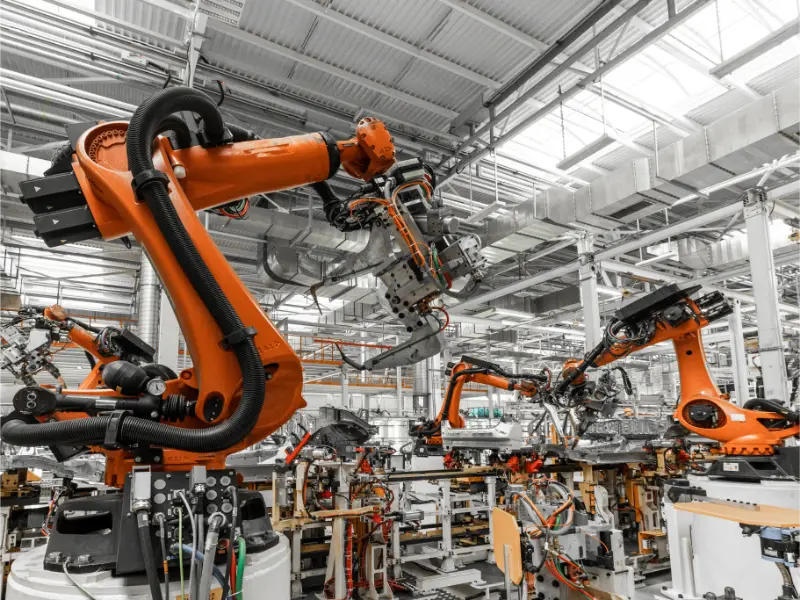
- Automation in industry significantly boosts efficiency and productivity.
- Embracing automation can lead to substantial cost savings and improved safety.
Automation is revolutionising the industrial sector, transforming how businesses operate and compete in a global market. As industries strive for greater efficiency and productivity, automation emerges as a game-changer, offering a myriad of benefits that cannot be ignored.
1. Enhanced efficiency and productivity
Automation streamlines processes by eliminating the manual handling of repetitive tasks. Machines and software can operate continuously without fatigue, resulting in higher production rates and consistent quality. For instance, in the automotive industry, robotic assembly lines have drastically reduced production times, allowing companies like Tesla to meet increasing demand and maintain high standards.
2. Cost savings
One of the most compelling advantages of automation is the potential for cost savings. By reducing labour costs and minimising human error, businesses can save significant amounts. Automated systems also optimise resource use, reducing waste and operational costs. According to a report by McKinsey, companies that implement automation can cut operating costs by up to 30%.
3. Improved safety
Automation reduces the need for human workers to perform dangerous tasks, thereby enhancing workplace safety. In hazardous environments, such as chemical plants or mining sites, robots and automated systems can handle dangerous materials and processes, significantly lowering the risk of accidents and injuries. This shift not only protects employees but also reduces the costs associated with workplace injuries and compensation.
4. Consistency and quality control
Machines do not suffer from the inconsistencies of human workers. Automation ensures that tasks are performed with the same precision every time, leading to uniformity in product quality. For example, in the pharmaceutical industry, automated processes ensure that each drug batch meets stringent quality standards, safeguarding consumer health and complying with regulatory requirements.
5. Scalability and flexibility
Automation allows industries to scale operations efficiently. Automated systems can be easily adjusted to meet changing demands, enabling businesses to respond quickly to market fluctuations. During the COVID-19 pandemic, companies with automated systems could swiftly adapt to the increased demand for essential goods, highlighting the flexibility that automation provides.
Also read: Future trends in AI, analytics, and automation
Also read: AI and automation: Global transformation
Further information: Real-world examples
The adoption of automation is evident across various industries. Amazon’s use of automated warehouses has set new benchmarks in logistics and supply chain management. By employing robots to sort and move products, Amazon has drastically reduced order processing times, enhancing customer satisfaction and maintaining a competitive edge. Similarly, in agriculture, automated tractors and drones are revolutionising farming practices, increasing crop yields, and reducing the need for manual labour.
Critical perspective on automation
While the benefits of automation are undeniable, there are critical considerations to address. One major concern is the potential displacement of jobs traditionally performed by humans. As automation replaces manual labour in various industries, there is a risk of job loss, particularly for low-skilled workers. This shift could exacerbate income inequality and contribute to social tensions.
Moreover, the upfront costs of implementing automation can be substantial. Small and medium-sized enterprises (SMEs) may struggle to afford the initial investment in automated systems and technology. Access to capital and technical expertise are crucial barriers that must be addressed to ensure equitable adoption of automation across all sectors.
Furthermore, reliance on automation poses cybersecurity risks. As industries become increasingly interconnected and reliant on digital systems, the threat of cyberattacks and data breaches becomes more pronounced. Safeguarding sensitive information and maintaining robust cybersecurity measures are essential to mitigate these risks.
Despite these challenges, the benefits of automation outweigh the risks when approached thoughtfully. Automation not only drives efficiency and innovation but also creates new opportunities for economic growth and job creation. By investing in education and training programs, governments and businesses can equip workers with the skills needed to thrive in an automated world.
Navigating the complexities of automation requires foresight and empathy. As we embrace technological advancements, it is crucial to prioritise inclusivity and consider the broader impact on society. By fostering a collaborative approach between humans and machines, we can harness the full potential of automation while ensuring a sustainable and equitable future for all.