
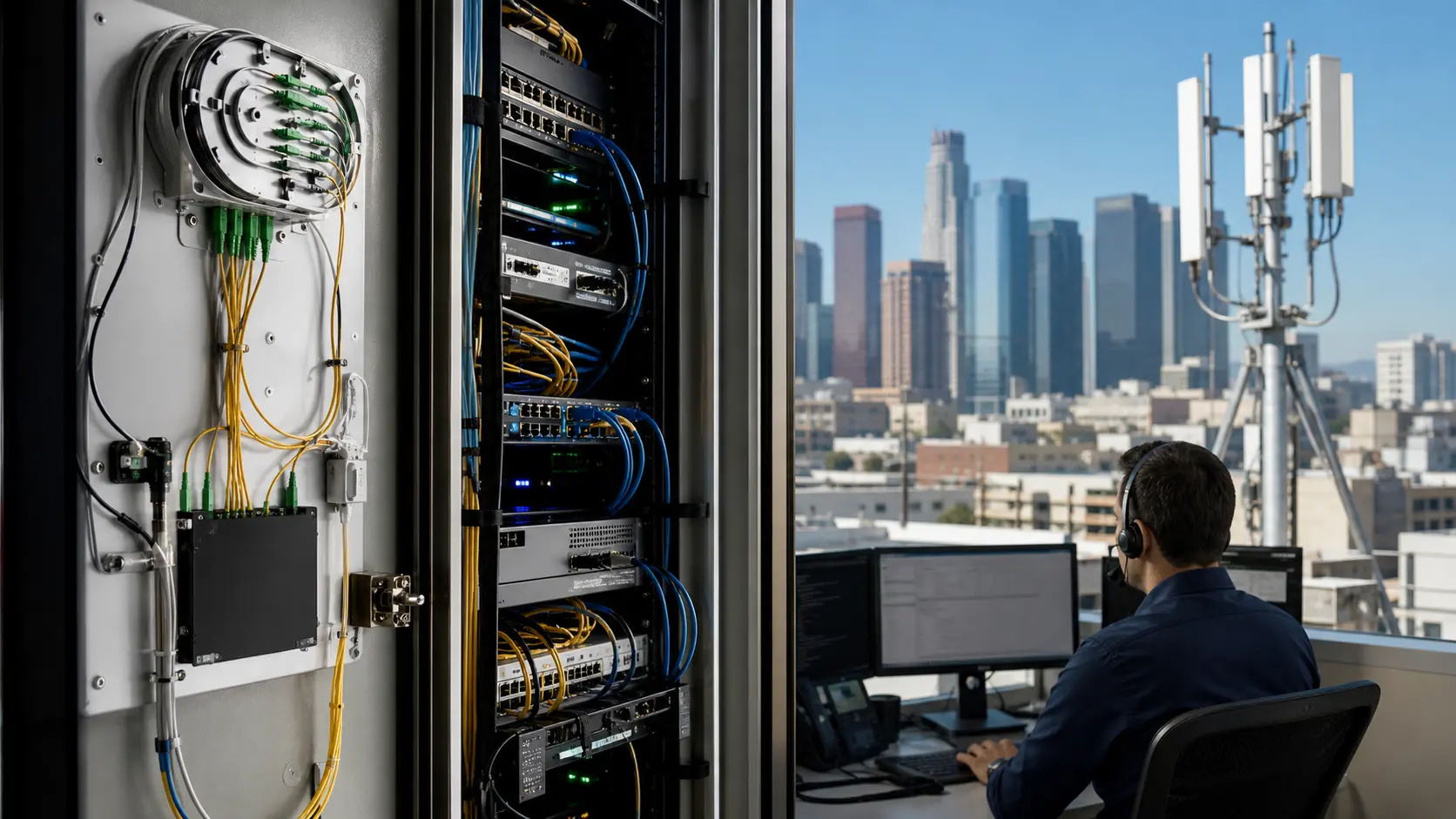
The buyer is paying for a reliable handoff, not a speed trophy
A Los Angeles business choosing Tierzero is usually not making the same purchase as a household comparing gigabit download numbers. The concrete buyer to keep in view is a 35-person law, medical, accounting, production, property-management or design office in West Los Angeles: card terminals at the front desk, cloud case files or patient records, hosted voice, a camera system, guest Wi-Fi, a firewall managed by an outside IT firm, and a line-of-business application that becomes the whole office when it stops loading. In that setting, the headline question is not whether a provider can put a large number on a flyer.
It is whether someone can explain the handoff, preserve static routing, coordinate a failover path, and answer the phone when the carrier, router, voice platform and LAN switch are all blaming one another.
That is the economic unit in which Tierzero is legible. The company markets itself around Los Angeles and Southern California business internet, voice and managed network services, with one provider and one bill, 24/7 US-based support, a claimed history since 1997, more than 60,000 users and 1.4 million calls per month (https://tierzero.com/). Its West LA page narrows the generic pitch into a local office workflow: dedicated fiber, VoIP and managed network services for Westside businesses, dedicated circuits rather than best-effort shared service, proactive monitoring, flat-rate pricing, and local field technicians (https://tierzero.com/areas/west-la/). The most important phrase in that stack is not "fiber." Many companies sell fiber. The phrase that explains the price premium is that Tierzero wants the customer to buy a support chain in which the connection, phone service and managed network are treated as one business problem rather than separate vendor tickets.
The public service pages back that interpretation. Tierzero's dedicated fiber page says its business fiber is installed as dedicated internet access, not shared with other subscribers, and it links that circuit directly to voice readiness and full-bandwidth availability (https://tierzero.com/services/internet/dedicated-fiber/). Its Network as a Service page is even more revealing: the company says it treats fail-safe internet, firewall, traffic management, LAN switching, Wi-Fi and VoIP as one service, taking end-to-end accountability with 24/7 monitoring (https://tierzero.com/services/managed/network-as-a-service/). Its fail-safe internet offer adds the next piece of the mechanism: automatic failover, multiple carriers, proactive monitoring and SD-WAN for companies running phones, cloud applications and multi-location networks (https://tierzero.com/services/managed/fail-safe-internet/). In the opening economic case, the buyer is not just buying access to the internet. The buyer is outsourcing a class of operational arguments.
The routing evidence makes the same point from the infrastructure side. PeeringDB lists Tierzero's AS11509 as a Cable/DSL/ISP network, with North American scope, balanced traffic, 50-100Gbps reported traffic levels, 10 IPv4 prefixes, 5 IPv6 prefixes, selective peering policy, and an interconnection facility at CoreSite Los Angeles LA1 One Wilshire (https://www.peeringdb.com/net/13485). BGP.tools shows AS11509 as registered to Tierzero, active under ARIN, with 14 IPv4 originated prefixes, one IPv6 originated prefix, and upstream connectivity visible to Arelion and Zayo (https://bgp.tools/as/11509). Hurricane Electric's BGP page separately lists AS11509 as Tierzero with 15 originated and announced prefixes and the company website (https://bgp.he.net/AS11509). ARIN's RDAP record shows the autonomous system registration dating to September 15, 1998, which is consistent with a long-lived network operation rather than a recent marketing shell (https://rdap.arin.net/registry/autnum/11509). ARIN also shows the 64.239.128.0/18 block as a Tierzero direct allocation registered in 2001, with non-portable address comments, which matters for static addressing and customer handoff economics (https://rdap.arin.net/registry/ip/64.239.128.0/18).
Those records do not prove revenue, margins, customer retention or service quality. They do prove that Tierzero is not merely a reseller landing page. It has a visible autonomous system, public number resources, a Los Angeles interconnection presence and service pages organized around the operational nuisance that small and mid-sized businesses actually feel. That is why the lens should be accountability over raw bandwidth. A West LA office with cloud software and phones already knows that AT&T, Spectrum, Frontier, Sonic, wireless carriers and brokered fiber quotes exist.
Tierzero's bet is that the decisive pain comes after the speed test: who owns the router change, who preserves the public IP requirement, who watches failover, who answers at 2 a.m., and who keeps phones usable when the main circuit is impaired.
What Tierzero appears to sell
Tierzero's public materials describe three overlapping businesses. The first is business internet: dedicated fiber, 5G, fixed wireless, Starlink, redundancy options, scalable bandwidth and 24/7 monitoring (https://tierzero.com/services/internet/). The second is voice: hosted PBX, VoIP phone lines, SIP trunks, call center functions, POTS replacement and virtual fax, with the public voice page emphasizing QoS, web administration and US-based support (https://tierzero.com/services/voice/). The third is managed network services: monitoring, managed firewall, SD-WAN, managed Wi-Fi, LAN switching, Microsoft Teams calling integration, cabling and "bring your own bandwidth" improvement services (https://tierzero.com/services/managed/). The overlap between the three is the strategy. Tierzero is trying to make the office network a managed subscription rather than a collection of commodity access lines.
The package page puts this into pricing language. As of the page captured for this article, Tierzero lists a small-business package for 1-15 users at $30 per user per month, a mid-size package for 16-50 users at $25 per user per month, and an enterprise package for 50-plus users at $20 per user per month, with combinations of VoIP phone system, unlimited domestic calling, handsets, fiber internet, failover, threat monitoring and basic firewall depending on tier (https://tierzero.com/packages/). That page should not be mistaken for a full circuit tariff. Dedicated internet access, construction, address blocks, voice seats, hardware and managed network scope will vary by site. But the package framing is still economically useful: it suggests that Tierzero wants recurring per-user and per-site revenue attached to the office's communication stack, not only a one-line monthly circuit charge.
That matters because business internet margins rarely come from bandwidth alone once a market has multiple fiber, cable, wireless and brokered options. A local provider with a narrow footprint needs to monetize what larger carriers often struggle to sell to smaller customers: design, follow-through, support escalation, and responsibility for messy edge cases. If a dental office needs static IP addressing for imaging software, a legal firm needs a stable VPN endpoint, a property manager wants cameras and access control reachable without consumer-grade workarounds, or a production shop wants voice and cloud backup to survive a primary-circuit incident, the dollar value is in the avoided internal IT time and the avoided deadlock among vendors. Tierzero's support page reinforces that it wants to be contacted for outages, billing, phone-system changes and service upgrades through named support and care channels rather than leaving the customer to infer responsibility from a national call tree (https://tierzero.com/support/).
The business-phone pages sharpen the point. Tierzero's hosted PBX page emphasizes unlimited calling, Teams integration, auto-attendant, mobile app access and an administration console (https://tierzero.com/services/voice/business-phone-systems/). Its SIP trunking page emphasizes connecting an existing PBX to the cloud, flexible capacity, unified communications and disaster recovery (https://tierzero.com/services/voice/sip-trunking/). For a business that still thinks of telecom as "the phones," this voice layer is not an add-on. It is a retention device. Once voice, internet, failover, firewall and Wi-Fi are managed together, switching access providers becomes less like changing a cable modem and more like reassigning operational responsibility for the whole office.
This is why Tierzero's customer promise is both attractive and fragile. It is attractive because the customer can buy a single accountable service surface. It is fragile because the provider then has to staff for exactly the irritations that national carriers try to push into portals and queues. The public contact page promises free consultations, custom quotes, 24/7 support availability and a 24-hour response for ordinary inquiries (https://www.tierzero.com/contact/). That is a service-intensive posture. If Tierzero underinvests in people, the brand promise erodes quickly. If it overstaffs ahead of revenue, support labor eats the margin. The company is therefore best read as a regional managed connectivity business whose economics depend on matching local support capacity to customers willing to pay for fewer surprises.
The routing footprint is small enough to read
Tierzero's network evidence is useful because it is neither invisible nor sprawling. PeeringDB's AS11509 record is not the record of a global carrier with thousands of exchange ports. It shows a North American Cable/DSL/ISP network, balanced traffic, a selective peering policy and one listed interconnection facility at One Wilshire in Los Angeles, with no public exchange points displayed on the page (https://www.peeringdb.com/net/13485). The PeeringDB API record for the same network shows the same basic shape: AS11509, 50-100Gbps traffic level, balanced traffic, 10 IPv4 prefixes and 5 IPv6 prefixes, with RIR status marked ok (https://www.peeringdb.com/api/net/13485). The separate PeeringDB facility API shows a network-facility association at CoreSite - Los Angeles LA1 One Wilshire (https://www.peeringdb.com/api/netfac?net_id=13485). In Los Angeles networking, One Wilshire is not a random address. It is a dense interconnection location, and a regional provider's presence there is a plausible way to buy transit, connect to carriers and manage routes without owning every last-mile path.
BGP.tools gives the operating dependency more texture. It lists AS11509 as peering with two other networks and having two upstream carriers, Arelion and Zayo, while showing Tierzero-originated IPv4 and IPv6 prefixes (https://bgp.tools/as/11509). IPinfo's AS11509 page also identifies peers and upstreams as Arelion Sweden AB and Zayo Bandwidth, and says there are no downstreams visible in its dataset (https://ipinfo.io/AS11509). The exact vocabulary of "peer" and "upstream" can differ across measurement services, but the economic reading is stable: Tierzero's public routing view is concentrated. It does not appear to be a carrier-of-carriers selling transit to many downstream networks. It appears to be a regional access and managed-services provider using wholesale or upstream connectivity and its own address resources to deliver business service.
That concentration can be a weakness. A customer buying from Tierzero is not buying the route diversity of a multinational backbone by default. Arelion and Zayo are high-quality upstream names, but two visible upstream dependencies mean that Tierzero's resilience depends on physical path diversity, contract terms, colocation practices, failover design and operational competence more than on raw network breadth. If the same building lateral, conduit route or aggregation device becomes a hidden common point of failure, the marketing promise of multiple carriers can disappoint.
The question for a buyer is not "does Tierzero have transit?" The question is "which physical paths and carriers serve my exact suite, and how is failover tested?"
The concentration can also be a strength. A smaller provider with a readable network can know its routes, handoffs, address pools, customers and local field constraints better than a giant organization in which the business customer is a small ticket inside a national machine. ARIN's autnum record dates AS11509 to 1998 (https://rdap.arin.net/registry/autnum/11509). ARIN's TIERZ organization record was registered in 2004 and last changed in 2024 (https://rdap.arin.net/registry/entity/TIERZ). The 64.239.128.0/18 direct allocation dates to 2001 and is identified as a Tierzero block (https://rdap.arin.net/registry/ip/64.239.128.0/18). These are old resources in internet terms. They can support business services that depend on stable addressing and recognizable reverse-DNS patterns, a point visible in public reverse-host examples for Tierzero static addresses (https://whois.ipip.net/AS11509/64.239.128.0/18).
The routing record also prevents an overclaim. Tierzero should not be valued as if it owns a massive network moat simply because it has an autonomous system. An AS number is a necessary ingredient for routing independence; it is not a complete economic moat. The moat, if it exists, is local operating knowledge plus customer dependence on managed edge service. The public records suggest that Tierzero has enough network substance to make the support story credible, but not enough scale to escape the cost and vendor-dependence issues that regional providers face. That is precisely the interesting investment and market question.
Tierzero is exposed to the economics of wholesale access, transit, colocation, software, customer-support labor and truck rolls, while selling a customer experience that asks buyers to care less about each of those individual components.
Pricing power comes from avoiding blame
The strongest argument for Tierzero is that business connectivity is often purchased at the moment a customer is tired of blame. A national cable provider blames the customer's firewall. The firewall vendor blames packet loss on the access circuit. The VoIP provider blames jitter. The cloud application vendor says its status page is green. The office manager cannot convert any of that into a working Tuesday morning. Tierzero's Network as a Service language is built exactly around that pain: "one bill, one vendor," monitoring around the clock, and responsibility for the whole network (https://tierzero.com/services/managed/network-as-a-service/). In a serious buyer's budget, that accountability can sit between telecom expense and outsourced IT expense. It is not simply the price of megabits.
Cloud adoption actually helps this model even though it substitutes away from some old on-premises infrastructure. If the customer's accounting platform, storage, security camera portal, phone management and customer records live outside the office, the local access line becomes the office's dependence on the cloud. But the resulting demand is not always for the fastest possible pipe. It is for predictable upload, low jitter, stable addressing, path diversity, monitoring, and someone who can tell whether the failure sits in the access loop, CPE, DNS, voice platform, firewall or cloud vendor. Tierzero's own blog on 5G business internet makes a related argument: 5G can be useful for backup and fast deployment, but business users with guaranteed-performance needs still look to dedicated fiber or fixed wireless because shared bandwidth, variable performance and limited SLAs can matter more than marketing speed (https://tierzero.com/blog/5g-business-internet-guide/).
Static addressing is a good example of the support premium. Many modern SaaS tools do not require static IPs, but many real offices still have vendor allowlists, VPNs, remote desktops, PBXs, alarm panels, cameras, access-control systems and legacy integrations that assume stable public addressing. Sonic's own support page says static IPs are not available on Sonic Gigabit Fiber and notes that the LA area is still under construction for IPv6 context (https://help.sonic.com/hc/en-us/articles/115000419168-Fiber-FAQ). That does not make Sonic a poor product; it shows that a fast consumer-style or small-business fiber product can still fail a specific office networking requirement. Spectrum's enterprise dedicated fiber materials include static IP address blocks and dual-stack support, but that is an enterprise product with its own ordering and contract motion (https://www.spectrum.com/business/enterprise/insights/resource-center/product-briefs/dedicated-fiber-internet). AT&T Dedicated Internet is positioned around an unshared connection, 24/7 active monitoring and SLA-backed performance, which is a direct competitor at the high-assurance end of the market (https://www.business.att.com/products/att-dedicated-internet.html).
Tierzero's room is between the commodity product and the national enterprise product. Its packages show per-user pricing that looks approachable to small and mid-sized businesses (https://tierzero.com/packages/). Its dedicated fiber and fail-safe pages talk like a managed provider that can design around a specific customer site (https://tierzero.com/services/internet/dedicated-fiber/; https://tierzero.com/services/managed/fail-safe-internet/). The tension is that custom support reduces churn but increases cost. A provider cannot promise "real humans" and "no finger pointing" without paying people to answer, diagnose, dispatch, configure and coordinate. That means Tierzero's pricing power depends on customers valuing operational certainty enough to pay above a minimal access quote.
The customer segment is therefore likely not the extremely price-sensitive microbusiness, unless the package price is bundled with voice in a way that displaces other spending. Nor is it necessarily the very large enterprise with national procurement, global SD-WAN architecture and carrier-diverse network engineering staff. The natural customer is the business too complex for consumer-style broadband and too small to manage carrier engineering itself. Tierzero sells that customer a wrapper: fiber or wireless access, voice, failover, managed firewall, Wi-Fi and support under one responsible operator.
That wrapper is where the margin sits if the company executes well.
The cost base is people, access, transit and field work
The least visible part of Tierzero's model is the cost side, because private regional providers rarely disclose revenue or margin. Public evidence still helps identify the cost stack. First, there is the access cost: fiber construction, leased last-mile loops, fixed-wireless equipment, customer-premises routers, switches, firewalls, handsets, UPS equipment and installation labor. Tierzero's dedicated fiber page sells a private data connection and says its team handles installation and configuration (https://tierzero.com/services/internet/dedicated-fiber/). Its managed service pages include LAN switching, Wi-Fi, firewall and cabling (https://tierzero.com/services/managed/). Each of those is a possible revenue item, but each is also a support surface.
Second, there is upstream and colocation cost. PeeringDB's One Wilshire facility listing and the BGP-visible upstreams imply that Tierzero pays for some combination of colocation, cross-connects, transport, IP transit or related network services (https://www.peeringdb.com/net/13485; https://bgp.tools/as/11509). If it delivers dedicated fiber through leased local access rather than self-owned plant in every case, it also pays wholesale access or construction contributions. The economics of a regional provider improve when it can aggregate multiple customers through common facilities and vendors. They deteriorate when each customer site becomes a bespoke circuit with one-off project management and low reusability.
Third, there is support labor. The Bureau of Labor Statistics reports that network and computer systems administrators had a national median annual wage of $96,800 in May 2024 (https://www.bls.gov/ooh/computer-and-information-technology/network-and-computer-systems-administrators.htm). The BLS May 2023 occupational wage page for telecommunications line installers and repairers lists California as one of the highest-employment states for the occupation, with an annual mean wage of $78,440 (https://www.bls.gov/oes/2023/may/oes499052.htm). Those are not Tierzero's payroll numbers, but they frame the wage environment. A provider selling 24/7 support, managed firewall, SD-WAN, voice troubleshooting and local field technicians cannot rely only on low-cost call-center labor. It needs technical people who understand routing, voice, customer-premises gear, cabling, carrier tickets and business etiquette.
Fourth, there is customer-acquisition and retention cost. Tierzero's website is built as a direct-response local marketing funnel: service pages for West LA, Downtown LA, Santa Monica, Beverly Hills, Culver City and other Southern California areas; calls to request quotes; package pages; testimonials; and a 3 months free offer surfaced in the navigation (https://tierzero.com/areas/). That marketing posture is rational. A regional provider cannot simply wait for national procurement platforms to deliver high-fit customers. It must be found when a local office searches for a better provider, a phone-system replacement, a failover project or a managed Wi-Fi fix. But local acquisition can be expensive if every lead requires a site-specific quote and network design before the customer knows whether the budget works.
Finally, there is the cost of standing behind an accountability promise. Uptime Intelligence's 2026 outage analysis says external infrastructure failures are becoming more prominent in publicly reported outages, fiber and connectivity-linked outages are rising and more likely to produce extended disruptions, and 57% of respondents in its 2025 annual survey said their most recent major outage cost more than $100,000 (https://intelligence.uptimeinstitute.com/resource/annual-outage-analysis-2026). That kind of outage-economics evidence is exactly why customers pay for redundancy. It is also why a provider that sells redundancy must test it. A backup circuit that has not been exercised, a failover policy that breaks voice registration, or a firewall rule that blocks a cloud application during failover can convert a premium product into an expensive disappointment.
The cost implication is straightforward. Tierzero's best customers are those whose own downtime and IT coordination costs are high enough that a managed premium is rational. Its weaker customers are those who compare only monthly access price or never use the support capacity they are paying for. The business is not fundamentally about creating the cheapest internet access in Los Angeles. It is about converting local operational risk into recurring revenue while keeping the actual cost of support and remediation below the customer's willingness to pay.
Competition is abundant until the customer asks for a named owner
Los Angeles is not a broadband desert for business buyers. AT&T advertises Business Fiber in Los Angeles starting at $40 per month and up to 5Gbps where available, with symmetric speeds on fiber (https://www.business.att.com/areas/los-angeles.html). AT&T Dedicated Internet is a different, higher-assurance product with an unshared connection, SLA support and 24/7 active monitoring (https://www.business.att.com/products/att-dedicated-internet.html). Spectrum Business sells enterprise dedicated fiber with static IP address blocks, IPv4/IPv6 support and managed service options (https://www.spectrum.com/business/enterprise/insights/resource-center/product-briefs/dedicated-fiber-internet). Frontier, Verizon, T-Mobile, Starlink, brokered fiber, fixed wireless operators, cable products and local IT providers add still more alternatives. Public business-internet aggregators commonly show several providers available in Los Angeles, though their coverage and product fit vary by address (https://www.meter.com/connect/locations/los-angeles).
This competition caps Tierzero's ability to price simple access. If the customer wants only a high download speed and is willing to accept a standard support path, Tierzero has to compete against national scale. National carriers can subsidize acquisition, bundle wireless, automate installs, absorb churn and amortize backbone cost across millions of customers.
A regional provider's advantage has to come from things that are difficult to centralize: local site knowledge, careful handoff, faster escalation, custom routing, bundled voice, and the ability to coordinate multiple access technologies without making the customer become the project manager.
The local office market makes that service promise more relevant, not less. Los Angeles office demand has been uneven since hybrid work became durable. Kidder Mathews reported that the Los Angeles office market's first-quarter 2026 leasing activity remained relatively flat, Class A direct vacancy held at 20.6%, many companies continued to reassess space needs, and average asking rents remained stable despite pressure (https://kidder.com/market-reports/los-angeles-office-market-report/). CBRE's Downtown Los Angeles Q3 2025 figures showed downtown vacancy at 33.3% and availability at 36.8% (https://www.cbre.com/insights/figures/los-angeles-downtown-office-figures-q3-2025). A market with cautious tenants and leaner footprints is a hard place to sell unnecessary telecom complexity. But it is also a market where remaining offices are often more dependent on hybrid collaboration, cloud access and fewer on-site IT people.
That is why a smaller provider can still matter. A firm shrinking from 100 seats to 45 may not keep a full internal network staff, but it still needs phones, cameras, Wi-Fi, secure remote access, payment systems and vendor allowlists. A landlord trying to refill smaller suites may prefer tenants with quick, supportable connectivity. A medical office may not care that a consumer fiber plan posts higher speed than the old circuit if its phone calls, claims software and backup link have no accountable owner. Tierzero's public pages speak to those buyers by bundling the operational layer with the access product.
The company's challenge is to keep that promise specific enough to justify itself without becoming so labor-intensive that every marginal customer is a custom project.
The competition also explains why Tierzero needs voice and managed services. A pure access reseller is exposed to price compression. A voice provider alone is exposed to cloud PBX competitors. A managed IT provider alone is exposed to local MSPs. By combining those functions, Tierzero tries to own the edge of the business communications stack. The risk is strategic clutter: too many products can dilute operational focus. The opportunity is retention: a customer that uses Tierzero for fiber, failover, phones, firewall and Wi-Fi has many more reasons to call before switching.
Regulation and operational risk sit in the background
Tierzero is not a regulated utility in the way a historic telephone monopoly was, but regulation and public infrastructure policy still shape the environment. The FCC's Broadband Data Collection program requires broadband providers to report availability and related data for national mapping, and the FCC describes the National Broadband Map as a public view of where internet services are available in the United States (https://www.fcc.gov/BroadbandData). The BDC help center explains that a Provider ID is assigned to every service provider that completes a biannual BDC filing and that availability filings include provider and technology fields (https://help.bdc.fcc.gov/hc/en-us/articles/7682769466395-Broadband-Data-Collection-BDC-FAQs). For a business-focused provider, the map is not the sales funnel that matters most, but the regulatory context reinforces a wider truth: coverage claims, availability, technology type and provider identity are increasingly treated as public infrastructure facts rather than private marketing language.
Voice regulation is more direct. Tierzero's legal page includes a VoIP E911 notice telling hosted PBX customers that emergency dialing may be unavailable or may route to the registered service location under certain circumstances, including equipment moved from the registered location, non-native numbers, broadband failure, power loss, or failure to update registered addresses (https://www.tierzero.com/legal/). This is not just fine print. It is part of the economics of replacing copper voice with IP voice. The more Tierzero sells POTS replacement, hosted PBX, SIP trunks and Teams integration, the more it has to manage customer education, registered-location data, failover, power backup and support practices around emergency calling. That is a compliance and service-quality cost.
Routing security is another background issue. MANRS says its Observatory uses publicly available data to measure routing activities and readiness, with imperfect but useful passive measurements and existing databases (https://manrs.org/manrs-observatory/observatory-faq/). MANRS network-operator actions emphasize routing information, coordination and anti-spoofing as operational norms (https://manrs.org/netops/actions/). The assignment of AS11509 and Tierzero's PeeringDB and ARIN records do not by themselves certify routing hygiene. They do create public surfaces through which customers, peers and analysts can ask better questions: are ROAs complete, are route objects current, are abuse and technical contacts maintained, are max-prefix settings sensible, and are customer routes filtered? For ordinary office buyers, these questions rarely appear in procurement. For the reliability promise Tierzero sells, they are part of the hidden quality of the service.
Geopolitics is less dramatic but still present through supply chains and upstream dependence. A regional provider in Los Angeles depends on routers, optics, firewall appliances, cloud voice components, power, colocation facilities, local construction, upstream carriers and sometimes wireless spectrum or satellite inputs. The customer hears "one provider." The provider manages a web of external dependencies. Uptime's 2026 outage research is relevant here because it says outages increasingly involve external infrastructure, network connectivity, power availability and reliance on external cloud services (https://intelligence.uptimeinstitute.com/resource/annual-outage-analysis-2026). The more a provider packages those dependencies into a clean promise, the more important its vendor discipline becomes.
Local disaster and recovery conditions matter too. Los Angeles County's 2026 wildfire recovery update, focused on the Eaton and Palisades fires, described local business recovery, reoccupation, transit usage, job postings and household spending losses as part of the region's economic recovery picture (https://opportunity.lacounty.gov/econ-update3/). Tierzero is not being valued as a disaster-recovery company, but Southern California businesses understand fire, power, mobility and reopening risk in a practical way. A provider selling fail-safe internet and managed networks in that market benefits from the customer's lived awareness that connectivity is not an abstract convenience. It is part of whether an office can reopen, answer calls, take payments and coordinate employees when physical conditions are unstable.
Unofficial signals show the support premium and the contract risk
The public chatter around Tierzero is mixed in a way that fits the model. Tierzero's homepage carries Google-review-style testimonials praising service, fast internet and helpful staff (https://tierzero.com/). The company's Instagram page presents the brand as a Los Angeles business communications provider focused on solving real business problems and responsive service (https://www.instagram.com/tierzerocommunications/). Those are promotional surfaces, but they still tell us what Tierzero thinks the market rewards: not only capacity, but a feeling that someone picked up the problem.
The negative signals point to the same economic lever from the other side. A VoipReview comparison page includes a harsh user complaint alleging a three-year contract lock-in, slow or subpar internet and expensive cancellation terms (https://www.voipreview.org/compare/global-freedom-phone-vs-tierzero). The BBB profile says Tierzero is not a BBB accredited business and lists an older El Monte address in its profile (https://www.bbb.org/us/ca/el-monte/profile/telecommunications/tierzero-1216-1316210). These sources do not establish a statistical service-quality record. They do establish that contract friction and support reputation are exactly where the market will judge the company. A customer who buys only a cheap pipe may tolerate a portal. A customer who pays for accountability will react strongly if the contract feels asymmetric or the support outcome disappoints.
This is useful market evidence because the business model creates higher expectations. A national carrier can disappoint a small business and still retain it because alternatives are annoying and the brand is impersonal. A regional provider that says it is different has less room for "that is just telecom" excuses. Positive reviews support pricing power only if they reflect repeatable operations. Negative reviews are damaging not simply because they are negative, but because they attack the premise that the provider reduces stress.
The market's unofficial signals therefore suggest a practical diligence question: does Tierzero convert local support into measurable retention, or does it rely on contract terms after customer trust declines?
The customer should also separate outage reputation from outage inevitability. All access providers fail sometimes. Fiber cuts, upstream issues, construction mistakes, power failures, software bugs and CPE faults are normal hazards. The commercial question is how the provider communicates, reroutes, credits, repairs and learns. Tierzero's fail-safe and Network as a Service pages give it the language to compete on that basis (https://tierzero.com/services/managed/fail-safe-internet/; https://tierzero.com/services/managed/network-as-a-service/). The question not visible in the public record is whether its internal operational data matches the language: mean time to answer, mean time to restore, failover success rate, SLA credit rate, truck-roll backlog, churn by product bundle, and renewal rate by customer size.
The practical buyer conversation should therefore be concrete, not sentimental. If Tierzero says it will manage the business network, the customer should ask for the exact demarcation between Tierzero-owned equipment, customer-owned equipment and third-party carrier facilities. If static addresses are part of the service, the buyer should ask whether they survive failover, whether DNS and reverse DNS changes require a ticket, and whether a firewall replacement changes the public handoff. If voice is bundled, the buyer should ask how E911 registration, handset provisioning, QoS markings, backup power and mobile-app continuity are handled. If SD-WAN is included, the buyer should ask whether policy decisions are based on packet loss, latency, jitter, route availability, application class or simple circuit status. These are not engineering trivia. They determine whether a paid support relationship turns into shorter downtime or merely a friendlier explanation of the same outage. Tierzero's public materials invite that level of diligence because they sell one responsible operator for internet, phones and managed network services rather than an isolated access circuit (https://tierzero.com/services/managed/network-as-a-service/). A provider confident in that model should welcome exact questions, because specificity is how it proves the difference between a managed service and a bundled invoice.
For a buyer, the unofficial market signals argue for a disciplined procurement conversation rather than a simple yes or no. Ask for circuit diagrams by site. Ask which carrier or access technology is primary and which is backup. Ask whether the backup uses a physically diverse path. Ask how static IPs are delivered during failover. Ask whether VoIP registration persists. Ask what the support escalation path looks like after hours. Ask for the cancellation language and the SLA credit process before signing. Tierzero's model can be attractive if those answers are clear.
It is less attractive if the sales motion substitutes trust language for precise service commitments.
What would change the judgment
The current judgment is that Tierzero is a credible regional managed connectivity provider whose differentiation rests on local accountability, stable addressing, voice integration and support execution rather than unique raw bandwidth. Several facts would strengthen that view. Public evidence of renewal rates, customer count by segment, bundled-service attachment rates, outage history, SLA performance and average time to restore would show whether customers experience the promised accountability. More specific disclosure around network diversity, upstream contracts, facility redundancy and route-security posture would also help. A PeeringDB record with more recent updates, broader facility data or clearer peering information would reduce uncertainty around the current network footprint (https://www.peeringdb.com/net/13485).
Evidence of disciplined growth would be especially valuable. A regional provider can destroy service quality by growing faster than its support and provisioning systems. If Tierzero has expanded from pure internet access into voice, SD-WAN, firewall, Wi-Fi, Teams calling and NaaS, the operating question is whether those products share a coherent support platform or are a bundle of vendor integrations held together by heroic staff. Public pages can list the products (https://tierzero.com/services/managed/). They cannot prove operational integration. Customer case studies with concrete before-and-after metrics would be more persuasive than generic testimonials.
Several facts would weaken the view. A pattern of unresolved complaints about contracts, service restoration or cancellation would matter more here than it might for a commodity ISP, because support trust is the product. Evidence that most dedicated fiber relies on single-path leased access without tested failover would undercut the fail-safe narrative. Evidence of poor route-security hygiene, stale contact data, incomplete route-origin authorization or repeated routing incidents would weaken the reliability claim. A deterioration in upstream diversity or colocation access would make the network footprint less resilient.
A move toward aggressive promotional pricing without support investment would suggest the company is competing in the wrong part of the market.
Competition could also change the view. If AT&T, Spectrum, Frontier, Sonic or wireless providers make static addressing, managed failover and high-quality business support easier to buy for smaller offices, Tierzero's differentiation narrows. If local MSPs increasingly resell national access with strong SD-WAN and voice overlays, the customer may get accountability without choosing Tierzero as the access provider. Conversely, if national carriers continue to separate access, voice and managed support into different queues, Tierzero's "one accountable operator" message remains valuable. The public competitor evidence already shows both pressures: national carriers sell high-assurance dedicated products, while some fast local fiber products may not match all business edge requirements (https://www.business.att.com/products/att-dedicated-internet.html; https://help.sonic.com/hc/en-us/articles/115000419168-Fiber-FAQ).
The most important diligence item is not a single number. It is fit. Tierzero makes the most sense for a Los Angeles or Southern California business that wants a provider to own the boundary between internet access, voice, firewall, failover and office network support. It makes less sense for a buyer with in-house network engineering, national procurement leverage, very large multi-region needs, or a pure commodity access requirement.
The public evidence supports a serious but bounded claim: Tierzero has the visible network resources and service posture to be more than a brochure; it also has the scale and dependency profile of a regional provider whose promise depends on execution.
Evidence note
The most probative sources are Tierzero's own service pages for internet, dedicated fiber, fail-safe internet, Network as a Service, managed services, voice and support; PeeringDB's AS11509 record and facility data; BGP.tools and Hurricane Electric's public BGP views; ARIN RDAP records for AS11509 and the 64.239.128.0/18 block; and competitor pages from AT&T, Spectrum and Sonic. Local economic context comes from Kidder Mathews and CBRE office-market reports, while operational-risk context comes from Uptime Intelligence, BLS labor-cost pages, FCC broadband data pages and MANRS routing-security materials.
The least certain evidence is customer sentiment, where public review surfaces are useful mainly as signals of what customers praise or resent rather than as a statistically complete reputation record.
The resulting view is not that Tierzero is the fastest or cheapest way to connect an office in Los Angeles. The view is that Tierzero's commercial logic is coherent when the customer values escalation, static routing, voice continuity, failover design and a reliable handoff more than a speed trophy. In that market, the durable asset is not only AS11509 or a One Wilshire presence. It is the provider's ability to turn a messy local communications stack into a single accountable operating relationship. That is a real product if support quality holds, and an expensive promise if it does not.