
The Product Is the Visit That Ends the Outage
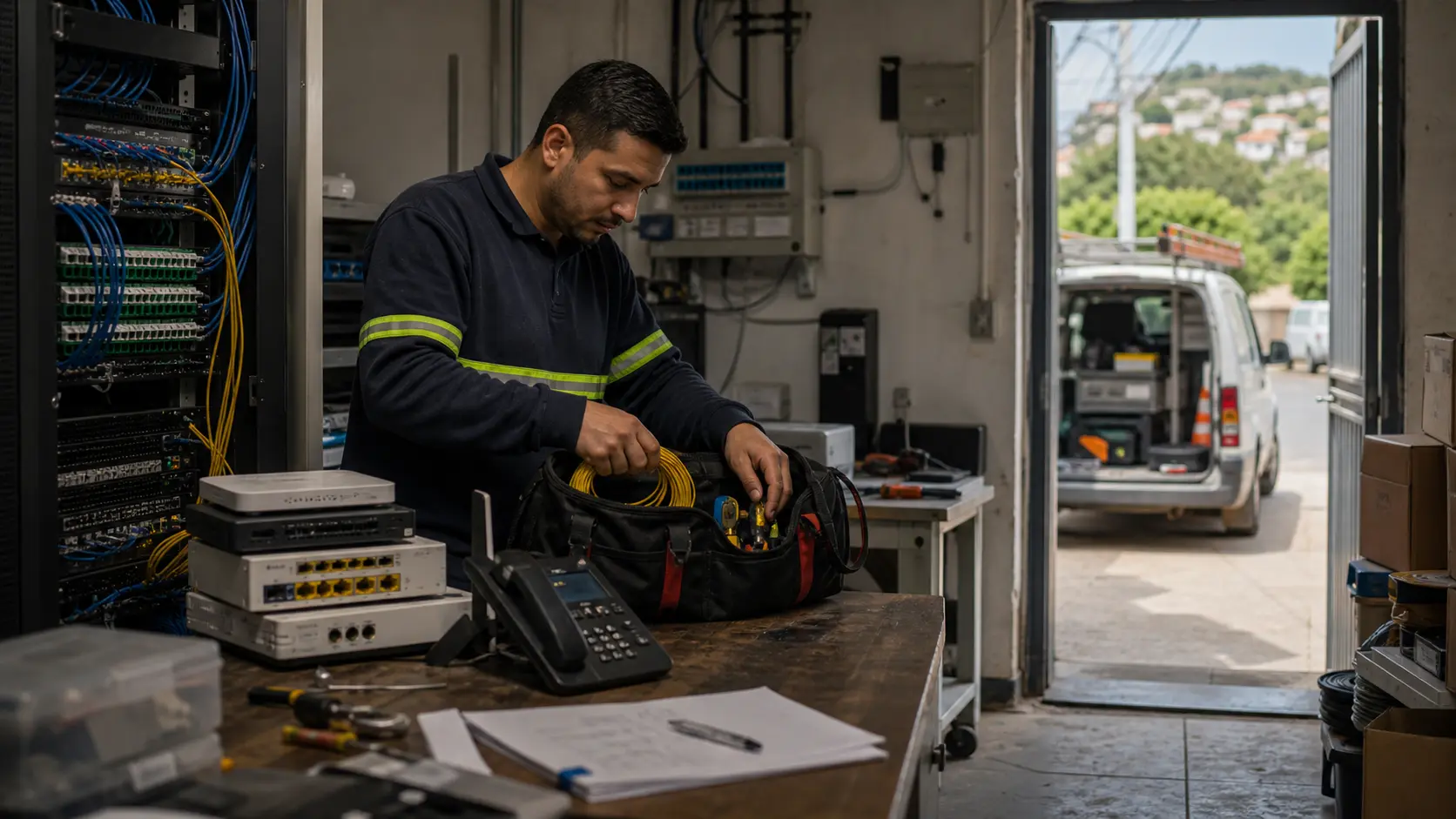
The useful economic unit for Terranet Internet Telecomunicacao LTDA is not the advertised megabit. It is the recovery visit that happens after a rural house, a small shop, a guesthouse, a farm office or a local professional in Terra de Areia loses the line at the wrong hour. In a town of roughly 10,575 estimated residents in 2025 according to IBGE's municipal page at https://www.ibge.gov.br/cidades-e-estados/rs/terra-de-areia.html, the customer buying a regional ISP is buying answer time as much as bandwidth. A 600 Mbps plan looks attractive when the video works. It becomes secondary when the router light is dark, the card machine will not settle, the camera feed is unavailable, a school assignment must be uploaded, or a family business discovers that national call-centre economics do not fit a local outage.
Terranet's own public selling language points in that direction. Its Facebook presence identifies TerraNet Internet in Terra de Areia and describes it as a broadband internet provider for the municipality at https://www.facebook.com/TerraNetinternet/ and https://www.facebook.com/101182997898894/. A recent support-oriented video caption says the team is in the field while the customer browses, a promise of installation, maintenance and support rather than only speed, at https://www.facebook.com/TerraNetinternet/videos/enquanto-voc%C3%AA-navega-nossa-equipe-est%C3%A1-em-campo-garantindo-que-tudo-funcione-com/1345117410814846/. Another Facebook post says the offer is not only to install internet, but to deliver quality, stability and support when needed, at https://www.facebook.com/TerraNetinternet/photos/trabalhar-assistir-estudar-ou-navegar-tudo-fica-melhor-com-uma-conex%C3%A3o-de-qualid/1426747369242981/. An Instagram post promotes fibre internet, a local WhatsApp channel and the Osvaldo Bastos address at https://www.instagram.com/p/CwWLqjDLzzG/, while another says a 600MB plus SKY+ Light bundle is one plan option at https://www.instagram.com/p/CtSQ728rJ8h/. A separate Instagram post frames the offer around stable connection, nearby service and support at https://www.instagram.com/p/CxJoYmeLV1r/. The repeated public theme is not exotic technology. It is local restoration.
That matters because the first cost of recovery is a person, not a switch. A truck roll in a small Brazilian ISP is a bundle of fuel, technician time, ladder safety, optical power testing, drop cable, connectors, router configuration, customer education, WhatsApp follow-up and sometimes a return visit when a fault is upstream rather than at the customer premises. The provider has to absorb enough of those visits to protect reputation, charge enough monthly subscription revenue to fund them, and still buy upstream transit, poles, customer premises equipment and back-office labour.
A large carrier can spread call-centre, field-force and procurement costs over millions of lines. A local operator earns loyalty only if it knows which road, beach access, farm entrance, hill, pole route and power problem is likely to turn a simple outage into an afternoon of labour.
The evidence base for Terranet is narrow but concrete. Public company records identify the legal company as Terranet Internet Telecomunicacao LTDA, CNPJ 25.138.979/0001-90, trading as Terranet Internet, active since 1 July 2016, with an address at Rua Osvaldo Bastos, 4931, Loja 01, Centro, Terra de Areia, RS, on Casa dos Dados at https://casadosdados.com.br/solucao/cnpj/terranet-internet-telecomunicacao-ltda-25138979000190. CNPJ.biz carries the same legal name, trade name and Terra de Areia address at https://cnpj.biz/25138979000190. RioGrandeDoSulEmpresas lists the company as an active small business, shows R$60,000 of stated capital, describes the principal activity as Servicos de comunicacao multimidia, and names Josilene Florencio Leal and Edson Fabiano Leal dos Santos as administrator-partners from September 2023 at https://riograndedosulempresas.com.br/empresas/rs-rio-grande-do-sul/terra-de-areia/7333/25138979000190/terranet-internet-telecomunicacao-ltda. Casa dos Dados also lists secondary activities that include retail of computing equipment, internet access provision, technical support and electronic security monitoring at https://casadosdados.com.br/solucao/cnpj/terranet-internet-telecomunicacao-ltda-25138979000190.
Those activities fit the first 800 words of the case. The measurable unit is a support visit attached to a residential or small-business fibre account. Terranet's customer is not only buying access to the global internet. The customer is buying someone close enough to answer, diagnose and restore when the line fails. The value of that promise rises in a place such as Terra de Areia because the municipality is small, sits in Rio Grande do Sul's north coast, and has a mix of urban, roadside, rural and tourism-adjacent demand. A travel guide describes the city as an access point between BR-101 and the Rota do Sol, with beaches, lagoons and rural attractions at https://www.viagensecaminhos.com/terra-de-areia-rs/. The municipality's own site presents tourism, lagoons, rivers, public offices and local services at https://www.terradeareia.rs.gov.br/. That is a geography in which the marginal customer may not be a generic apartment in a dense capital. It may be a dispersed household, a roadside business, an inn, a farm office, a municipal service point or a seasonal user whose willingness to pay depends on whether the provider can recover the service when the local terrain, poles or weather interrupt it.
A Ten-Year Local Company Now Carries a Fresh Routing Signal
Terranet's public identity has two timelines. The first is the legal-company timeline: a business opened in July 2016, active in Terra de Areia, trading as Terranet Internet, with telecom and technical-support activities recorded by company-information services that draw on Brazilian public corporate data. Casa dos Dados gives the opening date, active status, principal activity and administrator-partners at https://casadosdados.com.br/solucao/cnpj/terranet-internet-telecomunicacao-ltda-25138979000190. EmpresAqui also identifies Terranet Internet Telecomunicacao LTDA as Terranet Internet in Terra de Areia and lists the principal CNAE as 6110803, Servicos de comunicacao multimidia, at https://www.empresaqui.com.br/detalhes-de-empresas/25138979000190-TERRANET-INTERNET. Teia CNPJ gives the same CNPJ, legal name, active status and Osvaldo Bastos address at https://www.teiacnpj.com.br/cnpj/25138979000190. Serasa Experian's free page labels the company as a small and medium enterprise listing and repeats the CNPJ at https://empresas.serasaexperian.com.br/consulta-gratis/TERRANET-INTERNET-TELECOMUNICACAO-LTDA-25138979000190.
The second timeline is the internet-number timeline. LACNIC's public members list includes Terranet Internet Telecomunicacao LTDA under Brazil at https://milacnic.lacnic.net/lacnic/asociados/publico?locale=EN. BGP.tools shows AS275736 registered on 17 April 2026, active and allocated under NIC.BR, with one IPv6 prefix and no IPv4 prefixes originated on that page at https://bgp.tools/as/275736. Hurricane Electric's BGP Toolkit likewise identifies AS275736 as Terranet Internet Telecomunicacao LTDA, country of origin Brazil, with one IPv6 prefix originated and two observed IPv6 peers at https://bgp.he.net/AS275736. IPIP's whois view gives the owner as Terranet Internet Telecomunicacao LTDA, owner ID 25.138.979/0001-90, responsible contact Josilene Florencio, creation and change dates in April 2026, and inetnum 2804:98c8::/32 at https://whois.ipip.net/AS275736. The key point is chronological: the company appears to be an older local broadband business, while the visible autonomous-system record is new.
That split can be read in more than one way. It may indicate that Terranet previously operated as a downstream retail ISP using another provider's addressing and transit, then began moving toward more direct number-resource control in 2026. It may indicate a network expansion, a compliance step, a commercial relationship with upstream providers, or a technical change to support IPv6. It does not by itself prove customer count, revenue, service quality, fibre kilometres or cash flow. But it does change the diligence question.
A local provider with a social-first retail presence and no visible independent routing is mostly judged by customer service and local reach. A local provider with its own autonomous-system evidence is also judged by upstream diversity, routing hygiene, address management and whether the operator has the engineering discipline to use those resources without creating new fragility.
The public routing pages show a small and dependent network, which is normal for a local ISP. BGP.tools lists two upstreams: Digitotal Networks Telecomunicacoes ltda and BR.DIGITAL, at https://bgp.tools/as/275736. Hurricane Electric lists the same two IPv6 peers, AS52600 Digitotal Networks Telecomunicacoes ltda and AS14840 BR.Digital Telecom, at https://bgp.he.net/AS275736. IPIP also places AS14840 and AS52600 beside the Terranet record at https://whois.ipip.net/AS275736. This is not a network with public evidence of national peering, large public-exchange presence or a dense multi-homed backbone. It is the shape of a retail operator whose customer promise depends on the economics and reliability of a short upstream chain.
The IPv4 evidence is more ambiguous. NetworksDB says it found three IPv4 networks operated by Terranet Internet Telecomunicacao LTDA, namely 177.137.113.240/28, 177.137.117.16/28 and 177.137.117.8/29, and assigns the organisation to AS275736 at https://networksdb.io/ip-addresses-of/terranet-internet-telecomunicacao-ltda. BGP.tools and Hurricane Electric, by contrast, show no IPv4 prefixes originated by AS275736 at https://bgp.tools/as/275736 and https://bgp.he.net/AS275736. The safest interpretation is not to choose a winner between public network directories. It is to say that the visible IPv6 record is stronger than the visible IPv4-origin record, and that any commercial view of Terranet should ask how IPv4 is being supplied to customers, whether by upstream allocation, carrier-grade NAT, delegated blocks, old assignments, or another arrangement.
This matters because customers rarely ask about route origin validation, IPv4 scarcity or upstream AS paths when they buy a plan. They ask whether the service works. The provider, however, must turn scarce technical resources into a retail product. IPv4 addresses remain expensive and operationally constrained. IPv6 deployment may be cheaper in address terms but requires customer equipment, configuration skill and upstream readiness. A small operator that has just appeared with a new IPv6 autonomous-system record may be trying to improve independence, but the move adds a management burden.
Recovery after an outage is easier when addressing, routing, DNS and upstream escalation are clean. It is harder when the provider's retail support promise sits on top of undocumented or brittle upstream arrangements.
Terranet's Revenue Logic Depends on Local Density, Low Churn and Trust
Terranet is not selling into a blank market. Terra de Areia is small enough for reputation to travel quickly and large enough to sustain more than one telecom option. Buscarempresa's page for companies in Terra de Areia under CNAE 6110803 lists Terranet Internet, RMS Telecom, a Vero S.A. branch and Comercial Netuno among local service-activity records at https://www.buscarempresa.com.br/empresas/rs/terra-de-areia/6110803. Econodata's telecom listing for Terra de Areia also places Terranet among local telecom companies at https://www.econodata.com.br/maiores-empresas/rs-terra-de-areia/busca-telecom. RioGrandeDoSulEmpresas lists RMS Telecom, Vero S.A. and Ricardo Mariano dos Santos LTDA as other companies in the same sector in Terra de Areia at https://riograndedosulempresas.com.br/empresas/rs-rio-grande-do-sul/terra-de-areia/7333/25138979000190/terranet-internet-telecomunicacao-ltda. The competitive fact is therefore not simply "big carriers versus Terranet." It is local crowding, with a national or consolidated brand presence visible in the same municipality and at least some smaller alternatives.
The revenue logic for a provider like Terranet has three levers. The first is take-up density along built routes. Fibre economics improve when many subscribers can be served from the same feeder, distribution network and pole route. A long drop to a low-paying customer is less attractive than a dense street with several paying homes and businesses. The second is churn control. If the customer cancels after a few months, the provider may not recover the installation labour, optical drop, router subsidy, marketing cost and support time. The third is local trust. Terranet's public posts lean into that lever by advertising support, field work and local contact channels rather than only abstract speed. Its Facebook page gives a base of roughly 1,250 likes and a local Terra de Areia identity at https://www.facebook.com/TerraNetinternet/, while search-visible social posts point to WhatsApp contact and the Rua Osvaldo Bastos address at https://www.instagram.com/p/CwWLqjDLzzG/ and https://www.instagram.com/p/CxJoYmeLV1r/.
The bundle with SKY+ is especially revealing. A post about 600MB plus SKY+ Light at https://www.instagram.com/p/CtSQ728rJ8h/ and a Facebook post about SKY+ solving TV-signal problems in the interior at https://www.facebook.com/TerraNetinternet/photos/sem-sinal-de-tv-no-interior-a-terranet-tem-a-solu%C3%A7%C3%A3ocom-sky-no-seu-plano-voc%C3%AA-as/1454697549781296/ suggest that Terranet is trying to make the broadband bill more difficult to cancel by attaching entertainment value. That is not a trivial marketing flourish. For small ISPs, average revenue per user and churn often decide whether the company can fund maintenance without starving expansion. A customer who buys only a low-price internet plan may switch when a rival discounts. A customer who associates the provider with internet, TV-like content, WhatsApp help and a familiar local office may stay longer.
The economic risk is that bundles can create complexity without enough margin. If a small ISP resells or bundles third-party content, it may gain stickiness, but it also introduces partner economics, customer confusion, support questions and promotional exposure. A customer does not care whether an outage is a fibre fault, a Wi-Fi problem, a content-app login issue, a router failure or a partner-service problem. The customer calls the local provider. The more Terranet sells the household as an integrated experience, the more its support labour becomes the real product.
That supports the assignment's lens: the regional internet line sells recovery, not only speed.
Brazilian market context helps explain why this model is viable. Teleco's fixed broadband market page, citing Anatel, reports 55.4 million fixed broadband accesses in Brazil in May 2026 and tracks market share by provider type at https://www.teleco.com.br/blarga.asp. Poder360, using Anatel panel data, reported 53.9 million fixed broadband accesses in December 2025 and said fibre represented about 79% of fixed broadband connections at https://www.poder360.com.br/poder-infra/acesso-a-banda-larga-fixa-cresce-27-em-dezembro-diz-anatel/. Anatel's October 2025 note on small providers says small broadband providers play a fundamental role and that the agency's financial panorama examines net operating revenue, ARPU, capex, data consumption and price proxies for the segment at https://www.gov.br/anatel/pt-br/assuntos/noticias/anatel-divulga-panorama-economico-financeiro-das-prestadoras-de-pequeno-porte-ppps-no-mercado-de-banda-larga. In other words, regional ISPs are not a fringe afterthought in Brazil. They are structurally important to the fixed-broadband market.
But structural importance does not guarantee individual resilience. A town can have many providers and still punish weak operators. Customers learn quickly which provider answers WhatsApp, which provider sends a technician, which provider blames the router, which provider overpromises Wi-Fi, and which provider disappears after installation. Terranet's public pages say the right things about support. The investment question is whether the company has enough scale, process discipline and upstream reliability to keep saying them when outages cluster, poles are damaged, power fails or a rival starts discounting.
The Network Record Makes Supplier Dependence Visible
The most valuable thing about Terranet's 2026 network evidence is not that it proves a large network. It does not. Its value is that it exposes the supplier dependence a buyer or analyst should price. BGP.tools lists AS275736 as an IPv6-only network with two upstreams, Digitotal Networks Telecomunicacoes ltda and BR.DIGITAL, at https://bgp.tools/as/275736. Hurricane Electric shows one announced IPv6 prefix, 2804:98c8::/32, two observed IPv6 peers and 681 observed IPv6 paths on the page snapshot at https://bgp.he.net/AS275736. IPIP's whois view also records 2804:98c8::/32, owner ID 25.138.979/0001-90 and April 2026 creation and change dates at https://whois.ipip.net/AS275736. Those records show a public internet-resource footprint, but a small one.
Supplier dependence has several layers. The first is transit and backhaul. If Terranet depends mainly on two upstreams, the terms, routes, failure response and physical diversity of those upstreams matter. Are the two paths actually diverse in ducts, poles and upstream facilities, or do they share a vulnerable stretch? Does one upstream provide most traffic while the other is a backup? Are there written service commitments, or mainly best-effort wholesale relationships? Does Terranet have access to a regional interconnection point, or does traffic travel through larger hubs before returning to nearby content?
Public BGP pages cannot answer those questions. They show where to ask.
The second layer is customer equipment. The public retail offer points to fibre, WhatsApp signup, support and sometimes content bundles, but it does not reveal router models, ONT procurement, spare inventory, replacement policy or Wi-Fi management. A support visit is cheap when the fault is a loose connector and the technician is nearby. It becomes expensive when a low-cost router fails frequently, when customers expect whole-home Wi-Fi without paying for managed equipment, or when a firmware issue produces many calls at once. Secondary CNAE records for equipment retail and technical support at https://casadosdados.com.br/solucao/cnpj/terranet-internet-telecomunicacao-ltda-25138979000190 fit the idea that Terranet's business sits close to the customer-premises equipment layer. They do not prove procurement terms.
The third layer is numbering and addressing. NIC.br and Registro.br administer IP number resources and autonomous-system registrations in Brazil, and IX.br's homepage explains that Registro.br allocates IPv4, IPv6 and autonomous-system resources for internet providers at https://ix.br/. BGP.tools says Terranet's AS is active under NIC.BR and has one IPv6 prefix at https://bgp.tools/as/275736. NetworksDB lists small IPv4 ranges associated with the organisation at https://networksdb.io/ip-addresses-of/terranet-internet-telecomunicacao-ltda. If Terranet serves customers through IPv4 scarcity and IPv6 growth at the same time, the operational quality of NAT, address delegation, DNS and customer-router configuration becomes a hidden determinant of customer experience. A customer experiences it as "the internet is bad"; the provider experiences it as address economics and support cost.
The fourth layer is interconnection. Brazil has unusually strong public internet-exchange infrastructure. IX.br says direct interconnection among autonomous systems improves quality, reduces costs and increases network resilience at https://ix.br/. NIC.br announced in March 2026 that IX.br reached 50 Tbit/s of aggregated traffic, with 39 metropolitan areas, about 3,800 participating autonomous systems and around 7,000 connections, at https://nic.br/noticia/releases/ix-br-hits-record-50-tbit-s-of-aggregated-internet-traffic-driven-by-content-and-digital-services/. CGI.br's 20-year IX.br release says the exchange ecosystem has helped regional providers bring quality broadband to cities where large operators had less commercial interest at https://www.cgi.br/noticia/releases/ix-br-celebrates-20-years-with-a-prominent-role-in-improving-the-internet-in-brazil/. If Terranet can use that ecosystem through upstreams or future direct participation, its content costs and latency can improve. If it remains fully dependent on wholesale transit without efficient content reach, speed claims can become expensive at peak hours.
The final layer is cyber and abuse handling. A provider that obtains its own autonomous-system resources is more visible to the wider internet. It must handle abuse reports, compromised customer devices, routing mistakes, DNS issues and potential filtering requests. BGP.tools' whois section for AS275736 lists a responsible contact and abuse contact handle at https://bgp.tools/as/275736. That is a normal part of operating network resources, but it shifts Terranet from being only a retail service brand toward being a participant in the routing system. The move can improve control. It also increases the need for technical governance inside a small company.
Poles, Power and Labour Decide Whether Support Can Be Profitable
The romance of regional fibre hides an unromantic cost base. A local ISP pays for transport, poles, active electronics, passive fibre plant, customer routers, billing, support, taxes, vehicles, ladders, tools, insurance, software, office rent and people. For Terranet, the public address at Rua Osvaldo Bastos, 4931, Loja 01, Centro, Terra de Areia, shown by Casa dos Dados at https://casadosdados.com.br/solucao/cnpj/terranet-internet-telecomunicacao-ltda-25138979000190 and CNPJ.biz at https://cnpj.biz/25138979000190, gives the retail operation a physical centre. The network itself is spread across poles, homes, small businesses and backhaul links. The support promise has to be funded from recurring monthly bills.
Pole access is becoming a more explicit regulatory and cash-flow issue in Brazil. Anatel's page on pole-sharing contract data says the agency began a one-off collection of information about contracts for sharing pole infrastructure between telecom providers and electricity distributors, and that submission was mandatory for all SCM providers using shared poles, regardless of size, with a deadline extended to 31 March 2026 at https://www.gov.br/anatel/pt-br/dados/infraestrutura/coleta-de-dados-contratos-de-uso-de-postes. That is directly relevant to a regional fibre operator. It turns what might have felt like a local operating habit into a documented compliance and cost item. If a provider's pole use is regular, contracted and well mapped, it gains legal security. If not, the business may face cleanup costs, disputes, removal risk or delayed expansion.
Power is the second pressure. A small ISP does not consume data-centre-scale electricity, but it still depends on power at the office, headend, distribution equipment, customer premises and any active field cabinets. It may need UPS batteries, generator arrangements, surge protection and replacement stock after storms. GlobalPetrolPrices, using sources including ANEEL and distributors, reported Brazil business electricity at BRL 0.789 per kWh in September 2025 at https://www.globalpetrolprices.com/Brazil/electricity_prices/. CEEE Equatorial's tariff page says ANEEL fixes tariff values charged in bills and service values at https://ceee.equatorialenergia.com.br/valor-de-tarifas-e-servicos/. Even when the absolute energy bill is not the largest cost, power volatility affects restoration: a line fault is one thing; a local outage that drains batteries and disables customer routers is another.
Labour is the third pressure and the one closest to Terranet's brand promise. Social posts that show or describe field support, installation and maintenance at https://www.facebook.com/TerraNetinternet/videos/enquanto-voc%C3%AA-navega-nossa-equipe-est%C3%A1-em-campo-garantindo-que-tudo-funcione-com/1345117410814846/ and https://www.instagram.com/reel/DX9UkUktF7L/ turn technicians into part of the product. That is powerful in a small town, but it can also cap margins. A customer who expects quick in-person support is more expensive than a customer who accepts a long remote queue. A provider can either price that labour, restrict it, automate part of it, or let it consume profit. The best small ISPs make local support efficient through route planning, good installation standards, remote diagnostics, spare equipment discipline and clear customer education. The weakest use heroic technicians to compensate for poor plant records and bad installations until the business burns cash.
Weather and regional disruption make the recovery economics more important. The 2024 Rio Grande do Sul floods showed how quickly telecom services can become critical infrastructure. Anatel launched a public panel on affected mobile networks in Rio Grande do Sul and Santa Catarina during the floods at https://www.gov.br/anatel/pt-br/assuntos/noticias/anatel-lanca-painel-publico-com-informacoes-sobre-a-afetacao-nas-redes-de-telefonia-movel-em-sc-e-rs. Teletime reported a campaign to recover internet infrastructure in Rio Grande do Sul, noting that many service locations were without internet and that essential organisations were affected, at https://teletime.com.br/06/05/2024/campanha-visa-recuperacao-da-infraestrutura-no-rio-grande-do-sul/. World Weather Attribution said the late April to early May 2024 rainfall event affected more than 90% of the state and was made more likely by climate change and El Nino at https://www.worldweatherattribution.org/climate-change-made-the-floods-in-southern-brazil-twice-as-likely/. Terra de Areia is not the same as the worst-hit municipalities, but it is in the same state and in a geography where storms, power interruptions, roadside fibre cuts and pole issues cannot be treated as distant abstractions.
The result is a simple margin test. Terranet can earn attractive local economics if it has dense routes, disciplined installs, low churn, regular pole arrangements, sufficient spare stock, clear upstream escalation and customers willing to pay for fast local recovery. It can struggle if customers buy only headline speed, competitors discount below maintenance cost, pole compliance becomes expensive, upstream outages damage its reputation, or field labour is spread too thin. The public evidence does not disclose Terranet's subscriber count, ARPU, churn, truck-roll volume, fibre kilometres or route density.
Those are exactly the facts that would turn a qualitative view into a valuation.
Brazil's Fragmented Broadband Market Rewards Regional ISPs Until Compliance and Scale Squeeze Them
Brazil's fixed broadband market is unusually friendly to regional ISPs, but that friendliness is not permanent. Teleco's Anatel-based page reports 55.4 million fixed broadband accesses in May 2026 at https://www.teleco.com.br/blarga.asp. Anatel's October 2025 note says the small-provider panorama covers the fourth quarter of 2024 and examines indicators such as net operating revenue, ARPU, capex, data consumption and price proxies at https://www.gov.br/anatel/pt-br/assuntos/noticias/anatel-divulga-panorama-economico-financeiro-das-prestadoras-de-pequeno-porte-ppps-no-mercado-de-banda-larga. The same Anatel note says small providers have a fundamental role in fixed broadband. This broad market fact supports Terranet's opportunity: local operators can win where national operators do not tune service, sales and field operations to the local street.
The regulatory direction is tightening, however. Anatel's July 2025 note on the fifth edition of its obligations guide says the plan for fixed-broadband regularisation suspended the exemption from authorisation for SCM and required companies to regularise by 28 October 2025; it also refers to obligations around station licensing, sectoral data submission, funds, consumer rights, cybersecurity and accessibility at https://www.gov.br/anatel/pt-br/assuntos/noticias/anatel-publica-nova-edicao-do-guia-de-obrigacoes-para-pequenas-prestadoras-de-telecomunicacoes. The authorised-provider page says consultation of telecom service providers is available through Anatel's outorga and licensing data panels, covering authorised services and entities with exemption records at https://www.gov.br/anatel/pt-br/regulado/outorga/lista-de-autorizados. The open-data page says Anatel's data plan is intended to expand dissemination of sector information and lists outorga and licensing data among public data categories at https://www.gov.br/anatel/pt-br/dados/dados-abertos. Regulation therefore moves the market away from informal local expansion and toward documented authorisation, data reporting and infrastructure regularity.
That shift can help serious local operators. A company with active CNPJ status, an SCM principal activity, LACNIC membership visibility and a new autonomous-system record may be better positioned than an informal reseller. Terranet's company records show an active legal structure and telecom activities at https://casadosdados.com.br/solucao/cnpj/terranet-internet-telecomunicacao-ltda-25138979000190. LACNIC lists it among Brazil organisations at https://milacnic.lacnic.net/lacnic/asociados/publico?locale=EN. BGP.tools shows the network status as active under NIC.BR at https://bgp.tools/as/275736. Those are positive formalisation signals. But formalisation also brings cost: paperwork, fees, technical compliance, security obligations, reporting, cleaner pole contracts and more visible abuse handling.
Large operators and consolidators create the other squeeze. The local records naming Vero S.A. in Terra de Areia's telecom sector at https://www.buscarempresa.com.br/empresas/rs/terra-de-areia/6110803 and https://riograndedosulempresas.com.br/empresas/rs-rio-grande-do-sul/terra-de-areia/7333/25138979000190/terranet-internet-telecomunicacao-ltda matter because a consolidated operator can change the local price frontier. It can offer professionalised customer service, broader marketing, mobile or TV bundles, financing and procurement scale. It can also be slower, less personal and less willing to make a marginal rural visit. The small provider wins when local care beats corporate scale. It loses when scale providers match enough local service while undercutting or bundling.
Hyperscalers and cloud platforms are a subtler competitive pressure. They do not replace a household access line. They do change customer expectations. More content is delivered through cloud, video, gaming and social platforms; IX.br's 50 Tbit/s milestone release says growth is driven by online content consumption and demand for digital services at https://nic.br/noticia/releases/ix-br-hits-record-50-tbit-s-of-aggregated-internet-traffic-driven-by-content-and-digital-services/. That raises peak traffic, encourages local caching and makes upstream economics more important. A small ISP may find that customers blame it for buffering caused by Wi-Fi, content routing, device congestion or upstream capacity. To protect reputation, the ISP needs better network visibility, more efficient interconnection and clearer support practices.
The substitution risk is not only "another ISP." It is also mobile broadband for light users, satellite for hard-to-reach customers, self-managed routers for businesses, national fibre where available, and bundling from operators that can combine connectivity with content or mobile. The more Terranet sells trust and restoration, the more defensible it is against pure speed substitution. The more it competes on megabits alone, the more vulnerable it becomes to every rival's promotional headline.
Reputation Signals Point to a Hands-On Operator, but They Do Not Prove Resilience
Public non-official signals about Terranet lean positive on effort and locality, but they are not the same as audited reliability. Facebook and Instagram posts show a provider that wants to be seen in the field, wants customers to contact it through local channels and wants the brand to mean practical help. The Facebook pages show a Terra de Areia presence at https://www.facebook.com/TerraNetinternet/ and https://ka-ge.facebook.com/TerraNetinternet/. The support-video post at https://www.facebook.com/TerraNetinternet/videos/enquanto-voc%C3%AA-navega-nossa-equipe-est%C3%A1-em-campo-garantindo-que-tudo-funcione-com/1345117410814846/ and the Instagram support reel at https://www.instagram.com/reel/DX9UkUktF7L/ are especially consistent with the thesis that the company sells restoration as part of the service. Search-visible snippets for recent Instagram posts also repeat field-team, fibre-optic, Terra de Areia and WhatsApp cues at https://www.instagram.com/reel/DYw8OrVgboy/ and https://www.instagram.com/p/DZ-E4f4O_8A/.
The absence of a rich negative public complaint trail in easily visible search results is not proof of high satisfaction. Small local providers often generate complaints through WhatsApp, local Facebook comments, Google reviews, in-person visits or municipal word-of-mouth rather than national complaint sites. The public pages do show engagement and brand activity, but they do not show mean time to repair, outage frequency, customer churn, unresolved-ticket aging, refund policy or service-credit discipline. The analyst should treat the social trail as a market signal: Terranet understands that customers care about nearby service.
It does not prove that the service machine performs under stress.
There is also a brand-identity caution. "Terranet" is not unique. Search results can return unrelated Terranet businesses, including a Lebanese ISP at https://www.terra.net.lb/, a rural/agriculture-focused TerraNet at https://terranet.com.br/, and other Terranet-named communications businesses. The local Terranet discussed here is the CNPJ 25.138.979/0001-90 company in Terra de Areia, tied to the Facebook and Instagram local signals and to AS275736. That distinction matters because a reader who searches the name without the CNPJ or municipality can easily mix different businesses. The legal records at https://casadosdados.com.br/solucao/cnpj/terranet-internet-telecomunicacao-ltda-25138979000190 and routing records at https://bgp.tools/as/275736 anchor the subject.
There is an opposite caution as well: public network records can make a small operator look more technical than its actual customer experience. A new autonomous-system record does not mean customers receive enterprise-grade redundancy. It means the provider has a visible internet-number footprint. A social post about field support does not mean a technician is always available. It means the provider has chosen that promise as part of the brand. A bundle post about SKY+ does not mean content economics are profitable. It means the company sees value in attaching entertainment to broadband.
The right reading of the public evidence is neither scepticism for its own sake nor promotional acceptance. It is conditional confidence in a local ISP with new network-resource visibility and still-private operating metrics.
The municipality itself shapes reputation. Terra de Areia's small population, road access and tourism-rural mix make local service failures more visible. IBGE's municipal page at https://www.ibge.gov.br/cidades-e-estados/rs/terra-de-areia.html and the tourism-oriented geography at https://www.viagensecaminhos.com/terra-de-areia-rs/ describe a place where households, small businesses, public services and seasonal activity are not all concentrated in a dense metropolitan grid. A provider that can dispatch quickly in that geography can build loyalty. A provider that cannot may find that word of mouth travels faster than any paid post.
The Facts That Would Change the View Are Operational, Not Promotional
The most important unknown is route density. If Terranet has built fibre along streets and rural routes where take-up is high, each incremental customer can be profitable because the feeder cost is already sunk. If its network is spread thinly across low-density roads, each support call and expansion request may consume disproportionate labour. Public pages identify the company, legal activities, local address and social offer, but they do not disclose homes passed, subscribers, fibre kilometres or route maps. Those facts would change the investment view immediately.
A 2,000-subscriber local provider with disciplined plant is a different company from a few hundred dispersed accounts supported by heroic labour.
The second unknown is upstream quality. BGP.tools and Hurricane Electric show two upstream relationships for AS275736 at https://bgp.tools/as/275736 and https://bgp.he.net/AS275736. That is useful, but it does not tell whether physical diversity is real, whether contracts include meaningful repair targets, whether traffic is balanced, or whether the company has affordable room to upgrade capacity. A provider can advertise 600MB while quietly suffering peak-hour transit constraints. It can also buy enough upstream capacity and run a clean network without much public fanfare. The facts that matter are traffic graphs, capacity headroom, failover tests, upstream repair history and whether IPv4 and IPv6 are managed coherently.
The third unknown is customer economics. The public posts show plans, support language and bundles at https://www.instagram.com/p/CtSQ728rJ8h/ and https://www.facebook.com/TerraNetinternet/photos/sem-sinal-de-tv-no-interior-a-terranet-tem-a-solu%C3%A7%C3%A3ocom-sky-no-seu-plano-voc%C3%AA-as/1454697549781296/. They do not reveal ARPU, installation fees, router subsidies, bad debt, churn, discounting, payment method, average tenure or the cost of supporting SKY+ related questions. A local ISP can look vibrant on social media while fighting low margins. It can also have excellent retention and stable cash flow precisely because customers value local recovery. The difference is not visible in posts.
The fourth unknown is compliance and pole regularity. Anatel's pole-contract collection at https://www.gov.br/anatel/pt-br/dados/infraestrutura/coleta-de-dados-contratos-de-uso-de-postes and its 2025 small-provider obligations guide at https://www.gov.br/anatel/pt-br/assuntos/noticias/anatel-publica-nova-edicao-do-guia-de-obrigacoes-para-pequenas-prestadoras-de-telecomunicacoes show that the regulatory cost of being a small fixed-broadband provider is becoming more formal. Terranet's legal and network-resource records are positive signs, but the decisive questions are whether every pole route is properly contracted, whether station and sector reporting obligations are current, whether consumer-rights processes are documented, and whether cybersecurity requirements can be met without overloading a small team.
The fifth unknown is disaster resilience. Rio Grande do Sul's recent flood experience shows that connectivity recovery is a public-interest issue, not just a customer-service problem. Anatel's flood network panel at https://www.gov.br/anatel/pt-br/assuntos/noticias/anatel-lanca-painel-publico-com-informacoes-sobre-a-afetacao-nas-redes-de-telefonia-movel-em-sc-e-rs and Teletime's report on recovery of internet infrastructure at https://teletime.com.br/06/05/2024/campanha-visa-recuperacao-da-infraestrutura-no-rio-grande-do-sul/ show the scale of disruption that can hit telecom networks in the state. Terranet's public pages do not show backup power duration, spare-cable inventory, emergency routing, mutual-aid relationships, insurance, or service-priority arrangements for essential customers. Those are not promotional facts. They decide whether the recovery promise survives a regional event.
The sixth unknown is management depth. Public records name administrator-partners Josilene Florencio Leal and Edson Fabiano Leal dos Santos at https://casadosdados.com.br/solucao/cnpj/terranet-internet-telecomunicacao-ltda-25138979000190 and https://riograndedosulempresas.com.br/empresas/rs-rio-grande-do-sul/terra-de-areia/7333/25138979000190/terranet-internet-telecomunicacao-ltda. The routing whois also names Josilene Florencio as responsible contact at https://whois.ipip.net/AS275736. That suggests visible continuity between legal and network records. It does not reveal whether the company has separate network engineering, finance, customer support and field-supervision capacity. Small ISPs often depend heavily on a few people. That can make them fast and trusted. It can also create succession, burnout and control risk.
The Investment View Is a Conditional Local Franchise, Not a Scale Story
Terranet's investable story, if there is one, is not a national broadband land grab. It is a conditional local franchise in a small Rio Grande do Sul municipality where customers may value restoration, familiarity and field response above the largest speed number. The company has a real legal trail, an active local brand, telecom service activities, a visible Terra de Areia address, LACNIC membership presence and a new AS275736 routing signal. Those facts are supported by company records at https://casadosdados.com.br/solucao/cnpj/terranet-internet-telecomunicacao-ltda-25138979000190, LACNIC at https://milacnic.lacnic.net/lacnic/asociados/publico?locale=EN and routing pages at https://bgp.tools/as/275736, https://bgp.he.net/AS275736 and https://whois.ipip.net/AS275736.
The positive case is straightforward. Terranet appears to have operated under the Terranet Internet brand since 2016, serves a local market where regional ISPs matter, talks publicly about support and field work, has attached content and WhatsApp-led sales signals to fibre broadband, and now carries public internet-number evidence. In a market where Anatel and Teleco data show large national fixed-broadband scale but also a critical role for small providers, a disciplined local ISP can keep customers by answering faster than a distant carrier. IX.br's national interconnection ecosystem at https://ix.br/ and https://nic.br/noticia/releases/ix-br-hits-record-50-tbit-s-of-aggregated-internet-traffic-driven-by-content-and-digital-services/ gives regional operators a broader infrastructure environment that can reduce cost and improve performance when used well.
The negative case is equally plain. The public record does not prove subscriber scale, route density, customer satisfaction, profitability, upstream diversity, IPv4 strategy, pole-contract quality, power resilience or disaster recovery. Local competitors are visible in Terra de Areia's sector records at https://www.buscarempresa.com.br/empresas/rs/terra-de-areia/6110803. Regulatory compliance is becoming more demanding, as Anatel's obligations guide and pole-contract collection show at https://www.gov.br/anatel/pt-br/assuntos/noticias/anatel-publica-nova-edicao-do-guia-de-obrigacoes-para-pequenas-prestadoras-de-telecomunicacoes and https://www.gov.br/anatel/pt-br/dados/infraestrutura/coleta-de-dados-contratos-de-uso-de-postes. The routing footprint is small and upstream-dependent, not proof of a robust independent backbone. Social-media support language is a valuable market signal, but not a service-level history.
The most balanced view is therefore conditional. Terranet is worth tracking because it sits at the intersection of three forces: Brazil's fragmented fibre market, the formalisation of small broadband providers, and the local economics of recovery. The company can be valuable to customers if it turns proximity into short restoration time. It can be valuable as a business if that restoration promise is delivered through disciplined installs, dense fibre routes, regular pole access, manageable upstream contracts and low churn.
It becomes fragile if the promise relies on underpriced labour, thin redundancy, informal infrastructure or promotional speed that outruns the cost base.
The customer's outage remains the clearest test. When the line fails, the customer does not ask whether AS275736 is new, whether LACNIC lists the company, or whether Brazil has a 50 Tbit/s exchange ecosystem. The customer asks who answers, who comes, and how long the business or household remains disconnected. Terranet's public evidence says the company wants to compete on that answer. That makes the company less a speed-table story than an operating-discipline story: local knowledge must be converted into repeatable routing, dispatch, billing, maintenance and escalation habits.
The next facts that would change the judgment are the ones that prove whether the answer is repeatable at scale: repair time, churn, route density, upstream failover, pole compliance, backup power and the economics of every support visit after the sale.