
Summary
- What it says: TecPlus Telecom is not best understood as another Brazilian ISP promising faster household internet.
- Main topic: Regional ISP economics; Network-resource evidence; Local support labour
- Context: market / company research report / Brazil
The bill is cheap; the second visit is not
A useful way to read TecPlus Telecom is to begin with a technician dispatch and a household bill. On the company's residential plan page, the first visible fibre offer is 400 Mega at R$99.90 per month, followed by 600 Mega at R$109.90 and 700 Mega at R$139.90, all sold as 100 percent FTTH with local support (https://www.tecplustelecom.com.br/planos-tecplus/). In Santa Barbara d'Oeste, the same customer can see market comparison pages listing national or larger-brand 600 Mega offers around R$99.90 to R$100 from Claro, Vivo and Desktop (https://www.minhaconexao.com.br/ranking/sp/santa-barbara-d-oeste). That is the opening number. TecPlus is not selling connectivity into a market where bandwidth is scarce. It is selling a local service promise into a market where a 600 Mega headline at roughly one hundred reais has become ordinary retail language.
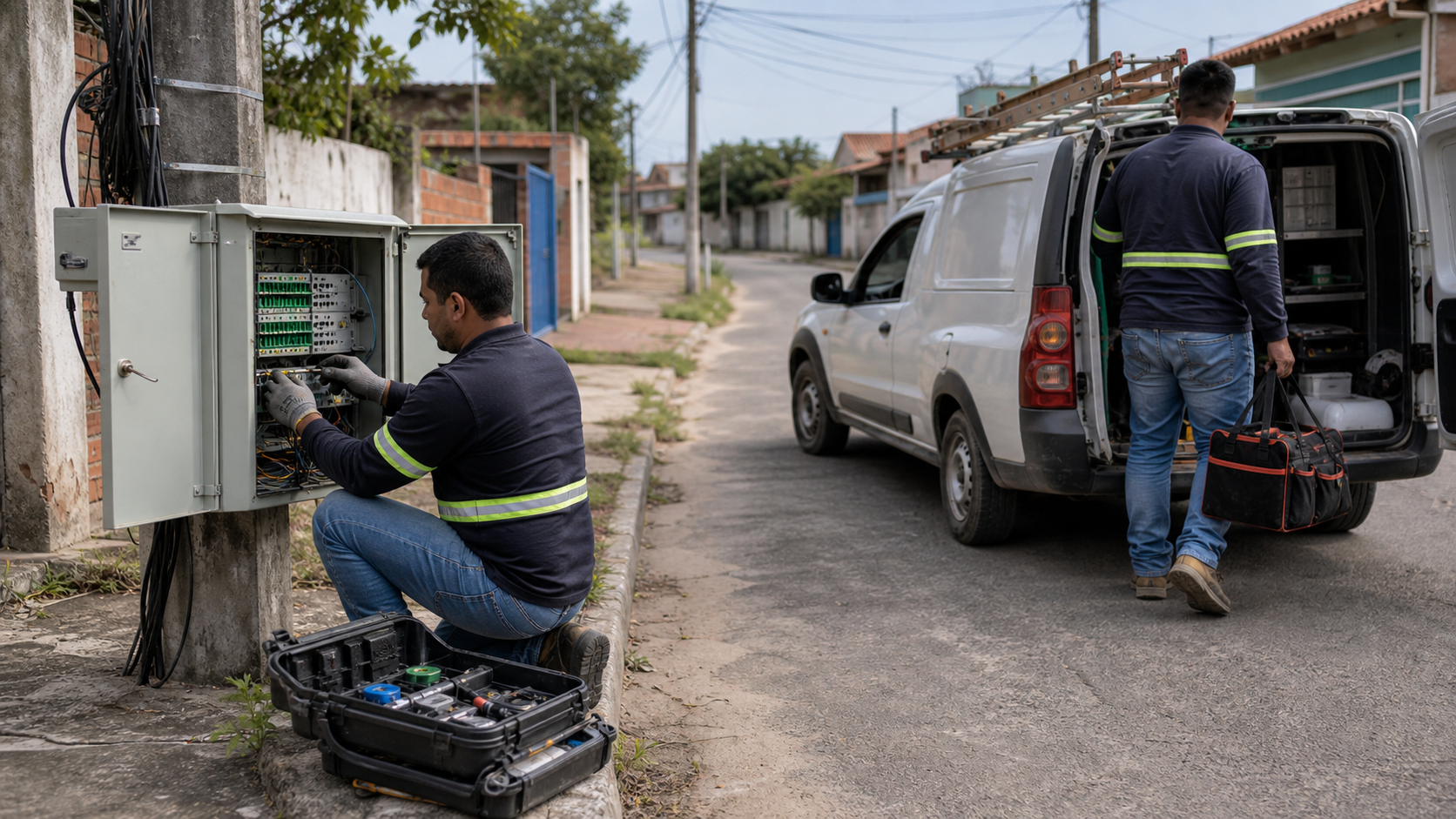
The economics start there but are decided later. A provider can make the first installation look attractive with a low plan price, Wi-Fi equipment, a WhatsApp contact and a claim of local attention. The harder moment comes when the same customer calls again after the initial fix, when evening video drops, a payment terminal fails, a mesh point misbehaves, a pole span is disturbed, a rural drop is damaged, or a router has to be replaced. The first visit can be marketing. The second visit is cost accounting. It absorbs a technician's time, fuel, customer-service attention, spare equipment, scheduling capacity and reputation.
If the second visit restores confidence, the R$99.90 or R$109.90 subscription becomes a small annuity. If it fails, the operator has spent money proving that a larger rival's similar price might be less risky.
The legal identity is real enough to make that operating question worth asking. BrasilAPI identifies CNPJ 03.828.257/0001-24 as TEC PLUS TELECOMUNICACAO LTDA, with the trade name TEC-PLUS TELECOMUNICACAO, active status, an activity start date of May 9, 2000, a Santa Barbara d'Oeste address on Rua Sao Joao, 201, Vila Dainese, and the main CNAE for Servicos de comunicacao multimidia, the Brazilian SCM category (https://brasilapi.com.br/api/cnpj/v1/03828257000124). The same record shows declared capital of R$150,000 and lists Mikael Borges de Oliveira as socio-administrador. The company's privacy page repeats the same CNPJ, while current site footers use Av. da Amizade, 102, Candido Bertine, Santa Barbara d'Oeste, as the public service address (https://www.tecplustelecom.com.br/quem-somos/politica-de-privacidade/ and https://www.tecplustelecom.com.br/central-do-cliente/). That slight address difference is not a red flag by itself. It is common for small operators to preserve older registry addresses while moving visible service counters. It is still a diligence item because customer operations, legal notices and field dispatch all need to line up in a company that sells local trust.
The company's public story is built around locality. TecPlus says it has more than 300 km of regional FTTH network, headquarters in Santa Barbara d'Oeste, local technicians, human support, 24/7 monitoring and service across Santa Barbara d'Oeste, Americana, Sumare, Limeira, Paulinia, Nova Odessa and rural areas (https://www.tecplustelecom.com.br/quem-somos/ and https://www.tecplustelecom.com.br/cobertura/). Its Santa Barbara page claims 99.9 percent uptime, 5 ms latency and a 100 percent FTTH network for that city, and its Americana page repeats the message of local engineering, Wi-Fi 6 and regional support (https://www.tecplustelecom.com.br/internet-em-santa-barbara-doeste/ and https://www.tecplustelecom.com.br/internet-em-americana/). Those are self-reported marketing claims, not audited performance measures. They are still economically revealing because they show what the company thinks customers are buying: not just a speed tier, but the reassurance that someone nearby will answer and repair.
The governing argument is therefore simple. TecPlus Telecom's value depends less on whether it can advertise another fibre speed and more on whether it can keep the cost of credible support below the revenue of a cheap regional plan. The company has enough public network, legal and service evidence to look like an operating ISP rather than a brochure. It also sits in a Brazilian market where fibre has become abundant, regulation is tightening, pole rights are becoming more formal, and larger players can attack with similar prices. The second repair is the point where all of those forces meet.
A local ISP with a long legal tail
The age of the company matters. A 2000 start date makes TEC PLUS TELECOMUNICACAO older than the current fibre sales page and older than the latest app economy around broadband billing (https://brasilapi.com.br/api/cnpj/v1/03828257000124). That does not mean the present FTTH network has been in place for two decades. It means the operator has a long legal and commercial tail in Santa Barbara d'Oeste, the kind of background that can help with municipal familiarity, customer memory, vendor relationships and local hiring. The trade name and website branding now use TecPlus Telecom, but the resource and corporate trail point back to the same CNPJ.
The site's own "Quem Somos" page says the company connects thousands of residential and business customers in Santa Barbara d'Oeste, Americana, Sumare, Limeira and the region, and says it has more than two decades in the market, more than 300 km of regional FTTH network, more than five cities served, 24/7 active monitoring and a 4.9 customer rating (https://www.tecplustelecom.com.br/quem-somos/). Each of those figures has to be weighed differently. The two-decade claim is supported by the CNPJ opening date. The 300 km network and 4.9 rating are company claims. The service-city list is consistent across the website, coverage page and plan page. A lender or buyer would not treat the full set as audited fact, but would use it as a map for diligence: where are the fibre routes, how many customers are active in each town, and what share of the public brand's coverage is inside the legal entity carrying AS269535 and the SCM CNPJ?
The retail offer is now explicit. The 400 Mega residential plan at R$99.90, the 600 Mega plan at R$109.90 and the 700 Mega plan at R$139.90 are packaged with Wi-Fi, support and installation messaging (https://www.tecplustelecom.com.br/planos-tecplus/). The same page sells add-ons that are small but revealing: an extra Wi-Fi 6 point at R$39.90 per month, open channels at R$14.90, fixed phone at R$49.90, more than 100 channels on three screens at R$99.90, and TecPlay from R$24.90 per month. The rural page gives another price ladder, with 300 Mega at R$99.90, 400 Mega at R$109.90 and 500 Mega plus Deezer at R$134.90 for farms, smallholdings and rural condominiums where technical availability must be confirmed by address (https://www.tecplustelecom.com.br/planos-tecplusrural/).
Those prices are not luxury broadband economics. They are a compact local revenue stack. A household fibre line may begin at roughly one hundred reais, but the operator can try to lift contribution with mesh Wi-Fi, streaming, channels, fixed voice, rural premiums and business links. That is why the company talks about support and household experience rather than only megabits. At R$99.90, a technician cannot visit too often before the month's margin disappears. At R$139.90 or with add-ons, the line can carry more support cost, but only if the customer believes the extras solve real problems.
Wi-Fi 6, a second access point and streaming apps are not just features. They are attempts to reduce complaints, increase stickiness and stop the household from comparing only speed against price.
The business offer confirms the same logic at a higher service bar. TecPlus's enterprise page says companies in Santa Barbara d'Oeste and Americana need stable connectivity for invoices, video calls, digital service, cloud storage, cameras, servers, VPNs, ERP systems and points of sale; it offers fixed IP, dedicated links, support, redundancy analysis and customized technical review (https://www.tecplustelecom.com.br/internet-empresarial/). A business account can be worth more than a household plan, but it is less forgiving. When a small shop's payment system fails or a clinic cannot issue invoices, the supplier is not judged by the price of the plan card. It is judged by whether the technician can isolate the fault, whether the route is stable, whether the account team can answer, and whether the company can explain what happened without hiding behind generic language.
This is the first important distinction. TecPlus is not trying to be a national telecom carrier in miniature. Its public surface is a regional access business, with enough digital tools to bill and support customers and enough local language to differentiate itself from national call-centre experiences. Its risk is that every promise of proximity has a labour cost.
AS269535 gives the brand a network floor
The strongest non-marketing evidence is the network record. Registro.br RDAP shows AS269535 registered on November 11, 2019, with TEC PLUS TELECOMUNICACAO LTDA as registrant and Mikael Borges de Oliveira as administrative and abuse contact (https://rdap.registro.br/autnum/269535). The related RDAP records assign 45.188.176.0/22 and 2804:663c::/32 to the same CNPJ and company name (https://rdap.registro.br/ip/45.188.176.0/22 and https://rdap.registro.br/ip/2804:663c::/32). That matters because a sales brand can exist with little public infrastructure. An autonomous system and assigned IPv4/IPv6 resources make the operation more legible.
RIPEstat's announced-prefixes API shows AS269535 announcing the 45.188.176.0/22 aggregate, several more-specific IPv4 routes inside that range, the 2804:663c::/32 IPv6 allocation and several IPv6 sub-prefixes during the June 19 to July 3, 2026 observation window (https://stat.ripe.net/data/announced-prefixes/data.json?resource=AS269535). BGP.tools similarly lists AS269535 as active, allocated under NIC.br, registered in 2019, with seven IPv4 and seven IPv6 originated prefixes, four /24s of IPv4, 65,536 /48s of IPv6, valid RPKI marks on the listed routes, four upstream carriers, 61 peers and one downstream (https://bgp.tools/as/269535). Hurricane Electric's page also identifies Brazil as country of origin and counts 14 originated prefixes and one internet exchange (https://bgp.he.net/AS269535).
The resource footprint is modest in global terms but meaningful for a regional ISP. A /22 of IPv4 gives 1,024 addresses before operational subdivision. The IPv6 /32 is large enough for modern access design if deployed well. The BGP.tools upstream list names Desktop Sigmanet Comunicacao Multimidia, UFINET Panama, SJNET Telecomunicacoes and NAVEX Telecom, while the peer table includes Hurricane Electric, EdgeUno, Gcore, RNP, Eletronet, Cloudflare, Google and many other networks observed through public routing views (https://bgp.tools/as/269535). A customer will not read those route tables before buying a plan. But the customer feels their effects when a game server is reachable, a streaming cache works, a business cloud app stays stable, or an upstream fault is routed around.
PeeringDB gives the exchange layer. It lists TEC PLUS TELECOMUNICACAO as a Cable/DSL/ISP network, AS269535, website http://www.tecplustelecom.com.br, traffic level 10-20Gbps, mostly inbound ratio, regional scope and an open peering policy (https://www.peeringdb.com/asn/269535). It also lists two operational IX.br Sao Paulo public peering entries: one 15G port at IPv4 187.16.212.164 and IPv6 2001:12f8::212:164, and one 10G port at IPv4 187.16.213.187 and IPv6 2001:12f8::213:187 (https://www.peeringdb.com/asn/269535). That is the sort of record a business buyer or upstream partner can understand. It does not prove last-mile quality in Santa Barbara d'Oeste, but it supports the view that the network has a public interconnection floor rather than relying on a single invisible resale arrangement.
The network floor changes the economics in two ways. First, it can lower the cost of performance by improving content reachability and reducing dependence on expensive transit. Second, it raises the operator's obligations. Once a small ISP has public exchange ports, multiple upstreams, RPKI-visible routes and a network operations contact, it is selling more than installation labour. It is selling route discipline. If traffic is misrouted, if prefixes are poorly managed, if capacity is underbought, or if customers cannot get honest incident information, the public route record becomes a standard against which the company can be judged.
This is why TecPlus's marketing claim of local engineering is not decorative. A company with AS269535 has to operate the access network and the public edge together. The technician who changes a router, the back-office staff who handles a billing unlock, the engineer who watches IX.br traffic, and the person who negotiates transit all touch the same subscription economics. Cheap fibre only looks cheap when those layers work without repeated manual intervention.
The support surface is part of the product
TecPlus's public support surface is unusually explicit. The site footer lists central phone numbers, WhatsApp links, weekday service from 08:00 to 20:00, Saturday service from 08:00 to 18:00 and Sunday service from 09:00 to 13:00 (https://www.tecplustelecom.com.br/). The central client page gives phone and finance contact details and points customers toward an account area (https://www.tecplustelecom.com.br/central-do-cliente/). A separate customer portal hosted at tecplustelecom.mikweb.com.br says customers can update registration details, change passwords, obtain a second copy of a bill, see a financial statement, view connection history and open support tickets (https://tecplustelecom.mikweb.com.br/). The Google Play listing for the Tec Plus Telecom app says it lets users consult debts and invoices, view invoice history, access network information, open support tickets, run speed tests, request a payment promise or unblock, receive push notifications and see consumption graphs, with more than 1,000 downloads (https://play.google.com/store/apps/details?id=com.provedor.tecplusc).
Those tools matter because they show what has to happen after installation. A local ISP's relationship with a household is a sequence of small frictions: the bill arrives, the customer forgets a password, a payment clears late, Wi-Fi slows in a back room, the child starts gaming at night, a streaming app buffers, the family asks for a second router, or a rural camera goes offline. A billing portal, app and ticket flow can keep those frictions from becoming phone calls and truck rolls. But they only reduce cost if the portal is clear, the app stays current, account data are accurate and field staff can close the loop.
Third-party customer signals are thin but useful. MelhorPlano says TecPlus is a Prestadora de Pequeno Porte, reports a 5.0 user average from three reviews, notes comments praising support, and also reports an average speed of 119Mbps in its ranking data, below the national average cited on that page (https://melhorplano.net/provedores/tec-plus-telecomunicacao). Minha Conexao's Santa Barbara d'Oeste ranking, using user tests, places Tecplus fifth in April 2026 with an average of 232.29Mbps, behind Clicknet, Ees Multimidia, Telefonica Brasil and Vero, and ahead of Vivo, Netweb, Simnet, Wf Net and others (https://www.minhaconexao.com.br/ranking/sp/santa-barbara-d-oeste). These are not audited service-quality measures. They are market signals. They say TecPlus has enough consumer visibility to be measured, but also that its actual experienced speed is part of a competitive spread rather than a clear local monopoly.
The same market signals sharpen the support thesis. If customers can buy or compare a national 600 Mega plan at around R$100, a local operator cannot rely only on the number printed on the card (https://www.minhaconexao.com.br/ranking/sp/santa-barbara-d-oeste). It has to make the relationship feel easier. The company's own coverage page says experience can differ between two houses on the same street because of neighbourhood infrastructure, capacity at peak times, installation quality, Wi-Fi design and the floor plan of the home (https://www.tecplustelecom.com.br/cobertura/). That is unusually candid marketing. It admits that the sold speed is not the delivered experience. In practice, that admission is the small ISP's business case: the local team can diagnose what the national provider treats as a remote script.
But that advantage can invert. If the customer chooses TecPlus because support is local, a failed repeat repair is more damaging than with a faceless national carrier. The customer expects a person, not a ticket number. The provider has to carry enough field labour to keep the promise and enough operational discipline to avoid wasting that labour. A cheap plan with frequent visits is bad business; a cheap plan with fewer visits and fast digital handling can be a durable subscription.
Density, not footprint, pays the bill
The public site says TecPlus serves Santa Barbara d'Oeste, Americana, Sumare, Limeira, Paulinia, Nova Odessa and rural areas (https://www.tecplustelecom.com.br/planos-tecplus/). That is attractive on a service map, but service maps can mislead. A regional ISP does not earn a return from city names. It earns a return from dense, reachable, paying customers on routes it can install and maintain efficiently. A 300 km FTTH claim is commercially meaningful only if enough customers sit close enough to the plant, pay reliably and do not require too many follow-up visits (https://www.tecplustelecom.com.br/quem-somos/).
Santa Barbara d'Oeste is not an empty market. Radar da Telecom's local "mercado nao visto" page reports 183,347 inhabitants, 61,116 households, 69,826 fixed-broadband accesses declared to Anatel, 38,381 estimated households with internet, and 41 local operators declaring data in the 04/2026 base (https://www.radardatelecom.com/dados/mercado-nao-visto/santa-barbara-d-oeste-sp). The same page warns that official municipal access figures can be distorted because providers report by CNPJ municipality rather than the actual address of every customer. That caveat is important. The access count should not be read as a clean subscriber pool inside the city. It is still useful because it shows a crowded reporting environment and a municipal data problem that makes street-level diligence essential.
Radar's broader Santa Barbara d'Oeste internet page reports SIMET/NIC.br-style local quality signals, including a median download of 157.4Mbps, median upload of 64.1Mbps and 24.8 ms latency, while also showing 220,230 mobile lines and 51 percent 5G coverage (https://www.radardatelecom.com/internet/santa-barbara-d-oeste-sp). The same page has an apparent fixed-broadband table inconsistency, showing zero active fixed operators in one view while its "mercado nao visto" companion page reports broadband access records. That contradiction should make analysts cautious. The safe conclusion is not that the city has no fixed broadband. It plainly does. The conclusion is that public municipal telecom datasets need cross-checking before any one number becomes an investment thesis.
The local wage signal gives another cost anchor. Radar's salary page reports a Santa Barbara d'Oeste median admission wage of R$2,060.09 and an average of R$2,220.34 in the 04/2026 labour data, with a 42.7-hour average workweek (https://www.radardatelecom.com/pesquisa-salarial/santa-barbara-d-oeste-sp). That is not a TecPlus payroll record. It is a local labour context. For a field-heavy ISP, technician availability, after-hours coverage, retention and training are not background matters. A plan price near R$100 per month has to support labour, vehicles, equipment, taxes, pole costs, transit, content bundles, billing software, bad debt and customer acquisition. Local wages are therefore part of the unit economics even when the company does not publish payroll.
Density is the solution. If a technician can install several customers along a compact route, if a single cabinet supports many paying homes, if an office in Santa Barbara d'Oeste can dispatch quickly to nearby neighbourhoods, and if business links share the same access plant, the company can make a low retail price rational. If the same footprint stretches into thin rural pockets or low-take-up streets, each visit and each drop cable weighs harder. The rural plan page acknowledges this implicitly by saying availability must be confirmed by address for farms, smallholdings and rural condominiums (https://www.tecplustelecom.com.br/planos-tecplusrural/).
This is the practical test for the 300 km claim. Long fibre can be valuable, but profitable fibre is dense fibre. A buyer would want route maps, addresses passed, addresses activated, churn by neighbourhood, installations per kilometre, support tickets per 100 customers, evening utilization, pole-attachment status, repair repeat rates and revenue per active line. The public record supports a regional operating story. It does not reveal whether that story is already dense enough.
A failure scenario: the second repair after a crowded evening
Consider the failure scenario that matters most for TecPlus. A household in Santa Barbara d'Oeste buys the 600 Mega plan at R$109.90 because it wants streaming, home office and gaming. The first installation is clean. The app shows invoices, the WhatsApp contact is friendly, and the speed test looks good. Two weeks later the customer complains that evening video freezes in the back room and a work call drops. A technician visits and changes placement or equipment. The complaint returns the following weekend. Now the second repair begins.
That second repair can fail for several reasons. The problem may be in the house: a bad router position, thick walls, too many devices, a weak mesh design or a customer's unrealistic expectation of Wi-Fi through concrete. It may be in the access plant: a dirty connector, a damaged drop, a splitter problem, a power issue at a street cabinet, an overloaded segment or a pole route affected by local works. It may be upstream: congestion, a route change, a content path issue or a temporary fault beyond the last mile.
It may be commercial: a customer who wants a premium Wi-Fi solution but bought the cheapest tier, or a household that can switch to a 600 Mega national offer at nearly the same price.
The company's own coverage page says comparing neighbourhood to neighbourhood helps more than comparing city to city, and it advises tests for cable versus Wi-Fi, 20:00 stability, ping and support response (https://www.tecplustelecom.com.br/cobertura/). That gives TecPlus a sensible diagnostic language. It also raises the bar. If the company knows these are the real variables, the second visit must sort them quickly. A technician who cannot separate in-home Wi-Fi from access congestion wastes margin. A support desk that cannot read network data sends a field worker to solve a customer-education problem. An engineer who cannot spot a route or capacity fault leaves the front line carrying the blame.
This is why the second repair, not the first sale, decides cheap fibre economics. The first sale brings a customer into the base; the second repair either protects or destroys that acquisition cost. If the customer stays for two years, pays on time and buys a Wi-Fi or TecPlay add-on, the plan can be profitable. If the customer churns after repeated visits, the provider loses installation labour, equipment handling, support time and reputation while a competitor gains a price-sensitive household. At scale, the repeat-repair rate is more important than the advertised speed.
The scenario is not hypothetical in its cost structure. Brazilian local ISPs carry physical-plant risk as well as customer-premises risk. Anatel's pole-contract collection shows why. In February 2026, Anatel said 995 providers had submitted 1,619 pole-sharing contracts covering about 54 percent of reported fixed-broadband accesses, with average reported price of R$8.40 per attachment point and observed dispersion from R$3.19 to R$38.13 (https://www.gov.br/anatel/pt-br/assuntos/noticias/anatel-prorroga-prazo-para-envio-de-dados-sobre-contratos-de-uso-de-postes-e-reforca-transparencia-no-setor-de-banda-larga-fixa). By late March, Anatel said 2,557 providers had sent more than 3,500 contracts, covering a little more than 65 percent of SCM accesses, with average price of R$8.61 and extremes from R$1.35 to R$38.13 (https://www.gov.br/anatel/pt-br/assuntos/noticias/ultimos-dias-para-envio-de-dados-sobre-contratos-de-uso-de-postes-medida-reforca-transparencia-no-setor-de-banda-larga-fixa). These figures are national and unaudited at the time of publication, not TecPlus-specific. They still show that pole access is now a visible operating cost and regularity test.
For TecPlus, the pole question is especially important because the company's value proposition is physical proximity. Local technicians cannot overcome a poorly documented outside plant forever. If a route uses crowded or disputed poles, if make-ready costs rise, if a utility or regulator tightens enforcement, or if a high-value street requires remediation, the cost of keeping a low-price fibre plan credible can rise quickly. The second repair may begin as a customer complaint. It may end as a route-rights problem.
Regulation is turning local credibility into a formal asset
Brazil's small-ISP market has benefited from fragmentation, local initiative and regulatory tolerance. That phase is changing. Opensignal's October 2025 Brazil fixed broadband report says Anatel data showed 78 percent of fixed broadband connections were fibre by July 2025, estimates Brazil has 10,000 to 19,000 ISPs, and says smaller Prestadoras de Pequeno Porte controlled 57.0 percent of the fixed-broadband market in Q2 2025 (https://insights.opensignal.com/reports/2025/10/brazil/fixed-broadband-experience). IPNews, summarizing Anatel competition monitoring, reported about 22,500 PPPs in operation in Q2 2025, including 11,951 with authorization and 10,523 still operating under the older dispensation regime, while only a little over 8,000 regularly sent access data (https://ipnews.com.br/isps-representam-564-do-mercado-de-banda-larga-fixa-no-brasil-aponta-anatel/).
That national setting is not background noise. It defines the cost of being taken seriously. Anatel Resolution 449 of June 27, 2025 approved an action plan to combat unfair competition and regularize fixed-broadband SCM provision, citing the contribution of small providers to expansion and the need for better data, authorization and enforcement (https://informacoes.anatel.gov.br/legislacao/resolucoes-internas/2030-resolucao-interna-449). Anatel's pole-contract page says the pole collection was created to update or correct the agency's records and support a positive register of providers regular from the perspective of shared electric-sector infrastructure (https://www.gov.br/anatel/pt-br/dados/infraestrutura/coleta-de-dados-contratos-de-uso-de-postes). Opensignal also notes that Brazil's market is moving from rapid growth toward consolidation, tighter licensing and tax changes around fixed broadband's treatment as SCM, with operators having until January 1, 2027 to prepare for a key change in the Norma 4 transition (https://insights.opensignal.com/reports/2025/10/brazil/fixed-broadband-experience).
TecPlus is better positioned than an invisible informal access seller because it has an active CNPJ, an SCM CNAE, a licensed-provider claim on its site, AS269535, registered IP resources and public peering records (https://brasilapi.com.br/api/cnpj/v1/03828257000124, https://rdap.registro.br/autnum/269535 and https://www.peeringdb.com/asn/269535). But formal visibility is not the same as full regulatory comfort. A buyer or lender would still ask whether every active service city is covered by appropriate authorizations, whether access data are reported consistently, whether pole contracts match actual plant, whether addresses in customer contracts and regulator records are current, whether content bundles are treated correctly, and whether any related Tec Plus-branded legal entities complicate ownership of customers, software or routes.
The discovery of a separate Radar da Telecom page for Tec Plus Solucoes Ltda, CNPJ 48.330.959/0001-11, opened in 2022 with a software CNAE and the same city, is a reminder to be cautious with brand names (https://www.radardatelecom.com/empresa/tec-plus-solucoes-ltda). That record is not the assigned telecom directory company and should not be treated as a network operator without stronger linkage. It may be unrelated, adjacent, or part of a wider local business context. The article's telecom analysis rests on TEC PLUS TELECOMUNICACAO LTDA, CNPJ 03.828.257/0001-24, AS269535 and tecplustelecom.com.br. Any transaction would need to map exactly which legal entity owns contracts, customer data, apps, equipment, routes, brand rights and receivables.
The regulatory direction changes valuation. In a loose market, a small ISP could be valued mainly by customer count and monthly revenue. In a tightening market, records become assets: outorga status, pole data, CNPJ consistency, reported access data, tax treatment, route-security posture and contract clarity. TecPlus has several visible records that help. The unresolved question is whether the private files behind them are as clean as the public surface.
Competition is no longer about who can say fibre
The customer no longer treats fibre as rare. TecPlus says it offers 100 percent FTTH, Wi-Fi 6, low latency and unlimited plans (https://www.tecplustelecom.com.br/internet-em-santa-barbara-doeste/). National and regional competitors say similar things. Minha Conexao's Santa Barbara d'Oeste ranking lists Clicknet, Ees Multimidia, Telefonica Brasil, Vero, Tecplus, Vivo, Netweb, Simnet, Wf Net, Algar, Claro, Desktop and others in the local speed table (https://www.minhaconexao.com.br/ranking/sp/santa-barbara-d-oeste). MelhorPlano compares TecPlus against Claro, Alares and Vivo on user score, speed and plan availability, and notes that it did not have TecPlus plans available for direct sale on its site (https://melhorplano.net/provedores/tec-plus-telecomunicacao). These consumer platforms have limitations, but they capture the market texture: customers can compare, switch and complain.
This gives TecPlus two defensible niches. The first is local responsiveness. The company repeatedly contrasts regional human support with national operators, and its public hours extend into weekends (https://www.tecplustelecom.com.br/ and https://www.tecplustelecom.com.br/internet-em-americana/). A customer who has already suffered through remote scripts may value a nearby technician more than a nominally faster plan. The second is bundling around household experience. TecPlay offers streaming, music, education, health, games and digital-security apps inside a customer platform, including references to Disney+, HBO Max, Globoplay, Deezer, ExitLag, Kaspersky and other services (https://www.tecplustelecom.com.br/tecplay/). The residential plan page turns those into paid add-ons from R$24.90 per month or plan features (https://www.tecplustelecom.com.br/planos-tecplus/).
Bundling can help retention, but it can also distract. A broadband customer who cannot keep a stable evening connection will not be pacified by another app. Content benefits are useful only after the access line works. The best reading is that TecPlay, Wi-Fi 6, extra points and channels are not separate luxuries. They are attempts to make the household connection feel like a managed home service. That is a valid strategy for a local ISP, provided the support team can handle the extra complexity.
The risk is comparison pressure. If a large operator can offer 600 Mega with a national brand, a streaming bundle and a similar price, TecPlus has to win in the last ten metres and the first hour after a complaint. It can do that if its field knowledge is real. It loses if local support becomes slower than the promised alternative. In small-ISP economics, loyalty is not sentimental. It is the customer's memory of the last failure.
The supplier stack sits behind every local promise
The article's local-support emphasis should not obscure the supplier stack behind it. TecPlus can answer a call locally, but the service depends on equipment vendors, billing software, payment rails, content partners, pole access, power continuity, exchange ports and wholesale capacity. BGP.tools names Desktop Sigmanet Comunicacao Multimidia, UFINET Panama, SJNET Telecomunicacoes and NAVEX Telecom as upstreams for AS269535 in its current view (https://bgp.tools/as/269535). PeeringDB places the network at IX.br Sao Paulo with 15G and 10G operational ports (https://www.peeringdb.com/asn/269535). The customer does not see those suppliers on a bill. The company feels them whenever a route degrades, a commercial term changes or a carrier fault creates support load.
This is the hidden asymmetry in regional ISP economics. A national carrier can spread network engineering, vendor contracts, tax advice, app maintenance and contact-centre software over millions of customers. A local ISP has to buy enough of those capabilities to look reliable while still charging a local plan price. TecPlus's use of the MikWeb subscriber portal and a branded app is sensible because it gives customers bill, ticket and account functions without the company building every system from scratch (https://tecplustelecom.mikweb.com.br/ and https://play.google.com/store/apps/details?id=com.provedor.tecplusc). But outsourced or platform-based functions do not remove responsibility. If the customer cannot retrieve a bill, request an unlock, open a ticket or understand a speed result, the complaint lands on TecPlus, not on a software supplier.
The same is true of content and Wi-Fi. TecPlus's plan page and TecPlay page turn broadband into a bundle of access, mesh equipment, streaming, music, education, security and home-network convenience (https://www.tecplustelecom.com.br/planos-tecplus/ and https://www.tecplustelecom.com.br/tecplay/). That makes the service more defensible than a naked pipe, but it also adds support categories. A household that buys a second Wi-Fi point expects the back bedroom to work. A customer who pays for content expects passwords, apps and device access to behave. A small business that buys fixed IP expects route stability and fast diagnosis. Each bundle line that raises revenue can also raise the number of ways a customer can be disappointed.
For TecPlus, the right supplier posture is therefore not maximum complexity. It is controlled complexity. The company needs enough upstream diversity to keep performance credible, enough app and billing automation to reduce manual support, enough content and Wi-Fi value to lift average revenue, enough pole documentation to protect the physical plant, and enough local labour to make the bundle believable. Too little supplier depth makes the operator fragile. Too much unmanaged supplier breadth creates finger-pointing during faults.
The public records show a company that has moved beyond a simple resale story; they do not show whether every dependency is governed tightly enough.
This point matters for valuation because supplier dependency often hides inside good customer numbers. A book of subscribers can look profitable until a transit contract reprices, a software bill rises, an equipment batch fails, an electricity distributor pushes a pole cleanup, or a content partner changes terms. The public article cannot quantify those risks for TecPlus, but it can identify where they sit. In a low-price fibre market, supplier management is not a back-office detail. It is one of the ways the company keeps the second repair from becoming a margin leak.
What a buyer or lender would demand
A buyer, lender, acquirer, large customer or regulator would pay for the parts of TecPlus that convert locality into predictable cash: verified active subscribers by city and plan, low churn after the first three months, repeat-repair rates by neighbourhood, installation cost by route, pole contracts tied to mapped plant, clean CNPJ and contract ownership, current SCM and reporting posture, IX.br and transit agreements, real NOC logs, payment collection performance, customer equipment inventory and proof that business-link customers receive the promised fixed IP, SLA and response.
They would discount unsupported marketing claims, rural routes with thin take-up, unclear brand or related-entity boundaries, unverified 300 km fibre mileage, high truck-roll rates, unresolved pole documentation, weak app or billing data, and any difference between reported regulatory access data and actual customers. They would refuse to underwrite a high multiple on plan cards alone.
The most important missing fact is not another speed test. It is a reconciled operating pack: active customers by addressable route, monthly churn, accounts receivable aging, average revenue per line, support tickets per 100 customers, truck rolls per 100 customers, repeat-repair rate, pole attachment status and upstream capacity utilization. One clean month of that data, backed by invoices and network logs, would change the judgement more than any public claim about latency.
There is a narrower public point too. TecPlus's PeeringDB contact set includes Mikael contacts and a ProvSolutions technical contact (https://www.peeringdb.com/asn/269535). That suggests either outsourced or partner support around network operations, or at least a public NOC relationship beyond the company's own address. That can be good if it adds competence and 24/7 depth. It can be risky if responsibility is unclear during incidents. A business customer buying fixed IP and a dedicated link would want to know who owns incident response when the fault sits between access plant, edge router, transit and customer premises.
For a small regional ISP, this is not bureaucracy. It is the difference between a saleable company and an owner-operated service book. The more TecPlus can document its plant, customers, repairs and route control, the more its local advantage becomes financeable.
Public evidence register
The legal and registry floor is supported by BrasilAPI's CNPJ record for TEC PLUS TELECOMUNICACAO LTDA, CNPJ 03.828.257/0001-24 (https://brasilapi.com.br/api/cnpj/v1/03828257000124), Registro.br RDAP for AS269535 (https://rdap.registro.br/autnum/269535), Registro.br RDAP for the IPv4 block 45.188.176.0/22 (https://rdap.registro.br/ip/45.188.176.0/22), and Registro.br RDAP for the IPv6 block 2804:663c::/32 (https://rdap.registro.br/ip/2804:663c::/32). These support identity, registration date, resources and public contact responsibilities.
The product and support surface is supported by the TecPlus residential plan page (https://www.tecplustelecom.com.br/planos-tecplus/), the rural plan page (https://www.tecplustelecom.com.br/planos-tecplusrural/), the business page (https://www.tecplustelecom.com.br/internet-empresarial/), the company profile page (https://www.tecplustelecom.com.br/quem-somos/), the coverage page (https://www.tecplustelecom.com.br/cobertura/), the customer portal (https://tecplustelecom.mikweb.com.br/), and the app listing (https://play.google.com/store/apps/details?id=com.provedor.tecplusc). These support price ladders, local-service claims, customer-service channels and post-installation operating tools.
The network and interconnection view is supported by BGP.tools for AS269535 (https://bgp.tools/as/269535), RIPEstat announced prefixes (https://stat.ripe.net/data/announced-prefixes/data.json?resource=AS269535), Hurricane Electric's AS269535 page (https://bgp.he.net/AS269535), and PeeringDB's AS269535 profile (https://www.peeringdb.com/asn/269535). These support the article's statements on prefixes, RPKI-visible routes, upstreams, peers, IX.br Sao Paulo ports, traffic range and open peering policy.
The market and regulatory context is supported by Minha Conexao's Santa Barbara d'Oeste ranking (https://www.minhaconexao.com.br/ranking/sp/santa-barbara-d-oeste), MelhorPlano's provider page (https://melhorplano.net/provedores/tec-plus-telecomunicacao), Radar da Telecom's Santa Barbara d'Oeste market-anomaly page (https://www.radardatelecom.com/dados/mercado-nao-visto/santa-barbara-d-oeste-sp), Radar's local wage page (https://www.radardatelecom.com/pesquisa-salarial/santa-barbara-d-oeste-sp), Anatel's fixed-broadband panel description (https://informacoes.anatel.gov.br/paineis/acessos/banda-larga-fixa), Anatel Resolution 449 (https://informacoes.anatel.gov.br/legislacao/resolucoes-internas/2030-resolucao-interna-449), Anatel's pole-contract collection page (https://www.gov.br/anatel/pt-br/dados/infraestrutura/coleta-de-dados-contratos-de-uso-de-postes), Anatel pole-collection news (https://www.gov.br/anatel/pt-br/assuntos/noticias/anatel-prorroga-prazo-para-envio-de-dados-sobre-contratos-de-uso-de-postes-e-reforca-transparencia-no-setor-de-banda-larga-fixa and https://www.gov.br/anatel/pt-br/assuntos/noticias/ultimos-dias-para-envio-de-dados-sobre-contratos-de-uso-de-postes-medida-reforca-transparencia-no-setor-de-banda-larga-fixa), Opensignal's Brazil fixed-broadband report (https://insights.opensignal.com/reports/2025/10/brazil/fixed-broadband-experience), and IPNews's Anatel summary (https://ipnews.com.br/isps-representam-564-do-mercado-de-banda-larga-fixa-no-brasil-aponta-anatel/).
The judgment
TecPlus Telecom's public record supports a serious but still small regional-ISP reading. The company has a long active CNPJ, an SCM business classification, a visible local brand, priced residential and rural plans, a business connectivity offer, customer portals, mobile-app service functions, AS269535, registered IPv4 and IPv6 resources, IX.br Sao Paulo peering and a public support story that matches the economics of a neighbourhood fibre operator. It is not merely a domain and a logo.
The unresolved issue is whether the operating base is dense and disciplined enough to make cheap fibre profitable after the first installation. A 400 Mega plan at R$99.90 and a 600 Mega plan at R$109.90 leave little room for repeated field work unless routes are compact, support systems are efficient and add-ons or business customers lift contribution.
Brazil's market setting makes that discipline more important: fibre is widespread, small providers hold a large national share, regulation is becoming stricter, pole access is being formalized and consolidation buyers are looking for assets that can be integrated without hidden repair liabilities.
The company should therefore be judged less by the speed on the plan card than by the second repair. If TecPlus can answer quickly, separate Wi-Fi faults from network faults, keep pole routes regular, maintain route diversity, use digital service tools to avoid unnecessary visits and hold customer trust after a complaint, it has a defensible regional niche. If repeat repairs rise, pole costs surprise, support overloads or larger rivals match its local offer with similar prices, the same cheap fibre bill becomes a thin-margin promise. In Brazilian small-ISP economics, the first sale proves demand.
The second repair proves whether the business is worth owning.