
Summary
- What it says: Tecnoasp and the Thin Margin Between the Router and the Reliable Line
- Main topic: Network-resource evidence
- Context: Regional ISP
The margin is earned after the box leaves the bench
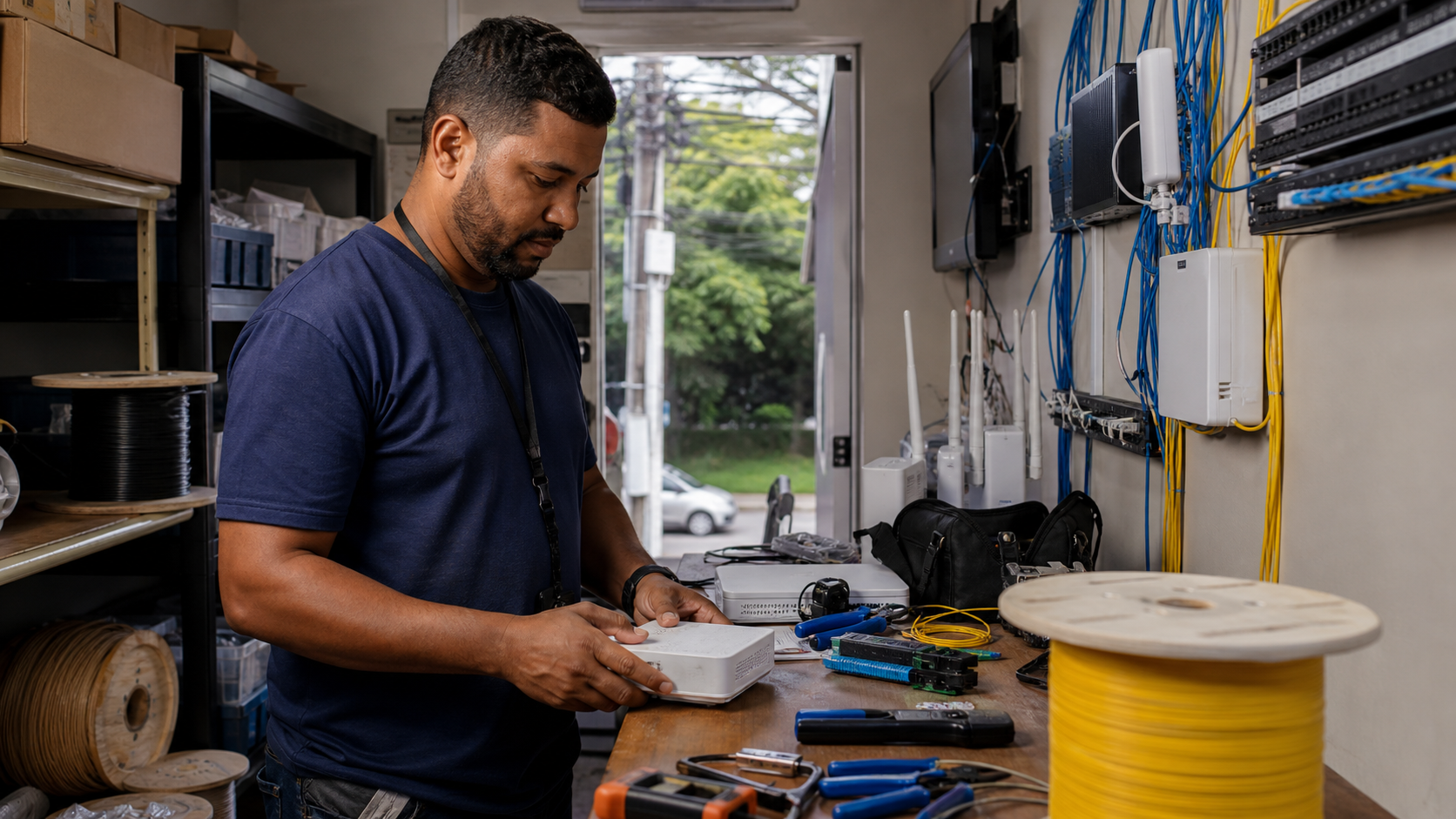
The revealing moment in a small Brazilian communications business is not the sale of a router. It is the decision that follows: whether the real margin sits in the installation visit, the support call, the managed Wi-Fi configuration, the telephone bundle, or the monthly line that must work every day after the customer has forgotten the brand of the device on the shelf. Tecnoasp Tecnologia e Serviços de Comunicação Ltda belongs in that margin. Its public footprint is not that of a national telecom group with a dense investor-relations archive. It is a narrower and more instructive case: a Salvador-based communications-service operator whose own materials sell cost reduction, fixed telephony, broadband, VoIP, support and practical service packaging, while public internet-number records show a small but formal network resource presence. https://www.tecnoasp.net.br/ https://www.tecnoasp.net.br/servicos.html https://rdap.registro.br/autnum/53071
That distinction matters. A company like Tecnoasp should not be judged as if it were a pure equipment reseller, and it should not be inflated into a carrier of national systemic weight merely because it has a registry listing. The economically interesting question is how much durable value can be built in the space between commodity hardware and a customer relationship that renews monthly. Routers, Wi-Fi modems and fibre access equipment are purchasable inputs. Connectivity, installation discipline, billing, repair response and regulatory compliance are harder to commoditize at the local level.
The local operator earns if the customer believes that the line, the person answering the phone and the replacement visit are worth more than the cheapest advertised megabit.
Tecnoasp's public evidence points to a communications-service business that has tried to occupy exactly that middle ground. Its company pages describe it as an SCM operator authorized by Anatel, historically headquartered in Salvador, with service references to fixed telephony, internet access, VoIP, data-centre and outsourced IT. Its service page divides offers between residential and business broadband and telephony, with promised support, valid individual IP addressing and Wi-Fi modem comodato. Corporate registry mirrors show an active limited-liability company with telecom-related economic activity codes, including multimedia communication service, VoIP, fixed switched telephone service and access-provider activity. Network records connect the legal company to an autonomous system and an IPv6 allocation. https://www.tecnoasp.net.br/empresa.html https://www.tecnoasp.net.br/servicos.html https://cnpja.com/office/08382671000176 https://bgp.tools/as/53071
The investment judgment, editorially speaking, is restrained but not dismissive. Tecnoasp looks less like a company whose strength is scale and more like one whose business logic depends on keeping the service layer credible. The upside is local intimacy: proximity to customers, familiar installation environments, and the ability to bundle telecom, support and practical IT tasks. The downside is dependence: on upstream connectivity, on equipment vendors, on technicians, on Anatel compliance and on a customer base that can churn quickly when the line fails. In that model, the router is not the product. It is the visible receipt for an obligation. https://www.gov.br/anatel/pt-br/regulado/outorga/comunicacao-multimidia
Identity is clearer than scale
Tecnoasp's identity is materially clearer than its current scale. The company name, CNPJ-linked registry mirrors, official website and internet-number records all point to the same legal subject: Tecnoasp Tecnologia e Serviços de Comunicação Ltda, also presented commercially as Tecnoasp Comunicação. Public corporate data list the company as active, opened in October 2006, organized as a sociedade empresária limitada, and associated with an address on Avenida Antônio Carlos Magalhães in Salvador, Bahia. The official contact page gives Salvador contact numbers, a service email and WhatsApp channel. Its own historical page says the business began in the mid-2000s, started activity in Petrópolis, later operated in Salvador, Porto Seguro and Belém, and positioned itself around telecom and technology services. https://cnpja.com/office/08382671000176 https://www.tecnoasp.net.br/contato.html https://www.tecnoasp.net.br/empresa.html
The scale question is harder. The website carries old date markers and legacy design, which makes it useful as evidence of positioning but weak as evidence of present subscriber count, headcount or exact service footprint. It once claimed roughly 15 direct collaborators and ambitious expansion into interior Bahia, but those statements should be treated as historical self-description rather than a current operating census. The customer page shows client logos as images without readable explanatory text in the accessible page output. The Google Play listing for a Tecnoasp self-service app, updated in 2024, suggests continued customer-account operations, including bill payment and support channels, but download count visibility is too low to infer subscriber scale. https://www.tecnoasp.net.br/clientes.html https://play.google.com/store/apps/details?hl=gsw&id=br.net.tecnoasp.centralassinante
That leaves a business whose legal and service identity is much firmer than its measurable commercial reach. This is common among regional Brazilian providers. Many are substantial inside a neighbourhood, industrial park, condominium cluster or municipal cluster without producing the public disclosure expected of listed companies. Others preserve old websites long after the operating model has changed. For Tecnoasp, the careful reading is that the company exists as a licensed or licensing-facing communications-service operator, has maintained public customer contact channels, and has number-resource evidence.
It does not support a claim that Tecnoasp is a major national broadband provider.
The distinction is important because local telecom economics are not only a function of reported customer count. A small operator can be strategically relevant if it controls customer relationships in places where large carriers are slow, expensive or operationally impersonal. Conversely, a small operator can be fragile even with a loyal base if it lacks enough purchasing power, network redundancy or operational staffing. The public evidence does not let us settle Tecnoasp's size.
It does let us locate its commercial role: a communications-service company whose claim to value is practical reliability for homes and businesses, not national infrastructure dominance.
The service menu reveals the revenue model
Tecnoasp's service descriptions are modest but revealing. The residential product is framed as broadband and telephony for domestic users who want everyday web access, email, video and chat. The business offer is framed around reducing company costs and improving access speed. Both refer to access that does not require a telephone line, included provider access, extended support, speeds up to 20 mega in the old copy, 24-hour guaranteed access, a valid and exclusive IP address for each client, and a Wi-Fi modem under comodato. A separate service entry discusses consultancy through an online manager for controlling mobile-phone use. The website also advertises fixed telephony, VoIP, broadband, customized solutions, colocation, virtual desktop and IT outsourcing in footer navigation. https://www.tecnoasp.net.br/servicos.html https://www.tecnoasp.net.br/diferenciais.html
That menu reads like a company trying to avoid being reduced to a simple access pipe. The base recurring revenue is likely monthly connectivity: residential broadband, business broadband, fixed voice and VoIP. Around that base sit add-ons and retention devices: installation, equipment loan, support, account management, telephone-cost reduction, and potentially business IT services. The router or modem is placed in the customer's premises, but the economic aim is continuity. Comodato, in particular, shifts the customer's upfront cost lower while keeping the operator responsible for equipment availability, retrieval and replacement.
That can improve conversion, but it ties working capital to devices that wear out, disappear, become obsolete or require truck rolls.
The pricing logic is therefore probably less about a one-time hardware spread and more about contribution margin over the customer life. The first month can be unattractive after sales effort, installation labour, travel, modem cost, cable, connectors and activation work. The later months become valuable if the customer stays, pays on time and uses support at a manageable rate. The model breaks when support becomes the product without enough price to pay for it. A customer who experiences repeated outages, poor in-home Wi-Fi, confusing billing or slow repair can destroy the economics even if the nominal plan price looks profitable.
The same logic applies to business customers but with sharper consequences. A small firm buying Tecnoasp for internet and telephony is not just buying access. It is buying continuity for card machines, customer service, back-office software, WhatsApp sales, remote work and voice contact. If the line fails, the customer's revenue may stop immediately. That gives the operator pricing power if reliability is visibly better than alternatives, but it also raises the penalty for weak support. The most valuable customer is not necessarily the one on the highest speed plan.
It is the one whose monthly payment reflects the operator's real cost of keeping the site working.
Anatel gives the frame, not the moat
Brazil's telecom regime is central to the Tecnoasp story because the company identifies itself through communications-service language rather than only retail internet language. Anatel's description of Serviço de Comunicação Multimídia defines SCM as a fixed telecommunications service of collective interest, supplied in the private regime, that enables the transmission, emission and reception of multimedia information and can include internet connection within a service area. Anatel also points regulated users to outorga and licensing panels for authorized service providers, station information and related formalities. Tecnoasp's website says it was authorized by Anatel from August 2008 to act throughout Brazil. https://www.gov.br/anatel/pt-br/regulado/outorga/comunicacao-multimidia https://www.gov.br/anatel/pt-br/regulado/outorga/lista-de-autorizados https://www.tecnoasp.net.br/empresa.html
The economic meaning is not that authorization alone creates a moat. In Brazil, small and regional providers have become numerous enough that regulatory standing is a ticket to compete, not a guarantee of margin. The formal frame does matter, however, because it converts a homegrown access business into a regulated service provider with duties, filings, station considerations and consumer obligations. For a small operator, compliance is both burden and credibility. It consumes administrative attention, but it gives enterprise and residential customers a reason to treat the provider as more than an informal installer.
The regulatory context has become more important as Brazil's broadband market has matured. Recent Anatel-linked industry reporting shows a highly fragmented fixed-broadband sector in which small providers have gained more than half of national fixed-broadband access share. ABRINT, citing Anatel's competition monitoring, reported in 2025 that small providers held more than 56 percent of fixed-broadband market share, with more than 22,500 active providers and a very low market-concentration index. TeleSíntese, also citing Anatel data, reported that Brazil finished 2025 with roughly 53.9 million fixed-broadband accesses and that fibre accounted for about 79 percent of connections. https://abrint.com.br/noticias/ppps-lideram-banda-larga-e-mantem-o-setor-como-o-mais-competitivo-confirma-relatorio-da-anatel/ https://telesintese.com.br/quem-lidera-a-banda-larga-no-brasil-segundo-a-anatel/ https://www.teleco.com.br/blarga.asp
That broader market makes Tecnoasp's position both plausible and pressured. The opportunity for local providers is real: Brazil has thousands of places where proximity, quick field work and local trust matter. The threat is equally real: the same fragmentation that lets local providers grow also means customers can compare plans, complain publicly and switch when another provider offers fibre, lower installation cost or faster repair. Regulation does not shield Tecnoasp from that competition. It mostly sets the rules under which service promises become accountable.
A company that sells telecom reliability must not only market a line; it must maintain a regulated service posture while competing with both national carriers and other local operators.
Number resources show a small network surface
The network evidence is small but significant. Registro.br RDAP data for AS53071 identify Tecnoasp Tecnologia e Serviços de Comunicação Ltda as the registrant, with the company CNPJ attached and Brazil as the country. The same RDAP record links the autonomous-system allocation to an IPv6 resource, 2804:92b8::/32. BGP.tools presents AS53071 as active, registered in September 2009, allocated under NIC.br, originating no IPv4 prefixes and four IPv6 prefixes in its view. It lists one visible upstream and peer relationship with AS52696, JSX Telecom, and shows a presence related to IX.br São Paulo. PeeringDB's API query for the ASN returned no network entity. https://rdap.registro.br/autnum/53071 https://bgp.tools/as/53071 https://ftp.registro.br/pub/numeracao/origin/nicbr-asn-blk-latest.txt https://peeringdb.com/api/net?asn=53071
The interpretation should be disciplined. These records demonstrate that Tecnoasp has formal number-resource evidence and a visible routing identity. They do not prove the size of its retail customer base, the quality of its physical access network, or the current split between fibre, wireless, leased lines and voice services. The absence of visible IPv4 origination in one routing view could mean a genuinely IPv6-focused visible footprint, reliance on upstream arrangements, address translation, legacy arrangements not surfaced in that view, or simply that the public routing picture is incomplete.
The prudent conclusion is not "large network" or "no network." It is "small visible network surface with formal registration."
That still matters for the business mechanism. A provider that appears in LACNIC, Registro.br and BGP views is not merely reselling a retail connection in a purely informal way. It has at least some relationship to internet-number administration and routing. That can support business services such as valid addressing, connectivity management and more professional network operations. It also creates operational duties: routing contacts, abuse contacts, registry maintenance and dependence on upstream transit and exchange arrangements. A small routing table is not free. It requires knowledge, monitoring and a response process when reachability breaks. https://milacnic.lacnic.net/lacnic/asociados/publico?locale=EN https://www.lacnic.net/1009/2/lacnic/members-list/1000 https://rdap.registro.br/autnum/53071
The visible upstream dependence is especially important. If an operator has only one publicly observed upstream path in a routing view, bargaining power and resilience are limited unless there are backup arrangements not visible in the same data. Upstream outages, price increases, traffic-quality problems or commercial disputes can flow through to the local customer experience. For customers, the line either works or it does not; they rarely care whether the fault sits in the last drop, the local aggregation point, the upstream provider, routing policy or customer equipment. For Tecnoasp, the public network evidence reinforces the central economic point: reliability is a chain of dependencies, and the local brand receives the complaint when any link fails. https://bgp.tools/as/53071 https://cidr-report.org/cgi-bin/as-report?as=AS53071&v=6&view=2.0 https://bgp.he.net/AS52696
Equipment policy turns capital into churn control
The company's service copy gives unusual weight to equipment. The residential and business descriptions include a Wi-Fi modem under comodato, and the footer links to a separate equipment-loan contract. Because the scanned contract text was not machine-verifiable in this pass, the stronger claim rests on the readable service page: Tecnoasp advertises the access line together with a supplied modem, which is enough to show that equipment is part of the service economics rather than a detached retail sale. https://www.tecnoasp.net.br/servicos.html
This choice has two sides. On the upside, customer-premises equipment can be a retention tool. If Tecnoasp supplies and configures the modem, it can standardize support, reduce blame games over unsupported devices, and make the service feel bundled rather than assembled by the customer. It can also use equipment policy to protect service quality: known firmware, known Wi-Fi behaviour, known reset procedures, known replacement process. In a local market, the technician who understands the installed base may be more valuable than a faster headline speed from a carrier with distant support.
On the downside, equipment converts sales growth into capital pressure. Every modem placed under loan is cash or supplier credit tied up in a household or business premise. Devices fail during storms, power fluctuations, renovations and careless handling. Wi-Fi performance depends on apartment walls, router placement, interference and customer expectations that often exceed what the plan actually promises. The operator then pays for diagnosis, replacement and education. A cheap device can create costly support. A better device can improve stability but raises the payback threshold. The same paragraph in the service menu that helps win a customer also implies inventory, configuration, replacement and technician time as recurring costs. https://www.tecnoasp.net.br/servicos.html https://www.tecnoasp.net.br/diferenciais.html
This is why the margin between router sale and reliable line is so thin. Selling a router once is easy to understand: buy at one price, sell at another. Supplying a managed access device is harder: the device is part of a recurring service promise. The operator earns over time if the equipment reduces calls, extends customer life and allows a plan price that covers support. It loses if the equipment becomes a recurring repair liability or if customers churn before the capital is recovered.
The installation visit is where that accounting becomes physical. The technician is not only plugging in a modem; the visit translates Anatel service authorization, LACNIC/Registro.br numbering, upstream transit, customer billing and Wi-Fi expectations into a line that a household or business can actually use. Tecnoasp's official service page promises individual valid addressing and supplied Wi-Fi equipment; Registro.br and BGP views show the formal address-and-routing layer behind that promise; Anatel defines the regulated fixed multimedia service frame in which the promise is sold. The cost of one poor installation is therefore larger than the cable and connectors used on the day. It can create repeat visits, support calls, device swaps, bad Wi-Fi perception, billing disputes and eventual churn. https://www.tecnoasp.net.br/servicos.html https://rdap.registro.br/autnum/53071 https://bgp.tools/as/53071 https://www.gov.br/anatel/pt-br/regulado/outorga/comunicacao-multimidia
For Tecnoasp, this makes installation and support quality economically central. The public complaints visible on consumer forums are not statistically sufficient to measure service quality, but they fit the known risk pattern: no signal, unstable internet, difficulty reaching support, and impact on work or study. Those complaints should not be treated as a full customer-satisfaction survey. They should be treated as reminders that in this business, the router is where customer expectation meets provider cost. Bad Wi-Fi can look like bad internet. A power issue can look like network failure. A slow answer can turn a fixable outage into churn. https://www.reclameaqui.com.br/empresa/tecnoasp/ https://www.reclameaqui.com.br/tecnoasp/sem-sinal-de-internet_otiJqkQ85A6SWXSz/
Customer dependence runs through households and small firms
Tecnoasp's own service language points to two customer groups: residential users and companies of all sizes. The residential pitch is convenience and everyday use. The business pitch is cost reduction, faster access and less worry about telecom. That mix is typical of a local communications provider because it diversifies revenue but also complicates operations. Households are price-sensitive and support-intensive. Small businesses are less tolerant of downtime and may need more customized handling. Larger business customers can demand service levels that a small provider may struggle to guarantee without stronger redundancy and field capacity. https://www.tecnoasp.net.br/servicos.html
The company also advertises fixed telephony and VoIP. That matters because voice can be both an add-on and a retention anchor. A customer who buys internet alone may switch for price. A customer who has phone numbers, billing history, account access and support routines tied to the same provider may hesitate. Yet voice also brings complexity: number management, call quality, emergency expectations, customer equipment, portability issues and regulatory sensitivity. The advertised ability to reduce fixed-telephony costs for companies suggests that Tecnoasp historically saw an opening where traditional telephony prices left room for a more service-led alternative. https://www.tecnoasp.net.br/ https://cnpja.com/office/08382671000176
Customer dependence is therefore not simply concentration risk in one named account. It is behavioural risk. How many customers renew because the service is better, and how many renew because switching is inconvenient? How much revenue depends on customers who use support heavily? How many business accounts treat Tecnoasp as mission critical, and how many treat it as backup or low-cost access? The public file does not answer these questions. But the business model makes them decisive.
Brazil's regional ISP market makes customer dependence more demanding. In a fragmented market with many small providers, the customer is no longer choosing only between a national incumbent and one local alternative. In many municipalities, customers may face several fibre and wireless providers, plus national brands and mobile fallback. The operator's defence is not just speed. It is local trust, fast installation, honest billing, practical repair and clear communication during outages. The attack on that defence comes from every complaint that says a customer could not reach support when the line failed.
The Google Play listing for a Tecnoasp self-service app is meaningful in this context. Bill payment, payment history and support channels inside an app can lower call-centre load and make the account relationship more modern. But an app does not fix a broken last-mile link. It is a customer-dependence tool only if it reduces friction and speeds resolution. If it becomes a screen customers open while waiting for a technician, it has limited value. The operator's margin still depends on the physical and human repair loop. https://play.google.com/store/apps/details?hl=gsw&id=br.net.tecnoasp.centralassinante
Supplier and upstream dependence are the hidden balance sheet
Small communications providers often carry a hidden balance sheet that does not appear in simple public registry records. It includes routers, optical network terminals, Wi-Fi modems, switches, poles, ducts, leased facilities, upstream contracts, installation vehicles, splicing tools, testing equipment, software, billing systems, support labour and the informal knowledge of technicians who know which building has difficult risers and which street cabinet floods. Tecnoasp's public documents expose only fragments of this balance sheet, but the fragments are enough to show the direction of dependence: supplied access equipment in the service offer, visible routing dependence, formal regulatory context and a public self-service app. https://www.tecnoasp.net.br/servicos.html https://bgp.tools/as/53071 https://www.gov.br/anatel/pt-br/regulado/outorga/comunicacao-multimidia https://play.google.com/store/apps/details?hl=gsw&id=br.net.tecnoasp.centralassinante
The first dependence is upstream connectivity. Public routing views connect AS53071 to JSX Telecom in the observed upstream and peer fields. Whether Tecnoasp has other commercial arrangements outside that view is not established, but the visible evidence is enough to treat upstream concentration as a question. Upstream suppliers influence latency, reachability, capacity upgrades, outage handling and wholesale pricing. A local provider can be excellent at the doorstep and still disappoint if its upstream path is congested or fragile. Conversely, a strong upstream relationship can let a small operator provide credible service without owning every part of the network stack. https://bgp.tools/as/53071 https://bgp.he.net/AS52696
The second dependence is equipment supply. The website's modem-loan language and broadband positioning imply recurring purchases of customer-premises devices and replacement inventory. Brazil's broadband sector has become heavily fibre-oriented, but Tecnoasp's publicly visible pages still speak in older broadband and telephony language. If the company has modernized its access network, that modernization would have required new optical equipment, field skills and supplier financing. If it has not, competition from fibre-heavy providers becomes more severe. Either way, equipment strategy determines whether the provider can keep plan speeds, Wi-Fi quality and repair costs aligned. https://www.tecnoasp.net.br/servicos.html https://telesintese.com.br/quem-lidera-a-banda-larga-no-brasil-segundo-a-anatel/
The third dependence is labour. Telecom support is not just a call-centre script. It is dispatch scheduling, field diagnosis, cable work, radio or fibre troubleshooting, customer education and billing dispute handling. Tecnoasp's site emphasizes fast service, commitment and qualified support. That is commercially smart, but it also exposes the cost base. A local provider cannot promise proximity without paying for people and vehicles close enough to act. The labour model becomes especially difficult when storms, power failures or neighbourhood outages create simultaneous calls. https://www.tecnoasp.net.br/diferenciais.html https://www.tecnoasp.net.br/contato.html
The fourth dependence is software and account management. The customer app suggests a move toward self-service, which can reduce payment friction and support calls. But billing software, authentication systems, customer portals and network management tools all create supplier or platform dependence. For a small operator, the risk is not only vendor price. It is operational lock-in: if the billing and support workflow becomes hard to change, the provider may lose agility exactly where local operators are supposed to be strongest. https://play.google.com/store/apps/details?hl=gsw&id=br.net.tecnoasp.centralassinante
Renewal quality matters more than advertised speed
The most important financial number for a company like Tecnoasp is probably not the highest advertised speed, and it is not the nominal price of the router. It is the quality of renewal. A local provider can sell a plan aggressively, waive part of the installation, place equipment under loan and still destroy value if the customer leaves before the installation cost, device cost and support burden have been recovered. The economics reward boring continuity: paid invoices, low repeat-fault volume, few unnecessary truck rolls, and customers who regard the provider as dependable enough to renew without renegotiating every month.
That makes customer lifetime a better lens than plan headline. The first revenue from a new residential account may be offset by sales contact, scheduling, cable and connector use, technician travel, router or optical terminal allocation, account setup and early support. A business account may require more careful site work, number handling, router configuration, internal Wi-Fi discussion and after-hours sensitivity. If that customer then calls repeatedly, pays late or cancels when a rival offers a lower teaser price, the operator has converted growth into strain.
If the customer stays for years and support calls decline after the first month, the same installation becomes a productive asset.
Tecnoasp's public service language implies that the company understands this renewal logic. The repeated emphasis on support, cost benefit, valid individual IP addressing, telephony and a supplied modem suggests an attempt to make the monthly relationship more valuable than a bare broadband line. The customer is not just buying megabits. The customer is buying a package that should be easier to use, easier to support and easier to justify to a household or office manager. That is the right commercial instinct in a crowded broadband market, but it raises the standard for execution. Bundles only protect margin when every component reinforces trust. https://www.tecnoasp.net.br/servicos.html https://www.tecnoasp.net.br/diferenciais.html
The hard part is that renewal quality is invisible from most public evidence. A provider can look healthy from the outside while quietly losing customers to poor repair performance. It can also look dated online while maintaining loyal accounts through responsive local service. Public complaints, app listings and old service pages show the shape of the question, not the answer. The answer would sit in churn by cohort, average revenue per account, overdue-payment rate, equipment loss, repair backlog and the share of customers who require repeat visits within the first ninety days. https://www.reclameaqui.com.br/tecnoasp/internet-instavel-e-dificuldade-de-contato-com-o-suporte-tecnico-da-tecnoasp-em-salvador_LFe-DlsZ1oZz42QY/ https://play.google.com/store/apps/details?hl=gsw&id=br.net.tecnoasp.centralassinante
The recurring-service test also changes how to interpret price competition. A low monthly plan can be rational if density is high, installation routes are efficient and support volume is controlled. A higher plan can be rational if it includes business responsiveness, better equipment and more resilient upstream capacity. The dangerous middle is a plan priced like a commodity but serviced like a managed product. That is where local ISPs can get trapped: customers demand personal attention, but the tariff only covers a low-touch access line. Tecnoasp's future margin depends on avoiding that trap.
Competition is not only the national carriers
Tecnoasp competes in a market where the old map of Brazilian telecom has changed. National operators still matter, and TeleSíntese's 2025 ranking shows Claro and Vivo with very large fixed-broadband bases. But the more relevant competitive fact for a regional ISP is that small providers as a group have become the majority force in fixed broadband. ABRINT's 2025 reading of Anatel competition data puts small providers above 56 percent market share, with more than 22,500 active providers. That means Tecnoasp is competing not just against incumbents but against a swarm of companies with similar local logic. https://telesintese.com.br/quem-lidera-a-banda-larga-no-brasil-segundo-a-anatel/ https://abrint.com.br/noticias/ppps-lideram-banda-larga-e-mantem-o-setor-como-o-mais-competitivo-confirma-relatorio-da-anatel/
This is a harder competitive environment than a simple David-versus-Goliath story. Against large carriers, a local operator can argue that it knows the customer, responds faster and is more flexible. Against other local operators, those advantages are less exclusive. Everyone can claim proximity. Everyone can claim support. Everyone can discount installation. Everyone can offer a router. The winner is the operator that turns those claims into fewer service failures, lower churn and enough price discipline to fund maintenance.
Fibre economics intensify the pressure. Fibre has become the dominant Brazilian fixed-broadband technology by reported access share. If customers expect fibre speeds and stability, legacy wireless or older copper-like service language becomes a disadvantage unless the operator can show strong local performance or niche specialization. Tecnoasp's public pages do not provide a current technology map. They do not say how much of the access base is fibre, radio, leased line or another medium. That uncertainty affects the judgment. The company may have upgraded substantially without updating its pages; many local operators do. But from public evidence alone, the modernization question remains open. https://telesintese.com.br/quem-lidera-a-banda-larga-no-brasil-segundo-a-anatel/ https://insights.opensignal.com/reports/2025/10/brazil/fixed-broadband-experience
Pricing pressure is also likely. In a fragmented market, headline plan prices can fall even when the real cost of support rises. Local operators often respond by bundling installation, Wi-Fi, voice, business support, static or valid IP addressing, and account responsiveness. Tecnoasp's service copy fits that response: it sells cost benefit, telephone savings, support and individual IP addressing alongside access. That can work if customers recognize the bundle's value. It fails if competitors offer higher speeds at lower prices and customers treat support as something they will only think about after the first outage.
The best competitive reading is therefore conditional. Tecnoasp has a plausible local-service proposition and formal telecom/network credentials. Its risk is that the attributes it advertises are now the minimum standard for serious regional providers. The moat is not the existence of an authorization, a router or a website. The moat would be a measurable pattern of customers staying because problems are fixed quickly and honestly.
Public complaints are weak data but strong warning signals
Unofficial market signals around Tecnoasp are consistent with the support-sensitive nature of the business. Reclame Aqui pages include complaints about no internet signal, instability, difficulty reaching technical support and service interruptions affecting work or study. The complaint pages are individual reports, not audited performance data. They can be emotional, incomplete and unrepresentative. They may also reflect ordinary incidents that happen to every provider. The right analytical use is not to declare Tecnoasp unreliable. It is to observe that the kind of complaints that surface are exactly the kind that matter most to this business model. https://www.reclameaqui.com.br/empresa/tecnoasp/ https://www.reclameaqui.com.br/tecnoasp/sem-sinal-de-internet_otiJqkQ85A6SWXSz/ https://www.reclameaqui.com.br/tecnoasp/cliente-tecnoasp-relata-falta-de-internet-e-demora-no-atendimento-tecnico-impactando-atividades-profissionais-e-academicas_NxyG3LGxS_wpQqfW/
For a communications-service provider, complaints about outage and support delay strike at the revenue mechanism. The customer does not experience telecom as an average uptime percentage. The customer experiences it as whether the meeting starts, the card machine works, the student can submit work, or the family can stream in the evening. When a provider sells itself on fast support, cost benefit and qualified service, every failure to answer becomes reputationally more expensive. The brand promise creates the measuring stick.
The same market signals also point to a larger truth about local ISPs. Customers often blame the provider for problems that may begin elsewhere: upstream congestion, power instability, damaged local plant, customer Wi-Fi placement, cheap devices, building wiring or weather. A disciplined operator can use that complexity as an advantage by diagnosing clearly and communicating honestly. A weaker operator lets complexity become opacity. The difference shows up in churn. Customers will tolerate some failures if they believe the provider knows what happened, owns the problem and fixes it. They will not tolerate silence.
Tecnoasp's app listing suggests at least an attempt to lower service friction through self-service. Its contact page lists phone, email and WhatsApp. Those are necessary but not sufficient. The economics of support depends on whether those channels reduce the time between problem and resolution. WhatsApp can be a powerful local-support tool, but it can also become a queue of unhappy customers if staffing is thin. An app can reduce billing calls, but it cannot substitute for field capacity. A service email can document problems, but customers often want a live answer when their business is offline. https://play.google.com/store/apps/details?hl=gsw&id=br.net.tecnoasp.centralassinante https://www.tecnoasp.net.br/contato.html
The market-signal conclusion is simple: Tecnoasp's public proposition lives or dies on operational responsiveness. The unofficial complaints do not prove systematic weakness, but they identify the specific area where diligence should focus. The next facts that would matter are complaint volume relative to subscriber base, average repair time, repeat-fault rate, first-contact resolution and whether business customers receive differentiated handling.
Geography and geopolitics sit inside local operations
Tecnoasp is Brazilian, Salvador-anchored in public records, and linked to a Latin American internet-number environment through LACNIC and Registro.br. That geography carries more than a country label. Brazil's broadband market is unusually shaped by the strength of regional providers, the spread of fibre, the challenge of serving peripheral and interior areas, and the regulatory effort to keep many small operators visible and accountable. A company like Tecnoasp operates inside that national bargain: local providers extend competition and access, but they must professionalize as the market becomes bigger and more regulated. https://cnpja.com/office/08382671000176 https://www.lacnic.net/1009/2/lacnic/members-list/1000 https://abrint.com.br/noticias/ppps-lideram-banda-larga-e-mantem-o-setor-como-o-mais-competitivo-confirma-relatorio-da-anatel/
Salvador and Bahia are also operationally meaningful. Urban density can help local providers by concentrating customers, reducing route length and enabling faster dispatch. It can also complicate installation through building access, rights of way, traffic, informal wiring and neighbourhood infrastructure constraints. Serving business customers in a city such as Salvador means supporting not only homes but retail, service firms, transport-adjacent sites, offices and local institutions. The official address near a major urban corridor reinforces a practical, service-oriented commercial identity rather than a remote network-only posture. https://www.tecnoasp.net.br/contato.html https://cnpja.com/office/08382671000176
The company's old page also mentioned operations or ambitions beyond Salvador, including Petrópolis, Porto Seguro, Belém and interior Bahia. Because the page is dated, those references should not be read as a current footprint map. They do show that Tecnoasp historically imagined itself as more than a single-neighbourhood access shop. Multi-city ambition, however, raises the operational bar. Each additional city adds inventory, field staff, local permissions, supplier relationships and support complexity.
The economics that work inside one dense service area can deteriorate if expansion stretches response times and splits management attention.
Geopolitically, the most relevant issue is not international conflict in the dramatic sense. It is dependence on global equipment supply chains, imported electronics, exchange-rate exposure, standards evolution and domestic regulatory changes. Routers, optical equipment, switching gear and Wi-Fi devices often tie local providers to global vendors and currency cycles. A weakening real can raise replacement costs. New Wi-Fi expectations can make older devices feel inadequate. IPv6 adoption and address scarcity can require operational competence that smaller providers cannot fake.
Regulatory tightening around authorization, station registration or consumer protection can impose costs that favour more professional operators.
Tecnoasp's number-resource evidence may be a quiet advantage here. Formal IPv6 allocation and routing presence suggest at least some technical capability beyond pure resale. But capability must be maintained. The future of local broadband is not only pulling more cable. It is managing addresses, devices, customer experience, compliance and suppliers in a way that keeps a small operator from being squeezed between national scale and local price wars.
What would change the judgment
The present judgment on Tecnoasp is deliberately conditional. The company has a coherent communications-service identity, public telecom-service claims, active corporate registration evidence, Anatel-relevant service categories, LACNIC/Registro.br number-resource evidence, and a visible but small routing profile. It also has an old public website, limited current commercial disclosure, uncertain technology mix, no obvious PeeringDB profile, and unofficial complaints that highlight support and outage risk. That combination supports cautious attention, not a sweeping conclusion. https://www.tecnoasp.net.br/empresa.html https://cnpja.com/office/08382671000176 https://rdap.registro.br/autnum/53071 https://bgp.tools/as/53071 https://peeringdb.com/api/net?asn=53071
Several facts would improve the assessment. The first is a current service-footprint map: which municipalities, neighbourhoods or business corridors are actively served, and through which access technologies. The second is a current product and price schedule that distinguishes residential, business, dedicated access, VoIP and managed Wi-Fi. The third is proof of redundancy: multiple upstreams, clear backbone arrangements, backup power, and documented monitoring. The fourth is operational performance: repair times, outage communication practice, support staffing and churn.
The fifth is customer mix: the split between residential, small business and larger enterprise accounts. The sixth is capex discipline: how equipment loans are financed, recovered and replaced.
Several facts would weaken the assessment. A current footprint materially smaller than the website implies would reduce confidence in the operating story. Persistent unresolved complaints relative to a small customer base would damage the service-quality claim. Heavy dependence on one upstream without backup would make reliability fragile. A service portfolio still anchored in older speeds while nearby competitors sell modern fibre would raise churn risk. A lack of clear billing and equipment recovery controls would make the comodato model costly. Weak compliance hygiene would reduce the credibility gained from telecom-service language.
There is also a middle possibility: Tecnoasp may be a steady, locally useful operator whose public materials simply understate or poorly update the present business. That happens often in regional telecom. A provider can be operationally alive while its website looks frozen. It can have technicians, app billing, WhatsApp support and customers even when its public marketing copy still speaks in old speed tiers. If that is the case, the most important evidence would be operational rather than promotional: field presence, current plans, outage handling, and active customer accounts.
The strongest conclusion is therefore about business mechanism rather than company destiny. Tecnoasp illustrates the economics of a regional communications-service provider at the edge of commodity hardware. Its value is created only when installation, equipment, upstream connectivity, billing and support become a reliable monthly service. The router starts the relationship, but it does not protect the margin. The margin is protected by every day the line works, every call that is answered, and every customer who decides that local service is worth renewing.