
Summary
The loss unfolded in about 20 minutes, but it was built from controls accumulated over years. Swissair Flight 111 left New York for Geneva on September 2, 1998, with 215 passengers and 14 crew members. At 0110:38 UTC, the pilots detected an unusual odour. They declared “Pan Pan Pan” 3 minutes 37 seconds later, selected Halifax after it was offered as a closer diversion, and declared an emergency after aircraft systems began failing. Both recorders stopped at 0125:41. The MD-11 struck the Atlantic at 0131:18, killing everyone aboard. The TSB final report A98H0003 is the controlling safety account.
Its findings are not civil or criminal judgments.
The evidence supports electrical arcing as the ignition class, not one proven sole wire. Investigators localized the most likely origin above the cockpit ceiling near the rear wall at station 383. An IFEN power cable segment, exhibit 1-3791, had a forward arc in that area and during the likely fire-initiation period. The arc was likely associated with initiation, but investigators could not determine whether it was the lead event or whether IFEN wiring, original aircraft wiring or a combination was involved. The FAA's official summary of the adopted accident findings preserves that distinction.
Assigning the entire fire to a single identified wire would go beyond the evidence.
A supplemental passenger system exposed an integration and configuration-control failure. The in-flight entertainment network was described as non-essential, yet most of its power came from AC Bus 2 rather than a cabin bus. Turning the CABIN BUS switch off therefore did not remove IFEN power as the crew would reasonably expect. The approved package did not fully define routing in a critical forward area, and installations varied. Those were serious certification and installation findings.
They do not establish that the IFEN integration flaw initiated or propagated the fire; the TSB expressly found no such link because the fire was already underway when the cabin bus was selected off.
Material certification allowed a compliant blanket to become major fire fuel. Metallized polyethylene terephthalate, or MPET, covering on thermal-acoustic insulation blankets met the applicable vertical Bunsen-burner test. In installed configurations and under more representative ignition conditions, it could ignite and propagate flame. The TSB found it was most likely the first material ignited and the largest share of combustible material feeding the fire. The FAA's Swissair 111 lessons module shows why certification must reproduce credible installed threats rather than reward a specimen for shrinking away from a laboratory flame.
The hidden attic was neither observable nor defensible as a fire zone. There was no built-in smoke or fire detection and suppression where the fire started and propagated, and regulation did not require it. Human smell and sight produced late, ambiguous cues, while a hand extinguisher could not reliably reach fire above liners and behind structure. Circuit breakers protected wiring against sustained overcurrent but could miss intermittent arcing below their time-current trip threshold. The result was a system in which ignition could remain energized, fire could remain hidden and the crew could not locate or attack it.
Procedure evidence must not be turned into a guaranteed alternate outcome. The pilots made a timely diversion decision based on the limited cues they had, were trained to land overweight when an emergency required it, and eventually said they had to land immediately. Fuel dumping had not begun before recorder stoppage and was not underway at impact. The final report concluded that, from points along the actual flight path after the first odour, an approach to Halifax would have taken longer than the cockpit remained safely usable.
Simulator and theoretical profiles illuminate time and workload; they do not prove that one different dump, route or checklist choice would certainly have saved the aircraft.
Repair is a chain of verifiable controls, not the closure label on a recommendation. MPET removal, stronger flame-propagation tests, electrical-wiring rules, supplemental-system isolation guidance, checklist changes, crew training and fire-hardening work all followed. The FAA compilation of Swissair recommendations and responses documents substantial action. Accountability in 2026 still requires evidence that each applicable fleet, alteration, maintenance program and crew procedure implements the intended control—and that a hidden fire is detected, isolated and suppressed before it destroys the systems needed to land.
Twenty minutes turned a hidden-space assumption into a public catastrophe
The occurrence did not announce itself as an obvious fire. The first officer referred to an unusual odour at 0110:38 UTC. No warning or flight-data parameter identified a technical fault. The pilots investigated, saw some indication of smoke, did not receive a smoke report from the cabin and initially associated the condition with air conditioning. That interpretation mattered because transport-aircraft procedures and training distinguished nuisance or system-related odours from emergencies, and because the fire itself was above the visible cockpit ceiling.
At 0114:15, the captain transmitted the international urgency signal “Pan Pan Pan,” reported cockpit smoke and asked for an immediate return to a convenient airport. He first named Boston, an airport with which he was familiar. The aircraft was then about 66 nautical miles southwest of Halifax and roughly 300 nautical miles beyond Boston. When the controller offered Halifax, the crew accepted it. They donned oxygen masks, descended and began preparing for a landing that required managing altitude, speed, aircraft weight, cabin readiness, navigation, communications and an abnormal smoke condition at night.
The crew asked to remain at 8,000 feet until the cabin was ready. When advised at one point that the aircraft was 30 nautical miles from the runway, they said they needed more distance to descend. At 0120:48 they discussed fuel dumping because the aircraft weighed about 230 tonnes, above its normal maximum landing weight. That figure was transmitted in response to a request for fuel quantity and was actually aircraft gross weight. Air traffic control routed the flight south over water while keeping it within roughly 35 to 40 nautical miles of Halifax.
The observable situation changed abruptly. At 0123:45 the captain selected the CABIN BUS switch off, the first item in the smoke/fumes-of-unknown-origin checklist then in use. Twenty-four seconds later the autopilot disconnected. A rapid series of failures followed. Both pilots declared an emergency at 0124:42. At 0124:53 they advised that they were starting to dump fuel and had to land immediately, but the record shows that dumping had not begun before the recorders stopped and was not underway at impact. The last intelligible aircraft transmission was received at 0125:02.
Both cockpit voice and flight data recording ended at 0125:41 after a loss of electrical power.
Impact came 5 minutes 37 seconds after recorder stoppage and 20 minutes 40 seconds after the first odour. Primary radar, seismic data, engine non-volatile memory and wreckage evidence preserve pieces of the final period. They do not preserve the crew's complete actions, words, visibility, instrument state or decision process. That absence is an evidentiary boundary, not an invitation to write a dramatic ending.
The time compression is central to accountability. A design or certification decision made years earlier determined whether insulation would self-propagate. A modification decision made months earlier determined where entertainment-system cables ran and which switch removed their power. A circuit-breaker design determined which arcing signatures would be interrupted. A checklist determined how quickly essential and non-essential loads could be isolated. A fire-zone definition determined whether the attic contained detection or suppression.
Once the odour reached the crew, all of those prior allocations of control had already shaped the remaining options.
The evidence establishes a fire system, not a single-cause slogan
An accident narrative becomes misleading when it collapses an interacting system into one object. In this case, “an entertainment-system wire caused the crash” is too certain and too narrow.
The physical evidence instead supports a linked sequence: one or more electrical arcs provided an ignition source; nearby MPET-covered insulation was readily ignitable under the conditions; multiple other combustible materials sustained and intensified propagation; hidden-space architecture delayed detection and limited attack; airflow and fire-induced system failures worsened the fire; and degradation of cockpit systems and environment ended in loss of control.
The TSB located the most likely origin on the right side above the cockpit ceiling, close to the cut-out at the top of the cockpit rear wall near station 383. That location fit the migration of the first odour, the delay before systems anomalies, the observed heat pattern, the available combustible materials and the way flame could travel rearward and then return more intensely toward the cockpit. Investigators rejected other origin regions when their predicted smoke cues, damage timing or propagation paths did not fit the record.
That localization did not reveal a unique initiating conductor. Hundreds of wires crossed the region. Some recovered wires showed electrical arcing; many arcs were clearly secondary effects after fire damaged insulation. The analytical task was to distinguish an arc that preceded combustible ignition from arcs produced by the fire itself. Recovery was extraordinarily extensive, but it did not recover every wire or preserve every identifying sleeve. Impact and fire also altered the evidence.
The distinction between “cause class” and “identified component” matters. The fire most likely began with wire arcing because no other plausible ignition source fit the localized evidence. Exhibit 1-3791 mattered because its forward arc was placed in the origin region and was inconsistent with a simple late fire-damage scenario. Yet the forward portions of another IFEN cable pair and a control wire were not identified, and original aircraft wires were also present. The TSB concluded that at least one other wire likely participated in the lead arcing event, but could not say which system owned it.
This is not indecision. It is calibrated proof. Safety action can be broad even when the first electron path is unknown: protect wire from damage, qualify insulation failure behaviour, improve arc detection, separate and document supplemental wiring, remove readily ignitable material, detect hidden smoke, suppress inaccessible fires and make non-essential loads directly isolatable. A legal accusation against a particular actor or product requires a different mandate and potentially different evidence. The safety investigation identifies which defences failed; it does not decide damages or guilt.
Wire 1-3791 is an uncertainty boundary, not a culprit label
Exhibit 1-3791 was a segment of one power-supply-unit cable in the IFEN installation. A copper resolidification near its forward end was an electrical arc site. A second melt roughly 51 centimetres farther aft showed that at least one arcing event had not opened the associated breaker. Investigators used metallurgical work, exemplar arc beads, position reconstruction, fire-damage patterns and electrical-system logic to determine whether arc sites were causal or consequential.
The test program illustrates why visual inspection alone was inadequate. In exemplar tests, some deliberately damaged wires arced to aluminium or to other conductors without consistently tripping their circuit breakers. In one series at normal pressure, breakers opened in 15 of 30 tests. In another at a simulated 8,000-foot pressure, one of four breakers opened. These are bounded test observations, not a statistical probability for the accident. Their importance is conceptual: an arc can create intense localized heat while drawing current that does not persist above the breaker's trip curve.
The TSB supporting record on techniques, tests and simulator work also separates primary from secondary arcing. Fire can melt or carbonize insulation, bringing energized conductors into contact and generating many late arcs. An intermittent “ticking” fault can repeatedly strike without enough integrated overcurrent to open a conventional breaker. Some polyimide insulation can form conductive carbon char under heat, enabling arc tracking along a wire and flashover across a bundle. ETFE behaves differently, melting and burning rather than supporting the same carbonized track.
A credible protection regime must therefore test failure behaviour under voltage, altitude, damage, bundling and material conditions—not merely the intact wire's nominal rating.
Investigators reasoned that the 1-3791 forward arc was unlikely to have been caused solely by a later fire selectively breaching just the necessary insulation in that location while leaving the adjacent evidence pattern. It was likely associated with the fire-initiation period. But association does not prove primacy. The conductor could have arced with another IFEN wire, with an original aircraft wire, or as collateral to another initiating arc. Investigators could not determine how its insulation was first breached or what it contacted.
The accountability response is therefore deliberately wider than “replace this cable.” It asks who specified the wire, who evaluated failure modes, who controlled routing and edge protection, who inspected the installed configuration, who captured service discrepancies, who selected circuit protection and who reviewed the combined aircraft system. If the control only works after investigators identify a unique failed conductor, it is too narrow for the evidence.
This boundary also protects institutional legitimacy. The public can understand that an investigation found a likely electrical-arc ignition without pretending that a forensic gap was closed. Precision strengthens the case for reform because it maps controls to demonstrated hazards. Overclaiming would make an otherwise strong safety record vulnerable to a single correct objection: the lead wire was never uniquely proved.
The entertainment network made “non-essential” a systems-integration question
Swissair's IFEN was an interactive passenger entertainment installation approved through FAA Supplemental Type Certificate ST00236LA-D. The label “non-essential, non-required” described its intended operational criticality. It did not make the installation physically separate from the aircraft. It added power demand, circuit breakers in a cockpit panel, cabling through forward hidden areas, cooling and control functions, installation drawings, operational assumptions and crew-isolation consequences.
Early design material contemplated powering the system from cabin buses. Those buses could not support the planned 257-seat configuration, so most IFEN power was moved to 115-volt AC Bus 2. The design change altered the meaning of the MD-11 CABIN BUS switch. That switch was intended to remove non-essential cabin power and was the first action in the smoke/fumes checklist, but it did not de-energize AC Bus 2. No relay automatically removed IFEN power when the cabin bus was switched off, and no approved flight-manual supplement gave pilots another direct isolation instruction.
The TSB's supporting account of the FAA STC reviews shows how the approval interface failed. An initial critical design review incorrectly stated that IFEN was on a cabin bus. A later briefing corrected that error. The FAA then conducted a special certification review examining the design, installation, the delegate's certification practice and FAA oversight. The TSB found that the certified power integration was incompatible with the MD-11's emergency load-shedding philosophy and did not comply with the type certificate. It was a latent unsafe condition.
The installation package also lacked complete routing definition between the lower avionics circuit-breaker panel and roughly station 515. Instead of a full configuration, documents repeatedly referenced general best-practice guidance. Inspections of other Swissair MD-11s found routing differences, inconsistent protective spiral wrap, wire contact with an equipment edge, hardware and termination discrepancies, and no change notices recording variations in an area the approved package had not defined. A configuration that exists only in installer judgment is difficult to inspect, reproduce or audit.
Responsibility was distributed. The STC approval holder and its design contributors developed and substantiated the alteration. The FAA delegate made compliance findings on the agency's behalf. The FAA retained oversight responsibility for the delegation system. Swissair was the operator and customer. SR Technics supplied support, performed installations through contractors and quality assurance under its maintenance obligations, but the report distinguished that role from approving the design and certification. Each actor controlled a different part of the evidence chain.
The post-accident Transport Canada advisory on entertainment-system integration makes the repair logic explicit: non-required equipment should be removable from power without sacrificing systems necessary for safe flight and landing; crews need a practical switch rather than reliance on pulling individual breakers; and operational procedures must be revised with the installation. That is later guidance, not the exact legal standard governing every 1996 decision. It is evidence of the system lesson drawn from the accident.
The final boundary is essential. The IFEN integration flaw did not become active through the CABIN BUS selection until 13 minutes 7 seconds after the first odour, when the fire was already self-propagating. The TSB found no link between that latent condition and initiation or propagation. Similarly, investigators ruled out the IFEN power-supply units themselves as the ignition source. The serious accountability issue is that certification and installation controls allowed an incompletely defined, incorrectly isolated supplemental system—not that every deficiency proved the physical origin.
Material passed its test and failed its installed purpose
Thermal-acoustic insulation blankets are not decorative cabin trim. They manage temperature, sound and condensation over large areas of the pressure vessel. Their cover films, batting, tapes, fasteners and repairs form an installed system positioned beside wiring, ducts and structure. In HB-IWF, much of the blanket covering was MPET, a thin metallized polyester film.
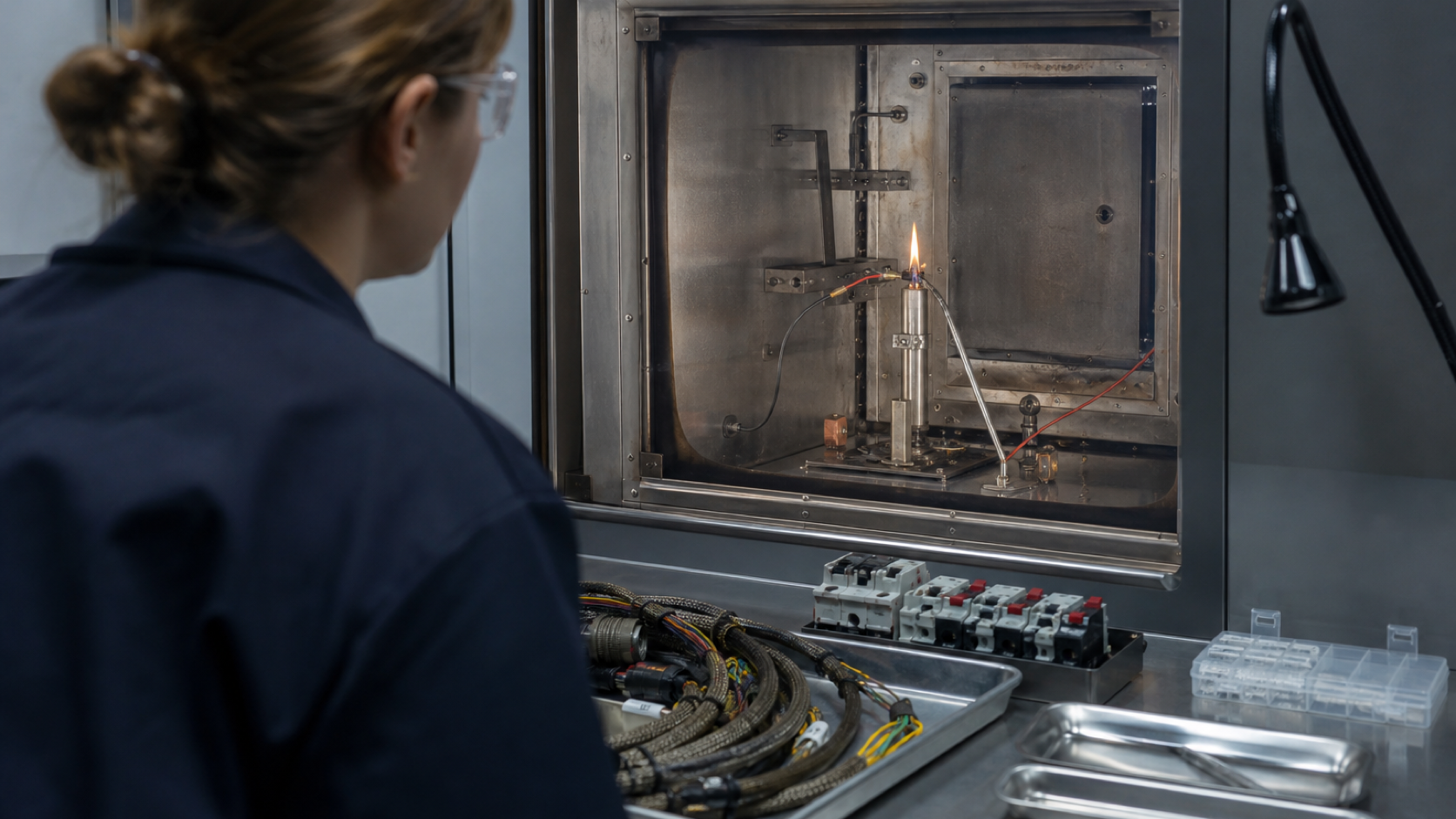
MPET-covered blanket material met the flammability requirement applicable when the MD-11 was certified. The vertical Bunsen-burner test suspended a narrow specimen above a flame for 12 seconds and judged after-flame time, burn length and flaming drips. MPET film could shrivel away from the burner and avoid sustained contact. That behaviour allowed it to pass. In an aircraft, however, blanket surfaces were broad, curved, layered, close to adjacent surfaces and exposed to radiant feedback, preheating, airflow, splicing material and small electrical arcs. Those conditions changed the outcome.
Investigators tested more representative arrangements and found that MPET could be ignited by a small source and propagate flame. It was most likely the first material ignited in the origin region and the largest component of the combustible load that propagated and intensified the fire. Other approved materials also contributed: metallized polyvinyl fluoride covering, silicone elastomeric end caps, hook-and-loop fasteners, foams, adhesives and splicing tapes. The issue was not a dirty old airplane.
Testing found relevant materials flammable in an uncontaminated, newly installed condition, so contamination was discounted as necessary to initiate this fire.
Certification had encoded a geography of risk. Occupied cabin surfaces and designated fire zones received comparatively severe requirements. Hidden, non-designated areas were treated as relatively benign because designers assumed they lacked the combination of ignition source and fuel. Yet those spaces contained energized wiring and large areas of insulation. The standard had separated the two hazards administratively while installation placed them together physically.
The TSB's Recommendation A99-08 on deficient material fire tests called for insulation materials to be validated as installed systems against more rigorous, representative criteria. Regulators later adopted a radiant-panel flame-propagation test, and the recommendation page records a Fully Satisfactory assessment and closure in 2020 after MPET and AN-26 actions and stronger standards. Closure means the Board judged the response sufficient to substantially reduce the identified deficiency. It does not mean every material in every legacy repair has been individually retested or that no hidden-space fire can propagate.
The broader Recommendation A01-02 on material flammability moved beyond insulation blankets. It asked that materials in the pressurized portion of an aircraft be assessed against realistic ignition scenarios so that sustaining or propagating fire would not be accepted merely because of location, type or quantity. The TSB later assessed the response Fully Satisfactory. That status reflects standards work; it does not retroactively make the pre-accident test adequate or prove compliance at each maintenance event.
The design lesson is about representativeness. A certification coupon can pass while the installed assembly fails if the test omits orientation, adjacent surfaces, heat flux, ageing, contamination, repairs, fasteners, airflow or the credible ignition energy. The corrective proof must connect laboratory method to aircraft configuration. It should identify worst-case installation, sample all component combinations, define repair materials, verify supplier production, inspect fleet installation and track any approved alternative means of compliance.
Material accountability also cannot end at MPET removal. A replacement film may resist ignition better but still be compromised by tape, adhesive, repair patches or contamination. A “compliant material” label is meaningful only when the configuration actually installed matches the tested configuration and remains controlled through service. This is the same configuration-governance problem exposed by the IFEN drawings: a safe design on paper is not enough without an as-maintained record.
The hidden attic lacked both a sensor and a reachable fire boundary
The space above the cockpit and forward cabin ceilings was not a designated fire zone. No regulation required built-in smoke or fire detection there, no fixed suppression system protected it, and no access path reliably let crews discharge a portable extinguisher at the flame front. That design left detection to odour and smoke reaching occupied space and left suppression to a person who first had to infer where a concealed fire was burning.
Human senses were a weak sensor. Airflow could move combustion products away from the source, filter them, dilute them or deliver them through an air-conditioning outlet that suggested the wrong origin. In this occurrence, the initial odour and intermittent visible cue were consistent with the crew's air-conditioning assessment. The fire could travel over and between blanket surfaces above the liner while the passenger cabin showed no corresponding cue.
The attic's boundaries were also not fire-hardened for this task. A smoke barrier divided portions of the overhead region, but passenger-aircraft rules did not require it to meet a fire-blocking standard. Openings admitted ducts, cables and engine fire-handle linkages. As heat damaged the barrier and ceiling liner, smoke and hot gases could enter the cockpit. When cabin recirculation fans stopped with the CABIN BUS selection, airflow above the forward drop ceiling reversed toward the cockpit. That did not initiate the fire, but it affected the late propagation environment.
The TSB recommendation on designated fire-zone methodology asked regulators and industry to reconsider which pressurized areas need improved detection and suppression. Its latest displayed assessment is Satisfactory in Part and its file is closed. That combination is important: a closed file can preserve residual concern when further action is not expected to produce more progress. It should not be translated into a claim that every hidden area now has automatic detection and extinguishing.
The TSB recommendation on in-flight firefighting standards addressed procedures, training, equipment and access to spaces such as attics as one system. It was later assessed Fully Satisfactory and closed. The systems framing remains the correct audit frame. A new smoke sensor without localization may generate an alarm but not an attack path. An access tool without protective breathing equipment, practice and crew coordination may be unusable. More fire-resistant material may slow propagation but does not eliminate wiring faults.
Proof should be scenario-based. A credible test introduces a small hidden electrical ignition, measures detection latency, confirms which alert reaches the crew, verifies automatic or manual isolation, demonstrates agent delivery or access to the source, and confirms that essential navigation, communication and recording remain available. It must include realistic airflow states and failures. A checklist review by itself cannot prove that the fire is reachable.
Conventional breakers protected conductors but not every arc signature
The MD-11 used thermal circuit breakers typical of transport aircraft. Their principal job was to protect wiring from excessive current over time. They were not guaranteed to detect every intermittent metal-to-metal arc, carbonized tracking path or high-temperature “ticking” fault. A very hot local discharge can exist below the current-time combination required to heat and trip the breaker.
This distinction explains why “the breaker did not trip” does not prove “there was no electrical fault.” It also explains why oversizing a breaker or relying on a breaker as the crew's primary switch can undermine safety. The recovered evidence and exemplar tests showed that some arcs could continue or recur without opening protection. Other later arcs did trip breakers. The response depends on fault waveform, material, contact geometry, pressure, circuit load and time.
The TSB's Recommendation A01-03 on wire failure certification sought realistic operating-condition tests and specified performance criteria for the way wire insulation fails. The recommendation was assessed Fully Satisfactory and closed in March 2023 after regulators described wiring-system rulemaking, qualification standards and continuing-airworthiness actions. That is a meaningful institutional response. It is not proof that conventional breakers have become universal arc-fault detectors or that every ageing installation has been inspected.
Electrical isolation also has two different purposes. Automatic circuit protection should stop a dangerous electrical fault without crew diagnosis. Operational load shedding should let the crew remove non-essential equipment quickly while preserving the systems needed to fly and land. The IFEN crossed those purposes badly: individual circuit breakers protected its circuits, but the expected cabin-power control did not de-energize them. A crew facing smoke should not need a wiring diagram and a row-by-row breaker search to achieve the isolation assumed by the procedure.
An accountable electrical system therefore needs layered proof: damage-resistant routing and separation; compatible insulation and clamps; arc-failure qualification; protection tuned to credible faults; a direct and clearly labelled non-essential-load disconnect; independent essential power; configuration records; inspection thresholds; and service-difficulty data that make recurring wire damage visible across fleets. Each layer covers uncertainty left by the others.
A checklist cannot recover time the architecture has already spent
The Swissair crew had two smoke-related procedural paths. They initially believed the condition came from air conditioning and discussed the corresponding checklist. The broader smoke/fumes-of-unknown-origin procedure used sequential electrical and pneumatic isolation to locate the source. Completing it could take 20 to 30 minutes, depending on how long the crew waited in each configuration to observe whether smoke changed. There was no regulation limiting the time such troubleshooting could require.
That duration was poorly matched to a self-propagating hidden fire. By the time visible smoke reached the cockpit, investigators believed the fire was already sustaining itself. Even immediate electrical load shedding at that point probably would not have changed this fire's propagation, though rapid de-powering could prevent ignition in another event where an overheating component had not yet ignited surrounding material. The correct lesson is not “checklists never matter”; it is that isolation must be fast enough for the hazard stage it is meant to control.
The TSB recommendation on smoke-checklist timing asked for procedures that minimize the chance an electrical anomaly can become or sustain a fire while crews troubleshoot. It was assessed Fully Satisfactory and closed in 2023 after a long history of responses and review. A procedural audit should still ask how many actions occur before landing preparation, which actions de-power likely sources, which essential systems are lost, how long diagnostic waiting takes and what happens when the source cannot be identified.
Landing philosophy is a separate control. The TSB recommendation on expeditious landing preparation urged industry standards to treat unknown odour or smoke as a reason to prepare for the nearest suitable landing without delay. It was assessed Fully Satisfactory and closed. The recommendation does not say that every odour demands an uncontrolled dive or that crews should ignore terrain, weather, aircraft energy, runway suitability and system state. It moves the default from diagnosis first to landing preparation while diagnosis proceeds.
The SR 111 pilots' actual decisions must be judged against their cues, not investigators' later knowledge of a fire above the ceiling. The TSB found their diversion to Halifax timely. They were trained to land overweight if an emergency required it and to dump without restriction when appropriate. They initially saw a condition treated in the industry as not necessarily immediate and catastrophic. They needed track distance to descend and slow from cruise altitude. Their cabin had to be prepared. Approach charts were not within direct reach. Weather meant portions of the descent were in cloud.
The TSB performance study of the unrecorded final minutes carefully labels its emergency descent as theoretical. It uses radar and performance assumptions to create an academic baseline, not a recreation of what pilots with smoke, failures and incomplete information could certainly execute. The final report found that from points along the actual path after the first odour, completing a Halifax approach would have taken longer than the cockpit remained safe for landing. That supports the severity and time deficit of the event.
It does not license the reverse claim that one alternative certainly would have worked. A direct overweight landing would still have required descent, deceleration, alignment, navigation and a usable cockpit. Turning at a different moment changes altitude and distance but also changes energy management. Omitting fuel dumping saves time, yet the crew had already begun positioning before the situation declared itself as catastrophic, and dumping was not underway at impact. Simulator runs begin with known failures, a prepared crew and a serviceable simulator; they cannot reproduce every uncertainty, sensory cue or cascading system loss.
Counterfactual discipline is a form of accountability. It prevents procedure debates from hiding the physical failure chain. The loss was not simply the number of minutes spent discussing fuel. It was an aircraft in which a small hidden arc could ignite compliant material, grow without detection or suppression, defeat systems and destroy the cockpit faster than a normal diversion could be completed. Better procedures are necessary, but they are not a substitute for preventing and containing the fire.
Recorder loss and recovery define what can still be known
The cockpit voice recorder captured only 30 minutes, the regulatory minimum at the time. Its earliest content began about 17 minutes before the first odour. The flight data recorder and cockpit voice recorder were powered through the same generator-bus system. Both stopped within a one-second interval at 0125:41, most likely because fire-related damage removed power; evidence indicated the smoke selector was probably in its normal position then. Simultaneous loss erased the richest evidence from the final 5 minutes 37 seconds.
Investigators compensated without pretending the gap disappeared. Primary radar continued almost to impact. Engine electronic-control memory retained faults and an engine shutdown indication. Seismic records fixed impact time. Wreckage positions, instrument witness marks, heat signatures and soot patterns supported portions of the physical reconstruction. None recorded the final cockpit conversation, exact visibility, every switch action or the captain's location at every instant.
Recovery was immense. The TSB account of search, recovery and investigation participation describes naval, coast-guard, police, military, local and technical resources working in water about 55 metres deep. Nearly 98 percent of the aircraft's structural weight was recovered. The forward fuselage was reconstructed so investigators could map heat, wire and material evidence. All people aboard were identified, and the operation was completed without serious injury to recovery personnel despite significant hazards.
The public chronology matters too. The TSB abbreviated investigation chronology records early recorder recovery, heavy-lift operations, thousands of participants, voluntary disabling of IFEN and the long path to the 2003 final report. It shows that evidentiary continuity was an institutional function: debris had to be located, catalogued, sorted, reconstructed, tested and compared before a responsible conclusion was possible.
Recorder resilience is therefore part of prevention accountability. Separate power sources, longer duration and protected independent power can preserve evidence through an electrical emergency. They do not help the crew suppress the fire, but they improve the public system's capacity to learn. Public-sector continuity after a catastrophe depends on that capacity: response organizations must recover people and evidence, investigators must preserve chain of custody, regulators must act on interim hazards and families must receive findings bounded by what the record can support.
Accountability follows control rights across the aircraft lifecycle
Swissair controlled operational adoption of the entertainment service, crew procedures, fleet actions and its relationship with maintenance and modification organizations. It disabled IFEN after the accident, revised checklist presentation and smoke procedures, introduced wiring training and inspections through SR Technics, replaced MPET blankets in response to regulatory action and pursued aircraft modifications. Those actions matter because an operator can reduce exposure before a final report is issued.
The operator did not control every design standard or certification delegation. The aircraft manufacturer controlled the base MD-11 design, electrical philosophy, service information and many post-accident modifications. The IFEN design and STC organizations controlled alteration data and compliance substantiation within their assigned roles. Installers and SR Technics controlled workmanship, conformity, quality assurance and the as-installed record. The FAA controlled the United States certification and delegation framework for the STC.
Swiss and other airworthiness authorities controlled validation and mandatory applicability to their registries.
Material suppliers and test-method authorities controlled different evidence. A supplier could demonstrate film properties under a specified method; regulators decided whether that method represented the hazard. Aircraft manufacturers and modifiers decided how materials, wires and ducts were brought together. Maintenance organizations decided which repair tapes and patches entered service. No one layer could safely assume another had tested the installed combination.
Flight crews controlled the aircraft only after the hazard produced a cue. Their authority included diversion, emergency declaration, overweight landing, fuel dumping and checklist execution. But their control was constrained by what they could detect, which switches existed, which equipment remained powered, the aircraft's altitude and energy, the location of charts, weather and the speed of propagation. Assigning crews responsibility for a hidden fire they could not locate or reach confuses operational agency with design control.
Air traffic control shaped routing and emergency support but did not see the cockpit. The final report found that pilot-controller interactions did not affect the outcome. Emergency responders and coastal communities mobilized rapidly after radar contact was lost; they controlled search and recovery, not prevention of the airborne fire. Investigators controlled the safety reconstruction, not legal liability. Courts and competent enforcement authorities, where engaged, control legal conclusions.
This allocation prevents two common errors. The first is totalizing corporate blame: saying “Swissair” as if an airline alone authored federal material tests, every STC finding, every breaker characteristic and every installed cable. The second is fragmentation: saying each component separately complied, so no institution owned the combined hazard. Accountability sits between them. Each actor should answer for the controls and interfaces it actually held, while system owners and regulators must ensure the interfaces add up to a safe aircraft.
A verifiable repair needs ten connected defences
First, supplemental-system configuration must be complete. Every added wire should have a controlled origin, destination, route, separation, support, edge protection, breaker, connector, load calculation and removal method. The approved drawing must match the installed aircraft. Deviations require recorded engineering disposition, not undocumented installer discretion. Digital configuration tools and enterprise workflow automation can improve traceability, but only if physical conformity inspections close the loop.
Second, non-essential power must be directly isolatable. A crew action described as removing cabin or non-essential loads should do exactly that across factory and supplemental equipment. The isolation must preserve the minimum navigation, communication, flight-control, lighting, oxygen and recording functions needed for continued safe flight and landing. Certification tests should verify the switch on the actual modified electrical architecture.
Third, circuit protection must address failure physics. Conventional overcurrent protection remains necessary, but credible intermittent arc and tracking signatures need detection or prevention appropriate to their circuits. Qualification should include damaged insulation, altitude, mixed wire types, bundles, vibration, moisture and contact with structure. A breaker should not be used as a routine switch unless specifically designed and approved for that duty.
Fourth, material tests must represent installed systems. Insulation film, batting, tapes, fasteners, adhesives and repairs should be evaluated together in worst-case orientations, heat flux and airflow. Production and repair materials must remain equivalent to the test specimen. Ageing, contamination and maintenance damage should be addressed where they materially change performance.
Fifth, hidden fire must produce an early, locatable alert. Sensor placement and algorithms should cover attic, avionics and other non-designated spaces where ignition and fuel coexist. Testing should measure detection time before smoke reaches occupied space, resistance to nuisance alarms and the crew's ability to identify the affected zone. An alert that arrives only after multiple system failures is not an effective defence.
Sixth, suppression must reach the source. A fixed system, an engineered access point or another validated method should control fire where a portable extinguisher cannot be aimed. Agent distribution must be demonstrated under realistic ventilation states. Crew protective equipment, access tools and training must be compatible with the time available and must not require unsafe dismantling in flight.
Seventh, system safety analysis must include fire in progress. The TSB recommendation on fire-induced system failures addressed oxygen, conditioned air, hydraulic and other systems whose breach can feed a fire or change airflow. It was assessed Fully Satisfactory and closed in 2023 after authorities identified flammability and wiring-system actions. The continuing proof is that each system is assessed not only for internal malfunction but also for how its materials and connections behave when an adjacent fire attacks them.
Eighth, procedures must prioritize landing while isolation proceeds. Unknown smoke should trigger immediate preparation for the nearest suitable airport, explicit crew task division and rapid non-essential-load shedding. Troubleshooting should have bounded dwell times and a clear stop condition. Training must include ambiguous odours, hidden sources, system cascades, smoke-impaired visibility, standby instruments and coordination between cockpit and cabin crews.
Ninth, recorders and essential instruments need resilient power. Voice and flight data should not disappear together because a single fire-damaged bus fails. Independent or alternate power, adequate duration and protected routing should be verified in smoke-isolation configurations. Standby flight, communication and navigation capability must remain usable from crew positions in reduced visibility.
Tenth, fleet repair must be auditable. Authorities and operators should publish or retain applicability lists, completion records, approved alternative methods, inspection findings and recurring defect trends. Sampling should confirm that drawings, service bulletins and airworthiness directives reached the physical aircraft. Recommendation closure is governance evidence; aircraft-level conformity is operational evidence.
The ten defences are intentionally linked. Better material buys time for detection. Detection triggers isolation and suppression. Isolation should not remove the instruments needed to land. Suppression depends on access and training. Configuration records tell inspectors where additions actually run. Recorder resilience shows what happened when a defence fails. A safety case that proves only one element leaves the same interface problem that characterized the occurrence.
Regulatory action was substantial, but status is not the same as universal proof
The first major material action targeted MPET. The TSB page for Recommendation A99-07 records FAA airworthiness directives requiring removal on affected United States-registered aircraft, Transport Canada and industry responses, and a Fully Satisfactory assessment with the file closed in 2018. Swissair began selected replacement before the mandate and then started a complete program under the directive framework; the final report said the directive had been accomplished on 11 MD-11s previously owned by Swissair by January 2003. This is a concrete remedy: an identified material was located and removed on documented affected aircraft.
The deeper repair changed tests and design rules. Radiant-panel criteria addressed flame propagation in thermal-acoustic insulation. Wiring programs expanded inspection, maintenance, separation and qualification. Supplemental entertainment installations were reviewed, unsafe conditions produced airworthiness directives and guidance emphasized a dedicated removal-of-power function. Checklists and training increasingly treated unknown smoke as a time-critical landing event. Manufacturers fire-hardened specific oxygen fittings and other vulnerable components.
The recommendation record should be read precisely. A99-07, A99-08, A00-18, A00-19, A00-20, A01-02, A01-03 and A01-04 display Fully Satisfactory final assessments and closed files. A00-17 displays Satisfactory in Part and closed. Those labels reflect the TSB's assessment of responses to the safety deficiencies, often after years of rulemaking and review. They do not all mean the same thing, and a closed status does not necessarily mean regulators implemented the recommendation exactly as written.
Later regulatory action also cannot be projected backward as the exact legal duty on September 2, 1998. A post-accident rule may demonstrate that authorities recognized a better control; it does not, by itself, decide whether a pre-accident actor violated then-applicable law. Conversely, proof that a material or installation passed the old standard does not answer whether the standard adequately controlled the safety risk. Safety accountability evaluates both compliance and standard adequacy while preserving their legal difference.
The practical audit in 2026 is configuration-specific. For each aircraft and modification, can the operator identify the insulation film and tape now installed? Can it show that IFEN or other non-required loads drop when the designated control is used? Can maintenance records identify hidden-wire discrepancies and recurring arcs? Can a crew reach or suppress a fire above the ceiling? Does the recorder remain powered during isolation? Can the regulator sample the evidence rather than rely on a completion statement?
Public trust depends on visible answers. The accident involved passengers from many countries, an aircraft registered and operated through European institutions, a United States-approved alteration, Canadian airspace and a Canadian investigation. No single jurisdiction alone held the entire safety chain. Institutional legitimacy therefore comes from harmonized standards plus local enforcement, not from assuming another authority's approval covers every interface.
Safety findings must remain separate from legal liability
The TSB's mandate statement is unambiguous: it investigated to advance transportation safety and does not assign fault or determine civil or criminal liability. Its report uses causal and contributing language to identify unsafe acts, conditions and deficiencies. That language is vital for prevention. It is not a verdict against Swissair, a supplier, a modifier, an employee or a regulator.
Evidence types have different authority. The final report contains the Board's adopted findings. Supporting technical pages show methods, tests, records and intermediate evidence. FAA lessons material is a retrospective educational synthesis. Recommendation pages document a safety concern, stakeholder responses, Board assessments and status. An advisory circular supplies guidance; it is not automatically a binding rule in every jurisdiction and time period. A service bulletin can become mandatory when incorporated by an airworthiness directive, but the two are not interchangeable.
This article therefore does not infer intent, negligence, criminality or damages from a technical finding. It does not say that an IFEN wire was definitively the sole ignition source. It does not claim that the crew caused the loss by planning to dump fuel. It does not state that the STC integration flaw propagated the fire when the TSB found no link. It does not treat post-accident standards as the exact 1998 legal baseline.
Accountability remains possible within those limits. Institutions can be asked to explain why a modification was incompletely defined, why non-essential power was not shed by the expected switch, why compliant insulation propagated flame, why the attic was neither detected nor suppressed, why breakers could miss arcs, why recorders shared a vulnerable power source and how those hazards were repaired. Those are evidence-based governance questions even when a safety board does not adjudicate liability.
What remains unresolved
The unique lead arcing event remains unresolved. Exhibit 1-3791 carried strong temporal and spatial significance, but the TSB could not determine whether it was the first arc or identify every other wire involved. Not all wires were recovered or identifiable. Future discussion should preserve “likely associated with initiation” and reject “proved sole source.”
The precise cockpit sequence after 0125:41 remains unresolved. Radar and engine data constrain the flight path and some system states, but the recorders stopped. It is not known exactly which checklist items were completed, which instruments remained visible, whether firefighting occurred, why Engine 2 was shut down, whether the captain was seated at impact or what alternatives the crew considered in the last minutes.
The counterfactual landing outcome remains unresolved in the only form that matters: a certainty claim. The investigation established a severe time deficit on the actual path and found the crew's diversion timely given their cues. A theoretical or simulator profile can show feasibility under specified assumptions. It cannot prove that a different route, immediate overweight approach, omitted dump plan or earlier checklist action would certainly have produced a safe landing amid evolving fire and failures.
The exact fleet-wide effectiveness of every reform is not contained in one public dataset. Recommendation assessments record substantial progress. They do not provide current, tail-number-level evidence for every legacy aircraft, every supplemental alteration, every insulation repair or every crew training cycle worldwide. Absence of such a public consolidated record is not proof of noncompliance; it is a limit on what this review can verify.
The future performance of hidden-space detection and suppression also remains a live systems question. Some aircraft and operators adopted improvements, but the accident's broader lesson is architecture-specific. New electrical loads, cabin connectivity, battery systems, repairs and materials continue to change aircraft interiors. Each alteration must be assessed against fire detection, isolation and suppression rather than relying on the historical closure of a recommendation.
The accountability test
Swissair 111 demonstrates how a system can meet component rules and still assemble an intolerable hazard. The wire could be certified. The blanket could pass its burner test. The entertainment system could be called non-essential. The circuit breaker could meet its overcurrent purpose. The attic could sit outside designated fire-zone requirements. The checklist could be approved. The recorders could meet their duration rule. None of those propositions ensured that a hidden arc would be detected, isolated and suppressed before the cockpit became unusable.
The corrective standard is an end-to-end proof. It begins with the installed route of every supplemental wire and the realistic failure behaviour of its insulation. It follows available ignition energy into the complete material assembly. It measures detection and suppression time in the hidden space. It verifies the crew's isolation switch, essential-power continuity, checklist workload, landing preparation and recorder endurance. It ends with aircraft-level conformity records and regulator sampling.
Accountability should follow the right to control each link. Operators control fleet configuration and procedures. Design and modification organizations control substantiation. Maintenance organizations control workmanship and continued airworthiness. Manufacturers control base-system integration and service information. Regulators control standards, delegation, mandatory action and surveillance. Crews control the response possible with the cues and tools they receive. Investigators control the calibrated public safety record.
The final discipline is restraint. A probable ignition relationship is not a uniquely proved wire. A finding about a latent STC condition is not proof that it fed this fire. A simulator landing is not a guaranteed alternative history. A closed safety recommendation is not universal aircraft-level proof. And a TSB finding is not a legal judgment. Preserving those boundaries makes the accountability case stronger, because every claim then points to a control that can be inspected, tested and improved.
Source notes
This article gives controlling weight to the TSB final report for adopted chronology, analysis and findings. TSB supporting records are used for bounded technical, performance and recovery detail; FAA material is used for official retrospective synthesis and response documentation. Recommendation assessments describe the status of safety deficiencies, not universal implementation or legal liability. Later standards and guidance are dated and are not projected backward as the exact 1998 legal rule. Access, evidence grades, intended uses and unresolved boundaries are recorded in the companion source ledger.