
Summary
- StoneX Network Systems should be read through the local access and field-support account: the buyer is not paying only for a routed prefix or a line, but for installation work, escalation, uptime discipline, upstream selection and a service relationship that decides whether a branch, desk or operating site keeps working during an outage.
- The strongest public evidence is bounded. The BTW directory record links StoneX Network Systems to AS11369, while ARIN and third-party route views tie AS11369 to StoneX Group Inc.; that proves a network identity and a small public routing footprint, not a standalone public broadband business or an independently measurable access margin.
- StoneX Group evidence matters because the wider group is a global financial-services operator whose platforms, payments, clearing, trading and regulated subsidiaries make connectivity operationally material. But group revenue and regulatory scale are context only; they do not prove the profitability of the access-support unit.
- Public route evidence shows a compact IPv4 footprint, no visible IPv6 in the sampled sources, several upstreams and no obvious downstream customer base. That looks more like corporate or enterprise network infrastructure than a large retail ISP, so any claim about field-support economics must stay inferential.
- The judgement turns on private facts that are not public: circuit costs, dispatch frequency, mean time to repair, SLA penalties, customer or internal desk retention, backup-path usage, upstream contracts, traffic utilization, local technician coverage, and whether renewals are won because support prevents operational loss.
Start With The Fault Visit
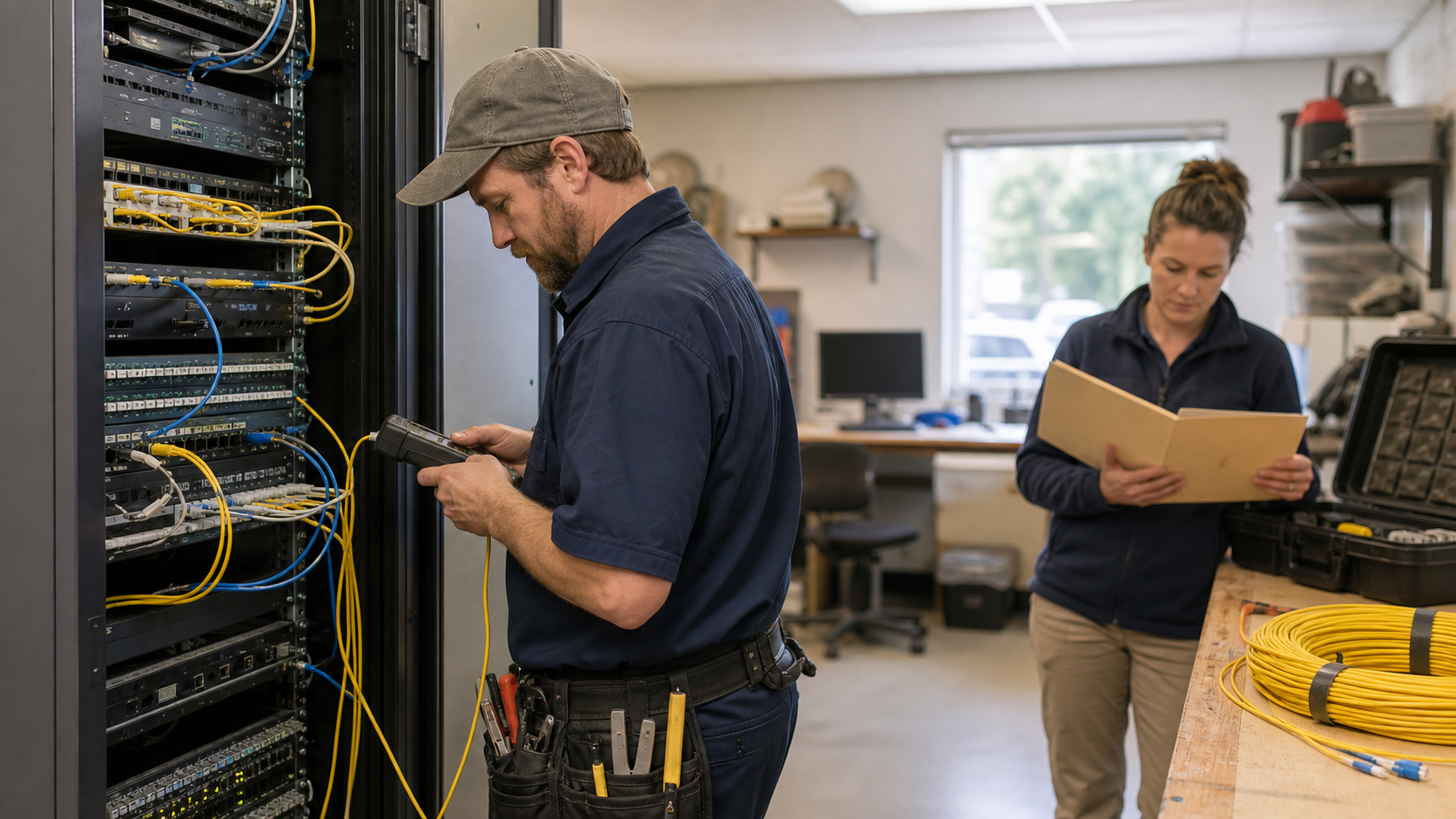
The useful way to think about StoneX Network Systems is not to start with the autonomous system number. It is to start with a fault visit. A paid access account fails before a market open, a field technician is sent to a building or a carrier handoff, the line either comes back before business harm compounds or it does not, and a renewal decision later asks whether the monthly bill bought mere bandwidth or a practical operating guarantee. The account buyer may be a local office, a trading desk, a payments operation, a commodity-risk team, or an internal technology group. In each case the unit being priced is not a route record.
It is a bundle of last-mile availability, installation labour, equipment configuration, monitoring, escalation, outage recovery and supplier management.
That distinction matters because the public StoneX Network Systems record is sparse. The assigned BTW directory page describes StoneX Network Systems as a network operator associated with ASN/IP resources and links it with AS11369 at https://btw.media/en/directory/stonex-network-systems. ARIN's public ASN record for AS11369 shows the AS name STONEX, a February 2009 registration date and a March 2024 update at https://whois.arin.net/rest/asn/AS11369. ARIN's organization record for SG-718 identifies StoneX Group Inc. at 230 Park Avenue in New York at https://whois.arin.net/rest/org/SG-718. ARIN's point-of-contact record for SNS29-ARIN names StoneX Network Systems as a contact for StoneX Group Inc. at https://whois.arin.net/rest/poc/SNS29-ARIN. Those records are meaningful. They show that StoneX Network Systems is not a made-up label; it sits in the network registration layer around StoneX Group. They do not, by themselves, show that StoneX Network Systems sells broadband accounts to the public.
The article therefore treats the company evidence and the network evidence separately. Company evidence tells us what kind of operating environment might make connectivity valuable. Network evidence tells us what can be seen from the public routing table. Generic network economics explain why a buyer may pay for support instead of just megabits. None of those categories should be collapsed into the other. A compact ASN cannot prove a support business. A public financial-services group cannot prove a local access margin.
A field-support thesis is still legitimate, but only if it is stated as an economic test: what must be true for a local access and support account to deserve its price?
The answer is that the paid unit becomes valuable when the line is costly to install, difficult to restore, expensive to substitute and close enough to revenue or regulated service that downtime has consequences. A national operator, mobile broadband, satellite, another local ISP, an in-house private link or simply delaying installation can discipline price. But those substitutes are not equal. A national operator may offer scale but slower escalation for a small site. Mobile broadband may work as a backup but fail under traffic load, coverage limits or compliance policies.
Satellite may be available where fibre is not, but latency, weather sensitivity, equipment placement and contract terms may limit the use case. An in-house link may reduce dependence but require capital, rights of way, network engineering and maintenance capacity. Delayed installation saves cash today and creates option value, but it can also postpone revenue, weaken customer service and leave staff working on brittle temporary access.
That is why a support-heavy access bill is often priced around avoided failure rather than average throughput. The installation crew, the router configuration, the spare equipment, the overnight escalation path, the carrier ticket discipline and the upstream redundancy are not decorative extras. They are the economic content of the product. The buyer pays because the worst hour matters more than the median hour. StoneX Network Systems is an interesting case precisely because the visible public data is too thin to make the easy claim.
It forces the analysis to ask what public records can prove, what they can only suggest, and what private operating facts would change the conclusion.
What The Customer Actually Buys
If the paid unit is a local access and field-support account, the customer buys four things at once. First, the customer buys physical access: a circuit, wireless link, managed handoff, cross-connect, customer premises device or other means of reaching a network. Second, the customer buys coordination: someone to schedule installation, work around building access, translate carrier terms, configure equipment, record the demarcation point and keep enough history to fix the same site later. Third, the customer buys recovery: monitoring, triage, dispatch, carrier escalation, backup-path activation and restoration discipline.
Fourth, the customer buys confidence that the provider knows which upstream paths, route filters and support processes matter for the buyer's application.
That is a different product from raw bandwidth. Raw bandwidth is the easy part to compare. A quote can say 100 Mbps, 1 Gbps, burstable capacity, fixed wireless or fibre. A support account is harder to compare because the buyer is really pricing uncertainty. Who answers after the circuit drops? Who owns the problem when the carrier blames the building, the building blames the carrier and the customer premises equipment is unreachable? Who knows whether the failure is local power, last-mile fibre, route propagation, upstream congestion, a bad optic, a firewall policy, a cross-connect, a vendor change or an internal configuration error?
Who decides whether to move traffic to a backup path, and who is authorized to make that decision?
The StoneX evidence makes this operating frame plausible but not proven. StoneX Group's own website says it provides global market access, clearing and execution, trading platforms and related financial services to clients worldwide at https://www.stonex.com/en/. Its payments page describes cross-border payment coverage across many countries and currencies at https://www.stonex.com/en/business/payments/. Its public "Boots on the Ground" page emphasizes local expertise, direct field knowledge and client relationships in commodity and financial markets at https://www.stonex.com/en/business/boots-on-the-ground/. Those are not internet-access product pages. They do not say StoneX Network Systems sells last-mile connectivity. They do, however, show why a StoneX network-support function could be economically important inside a global financial-services group: the customer-facing promise relies on platforms, offices, desks, payments processes, market data and regulated communications working across locations.
The public group context is reinforced by StoneX's compliance library at https://www.stonex.com/en/business/compliance-library/. It lists regulated subsidiaries across the United States, Europe, Asia-Pacific and Latin America, and it identifies U.S. broker-dealer, futures commission merchant, commodity trading advisor, swap dealer, payment-services and other regulatory statuses. A financial-services operating group with regulated subsidiaries has a different tolerance for connectivity failure from a consumer website. It has client obligations, trade execution requirements, reporting obligations, backup-communication expectations and reputational risk. A local access account for such an environment is not sold only on a speed table. It is sold on the idea that a site can keep serving clients and regulators when normal operations are stressed.
StoneX's business resiliency disclosure is also relevant. The disclosure says StoneX and affiliates maintain a global business resiliency planning policy and program that addresses data backup and recovery, mission-critical systems, alternative communications, alternative physical locations, critical third parties and other disruption categories at https://www.filesandimages.com/Brand/StoneX/PDF/StoneX_Business_Resiliency_Disclosure-2023.pdf. This still does not prove any StoneX Network Systems revenue line. It does show that the group publicly recognizes operational continuity as a formal business issue. When a firm has to plan for loss of applications, phones, staff, power, buildings, critical third parties and pandemic conditions, access and field support become part of operational resilience rather than an office utility.
The access account buyer therefore may not be a retail subscriber at all. It may be an internal business unit, a branch, a trading office, a payments workflow, a customer-service desk or a local operations team. The economic unit can still be priced: one site, one managed handoff, one support relationship, one renewal decision. The buyer wants to know whether the service reduces outage frequency, shortens restoration, prevents missed trades or payment delays, lowers internal coordination burden and keeps the office inside group resiliency expectations. If the answer is yes, the access bill contains a support premium.
If the answer is no, the buyer should strip the service back to commodity connectivity and price it against the cheapest credible substitute.
What The Records Prove
The public network record begins with AS11369. BGP.tools lists AS11369 as StoneX Group Inc., identifies the AS number 11369, shows a registration date in February 2009, classifies the network type as content, shows three originated IPv4 /24s and no visible IPv6 prefixes, and lists upstreams including Crown Castle Fiber, Arelion, Zayo, COLT and Optimum WiFi at https://bgp.tools/as/11369. IPinfo's AS11369 page similarly identifies StoneX Group Inc., shows three /24 netblocks, reports 768 IPv4 addresses and no IPv6 addresses, and lists five peers or upstreams at https://ipinfo.io/AS11369. These are useful routing facts. They show ownership or control of a small public routing footprint. They do not show access customers, retail plans, service territories, local technician density, ticket volumes or revenue.
The absence of downstreams in IPinfo's view is especially important. A network that sells wholesale transit, large-scale broadband or hosting to many dependent networks would normally leave more downstream evidence. A compact AS with three /24s and several upstreams may instead be a corporate network, financial-platform edge, office or application-support footprint. That can still matter operationally. A small autonomous system can carry critical services.
But its public routing table does not tell us whether a local access account is profitable, whether field labour is bundled into price, whether there are external customers, or whether the support function is mostly internal.
ARIN records sharpen the identity but also sharpen the caution. The ASN record uses the AS name STONEX. The organization record identifies StoneX Group Inc. The point-of-contact record names StoneX Network Systems as a contact associated with StoneX Group Inc. Public directory pages sometimes turn such operational names into organization entries because network-resource records contain names that look like directory entities. That is not wrong as long as the directory record is treated as a network identity, not a full commercial biography.
The analysis should not pretend that "StoneX Network Systems" has a separate audited income statement, office footprint or access-product catalogue when public evidence has not shown those things.
This is the central evidentiary boundary. The company evidence belongs mostly to StoneX Group. The network evidence belongs to AS11369 and its registration/contact records. The field-support thesis belongs to the access-account economics that could sit around this network function. Public records connect those layers, but they do not collapse them.
A serious buyer or analyst would ask for the private operating pack before judging the paid unit: circuit inventory, site list, carrier contracts, installation costs, restoration records, ticket categories, committed service levels, backup usage, customer or internal desk satisfaction, renewal outcomes and churn drivers.
The public route record can still inform the cost model. Multiple upstreams suggest that route availability and supplier management matter. A small IPv4 footprint suggests scarcity and operational discipline around address use. The lack of visible IPv6 suggests either limited public-facing modernization in the sampled route view, a conscious application design, or simply a set of services that do not expose IPv6 publicly. The upstream mix suggests that StoneX is not a self-contained global backbone. It depends on larger carriers for reach.
That dependence is normal for a corporate or specialized network, but it means bargaining power, routing policy and escalation quality are part of the access-support value proposition.
Generic BGP practice explains why this matters. RFC 7454 describes BGP as the protocol used to exchange routing information between network domains and sets out practices around prefix filtering, session protection, maximum-prefix limits and route-policy control at https://www.rfc-editor.org/rfc/rfc7454. RFC 7908 classifies BGP route leaks and explains why incorrect route propagation can create reachability and traffic-flow problems at https://www.rfc-editor.org/rfc/rfc7908. These are generic network sources, not StoneX-specific evidence. They should not be used to claim StoneX suffered a route leak or operates a particular security control. They do explain why a buyer of a support-heavy access account cares about upstream discipline, route filtering and escalation. A line can be physically intact and still fail the business if routing policy or upstream coordination is poor.
The public evidence therefore proves a bounded proposition: StoneX Network Systems is visible as a network-systems contact/name around AS11369; AS11369 is tied to StoneX Group Inc.; AS11369 originates a small IPv4 footprint and uses several upstreams; StoneX Group is a regulated, global financial-services business for which operational continuity is material. The public evidence does not prove a standalone regional ISP, a consumer access product, local field crews, customer numbers, revenue per access account, installation backlog, margin, churn or SLA performance.
Why The Unit Is Costly
The local access unit is costly because it is labour-shaped. The first cost is qualification. Someone has to determine whether a site can be served, what medium is available, who controls building access, whether the landlord or facilities team will permit equipment, whether the demarcation point is usable, whether power is adequate, and whether an existing carrier handoff can be reused. That work is rarely captured in a clean bandwidth quote. It sits in sales engineering, project coordination, site survey and installation time.
The second cost is installation. A service provider may need to dispatch a technician, order a loop from a carrier, schedule an access window, configure equipment, label ports, install backup equipment, coordinate with a building engineer, test failover and document the site. If the site is a financial-services office or a high-value operating location, the support process may also need change windows, evidence of completion, security approvals and a fallback plan. Each installation creates a small project with cost before monthly revenue begins.
The third cost is exception handling. Commodity access economics assume the happy path: the circuit is ordered, installed, billed and left alone. Support-heavy access economics price the exceptions. The access team must know how to handle a failed install, a carrier missed appointment, a building access refusal, an intermittent link, a routing change, a degraded upstream, an equipment fault, a cross-connect issue, or a customer who cannot wait through a normal repair window. Exception handling is not just technical labour; it is coordination labour. It consumes senior attention because the customer pays for a problem to be owned.
The fourth cost is redundancy. A buyer who cares about outage recovery may require two carriers, diverse entrances, backup wireless, secondary routers, spare hardware, failover testing and monitoring. Redundancy makes the service more valuable but also complicates gross margin. Backup capacity may sit idle most of the time but still cost money. Diverse paths may be unavailable or expensive in smaller buildings. A second carrier may fail through the same upstream facility. A backup service may work for basic traffic but not for latency-sensitive trading, payment authorization, voice or market-data workflows.
The price has to recover not just active traffic but option value.
The fifth cost is route and supplier discipline. BGP.tools and IPinfo list several upstreams for AS11369. For any small or specialized network, upstreams are both resilience and dependence. They provide reach but also create operational exposure. If a route is filtered incorrectly, if an upstream has congestion, if a maintenance window is poorly communicated, or if a carrier ticket is mishandled, the local support team must know how to escalate. The buyer is paying for that judgment. A cheap line with no useful escalation may be fine for ordinary office browsing.
It may be unacceptable for a location that handles client money, trading instructions, regulated communications or market access.
The sixth cost is retention risk. Support-heavy access accounts are often won at renewal, not at installation. The first bill tests whether the provider can deliver. The first outage tests whether the provider is worth keeping. A buyer remembers whether the provider answered, identified the fault, escalated with the carrier, offered temporary access, documented the event and adjusted the design afterward. Churn is not driven only by price. It is driven by the memory of failure. That is why field support becomes part of the access bill: the support record is the evidence used at renewal.
The StoneX context magnifies this because the group operates in businesses where interruption can be costly even if it is brief. StoneX's website describes listed derivatives, securities, foreign exchange, OTC derivatives, supply and trading, payments, clearing, custody and capital markets services. Its SEC quarterly filing for the period ended March 31, 2026 says the company manages operating segments based on commercial, institutional, self-directed/retail and payments clients, and it refers to more than 5,400 employees serving clients in more than 180 countries at https://www.sec.gov/Archives/edgar/data/913760/000091376026000031/intl-20260331.htm. That is group evidence. It does not show the economics of StoneX Network Systems. It does show why internal or local connectivity support could have high avoided-loss value.
For a regional ISP or access-support provider, the same mechanism applies outside StoneX. A small business may tolerate a slower web browser. A trading desk, payments operation, logistics office, call centre, healthcare practice or government contractor may not. The provider that can install correctly, recover quickly and manage upstream dependence earns a support premium. The provider that cannot becomes a commodity. The buyer may then switch to the national operator, mobile broadband, satellite or another local ISP, even if those substitutes are imperfect, because the incumbent's support premium has failed its test.
Supplier Dependence And Upstream Bargaining
The public AS11369 route view makes StoneX Network Systems look supplier-dependent rather than supplier-dominant. BGP.tools and IPinfo list upstreams or peers including Crown Castle Fiber, Arelion, Zayo, COLT and Optimum WiFi. Those names matter because they show that the visible network relies on larger connectivity providers for reach. The economics of a local access account therefore include bargaining and coordination with suppliers.
A network-support team can control its configuration and customer relationship, but it cannot unilaterally control every fibre cut, carrier maintenance event, transit policy, route filter or upstream congestion point.
Supplier dependence is not weakness by itself. Multihoming is a rational way to manage risk. If one upstream fails, another may continue. If one path has poor performance, another may be preferred. If a supplier's price rises, the network may have a negotiation alternative. But multihoming creates complexity. Route policies need to be maintained. Prefix advertisements need to be consistent. Filters need to be coordinated. Capacity needs to be sized. Contact paths need to be current. Support teams need to know which provider owns which fault domain. If nobody owns the combined service, the buyer experiences the entire arrangement as delay.
The field-support account is where that complexity is monetized. A customer does not want to hear that the provider's upstream is still investigating. The customer wants the service restored or a practical workaround. The access provider, or internal network-systems team, therefore sells a form of supplier translation. It knows which upstream to call, what evidence to provide, how to interpret a route change, when to fail over, when to dispatch locally, and when the issue is outside the public internet path altogether. That is the hidden labour behind a support premium.
This is also where national operators and local providers compete differently. A national operator may own more physical infrastructure, more field crews and more formal processes. It may offer better coverage and procurement confidence. But it may also be slow to adapt to a specialized customer, especially where the account is small relative to the operator's base. A local access provider may offer faster response, better site memory and more flexible escalation, but it may depend on wholesale circuits and upstreams it does not own. The buyer chooses between scale and attention. The right choice depends on the operating risk of the site.
Mobile broadband and satellite discipline price by offering outside options. If a site can operate over 5G or satellite during an outage, the fixed-access provider's pricing power weakens. But these substitutes are often partial. Mobile service may be congested at exactly the wrong time, may not support static addressing or security requirements, and may fail inside dense buildings. Satellite can be powerful for remote resilience but has equipment, sky-view, weather, latency, usage and policy limitations.
For a regulated financial-services environment, substitute access also has compliance implications: devices, authentication, logging, data routes and approved-use policies matter.
In-house private links are the hardest substitute to price. A large group can sometimes build or lease its own dedicated connectivity, manage routers directly and hire internal field support or managed-service partners. That reduces dependence on a single access provider but shifts responsibility inward. The buyer must fund engineering, procurement, support coverage, monitoring tools, vendor management and incident response. For StoneX Group, the existence of a named network-systems contact around AS11369 suggests some internal capability. It does not reveal whether local access work is internal, outsourced or mixed.
The economic point is that a sophisticated buyer may not accept a simple retail access offer; it will compare the vendor's support premium with the cost of doing more in-house.
Delayed installation is the quiet substitute. A branch can postpone a project, run on temporary access, consolidate work into another site, or delay a service launch. That option disciplines price when the provider cannot prove installation value. But delay has its own cost. Staff may work around unreliable links. Client service may suffer. A business may lose market opportunity. In a financial-services environment, delayed connectivity can also postpone integration after acquisitions, slow office moves or complicate resiliency planning. The access provider wins when it can show that quick, well-supported installation is cheaper than delay.
The public StoneX evidence does not let us price these alternatives. It lets us identify the correct questions. How many sites depend on AS11369 or related connectivity? Which upstream contracts carry minimum commitments? How much traffic is business-critical versus ordinary office traffic? Which offices have diverse links? How many incidents required carrier escalation? How often was a field visit needed? Were renewals won because of response quality? Were any circuits cancelled after poor restoration? Without those facts, upstream count is only a clue.
It tells us where dependence may sit; it does not tell us whether the support account earns its premium.
Demand, Customers And Retention
The demand side should be divided into external StoneX clients and internal access customers. StoneX Group's public business sells financial services to commercial, institutional, retail and payments customers. That is the external customer base. StoneX Network Systems, as visible in network records, appears more likely to support the network infrastructure behind that external business than to sell broadband directly to those clients. The access account being analyzed may therefore be internal: a site, desk, office, platform team or business unit pays directly or indirectly for connectivity and support.
Internal demand can be economically real. A branch that needs reliable connectivity creates a cost centre. A trading desk that needs low-disruption access creates a service expectation. A payments operation that needs availability creates a resilience requirement. A compliance team that needs communication continuity creates a control requirement. These internal buyers may not pay invoices in the same way as retail broadband subscribers, but they still decide whether a service is worth funding.
Their renewal decision may appear as budget approval, vendor continuation, circuit upgrade, backup investment or a decision to move work to another site.
The external StoneX client base also matters indirectly. If a network outage harms client service, the cost is not limited to the access bill. A payments delay, trade-execution problem, failed communication or unavailable platform can damage client trust. The business resiliency disclosure says StoneX plans for alternate communications, mission-critical systems, critical third parties and service continuity. That kind of public statement makes the access-support account part of a broader client promise. The internal buyer pays because a failed link can become a client event.
Retention therefore has two layers. The first layer is the retention of the access account itself: will the buyer keep the provider, support arrangement or internal service design? The second layer is retention of the business relationships that depend on that connectivity: will external customers continue to trust the platform or office if service quality fails? A support-heavy access account earns its price when the first layer protects the second. It loses value when the support relationship becomes a bureaucratic pass-through that does not reduce business impact.
Public data cannot show StoneX Network Systems' churn. It cannot show how many access accounts exist, whether they are internal or external, how many renew, or what a buyer pays. It cannot show whether StoneX Group's local offices experience connectivity pain or whether AS11369 supports revenue-critical functions. The article should not invent those facts. It should say what would matter. A renewal pack that showed high uptime, fast restoration, diverse paths, low repeated fault rates and improved business continuity would support the thesis.
A pack that showed high cost, slow repairs, no meaningful failover and little business impact would weaken it.
Unofficial market signals must stay in their lane. Public route collectors such as BGP.tools and IPinfo are not company filings, but they are useful signals about the visible internet footprint. They show a small AS, three IPv4 /24s, several upstreams and no obvious downstream customer base in the sampled data. Investor media or market chatter about StoneX Group's broader financial performance may signal public-market interest in the group, but it does not prove network-support economics.
Online job posts, employee comments, forums or social-media remarks, if found, would be even weaker: they might suggest hiring pressure or technology focus, but they would not prove service quality, margin or customer retention. In this case, the strongest responsible statement is that public informal signals do not overcome the sparse official record.
The absence of loud market chatter can itself be read cautiously. A small corporate AS often attracts little public discussion unless something goes wrong. Quietness may mean stable operations, low public exposure, limited customer-facing internet activity, or simply lack of visibility. It is not proof of excellence. It is not proof of weakness. It is a reminder that the decisive facts are operational and private.
The local support thesis is still commercially coherent. For a buyer, the access account is worth paying for when support reduces the total cost of running the site. That total cost includes monthly circuit price, installation delay, staff time lost to coordination, outage loss, client impact, regulatory worry, duplicate backup service and management distraction. The cheapest line is not always the lowest-cost line. But a support premium needs evidence. Buyers should ask for incident history, escalation data, service credits, site-specific design, failover tests and named responsibility. Without that, "support" is just a sales word.
Revenue And Margin Logic
There is no public revenue line for StoneX Network Systems. That absence should shape the analysis. StoneX Group reports at group and segment levels, not at an AS11369 or network-systems-unit level. Its March 2026 quarterly filing describes operating segments by client type and notes that corporate costs include shared services such as information technology, accounting, treasury, credit and risk, legal and compliance, and human resources. That tells us information technology is a shared cost area in the group. It does not tell us whether StoneX Network Systems has external revenue or whether local access support is allocated internally.
For a public regional ISP, revenue logic would start with subscriber count, average revenue per account, installation fees, support charges, equipment rental, managed router fees, SLA tiers and churn. For StoneX Network Systems, the safer model is an internal or enterprise support model. Revenue may appear as internal allocation, cost recovery, procurement budget, managed-service spend, carrier-cost pass-through or avoided-loss justification. The "price" of the unit is the amount the business is willing to spend to secure local connectivity and support.
The "margin" may be vendor margin if outsourced, or productivity and avoided-risk value if internal.
The first revenue lever is installation. A provider that can install faster or with fewer failed visits can charge more than a provider that treats installation as generic scheduling. In business access, installation failure has a visible opportunity cost. Staff may be unable to move into a site. A trading desk may delay launch. A payments operation may need temporary workarounds. A support account that reduces installation uncertainty can justify upfront charges or a higher monthly recurring fee.
The second lever is recovery. A provider that reduces downtime can price against avoided harm. If a site generates material revenue or supports regulated obligations, a few hours of faster restoration can be worth more than months of access charges. The provider has to prove it with incident data. Mean time to acknowledge, mean time to repair, repeat-fault rate, escalation time, backup activation success and post-incident design changes are the metrics that matter. Public AS records do not contain any of them.
The third lever is supplier aggregation. A buyer can contract directly with national operators, mobile providers, satellite providers and equipment vendors. That may be cheaper on paper. But the buyer then becomes the integrator. A support provider earns margin by aggregating suppliers and absorbing coordination. It turns a messy carrier stack into one accountable service. The risk is that aggregation becomes expensive pass-through if the provider lacks real control. Buyers should therefore ask where the provider has its own field capability, where it depends on wholesale partners and where it can enforce service levels.
The fourth lever is compliance and documentation. StoneX Group's regulated context makes documentation valuable. A support account may need inventories, diagrams, incident records, change approvals, recovery plans and evidence of alternate communications. The business resiliency disclosure points to formal planning around critical functions and third-party dependencies. A support provider that keeps records and supports internal controls can earn a premium over a provider that only fixes faults reactively. Again, this is a plausible mechanism, not a proved StoneX Network Systems revenue stream.
The cost side is equally important. Labour is lumpy. A small base of high-touch access accounts can look profitable until a few difficult installations or chronic sites consume senior engineering time. Upstream contracts may have minimum commitments. Spare equipment ties up capital. Monitoring tools and after-hours coverage add fixed cost. If a provider promises rapid restoration without enough local technicians or carrier leverage, the service can lose money or damage trust. A support premium is therefore attractive only when account density, process discipline and supplier terms are strong enough to absorb exceptions.
For StoneX Network Systems, the visible IPv4 footprint is small. That limits what can be inferred about scale. Three /24s can support important services, but they do not indicate a mass access network. If the network-systems function serves StoneX Group internally, scale may come from the broader office and platform estate, not from public prefixes. If it has external access customers, the public evidence has not shown them.
The responsible margin conclusion is conditional: the access-support unit is valuable if it lowers group operating risk or earns support premiums from identifiable accounts; it is not proved valuable merely because AS11369 exists.
Regulation, Resilience And Operating Risk
StoneX Group's regulatory footprint raises the stakes of connectivity. The compliance library identifies numerous regulated entities and services across jurisdictions. In the United States, StoneX Financial Inc. is described as a FINRA/SIPC/NFA member, SEC-registered broker-dealer, CFTC-registered futures commission merchant and commodity trading advisor; StoneX Markets, LLC is described as an NFA member and CFTC-registered swap dealer; other subsidiaries are described under payment, securities, futures, commodities and regional regimes. This does not regulate StoneX Network Systems as an ISP.
It does mean that connectivity supporting StoneX's operations sits near regulated business processes.
Regulated financial firms usually care about business continuity, communications, recordkeeping, access controls, third-party risk and operational resilience. A local access account may therefore be part of a control environment. If a branch loses connectivity, the issue is not only whether employees can browse the internet. It is whether the business can communicate with clients, execute or route orders, process payments, access market data, meet reporting obligations, coordinate with counterparties and maintain records. The harm may be operational, regulatory and reputational at once.
The business resiliency disclosure is a useful official source because it names the disruption categories StoneX plans for: applications, phones, staff, power, buildings, critical third parties and pandemic conditions. A local access account intersects several of those categories. Loss of phones may depend on network connectivity. Loss of applications may require alternate access. Loss of a building may require staff to work elsewhere. Critical third parties may include carriers, data centres, vendors, cloud services or market infrastructure.
A support provider that understands those dependencies is more valuable than one that treats every ticket as a generic circuit fault.
Operational risk also comes from acquisitions and integration. StoneX's March 2026 quarterly filing discusses the R.J. O'Brien acquisition and related financing, including senior secured notes issued in July 2025 to fund the cash portion of the acquisition. Acquisitions can create network-integration work: offices, trading systems, communications, security policies, data circuits, vendor contracts and business-continuity plans need to be aligned. The filing does not say AS11369 or StoneX Network Systems handled that work. It does show the group was integrating a larger business context in which network support can become more complex.
Supplier and third-party risk is another pressure point. The same quarterly filing says StoneX had seven committed bank credit facilities totaling $1.685 billion as of March 31, 2026 and lists various facilities supporting working capital, short-term funding, physical commodity trade and other needs. That is financial-liquidity evidence, not network evidence. But it illustrates a broader operating fact: StoneX's business depends on formal agreements with external providers, covenants, regulatory capital and third-party institutions. Network access is part of that dependency map.
A carrier or upstream provider may not be as financially material as a credit facility, but a network failure can still interrupt the business processes those facilities support.
The generic internet risk layer is visible through BGP standards. Route leaks, poor filtering, session protection failures and prefix-management mistakes can affect reachability. Public sources do not show AS11369 experiencing such problems. The point is that a support-heavy access account should include competence around them. If a buyer is paying for support, it should ask whether the provider uses route filters, maintains current registry data, monitors upstream reachability, tests failover and documents routing changes. These questions are fair even when the public record is quiet.
There is also an image and identity risk. The name StoneX Network Systems might lead an observer to assume a network-services company. ARIN records show it as a point-of-contact name around StoneX Group. If a public directory entry labels it as a company, the article must avoid turning that into a story the evidence cannot support. Misclassification risk matters because market analysis can accidentally create a false business model. The safer reading is that StoneX Network Systems is a network identity associated with StoneX Group's AS11369 and that its economic relevance lies in network support for a high-stakes operating environment.
What Public Evidence Cannot Prove
Public evidence cannot prove the location of the paid unit. The directory page says geography is not available while network-resource scope is global. ARIN and BGP sources point to a U.S.-registered StoneX Group network with global reach through upstreams. StoneX Group itself has global operations. None of that tells us whether the relevant local access account is in New York, London, Singapore, Lagos, Sao Paulo, a data centre, a branch office, a commodity-market site or a remote-work support arrangement.
Public evidence cannot prove field labour. There is no public technician roster, dispatch record, truck-roll history, installation schedule or local partner contract. The "Boots on the Ground" StoneX page is about market expertise and client relationships in commodities and financial services, not network field crews. It supports the cultural idea that StoneX values local knowledge, but it should not be used as evidence of telecom installation capacity.
Public evidence cannot prove access revenue. StoneX Group's financial reports discuss group segments and shared services. They do not isolate StoneX Network Systems. If access support is internal, it may never appear as revenue. If a vendor supplies local access to StoneX, vendor margin would sit outside StoneX. If StoneX Network Systems has external customers, public records reviewed here do not identify them. Any article that assigns subscriber counts, ARPU, margin or churn would be overclaiming.
Public evidence cannot prove customer satisfaction. No official status page, SLA report, repair history or survey was visible in the source set. Informal web remarks, if found, would be weak because they would not establish representativeness or causation. A few unhappy posts would not prove systemic failure; a few positive comments would not prove support excellence. The right evidence would be ticket data and renewal outcomes.
Public evidence cannot prove route security posture. RFCs explain what good BGP practice looks like, and route viewers show externally visible announcements, but they do not reveal all internal controls. They do not show change management, route-filter automation, vendor credentials, incident response or internal monitoring. They may show prefixes and peers; they do not show operating maturity.
Public evidence cannot prove whether IPv6 absence in visible route views is a problem. IPinfo and BGP.tools show no IPv6 for AS11369 in the sampled view. That might mean the public services on this AS are IPv4-only. It might mean IPv6 is handled elsewhere. It might be irrelevant for the specific applications. It might become a risk if clients, partners or operating standards require dual-stack reachability. The fact is useful, but the judgement depends on application design and client requirements.
Public evidence cannot prove whether national operators, mobile broadband, satellite or in-house links are practical substitutes for a given site. Substitute value is local. It depends on building coverage, fibre availability, latency, security rules, equipment placement, weather, regulatory requirements, contract terms and the cost of delay. The article can name the substitutes that discipline price; it cannot rank them without site facts.
These limits do not make the analysis useless. They make it honest. A support-heavy access account is a real economic unit, but it is usually proved by operating evidence rather than public registry evidence. The public record can identify where to look. It cannot do the buyer's due diligence.
Facts That Would Change The Judgement
The first fact that would change the judgement is a service catalogue. If StoneX Network Systems publishes or privately provides a catalogue showing managed access, local support, installation services, SLA tiers, managed routers, backup connectivity and customer segments, the analysis would move from internal-support inference to product economics. If no such catalogue exists and the name is only an ARIN contact label, the article should continue to treat it as network-function evidence around StoneX Group.
The second fact is a circuit inventory. A list of sites, carriers, access types, recurring costs, install dates, renewal dates and backup paths would show whether the access unit has scale and diversity. Ten high-value offices with difficult last-mile conditions create a different cost base from one data-centre edge with several transit providers. A support premium needs density or high avoided-loss value. Circuit inventory would reveal which.
The third fact is dispatch history. How many incidents required a field visit? How many were solved remotely? How many were carrier faults? How many were customer-premises faults? How many repeated at the same site? How long did access take? How often did a backup path carry traffic? The answers would show whether field support is a meaningful part of the bill or mostly an insurance promise that is rarely used.
The fourth fact is restoration performance. Mean time to acknowledge and mean time to repair are more useful than uptime averages alone. A site can have good average uptime and still fail badly during the one event that matters. Restoration records should separate provider-controlled faults, carrier faults, power faults, equipment faults, routing faults and customer-side issues. They should also show whether post-incident changes reduced recurrence.
The fifth fact is upstream contract quality. Public route views list upstream names; contracts reveal price, capacity, minimum commitments, service levels, credits, escalation rights and renewal terms. A network-systems function with strong upstream contracts can offer better support than a function that merely resells a best-effort connection. Upstream bargaining power determines how much of the support promise is enforceable.
The sixth fact is utilization. A small IPv4 footprint can carry trivial traffic or critical flows. Traffic graphs, application mapping and peak utilization would show whether AS11369 is a core production path, a narrow application edge, a backup route or a legacy footprint. Without utilization, prefix count is a poor proxy for economic importance.
The seventh fact is customer or internal desk retention. Did offices renew because support was good? Did business units move circuits after outages? Did support quality affect vendor selection? Did users complain about restoration time? Did a backup design prevent a known business loss? Retention evidence turns support from a claimed feature into a priced benefit.
The eighth fact is regulatory or control evidence. For a regulated financial-services group, the strongest access-support case would show that the service supports documented business-continuity objectives, alternate communications, critical application access and third-party dependency management. StoneX's public resiliency disclosure makes this line of inquiry relevant. Internal control records would determine how strong it is.
The ninth fact is local substitute pricing. A support account can look expensive until compared with the alternatives available at the exact site. National operator quotes, mobile coverage tests, satellite installation conditions, private-link capital cost, another local ISP's SLA and the cost of delaying the site would show whether the current bill is disciplined or overpriced. Without substitute pricing, the access bill cannot be judged.
The tenth fact is governance over address and routing records. ARIN records show updates in 2024 and a point-of-contact validation note in the POC record. A mature network-systems function should keep registry contacts current, maintain route objects where appropriate, monitor route visibility and define who owns changes. Public records show contact and registration status; internal governance would show whether records are maintained as an operating control.
The Investment View
From an investment or operating-risk perspective, StoneX Network Systems is not a clean regional ISP story. It is a network identity around a large financial-services group. That makes the access-account thesis more subtle. The upside is not mass-market broadband growth. The upside is operational leverage: small, well-supported connectivity units can protect high-value workflows, reduce downtime, simplify supplier management and support regulated continuity expectations. The downside is evidentiary opacity: public records do not show the unit's revenue, customers, costs, margins or field capacity.
For a buyer, the practical question is whether the support premium prevents real harm. If the provider or internal team can show fast installation, accurate documentation, diverse paths, competent routing, strong carrier escalation, short restoration times and a record of preventing business disruption, the support-heavy access account is worth paying for. If it cannot show those things, the buyer should price it as commodity access and test substitutes aggressively.
For a supplier, the lesson is that local access economics are not won by pretending every line is special. They are won by proving where support changes outcomes. That means tracking incidents, publishing service commitments, documenting site designs, maintaining current contacts, training field and escalation teams, and being honest about what depends on upstream carriers. A provider that hides behind vague resilience claims will be exposed at renewal. A provider that can show how support reduced outage cost will keep pricing power even against larger operators.
For StoneX Group, the public evidence suggests network operations are part of a broader resilience problem. The group serves global financial clients, operates regulated subsidiaries and publishes business-resiliency disclosures. The network footprint around AS11369 is small but potentially important. If StoneX Network Systems is mainly an internal network function, its performance should be judged by how well it supports the group's client-facing and regulated operations. If it has external access customers, the company would need to show product evidence before the market should treat it as a standalone regional ISP.
The most defensible conclusion is conditional but clear. StoneX Network Systems matters if the paid unit is a local access and field-support account attached to high-value operations. The buyer is paying for installation certainty, outage recovery, upstream discipline and retention of trust. The unit is costly because it requires labour, supplier management, redundancy, documentation and after-hours judgement. Public evidence can prove the network identity and broader StoneX operating context; it cannot prove customer margin or support quality.
The facts that would change the judgement are private utilization, outage, renewal and support records.
That is a more useful answer than a false certainty. The ASN says StoneX has a public routing identity. The StoneX filings and disclosures say the broader group has operational stakes high enough to make connectivity matter. The route viewers say the footprint is compact and supplier-dependent. The field-support thesis says the access bill is justified only if the service reduces the cost of failure. Until the private facts are visible, StoneX Network Systems should be evaluated as a bounded, support-sensitive network identity, not as a proven mass access provider.