
Summary
- What it says: Stiegeler Internet Service is a case study in the economics of trust. The company has grown from a Black Forest IT business into a regional broadband operator serving households, firms and public networks across Baden-Wuerttemberg.
- Main topic: Regional ISP economics; Wholesale access economics; IPv4 leasing and shadow allocation
- Context: market / company research report / Germany
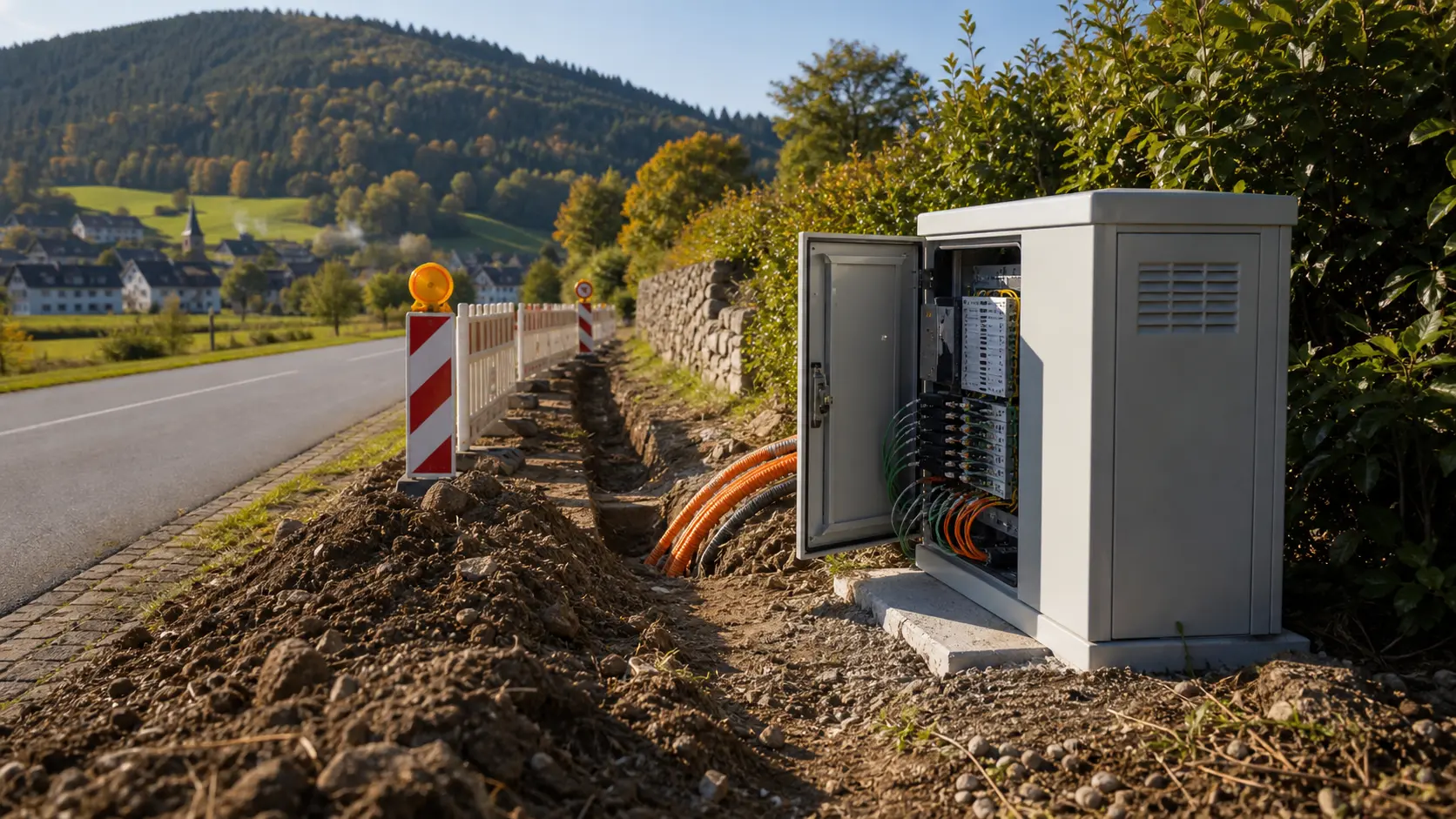
The rural fibre business is often described as a contest between old copper and new glass, or between slow incumbents and faster challengers. That is too simple. In the hills, small towns and border districts of southern Baden, the harder question is not whether fibre is technically superior. It is whether a network operator can turn scattered civil works, municipal politics, household hesitation and support calls into enough monthly revenue before the economics go cold. Stiegeler Internet Service matters because it sits in that exact problem.
The company is not Deutsche Telekom, Vodafone or a national cable platform. It is also not a two-person local access reseller. Its public record shows a business with roughly 90,000 households and firms served across Baden-Wuerttemberg, about 80 employees across seven regional locations, a reported 2025 revenue of around EUR30m, and an autonomous network visible at German and Swiss exchange points. It sells fixed internet, telephony, television and mobile products to households; business access, telephony, site networking and service-level packages to firms; and network operation to municipalities and regional broadband associations.
Its routes appear at DE-CIX Frankfurt, Stuttgart-IX and SwissIX. Its name appears in local-government pages because public bodies in places such as Waldshut and the Schwarzwald-Baar-Kreis have relied on it to run fibre networks built through public or municipal initiatives.
That combination makes Stiegeler a useful lens for the next phase of German broadband. Germany is no longer arguing only about whether fibre should be built. Fibre is being built. The problem is how to make it used, financed and trusted. Bundesnetzagentur reported that active German FTTH and FTTB connections rose from 5.3m at the end of 2024 to 6.4m at the end of 2025, while fibre's share of active fixed broadband rose to 16.5 percent. VATM and Dialog Consult estimated 24.8m homes passed by fibre in 2025 but only 9.9m homes connected, and competitor take-up of 33.6 percent against Telekom's 15.9 percent.
The distance between a cable passing a street and a bill-paying customer inside a house remains the economic canyon.
Stiegeler's public numbers suggest it has sometimes crossed that canyon better than the national average. In early 2026, regional business coverage attributed to Stiegeler said the company achieved around 65 percent active use of fibre connections in its own network areas. A January 2025 company report on the Schwarzwald-Baar-Kreis said the active customer ratio there was 54 percent, far above the cited national market average of 26 percent. In a 2025 VATM interview, founder Felix Stiegeler said pre-marketing in new rural build areas regularly reached more than 50 percent. These numbers are not audited financial statements.
They are, however, consistent with the central thesis: a local operator can have more trust than national overbuilders in rural German fibre markets. Trust lowers the selling cost, raises take-up and helps a project reach cash flow sooner.
But the same evidence also narrows the original lens. Stiegeler is not just a small local operator defending a village niche. It has become a regional consolidation and access platform. The former brain4kom and nswnetz environment brought more customers, staff and northern Black Forest territory into the Stiegeler orbit. Wholesale arrangements with Plusnet's Netbridge are meant to give Stiegeler reach on additional fibre footprints, including areas where Deutsche Telekom is relevant. That is not the behaviour of a company content to remain a small rural utility.
It is the behaviour of a regional operator trying to scale the trust advantage without inheriting the bureaucracy of the national carriers. The economics are attractive if it works. They are unforgiving if it does not.
The identity is regional, but the company is now more than a local brand
Stiegeler Internet Service GmbH gives its legal address as Paradiesstrasse 18, 79677 Schoenau. The company's imprint lists Felix Stiegeler, Marina Stiegeler and Alexander Siebnich as managing directors, with Andrea Wolke and Tadeusz Lutoborski as authorised officers. It also lists related companies Stiegeler Baden-Wuerttemberg GmbH and Stiegeler Gaggenau GmbH, all seated at the same address. German register summaries place Stiegeler Internet Service GmbH in the Freiburg commercial register under HRB 704175 and show the company as active.
The company's own history is unusually personal for a telecommunications operator. Its about page describes Felix Stiegeler repairing computers at age 15, then moving from hardware trading and business IT support into rural internet access. The business says the first rural wireless network came after a nearby municipality asked for help because it lacked a functioning internet connection. Today the company describes internet service in rural areas as its sole focus. That origin story matters commercially because rural broadband buying is not only a technical transaction.
A household that has waited years for a useful connection is not simply choosing a tariff; it is deciding whether to let another provider, contractor and router into the property after repeated disappointments.
The public management record reinforces this regional identity. Felix Stiegeler is presented as founder and managing director. Marina Stiegeler joined the company after marketing and communications experience and carries responsibility for communications and marketing. Alexander Siebnich, founder of the regional provider brain4kom, became the third managing director after the brain4kom-Stiegeler combination. The company also discloses a minority shareholder relationship: since December 2018, Adiuva Capital of Hamburg has held a minority stake in Stiegeler Holding GmbH, which comprises Stiegeler Internet Service GmbH and MKTH GmbH.
That is important because it changes the financial interpretation. Stiegeler is family-and-founder led in public posture, but not purely owner-funded local craft. It has private-capital backing and a supervisory-advisory layer, which can support growth while also making execution metrics more important.
Public descriptions of scale have moved quickly. Older pages spoke of about 60,000 customers and 70 employees. VATM's member page said more than 80,000 households and businesses. The Stiegeler about page and Plusnet's 2026 wholesale announcement say more than 90,000 households and firms across numerous Baden-Wuerttemberg districts. A January 2026 regional business article said 2025 revenue was around EUR30m, up about 15 percent, with roughly 10,000 new customers and around EUR7m of own-financed fibre investment in the year.
Those numbers place Stiegeler in a middle category: too large to be analysed as a village ISP, too small to absorb mistakes like a national incumbent.
The product is not only bandwidth
The obvious product is fixed broadband. Stiegeler sells internet over fibre and DSL, fixed telephony, television and mobile products to households. Its current home page frames the offer as "Internet over fibre, telephone, television and mobile" for the region. Its fibre pages emphasise house connections, router requirements, internal wiring and a signalliefervertrag, meaning the service contract that turns a physical house connection into billable service. It also tells customers that Stiegeler is not relying on hidden costs or opaque promotional periods, and that regional staff know the territory.
That wording is not just marketing polish. It reveals how the business makes money. A rural fibre network does not become economic when the conduit is laid. It becomes economic when a household pays a monthly access fee, adds telephony or television, rents or buys a router, maybe takes mobile, and stays long enough to repay the cost of acquisition, provisioning and support. Stiegeler's FAQ says glass-fibre customers need appropriate in-home wiring and a WLAN router, and that installation help can be booked. Its service pages price simple router installation at EUR69 and extended installation at EUR99.
Those are small sums relative to fibre capex, but they reveal one of the hidden bottlenecks in rural networks: the last 20 metres inside the property are as capable of delaying revenue as the main trench.
The business product surface is broader. Stiegeler says it serves companies from small firms to DAX-level customers in surrounding counties with internet, IP telephone systems and site networking. FiberPLUS, a 2025 product for smaller businesses, adds a fixed IP address, SIP trunk with two voice channels and an all-net flat rate, plus 24-hour hotline and maximum reaction and fault-restoration times after 12 hours, for EUR49 per month plus VAT on top of the underlying private-customer fibre tariff.
In the VATM interview, Felix Stiegeler said the company offers internet access, telephony, MPLS site networking and dark fibre for business customers, and that a Gold service level can provide four-hour maximum restoration time with round-the-clock service availability.
This turns Stiegeler from a pure access line seller into a local dependency manager. A craft business, medical practice, guesthouse, factory, school, club or municipal facility does not buy fibre only because streaming is faster. It buys continuity, number portability, site networking, static addressing, Wi-Fi, service reachability and a local escalation path. The January 2025 clinic story is a good example. Stiegeler said it provided a direct fibre link between the Donaueschingen and Villingen-Schwenningen sites of Schwarzwald-Baar Klinikum in cooperation with the regional broadband association, adding resilience for critical healthcare IT.
That is not the same product as a residential gigabit line. It is a local infrastructure service with institutional consequences.
The revenue arithmetic depends on active use, not construction press releases
The rural fibre calculation is brutal because civil works are paid before demand is fully known. Stiegeler's own project announcements show the order of magnitude. In 2020 it said it would invest around EUR2.5m in parts of Laufenburg, while the city also planned around EUR2.5m, of which about EUR1.4m came from state support. The company warned then that it needed strong contract support to "financially carry" the project. In March 2026 it said it would invest about EUR700,000 to reach around 310 buildings in Schlatt, a Bad Krozingen district.
In June 2026 VATM published Stiegeler's announcement that around 500 buildings in Bad Krozingen-Tunsel would get a chance at fibre through an own-financed project of about EUR1.2m. In September 2025 Stiegeler said around 600 buildings in Laufenburg Weststadt could request a fibre house connection, with the company using a faster, minimally invasive cutting method after a pilot in Stadenhausen.
Those figures imply rough build costs in the low thousands of euros per building passed in some compact projects before customer premises work, electronics, sales, support, wholesale, financing and maintenance are considered. They are only project-level public numbers, not standardised cost accounts, but they are enough to explain the obsession with take-up. A EUR700,000 build that reaches 310 buildings may look economical if half the homes become paying customers on EUR50-EUR80 monthly products and remain for years.
It looks different if only one quarter sign, if too many delay activation, if in-home wiring slows installations, if a contractor has to revisit streets, or if an overbuilder arrives after Stiegeler has created demand.
Stiegeler's apparent strength is that take-up in many of its local areas is high. The company says it achieved around 65 percent active use in own-network fibre areas and above 50 percent pre-marketing in rural build areas. In Schwarzwald-Baar, Stiegeler and the Zweckverband reported 10,000 customers by January 2025 and a 54 percent active customer ratio relative to fibre-served dwelling units. The same public statement says Stiegeler pays a lease fee to the Zweckverband per connected customer, helping municipalities refinance their projects.
That creates a neat alignment: Stiegeler wants customers to activate because it earns revenue; municipalities want activation because lease income supports refinancing.
But it also creates a second form of pressure. In a network Stiegeler owns, poor take-up hurts return on invested capital. In a municipal network Stiegeler operates or leases, poor take-up can hurt both the company's economics and the public partner's refinancing story. That makes local trust economically valuable. It is not soft branding. It is a financing input.
Municipal networks give reach and legitimacy, but they add obligations
Stiegeler's geography cannot be understood without the municipal broadband model in Baden-Wuerttemberg. The Landkreis Waldshut page says the district began building a roughly 380 km backbone in 2017 as a public answer to under-provision in a rural area. It says state support exceeded EUR26m for the backbone and that in April 2019 the operator contract was signed with Stiegeler IT, which runs the network in open access. Stiegeler's own 2019 announcement said the district selected a network operator through a Europe-wide tender and that Stiegeler submitted the most economical offer.
In the Schwarzwald-Baar-Kreis, the regional broadband association says Stiegeler won the network operation contract in an EU-wide tender in 2015, beating several competitors.
This structure gives Stiegeler three advantages. First, it can operate on public backbones and local access networks it did not have to finance entirely itself. Second, it becomes visible in town halls, village meetings and public information pages as an official or selected operator, which improves credibility in places where households are suspicious of remote telecom sales campaigns. Third, it can combine municipal networks with its own network, leased reach and open-access partnerships to create a regional service footprint larger than any one self-built network would allow.
The same structure introduces constraints. A municipal open-access network is not a private walled garden. Other providers may be able to use it. Public authorities care about coverage, nondiscrimination, construction disruption and citizen satisfaction, not only Stiegeler's margin. If Stiegeler pays per activated customer, the lease may be efficient when demand is high but still demands reliable activation and support. If the public body invested heavily, local politics will not be patient with unexplained delays or outages.
A local operator wins trust by being present; it can also lose trust faster because customers know where to complain.
The open-access story is becoming more strategic. Plusnet announced in March 2026 that it would supply bitstream access inputs to Stiegeler through the Netbridge platform. The deal lets Stiegeler market fibre service in additional Baden-Wuerttemberg localities without new own-build works, including areas where the Deutsche Telekom network is relevant after another operator withdrew. Stiegeler's quote in the Plusnet release is telling: it says open access is not a one-way street and that Stiegeler's own network is also open to other interested providers. That is a sensible position for a regional operator.
If it wants access to others' fibre, it must be willing to monetise its own fibre through others.
Wholesale, however, changes the margin stack. On own fibre, the operator owns the customer relationship and the physical network economics. On a municipal lease, it may pay the network owner but benefit from public investment. On a wholesale platform, it buys access from another network and competes on brand, service and bundling. The Stiegeler thesis is strongest where the local brand raises take-up on a network it owns or leases on favourable terms. It is weaker where Stiegeler is one of several retail brands on a national or third-party fibre footprint unless service quality, local support and price discipline remain clear.
The routing record shows a real regional network, not only a sales wrapper
Many local broadband brands are thin retail fronts over other networks. Stiegeler's public routing record suggests a more substantial operation. RIPE RDAP shows AS200924, name sis2, active, registered in March 2015, with Stiegeler Internet Service GmbH as the registrant at Paradiesstrasse 18. RIPEstat on July 2nd 2026 showed AS200924 announced and visible. Its routing-status data showed 35 IPv4 prefixes, 7 IPv6 prefixes, 27,392 IPv4 addresses, 655,619 IPv6 /48 equivalents, full visibility among the relevant RIPE RIS peers at the query time, and 116 observed neighbours.
PeeringDB lists the network as Cable/DSL/ISP, with an open peering policy, 100-200Gbps traffic level, heavy inbound traffic ratio and European scope. It shows public peering at DE-CIX Frankfurt at 100G, Stuttgart-IX at 10G and SwissIX at 20G. It lists facilities in Frankfurt, Karlsruhe, Stuttgart, Baden-Baden, Appenweier, Basel and Zurich. BGP tools and Hurricane Electric's BGP view show upstream relationships including Arelion, Lumen, NTT and Core-Backbone, with Hurricane Electric and others also visible in broader peer observations.
This matters for several reasons. First, a real autonomous network gives Stiegeler more control over routing, redundancy and traffic costs than a simple reseller would have. Second, exchange presence in Frankfurt, Stuttgart and Switzerland fits the geography of southern Baden: regional access traffic still needs efficient paths to major German and Swiss interconnection points. Third, the heavy inbound traffic pattern is consistent with a consumer and business access provider whose customers pull content from the internet.
Fourth, a broader routing footprint creates operational responsibilities: abuse handling, route security, interconnection monitoring, capacity planning and emergency response.
The network evidence also supports the article's economics lens. Bandwidth itself is not the largest long-term cost in fibre access, but traffic growth still matters. Bundesnetzagentur reported fixed-network data volume of around 175bn GB in Germany in 2025, averaging roughly 376 GB per broadband line per month, about 54 GB higher than in 2024. Stiegeler's own pages and interviews point to rising data demand as the reason copper networks must be overbuilt. The more households buy 500Mbps and gigabit products, the more the operator must keep access electronics, backhaul and peering ahead of evening usage.
A cheap monthly tariff is not cheap if customers experience congestion at 19:00.
Local trust is an economic asset, but support labour is the margin test
The strongest public case for Stiegeler is trust. Its home page is full of customer quotes praising smooth installation, technicians and customer service. Its fibre page says customers can reach people through a 24/7 hotline, email, social channels and local advice points. Its about page says callers are personally supported by people who know the region and its particularities. VATM's interview with Felix Stiegeler says information events and consultation days are run by the company's own staff and that this local presence helps pre-marketing reach over 50 percent.
That is exactly the kind of advantage a national overbuilder struggles to copy. A rural household may prefer a provider whose staff appear in the town hall, whose vans are seen at local construction sites, and whose founder can plausibly say the region is his home. Local trust also solves a collective-action problem. Fibre works best when many households agree during the construction window. If neighbours hesitate, the street becomes more expensive to revisit later. Stiegeler's public materials repeatedly stress that later house connections can be more expensive or slower, while early action can be cheaper.
That is not just a sales tactic; it is how construction scheduling and activation economics work.
The risk is that the same trust advantage depends on labour-intensive service. A local operator must answer calls, coordinate number porting, book technicians, handle in-home router issues, arrange electricians, keep municipal partners informed, explain delays, and deal with customers whose old provider, new house wiring or television service complicates activation. Growth from 40,000-plus customers to 90,000 customers changes the support problem. It becomes less like a neighbourhood helpdesk and more like an operations centre.
Unofficial signals show that pressure. Trustpilot, with only 34 reviews on the German page, is a small and self-selecting sample, but the low score and recent complaints point to service frustration, unanswered emails, delayed tariff changes, temporary disconnections and television problems. A Glasfaserforum thread from 2025 begins positively, with a user describing smooth Vodafone-to-Stiegeler switching and strong FTTH 1000 performance, then turns into complaints about disconnections, evening download drops and slow support. Stiegeler's own outage page on July 2nd 2026 showed a recently resolved problem in Bad Liebenzell-Moettlingen.
Downdetector's German Stiegeler page showed no current problem at the time checked, but identified broadband internet as the reported issue category. A 2022 local press article reported weeks of outages and communication frustration in St Georgen.
These signals do not prove a systemic reliability failure. They do show what a scaled regional provider must watch. A national carrier can be disliked and still retained because it is everywhere. A regional trust brand has less insulation. If the brand promise is "you can reach a person who knows the region", silence after a trouble ticket hurts more than it would at a faceless national provider. The company's own 2024 customer-satisfaction article seems aware of this, saying Stiegeler is not perfect and asking customers with improvement suggestions to write to a dedicated feedback address.
The labour market evidence is more favourable. Kununu reports 41 current and former employee reviews with an average of 4.1 out of 5 and 80 percent recommendation. Public employee comments mention growth, interesting tasks and direct communication. That is not a technical service metric. But in a company whose margin depends partly on field technicians, hotline staff, network engineers and municipal-facing employees, an employer brand is not irrelevant. A regional ISP with high churn among its support or field teams would struggle to preserve its local-service edge.
Competition is not only another fibre cable
Stiegeler competes at several layers. At the household level, substitutes include DSL, cable internet where available, mobile broadband and other fibre retail providers on open-access networks. At the infrastructure level, competition includes Deutsche Telekom, Vodafone, Deutsche Glasfaser, Unsere Gruene Glasfaser and regional or municipal operators. At the business level, it competes with national managed connectivity providers, local system houses and enterprise carriers. On municipal contracts, it competes for tenders and for the confidence of mayors, district administrators and broadband associations.
The national players have advantages Stiegeler cannot easily match. They have larger balance sheets, established procurement, national advertising, broader wholesale leverage and more ability to subsidise one district with profits from another. Deutsche Telekom's 2025 annual reporting said it made FTTH available to 2.5m additional households and companies in Germany in 2025 and reached 12.6m households and businesses able to subscribe to a fibre line. That scale shapes every regional operator's market. Even when Telekom does not build first, it can change the local investment case by announcing, delaying or selectively overbuilding.
German regulators and industry groups have spent years arguing over duplicate fibre infrastructure. Bundesnetzagentur's 2025 final report said it examined 539 notified duplicate-fibre cases and saw no immediate need for broader market intervention, while still acknowledging that a dominant operator's expansion can potentially hinder competition depending on local conditions. VATM and BREKO have argued more aggressively that strategic overbuild by Telekom can undermine competitors' economics.
The practical meaning for Stiegeler is simple: rural fibre projects are most attractive when a community believes one serious operator will build and serve the area. They become harder when a second network enters the most profitable streets after demand has been created.
Stiegeler's answer is not just defensive. It has joined the wholesale game. The Plusnet Netbridge deal lets it sell over additional fibre without funding every metre itself. Region im Blick reported that Stiegeler had signed a relevant contract with Vodafone and had a letter of intent with NetCom BW for further open-access reach in 2026. If Stiegeler can be both infrastructure owner in its home territory and service provider over third-party fibre elsewhere, it can reduce dependence on its own civil-works budget. That is strategically sensible.
But it also exposes the company to wholesale economics: access fees, service interfaces, fault boundaries and customer confusion over who owns the physical problem when something breaks.
Regulation and public funding shape the margins
Rural German fibre is not a pure private-market story. Public money, local permits, subsidy rules, telecom regulation and municipal contracts shape the market surface. The Landkreis Waldshut backbone was supported by state and federal funding. Schonach's municipal broadband page says a joint grey-spot funding application for several Schwarzwald-Baar municipalities received a preliminary federal grant notice of about EUR31m and state co-financing of EUR25m, with exact sums to be calculated after actual costs.
The federal Gigabitfoerderung 2.0 programme is designed for areas where commercial build reaches its limit, with support for a large share of eligible costs. That does not mean Stiegeler itself receives every grant in every project; it means the networks on which it operates often exist in a mixed public-private economic environment.
This matters because public funding can both help and complicate an operator. It lowers the barrier to serving rural communities that would not otherwise justify full private build. It also creates compliance obligations, public scrutiny, tender rules, open-access expectations and delays. Felix Stiegeler told VATM in 2025 that sometimes three years pass before a digger rolls in subsidised projects, and he called for simpler funding and clearer rules against duplicate build. That is exactly the complaint one would expect from a regional operator whose advantage depends on turning local enthusiasm into actual construction before patience fades.
Consumer regulation is also relevant. Stiegeler's FAQ directs customers to the Bundesnetzagentur-backed broadband measurement site when speeds are questioned. Its older product documents and municipal PDFs use standard German product-information categories such as maximum, normally available and minimum bandwidth. In Germany, access providers operate in a regulatory culture where advertised speed, number portability, contract terms, router freedom, emergency calling and customer rights matter.
Stiegeler's public support pages show the operational result: customers must receive credentials securely, number-porting must be coordinated, in-home equipment must be configured and speed complaints must be testable.
The geopolitics here are quiet but present. Rural fibre is a domestic resilience asset. Hospitals, small manufacturers, farms, tourism businesses, schools, home offices and municipal services depend on it. The Schwarzwald-Baar clinic fibre link demonstrates how regional providers can become part of critical local continuity. At the same time, Stiegeler's interconnection through Frankfurt, Stuttgart, Karlsruhe, Baden-Baden, Basel and Zurich shows that local service relies on larger national and cross-border internet infrastructure.
The Black Forest household may buy from a trusted regional provider, but its traffic economics still touch global content platforms, transit markets, exchange points, router vendors and energy prices.
The cost base is a portfolio of bottlenecks
The simple story says fibre capex is mostly trenching. That is true enough to be misleading. Stiegeler's cost base has several layers.
The first is civil works: planning, permits, traffic control, ducts, house entries, fibre blowing, road restoration and contractor coordination. The company says it uses regional companies and long-standing partners for excavation work, and recent projects mention firms such as Fiber Europe and Leonhard Weiss. The Stufenschleifverfahren used in Laufenburg and Schlatt is economically important because any method that reduces disruption and construction time improves both cost and local acceptance. A faster street cut is not a technical curiosity; it is a political and financial tool.
The second is activation labour. A house connection does not create monthly revenue until service is provisioned, the router works, numbers are ported, television is configured if ordered, and the customer is not left waiting between old and new providers. Stiegeler's support pages show the fragility of this step. It tells customers not to cancel existing providers themselves when number portability is involved, explains that credentials are sent by post for legal reasons, and says a fibre switchover can depend on the connection being reported as ready. Each of these steps can create delay, complaint volume and working-capital drag.
The third is network electronics and interconnection. Access switches, optical line equipment, customer premises devices, monitoring systems, data-centre presence, transit, peering ports and route security all need capex or monthly cost. PeeringDB's 100-200Gbps traffic level and 100G DE-CIX port show a meaningful network, not a symbolic one. Growth in evening video usage, cloud backup and home working can make yesterday's aggregation design tomorrow's bottleneck.
The fourth is wholesale and lease cost. In municipal networks, Stiegeler may pay a lease or pacht per connected customer. In third-party wholesale arrangements, it buys bitstream or access products. In its own open-access posture, it may sell access to others but must handle terms and interfaces. Wholesale can be capital-light, but it is not free. It changes the revenue share and can put the retail provider in the uncomfortable position of being blamed for a physical-network problem it does not fully control.
The fifth is support and reputation. A regional operator cannot replace support labour with brand advertising. If Stiegeler has to keep a 24/7 hotline, local advice points, field technicians and municipal engagement while serving 90,000 customers, labour productivity becomes a margin variable. Service automation can help, but too much automation would undermine the local trust proposition.
The strongest case and the bear case
The strongest case for Stiegeler is that the company has found a defensible rural-fibre formula. It is local enough to be trusted, large enough to run a serious network, visible enough to win municipal roles, and pragmatic enough to combine own build, leased municipal networks and wholesale access. Its reported 65 percent own-network take-up, 54 percent Schwarzwald-Baar active ratio, more than 90,000 customers and EUR30m revenue in 2025 all point in the same direction: when the region believes Stiegeler will deliver, fibre economics improve sharply.
A regional operator with high activation can outperform a national overbuilder with more capital but weaker local conversion.
The bear case is not that Stiegeler lacks a business. It clearly has one. The bear case is that growth dilutes the thing that made the business work. A company that wins because people can reach a competent human must keep competent humans reachable after customer numbers double. A company that earns trust in municipal meetings must still deliver when the trench is closed and the router blinks red. A company that uses wholesale to expand reach must keep fault boundaries invisible to customers. A company that claims transparent tariffs must handle tariff changes cleanly.
A company whose economics depend on high take-up must not let national overbuild or construction delays turn 55 percent interest into 30 percent activation.
The public evidence does not yet show which case will dominate. It shows a company with genuine strengths and visible stresses. The private-capital minority stake gives resources but also raises expectations. The brain4kom fusion adds territory and talent but also integration work. The Plusnet partnership adds reach but also wholesale complexity. Routing scale proves operational substance but creates capacity obligations. The customer review trail contains both enthusiastic praise and sharp frustration. Rural fibre companies rarely fail because the technology is wrong. They struggle when dozens of small frictions compound.
What would change the judgement
Several facts would materially improve confidence in Stiegeler's outlook. The first would be audited or lender-grade disclosure of subscriber count, churn, average revenue per user, gross margin by own-build, municipal-lease and wholesale customers, and capex per activated connection. The second would be independent confirmation of the 65 percent own-network take-up figure by geography and cohort. The third would be evidence that customer-service capacity is scaling with the subscriber base: shorter ticket times, fewer activation complaints, stable call-answer metrics and lower repeat-fault rates.
The fourth would be clarity on the economics of open-access partnerships with Plusnet, Vodafone, NetCom BW or other platforms, including whether Stiegeler can earn adequate margin when it does not own the fibre.
Negative evidence would also change the view. A fall in take-up in new build areas, repeated evening congestion on gigabit tariffs, unresolved municipal disputes, contractor delays, rising customer complaints, or an inability to integrate brain4kom/nswnetz systems would weaken the trust thesis. So would aggressive duplicate build in Stiegeler's most attractive streets, especially if national operators target the same high-density clusters after local pre-marketing has revealed demand. A sharp rise in debt or capex commitments without matching activation would make the regional growth story more fragile.
The most decisive evidence would be behavioural: whether households and small businesses keep choosing Stiegeler when they have a realistic alternative. If local customers pay a modest premium because they value reachability, continuity and regional accountability, Stiegeler's economics remain strong. If they treat fibre as a commodity once multiple providers are available, Stiegeler becomes a much tougher business.
Sources and signals
The evidence for this article comes from a mix of company publications, public registry and routing records, municipal broadband records, regulator and industry data, third-party wholesale announcements, customer-review sites and local press. The main public sources are listed here so readers can see what each one supports.
- https://stiegeler.com/about/ supports the company history, rural internet focus, management biographies, 90,000-household scale, business-customer positioning and Adiuva minority-shareholder context.
- https://stiegeler.com/impressum/ supports the legal identity of Stiegeler Internet Service GmbH, address, managing directors, authorised officers, commercial-register number and related Stiegeler companies.
- https://www.online-handelsregister.de/handelsregisterauszug/bw/Freiburg/HRB/704175/Stiegeler-Internet-Service-GmbH supports the active commercial-register entry, HRB 704175, address and corporate-name history.
- https://regionimblick.de/business/region-meets-business/wachstum-statt-glasfaserkrise-stiegeler-verzeichnet-erneut-erfolgreichstes-geschaeftsjahr supports reported 2025 revenue of around EUR30m, 15 percent revenue growth, about 10,000 new customers, around EUR7m own-financed fibre investment, roughly 80 employees, 90,000 customers, 65 percent own-network take-up and planned 2026 expansion.
- https://www.plusnet.de/presse/2026/3/stiegeler-erweitert-glasfaserreichweite-in-baden-wuerttemberg supports the Netbridge wholesale agreement, Stiegeler's access to additional fibre reach, the relevance of Telekom fibre in some municipalities, and the claim that Stiegeler serves more than 90,000 households and firms across numerous Baden-Wuerttemberg districts.
- https://stiegeler.com/netzausbau/ supports the company's FTTH project positioning, regional build focus, tariffs up to gigabit range, use of regional construction partners, older 60,000-customer reference and Waldshut/Schwarzwald-Baar operator references.
- https://stiegeler.com/news/glasfaser-fuer-laufenburg/ supports the 2020 Laufenburg project, Stiegeler's roughly EUR2.5m own investment, municipal investment and state support, house-connection costs and the explicit need for strong customer contract support.
- https://stiegeler.com/news/glasfaserausbau-beginnt-in-schlatt/ supports the 2026 Schlatt project, about 310 buildings, around EUR700,000 own-financed investment, and use of the Stufenschleifverfahren.
- https://www.vatm.de/stiegeler-spatenstich-fuer-den-glasfaserausbau-in-bad-krozingen-tunsel-eigenwirtschaftlicher-ausbau-bietet-rund-500-gebaeuden-die-chance-auf-zukunftsfaehiges-internet/ supports the 2026 Bad Krozingen-Tunsel project, roughly 500 buildings and about EUR1.2m own-financed investment.
- https://stiegeler.com/news/glasfaserausbau-startet-in-der-laufenburger-weststadt/ supports the 2025 Laufenburg Weststadt project, about 600 buildings, use of Stufenschleifverfahren and lower early house-connection pricing during the campaign window.
- https://www.breitband-sbk.de/betreiber/ supports Stiegeler's selection through an EU-wide tender as Schwarzwald-Baar network operator, the municipal-regional purpose of the network, more than 5,000 earlier connected customers, and the pacht model paid per connected customer.
- https://stiegeler.com/news/10-000ster-kunde-im-schwarzwald-baar-kreis/ supports the January 2025 milestone of 10,000 Stiegeler customers in the Schwarzwald-Baar network, the lease-to-refinance model, and the 54 percent active-customer ratio cited by Stiegeler and the Zweckverband.
- https://www.landkreis-waldshut.de/aktuelles/breitband/bautaetigkeit-des-landkreises-waldshut/ supports the Waldshut 380 km backbone, public funding context, 2019 Stiegeler operator contract and open-access operation.
- https://stiegeler.com/news/stiegeler-it-verantwortet-netzbetrieb-im-landkreis-waldshut/ supports Stiegeler's 2019 Waldshut operator award through a Europe-wide tender, the 380 km backbone context and state grant amount for the backbone.
- https://www.vatm.de/vatm-kurzinterview-mit-felix-stiegeler/ supports Stiegeler's rural build strategy, over-50 percent pre-marketing claim, challenge of controlling rural costs, business portfolio including MPLS and dark fibre, four-hour Gold service-level example, and policy concerns over duplicate build and funding delay.
- https://rdap.db.ripe.net/autnum/200924 supports AS200924, active RIPE registration, Stiegeler Internet Service GmbH as registrant and the Schoenau address.
- https://stat.ripe.net/data/as-overview/data.json?resource=AS200924 and https://stat.ripe.net/data/routing-status/data.json?resource=AS200924 support the current announced status, visible routing footprint, announced IPv4/IPv6 space and observed neighbours on July 2nd 2026.
- https://www.peeringdb.com/net/12443 and https://www.peeringdb.com/api/net?asn=200924 support the PeeringDB record: Cable/DSL/ISP type, open peering policy, 100-200Gbps traffic band, heavy inbound ratio, European scope, three public exchanges and eight listed facilities.
- https://bgp.tools/as/200924 and https://bgp.he.net/AS200924 support additional public BGP observations, upstreams, peer counts and originated prefixes.
- https://www.bundesnetzagentur.de/SharedDocs/Pressemitteilungen/EN/2026/20260605_TK_JB.html supports German 2025 telecom-market data: EUR15.3bn fixed-asset investment, active fibre connections rising to 6.4m, fibre share of active broadband reaching 16.5 percent, DSL falling to 58.5 percent and rising fixed-network data use.
- https://www.bundesnetzagentur.de/SharedDocs/Pressemitteilungen/EN/2025/20250730_Doppelausbau.html supports the regulator's final report on duplicate fibre infrastructure projects, 539 notified cases, and the conclusion that case-by-case competition scrutiny remains relevant.
- https://www.vatm.de/vatm-and-dialog-consult-present-the-26th-telecommunications-market-analysis-for-germany/ supports VATM/Dialog Consult estimates for homes passed, homes connected, take-up rates and the competitive argument around Telekom and alternative operators.
- https://stiegeler.com/hilfe-service/internet-dsl-und-glasfaser/ supports customer-process details, router installation pricing, speed-test guidance, house-wiring requirements, switching to fibre and activation dependencies.
- https://stiegeler.com/hilfe-service/stoerungen/ supports Stiegeler's published fault-handling and 24/7 network-monitoring language, plus the Bad Liebenzell-Moettlingen outage update visible during research.
- https://de.trustpilot.com/review/stiegeler.com, https://www.glasfaserforum.de/forum/thread/2701-stiegeler-meine-bisherigen-erfahrungen-und-aktuelle-probleme/ and https://xn--allestrungen-9ib.de/stoerung/stiegeler/ support unofficial customer-signal analysis around service complaints, peak-time speed reports and current outage chatter.
- https://www.kununu.com/de/stiegeler/kommentare supports employee-review signals around growth, culture and labour-market reputation.
- https://www.suedkurier.de/region/schwarzwald/schwarzwald-baar-kreis/frust-und-aerger-bei-vielen-stiegeler-kunden-seit-wochen-faellt-immer-wieder-das-internet-aus%3Bart372502%2C11040564 supports the 2022 local-press signal that some customers in St Georgen experienced repeated outages and communication frustration.
Final judgement
Stiegeler's strategic value is not that it can outspend Germany's national carriers. It cannot. Its value is that it may turn regional familiarity into a higher probability that rural households actually activate fibre. In a market where construction press releases are abundant but active fibre connections still trail homes passed, that is a real advantage. Local trust can convert a line in the street into a bill, and enough bills can finance the next street.
The company's problem is that trust is perishable. A regional ISP must execute like an infrastructure operator and behave like a neighbour. Stiegeler's public evidence shows both sides: strong local growth, high reported take-up, serious routing, municipal legitimacy and expanding wholesale reach, alongside customer complaints that point to the support burden of rapid growth. The investment case, viewed from the outside, is therefore not a simple story of rural underdog versus national giants. It is the harder arithmetic of a company trying to scale local accountability without making it feel scaled.