
Summary
- What it says: SpeedOnline.Net and the Fixed Line That Had to Answer
- Main topic: Network-resource evidence
- Context: Asia-Pacific regional ISP
The bill is small until the repair queue owns the day
Take a small accounting office, coaching class or retail counter in Rajkot. The proprietor can see the Indian broadband price floor on one screen: Jio advertises Rajkot home broadband from Rs. 399 plus GST for 30 Mbps and Rs. 699 plus GST for 100 Mbps, while GTPL's Gujarat fibre page shows long-validity plans that put 80 Mbps near Rs. 449 per month before tax and 100 Mbps around the same household-budget band once prepaid over a year. Those prices are visible at https://www.jio.com/fiber/en-in/broadband-plans/rajkot/, https://www.gtpl.net/broadband?list-type=all&state=GUJARAT and https://www.gtpl.net/broadband/GUJARAT%3APCK00617%3A12%20Months. A shopkeeper can also buy mobile data from the same large national brands that dominate Indian wireless. The uncomfortable question for a local fixed-line provider is therefore not whether a wire is faster in theory. It is why the wire deserves a recurring bill when the phone in the owner's pocket already works most of the day.
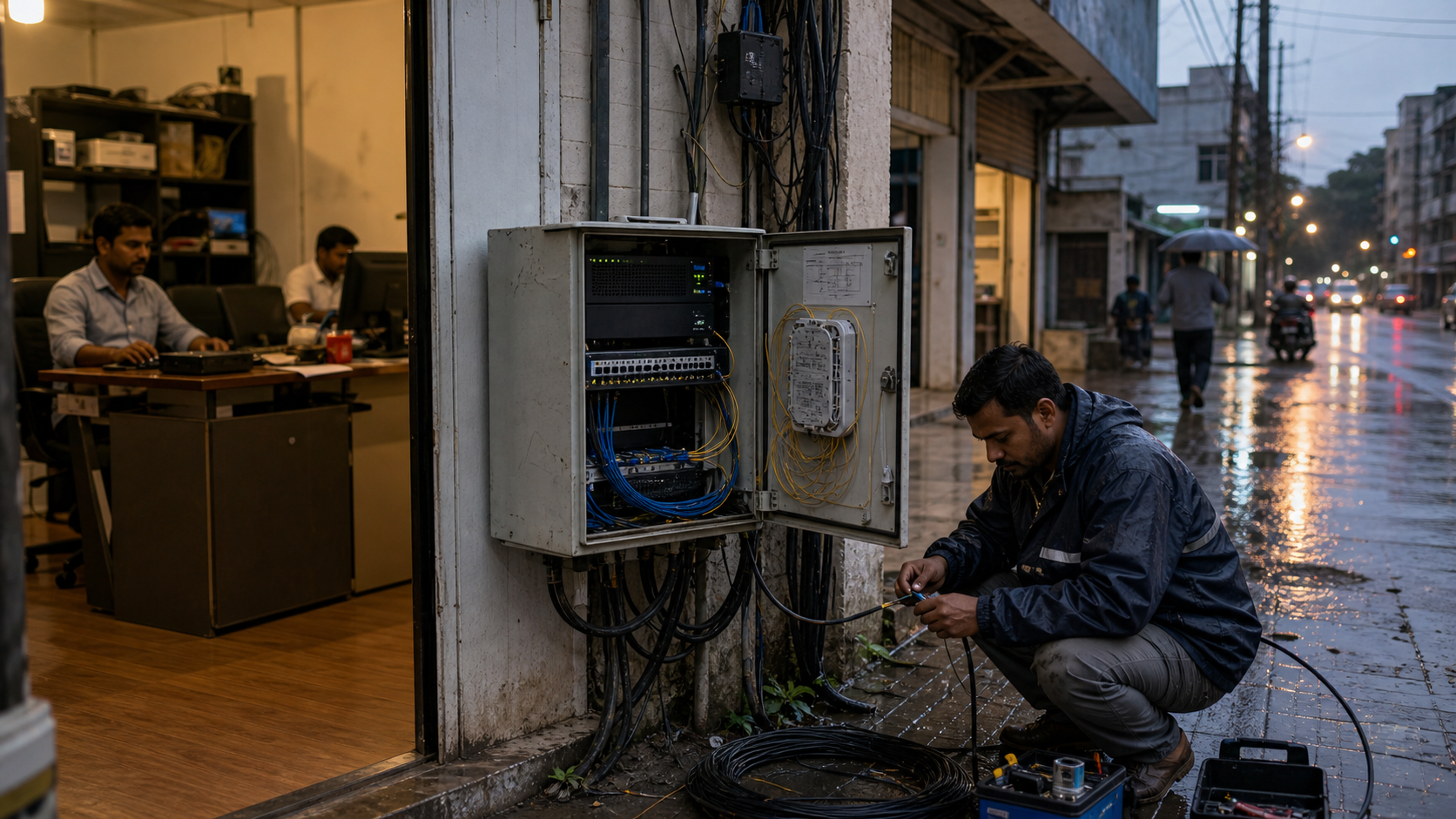
That question becomes concrete when the line fails. A business can survive a slower video stream; it may not survive a payment terminal that cannot settle, a GST filing that times out, a booking desk that cannot answer customers, or a warehouse app that stops syncing. The cost of fixed access is not just the quoted speed. It is the price of a technician visiting after rain, the price of a spare optical-network terminal or router, the cost of keeping backhaul available when the customer is not using it, and the reputational cost of telling a trader that the repair queue is full.
This is the economic problem that makes SpeedOnline.Net interesting. It was not a national operator with spectrum, towers and a retail bundle. The public record points to a Rajkot-based private company and an autonomous-system identity that had to live or die on the narrower promise that a local fixed connection would answer when a small business needed it.
The record also refuses to support a simple active-ISP story. Speed Online.Net Private Limited is a real Indian company in Rajkot: company-data pages list CIN U64202GJ2001PTC039850, incorporation on 3 August 2001, an address at 2/5 Galaxy Commercial Centre, Jawahar Road, Rajkot, Gujarat 360001, and the email info@speedonline.net. See https://www.zaubacorp.com/SPEED-ONLINE-NET-PRIVATE-LIMITED-U64202GJ2001PTC039850 and https://www.instafinancials.com/company/speed-online-net-private-limited-U64202GJ2001PTC039850/company-overview. Yet the Department of Telecommunications' surrendered-license list as of 28 February 2026 includes Speed Online.Net Pvt Ltd, Gujarat, UL B license 821-133/2014-DS, with signing and effective dates of 4 October 2016 and a surrender or cancellation effective date of 1 September 2023: https://www.dot.gov.in/static/uploads/2026/03/cc053af7de817c83432f0f5a86644ff0.pdf. The right thesis is therefore sharper than a profile of a live local broadband brand. SpeedOnline.Net is a case study in what happens when the economics of local fixed access, regulatory authorization, and visible routing presence no longer line up.
The company is real, but the live-service claim is weaker than the name
The corporate identity is the strongest part of the public file. ZaubaCorp and InstaFinancials agree on the company name, CIN, private-company status, Rajkot address and contact email. SensiBook, which presents structured MCA-derived company information, describes the company as incorporated on 3 August 2001, active, and in information technology services and telecommunications; it also names three active directors and reports a small paid-up capital base: https://www.sensibook.com/companies/2538641/U64202GJ2001PTC039850/SPEED-ONLINENET-PRIVATE-LIMITED. Those are not marketing claims. They establish that SpeedOnline.Net is a legal entity with a long local history.
There is also older service evidence. GujaratDirectory lists "SPEEDONLINE NET PVT.LTD." in Rajkot, describes "Internet Service On Cable & Wires," and gives a local telephone number: https://gujaratdirectory.com/product/internet-services-and-solutions.html. IndiaCatalog describes Speed Online as a Rajkot internet service provider offering digital connectivity: https://www.indiacatalog.com/web_directory/wd_detail.php?id=11936. A Facebook page for SpeedOnline.net identifies it as an internet service provider company in Rajkot and gives the Galaxy Commercial Complex location, phone number and speedonline.net link: https://www.facebook.com/SpeedOnline.net/. Those pages are not enough to prove current paid service availability, but they do show a local retail identity that fits the company record.
The problem is that the public-facing web identity has drifted. The PeeringDB network page points to http://www.speedonline.net as the company website, but the current domain at https://speedonline.net/ presents itself as a technology-news site, with article-style FAQ copy rather than an ISP product page. That does not prove the operating company lost the domain or stopped all communications activity, because domain content can be repurposed and old links can survive. It does, however, weaken any claim that the present public website is an active sales or support front for Rajkot broadband. In a due-diligence reading, that mismatch matters as much as a missing tariff card. It says the directory identity is durable, while the customer-facing brand proof is stale.
The license record is the larger break. Saral Sanchar's older list of granted ISP authorizations includes Speed Online.Net Pvt. Ltd. with license 821-133/2014-DS, category B, Gujarat, dated 4 October 2016: https://saralsanchar.gov.in/documents/List_of_ISP-UL.pdf. But the later DoT surrendered-license PDF is explicit about surrender or cancellation. For a business whose product is legal authority to provide internet service over a licensed service area, a surrendered or cancelled license changes the interpretation of every older local listing. It does not erase the company's past. It does mean that an article written in July 2026 cannot responsibly describe SpeedOnline.Net as a currently licensed Gujarat ISP without fresher proof.
That is why the thinness of the current public record is a substantive warning, not a footnote. The evidence supports SpeedOnline.Net as a Rajkot company with historic ISP activity, a network record and a past Gujarat authorization. It does not yet support a clean current-service statement. The distinction matters because customers buy continuity, while old company names and network records can survive for years after the commercial service behind them has changed.
The network record shows a small ISP profile and a possible retreat
The internet-resource trail carries the same split personality. PeeringDB lists SpeedOnline.Net as network 17054 under SpeedOnline.Net Pvt. Ltd., ASN 45954, network type Cable/DSL/ISP, geographic scope Asia Pacific, 30 IPv4 prefixes, one IPv6 prefix, traffic level of 1-5 Gbps and a mostly inbound traffic ratio: https://www.peeringdb.com/net/17054. Its public peering policy is open, with no ratio requirement and no contract requirement. On paper, that is the profile of a small access network, not a content network or national backbone. Mostly inbound traffic is what one expects from consumer or small-business broadband: users pull video, cloud apps and websites toward them more than they send traffic out.
The same PeeringDB page also shows no public peering exchange points and no interconnection facilities. That absence is not a fatal flaw for a small ISP. Many regional access providers buy upstream transit or hand off through a larger carrier rather than appear at exchanges under their own account. But it does tell us where the leverage is likely to sit. A network with no visible exchange presence and no listed facility footprint has less ability to bargain directly with content networks, reroute around congestion, or reduce transit cost through broad peering.
The customer may experience the product as "local broadband"; the operator experiences it as a chain of paid upstream capacity, local plant, repairs and customer collections.
Other network datasets suggest that the active BGP footprint is now weak. IPinfo's AS45954 page lists the registered name "speedonline.net," country India, APNIC registry, allocation in November 2009, but also shows the ASN type as inactive with zero IPv4 addresses, zero IPv6 addresses, no prefixes, no peers, no upstreams and no downstreams visible in its public summary: https://ipinfo.io/AS45954. Hurricane Electric's BGP Toolkit page for AS45954 similarly shows zero prefixes originated and zero prefixes announced, while observing two IPv4 peers in its table: https://bgp.he.net/AS45954. The safest reading is not that every historic SpeedOnline route vanished from all possible private arrangements. It is that the public global-routing view no longer looks like an active, customer-facing access AS.
There are still route objects that connect the name to real address space. RADb's query result for 103.7.81.0/24 shows APNIC route objects for 103.7.80.0/22 and 103.7.80.0/23 described as SPEEDONLINE.NET.PVT.LTD. with origin AS45954 and valid RPKI state; the same result also shows 103.7.81.0/24 associated with Ishan Netsol Pvt Ltd under AS45117 and a SpeedOnline route object: https://www.radb.net/query?advanced_query=&keywords=103.7.81.0%2F24. An Ipregistry page for 223.255.247.0/24 shows Ishan Netsol address registration details and a route object where the origin can be AS45954, with a notify address tied to the SpeedOnline maintainer: https://ipregistry.co/AS45117/223.255.247.0/24. These records are valuable, but they create more nuance than certainty. They point to a Rajkot network-resource environment in which SpeedOnline and Ishan Netsol records overlap, not to a simple standalone live SpeedOnline backbone.
This overlap is commercially plausible. Ishan Netsol is a substantial Rajkot-based connectivity name in the same local ecosystem, and BGP records often preserve old origination rights, customer routes, reseller arrangements or operational transitions long after a retail brand has changed. A small ISP that once managed its own ASN can end up relying on a larger local carrier, surrendering a license, keeping corporate status alive, or retaining legacy route objects. From the outside, the line between "operator," "customer," "reseller" and "legacy registration" can become blurred. That blur is the story.
It is exactly what happens when local broadband businesses are too small for public-company disclosures but still visible in routing and license records.
The fixed line was priced against mobile abundance, not against another wire
India's access market leaves little room for romance about fixed broadband. TRAI's May 2026 subscription release says total broadband subscriptions reached 1,080.15 million, of which wired fixed access accounted for 47.40 million, fixed wireless access for 17.97 million, and mobile wireless access for 1,014.79 million: https://www.trai.gov.in/sites/default/files/2026-06/PR_No78of2026_0.pdf. The top five broadband providers together held 98.59 percent of wired-and-wireless broadband subscriptions, and the top five fixed-wired providers held 71.53 percent of fixed-wired access. That is the market in which a Rajkot regional ISP had to price: not a fragmented world where every neighborhood provider sets the reference point, but a national market where Jio, Airtel, Vodafone Idea, BSNL and a handful of fixed specialists shape consumer expectations.
The January-March 2026 TRAI performance indicator report reinforces the same pressure. Total internet subscribers increased from 1,028.61 million at the end of December 2025 to 1,092.79 million at the end of March 2026; wired internet was 46.54 million and wireless internet was 1,046.26 million. Broadband internet was 1,065.88 million. Wireless data usage reached 77,953 petabytes in the quarter, with 4G and 5G accounting for nearly all of it: https://trai.gov.in/sites/default/files/2026-06/QPIR_22062026.pdf. In practical terms, mobile data is not the backup anymore. It is the default access layer for most Indian users.
That does not make fixed broadband irrelevant. It changes what fixed broadband must prove. A household may value fibre for stable video, work-from-home calls, gaming or unlimited usage. A small business may need lower latency, predictable uploads, point-of-sale resilience and a router that many devices can share. But the customer's mental anchor is no longer a leased line quoted in thousands of rupees. It is the national broadband menu. Jio's Rajkot page shows Rs. 399 plus GST and Rs. 699 plus GST household plans; YOU Broadband's Rajkot page says plans start from Rs. 353 per month with selected free installation: https://youbroadband.in/broadband-plans.php?city=rajkot. Airtel's Rajkot page markets unlimited data, Wi-Fi calling, landline and OTT benefits: https://www.airtel.in/plans/broadband/rajkot/, while Airtel's national broadband page shows Rs. 499 per month plus GST for 40 Mbps and richer bundles above that: https://www.airtel.in/plans/broadband. These prices do not leave a local provider much room to recover the true cost of hand-holding every customer.
The pricing trap is easy to understate. If a local ISP quotes a business connection high enough to include fast repair, backup capacity, spare equipment and route diversity, it may look expensive next to mass-market fibre or fixed wireless. If it matches the household price, it risks underfunding the support function that made the fixed line worth buying. The operator can hide the difference only for a while: through prepaid annual plans, low support wages, informal local cable work, shared upstream contention, or slower repair response. The moment customers expect business uptime at household prices, the economics become unforgiving.
There are really three invoices inside the customer's one invoice. The first is the access invoice: the drop cable, radio link, building entry, router, optical terminal, switch port and power protection that make one premise reachable. The second is the capacity invoice: paid upstream, local aggregation, DNS, address administration and enough headroom that evening video demand does not ruin daytime business traffic. The third is the trust invoice: a phone number someone answers, a technician who can find the lane, replacement equipment, account records and the discipline to chase late renewals without losing the customer.
Large operators can spread those invoices over millions of accounts. A small Rajkot operator has to recover them from a much smaller base, and the customer sees only a monthly broadband price.
That is why payment discipline matters. A prepaid annual plan gives the operator cash to fund the network, but it also locks in a support promise for twelve months. A monthly plan reduces customer friction, but it exposes the provider to churn immediately after an outage or a new competitor's offer. A business connection looks more attractive because the customer may pay more for uptime, static addressing, faster fault response or a relationship with a local technician.
But business customers also escalate faster, ask for credits, expect continuity during monsoon disruptions, and are less forgiving when a point-of-sale device or accounting workflow stops. The ISP's margin is made or lost in that gap between what a business line costs to support and what a small business believes connectivity should cost in a mobile-data market.
SpeedOnline.Net's public financial signals fit that vulnerability, though they are not a complete audit. SensiBook reports a very small paid-up capital base, one active charge, FY25 total income of Rs. 8.02 lakh, total expenses of Rs. 11.88 lakh, employee benefits of Rs. 9.95 lakh, depreciation and amortization of Rs. 1.16 lakh, and profit after tax of negative Rs. 4.03 lakh: https://www.sensibook.com/companies/2538641/U64202GJ2001PTC039850/SPEED-ONLINENET-PRIVATE-LIMITED. The numbers are presented by a third-party company-data service rather than directly in a downloaded MCA filing here, so they belong in the judgment as a structured signal. Still, the shape is instructive: a small company with labour as the largest visible expense line is not a carrier that can absorb endless repair calls through scale. In a local fixed-access business, the person who answers the phone and the person who fixes the line are part of the product.
Cost is local, dependence is not
The cost base of a regional ISP is local in ways a national mobile plan is not. It has to pull or lease last-mile paths, mount equipment, maintain customer routers, respond to rain damage, coordinate with building owners, and manage payment collection from customers who may churn or bargain after each outage. But the dependency stack is not local. Upstream internet, address resources, content reachability, licensing, right-of-way rules and large-operator competition are determined beyond the neighborhood.
The licensing evidence shows that SpeedOnline.Net once sat inside India's formal ISP authorization regime. A category B Gujarat authorization allowed a regional service area rather than all-India scope; that is appropriate for a Rajkot operator that did not need national retail reach. The surrendered-license record then signals a rational exit or restructuring from the regulated access role. Surrender can happen for many reasons: consolidation, migration to another operator's authorization, inability to justify compliance cost, a shift away from access services, or business decline.
The public record does not identify SpeedOnline.Net's reason. It only shows the outcome: the authorization trail that would support current retail ISP status is no longer clean after 1 September 2023.
Right-of-way reform is supposed to help precisely this sort of fixed-network economics. The GatiShakti Sanchar portal and the Telecommunications (Right of Way) Rules, 2024 are designed to streamline permissions for optical-fibre cable and telecom infrastructure, with uniformity across public authorities; the Department of Telecom eServices page collects the RoW materials at https://www.eservices.dot.gov.in/right-of-way-permissions, and the National Broadband Mission 2.0 release describes the portal and RoW rules as tools for quicker fibre and tower deployment: https://www.pib.gov.in/PressReleasePage.aspx?PRID=2102796&lang=1®=3. For a small operator, however, procedural improvement does not automatically create capital. A rule can reduce friction, but the business still must decide whether an extra lane, street, apartment block or commercial complex will repay the digging, attachment, splicing and maintenance cost.
The political economy of that last mile is not abstract. A fibre route can cross municipal property, private walls, shopfronts, utility poles, building ducts and roads that are already crowded with other services. A national operator may have a dedicated permitting team and enough volume to standardize the process. A local operator may know the street better, but each permission, repair cut or building negotiation can become a one-off cost. If a cable is damaged after road work or heavy rain, the customer does not care which authority, landlord or contractor caused the delay. The customer sees the ISP name on the bill.
That is the operational asymmetry: the small provider owns the relationship even when it does not fully control the environment.
There is also a security and compliance layer behind the economics. Internet access providers in India operate under a regime shaped by lawful authorization, subscriber accountability, network security, reporting and government rules that are not visible in a household broadband advertisement. A regional ISP has to carry that overhead while competing with retail products whose prices are advertised as entertainment and productivity bundles.
When an authorization is surrendered, the likely question is not only "Did customers leave?" It is "Was the continuing burden of being a licensed access provider worth it for the remaining opportunity?" SpeedOnline.Net's surrendered-license line cannot answer that causally, but it puts the question on the table.
There is also the upstream bill. PeeringDB's lack of public IX points and facilities for SpeedOnline.Net suggests a network that did not show a large independent interconnection strategy. If a small access network buys transit through another carrier or relies on a local upstream, its gross margin is squeezed between customer price expectations below and wholesale bandwidth above. The route records involving Ishan Netsol make that dependency visible without proving the precise commercial relationship.
They show that SpeedOnline.Net's resource identity was not floating in isolation; it was entangled with a stronger Rajkot connectivity ecosystem.
Upstream dependence is not only price. It is fault isolation. If the local drop is healthy but upstream paths are congested, the customer still calls the local provider. If DNS resolution is slow, a content cache is unreachable, or a route to a cloud service changes, the customer still experiences one broadband connection. A provider with public exchange ports, multiple facilities and strong route diversity has more tools to diagnose and route around those issues. A provider with a smaller and less visible interconnection base has to rely more heavily on supplier response.
In the PeeringDB record, the absence of public exchange points and facilities is therefore not a cosmetic gap. It points toward a business model in which local service quality can be hostage to upstream arrangements the customer never sees.
This is why local ISPs often disappear from the customer conversation before they disappear from registries. A business can stop selling new access, move subscribers, surrender authorization, or become an infrastructure/customer account while old BGP objects and directories remain searchable. The market then sees a ghost shape: corporate records active, routing records historic, phone numbers old, website repurposed, license surrendered. That is not merely messy data. It is a record of how thin the operating margin became.
The customer dependency is harsher than the bandwidth dependency
The commercial question is why fixed internet costs more than mobile data yet still fails if the local repair queue is slow. SpeedOnline.Net's public record answers that question by inversion. The value of a fixed ISP was never just megabits. It was local accountability. When that accountability is underfunded, the fixed line loses its reason to exist.
TRAI's May 2026 release shows why customers have alternatives. Wireless plus fixed wireless counted 1,032.75 million broadband subscribers, while wired fixed access counted 47.40 million. Fixed wireless is now significant in its own right: 5G FWA reached 12.73 million subscribers and UBR FWA 4.73 million at the end of May 2026. The same release shows Jio and Airtel controlling the 5G FWA market in the March 2026 figures and continuing to shape the May category. For small businesses, that means the fallback path is increasingly packaged and branded.
The question is less "Can mobile data work at all?" and more "Is the fixed line reliable enough to justify being the primary circuit?"
Customer-market chatter from Rajkot is thin but useful as signal. A Reddit thread asking for reliable broadband or fibre recommendations in Rajkot includes users discussing GTPL, BSNL service experience and annual pricing around Rs. 6,000: https://www.reddit.com/r/rajkot/comments/1hmnlo7/recommendations_for_reliable_broadbandfiber/. Sulekha's Rajkot ISP page shows recent local reviews for other providers, including comments about response and service quality: https://www.sulekha.com/internet-service-providers/rajkot. These are not proof of SpeedOnline.Net's current performance, and they do not name SpeedOnline.Net as the winner or loser. They do show what local customers talk about when they choose access: response, repair, promised speed, price and neighborhood experience. Those are precisely the categories a small fixed operator must win.
Older public records show that SpeedOnline once operated in a world where small subscriber counts were common. TRAI's July-September 2004 performance indicator report listed Speed Online.net Pvt. Ltd. as a category C Rajkot ISP with hundreds of subscribers: https://www.trai.gov.in/sites/default/files/2024-09/indicator17dec.pdf. In that earlier market, 600 or 700 subscribers could be a visible local business. In the 2026 market, a provider with a few hundred or a few thousand fixed lines faces national brands with bundled content, payment apps, 5G marketing, call centers, and device ecosystems. The customer still wants a local technician, but the bill is benchmarked against national scale.
The Speedtest-server traces add another historical layer. Public speedtest-cli server lists include "SpeedOnline.Net Pvt Ltd (Rajkot, India)" and a server name st1.speedonline.net:8080, server ID 8415, alongside Ishan Netsol and ExcoGitate in Rajkot: https://enos.itcollege.ee/~edmund/materials/tools/net/speedtest-cli/speedtest-servers.txt and https://gist.github.com/ofou/654efe67e173a6bff5c64ba26c09d058. A speed-test endpoint is not a license and not proof of current subscribers. But it shows the brand once expected to be measured as a Rajkot access network. In broadband, being visible to a speed-test user is part marketing, part support, and part self-discipline: if customers complain, the local test server becomes the argument.
The same traces also show why local reputation is fragile. A speed test collapses the whole network into one number, even though the number may reflect customer Wi-Fi, a cheap router, contention, upstream congestion, a distant test server or the user's device. A regional provider has to educate customers while also accepting that most customers will judge by the simplest visible metric. National operators can answer with advertising and bundle value. A small operator answers with technician memory: which lane has weak power, which building has a bad riser, which switch was overloaded last month, which customer pays late but calls first.
That local memory is valuable, but it is hard to capitalize on a balance sheet.
The regulatory record turns uncertainty into judgment
The decisive fact is the surrendered-license entry. Without it, the article might reasonably present SpeedOnline.Net as a small Rajkot ISP with limited public data and incomplete current verification. With it, the judgment changes: SpeedOnline.Net should be treated as a legacy or receded regional ISP identity unless new authorization or service evidence appears. That is not a negative moral judgment. It is an operating judgment.
Indian telecom regulation makes authorization part of the product. An ISP is not just a website, a router and a local cable path; it is a licensed participant in a sector where lawful interception, subscriber verification, revenue reporting, security obligations and service-area permissions matter. The surrender/cancellation list does not explain whether SpeedOnline.Net voluntarily surrendered because the business wound down, moved customers, merged arrangements, changed model, or failed to keep authorization worthwhile. But the result is commercially meaningful.
A buyer, partner or directory user cannot treat the old PeeringDB and directory evidence as enough to prove a current access service.
The current domain reinforces the same conclusion. If https://speedonline.net/ were an up-to-date ISP site with plans, support channels, payment pages and license references, there would be a reason to investigate whether the DoT list reflected a transferred or superseded authorization. Instead, the site reads as generic technology media. The Facebook page and local directories point backward to the ISP identity; the live domain points somewhere else. That mismatch is a public due-diligence signal. In telecom, stale identity is not harmless because customers depend on the name when they pay bills and troubleshoot service.
The domain point deserves emphasis because broadband trust is identity trust. A customer may not know the ASN, route object or license number, but the customer does know the bill name, the domain, the phone number and the person who visits. When those public identifiers no longer align, the risk is not just analytical uncertainty. It is a customer-protection issue. A business evaluating a supplier needs to know whether it is contracting with the licensed access provider, a reseller, a support contractor, a successor brand, or a company whose communications activity has shifted elsewhere.
Public evidence currently does not resolve that chain for SpeedOnline.Net.
The corporate record keeps the case from becoming a simple disappearance story. InstaFinancials says the company is active and has filed its latest balance sheet on 31 March 2024: https://www.instafinancials.com/company/speed-online-net-private-limited-U64202GJ2001PTC039850/company-overview. SensiBook's later structured figures portray a company still carrying assets, employees and filings. A company can remain active after surrendering an ISP authorization. It can own investments, settle obligations, support residual customers through another licensee, provide IT services, or retain a corporate shell for future work. The live question is not whether the company exists. It is what public authority and operational footprint it currently has to sell fixed access.
This is also why the route records cannot rescue the active-ISP claim. RADb and APNIC-derived entries show historical and administrative control patterns, but current BGP visibility from IPinfo and Hurricane Electric does not show a live originated-prefix base. PeeringDB's record is last updated in 2022 for the network and 2021 for public peering information, while the RIR status timestamp is 2024. A stale PeeringDB page can remain valuable for history and contact context, but it is not enough to override a later surrendered-license list.
Competition made support the scarce commodity
The Indian market has a structural irony. Broadband data can be cheap because the largest players amortize network, spectrum, content relationships, marketing and billing across enormous subscriber bases. Local support remains expensive because it is stubbornly physical. A Rajkot wire, rooftop radio, pole attachment, lane cut, switch, UPS, ONT and customer router cannot be repaired by national scale alone. Someone must show up.
For a small provider, that support function is both the differentiator and the cost trap. If customers believe the local provider will answer faster than a national call center, they may pay a premium. If the provider cannot answer faster, the premium evaporates. The SensiBook cost structure, with employee benefit expense dominating the reported FY25 expense base, is consistent with a business where labour is not incidental. Even a small staff becomes material when revenue is thin.
The competitive set in Rajkot also includes cable broadband and regional fixed players, not just Jio and Airtel. GTPL is particularly relevant in Gujarat, and its public broadband pages show aggressive prepaid price points for 60 Mbps, 80 Mbps, 100 Mbps, 150 Mbps and 200 Mbps plans. YOU Broadband, a Vodafone Idea company, lists Rajkot service and markets unlimited broadband with no installation charges on selected plans. These brands make it harder for a smaller company to use locality alone as the reason for higher price.
Locality must become service reliability, business responsiveness, or a niche relationship with customers that the larger provider cannot match.
Fixed wireless adds a second competitive squeeze. It does not require the same premise-by-premise fibre path, and TRAI's categories now separate 5G FWA and UBR FWA as visible broadband access modes. A local wired provider can still beat fixed wireless on stability, latency, heavy usage and control of the physical connection. But it must prove those advantages at the exact moment when a customer can ask whether a wireless box from a national operator is "good enough." Good enough is a dangerous phrase in infrastructure markets.
It lowers the price ceiling for the premium product even when the premium product remains technically better.
The public evidence does not show SpeedOnline.Net winning that competition in 2026. It shows an older Rajkot ISP brand, an ASN that appears inactive in major public summaries, a surrendered Gujarat authorization, and route traces that overlap with another Rajkot network. That pattern is common in fragmented fixed-access markets. Local ISPs help build early broadband habits, establish neighborhood cable or wireless paths, and sometimes become upstream customers, acquisition targets, dormant brands, or support shops as national and regional competitors grow.
This does not make SpeedOnline.Net unimportant. It makes it more useful as a market signal. The story of broadband is not only the rise of JioFiber, Airtel Xstream, GTPL and fixed wireless. It is also the quiet retreat of names that had enough technical competence to appear in BGP and PeeringDB, enough formal presence to hold a Gujarat authorization, and enough local recognition to appear in directories, but not enough public momentum to remain visibly active as licensed fixed-access providers.
What would change the judgment
Several facts would materially change the view. The first would be a current DoT or Saral Sanchar record showing a new, transferred or reinstated authorization under Speed Online.Net Private Limited or a successor legal entity. The surrendered-license list is the current hard fact in this file; a later official authorization would be stronger. The second would be a live service page or customer portal under a domain controlled by the company, with current tariff, support and license details rather than generic technology content. The third would be current BGP origination for AS45954 or clearly documented service through a named upstream or partner, with public route visibility consistent across PeeringDB, APNIC/RDAP, IPinfo, Hurricane Electric and other routing views. APNIC describes RDAP and Whois lookup paths for internet-number resources at https://www.apnic.net/about-apnic/whois_search/about/rdap/, https://rdap-web.apnic.net/ and https://www.apnic.net/about-apnic/whois_search/.
The fourth would be customer evidence from 2025 or 2026 naming SpeedOnline.Net as an active provider in Rajkot with installation, billing and repair experience. The fifth would be corporate filings that separate telecom-service revenue from other income and show whether FY25 activity is operating broadband, investment income, residual support or something else. The sixth would be direct clarification of the relationship between SpeedOnline.Net and Ishan Netsol in the route records, including whether SpeedOnline retained customers, delegated address use, migrated prefixes, or simply left legacy route objects behind.
Until those facts appear, the judgment is necessarily conservative. SpeedOnline.Net should be described as a Rajkot company with historical ISP activity, a SpeedOnline-branded network record, past Gujarat ISP authorization, and current public uncertainty after license surrender and weak visible routing. That phrasing is less flattering than "regional ISP," but it is more useful. It tells a business buyer, analyst or directory user where the confidence is high and where it is not.
The unresolved point is not a mere detail. In fixed internet, the difference between active and historical status is the difference between a support line that answers and a name that survives in old tables. SpeedOnline.Net's public file is full of old operational texture: the Galaxy address, the local phone number, the speed-test server, the PeeringDB traffic estimate, the APNIC route objects, the Gujarat license. But the most recent public signals point away from active licensed retail service.
That is the price of being a fixed line that had to answer: if the business can no longer fund the promise, the records remain, but the service story changes.
Why this matters beyond one Rajkot name
SpeedOnline.Net matters because Indian broadband policy often celebrates aggregate growth while the local access layer determines daily trust. TRAI can report more than one billion broadband subscriptions, and the National Broadband Mission can simplify fibre permissions, but the proprietor still evaluates the connection through one practical test: when it fails, who arrives and how fast? The economics of that test are brutal. The customer compares the monthly bill to mobile data and mass-market fibre. The operator pays for people, permissions, spares, upstream dependence and the risk of churn after each outage.
For national operators, scale turns that risk into a portfolio problem. For a small local provider, a cluster of bad repairs can become a cash-flow problem. A few unpaid renewals can delay equipment replacement. A new competitor's prepaid annual offer can reset the neighborhood price. A surrendered license can be the rational end of a business model that still has technical history but no longer has enough margin to stand alone.
The public record does not let SpeedOnline.Net be used as proof that every Indian regional ISP is failing. Many local and regional providers continue to operate, sometimes with better service than national competitors. But it does show how to read a fragile ISP identity. Look for current authorization, current route origination, current support channels, current pricing, current customer reports and current interconnection evidence. If those signals diverge, the name alone is not enough.
That is the final lesson. SpeedOnline.Net's most important public fact is not one prefix, one address, one PeeringDB field or one license line. It is the combination: a real Rajkot company, credible historical broadband activity, visible network-resource traces, a public website that no longer behaves like an ISP site, current BGP summaries that do not show a live originating network, and a DoT list that places its Gujarat ISP authorization in the surrendered or cancelled column. In a country where mobile data is abundant and fixed broadband must justify itself through uptime, that combination tells a serious story.
The fixed line can command trust only while the operational organization behind it remains visible, licensed, reachable and able to pay for the repair visit.