
Summary
- What it says: Spectranet AS37340 is a useful test of Nigerian household broadband economics because its service sits where spectrum scarcity, urban towers, backup power, imported routers, Lagos and Abuja apartment density, and prepaid renewal behaviour all meet.
- Main topic: Regional ISP economics; Network-resource evidence; Peering and transit; Telecom spectrum and security
- Context: market / company research report / Nigeria / Africa
A Lagos household is buying more than data
A middle-income household in Lagos or Abuja does not buy broadband in the abstract. It buys an answer to a recurring domestic failure. The work call freezes when the mobile network is congested. A child is supposed to submit an assignment from a laptop, not from a phone held near a window. A small online shop needs WhatsApp, Instagram, bank transfers, courier tracking and a payment terminal to behave on the same afternoon. The generator or inverter is already part of the home budget.
The question is whether another box on the table, another SIM, another monthly renewal and another customer-care channel will turn an unstable digital day into something predictable enough to justify the cash.
That is the substitution problem Spectranet lives inside. Its current public shop and tariff pages show the consumer entry bill plainly. A Freedom MiFi with 100GB is advertised at NGN 15,000; larger MiFi bundles run to NGN 42,999 or NGN 49,999; Titan, Ace, Spark, Whizz, Turbo, Witel and Flame devices sit between roughly NGN 25,000 and NGN 68,999 depending on device and bundled data (https://spectranet.com.ng/eshop/). The main "unlimited" data plans are not unlimited in the way a fibre customer in a mature fixed-line market might hear the word. They are monthly bundles with fair-usage thresholds: Diamond at NGN 30,000 for 200GB, Platinum at NGN 35,000 for 325GB, Bigdata at NGN 45,000 for 400GB and Megadata at NGN 60,000 for 550GB, each dropping to 1Mbps after the stated threshold (https://spectranet.com.ng/unlimited-plans/). Long-validity and shorter bundles widen the ladder for households that cannot or will not commit to a high monthly plan.
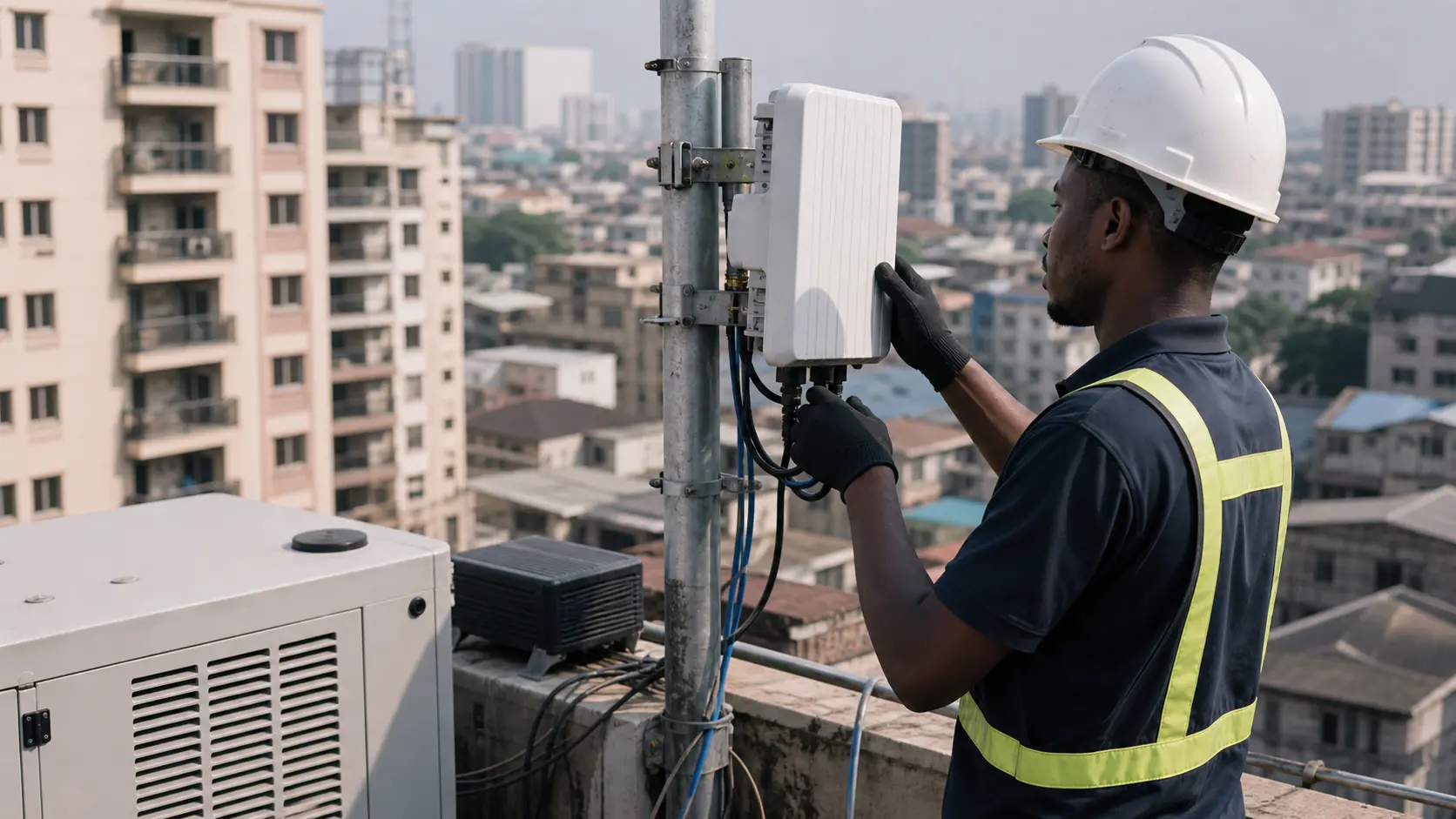
For a Nigerian family, that price is not compared only with another fixed ISP. It is compared with mobile data on phones, with an MTN or Airtel home router, with a neighbour's fibre recommendation, with an office connection used after hours, with Starlink for higher-income households, and with doing nothing. It is also compared with electricity. The broadband device itself needs power. The base station needs power. The tower, sector radios, aggregation switches, cooling, security and backhaul need power. In Nigeria, that often means diesel, batteries and a site-energy bill that does not disappear just because the customer paid in advance.
This is why Spectranet is not just another ISP record. It is a compact case study in whether fixed wireless can be a cash-flow machine or a maintenance burden. The asset promise is attractive: buy spectrum, place radios where urban demand is dense, sell prepaid data bundles through retail outlets and online self-care, use CPE and MiFi devices to avoid the slow street-by-street civil works of fibre, and keep traffic local where possible through Nigerian internet exchanges.
The operating reality is harder: radio capacity is finite, indoor signal quality varies by building and distance, router cost can become a sales barrier, high-use customers hit fair-usage policies, customer support has to explain a wireless product that households experience as "the internet", and every diesel or backhaul shock hits service quality before it hits a public financial statement.
Spectranet's own public record captures both sides. Its about page says service is available across Lagos, Abuja, Ibadan and Port Harcourt, and describes the company as providing broadband internet to homes and businesses (https://spectranet.com.ng/about-us/). Its enterprise page says business coverage spans those four cities, with a Lagos data center and two Evolved Packet Cores in Lagos and Abuja for redundancy (https://spectranet.com.ng/enterprise-business/). Its support page, however, is full of practical wireless realities: customers are told to check balance and validity, restart devices, reposition devices near an opening or high surface, move to an open area when the signal indicator is off, and remember that outdoor devices require a feasibility survey and technical representative installation (https://spectranet.com.ng/support/). Those instructions are not decorative. They are the physics of the product.
The first economic test, then, is not whether Nigerians need broadband. They do. The test is whether Spectranet can keep enough households and small businesses renewing prepaid service at a price that pays for spectrum, radios, power backup, imported devices, local sales channels, customer care, IP transit, exchange ports, and enough network upgrades to stop high-use customers from turning into public complaints. A fibre operator has its own trench and right-of-way problems. A mobile operator has national scale and handset data economics. A satellite operator has a high hardware barrier and foreign-exchange exposure.
Spectranet sits between them: more fixed than a handset, less dug-in than fibre, more local than satellite, and more dependent on urban signal quality than its plan names suggest.
Identity and operating footprint
The shorthand label "Spectranet AS37340" points to a real Nigerian broadband operator and a visible internet network, but the company should be understood as Spectranet Limited rather than as the autonomous system itself. AFRINIC RDAP identifies AS37340 as registered on 30 May 2011, linked to ORG-SL77-AFRINIC, and registered to SPECTRANET LIMITED with an address at Plot 36B Mobolaji Johnson Avenue, Oregun Industrial Estate, Alausa-Ikeja, Lagos. BGP.Tools shows the same AS as active, allocated under AFRINIC, registered for more than 15 years, and associated with Spectranet's public website (https://bgp.tools/as/37340). These routing records are evidence of network operation; they are not separate organisations.
The commercial identity is older than the current website design. Spectranet's own about page says that in 2013 Mr. Ramani launched Spectranet as the first ISP project in Nigeria to use 4G LTE technology, with the mission of becoming a leading internet services provider. GSMA's contemporary spectrum note reported in 2013 that Spectranet had launched a 4G LTE wireless broadband network in Nigeria, making it the first of its kind in the country (https://www.gsma.com/connectivity-for-good/spectrum/spectranet-debuts-4g-lte-in-nigeria/). The historical point matters because Spectranet was not a late reseller that simply appeared after Nigeria's data market matured. It was part of the early fixed-wireless broadband bet: use LTE outside the classic mobile-handset bundle and sell it as a household or office connection.
Its footprint remains selective. Spectranet says consumer service is available in Lagos, Abuja, Ibadan and Port Harcourt. The shop-location page lists multiple Lagos locations, including outlets in Ikeja, Lekki, Ogba, Opebi, Surulere and Victoria Island, as well as Abuja locations such as APO/Gudu, Wuse 2, Gwarimpa and Maitama, plus Ibadan and Port Harcourt outlets (https://spectranet.com.ng/shop-locations/). That retail footprint is operationally important. A fixed-wireless broadband provider has to sell devices, replace devices, register customers, troubleshoot SIMs and deal with households that may not distinguish between router, plan, tower and account problem. Physical outlets are part of customer acquisition and support, not just brand presence.
The enterprise surface is also visible. Spectranet sells dedicated internet services, says enterprise coverage spans four major cities, and describes redundancy through Lagos and Abuja EPC locations. This matters because enterprise and SME demand can improve average revenue and help justify investment in backhaul and service management. But the public product mix still looks heavily residential and small-office oriented. The device catalogue, fair-usage plans, MiFi bundles, home fibre and Fiber on Air tiers are all designed for a market where households and small businesses pay directly and expect immediate usefulness.
The company has also tried to move beyond pure LTE. Nokia announced in 2019 that Spectranet would deploy Nokia GPON technology as part of a fiber-to-the-home rollout for Lagos and Abuja customers, adding high-speed FTTH to the LTE wireless broadband portfolio (https://www.nokia.com/newsroom/spectranet-and-nokia-to-provide-100-mbps-ultra-broadband-services-with-ftth-to-home-and-business-users-in-nigeria/). Spectranet's current home-fiber page shows speed-based plans from Spectra Elite7 at NGN 17,000 for up to 7Mbps to Spectra Elite200 at NGN 100,000 for up to 200Mbps, with a one-time installation fee applicable and city selection limited to Lagos and Abuja (https://spectranet.com.ng/sh-home-fiber/). Its Fiber on Air page shows wireless speed-based plans from NGN 20,000 for up to 7Mbps to NGN 29,000 for up to 20Mbps, also with a one-time installation fee and Lagos/Abuja selection (https://spectranet.com.ng/sh-fiber-on-air/).
That portfolio tells a story of adaptation. Spectranet began with fixed LTE as the disruptive access layer. It now faces a market where mobile network operators sell 5G routers, fibre providers market true FTTH, Starlink can serve customers outside terrestrial coverage, and heavy users have learned to read fair-usage limits. A pure 4G LTE household proposition is less distinctive than it was in 2013.
Spectranet's answer appears to be a ladder: prepaid MiFi and CPE for mass users, "unlimited" FUP bundles for heavier homes, Fiber on Air for fixed wireless estates, home fibre where feasible, and dedicated business internet for customers that need more formal reliability.
Spectrum is the original scarce asset
The word "wireless" can make broadband sound asset-light. It is not. The original scarce asset is spectrum. Spectranet's economics trace back to Nigeria's 2.3GHz broadband wireless access history, where fixed-wireless operators were competing for enough bandwidth to make LTE capacity viable. Contemporary Nigerian press coverage from 2013 reported that Mobitel, Spectranet and Direct on PC were each sitting on 20MHz of 2.3GHz spectrum and objected to NCC plans to auction a 30MHz block to a new operator. The same coverage quoted operators arguing that existing 20MHz assignments should be increased to 30MHz to manage throughput degradation, interference and guard-band requirements (https://www.vanguardngr.com/2013/03/mode-of-planned-auction-of-2-3ghz-slots-unfair-spectranet-mobitel-dopc/). BusinessDay's 2014 coverage of the later Bitflux auction reported a reserve price of NGN 3.6 billion for 30MHz of 2.3GHz spectrum and a winning bid around NGN 3.8 billion, or USD 23.25 million at the time (https://businessday.ng/exclusives/article/bitflux-beats-analysts-expectation-as-it-wins-2-3ghz-spectrum/).
Those figures should not be retrofitted into a precise current valuation of Spectranet's own licence. Licence terms, renewal costs, spectrum fees, exchange rates and network use have changed. But they make one economic point unavoidable: urban wireless broadband starts with a paid, finite and regulated radio resource. Every plan that promises high-speed data has to share that resource across customers, sectors, devices and busy hours. Every heavy household that streams, works, games and downloads on a fixed router consumes more of that scarce capacity than an ordinary phone user checking messages.
Fair-usage policies are not only a pricing trick; they are a way to stop a small number of high-use homes from consuming the experience sold to everyone else.
The fixed-wireless capacity constraint also affects marketing truth. A plan can be sold as unlimited because the user does not lose access after the bundle threshold. But when the public plan page says post-FUP speed is 1Mbps, the service is economically closer to a high-speed allowance with a low-speed tail. That may still be valuable. A household can keep messaging, browsing and doing light work after it exhausts the high-speed allocation. It is not the same product as unconstrained fibre.
The customer's decision depends on whether the high-speed allocation is enough for the month, whether the renewal price is tolerable, and whether the router actually sees enough signal indoors to deliver what the plan implies.
Spectrum scarcity is not the only radio issue. Building penetration matters. Lagos apartment blocks, Abuja estates, shops in mixed-use buildings and homes behind concrete walls can produce sharply different signal experiences even within a covered area. Spectranet's own support advice to move a device near a window or high surface is a simple clue. A wireless broadband company can cover a city and still have unhappy customers in particular rooms. That creates a different support burden from fibre. Fibre fails at address availability, installation, local drop or backhaul.
Wireless fails at signal, congestion, device placement, plan speed, SIM, account validity and tower power. The customer collapses all of that into "Spectranet is slow" or "Spectranet works here".
The upside is speed of deployment. Fixed wireless can reach estates and neighborhoods faster than trenching every street, especially where right-of-way costs, landlord permissions, road cuts and vandalism slow fibre. The downside is that capacity and experience are shared through the air. For Spectranet, spectrum is therefore both the moat and the ceiling. If it has enough clean spectrum, good tower geometry, strong backhaul and disciplined pricing, it can serve dense urban demand without laying fibre to every flat.
If traffic growth outruns spectrum, if 5G competitors change customer expectations, or if customers use routers as household fibre substitutes without paying fibre-level prices, the same asset becomes a constraint.
Network evidence: AS37340 is a real eyeball network
Public routing evidence supports the view that Spectranet is a real operating access network, not a thin sales label. PeeringDB lists "Spectranet AS37340" as organization Spectranet Limited, also known as Spectranet Nigeria, network type Cable/DSL/ISP, with 100 IPv4 prefixes, one IPv6 prefix, traffic level of 10-20Gbps, heavy inbound traffic, African geographic scope, an open peering policy and RIR status "ok" (https://www.peeringdb.com/net/13280). PeeringDB's API also shows four operational public exchange points for the network: IXPN Lagos, AMS-IX Lagos, IXPN Abuja and AF-CIX, each at 10G in that record.
The IXPN export gives a more exchange-specific view. It lists Spectranet AS37340 as a peering member since 8 January 2015, with open peering policy and active connections. The export shows a Lagos connection with IPv4 196.216.148.164, IPv6 2001:43f8:bb1::164, route-server use and a 10G interface speed, and an Abuja connection with IPv4 196.216.150.21, IPv6 2001:43f8:bb1:150::21, route-server use and a 1G interface speed (https://ixpmanager.ixpn.ng/api/v4/member-export/ixf/1.0). That matters because local peering reduces the need to haul Nigerian traffic out of the country when content, banks, government services, CDNs or other networks are reachable locally. For a prepaid household, IX reachability shows up not as a line item but as latency, video startup, app responsiveness and lower transit dependence.
BGP.Tools reports AS37340 as an eyeball network with 165 originated IPv4 prefixes and one IPv6 prefix at retrieval, plus upstreams including Globacom, WIOCC, Liquid Intelligent Technologies and MTN Nigeria (https://bgp.tools/as/37340). The prefix descriptions include pools used for Spectranet LTE customers and dynamically allocated Lagos and Abuja LTE customers. These details fit the commercial product: a customer access ISP with enough address space and route visibility to serve a meaningful subscriber base. BGP.He.net, a supplementary routing surface, similarly shows a Nigerian origin, more than 160 originated IPv4 prefixes, one IPv6 prefix and observed peers including WIOCC, Liquid, Glo, MTN and Hurricane Electric (https://bgp.he.net/AS37340).
This network evidence should be read with discipline. It does not prove cell-site count, customer speeds, outage performance, private transport redundancy, tower ownership, core capacity or route diversity by city. It does prove that Spectranet announces its own internet resources, peers locally and buys or receives upstream connectivity from major wholesale networks. For an access ISP, those are the bones of independence. A pure reseller can outsource most of that. Spectranet's public route table suggests it is managing a real access and interconnection footprint.
The upstream list is also a dependency map. WIOCC, Liquid, MTN and Globacom are not just names; they represent the wholesale layer that decides how much resilience Spectranet can build into the path beyond its own radio network. If a customer is in Lagos on a Spectranet router, the product is a chain: power and radio at the local site, spectrum and sector capacity, customer device quality, aggregation into Spectranet's core, local peering at IXPN or AMS-IX Lagos where relevant, and upstream transit for everything else. Weakness in any segment becomes a retail complaint.
That chain is especially important for enterprise service. Spectranet's enterprise page says it has a Lagos data center and two EPCs in Lagos and Abuja for redundancy. That is a credible architecture claim for a wireless broadband provider serving multiple cities. But public sources do not disclose whether the paths between the customer, towers, EPCs, exchange ports and upstreams are physically diverse enough for high-dependency customers. Businesses buying dedicated internet need route diversity, service-level terms, escalation, backup power and repair commitments. Households need the video call to work.
Both depend on network investments that are not visible in a simple plan table.
Pricing and revenue: prepaid volume has to outrun churn
The most visible revenue mechanism is prepaid data. Spectranet does not need to persuade every user to sign a long fixed-line contract. It can sell a router or MiFi, attach a data bundle, and try to convert the customer into a recurring monthly recharge. That lowers switching friction for the customer and speeds acquisition for the operator. It also creates churn risk. A prepaid customer who is unhappy does not need to wait for a contract anniversary. The household can stop renewing, move the budget to MTN, Airtel, FibreOne, ipNX, Tizeti, Swift, a mobile hotspot or Starlink, and leave Spectranet with the installed device and acquisition cost.
The current public plans show a careful ladder. A light or cash-constrained user can buy small bundles or a long-validity plan. A heavy home can buy 200GB to 550GB monthly "unlimited" plans. A customer with a fixed site can consider Fiber on Air or home fibre. A small business can move toward dedicated internet. This ladder is economically sensible because it lets Spectranet segment households by willingness to pay and usage intensity. It also exposes the limits of average revenue.
A 200GB user paying NGN 30,000 per month is not the same as a 550GB user paying NGN 60,000, and neither is the same as a business paying for dedicated service. The company needs the mix to tilt toward customers whose usage and support cost fit the price.
NCC subscriber data gives scale. The NCC's Internet Service Operator Data table for Quarter 2 2025 lists Spectranet Ltd with one point of presence, 98,444 wireless internet subscribers, 1,076 wired internet subscribers and 99,520 total active internet subscribers, against a total ISP table count of 313,713 active subscribers (https://ncc.gov.ng/market-data-reports/subscriber-statistics). TechCabal, citing later NCC statistics, reported that Nigeria recorded 352,006 active ISP subscribers in Quarter 4 2025, with Spectranet remaining the market leader at 108,525 active subscribers, followed by Starlink at 91,991 and FibreOne at 44,413; the same report said those top three controlled 69.58 percent of the ISP market (https://techcabal.com/2026/06/03/spectranet-starlink-fibreone-hold-70-of-isp-subscribers/).
Those numbers are simultaneously impressive and sobering. Spectranet appears to be a leading Nigerian ISP by active subscriber count, and it is doing so against more than 200 licensed ISPs. But the denominator is small relative to Nigeria's overall internet market. NCC and press reporting show more than 150 million total internet subscriptions and more than 120 million broadband subscriptions by April 2026, driven overwhelmingly by mobile GSM networks. In other words, Spectranet is large among Nigerian ISP licensees, but small beside MTN and Airtel's national mobile base.
Its challenge is to defend a profitable fixed-wireless niche without the national mobile scale that can subsidize devices, bundle voice, spread tower costs and absorb churn.
The plan prices also show why churn matters. Suppose a customer buys a NGN 68,999 router bundle and then renews at NGN 30,000, NGN 45,000 or NGN 60,000. The cash inflow can look attractive if the customer stays for a year, uses the network within expected limits and does not require repeated support. The same customer becomes less attractive if the first month is slow, the device is returned or abandoned, customer care spends time explaining coverage, and the household shifts to another provider. Prepaid revenue is immediate, but the lifetime value can be short.
Spectranet's fair-usage model is therefore central to profitability. The company has to sell enough volume to appear generous, cap enough heavy usage to preserve network experience, and price the threshold so customers do not see a hidden trap. A 1Mbps post-FUP speed is usable for messaging and light browsing, but it is far from the product many households think they bought when they see "unlimited". The customer who hits the threshold too early may feel punished. The customer who never hits it may be happy. The operator has to balance both while paying for capacity that must be present before usage arrives.
Cost base: towers, power, devices and support
Spectranet's cost base starts with the radio network, but Nigeria's power problem turns that into a broader infrastructure bill. The Guardian reported in September 2025 that power-related expenses can account for 20 percent to 40 percent of a telecom operator's total operating costs, driven by diesel consumption for more than 30,000 base stations nationwide, and cited NCC estimates that telcos collectively consume more than 40 million litres of diesel every month to keep networks running (https://guardian.ng/technology/how-nigerias-power-crisis-slows-broadband-expansion/). Punch reported a similar figure from the Africa Finance Corporation's State of Africa's Infrastructure Report 2025: over USD 350 million annually on diesel-powered generators and more than 40 million litres of diesel per month across Nigerian telecom operators (https://punchng.com/local-telecom-operators-spend-350m-annually-on-diesel-report/).
Spectranet is not MTN, and public sources do not disclose its own diesel bill. But fixed-wireless broadband cannot escape the same physics. Radios need sites. Sites need electricity. Backup systems need maintenance, batteries, generator servicing, security and fuel logistics. A prepaid data bundle does not carry a separate power surcharge, but the power cost is embedded in the price and service quality. If diesel rises, if fuel delivery fails, if batteries are stolen, if grid supply worsens, or if tower providers raise pass-through costs, the wireless broadband margin compresses.
Power risk is not theoretical. Punch reported in December 2025 that telecommunications services in parts of Abuja were disrupted after a diesel supply shortage cut power to several mobile base stations, with the NCC saying the issue degraded service quality for mobile subscribers in affected areas (https://punchng.com/ncc-moves-to-resolve-abuja-telecom-disruption/). That story concerned mobile base stations and tower company operations, not Spectranet specifically. It is still relevant because Abuja is one of Spectranet's core markets and because fixed wireless depends on powered radio access. A fibre provider with passive last-mile fibre still needs active electronics, but the wireless operator's access capacity is more directly tied to powered sites.
Devices are the second cost layer. Spectranet's device shop is not incidental. CPE and MiFi devices are the bridge between spectrum and cash. They are imported or assembled hardware exposed to exchange-rate movement, shipping costs, inventory risk, warranty claims and retail discounts. A lower device price can increase customer acquisition but may reduce upfront margin or require bundled data economics to carry the subsidy. A higher device price screens for more serious customers but makes the service less attractive to households that can instead buy a cheaper mobile SIM plan or use an existing phone as a hotspot.
The support burden is the third layer. Spectranet's support page reads like a map of routine contact drivers: installation, signal indicator, balance and validity, WLAN discovery, CPE package contents, device battery, antenna questions and outdoor feasibility survey. Each support issue has a cost. Some can be handled through self-care or the mobile app. Google Play lists the Spectranet Selfcare app with 100K+ downloads, updated 1 May 2026, and describes account balance, usage history and payment functions (https://play.google.com/store/apps/details?id=com.covalense.Spectranet). That is valuable because prepaid broadband support scales better when customers can recharge, check usage and solve basic account issues themselves.
But self-care does not solve radio dissatisfaction. If a customer in Lagos buys a Turbo Router and sees low speed, the explanation may be coverage, building penetration, plan limit, congestion, device placement, peak hour, site issue or unrealistic expectation. A support agent can explain; the customer may still leave. This is why fixed-wireless economics are labour-sensitive. The company must educate customers before purchase, run feasibility checks for outdoor products, position routers correctly, manage plan expectations and handle angry customers who compare their router to a mobile phone that temporarily shows a higher speed.
Backhaul and wholesale connectivity are the fourth layer. Peering lowers some traffic cost and improves local performance, but upstream transit and metro transport remain necessary. The BGP.Tools upstream list points to dependence on Globacom, WIOCC, Liquid and MTN Nigeria. These are strong names, but they are still suppliers or network counterparties. Fibre cuts, commercial disputes, capacity constraints, route changes or upstream price movement can affect the end product. A customer buying NGN 45,000 of data is not buying abstract internet; the customer is funding a chain of Nigerian and international network costs.
Supplier dependence and the proposed Legend merger
Supplier dependence appears at several levels. Nokia's 2019 FTTH announcement shows that Spectranet has relied on major equipment vendors for GPON technology. The LTE and fixed-wireless device ecosystem depends on router and radio vendors. The exchange evidence points to IXPN and AMS-IX Lagos for local peering. BGP evidence points to major upstream networks. Retail distribution uses shops, kiosks and channel partners. Power and tower operations rely on site energy and, where sites are not self-owned, tower or facility partners. None of these dependencies is unusual.
The question is whether Spectranet has enough scale and cash flow to negotiate them well.
The proposed merger with Legend Internet is therefore a major unresolved fact. Proshare, carrying a Legend Internet release sourced to NGX Group, reported on 23 March 2026 that Legend Internet Plc had announced a proposed merger with Spectranet Limited, with boards and shareholders of both companies approving the transaction in October and November 2025 respectively. The report said the transaction would combine the businesses and operations under a unified corporate structure, subject to approvals from regulators including the Federal Competition and Consumer Protection Commission and the NCC, with completion anticipated in Quarter 2 2026 (https://proshare.co/articles/legend-internet-spectranet-announce-proposed-merger-to-combine-operations). TechAfrica News reported the same proposed transaction and described the strategic rationale as integrating fibre and wireless technologies, improving operational efficiency and extending coverage across key urban areas (https://techafricanews.com/2026/03/23/legend-internet-and-spectranet-announce-proposed-merger-to-boost-nigerias-broadband-sector/).
For Spectranet, this potential merger is more than corporate housekeeping. It is a possible answer to the fixed-wireless ceiling. Legend's fibre ambitions could complement Spectranet's wireless base. Spectranet's customer base and spectrum-backed access could complement a fibre operator's deeper fixed-line proposition. A combined company could migrate high-usage customers from wireless to fibre where available, use wireless for rapid coverage and backup, cross-sell in estates, and negotiate suppliers with more scale. That is the optimistic case.
The cautious case is that mergers are hard because customer systems, network architectures, brands, support teams, licences, debts, suppliers and culture do not merge automatically. Regulatory approval is not the same as operational integration. If the transaction closes, the economic question becomes whether the combined entity can reduce duplicated overhead, improve coverage and shift customers to the right access technology without confusing the market. If it does not close, Spectranet remains a leading ISP with a clearer need to fund its own wireless, fibre and support evolution.
This is one of the facts that could change the view quickly. A completed merger with clear integration milestones, disclosed customer counts, fibre passings, wireless subscribers, churn and capex plans would make Spectranet easier to underwrite. A failed or delayed merger would not prove weakness, but it would keep the company exposed to the same standalone tradeoff: maintain a prepaid fixed-wireless base while competitors use fibre, satellite and 5G to attack the same high-value homes.
Customer dependence: the household is the control surface
Spectranet's customer surface is unusually direct. The customer often buys the device, places it in the home, chooses the plan, watches the data counter, recharges, calls support, moves the router and decides whether the service is tolerable. That gives the customer more agency than a buried fibre line but also more blame. If the device is in the wrong room, if the signal is weak, if the customer bought a low-speed Fiber on Air tier and expected a 5G-like result, or if the fair-usage threshold was exhausted, the service can be perceived as broken even when the network is functioning according to plan.
Unofficial signals should be treated carefully, but they are useful for understanding this dependency. Trustpilot lists only one review for spectranet.com.ng, a 1-star review from May 2026 complaining about unreliability, upload caps, download speeds and subscription duration; Trustpilot itself warns that the company has not invited reviews and that the sample may not be representative (https://www.trustpilot.com/review/www.spectranet.com.ng). A single review cannot prove broad service quality. It does show the kind of accusation that matters in a prepaid broadband market: the customer believes the plan and lived service do not match.
Nairaland provides more granular, but still anecdotal, market chatter. In a June 2025 thread, a Lagos buyer said a NGN 69,000 Spectranet Turbo Router delivered around 5.3Mbps while an Airtel line reached much higher speed, and respondents debated whether the issue was coverage, plan speed, location or product choice (https://www.nairaland.com/8447048/why-spectranet-turbo-router-too). One reply argued that the customer was likely on a 7Mbps plan and suggested fibre alternatives if available. Again, this is not audited data. It is useful because it exposes the customer education problem. The buyer saw router price and data bundle; other users saw plan speed and coverage as the likely explanation.
This kind of confusion is costly. It can turn a valid low-speed product into a bad customer experience if the customer expected something else. It can make a nearby outlet feel like proof that coverage should be excellent when radio geometry says otherwise. It can make a fair-usage plan feel deceptive if the customer does not understand the post-threshold speed. For Spectranet, revenue quality depends on reducing this gap before the sale, not only solving it after.
The flip side is that many households want precisely this kind of product. A portable MiFi with 100GB, a home router with 300GB, a self-care app, a physical shop and no trench wait can be more practical than waiting for fibre or paying for Starlink hardware. Nigeria's urban broadband market is full of renters, small businesses, students, hybrid workers, estates with uneven fibre access and households that want a backup to mobile data.
Spectranet can serve those users if the product is positioned honestly: fixed wireless is location-sensitive, plan-sensitive and power-sensitive, but it can be faster to obtain and easier to manage than a fixed-line installation.
Competition has moved from scarcity to substitution
Spectranet's first decade benefited from scarcity. In 2013, being a 4G LTE broadband pioneer was a distinctive claim. In 2026, the customer has more substitutes. MTN's router plans page shows capped 30-day plans from 30GB at NGN 9,000 to 120GB at NGN 24,000, a 450GB 90-day plan at NGN 75,000, a 1.5TB annual plan at NGN 225,000, and unlimited speed-based plans such as Gold up to 50Mbps at NGN 40,000 with throttling after 400GB and Diamond up to 100Mbps at NGN 65,000 with throttling after 800GB (https://www.mtn.ng/broadband/router-plans/). MTN can bring national mobile scale, brand familiarity, retail reach and 5G marketing to the home-router fight.
Airtel is another pressure point. Its own consumer pages are JavaScript-heavy in public retrieval, but current Nigerian plan guides list Airtel unlimited router offers such as Unlimited Ultra at NGN 20,000 with 100GB high-speed plus daily data thereafter, Unlimited 20 at NGN 30,000 for up to 20Mbps, and Unlimited 60 at NGN 50,000 for up to 60Mbps, with router prices and installation economics varying by device and 4G/5G coverage (https://www.payora.app/blog/airtel-router-data-plans-nigeria-2026-4g-5g-bundles-prices-how-to-buy). Treat those as secondary retail references, but the competitive direction is clear: mobile operators are turning their spectrum and distribution into home broadband products.
Fibre is a different threat. FiberOne's public site says it serves more than 50,000 customers nationwide, markets itself as a major FTTH provider and sells across Lagos, Abuja, Port Harcourt, Ilorin and Ibadan (https://fob.ng/). A Legit.ng plan guide, based on FiberOne's plan information, lists Lagos residential monthly fees from NGN 16,914 to NGN 84,687 with installation fees generally starting around NGN 77,250, and Abuja plans from NGN 18,428 to NGN 56,438 with higher installation fees (https://www.legit.ng/ask-legit/guides/1677926-heres-a-fiberones-residential-plans-coverage-areas/). Fibre's weakness is installation and address availability; its strength is capacity and indoor stability once installed.
Starlink changes the outside option for wealthier or harder-to-reach users. A current Legit.ng guide puts Starlink Nigeria hardware around NGN 590,000 and personal monthly subscription between NGN 38,000 and NGN 57,000, with business service around NGN 159,000, while an independent Starlink pricing guide lists residential plans from NGN 38,000 to NGN 75,000 and hardware around NGN 450,000, warning users to verify current prices at Starlink (https://www.legit.ng/ask-legit/guides/1677853-starlink-price-coverage-nigeria-how-subscribe/ and https://starlinkprice.com/countries/nigeria.html). The exact price changes over time, but the economic role is stable: Starlink is a high-upfront-cost substitute for users who value coverage and speed enough to pay beyond local ISP hardware prices.
Against these substitutes, Spectranet's defendable space is not simply "cheap internet". It is a mix of urban wireless coverage, existing customer base, device availability, local shops, plan variety, local peering, enterprise services and possible fibre integration. The risk is that every part of that mix is attackable. MTN and Airtel can attack device and data bundles. Fibre providers can attack heavy home users. Starlink can take high-income customers who value independence from local terrestrial networks. Smaller ISPs can attack estates.
A proposed Legend merger can be read as an attempt to respond to that pressure by combining wireless and fibre rather than choosing one.
Regulation and operating risk
Regulation affects Spectranet at three levels: licence rights, subscriber reporting and market conduct. Spectrum and access licences are the foundation. Without clear renewal, fee and compliance terms, fixed-wireless investment becomes harder. Public sources do not provide a current, complete Spectranet licence file, so this remains a key gap. The older 2.3GHz record shows why it matters: operators fought over whether 20MHz assignments were enough and whether a 30MHz new entrant would distort competition. That was not abstract policy. It was the capacity foundation of the broadband product.
Subscriber reporting is also important. NCC ISP statistics are one of the few public ways to compare Nigerian fixed and wireless ISP scale. They show Spectranet as a leader among active ISP subscribers, but they also show how small the ISP table is relative to the mobile internet market. If future NCC reports show Spectranet losing share to Starlink, FibreOne or mobile operators, the market would be saying that fixed wireless is not defending its installed base.
If reports show Spectranet maintaining or growing share while fibre and satellite also grow, the more bullish interpretation is that Nigeria's household broadband market is expanding enough for multiple access types.
Quality-of-service regulation may become more consequential. The NCC has been under pressure to respond to slow internet, dropped-service complaints and infrastructure failures across the industry, while power and fibre-cut issues remain recurring causes of poor experience. For a prepaid ISP, any regulatory move that forces clearer plan language, tighter speed disclosure, outage credits or stronger customer redress could improve trust but raise operating obligations. Spectranet's fair-usage language is already public. The question is whether customers understand it and whether actual speeds in served areas support the proposition.
The merger process adds another regulatory layer. If the Legend-Spectranet transaction proceeds, approvals from competition and communications regulators will decide timing and conditions. Regulators may care about market concentration because TechCabal's NCC-based reporting already shows Spectranet, Starlink and FibreOne controlling nearly 70 percent of active ISP subscribers by Quarter 4 2025. A merger that strengthens one of the largest ISP positions may be defensible if it improves infrastructure investment and service quality, but it will still sit inside a market where independent ISP scale is scarce.
Operational risk is more immediate than formal regulation. Site power, fibre cuts, vandalism, diesel logistics, exchange connectivity, imported device supply and customer support all matter. Nigeria's broadband plan ambitions have often collided with right-of-way costs, power instability and foreign-exchange pressure. The 2025 Guardian power analysis and Punch diesel reporting make clear that energy is a structural cost. For Spectranet, a company whose product depends on urban radio sites and customer devices, operating risk is not a background macro issue. It is the margin.
What would change the view
Several facts would materially change the assessment of Spectranet.
The first is clear merger completion and integration detail. If Legend Internet and Spectranet close the proposed merger with regulatory approval, and if the combined entity discloses fibre passings, wireless subscriber count, customer migration plans, capex, debt and integration milestones, the investment case could shift from standalone fixed wireless to a hybrid access platform. If the merger fails or remains opaque, Spectranet should be judged more heavily on its own wireless and limited fibre evidence.
The second is spectrum clarity. Current public reporting is not enough to underwrite exact licence duration, renewal cost, annual spectrum fees, usable bandwidth, interference conditions or future additional spectrum. Confirmation of renewed or expanded spectrum rights at economically manageable cost would support the wireless model. Evidence of expensive renewal, constrained bandwidth or new competing spectrum assignments in core cities would weaken it.
The third is customer cohort data. Public NCC counts tell us active subscribers, not churn, gross additions, average revenue, usage distribution, support tickets, payment failures or the share of customers hitting fair-usage thresholds. A business with 100,000 active prepaid subscribers can be very strong if retention is high and support cost is low. It can be fragile if the base has to be constantly reacquired through device discounts and promotions.
The fourth is access mix. If more high-usage customers move to Spectranet home fibre or a merged fibre network, the company can protect wireless capacity for users who value mobility or rapid installation. If wireless remains the main product for heavy home use, traffic growth may push more customers into FUP frustration. The Nokia FTTH history and current home-fiber tariff page show intent, but they do not show actual homes passed, active fibre lines or economics.
The fifth is power autonomy. Any evidence that Spectranet has secured lower-cost site power, solar-battery upgrades, better tower energy contracts or resilient power at core sites would improve the margin view. Any evidence of recurring site outages, diesel supply disruption or power-related service degradation in Lagos and Abuja would weaken it.
The sixth is independent service quality. Public review surfaces are too thin and anecdotal to make a firm judgment. Better evidence would include city-level speed tests, outage logs, complaint volumes, NCC quality metrics, refund/credit data and customer support response times. Wireless broadband lives or dies by local experience. National claims are less important than whether the router works in a particular estate or apartment.
The bottom line
Spectranet is not a mystery shell. Public records show a Nigerian broadband company with long 4G LTE history, visible retail products, NCC-reported subscriber scale, AS37340 routing resources, IXPN presence, PeeringDB exchange points, upstream relationships and a current mix of LTE, MiFi, CPE, Fiber on Air, home fibre and enterprise offers. That is a real operating surface.
The economic question is whether that surface compounds or decays. The bullish case is that Spectranet has brand recognition, a leading ISP subscriber base, scarce spectrum, local peering, city presence and a chance to combine with fibre through the proposed Legend transaction. It can serve households that need more than phone data but cannot or will not wait for fibre, and it can use prepaid renewals to turn devices and towers into recurring cash.
The cautious case is that the same model is squeezed from every side. Mobile operators have larger spectrum portfolios, stronger balance sheets and 5G router offers. Fibre providers can win the heaviest homes where they have coverage. Starlink can take high-income customers who value independence from local terrestrial networks. Power and diesel costs punish every radio site. Fair-usage limits can disappoint the very users who spend the most. Customer support has to convert wireless physics into clear retail expectations. And a prepaid customer can churn quietly.
The most accurate view is therefore conditional. Spectranet can be a durable Nigerian urban broadband platform if it keeps spectrum productive, pushes heavy users to the right access layer, protects site power, uses local peering and upstream diversity well, prices fair-usage plans honestly, and turns the proposed merger into real fibre-wireless integration. It becomes a maintenance burden if router sales outrun capacity, if power and backhaul costs rise faster than renewals, if customers experience FUP as a broken promise, or if larger competitors force it to discount without lowering its cost base.
The Lagos or Abuja household does not care about any of that language. It cares whether the router works when the grid flickers, whether the plan lasts the month, whether a video call survives the evening rush, whether customer care can solve a problem, and whether the next renewal feels worth it. That household decision is Spectranet's income statement in miniature. Every spectrum block, tower lease, exchange port, router import, diesel delivery and support ticket ultimately has to earn the same answer: renew.