
Summary
- The paid unit is an industrial group IT, network and production-continuity account. Sandvik Group IT AB's public network-resource record sits behind a much larger Sandvik operating system: mining equipment, rock processing, metal-cutting systems, industrial software, aftermarket service, engineering data, customer portals, enterprise planning and plant-support labour. The economics are not a generic company profile; they are the price of keeping factories, mines, engineering teams and commercial systems synchronized across borders.
- The evidence proves scale, digital dependence, public risk priorities and RIPE NCC number-resource governance. It does not prove Sandvik's private downtime cost, incident history, service tickets, chargeback model, renewal terms, plant-by-plant network design or exact cloud, ERP and MES dependency map. Those private metrics decide whether the internal account earns its cost against centralized hyperscale cloud, an external managed-service provider, a plant-level IT team, a delayed digital project or a supplier-specific platform.
The paid unit is the continuity account
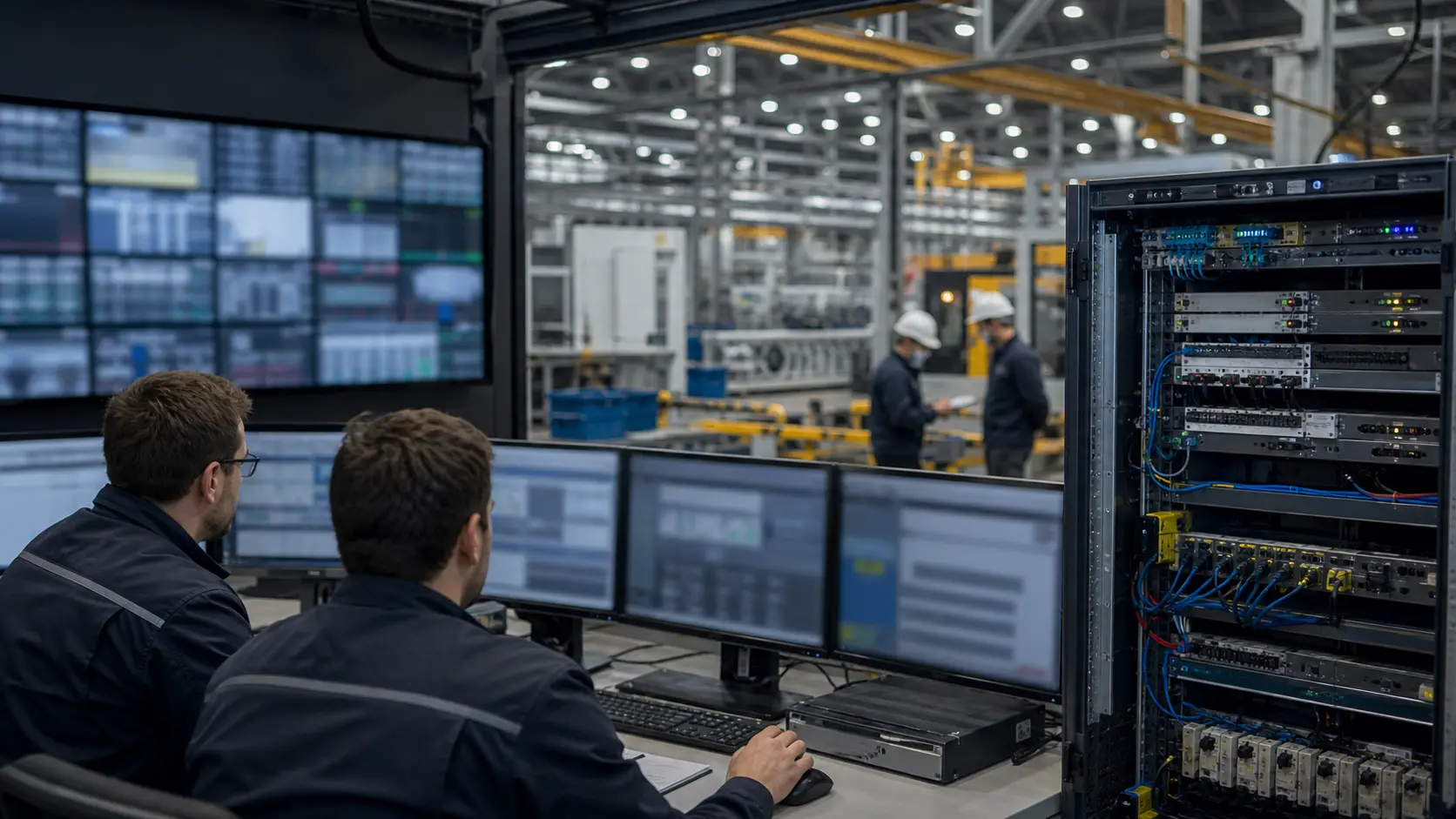
The operations team sees the account before the finance team names it. A plant in Sweden, Germany, India, China or the United States has production orders scheduled against real machines. A mining support team is waiting for diagnostic data from equipment in the field. A design engineer has a revised model that must reach manufacturing without version drift. A customer service desk needs the delivery promise to match inventory, service capacity and the actual state of production. The network and systems behind these movements are not a back-office convenience. They are a continuity account.
The paid unit is not an internet connection. It is an industrial group IT, network and production-continuity account that lets a global manufacturer price work through time. It includes enterprise addressing, routing, security monitoring, cloud connectivity, directory and identity services, engineering-data access, plant integration, ERP and MES availability, local support labour, supplier support, incident response, backup, recovery, compliance, and the cost of making changes without stopping the work the systems exist to support.
Sandvik Group IT AB matters because the public record places it in the number-resource and group-services layer of a company whose operating divisions depend heavily on digital coordination.
Sandvik is not a light digital-services business that can tolerate a loose separation between information systems and real activity. The official group description for 2025 places Sandvik at about 42,000 employees, about SEK 121 billion in revenues, about SEK 4.5 billion in research and development investments, and about 7,500 active patents. The company describes itself as a global industrial technology group serving manufacturing, mining and infrastructure. Its annual reporting divides the industrial problem into large operating arenas: Mining, Machining and Intelligent Manufacturing, and Rock Processing.
Each arena has a different cycle, but all three increase the value of reliable digital infrastructure.
That is why the opening economic question should be plain: what is the plant, mine-support, engineering and commercial system paying for? The answer is uptime priced through dependency. A factory can buy separate connectivity, a separate cloud account, a separate ERP service, a separate MES service, a local support desk and a cybersecurity retainer. The buyer can also choose centralized hyperscale cloud, an external managed-service provider, a plant-level IT team, a delayed digital project or a supplier-specific platform. Those substitutes are real, but they do not remove the need for continuity.
They move the risk to a different balance of scale, control, latency, knowledge and lock-in.
The internal group account earns a premium only if it lowers total interruption cost. It has to protect production hours, keep engineering data usable, make cross-border collaboration secure, reduce repeated plant-by-plant reinvention, prevent supplier dependence from fragmenting the estate, and make incidents recoverable. If it merely centralizes paperwork, plants will see it as an overhead. If it converts scale into availability, response discipline and better choices between internal and external services, it becomes part of industrial margin.
The public evidence is scattered across industrial, registry and supplier surfaces, which is exactly how an internal continuity account usually appears. Sandvik's group scale is visible at https://www.home.sandvik/en/about-us/ and its digitalisation strategy at https://www.home.sandvik/en/offerings/digitalization/. Segment economics come from the Mining report at https://www.annualreport.sandvik/en/2025/our-operations/mining.html, Machining and Intelligent Manufacturing at https://www.annualreport.sandvik/en/2025/our-operations/machining-and-intelligent-manufacturing.html, Rock Processing at https://www.annualreport.sandvik/en/2025/our-operations/rock-processing.html and the 2025 key-risks section at https://www.annualreport.sandvik/en/2025/directors-report/risk-management/key-risks-2025.html. The network-resource boundary is visible through RIPE at https://www.ripe.net/membership/indices/data/se.sandvik.html and https://rest.db.ripe.net/search.json?query-string=Sandvik%20Group%20IT%20AB. Supplier and substitute context comes from SAP manufacturing software at https://www.sap.com/products/scm/manufacturing.html, Siemens Industrial Edge at https://www.siemens.com/en-us/products/industrial-edge/, AWS manufacturing services at https://aws.amazon.com/manufacturing/ and the industrial-control advisory environment at https://www.cisa.gov/news-events/ics-advisories?search_api_fulltext=manufacturing. These sources prove dependence and governance, not private outage economics; that boundary is the reason the article prices watchpoints rather than pretending to know the internal service ledger.
Group scale makes IT an operating input
Sandvik's public operating profile explains why group IT should be read as an industrial input rather than an office expense. Sandvik Mining's 2025 revenue was reported at SEK 62.971 billion, with adjusted EBITA of SEK 13.045 billion and 18,395 employees. The business sells equipment, parts, service, digital solutions and technologies for mining and infrastructure. Its strategic priorities include aftermarket, surface drilling, automation, mining software and electrification.
A business with that mix depends on field data, service coordination, customer support systems, machine documentation, engineering knowledge and secure connectivity between mines, service teams and corporate systems.
Machining and Intelligent Manufacturing is a different but equally demanding case. Sandvik reported 2025 revenues of SEK 47.273 billion, adjusted EBITA of SEK 9.385 billion and 19,974 employees in that area. The business combines advanced metal-cutting products with digital manufacturing and industrial software positions across design, planning, simulation, production preparation, metrology and verification. The value chain described in the annual report runs from component design through production engineering, shop-floor execution, machining and verification. That chain is not tolerant of bad data continuity.
A wrong file, delayed update, failed license, identity outage or disconnected shop-floor system can turn engineering work into scrap, rework or idle machine time.
Rock Processing is smaller but still material, with 2025 revenue of SEK 10.435 billion, adjusted EBITA of SEK 1.546 billion and 2,779 employees. Its public description includes crushing, screening, wear protection, feeders, service, lifecycle optimization and digital solutions. The operating reality is again a blend of equipment, service and data. A customer paying for uptime in a quarry, mine or infrastructure setting wants support that knows the machine, the process and the availability consequence.
Group IT cannot run the crusher, but it can help decide whether the service record, parts visibility, diagnostic trail and customer communication stay connected.
Across these divisions, Sandvik's own digitalization page says the company aims for digital leadership by combining hardware and software. It describes mining equipment that collects data for advanced analysis and predictive maintenance; rock-processing offerings with connectivity and real-time production information; and manufacturing software that connects design, planning, production, verification and recycling. This is the core economic point. The company has moved enough operational value into digital coordination that network, cloud and plant systems now sit inside the value chain.
The scale also changes labour economics. A 42,000-person industrial group cannot support every plant by hiring full copies of rare network, security, ERP, MES, data, identity and industrial-connectivity expertise at each site. Local knowledge remains essential, but scarce expertise has to be shared. A group account can pool high-end architecture, security response, vendor management and standards while leaving plant teams close enough to machines and shifts. The tension is obvious: too much centralization creates queues and resentment; too much local autonomy creates duplicated cost, weak security and incompatible systems.
This is why the cost should be measured against output, not headcount alone. The account is expensive because it must serve revenue-bearing assets. It carries fixed costs in people, contracts, monitoring, connectivity, infrastructure and recovery capacity. In a downturn those fixed costs look heavy. In an uptime event they look cheap. The correct comparison is not a generic IT benchmark.
It is the cost of one hour of unplanned downtime in a high-utilization plant, the cost of engineering data loss, the cost of a delayed mining-service response, the cost of a failed cyber recovery and the cost of fragmented vendor platforms across hundreds of operating locations.
The RIPE record prices control, not retail transit
The public number-resource record gives a narrow but important signal. RIPE NCC lists Sandvik Group IT AB as a Local Internet Registry in Sweden, with a Sandviken address and Swedish service area. The RIPE database also includes Sandvik Group IT AB records tied to Swedish registration information, RIPE maintenance references and Sandvik-managed contacts. This does not prove that Sandvik Group IT AB sells retail internet access, cloud hosting, managed networking or IP transit to the market.
It proves something more relevant for this essay: the group maintains a public-facing number-resource and governance footprint that belongs to an industrial operating estate.
For a manufacturer, network-resource control is not glamorous. It is a set of rights, duties and practices that keep address space, routing, abuse contacts, maintenance records and provider relationships coherent. The price sits in administration, compliance, engineering review, route hygiene, DNS discipline, firewall policy, identity integration, remote-access control, peering or transit choices where applicable, and the boring work of preventing old assets from becoming unknown assets. A group with plants, sales offices, service centers, customer portals and engineering collaboration cannot treat this layer as casual clerical work.
The RIPE record also reveals a supplier boundary. One Sandvik-related RIPE record references Telia maintenance. That is exactly how large industrial groups often look from the outside: some resources and records are internally governed; some network functions depend on national carriers, global telecommunications providers, cloud providers and specialist integrators. The economics are not internal versus external. They are the cost of deciding what must stay governed by the group and what can be bought as a commodity service without losing recoverability or control.
Network resources become production economics when the network carries production dependencies. Remote support for mining equipment, access to engineering repositories, supplier portals, identity services, plant telemetry, customer-service systems and ERP connections all sit on top of addressing and secure transport decisions. When the network is unstable, the immediate symptom may be a login failure or a slow application.
The real cost is a production order that cannot be confirmed, a drawing that cannot be trusted, a remote technician who cannot see the machine, or a plant team that falls back to manual work while the rest of the group sees stale data.
This is also where cross-border collaboration becomes a cost line. Sandvik operates in many jurisdictions, serving industrial customers with plants, mines and infrastructure assets that do not share a single regulatory or network environment. Data locality, sanctions screening, export control, customer-security requirements, privacy rules, national telecom reliability and cyber reporting duties can all shape where data sits and how support teams reach it. A centralized account can simplify these decisions if it has authority and expertise. It can also create friction if it ignores local constraints.
The public record cannot price Sandvik's exact network account. It cannot show address utilization, route policy, transit contract terms, private links, plant segmentation, incident history or recovery time. But it does show that Sandvik Group IT AB belongs to a governance layer where network resources are held deliberately. In an industrial group, that layer is an option on continuity: not valuable because it is visible in registry data, but valuable because it gives the company a stronger hand when uptime, security and supplier dependence collide.
Cloud, ERP and MES dependence sits in the same stack
The digital stack in an industrial group is layered, but the production consequence is joined. Cloud services may host analytics, collaboration, development, customer-facing applications, backups and data platforms. ERP systems carry finance, purchasing, inventory, order promising and reporting. MES and plant systems translate planning into production activity, batch records, machine states, quality checks and shift reality. Engineering systems hold designs, process knowledge and configuration. The price of Sandvik's group IT account is the price of keeping those layers connected enough to be useful and separated enough to be resilient.
Supplier evidence shows the market direction. SAP's manufacturing software materials emphasize integration between manufacturing software, ERP and other systems through standardized interfaces and real-time data exchange, with end-to-end visibility between shop-floor execution and business management. Siemens describes industrial edge systems that connect shop-floor assets with cloud platforms, ERP, MES, SCADA and industrial messaging, while supporting central management and data processing near the factory floor. AWS positions cloud services for manufacturers from product design through smart manufacturing and connected products.
These supplier claims are marketing evidence, not proof of Sandvik's private architecture. They still show the menu that industrial groups now face.
The question for Sandvik is not whether cloud is good or bad. It is which workloads can tolerate distance, which require plant-local continuity, which require group-standard governance, and which should stay close to a supplier-specific machine or software environment. Enterprise reporting may tolerate a short delay. Production scheduling may not. Design collaboration may need global reach and version control. A plant control function may require local resilience even when the wide-area network is impaired. A support engineer may need secure access through approved paths rather than improvised remote sessions.
ERP and MES dependence also changes the meaning of downtime. A plant can sometimes keep machines running during an ERP outage, but only by accumulating reconciliation debt. Orders, inventory, quality records, shipment promises and finance entries must be corrected later. An MES outage may be more immediate if operators lose work instructions, production records or machine-state integration. A cloud identity failure can disable access across many services even when each application is healthy.
A certificate, directory, network-security or single sign-on problem can become the failure point that no plant manager wanted to learn about during a rush order.
This is the central-stack cost. Sandvik's public digitalization statements describe a company where industrial software, digital mining, predictive maintenance, real-time production data and connected manufacturing matter to the business proposition. That means the group IT account must buy more than servers. It must buy architecture that understands manufacturing cycles, controls change windows, sequences upgrades, keeps plant workarounds documented, and avoids making one supplier's convenience the default answer across the company.
The cost paragraph is therefore concrete. The account pays for number-resource administration; wide-area networking; cloud landing zones; security monitoring; identity and access; ERP, MES and plant-integration contracts; engineering-data systems; application support; backup and recovery; endpoint management; supplier support; vulnerability handling; industrial remote-access controls; local support labour; travel and shift coverage; cyber insurance where used; incident-response retainers; compliance evidence; business-continuity testing; data residency work; and the internal finance mechanism that allocates cost back to divisions and plants.
Some of these items are visible in procurement. Others appear only when a failed change has to be repaired outside office hours.
Plant support labour is the scarce input
The most important resource may be the one that does not scale cleanly: people who understand both industrial work and information systems. A plant-support specialist who knows local machines, shift practices, safety rules, network cabinets, supplier contacts, production planners and the informal sequence of work is not interchangeable with a remote help desk. The central account can provide standards and deep expertise, but local recovery often depends on someone who can stand near the line, talk to operators and translate a system failure into production language.
This labour is scarce because industrial knowledge is slow to build. A network engineer can learn routing and security, but that does not automatically teach the difference between a harmless office outage and a plant issue that threatens a shipment. A plant technician can understand machines, but that does not automatically cover identity federation, cloud policy, endpoint hardening, logging and segmented remote access. The valuable labour sits between these worlds. It knows when to escalate, when to isolate, when to wait for a maintenance window and when a system that looks secondary is actually holding production together.
Sandvik's risk reporting supports the labour point indirectly. The company identifies the need to attract and reskill talent in areas such as digitalization, electrification and sustainability. It also frames digital disruption, cybersecurity and customer requirements for cyber and information security as key risks. Those are not abstract human-resources themes. They are indicators that the company needs people who can turn technology programs into repeatable industrial practice. A shortage of this labour raises the price of every system decision.
Centralization can help. A group IT account can create playbooks, shared monitoring, common security controls, vendor-management discipline and a career path for specialist staff. It can prevent every plant from negotiating its own fragile support arrangement. It can also give local teams access to skills they could not hire alone. That is the positive case for Sandvik Group IT AB as a group-service layer: it pools scarce skill and converts it into repeatable support for manufacturing, mining and service businesses.
Centralization can also fail in familiar ways. A global service desk may route a plant issue through the wrong queue. A standard change may collide with a local production run. A cybersecurity rule written for office systems may block a production-support path. A remote engineer may miss the practical meaning of a local workaround. A plant may respond by rebuilding local shadow systems, storing copies in uncontrolled locations or paying a supplier directly for emergency support. When that happens, the account still exists, but its authority erodes.
The economic metric is mean time to industrial recovery, not ticket closure. A ticket can close when an application is available; production may still be behind. A network incident can be resolved technically while engineering teams spend hours reconciling file versions. A plant can run manually for a shift and then lose the next day to inventory and quality cleanup. The scarce labour account should therefore be priced by avoided industrial loss: hours of protected production, avoided rework, reduced travel, fewer repeat incidents, faster cyber containment, better upgrade timing and fewer uncontrolled local exceptions.
Cyber risk is an availability cost before it is a disclosure cost
Sandvik's annual risk reporting places cybersecurity and information security inside the digital disruption and customer-requirement risk area. It also refers to a cybersecurity improvement program and implementation work around the European NIS2 directive. That public language is important because it frames cyber risk as a mainstream industrial operating matter. For Sandvik's divisions, the first question is not only whether confidential information is protected. It is whether the company can keep manufacturing, service and engineering work moving when cyber risk rises.
Industrial cyber risk has a different cost shape from ordinary office disruption. A successful attack, credential compromise or uncontrolled vulnerability can stop a plant, isolate a remote-service path, prevent engineering access, block order processing, corrupt scheduling confidence or force a company to run on manual procedures. Some events become public. Many more remain internal: emergency patching, network segmentation work, supplier-access review, forensic investigation, password resets, endpoint cleanup, recovery testing, legal review and customer assurance.
The private cost is often measured in lost time and management attention even when no public incident is announced.
CISA's industrial-control advisory page provides background evidence for the risk environment. It tracks thousands of industrial-control advisories and describes advisories as notices covering vulnerabilities affecting industrial control, operational technology and connected industrial devices, with mitigation recommendations. This is not evidence of a Sandvik incident. It is evidence that industrial companies operate in a vulnerability environment where suppliers, plants and connected systems require continuous attention. A large manufacturer does not get to treat patching and segmentation as occasional housekeeping.
The price of cyber resilience lands in several buckets. There is preventive cost: asset inventory, segmentation, identity controls, privileged-access management, vulnerability scanning, endpoint hardening, backup immutability, supplier-access review, secure remote maintenance and training. There is detection cost: logs, monitoring, response staff, escalation and external specialist retainers. There is recovery cost: clean-room rebuild capacity, spare hardware, tested backups, communication channels, manual production procedures and customer-response capability.
There is also opportunity cost: slower change, extra approvals and the friction of making systems safer without freezing the business.
The key economic error is to price cyber as a compliance burden alone. Customers in mining, manufacturing and infrastructure increasingly ask suppliers to prove cyber and information-security discipline because a supplier's weakness can become a customer disruption. Sandvik's own risk reporting notes customer requirements around cyber and information security. That means strong group IT can support revenue by helping divisions satisfy customer assurance, bid requirements and service expectations. Weak group IT can become a commercial discount, even before an incident occurs.
The private metrics that matter are hard-edged: number of high-risk assets by site, time to remediate severe vulnerabilities, share of remote access under approved controls, incident containment time, recovery time, backup restore success, plant downtime from security changes, supplier exceptions, repeat findings, customer security questionnaires passed without escalation and the financial impact of near misses. Public reporting can tell readers that Sandvik takes the risk seriously. It cannot tell them whether the account is overbuilt, underfunded or exactly matched to the production risk.
Vendor lock-in is useful until it becomes a queue
Industrial companies buy lock-in for good reasons. A mining equipment platform, a manufacturing software suite, an ERP environment, a cloud service, a network provider and a plant-automation supplier all promise integration, support and reduced ambiguity. The more coherent the supplier stack, the easier it can be to deploy standard updates, support users, train staff and collect data. Lock-in becomes economically rational when the supplier's system reduces failure, shortens delivery time and gives the group capabilities it could not build cheaply alone.
Sandvik's operating context contains many such dependencies. The company sells and uses advanced industrial systems across mining, machining, software and rock processing. Its public annual report describes leadership in mining software and automation, digital manufacturing software, simulation, optimization and metrology. It also lists competitors and suppliers in overlapping industrial-software and equipment markets, including large machinery and software companies. The point is not that Sandvik is uniquely locked in. It is that any group operating at this level is surrounded by strong platforms with their own economic gravity.
Supplier-specific platforms can be a substitute for a general group account. A plant might rely on a machine supplier's remote-support environment. A manufacturing team might prefer a software vendor's cloud. An operations group might adopt an industrial edge platform from a major automation supplier. A business unit might believe its own preferred environment moves faster than a central standard. These choices can be sensible locally, especially when a supplier knows the machine or software better than anyone else.
The cost appears later if each supplier becomes its own identity island, data store, remote-access method, monitoring surface and renewal calendar. A plant can end up with strong local capability but weak group visibility. Security teams may not know who can reach what. Engineering data may be hard to compare. Procurement may lose bargaining power. Incident response may depend on several supplier help desks that cannot coordinate quickly. A downturn may expose renewal commitments that looked harmless in growth years.
Group IT's role is not to reject suppliers. It is to discipline lock-in. That means setting identity standards, remote-access rules, data-retention requirements, recovery expectations, integration patterns, contract exit rights, logging requirements and minimum support terms. It also means knowing when to accept supplier lock-in because the alternative would be slower, riskier or more expensive. In manufacturing, purity is often costly. The better question is whether the group can leave, recover, isolate and renegotiate if a platform stops serving the production account.
Vendor lock-in should therefore be priced as a queue. When a plant needs a change, does it wait behind a supplier roadmap, a central governance board, a global release cycle, a cybersecurity exception or a budget committee? If the queue is short and predictable, lock-in can be acceptable. If the queue blocks production improvements or emergency recovery, it becomes a hidden tax. Sandvik's group-service economics should be judged by how often it turns supplier dependence into leverage rather than delay.
Internal group services have their own economics
The internal group-service model is often misunderstood because no external customer invoice reveals the value. Sandvik Group IT AB is not being evaluated here as if it were a public ISP selling bandwidth to unrelated customers. Its economic role is closer to an internal utility and risk allocator. It can hold network governance, negotiate services, standardize controls, operate shared platforms, manage security and charge costs to divisions or sites. The price signal is internal, but the consequences are industrial.
Internal charging changes behaviour. If plants see group IT as a flat corporate tax, they will minimize engagement and build around it. If charges are tied too tightly to consumption, plants may avoid useful services or delay modernization to protect short-term budgets. If central services are subsidized without performance accountability, costs can drift. The right model must preserve enough central authority to protect the group while showing divisions that the account reduces real cost, not just local autonomy.
The cost bridge has to separate run cost from change cost. Run cost covers networks, identity, security monitoring, cloud base services, enterprise applications, backups, service desks, contract management and compliance. Change cost covers plant integrations, upgrades, migrations, acquisitions, divestments, new customer requirements, new software, cybersecurity uplift and data programs. Manufacturing groups often underestimate change cost because the visible license is only one line. The real expense is migration, testing, downtime windows, user retraining, local support and the period when old and new systems must coexist.
Sandvik's own risk reporting mentions business transformation, digital strategy, data-driven productivity, restructuring projects, contingency plans, pricing initiatives and inventory management. These are not purely financial statements. They imply active management of operating systems through the cycle. Group IT sits inside that work because transformation without reliable systems is theatre, and restructuring without clean data can create new confusion. The account becomes valuable when it helps management see and act on the business rather than waiting for manual reconciliations.
There is also a portfolio effect. A mining business may need resilient field support and customer service. A machining software business may need cloud, licensing, identity and engineering collaboration. A rock-processing business may need service visibility and industrial data around installed equipment. A central account can compare lessons across the portfolio: what remote-access control worked, which supplier terms caused trouble, which data standards reduced rework, which plant support model recovered fastest. That learning has value if it is actually captured and reused.
The danger is central averages. A shared service can optimize for the average site and miss the outlier that carries high margin, high risk or urgent customer obligations. A plant with unusual process constraints may need more local authority. A newly acquired software business may need different security and release practices from a heavy industrial site. A mining-service hub supporting customers across time zones may need staffing patterns that a standard office support model cannot handle. Good internal economics permit justified differences while stopping uncontrolled fragmentation.
Manufacturing cycles change the value of uptime
Manufacturing-cycle pressure is central to the account because uptime is not worth the same amount in every month. When order books are full, a plant outage can mean missed revenue, late deliveries, overtime, expedited freight and customer damage. When demand softens, the same outage may be absorbed into slack capacity, although it can still damage service and quality. Sandvik's annual report notes the need to manage through the cycle, protect margins, control working capital and handle ramp-up or contingency fatigue. Those financial phrases translate directly into IT value.
In Mining, cycle pressure may appear through customer capital spending, aftermarket demand, commodity prices, mine productivity needs and large equipment orders. Digital support and service systems can become more valuable when customers need availability and less patient when a mine is waiting for parts or diagnostics. In Machining and Intelligent Manufacturing, customer demand can move with industrial production, aerospace, automotive, energy and general engineering cycles. Software and engineering-data continuity matter because customers want to compress development and production time.
In Rock Processing, infrastructure, mining and aggregates cycles shape demand for equipment, wear parts and service.
The IT account has to handle both expansion and restraint. During expansion, plants may ask for faster onboarding, new capacity, new integrations, more remote support, customer data services and new software. During restraint, finance may demand lower run cost, delayed upgrades, fewer consultants and tighter vendor renewals. Cyber risk, however, does not fall neatly when demand falls. A downturn may actually make risk management harder if teams postpone upgrades, stretch hardware, reduce local support or accept temporary workarounds that become permanent.
This is why delayed digital projects are a real substitute. A business unit can defer an MES upgrade, postpone a cloud migration, delay plant data integration or leave a local system alone because the payback is hard to prove in a weak market. Deferral can be rational. A bad migration at the wrong moment can damage production more than it helps. But deferral also accumulates technical and operational debt: unsupported software, fragile interfaces, older security controls, staff knowledge trapped in local routines and greater dependency on suppliers who know obsolete environments.
The cycle also changes vendor bargaining. In strong markets, suppliers may have pricing power and scarce consultants. In weak markets, buyers may renegotiate, consolidate contracts or press for more flexible terms. A central group account can exploit this if it sees the whole estate. A local plant may lack leverage. Conversely, a central account can miss urgent local needs if it treats all renewals as procurement exercises. The right economics combine group leverage with production-sensitive timing.
Private downtime metrics are the missing proof. The article can say Sandvik's divisions are large enough that downtime matters. It can say public reporting shows digital, cyber and transformation priorities. It cannot state the cost of an hour of downtime in a Sandvik plant or service hub. That number belongs to internal production margin, bottleneck capacity, order backlog, customer penalties, restart time and quality risk. Without it, the external reader can understand the logic but cannot price the account precisely.
Outsourcing alternatives discipline the account
The internal account is not the only possible answer. A centralized hyperscale cloud model can reduce data-center complexity, provide global scale, improve security controls and shift some resilience burden to a major provider. An external managed-service provider can take over networks, endpoints, service desk, security monitoring, cloud operation or application support. A plant-level IT team can move faster locally and preserve site knowledge. A delayed digital project can avoid spending before the business case is proved. A supplier-specific platform can solve a narrow industrial problem faster than a group standard.
Each substitute prices a different risk. Centralized hyperscale cloud is attractive for scalability, resilience features and a deep services menu, but it can create cost surprises, dependency on identity and connectivity, data-location questions and difficulty when plant systems need local continuity. External managed service can professionalize operations and create service-level commitments, but providers may lack plant context and can become another queue during a production issue. Plant-level IT can be close to operators and machines, but it may duplicate cost, weaken governance and struggle with cyber complexity.
Delayed digital projects preserve cash, but they can let debt grow. Supplier-specific platforms can be excellent within their domain, but they can fragment identity, data and exit options.
Sandvik's group account should therefore be judged against the best mix, not an ideological preference for internal control. Some workloads belong in cloud. Some support functions can be outsourced. Some plant knowledge should remain local. Some supplier platforms are worth accepting. The value of Sandvik Group IT AB is in deciding the boundary intelligently and making the boundary recoverable. If everything is internal, the group may move too slowly and carry too much fixed cost. If everything is outsourced or supplier-specific, the group may lose the operating memory needed to respond when systems fail.
The outsourcing comparison is also financial. External providers can make costs visible through contracts, but visible does not mean lower. A provider's price includes its margin, standard service model, change fees, exception handling, transition work, retained internal oversight and the cost of proving industrial requirements. Cloud can look cheap at entry and expensive at scale if data movement, resilience, support, security and consumption are not governed. Local plant teams can look expensive per employee and cheap per avoided hour of downtime. Delayed projects can look prudent until an incident exposes old infrastructure.
For a global industrial group, the strongest model is usually hybrid in the practical sense: centralized governance, selected external scale, local industrial knowledge and supplier platforms kept under group rules. The hard part is not naming the model. It is funding the retained capability that makes outsourcing safe. A company can outsource a service, but it cannot outsource responsibility for production, customer trust and recovery. The retained group account must know enough to challenge suppliers, design exits, test recovery and tell divisions when a cheaper option is actually riskier.
The conclusion on substitutes should be explicit. Centralized hyperscale cloud, an external managed-service provider, a plant-level IT team, a delayed digital project and a supplier-specific platform all discipline the Sandvik Group IT account. None of them eliminates the need to price uptime, engineering data continuity and secure cross-border collaboration. They only change who carries the risk and where the bill appears.
Private downtime and incident metrics decide the premium
The external evidence supports a thesis, not a complete valuation. It proves that Sandvik is a large industrial group with major mining, machining, intelligent manufacturing and rock-processing businesses. It proves that Sandvik publicly describes digitalization, automation, connected production, predictive maintenance and industrial software as part of its strategy and offerings. It proves that Sandvik reports cybersecurity and information-security risks, customer security expectations and digital disruption as risk areas.
It proves that Sandvik Group IT AB appears in RIPE NCC and RIPE database records as a Swedish group IT and number-resource holder. It proves that industrial suppliers market cloud, ERP, MES, edge and plant-connectivity services to manufacturers.
What it does not prove is equally important. It does not prove Sandvik's private downtime cost by plant, product line or service hub. It does not disclose incident frequency, near misses, cyber recovery tests, service-ticket queues, local support staffing, remote-access exceptions, cloud spend, ERP or MES uptime, identity outages, backup restore rates, data-loss events, vendor discounts, internal chargeback rules, service-level credits, network topology, plant segmentation or the exact application map. It also does not prove whether Sandvik Group IT AB is cheaper or more expensive than an external provider for any specific scope.
Those private metrics are the premium. A renewal should ask for the production-loss model: how much contribution margin is at risk per hour at constrained plants, and how does that vary by cycle? It should ask for engineering-data metrics: version conflicts, file recovery, access latency, integration failures and rework tied to data errors. It should ask for cyber metrics: containment time, recovery time, backup success, critical-asset exposure and incidents caused by supplier access. It should ask for support metrics: mean time to restore industrial service, repeat incidents, plant satisfaction, emergency travel and after-hours escalation.
It should ask for supplier metrics: lock-in exposure, contract exit rights, renewal concentration, support responsiveness and number of exceptions.
The account also needs private incident economics. Not every incident is a shutdown. Some are slowdowns, manual workarounds, delayed shipments, engineering rework, support delays, security freezes, compliance cleanup or customer-assurance work. These events may never appear in a public filing, but they are the events that determine whether group IT is underfunded or overbuilt. A good account reduces the frequency and severity of these small losses before they become a headline.
The data should be compared with substitutes. If hyperscale cloud has better recovery and lower total cost for a workload, use it. If an external managed-service provider can meet industrial response needs at lower retained risk, buy it. If plant-level support prevents downtime that a central desk cannot see, fund it. If a digital project does not clear the hurdle in a weak cycle, delay it deliberately. If a supplier-specific platform is the fastest way to protect a machine or production cell, use it under group rules. The premium belongs only to the account that proves it makes the industrial system more reliable than those alternatives.
Market signals are useful only at the edge
Market and social signals can help frame the environment, but they should not be treated as proof of Sandvik's internal performance. Vendor marketing from cloud, ERP, MES and industrial edge suppliers signals that manufacturers are being sold an integrated future in which plant data, enterprise planning, security and analytics are joined. Cyber advisory volumes signal that industrial systems face continuous vulnerability pressure. Official corporate digitalization stories signal strategic intent. Public social channels and recruitment messages can signal where companies want talent and attention.
None of these signals reveals a private incident queue or uptime result.
This distinction matters because industrial technology narratives are often too smooth. Every supplier promises integration. Every corporate digital page promises productivity. Every cyber program promises resilience. Every platform says it reduces complexity. The factory test is harsher. Can the plant still work during a wide-area outage? Can a service team support equipment securely across borders? Can an engineering change reach production without version confusion? Can the company recover a critical system within the time the business actually needs? Can it keep suppliers useful without handing them uncontrolled access?
Sandvik's public evidence is stronger than chatter because it is anchored in operating segments and formal reporting. The company discloses the scale of its divisions, identifies digital and cyber priorities, and makes clear that software, data and connected industrial systems matter across its businesses. The RIPE record adds a concrete number-resource governance signal. Supplier pages add context for plausible alternatives. But the public material still stops short of the private data that would settle the price.
The right use of market signals is therefore comparative. If industrial cyber advisories rise, security work becomes less optional. If cloud and edge suppliers keep selling integration between shop floor and enterprise systems, Sandvik has more external options and more lock-in risk. If industrial software competitors bundle workflows tightly, group IT must understand data portability and identity boundaries. If customers demand stronger cyber assurance, the account can become revenue support rather than overhead.
If labour markets make industrial IT staff scarce, central sharing becomes more attractive, but local knowledge becomes more precious.
Signals should never replace operational measurement. A serious Sandvik assessment would ask the company to show downtime avoided, incidents recovered, labour pooled, supplier terms improved, cyber assurance passed, engineering errors reduced and upgrades completed without harming production. The public reader can see why the account should exist. Only private metrics can prove how much it should cost.
The renewal test is operational evidence
A serious renewal test would start with the production map, not the contract list. Which plants, service hubs and engineering teams depend on which systems at which moments? Which workloads can wait, which can run locally, which need cross-border access, and which require immediate recovery? The answer should not be a diagram drawn once for a review. It should be a living evidence pack that connects business value to technical dependency: constrained machines, high-margin product lines, field-service response, critical engineering repositories, customer portals, identity services, ERP posting, MES execution and plant data collection.
The first renewal question is cost of interruption. Sandvik's public operating scale makes it reasonable to assume that some hours are expensive, but a renewal cannot rely on scale alone. It needs a ranked list of production and service processes by interruption cost, with seasonality and cycle pressure included. A plant running at high utilization before a customer shipment is not the same as a plant with spare capacity. A remote-support team facing a customer machine outage is not the same as a routine office application user. The group account should know where the next protected hour matters most.
The second renewal question is recovery realism. Many companies hold recovery targets that are cleaner than their actual systems. The test should ask when each critical service was last restored from backup, how long identity recovery took, which plant processes were included, which suppliers were needed, and what manual procedure covered the gap. Recovery that has not been tested across identity, network, applications, data and local plant work is an assumption. A group IT account earns its premium when it turns recovery from assumption into practiced industrial routine.
The third renewal question is exception discipline. Industrial estates accumulate exceptions: old machines, isolated networks, local databases, supplier remote-access paths, legacy software, unpatched dependencies, special firewall rules and emergency accounts. Some exceptions are justified because the alternative would harm production. Others survive because nobody wants the argument. The renewal should measure exceptions by risk, business owner, expiry date and recovery plan. The goal is not zero exceptions. The goal is known exceptions that remain useful under pressure and do not become permanent blind spots.
The final renewal question is whether the group account improves decisions under scarcity. When capital, expert labour and change windows are limited, Sandvik must choose. It can fund a cloud migration, strengthen plant recovery, hire local support, renegotiate a supplier platform, improve identity controls, upgrade MES integration, defer a project or buy a managed service. The right answer will vary by business cycle and site. The value of Sandvik Group IT AB is greatest if it helps the group make those trade-offs with evidence instead of habit.
Conclusion: the premium is continuity
Sandvik Group IT AB should be understood as a continuity account for a global industrial group, not as a generic technology profile. The public evidence places the company inside Sandvik's network-resource and group-service layer. The wider Sandvik evidence shows a business where mining equipment, manufacturing systems, rock processing, industrial software, service, engineering data and customer commitments depend on digital coordination. The cost is not just connectivity or software. It is the price of keeping production, engineering, security and cross-border collaboration aligned when the business is under pressure.
The economic case is strongest when the account protects high-value industrial time. It earns its cost if plants lose fewer hours, service teams recover faster, engineering data remains trustworthy, cyber incidents are contained, supplier lock-in is disciplined, cloud and ERP/MES dependencies are governed, local support labour is used well and internal charges reflect value rather than bureaucracy. It weakens if central services become slow queues, if plants rebuild uncontrolled local systems, if suppliers own the practical architecture, or if private metrics cannot show avoided downtime and faster recovery.
Sandvik's own public material points in the same direction. The group has large operating divisions, digital manufacturing and mining ambitions, customer-facing industrial systems, cybersecurity commitments and a need for scarce digital talent. The RIPE record adds a narrow but concrete signal that number-resource governance belongs inside the account. Supplier evidence shows that the alternatives are real: centralized hyperscale cloud, an external managed-service provider, a plant-level IT team, a delayed digital project and a supplier-specific platform.
Those substitutes should remain in the conclusion because they discipline the price. Centralized hyperscale cloud can offer scale but cannot by itself understand plant downtime. An external managed-service provider can operate services but still needs Sandvik to retain industrial responsibility. A plant-level IT team can move quickly but may fragment security and bargaining power. A delayed digital project can preserve cash but accumulate risk. A supplier-specific platform can solve a narrow problem while creating exit and data costs.
The Sandvik Group IT account deserves a premium only where it beats that mix on production uptime, engineering data continuity and secure cross-border collaboration.
Public Evidence Notes
The article relies on public materials that are strong enough to identify the operating unit and its constraints, but not strong enough to prove private unit margin or service quality. The sources below are included so the reader can distinguish official mandate, product, regulatory, technical and substitute evidence from inference. They support the public record; they do not replace private metrics on economics, reliability or retention.
Key public materials used for this judgement include:
- https://www.home.sandvik/en/about-us/
- https://www.home.sandvik/en/offerings/digitalization/
- https://www.annualreport.sandvik/en/2025/our-operations/mining.html
- https://www.annualreport.sandvik/en/2025/our-operations/machining-and-intelligent-manufacturing.html
- https://www.annualreport.sandvik/en/2025/our-operations/rock-processing.html
- https://www.annualreport.sandvik/en/2025/directors-report/risk-management/key-risks-2025.html
- https://www.ripe.net/membership/indices/data/se.sandvik.html
- https://rest.db.ripe.net/search.json?query-string=Sandvik%20Group%20IT%20AB
- https://btw.media/en/directory/sandvik-group-it-ab-se
- https://www.sap.com/products/scm/manufacturing.html
- https://www.siemens.com/en-us/products/industrial-edge/
- https://aws.amazon.com/manufacturing/
- https://www.cisa.gov/news-events/ics-advisories?search_api_fulltext=manufacturing