
Samsung Electronics is profiled by BTW Media because published evidence links it to internet infrastructure, governance, operational dependencies, or market visibility.
Samsung Electronics is tracked as a network infrastructure operator within the internet infrastructure ecosystem.
Samsung Electronics has public-source relevance to network operations, governance, dependency mapping, or market structure.
Samsung Electronics is tracked as a network infrastructure operator within the internet infrastructure ecosystem.
Public-source signals support medium-impact monitoring for infrastructure visibility and dependency analysis.
Samsung Electronics is profiled by BTW Media because published evidence links it to internet infrastructure, governance, operational dependencies, or market visibility.
Public-source signals support medium-impact monitoring for infrastructure visibility and dependency analysis.
| 0.90–1.00 | A | High — direct sources |
| 0.75–0.89 | A/B | Strong |
| 0.55–0.74 | B/C | Medium |
| 0.35–0.54 | C/D | Weak–medium |
| 0.10–0.34 | D | Weak signal |
| 0.00–0.09 | D | Internal monitoring |
Several public sources
•Cell-edge uplink improves up to tenfold with higher terminal transmit power, boosting coverage consistency
•Higher transmit power reduces site density requirements and strengthens FWA as a fibre alternative
The fact
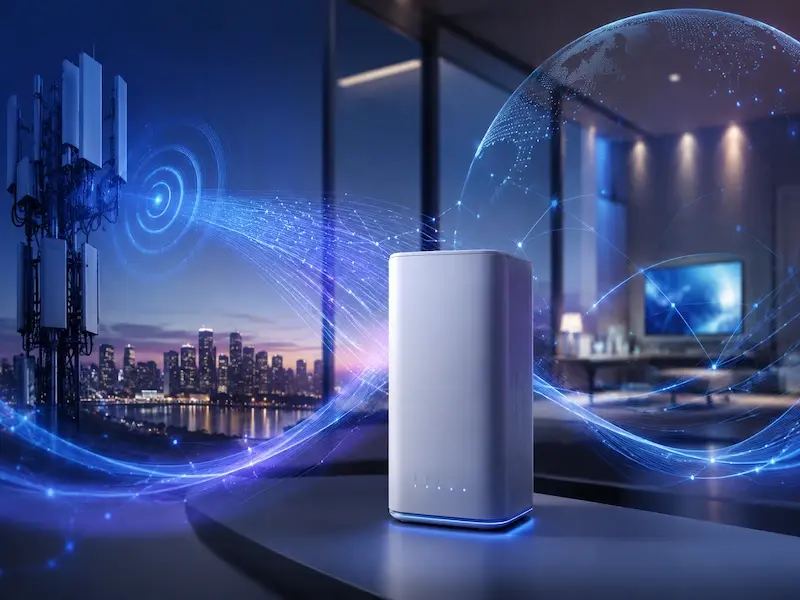
Samsung Electronics and Qualcomm have tested 5G Power Class 1 (PC1) for fixed wireless access using Samsung vRAN and Qualcomm's FWA modem platform. Results show up to 10x uplink improvement at cell-edge and around 1.4x coverage increase versus lower power classes. Testing covered lab and early field environments focused on FWA scenarios.
The assessment
The trials target 5G uplink constraints at cell-edge, where FWA performance is most sensitive. Higher terminal transmit power improves coverage consistency, strengthening FWA economics as a broadband alternative. The results also point to tighter alignment between device silicon and RAN design, with joint optimisation across the network stack replacing standalone hardware upgrades.
What to watch
Whether PC1 support reaches commercial FWA CPE shipments and next-generation vRAN deployments, and which operators move beyond lab validation to field trials.
Also read: Industry body urges carriers to build AI corridor backbone
Also read: Astera samples Scorpio X PCIe 6.0 switch for AI rack interconnect
At A Glance
- Name: Samsung Electronics
- Type: Network infrastructure operator
- Base: Global
- Profile focus: Company
What It Does
- Public records support monitoring of its role, services, and key relationships.
Why It Matters
- Public-source signals support medium-impact monitoring for infrastructure visibility and dependency analysis.
- Operational criticality: Medium
- Time horizon: Next quarter
What To Watch
- Monitoring focuses on verified service continuity, governance changes, and relationship signals.
Track verified source updates, role changes, and current public evidence.
Public-source signals support medium-impact monitoring for infrastructure visibility and dependency analysis.
Longer-term relevance depends on verified operating, policy, and relationship changes.
Member Briefing
Deeper Profile Context
Login is required to unlock the full profile briefing and source notes.
Only for Strategy Circle
Strategic Circle Access
Open to all readers. Unlock profile briefings after joining and logging in.
Join Strategic CircleOnly for Leadership Alliance
Leadership Alliance Access
For owners and management of IP-holding companies. Login required to unlock.
Join Leadership Alliance


