
Summary
- Planet Labs reported fiscal-Q2 revenue of US$116.052m, 58% above the prior-year quarter. Defence and intelligence supplied US$39.1m of the US$42.666m increase.
- The company also reported that 98% of annual contract value was recurring, but its filed definition excludes every satellite-services contract. The percentage does not describe total company revenue, bookings or backlog.
- From 30 April to 31 July, remaining performance obligations fell US$62.891m and non-GAAP backlog fell US$91.192m. These are net stock changes, not disclosed cancellation or demand-loss amounts.
- Satellite and ground-infrastructure revenue is generally recognised when customer acceptance transfers control, although qualifying contracts can be recognised over time. Launch, handover, acceptance, invoicing and collection are not one event.
- Q2 cost of revenue rose 62%, including higher spacecraft and ground-station costs. The operating test is whether new awards refill accepted work at margins and cash returns that compensate for manufacturing, launch and service risk.
The headline mixes two delivery clocks
Planet Labs' fiscal-Q2 results read like a software acceleration story. Revenue reached US$116.052m, up US$42.666m from a year earlier. Adjusted EBITDA was positive US$13.928m. Management highlighted 98% recurring annual contract value and a satellite handover for the Swedish Armed Forces.
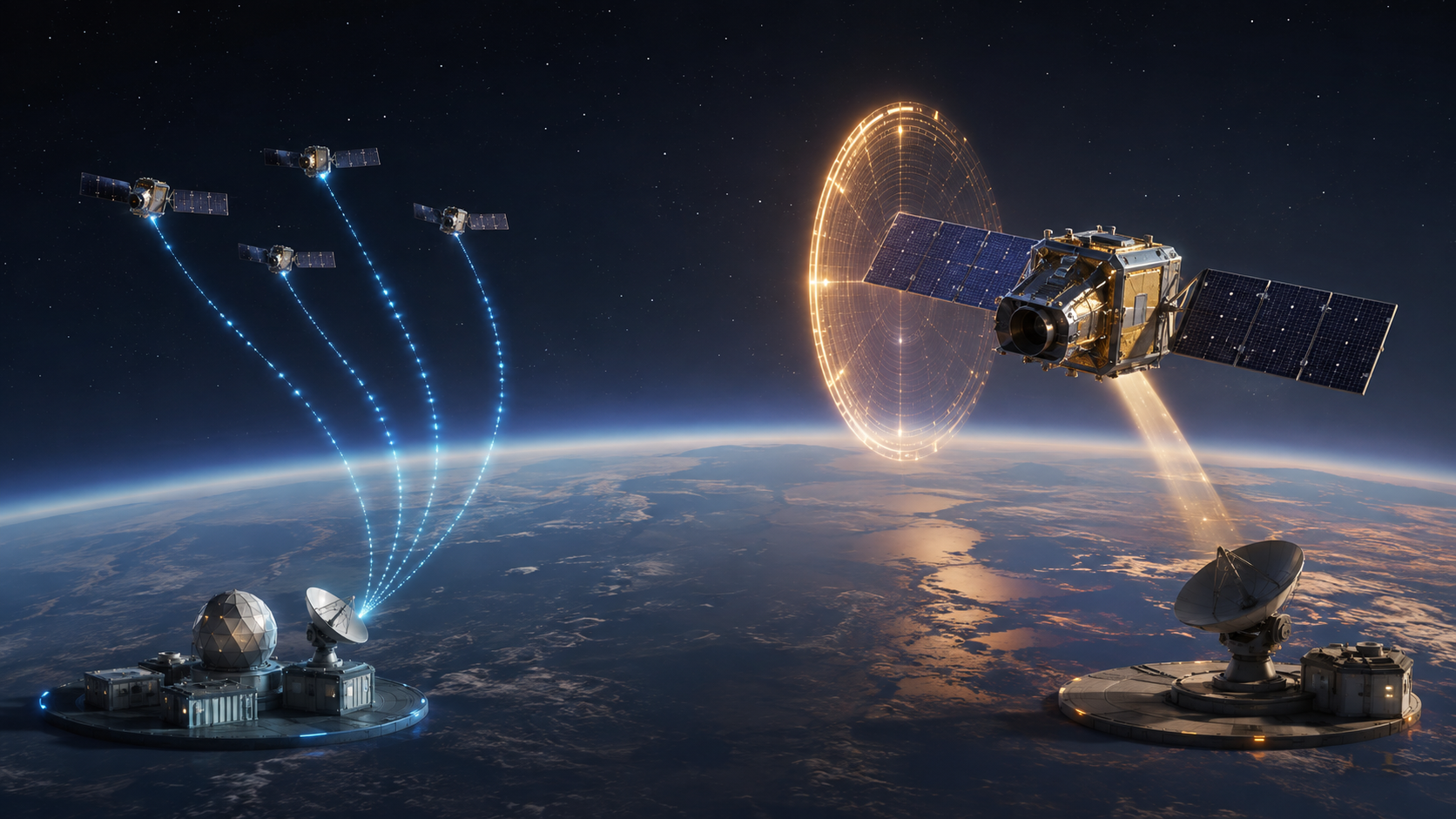
The Form 10-Q supplies the missing perimeter. Planet derives revenue from imagery licences, dedicated capacity, data solutions and satellite services. Platform access and dedicated tasking capacity are generally recognised over the contract term. A customer-owned satellite follows a different path: design, manufacture, launch, in-orbit commissioning and customer acceptance can precede point-in-time revenue.
The distinction does not make one stream better than the other. It tells readers which receipt has been produced. A subscription period produces access revenue. An accepted spacecraft can convert a large performance obligation into revenue at one control-transfer date. Putting both in one quarterly growth rate is correct accounting, but it does not make their repetition, margin or cash timing identical.
The filing attributes US$39.1m of the quarterly revenue increase to defence and intelligence. It says the wider increase came primarily from large expansions with existing customers and partially from satellite-hardware delivery recognised when control transferred. It does not disclose the hardware amount, the Sweden amount or a customer-by-customer revenue bridge. Any attempt to manufacture those numbers would convert a useful mechanism into false precision.
Ninety-eight per cent is a fenced statistic
Planet's definition of end-of-period ACV book of business includes imagery licensing, data solutions and dedicated image-tasking capacity. It excludes customers who only buy self-service access to Planet Insights Platform. More importantly for this quarter, it excludes the value of satellite-services contracts.
The 98% numerator is the value of data-subscription contracts plus the committed portion of eligible usage-based contracts that Planet classifies as recurring. The denominator is not all company contract value. It is the eligible ACV book after the stated exclusions.
That makes several common formulations wrong. It is not evidence that 98% of Q2 revenue was recurring. It does not say 98% of backlog will recur. It does not annualise satellite handovers. Nor does it show how much recurring data revenue followed the construction or operation of a customer-owned satellite.
The statistic remains useful inside its fence. It says the eligible data-and-imagery book was overwhelmingly composed of contracts with renewal potential. The filing separately reports net dollar retention including winbacks of 110% for the first half, driven mainly by large defence and intelligence expansions. Yet that retention measure also works from Planet's defined ACV population, not from satellite-services contract value.
The correct question is therefore not whether 98% is “real.” It is what decision the percentage can support. It can inform renewal durability in the included data book. It cannot settle the repeatability of point-in-time satellite revenue or the economics of manufacturing customer-owned spacecraft.
A US$91.2m backlog decline is not a cancellation report
Planet ended April with US$816.008m of remaining performance obligations. It added US$90.047m of cancellable contract value to report US$906.055m of backlog. At July, RPO was US$753.117m and the cancellable component was US$61.746m, producing backlog of US$814.863m.
The Q2 changes are exact: RPO fell US$62.891m, the cancellable component fell US$28.301m and backlog fell US$91.192m. But the interpretation is not exact without a roll-forward.
RPO contains deferred revenue and non-cancellable contracted revenue not yet recognised. It excludes unexercised options, written orders whose funding has not been appropriated and contracts terminable for convenience without a substantive penalty. Planet's backlog measure adds the cancellable and unfunded-written-order perimeter because such clauses are common in government work. It still excludes unexercised options.
A closing stock moves when new business enters, old business is recognised, contract scope changes, funding status moves or work is cancelled. Planet did not publish the Q2 amounts for each path. Calling the US$91.192m decline “lost demand” would ignore revenue conversion and new awards. Calling it all recognised revenue would ignore bookings and other changes. The honest observation is narrower: the future-work stock contracted during a quarter with unusually strong current revenue.
The first-half comparison shows why the components matter. Since January, RPO fell US$99.318m, while cancellable contract value rose US$13.754m. Backlog therefore declined by the smaller US$85.564m. A higher backlog can contain more revocable value; a lower backlog can accompany successful delivery. The label alone cannot reveal enforceability or progress.
Acceptance is the control receipt
Planet's satellite-services contracts are fixed-price, multi-year arrangements. A customer can purchase a satellite and also buy ground infrastructure, engineering, operations and professional services. Those are not automatically one performance obligation. Planet allocates price among them using estimated standalone selling prices, often through expected cost plus a margin because observable prices are unavailable.
Customer acceptance matters twice. Contractual milestones generally require acceptance before Planet can invoice. Revenue for satellites and ground infrastructure is generally recognised when control transfers, commonly when the customer accepts the commissioned in-orbit satellite or completed ground system.
Some arrangements qualify for revenue over time when Planet has a right to payment for work performed on an asset with no alternative use, or when termination terms support continuous transfer. Relevant over-time work uses cost-to-cost progress and therefore depends on estimates of total cost at completion. Engineering, operations and professional services are also recognised over time.
The sequence matters: signing is not funding; launch is not commissioning; first light is not acceptance; handover is not necessarily cash collection. Planet's Q1 release said Sweden's first sovereign reconnaissance satellite launched just over four months after contract signing. Q2 highlighted a handover. The annual results had described a wider multi-year, low-nine-figure Sweden agreement. None of those disclosures assigns Q2 revenue to Sweden, so the named programme is evidence of the operating gate, not a licence to reverse-engineer its accounts.
Margin and liquidity need their own receipts
GAAP cost of revenue rose 62% to US$50.420m, faster than revenue. Planet attributed US$9.2m of the increase to spacecraft costs and US$2.0m to ground-station expenses associated with satellite-services obligations. Gross margin rounded to 57%, down from 58%. That is consistent with a quarter in which the delivery mix changed, but the filing does not publish a satellite-services gross margin.
Three customers supplied 17%, 11% and 10% of quarterly revenue. Two customers represented 25% and 11% of receivables at quarter-end. Concentration can accelerate delivery and cash when milestones succeed; it can also make acceptance, appropriation and collection timing more visible in a single quarter.
Planet ended July with US$865.4m of cash, equivalents and short-term investments. Operations generated US$68.388m in the first half and free cash flow was US$21.297m. The liquidity headline also contains financing: US$122.4m of gross ATM equity proceeds and US$107.8m from warrant exercises entered financing cash during the half. Operating progress and capital-market access are both real, but they are different sources of capacity.
The Q3 guide makes the timing question concrete. Planet forecast US$101m–US$105m of revenue and an adjusted EBITDA loss of US$6m–US$1m after Q2's US$116.052m and positive US$13.928m. The guide does not predict a failed handover. It warns against annualising one acceptance-rich quarter before the next delivery and bookings receipts arrive.
Sources
Member Briefing
Deeper Profile Context
Sign in with the right membership level to unlock the full briefing and source notes.
Only for Strategic Circle
Strategic Circle
Open to all readers. Unlock profile briefings after joining and signing in.
Join Strategic CircleOnly for Leadership Alliance
Leadership Alliance
For qualified IP-asset owners and management; sign in to unlock alliance briefings.
Join Leadership Alliance