
Summary
- PGZ OBR CTM's economic unit is best understood as a naval systems research and test contract that transfers delivery risk from the buyer to a specialist domestic integrator. The burden being transferred is not only design work. It is the combined risk of mission software, sonar and mine-countermeasure integration, electromagnetic and environmental testing, classified handling, certification evidence, and through-life corrections.
- The direct substitute is a government-owned laboratory and integration team able to build similar test stands, recruit cleared engineers, maintain classified facilities, integrate naval software with sensors and effectors, and defend schedules across several ship classes. The avoided cost is visible in public evidence: CTM's accredited laboratories, NATO and EU industrial security certificates, Kormoran II combat-system scope, Ratownik command and underwater-observation scope, and European mine-warfare research participation.
- The renewal case is strongest when CTM prevents late deployment, repeated sea-trial faults, failed certification, or foreign-supplier lock-in. The case weakens if private metrics show cost growth without defect reduction, low staff retention in scarce systems roles, repeated rework after tests, or delayed naval deliveries that CTM could have influenced.
A defence ministry buyer deciding whether to renew a naval systems research and test contract with PGZ OBR CTM is not deciding whether to fund another report. The buyer is deciding where to place the operating burden that sits between a naval requirement and a working ship. On paper, that burden can be split into neat categories: research, design, software, sensors, testing, certification, classified handling, training and support. At sea, those categories collapse into one question. Does the platform work when a crew needs it, and can the state explain why it trusted the system before the first crisis?
CTM's public record should be read through that practical lens.
The burden being transferred is engineering uncertainty. A minehunter, rescue ship or harbour-surveillance capability does not fail only when a hull is late. It can fail when a sonar cannot classify the target in shallow acoustic conditions, when an onboard combat-management system cannot fuse sensor data quickly enough, when electromagnetic compatibility testing exposes interference too late, when a foreign subsystem cannot be modified for national security rules, or when classified information cannot be processed in a facility trusted by Polish and allied authorities. CTM's value proposition is that it absorbs part of that uncertainty before it reaches the buyer. Its official laboratory page says clients can use CTM's technical facilities without investing in advanced equipment and test stands themselves: https://ctm.gdynia.pl/en/services/accredited-research-and-testing-laboratories.html.
The direct substitute is not a cheaper consultancy. It is a permanent public laboratory and naval integration house with secure buildings, accredited test stands, military electronics engineers, software teams, classification procedures, and enough continuity to support several ship programmes over decades. Poland could try to keep more of that burden inside government, but that would require not only civil-service posts and equipment purchases. It would require maintaining competence through gaps between ship orders, keeping engineers who can earn more in commercial software or electronics roles, and proving to classification bodies and allied partners that the state lab is independent, repeatable and secure. The closest public avoided-cost signal is the EMC-LabNet investment. The official grants map records the Polish Network of EMC Laboratories at PLN 69.4 million in project value and PLN 42.6 million in EU co-financing: https://mapadotacji.gov.pl/projekty/781614/?lang=en. That figure is not CTM's full cost base, but it shows the scale of one slice of the test infrastructure that a buyer would otherwise need to own or rent.
The foreign-supplier substitute has a different price. Poland could buy more finished naval electronics from large foreign primes, accept their test evidence, and rely on them for modification. That may reduce near-term execution risk on a single subsystem, but it moves control risk outside Poland. A mine-warfare system is not a generic office application. It touches signatures, sensors, effectors, classified tactical information, and mission data.
If the foreign supplier controls the integration logic, every later change can become a negotiation about export permission, intellectual property, cyber assurance, local support and wartime availability. The CTM case is not that domestic is always cheaper. It is that local integration can be worth paying for when sovereignty, classified handling and rapid repair matter as much as list price.
The delayed-deployment substitute is the most expensive one because it hides in programme calendars. If a ship waits for a combat-management upgrade, a sonar fault investigation, a certification retest or an integration fix, the buyer has paid for steel without getting readiness. Public evidence is enough to see why this matters. The official CTM Kormoran II project page states that CTM produces and delivers the first Polish shipborne SCOT Combat Management System, continuously develops it for compatibility with new weapon and surveillance systems, and also delivers the SHL-101/TM sonar station, Passive Defense subsystems and Tactical Data Exchange Systems: https://ctm.gdynia.pl/en/projects/Kormoran-II.html. That is not a marginal component. It is a system role near the point where naval platform delivery becomes operational capability.
The strongest public evidence for CTM is therefore not a corporate slogan. It is the convergence of four visible facts. First, the company has specific mission products: SCOT, SHL-101/TM, MLM-Promienica, passive defence and Toczek charges, all described on CTM's own product pages. Second, CTM is named in live ship programmes, including Kormoran II and Ratownik. Third, CTM's laboratory and certificate pages show accreditations and security clearances relevant to defence testing and classified work. Fourth, independent European and defence-industry sources place CTM inside mine-warfare research and Baltic security needs.
Those facts do not prove that every contract should be renewed at any price. They do prove that the paid unit is a risk-transfer service, not just research headcount.
The private metrics that would change the judgement are also clear. The buyer should know the cost per accepted test report, the number of defects found before sea trials rather than after them, the average time from integration fault to tested fix, the share of engineering staff with five or more years on CTM naval systems, the percentage of classified work completed without facility or documentation exceptions, the number of third-party dependencies that CTM can modify locally, and the schedule variance on CTM-controlled deliverables. If those metrics are strong, CTM looks like an insurance premium against deployment failure.
If they are weak, CTM becomes an expensive domestic comfort label. Public evidence supports the first interpretation, but it cannot settle the private performance question.
What CTM actually sells
CTM's public description is unusually concrete for a defence research company. The official English homepage says the company has designed and integrated systems for the Polish Navy and Polish Armed Forces for more than 40 years, and its displayed service areas include maritime and underwater technologies, air defence and communications, critical-infrastructure protection, accredited laboratories and defence electronics production: https://ctm.gdynia.pl/en/index.html. That breadth matters because naval delivery risk rarely sits in one component. A minehunter's combat system must connect sensors, displays, mine-neutralisation tools, communications and platform safety constraints. A rescue ship's command and underwater-observation systems must work with diving, navigation, ROV and allied rescue interfaces. A harbour-surveillance capability must connect sensors to alerting and response.
The official Polish Defence Industry portal describes CTM as established in 1982 and says it has competence in the design, construction, supply and maintenance of integrated military and civil systems, particularly command, data analysis and processing, communications, ship and underwater systems: https://polishdefenceindustry.gov.pl/en/company/centrum-techniki-morskiej-sa-research-and-development-centre-osrodek-badawczo-rozwojowy-centrum-techniki-morskiej-sa/. This is useful evidence because it separates CTM from a pure research institute. The company is positioned around the full path from design to maintenance. That is the path on which a buyer's money either reduces deployment risk or disappears into technical activity that never becomes readiness.
CTM's public product pages make the delivery-risk point sharper. The SCOT page describes a shipborne combat management system that integrates sensors, effectors and shipboard systems, supports planning and combat mission execution, fuses data from onboard and external sources, and handles information at NATO Secret and Confidential levels: https://ctm.gdynia.pl/en/products/maritime-and-underwater-technologies/SCOT-system.html. A buyer paying for CTM in that context is paying for the integration point where sensor data, tactical picture, classification rules and crew decisions meet.
The SHL-101/TM sonar page places CTM in shallow-water mine detection and classification. CTM says the hull-mounted sonar is intended for demanding hydrological conditions, especially shallow waters with acoustic background and interference, and includes computer-aided detection and classification, archiving, a performance calculator and diagnostics: https://ctm.gdynia.pl/en/products/maritime-and-underwater-technologies/Sonar-SHL-101TM.html. That is important because the Baltic and Polish coastal waters are not a laboratory basin. They are cluttered, shallow, commercially busy and militarily sensitive. A sonar product is valuable only if integration and test work reduce false positives, missed objects and operator overload.
The MLM-Promienica page shows a different slice of the same economic unit. CTM presents it as an influence minesweeping system designed to counter mines with non-contact fuzes by modelling ship physical fields, including magnetostatic, alternating magnetic, static electric and extremely low-frequency electric fields: https://ctm.gdynia.pl/en/products/maritime-and-underwater-technologies/MLM-Promienica.html. This is not a commodity tow body. It depends on understanding signatures, vessel behaviour, power supply, control interfaces and mine-countermeasure doctrine. That is precisely the type of work that creates value when a buyer wants fewer surprises during trials.
The Toczek page reinforces the operational theme. CTM describes remotely and wirelessly initiated charges for destroying naval mines, with coded hydroacoustic initiation, unique identification codes, mechanical and hydrostatic safety mechanisms, arming delay and neutralisation capability: https://ctm.gdynia.pl/en/products/maritime-and-underwater-technologies/Toczki.html. Such details should not be overread as proof of current production volume. They are proof that CTM's public portfolio includes mission-critical mine-warfare elements where safety, testing and integration have direct economic value.
PGZ context is useful but limited
PGZ context matters because CTM does not compete as an isolated laboratory. It sits inside a state-owned defence industrial environment that is expected to support Polish sovereignty, continuity and allied interoperability. That matters for a buyer because group backing can help coordinate shipyard, electronics, ship systems and state customer relationships. It can also reduce perceived abandonment risk if a long naval programme stretches over several governments. CTM's own homepage describes membership in PGZ and domestic ownership signals, including more than 40 years of experience, more than a decade within PGZ and more than 340 specialists: https://ctm.gdynia.pl/en/index.html.
But group evidence should be used carefully. A PGZ partnership with foreign shipbuilders or naval primes can prove that the group is visible in strategic naval conversations. It cannot prove that CTM's sonar integration team closed a software defect faster, that its laboratory accepted a test article on time, or that its command-system engineers remained on the programme through a difficult design change. For example, Naval Group's 2025 industrial cooperation agreement with PGZ speaks to a broader ambition to build a sovereign naval industrial base in Poland: https://www.naval-group.com/en/presse/naval-group-and-polish-defense-group-pgz-polska-grupa-zbrojeniowa-sign-industrial. That is useful strategic context. It is not CTM-specific proof of delivery performance.
The same distinction applies to shipyard evidence. PGZ Naval Shipyard is central to Ratownik and Miecznik naval work, but the economic unit in this article is CTM's naval systems research and test role. The PGZ Naval Shipyard Ratownik page says the programme is carried out by a consortium of PGZ, PGZ Naval Shipyard and CTM, with contract value of PLN 1.257 billion gross, and states that CTM is responsible, among other things, for the ship's command system and underwater observation systems: https://pgzsw.com.pl/en/news/we-laid-the-keel-for-the-ratownik/. That proves CTM has a named systems role in a major ship. It does not tell us CTM's share of the contract or whether its internal milestones are on plan.
This distinction is not pedantry. Defence buyers often use group strength as a proxy for unit delivery, then discover too late that the real bottleneck is a scarce group of engineers, a test chamber reservation, a classified facility rule or a subsystem interface. CTM's public case is strongest where CTM itself is named: product pages, lab certificates, project scope, job evidence and European mine-warfare references. PGZ context should support confidence in continuity and state alignment, while CTM-specific proof should decide whether the paid unit is worth renewing.
The Kormoran proof is CTM-specific
Kormoran II is the cleanest public proof that CTM's work sits near operational delivery. CTM's own project page says the objective is an integrated SCOT combat system delivered for a series of Polish Kormoran II-class mine countermeasure vessels, and the software integrates radars, sonar systems, underwater vehicles, combat effectors and naval artillery to support mission planning and tactical situational awareness: https://ctm.gdynia.pl/en/projects/Kormoran-II.html. That public wording matters because it names integration across multiple systems rather than a single component sale.
The Kormoran contract history also supports continuity. CTM's 27 June 2022 note says the State Treasury represented by the Armament Agency and a consortium of Remontowa Shipbuilding, CTM and PGZ Naval Shipyard signed for three further Kormoran II minehunters, with deliveries planned in 2026-2027: https://ctm.gdynia.pl/aktualnosci/2022/Kolejne-trzy-niszczyciele-min-typu-Kormoran-II-zakontraktowane.html. The same note says the ships are for mine search, identification and destruction, guiding other vessels through mined waters, laying mines and remote control of self-propelled mine-countermeasure platforms. That is the mission environment in which CTM's combat-management and underwater systems either reduce risk or add it.
Independent reporting is consistent with that picture. Defence-industry.eu reported that the Kormoran II consortium included Remontowa Shipbuilding, PGZ Naval Shipyard and OBR CTM, and that a 2022 contract for three additional vessels was worth about EUR 540 million: https://defence-industry.eu/new-kormoran-ii-class-minehunter-handed-over-to-the-polish-navy/. The exact allocation to CTM is not public in that report, so the number should not be treated as CTM revenue. It does, however, frame the stakes. A systems integrator on a programme of that size is not pricing a small research task. It is helping protect a multi-vessel delivery promise.
Kormoran also shows why research and testing cannot be separated from deployment. The first-of-class lesson in naval programmes is that the prototype is not the end of the risk. It is the beginning of the evidence base. Later ships usually carry modifications from trials, operational feedback, supply-chain changes and new threat assumptions. CTM's Kormoran page explicitly says SCOT is continuously developed to ensure compatibility with new weapon and surveillance systems: https://ctm.gdynia.pl/en/projects/Kormoran-II.html. That is a recurring risk-transfer role. The buyer is paying to keep the system adaptable without breaking the integration base already accepted by the navy.
The product pages deepen the same point. SCOT's modular and scalable architecture, redundancy, distributed processing and integrated maintenance tools are public design claims: https://ctm.gdynia.pl/en/products/maritime-and-underwater-technologies/SCOT-system.html. SHL-101/TM's use of frequency-modulated signals, self-diagnostics and integration with the Combat Management System are public technical claims: https://ctm.gdynia.pl/en/products/maritime-and-underwater-technologies/Sonar-SHL-101TM.html. These claims are valuable only if CTM can keep them coherent at ship level. The buyer should therefore measure CTM not by pages delivered, but by accepted integration increments and reduced fault carryover between vessels.
The Kormoran proof has limits. Public sources do not disclose defect counts, warranty claims, cybersecurity findings, user-satisfaction data, configuration-control burden or the cost of software updates. They also do not isolate CTM's responsibility from shipyard, navy, supplier and customer-side delays. That is why the renewal decision should use Kormoran as proof of relevance, not proof of perfect performance. It shows CTM is on the critical path. Private programme records must show whether CTM improved that path.
Laboratories are the economic core
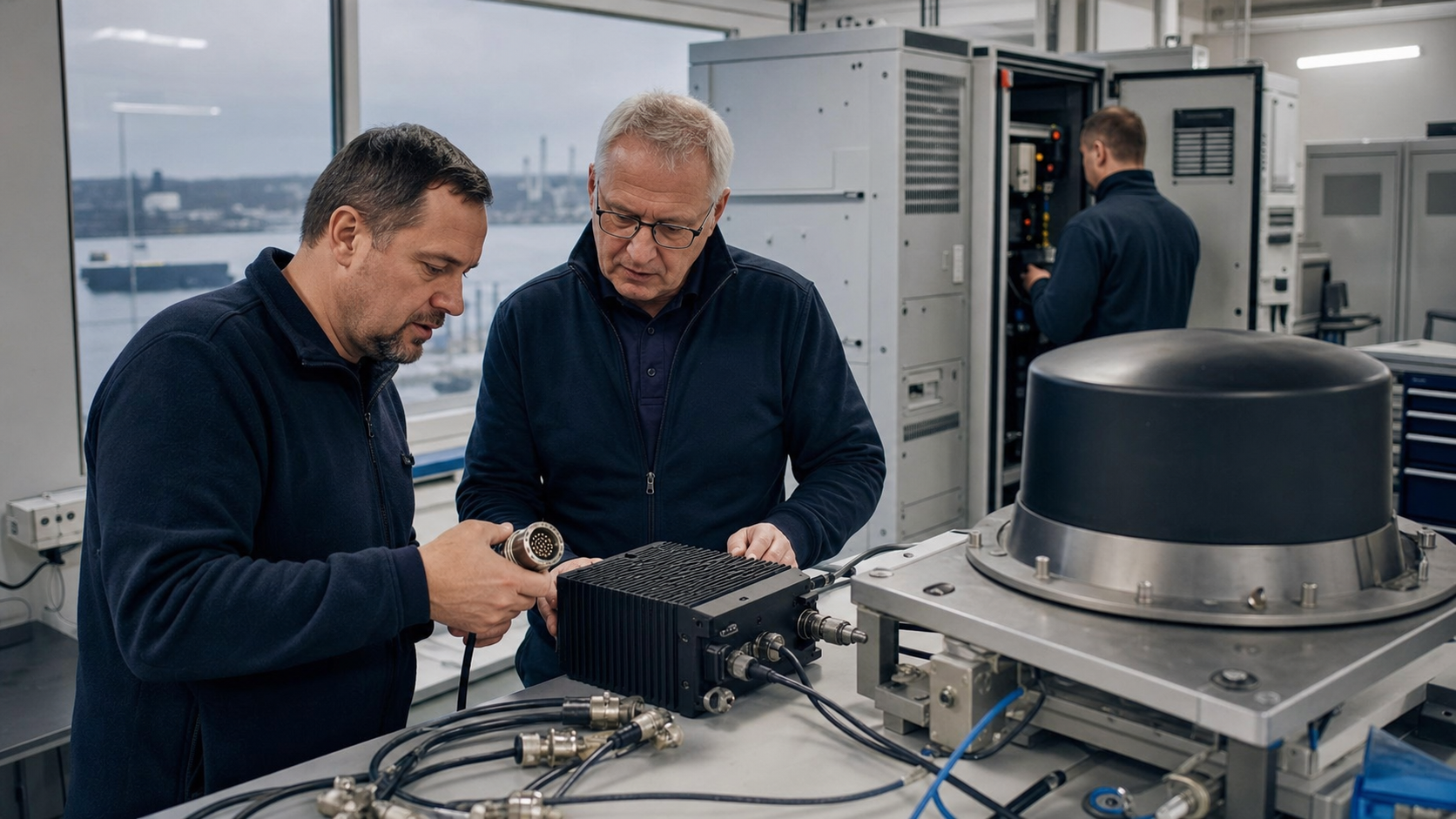
CTM's laboratory evidence is central because test capacity is where a research contract becomes delivery insurance. The official accredited laboratories page says CTM provides accredited testing services under scopes of the Minister of National Defence and the Polish Centre for Accreditation, and holds recognition from the Polish Register of Shipping: https://ctm.gdynia.pl/en/services/accredited-research-and-testing-laboratories.html. It also says laboratory activity covers military equipment, marine technology devices and commercial equipment, and that the facilities allow comprehensive testing without clients investing in advanced equipment and test stands. That is the direct avoided-cost comparison in CTM's public case.
The lab page lists electromagnetic compatibility, environmental and climatic testing, shock resistance, vibroacoustics, operational safety, and electric and magnetic fields: https://ctm.gdynia.pl/en/services/accredited-research-and-testing-laboratories.html. Those categories map directly to naval systems risk. A combat console that fails electromagnetic compatibility can interfere with or be disrupted by other ship equipment. A sensor electronics package that cannot tolerate shock, vibration or temperature variation may pass a bench test and fail at sea. A minesweeping or passive-defence system that depends on physical fields must be measured, not assumed.
The certificates page strengthens the argument. It lists Ministry of National Defence accreditation certificates, Polish Centre for Accreditation laboratory certificates AB296 and AB295, Polish Register of Shipping recognition, AQAP 2210:2022, AQAP 2110:2016, ISO 9001:2015, internal control certificates, NATO industrial security and EU industrial security certificates with validity dates into the 2030s for secret and confidential levels: https://ctm.gdynia.pl/en/company/policies-and-certificates.html. Again, those certificates do not prove low cost. They prove that the company has eligibility, quality systems and security status that a buyer would otherwise need to create, validate or source from another provider.
This is where CTM's unit should be priced against a government alternative. If the state wants to avoid CTM, it must still test military electronics, marine systems and classified interfaces somewhere. It can create a public lab, expand another national institute, rent foreign commercial capacity, or depend on prime-contractor evidence. Each option carries a different risk. A public lab may struggle to retain ship-specific integration knowledge between programmes. A foreign lab may be technically excellent but less useful for classified Polish mission data or urgent local modifications.
Prime-contractor evidence may be efficient but can leave the buyer dependent on the same party whose product needs independent verification.
The EMC-LabNet evidence gives the capital dimension. The public grants map lists the Polish Network of EMC Laboratories project at PLN 69.4 million in project value with PLN 42.6 million EU co-financing: https://mapadotacji.gov.pl/projekty/781614/?lang=en. CTM's own lab page states that accredited research laboratories were established as part of EMC LAB-Net, financed by European Funds: https://ctm.gdynia.pl/en/services/accredited-research-and-testing-laboratories.html. A trade report from Trojmiasto described a new CTM laboratory in Gdynia with a project above PLN 61 million, including an anechoic chamber and test stands for large objects up to five tonnes: https://www.trojmiasto.pl/biznes/Projekt-za-ponad-61-mln-zl-Nowe-laboratorium-CTM-w-Gdyni-n171688.html. The exact figures vary by source and project scope, but all point to the same conclusion: serious test capacity is a capital-intensive asset, not a casual service.
For the buyer, the relevant economic test is utilisation and substitution. If CTM's lab capacity is heavily used by naval programmes, commercial clients and defence electronics work, the fixed-cost burden can be spread and renewal becomes more attractive. If the facilities are underused or reserved for narrow programme needs, the state may still prefer CTM for sovereignty reasons, but the economic case becomes weaker. Public sources prove the capability exists. They do not prove utilisation. That missing private metric should be decisive.
Research becomes valuable when it reaches sea
CTM's research record matters because mine warfare is changing faster than traditional shipbuilding cycles. Unmanned surface and underwater systems, modular minesweeping, harbour surveillance, seabed infrastructure protection and integrated maritime awareness are all moving from experimental projects into procurement needs. CTM's public pages place it inside that shift. The Pelikan project page says the project is about technologies for an unmanned vehicle capable of mine-countermeasure operations, including mine neutralisation without damaging the vehicle, in cooperation with naval vessels and full integration with SCOT: https://ctm.gdynia.pl/en/projects/Pelikan.html. CTM's scope includes trajectory and manoeuvre planning, mission visualisation, result generation, explosive-charge integration and hydroacoustic communication.
The European Defence Agency article on underwater threats supplies independent context. EDA says its Modular Lightweight Minesweeping effort was launched in 2011, went through several phases, and included industry partners such as Patria of Finland and CTM of Poland supplying acoustic and electromagnetic modules tested at sea in Germany and Australia: https://eda.europa.eu/news-and-events/spotlight/spotlight-of-the-month/underwater-threats. The same article says commercially available technology from the programme is already in service, with Patria and CTM providing acoustic and electromagnetic signature generation modules for Belgian and Dutch minesweeping capabilities. For CTM, this is a significant public signal because it connects research work to fielded allied capability.
The PESCO Harbour and Maritime Surveillance and Protection project frames another part of the market. PESCO describes HARMSPRO's objective as a deployable integrated capability system for continuous protection of vessels, harbours and other littoral infrastructure, including detection, identification and response to threats: https://www.pesco.europa.eu/project/harbour-and-maritime-surveillance-and-protection/. Defence24 separately reported that OBR CTM representatives saw the company's NATO and OCEAN2020 experience as relevant to HARMSPRO-type harbour and maritime protection work: https://defence24.com/armed-forces/navy/european-maritime-defence-project-involving-poland. This does not prove a current CTM revenue line. It does prove that CTM's research themes align with public European security needs.
The renewal case depends on whether CTM can convert research participation into Polish naval risk reduction. A buyer should not pay indefinitely for research that remains detached from acquisition. But CTM's evidence is not detached. The same company appears in Kormoran II mission systems, Ratownik command and underwater-observation systems, accredited testing, mine-countermeasure products and European minesweeping research. That overlap is the economic reason to treat CTM as a risk-transfer supplier. Research matters because it updates the integration base before a threat or ship programme forces emergency change.
Price against in-house labs
An in-house government lab offers direct control, but direct control is not automatically lower risk. To replace CTM's paid unit, a government buyer would need to recreate several capabilities at once: maritime electronics design, software development, hydroacoustic and electromagnetic expertise, mine-countermeasure knowledge, classified infrastructure, accredited test reports, quality-management systems and relationships with shipyards and product teams. Those capabilities must be staffed continuously. They cannot be purchased only in the year a sea trial starts.
The staffing problem is visible in CTM's own hiring signals. The Pracuj employer profile listed three active job offers, placed CTM in research and development plus IT/programming, and described a team of about 300 people working in Gdynia and Gdansk: https://pracodawcy.pracuj.pl/profile/obr-ctm-s-a%2Cvte5vyf%2Cpl. It also mentioned roles such as electronics installer, junior Java programmer and IT department manager. That profile is not a financial audit, but it shows the competence mix: electronics, software, IT management and research. A government replacement would need to recruit from the same scarce labour pool while competing with commercial software, electronics and foreign defence employers.
The capital problem is visible in EMC-LabNet and CTM's certificates. Building a lab is only the first cost. Keeping it accredited, calibrated, staffed and secure is recurring overhead. CTM's public certificates show quality and industrial security structures that need continuous maintenance: https://ctm.gdynia.pl/en/company/policies-and-certificates.html. If the buyer internalises this capacity, it takes on the overhead directly. If it uses CTM, it pays for access and outputs while sharing part of the fixed cost with other CTM customers and programmes.
The governance problem is independence. A state lab can be trusted by the state, but a naval programme still needs repeatable evidence that suppliers, crews, classification societies and allied partners can accept. CTM's lab page says testing may be conducted in the presence of clients and under supervision of classification societies including PRS and DNV: https://ctm.gdynia.pl/en/services/accredited-research-and-testing-laboratories.html. That kind of externalised test practice is valuable when the buyer needs more than internal confidence. It needs defensible acceptance evidence.
The price comparison is therefore not CTM fee versus zero. It is CTM fee versus the full cost of government ownership: buildings, equipment, accreditations, security, specialists, management attention, update burden and idle capacity risk. The public evidence does not disclose CTM's margin or contract price per task, so a precise public value-for-money conclusion is impossible. The renewal question should be whether CTM's marginal cost to the buyer is lower than the risk-adjusted cost of owning equivalent capability, not whether an internal employee looks cheaper on a salary table.
Price against foreign suppliers
Foreign suppliers may win on scale, depth and battle-tested product maturity. Poland should not pretend every domestic supplier is automatically better. A global combat-system or sonar house may have a larger engineering base, broader export footprint and more recorded operating hours. For some systems, that may be decisive. But foreign supply also imports control risk. The buyer may receive a capable product while losing freedom to adapt it quickly, inspect it deeply, or integrate it with national systems without external permission.
CTM's public SCOT description explicitly includes information processing at NATO Secret and Confidential levels: https://ctm.gdynia.pl/en/products/maritime-and-underwater-technologies/SCOT-system.html. The certificates page lists NATO and EU industrial security certificates: https://ctm.gdynia.pl/en/company/policies-and-certificates.html. These facts matter because command systems and underwater-observation systems do not merely move data. They decide who can see it, how it is fused, how it is stored, how it is trained and how it can be changed. A foreign supplier can be trusted, but trust still comes with export controls, national release rules and support dependencies.
The foreign comparison also changes after Russia's full-scale invasion of Ukraine and the intensification of Baltic infrastructure threats. NATO launched Baltic Sentry in January 2025 to strengthen protection of critical infrastructure in the Baltic Sea and improve allies' ability to respond to destabilising acts: https://www.nato.int/en/news-and-events/articles/news/2025/01/14/nato-launches-baltic-sentry-to-increase-critical-infrastructure-security. The European Commission in July 2026 proposed joint defence projects including maritime and seabed defence and Eastern Flank security: https://defence-industry-space.ec.europa.eu/commission-proposes-five-joint-defence-projects-strengthen-europes-industrial-capabilities-2026-07-03_en. In that environment, local modification speed and trusted national data handling have higher value than they did in a calmer market.
CTM is not a complete substitute for every foreign prime. Ratownik itself shows that Poland still uses foreign specialist suppliers. PGZ Naval Shipyard says JFD supplies key specialist systems, OSI Maritime Systems supplies navigation systems, Schottel supplies propulsion, and CTM is responsible among other things for command and underwater observation systems: https://pgzsw.com.pl/en/news/we-laid-the-keel-for-the-ratownik/. The practical model is not autarky. It is domestic integration around foreign and local subsystems so the buyer retains enough control to operate, test and adapt the platform.
That model has an economic premium. Local integration may cost more than buying a sealed foreign suite, especially if domestic engineering teams are smaller. But it can save money when requirements change, sanctions or export controls bite, a supplier exits, a wartime repair must happen quickly, or classified data cannot leave national channels. CTM's renewal case is therefore strongest when the buyer values optionality. It is weaker when the system is genuinely commoditised, unclassified and easily supported by multiple foreign firms. Naval mine warfare and underwater observation are not in that low-control category.
Price against delayed deployment
Delayed deployment is the third substitute because a buyer can always defer integration risk without admitting it. The navy can accept a platform with temporary limitations, wait for a future upgrade, postpone a test event, or keep ageing vessels in service. Public Ratownik evidence shows why this cost is real. Defence24 reported that the 2024 Ratownik contract followed an earlier attempt from 2017 that was cancelled in 2020 due to cost concerns, while the Navy's existing rescue ships were about half a century old: https://defence24.com/armed-forces/navy/polish-navy-acquires-rescue-ship-based-on-pln-1-bn-contract. Delay is not free when existing assets age and threat demands rise.
PGZ Naval Shipyard's 2026 Ratownik milestone says the ship will replace ORP Piast and ORP Lech, support future Orka submarines, protect critical seabed infrastructure, cooperate with the NATO Submarine Rescue System, operate at depths up to 300 metres, and is scheduled for delivery in 2029: https://pgzsw.com.pl/en/news/we-laid-the-keel-for-the-ratownik/. CTM's named role in command and underwater-observation systems makes its work part of the delivery-risk map. If those systems are late, the cost is not limited to CTM's invoice. It affects a platform intended to close a decades-old rescue capability gap.
Kormoran II carries the same lesson at smaller displacement. The 2022 CTM contract note says the further minehunters were planned for 2026-2027 and would enter the 12th minesweeper squadron: https://ctm.gdynia.pl/aktualnosci/2022/Kolejne-trzy-niszczyciele-min-typu-Kormoran-II-zakontraktowane.html. Minehunters are a narrow but strategic capability because sea mines threaten ports, sea lanes, amphibious routes, energy infrastructure and alliance movements. If integration delays push a minehunter right, the navy does not lose an abstract product. It loses days of mine-countermeasure capacity in a region where mines, drones and infrastructure sabotage are no longer theoretical.
The economic value of CTM is highest when it finds problems before the ship does. A laboratory test that forces a design correction may look like delay inside a monthly report. Economically, it can be a schedule save if the same problem would otherwise emerge during sea trials, acceptance, crew training or first operational deployment. The buyer should therefore separate visible test duration from avoided failure. A fast test programme with high defect escape can be worse than a slower programme that prevents late rework.
This is why the first private metric should be defect escape. How many CTM-controlled issues are found in laboratory, bench or land-based integration phases rather than during shipboard trials? How many retests are needed after fixes? How often does CTM's evidence prevent a classification or safety hold? These metrics would price the delay substitute. Public evidence tells us CTM has the right facilities and programme roles. It does not tell us whether those facilities are preventing late failure at the desired rate.
Baltic security raises the value of local proof
CTM's market context has improved because the Baltic has become a higher-priority security theatre. NATO's Baltic Sentry announcement is the most direct public marker: https://www.nato.int/en/news-and-events/articles/news/2025/01/14/nato-launches-baltic-sentry-to-increase-critical-infrastructure-security. The announcement followed concerns over destabilising acts against critical infrastructure, and it placed maritime presence, surveillance and response at the centre of allied security. That context increases demand for mine-countermeasure, underwater-observation, harbour-protection and command systems.
European policy is moving in the same direction. The European Commission's July 2026 proposal for joint defence projects includes maritime and seabed defence, drones and counter-drone systems, air and missile defence, space and Eastern Flank security: https://defence-industry-space.ec.europa.eu/commission-proposes-five-joint-defence-projects-strengthen-europes-industrial-capabilities-2026-07-03_en. CTM should not be assumed to capture that demand automatically. But its public portfolio overlaps with several priority areas: underwater systems, mine countermeasures, maritime surveillance, critical infrastructure protection, communications and testing.
The security context also changes the meaning of data locality. In peacetime procurement, a buyer might treat local data handling as a compliance preference. Under hybrid pressure, local control becomes an operational feature. A naval system that can be tested, modified and supported inside Poland, under Polish security rules and allied-recognised procedures, has a different risk profile from a system that requires foreign release for key changes. CTM's NATO and EU industrial security certificates and SCOT's classified information handling claims are therefore not administrative trivia. They are part of the price of confidence.
Still, context is not performance. Baltic Sentry does not mean CTM deserves every renewal. European maritime and seabed defence priorities do not validate CTM's cost base. They simply raise the option value of a domestic naval systems integrator with accredited labs and mine-warfare experience. The buyer must still demand hard private evidence on cost, reliability and retention. A market tailwind is not a delivery record.
What public evidence cannot prove
The economics proof gap is cost efficiency. Public sources show CTM has facilities, certificates, products and programme roles. They do not show cost per accepted deliverable, margin, rework cost, lab utilisation, capacity conflicts or the share of ship-programme value that CTM captures. The decisive economics metrics are: first, cost per accepted integration or test milestone compared with foreign or government alternatives; second, lab utilisation and external revenue contribution; third, avoidable rework cost prevented before shipboard trials.
The reliability proof gap is field performance. Public sources describe SCOT, SHL-101/TM, MLM-Promienica and other systems, but they do not disclose mean time between failure, defect escape, operator workload, cyber findings, acceptance exceptions or sea-trial issue closure rates. The decisive reliability metrics are: first, defect escape from CTM-controlled phases into shipboard trials; second, time from fault identification to verified fix; third, number of mission-limiting issues per vessel after acceptance.
The retention proof gap is people. CTM's value rests on scarce engineers who understand both defence rules and naval systems. Public hiring and employer pages show a team and recruitment activity, but they do not reveal turnover, clearance delays, senior-engineer concentration or succession risk. The decisive retention metrics are: first, annual turnover among cleared systems, sonar, software and lab engineers; second, average tenure on Kormoran, Ratownik and related naval systems teams; third, vacancy duration for roles tied to classified software, electronics and test operations.
These gaps matter because CTM's model is continuity-heavy. A buyer renews CTM not only for a chamber or product card, but for accumulated understanding of Polish naval platforms. If the experienced engineers leave, the company still owns test stands but loses part of the risk-transfer value. If lab utilisation is low, the state may be carrying a disguised fixed-cost burden. If field defects remain high, the certificates become eligibility evidence rather than performance evidence.
The public evidence nevertheless supports a positive base case. CTM appears to have the right kinds of assets, the right programme exposure and the right security status for the paid unit. The question is not whether CTM is relevant. It plainly is. The question is whether renewal terms should reward measurable risk reduction rather than institutional continuity alone.
The renewal verdict
The buyer should renew CTM-like naval systems research and test work when three conditions hold. First, CTM must be reducing late technical surprises on Polish naval platforms. Second, it must maintain enough domestic and allied-trusted control over mission systems to justify any premium against foreign supply. Third, it must retain the people and facilities needed to keep knowledge alive between ship programmes. Public evidence supports all three as plausible, but only the buyer's private programme data can turn plausible into proven.
On public evidence alone, the strongest renewal case comes from Kormoran II. CTM is not merely adjacent to the programme. It is named for SCOT, sonar, passive defence and tactical data exchange. Those are precisely the areas where system faults can delay readiness. The second-strongest case comes from the laboratory and certificates evidence, because it shows CTM can test and handle sensitive defence work locally. The third-strongest case comes from European mine-warfare research, especially EDA's account of CTM-linked modular lightweight minesweeping technology reaching allied service: https://eda.europa.eu/news-and-events/spotlight/spotlight-of-the-month/underwater-threats.
The weaker part of the public case is commercial transparency. There is no public CTM contract-unit economics for the naval systems research and test role. Registry and business-information sources can identify the company and offer some financial indicators, but they do not price the specific unit. CTM's official contact page records KRS 0000295769, REGON 220535280, NIP 5840203601 and share capital of PLN 31,696,070: https://ctm.gdynia.pl/kontakt.html. Rejestr.io likewise records CTM's registered company identity and Gdynia address: https://rejestr.io/krs/295769/osrodek-badawczo-rozwojowy-centrum-techniki-morskiej. Those records establish the legal body. They do not tell the buyer whether a given renewal is efficient.
The buyer should therefore write renewal terms around outcomes. For research, require a path to ship, lab or field evidence. For testing, require accepted reports, defect classification and retest tracking. For integration, require configuration-control evidence, interface-risk logs, verified fixes and operator feedback. For security-controlled work, require clean facility audits and controlled handling of classified data. For continuity, require retention and succession reporting in critical engineering roles. These are not exotic demands. They are the natural metrics of a supplier whose economic promise is delivery-risk transfer.
CTM's public record justifies treating it as a strategic domestic integrator rather than a generic vendor. It has products tied to mine warfare and underwater systems, public roles in Kormoran II and Ratownik, accredited test capacity, industrial security certificates, and European research references. In Poland's Baltic security environment, those assets have higher option value than they would in a stable, low-threat market. The state is not only buying current tests. It is preserving the ability to understand, modify and certify systems close to the fleet.
The price discipline should be just as firm. Domestic relevance can become a shield against scrutiny if a buyer confuses sovereignty with value for money. The right conclusion is narrower and stronger: CTM should be paid when it demonstrably reduces the cost of uncertainty. That means fewer late integration failures, faster verified fixes, lower dependence on foreign black boxes, better classified handling, and a shorter path from research to deployable naval capability.
On that basis, the planned angle holds. PGZ OBR CTM turns naval research into delivery risk because the actual product is not the research itself. The product is the transfer of uncertainty from the public buyer to a domestic organisation that owns test stands, certificates, mission-system knowledge and ship-programme experience. If the private metrics confirm that this transfer is working, renewal is economically defensible even when CTM is not the cheapest apparent option.
If those metrics fail, the buyer should not abandon the capability casually, but it should renegotiate the unit around measurable outcomes rather than inherited confidence.
The most important question for the next renewal is therefore not "how much research did CTM perform?" It is "which delivery risks did CTM remove before they reached the fleet?" A buyer that asks that question will price CTM correctly: against the cost of building equivalent state capacity, the control cost of relying on foreign suppliers, and the readiness cost of delayed naval deployment.
Public evidence register
| Public evidence | Why it matters | URL |
|---|---|---|
| CTM official company page | Establishes the company as a Polish defence and maritime technology supplier with naval, laboratory, electronics and critical-infrastructure lines. | https://ctm.gdynia.pl/en/index.html |
| CTM laboratory page | Supports the avoided-cost comparison: buyers can use accredited military, marine and electronics test facilities instead of building equivalent stands themselves. | https://ctm.gdynia.pl/en/services/accredited-research-and-testing-laboratories.html |
| CTM certificates page | Supports the security-control and certification argument through MoD, PCA, PRS, AQAP, ISO, NATO and EU industrial-security evidence. | https://ctm.gdynia.pl/en/company/policies-and-certificates.html |
| Polish Defence Industry portal | Confirms CTM's legal identity, Gdynia base, system-design scope, product examples and defence-sector positioning. | https://polishdefenceindustry.gov.pl/en/company/centrum-techniki-morskiej-sa-research-and-development-centre-osrodek-badawczo-rozwojowy-centrum-techniki-morskiej-sa/ |
| Kormoran II project page | Provides the clearest CTM-specific proof that SCOT, sonar, passive defence and tactical data exchange sit inside a real Polish mine-countermeasure programme. | https://ctm.gdynia.pl/en/projects/Kormoran-II.html |
| CTM Kormoran II contract note | Names the Armament Agency buyer, the consortium and the 2026-2027 delivery window for three further minehunters. | https://ctm.gdynia.pl/aktualnosci/2022/Kolejne-trzy-niszczyciele-min-typu-Kormoran-II-zakontraktowane.html |
| Ratownik shipyard milestone | Shows CTM inside a current rescue-ship programme and states its command-system and underwater-observation scope. | https://pgzsw.com.pl/en/news/we-laid-the-keel-for-the-ratownik/ |
| Defence24 Ratownik report | Gives independent context on the PLN 1 billion-plus rescue-ship contract, earlier cancellation and ageing rescue-ship gap. | https://defence24.com/armed-forces/navy/polish-navy-acquires-rescue-ship-based-on-pln-1-bn-contract |
| SCOT product page | Supports the command-system and data-sovereignty analysis by describing sensor, effector and classified-information integration. | https://ctm.gdynia.pl/en/products/maritime-and-underwater-technologies/SCOT-system.html |
| SHL-101/TM sonar page | Supports the shallow-water mine-detection and reliability-risk discussion. | https://ctm.gdynia.pl/en/products/maritime-and-underwater-technologies/Sonar-SHL-101TM.html |
| MLM-Promienica page | Supports the argument that CTM's unit includes physical-field modelling and specialist minesweeping, not generic research. | https://ctm.gdynia.pl/en/products/maritime-and-underwater-technologies/MLM-Promienica.html |
| EDA underwater-threats article | Places CTM-linked mine-warfare research in a European capability context and shows why interoperability matters. | https://eda.europa.eu/news-and-events/spotlight/spotlight-of-the-month/underwater-threats |
| NATO Baltic Sentry announcement | Provides demand context for Baltic maritime and undersea-infrastructure protection. | https://www.nato.int/en/news-and-events/articles/news/2025/01/14/nato-launches-baltic-sentry-to-increase-critical-infrastructure-security |
| EU joint defence projects proposal | Shows current European policy emphasis on maritime and seabed defence, drones, air defence and Eastern Flank security. | https://defence-industry-space.ec.europa.eu/commission-proposes-five-joint-defence-projects-strengthen-europes-industrial-capabilities-2026-07-03_en |
| Rejestr.io company record | Cross-checks the legal body, KRS number, address and corporate form. | https://rejestr.io/krs/295769/osrodek-badawczo-rozwojowy-centrum-techniki-morskiej |