
Summary
- Oroville Dam itself did not fail in February 2017. A section of its gated service-spillway chute failed during releases; days later, first use of the emergency spillway caused rapid erosion of the hillside below its concrete weir. Concern that headcutting could undermine the weir foundation led local authorities to order a mass evacuation. The feared release did not occur, and that counterfactual must not be narrated as an actual flood.
- The independent record found no single root cause. Design and construction fragilities, foundation geology, slab cracking and drainage, incomplete records, maintenance practice, inspection limits, narrow potential-failure analysis, organizational assumptions and difficult operating decisions interacted over decades. Physical findings, organizational findings, regulatory-program assessments, contract costs and legal claims require separate evidentiary treatment.
- Durable assurance requires more than a repaired chute. It requires searchable design and construction records, failure-mode-led examinations below visible surfaces, independent review with protected dissent, operating rules that display forecast and structural uncertainty, executable evacuation protocols, environmental safeguards, monitored reconstruction, and evidence that findings are closed through verified performance. Completion of the rebuilt spillways does not certify zero remaining risk.
On 7 February 2017, operators releasing water from Lake Oroville observed an unusual flow pattern on the gated flood-control outlet, commonly called the service or main spillway. When releases stopped, inspection revealed substantial loss of concrete and foundation material in the chute. The reservoir was receiving major winter inflows, so the damaged controlled outlet could not simply remain unused while engineers studied it at leisure.
DWR, the California Division of Safety of Dams and the Federal Energy Regulatory Commission faced a moving problem: every operating choice altered both reservoir storage and the condition of structures whose behavior was incompletely understood.
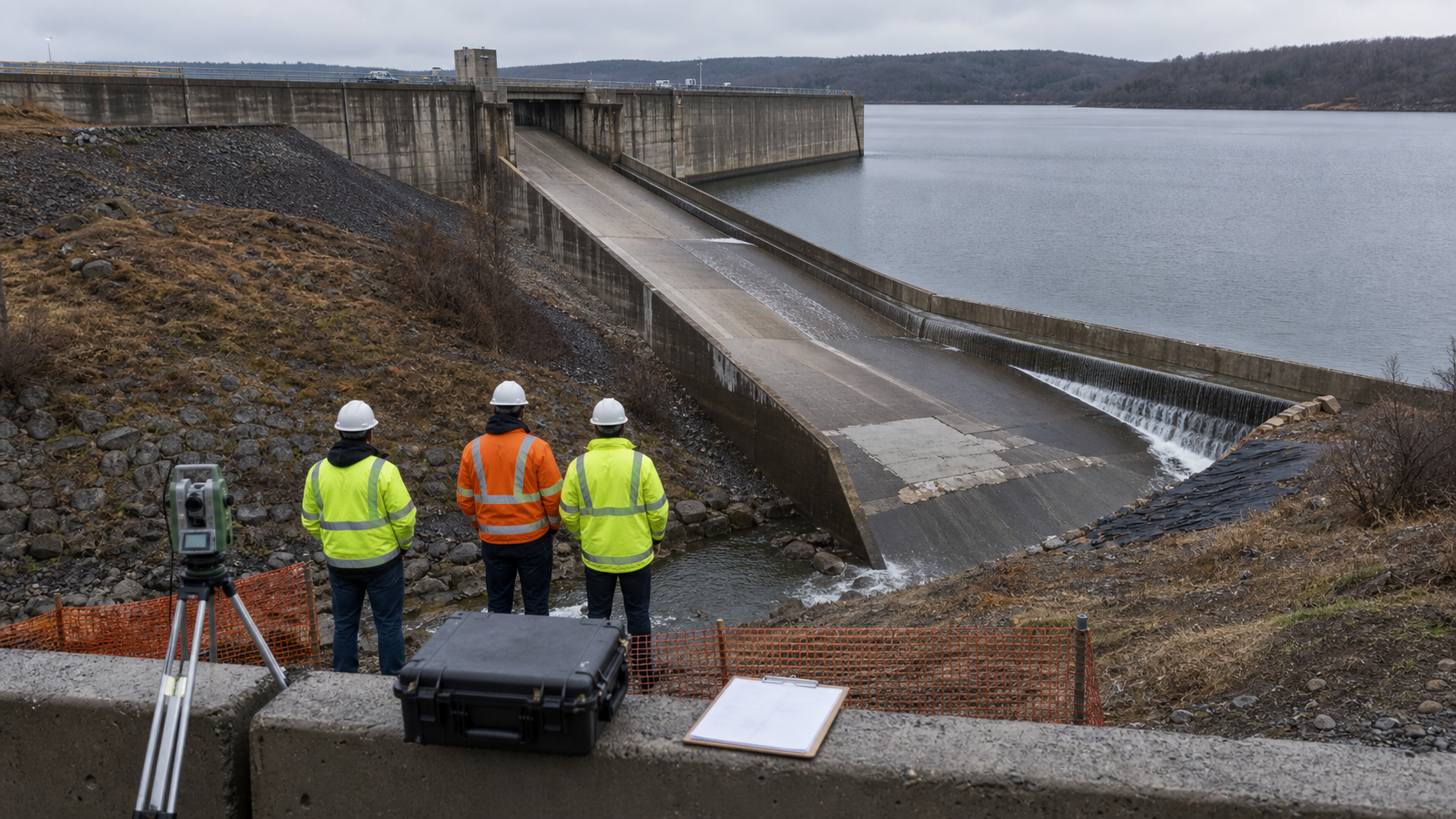
Water first passed over the ungated emergency-spillway weir on 11 February. The natural hillside below it eroded much faster and closer to the structure than decision-makers had expected. On 12 February, officials became concerned that uphill-progressing erosion could threaten the weir’s foundation. County and city authorities ordered downstream communities to evacuate. Releases through the already damaged service spillway were increased sharply to draw the reservoir below the emergency-spillway crest. Flow over the hillside stopped that evening, and the feared loss of the weir did not occur.
This sequence establishes the most important factual boundary. Oroville Dam, the earthfill embankment retaining the reservoir, did not collapse. The service-spillway chute suffered a structural failure, and the emergency-spillway discharge area suffered severe erosion. There was a credible concern about a possible progression to loss of part of the emergency-spillway structure, but the resulting uncontrolled release remained a scenario. Accurate accountability neither minimizes the danger nor turns the protective evacuation into evidence that the imagined flood actually happened.
The incident is therefore an ageing-infrastructure accountability test. The core question is not whether somebody should have noticed a dramatic hole before it appeared. It is who owned the evidence needed to understand less visible vulnerabilities: original calculations and construction decisions, the relationship between slab cracks and embedded drains, foundation quality, anchorage, joint details, repair history, operational loading, erodibility below the emergency weir, and the limitations of prior inspections and potential-failure reviews.
It is also who had authority to convert uncertainty into reservoir action, public warning, evacuation, emergency works, independent investigation, reconstruction and proof of safer future operation.
A controlled-outlet failure became a reservoir emergency
The operator’s official incident and recovery chronology records the sequence of releases, inspections, forecasts and emergency measures. Its value is operational specificity: releases were stopped after the abnormal flow was seen, short-duration flows were tried while damage was monitored, forecasts changed, and reservoir elevation approached the emergency crest. Its limit is authorship. DWR is the owner-operator whose decisions are being examined, so its chronology should be attributed and tested against the independent forensic and federal records rather than treated as the sole account of why each choice was made.
The initial service-spillway damage changed the available decision set. Continuing large releases risked enlarging the crater, driving erosion upstream toward the gates or downstream toward the diversion pool, and producing debris that could impair the Hyatt Powerplant. Reducing releases preserved the damaged chute but allowed storage to rise. Letting the lake pass over the emergency weir used a feature intended to release water when the gated outlet and reservoir could not contain the inflow, yet its natural discharge hillside had never carried flow in the facility’s operating history.
Operators had to compare risks that were not expressed in a common, reliable metric.
Forecast uncertainty made the tradeoff harder. A reservoir rule curve and inflow prediction can support decisions, but the forecast is not the water already in storage. Storm position, snow conditions, runoff response and successive forecast updates can materially change the available margin. Structural uncertainty was equally important. Decision-makers did not know exactly how the service-spillway damage would progress at different release rates, nor how the emergency hillside would erode when first used.
The system had operating data, engineering judgment and monitoring, but not a validated model that could convert each possible release strategy into comparable probabilities and consequences.
That distinction matters for accountability. A poor outcome does not by itself prove that a contemporaneous decision was irrational. Review must reconstruct what information existed, who received it, what alternatives were considered, what uncertainty ranges were used, and which failure thresholds triggered escalation. At the same time, emergency uncertainty cannot erase the pre-incident duty to understand structures before the crisis. If an organization enters an extreme operating period without an adequate model of its emergency outlet, the uncertainty encountered during response is partly inherited from earlier assurance choices.
On 12 February, rapid erosion near the emergency-spillway crest changed the perceived consequence. FERC’s official Oroville service-spillway record states that erosion threatened the stability of the structure and that the reservoir was lowered using the service spillway to prevent potential erosion of the foundation. That wording preserves the difference between threat and failure. It also exposes an unusual operational reversal: the damaged chute became the means of reducing a potentially more severe risk at the emergency outlet.
The drawdown required accepting further damage to the service spillway and downstream facilities. Debris accumulated in the diversion pool; high tailwater affected powerplant operations; crews fortified eroded ground and monitored structures continuously. Emergency operations were not one decision but a series of linked decisions about gate openings, lake targets, worker access, power continuity, sediment removal and public protection. A reliable after-action record must time-stamp each decision and identify the engineering and command authority behind it.
The physical failure started below what routine observation could prove
The Independent Forensic Team was commissioned to examine structural, geologic, operational and management contributors. DWR’s official forensic-team record documents the team’s mandate, preliminary work and final report. The report’s central finding was not a single defective part. Water entered through cracks and joints, uplift exceeded the slab’s resistance at a vulnerable location, and displacement exposed poor-quality foundation material to severe erosion. But the susceptibility arose from interacting design, construction, material, drainage, foundation and deterioration conditions accumulated across the project’s life.
The chute slab was not an isolated concrete surface. It was a system consisting of slab thickness, reinforcement, joints, anchors, foundation preparation, drain geometry, collectors, outlets and the foundation itself. Cracks above embedded herringbone drains were visible over many years and had been repaired. A visible crack can be a surface-maintenance problem, evidence of movement, a hydraulic pathway, or some combination. The forensic issue was not that every crack should have been read as proof of imminent collapse.
It was whether the inspection and engineering system connected crack patterns, leakage, drain condition, foundation records and hydraulic uplift into a testable failure mechanism.
Design details created reduced margins in ways that routine surface inspection could not directly measure. Drain elements intruded into the slab section, joints lacked waterstops, reinforcement and anchorage had limitations, and portions of the foundation contained weathered or soil-like material. Construction records contained information relevant to those conditions, but the later system did not consistently reconstruct the as-built asset from the historical evidence.
A sound inspection program cannot assume that a drawing represents what was built, that later repairs restored original capacity, or that an old board conclusion remains valid under present knowledge.
FERC’s independent After-Action Panel reviewed the federal program as well as the incident. Its final assessment agreed that the event involved design and as-constructed weaknesses, poor foundation in places and deterioration, while also discussing physical hypotheses and the implementation of annual inspections, five-year Part 12 reviews, potential-failure analyses and DWR’s owner dam-safety program. The panel’s technical discussion must retain its scope: it is a program and engineering assessment, not a civil judgment against DWR or a universal statement about every dam.
The emergency spillway revealed a different but related failure of physical understanding. The concrete crest discharged onto natural terrain. Earlier confidence emphasized competent bedrock, yet the hillside contained erodible soil and weathered rock associated with geologic features, and topography concentrated flow. There was little energy dissipation and no continuous erosion protection below the short apron. Once water crossed the weir, headcuts developed rapidly and advanced toward the structure. The system’s confidence had not been tested by actual use and was not supported by a sufficiently complete erosion analysis.
This is why the phrase “emergency spillway” can mislead. It names a hydraulic function, not a guarantee that the entire flow path is robust under every discharge. A crest may pass water without overtopping the dam while the downstream terrain, abutments, foundations, access routes and receiving channel create separate hazards. Readiness has to cover the complete path from reservoir to downstream conveyance, including progressive erosion and how damage could feed back into structural stability.
Inspection was necessary, but its method constrained what it could find
Before 2017, Oroville’s facilities were subject to state inspections, annual federal oversight and periodic independent Part 12 reviews. DWR’s page for California dam-safety inspection records states that formal inspections occurred multiple times and that earlier reviews had found the project suitable for operation. That history rebuts any simplistic claim that nobody inspected the facility. It also shows why inspection frequency alone is an inadequate measure of assurance.
An inspection sees only what its access, method, records and failure model allow it to see. Walking a dry chute can identify spalls, open joints, surface cracks and displaced panels. It cannot directly establish the condition of every drain, the thickness of concrete above a pipe, the pullout capacity of anchors in variable foundation, or voiding below the slab. Those questions may require historical reconstruction, nondestructive testing, drilling, instrumentation, hydraulic analysis or carefully selected destructive examination.
Without a failure hypothesis that makes those facts relevant, inspectors may repeatedly observe and repair symptoms without testing their interaction.
DWR’s archive of FERC Part 12D inspection materials explains the intended cycle: independent consultants inspect, assess actual or potential deficiencies and make recommendations; DWR then develops a plan and schedule for appropriate action. The archive also illustrates a records problem. Some detailed materials are redacted for critical-infrastructure security or available only on request. Those restrictions may be legitimate, but they heighten the need for controlled internal completeness, clear custody and an audit trail showing that the right specialists reviewed the unredacted evidence.
The 2017 failure exposed the difference between condition inspection and comprehensive review. Condition inspection asks what the asset looks like now. A comprehensive review also asks why it was designed that way, what was built, what has changed, which assumptions remain valid, how components interact and what credible failure modes are absent from the existing list. An ageing asset needs both. Repeating a historically bounded inspection scope can create a long series of reassuring reports without ever challenging the premise that defines what inspectors examine.
The California State Auditor used Oroville as an example of broader ageing-infrastructure risk. Its 2017 high-risk assessment reported the forensic team’s warning that the existing physical inspection regime, though necessary, was insufficient and unlikely to have uncovered the issues that caused the incident. It also identified resource limits affecting comprehensive dam reevaluations. This is a statewide governance assessment, not an engineering cause report for Oroville. Its importance is institutional: a regulator can know that deeper reviews are desirable while lacking staff and time to perform them across a large portfolio.
Risk-based prioritization is unavoidable under finite resources, but it must not become a euphemism for unexamined inherited assumptions. Prioritization should score consequence, component age, uncertainty in as-built records, untested features, recurring deterioration, geology, loading changes and the quality of prior failure-mode work. A high-consequence structure with apparently stable surface condition may deserve deeper review precisely because uncertainty below the surface remains high.
Maintenance must restore a defined function, not merely a surface
The service spillway had a history of concrete repair. Repairs can be appropriate and may extend service life, but their accountability meaning depends on the defect model. Filling or patching cracks restores a surface and may limit water entry. It does not necessarily restore reinforcement, slab anchorage, drain capacity, foundation contact or resistance to uplift. If cracks recur in a recognizable pattern, the maintenance system must ask whether the recurring feature is a symptom of an unresolved mechanism.
A defensible repair record needs location, geometry, photographs, date, material, surface preparation, curing, inspection result and the engineer’s stated diagnosis. It should be spatially linked to drains, joints, anchors, foundation zones and earlier work. Software can help maintain that history, but digitization is not itself understanding. A database that stores repeated repairs as closed work orders may conceal the pattern unless its data model permits component-level trend analysis and engineers are responsible for reviewing it.
Maintenance thresholds also require escalation rules. The first recurrence may justify observation; repeated recurrence at a hydraulically important location may require investigation; evidence of movement or increasing leakage may justify operating limits until capacity is established. Those thresholds should be agreed before a storm, not invented while the reservoir rises. Where no validated threshold exists, the uncertainty should be visible in the dam-safety case and operating plan.
The federal response broadened attention beyond Oroville. FERC’s page on focused spillway assessments and inspections records its requirement for detailed assessments of similar concrete chute and unlined spillways at high- and significant-hazard projects. That action is evidence of regulatory learning. It is not proof that every assessed spillway was defective, that the new assessment identified every mechanism, or that corrective work at every project was completed.
FERC also published implementation questions for spillway inspections, including how teams should respond when records are insufficient and when material testing or drilling may be needed. The value of this guidance is procedural: an inspection should identify uncertainty and create a plan to resolve it. A report should not silently convert missing information into an assumption of adequacy.
Evacuation was a protective control under uncertainty
The evacuation is often treated as the event’s dramatic endpoint. For accountability, it is better understood as a control decision. On 12 February, engineers and officials observed erosion progressing toward the emergency-spillway structure. They could not know with certainty whether, when or by what mechanism the headcut would reach and destabilize the foundation. Waiting for certainty would have left too little time for people to move through a large downstream area. Acting early imposed major costs and disruption, but it reduced exposure to a low-frequency, high-consequence scenario.
The Governor’s 12 February state-of-emergency proclamation recorded the rapid escalation, the threatened auxiliary spillway and the evacuations, and mobilized state personnel and mutual-aid resources. This is a contemporaneous legal and executive record. Its language reflects what officials feared at the time; it must not be read as a forensic finding that the structure was certain to fail or that all downstream flooding described in the scenario occurred.
Authority was distributed. Engineers assessed structure and erosion; DWR operated the reservoir; FERC and DSOD exercised oversight; Cal OES coordinated state response; local sheriffs and municipalities issued evacuation orders and warnings; transport, shelter and law-enforcement agencies implemented movement. That distribution can be effective if each trigger and communication route is explicit. It becomes dangerous if technical personnel assume local authorities understand an evolving failure mode, or if local authorities believe the owner will make the public-protection decision for them.
A credible emergency action plan therefore needs more than inundation maps and contact lists. It needs plain-language failure scenarios, thresholds tied to observable conditions, authority for warning and evacuation, redundant communications, traffic-control plans, shelter capacity, provisions for hospitals, care facilities, schools, prisons, people without vehicles and those needing language or disability support, and a method for updating communities when the threat changes. Exercises should test night conditions, congested routes, communication outages and disagreement about the technical signal.
FERC’s acting chair issued a public statement on 14 February describing federal personnel on site, immediate repair direction and the requirement for an independent board. The statement is evidence of contemporaneous oversight action, not of the later forensic result. Its focus on residents and property demonstrates that dam-safety supervision is inseparable from consequence management once a structure’s condition is uncertain.
The evacuation order should be judged with a counterfactual discipline. Because the weir remained standing, it is tempting to call the order an overreaction. That reasoning uses the successful reduction of lake level and interruption of erosion to deny the risk those actions were intended to control. Conversely, the number of evacuees is not proof that failure was inevitable. The proper test is whether officials had credible evidence of a severe scenario, whether available time was narrowing, whether the order was within lawful authority, and whether communications and movement were executed proportionately.
Re-entry required a separate decision. Lake level had fallen, emergency-spillway flow had stopped, the hillside could be assessed more directly, and stabilization work was underway. A warning status could replace mandatory evacuation without declaring the system fully restored. This staged approach should be documented so residents understand which immediate trigger changed and which longer-term risks remained.
Organizational confidence narrowed the failure model
The forensic and after-action findings reach beyond concrete and rock. DWR, federal and state safety programs, consultants and the wider dam industry had accumulated practices that did not force a comprehensive reconsideration of original design and construction. Repeated inspections and repairs created evidence of activity, yet the evidence was organized around known issues and visible condition. The system did not adequately challenge whether its categories of concern were complete.
Potential Failure Mode Analysis should provide that challenge. A PFMA brings qualified participants together to identify how a dam or appurtenant structure could fail, what evidence supports or weakens each mechanism, what surveillance could detect progression and what action would reduce risk. At Oroville, the process did not develop and carry forward the mechanism that linked cracks and joints, hydraulic pressure, drains, slab resistance and weak foundation into the 2017 chute failure. Nor did it sufficiently characterize rapid emergency-hillside erosion threatening the weir.
This was not simply an individual failure of imagination. Group processes inherit framing. If participants begin with prior conclusions that a component is safe, they may discuss deterioration inside that assumption rather than reopen the basis for it. If historical records are fragmented, the workshop may rely on institutional memory. If action items are not assigned and tracked, uncertainty raised in one review may disappear before the next. If dissent is recorded only as consensus wording, senior owners cannot see which assumptions remain contested.
The After-Action Panel’s scope included how the Part 12 process, PFMA, instrumentation and monitoring, and owner’s dam-safety program were implemented. FERC later issued a January 2018 direction responding to the forensic report, asking DWR for a plan and schedule to address findings. A direction and plan are accountability milestones, not closure. Closure requires evidence that each finding was translated into design, inspection, records, staffing, procedure or governance action, independently checked, and maintained after the immediate crisis team disbanded.
Institutional legitimacy matters because residents downstream cannot inspect the slab or audit the operating model themselves. They rely on the owner, regulator and independent experts to disclose what can safely be disclosed, distinguish known facts from uncertainty, explain why operating decisions change, and acknowledge prior assurance failures. Security restrictions around critical infrastructure may limit publication of design detail, but they should not prevent meaningful explanation of governance, risk and corrective action.
Public communication during Oroville also had to compete with fast images and changing conditions. Photographs of a widening crater, aerial views of erosion and urgent social-media reports could outrun technical explanation. The solution is not false certainty. Authorities should publish a common operating picture: current lake elevation and trend, outlet status, observed structural condition, active protective action, responsible decision authority, public instruction and the time of the next update.
If agencies disagree, the disagreement should be resolved through incident command or openly bounded rather than expressed as incompatible assurances.
Independent review had to remain independent through reconstruction
After the incident, DWR convened an Independent Board of Consultants to review emergency conditions, risk reduction and design. DWR’s Board of Consultants archive preserves public memoranda and explains limits imposed by critical-infrastructure information rules. The board’s value came from repeated review as design and field conditions evolved, not from a one-time approval stamp.
Independence in an emergency construction program requires clear mechanics. Reviewers need direct access to design assumptions, field observations, test results, change proposals, schedules and unresolved nonconformances. They must be able to request additional work, document reservations and escalate disagreement without contractor or owner pressure. The owner remains accountable for the decision; an independent board advises and challenges but does not absorb operating responsibility.
The rebuild occurred in phases. The first objective was to restore a controlled release path before the next wet season. Later work reconstructed the main spillway to final configuration and strengthened the emergency-spillway system. DWR’s recovery program page describes reinforced structural concrete, roller-compacted concrete, a buttress, a below-ground secant pile wall and a splashpad. These features addressed identified vulnerabilities and increased erosion resistance. Their existence is evidence of remediation, not an unconditional guarantee.
Accelerated work creates its own risk. Design, demolition, excavation, foundation mapping, concrete placement, drainage, anchorage, curing, instrumentation and acceptance may overlap. Schedule pressure before a flood season can encourage deferred documentation or tolerance of deviations. Quality assurance must therefore be built into construction sequencing: hold points before concealed work, independent material testing, surveyed as-builts, photographic records, nonconformance control and explicit authority to stop work. Temporary configurations need their own capacity limits and operating plans.
DWR’s December 2017 construction update illustrates the evolving program: emergency-spillway secant-pile work continued, the forensic report was pending and the independent board was still reviewing. A progress release is useful for chronology but is not a technical acceptance certificate. Percent complete does not establish performance, and a schedule update should not be used to imply that all underlying causes had already been resolved.
By late 2018, DWR reported major construction milestones. Its November 1 public-safety milestone release records placement of new service-spillway slabs and walls, completion of the emergency-spillway splashpad and buttress work, and restored design capacity for the main chute. Those are concrete outputs. Performance assurance additionally requires testing, surveillance during operation, drain response, piezometric behavior, crack monitoring, erosion inspection and comparison with design predictions.
The distinction between design capacity and preferred operation is particularly important. A structure may be capable of a maximum discharge while downstream levees, powerplant constraints, environmental conditions or construction status support a lower preferred limit. Public descriptions should not collapse structural capacity, operational target and emergency capability into one number. Each has a different basis and decision owner.
Cost accountability requires separate ledgers
Emergency response, reconstruction and recovery generated large costs. A single dramatic total is tempting but often misleading. The proper ledger separates immediate erosion control, sediment and debris removal, power and access restoration, technical consultants, interagency support, main construction contracts, change orders, owner labor, environmental mitigation, claims, financing and later monitoring. It also separates estimates from obligations, expenditures, eligible federal costs and amounts actually reimbursed.
DWR’s incident and recovery FAQ presents time-specific estimates for the main construction contract, related recovery work and the emergency response, while warning that costs could evolve. The page is the owner’s public account. It should not be converted into one fixed damage figure, and a later reimbursement decision does not retroactively change what the work cost.
Emergency procurement also changes ordinary controls. Speed may justify suspended bidding requirements, but it does not justify an absent record. The Governor’s April 2017 executive order expediting repairs directed agencies to assist DWR and allowed specified legal and permitting processes to be accelerated for response, reconstruction, debris removal and protection of fish and wildlife. That order establishes authority and urgency; it does not prove that every contract term, change order or environmental choice was optimal.
Cost governance should preserve competition where feasible, document why a contractor or method was selected, maintain independent quantity and schedule controls, and link changes to field conditions or design decisions. Emergency contracts should include transparent unit rates and auditable records because unknown subsurface conditions can drive major scope growth. Oversight should distinguish unavoidable discovery from preventable rework.
Federal disaster assistance adds another evidentiary layer. Eligibility rules, documentation and appeals determine how much cost is shared; they do not determine engineering cause or tort liability. Likewise, state water contractors’ financing obligations, DWR’s accounting and possible insurance or claim recoveries answer different questions. A credible public report presents these streams side by side rather than netting them into an unexplained figure.
The best cost-control test is not whether the final amount exceeded the first estimate. Early estimates made during an unfolding emergency necessarily contain wide uncertainty. The test is whether assumptions and ranges were disclosed, changes were traceable, alternatives were compared, and governance could detect waste or scope drift without delaying necessary public-safety work.
Environmental protection was part of operational continuity
Oroville is not only a dam and power facility. It is part of a river, fish-hatchery, water-supply, recreation and downstream flood-management system. The damaged spillway produced debris and sediment in the diversion pool, affected water quality and complicated powerplant and fish operations. High releases and construction work created additional environmental risks. These effects cannot be treated as decorative consequences outside the safety case because they influence the ability to operate the reservoir and restore controlled releases.
Environmental evidence requires media-specific precision. Turbidity at a monitoring point, sediment in the diversion pool, fish relocation, debris volume and a permit condition are different measures. A sample applies to its date, location, analyte and method; it neither proves universal harm nor universal absence of harm. Short-term emergency mitigation, construction compliance and long-term ecosystem recovery should have separate objectives and reporting.
Federal correspondence during the response included National Marine Fisheries Service concerns. FERC’s February 2017 fish-resources letter record documents the interface between emergency dam work and protected aquatic resources. The letter is evidence of consultation and requested measures within its stated scope. It is not a complete ecological impact assessment or proof that every downstream effect was prevented.
Incident command should include environmental specialists early enough to shape choices, not merely approve them afterward. Debris removal, temporary access, rock placement, construction discharge and reservoir releases can affect water quality and habitat while also being necessary to prevent a larger safety consequence. The decision record should identify the competing risks, legal authorities, monitoring conditions and restoration obligations.
Environmental continuity also affects public confidence. Communities may hear that a repair is complete while fishing, recreation or local water conditions remain disrupted. Separate dashboards or reports should distinguish structural recovery, power restoration, recreation access, hatchery operations, sediment management and ecological monitoring. One green status cannot honestly represent all of them.
Later operations had to convert lessons into decision rules
Reconstruction changed the physical system, but reservoir operations still needed to account for construction status, downstream limits and uncertainty. DWR’s 2018–2019 flood-operations plan announcement described adjustable storage targets, lower operating levels during remaining work, a preference to avoid emergency-spillway use and review by the Army Corps of Engineers, DSOD and FERC. This is evidence of a post-incident operating control. It does not prove that every forecast or future release decision will be correct.
A risk-informed operating plan should show how lake elevation targets respond to watershed wetness, inflow forecasts, outlet availability and downstream capacity. It should define who may depart from a target and what evidence supports the departure. Forecast ensembles and scenario ranges are more honest than a single expected inflow. Structural condition should enter the same decision space: an outlet available at reduced confidence is not equivalent to a fully available outlet merely because its gates can open.
Monitoring needs linked thresholds. Instrument readings, drain flows, visual observations, crack measurements, uplift indicators and erosion surveys should have expected ranges, alert levels and action levels tied to potential failure modes. An alert should trigger a named review and timetable; an action level should connect to operating restriction, additional inspection, notification or emergency activation. Thresholds without response authority produce data, not control.
The post-event system also needs periodic challenge. A comprehensive needs assessment should revisit design and construction records, current condition, seismic and hydrologic information, downstream consequences, operating experience and new industry knowledge. Independent reviewers should see closure evidence from earlier recommendations and be able to reopen a matter if observations conflict with the accepted model. Digital models and asset systems should preserve provenance so an engineer can trace a conclusion to the drawing, field record, calculation, inspection and approval that support it.
Enterprise software can improve this evidence chain but also create false completeness. A scan of an old drawing is not a verified as-built record. A closed maintenance ticket is not proof that capacity was restored. A dashboard average may conceal a spatially concentrated trend. Automated alerts are only as good as sensor condition, thresholds and routing. The accountable design assigns a human owner to each data product and records how uncertainty affects decisions.
What durable assurance would look like
Proof of improvement begins with a configuration baseline. DWR should be able to identify the current physical configuration of each spillway component, the governing drawings and calculations, construction deviations, material records, inspection history, repairs, instrumentation and unresolved assumptions. Security-sensitive details can be access-controlled, but absence from the public record must not mean absence from the owner’s safety record.
Second, the failure-mode register should be a living technical argument. Each mode needs a mechanism, initiating conditions, supporting and contrary evidence, surveillance indicators, confidence rating, consequence, risk-reduction action and named owner. Modes should include interactions between structures and operations, not just component failures. A panel should document dissent and information gaps, then track whether investigation resolved them.
Third, inspection should be tiered. Frequent visual observation detects change. Periodic detailed inspection measures condition. Comprehensive review reconstructs design and as-built assumptions. Targeted investigation examines concealed conditions where uncertainty and consequence justify it. The program should explain why each method is sufficient for the failure modes assigned to it, rather than use frequency as a proxy for depth.
Fourth, reservoir operations and emergency action must be exercised together. A simulation should force operators to choose among a degrading outlet, uncertain inflows and an emergency feature with limited confidence, while local officials decide warning and evacuation. The exercise should test data latency, public wording, authority handoffs, traffic and shelter constraints, and the transition from evacuation to re-entry. Lessons should generate assigned actions and repeat tests.
Fifth, reconstruction and maintenance require outcome evidence. Concrete placement, drainage installation and erosion protection should be matched to quality records, as-built surveys and independent acceptance. Subsequent operation should compare measured behavior with predictions. Recurring cracks, anomalous drainage or unexpected movement should reopen the safety case instead of becoming routine maintenance by default.
Sixth, cost and environmental records should remain auditable. Contract changes should connect to discovered conditions and approvals. Sampling should retain method and location. Mitigation commitments should have completion and effectiveness measures. Federal reimbursement, owner expenditure and claims should remain separate. Transparency should be sufficient for public accountability without disclosing exploitable infrastructure details.
Finally, oversight must demonstrate capacity. Regulators need enough qualified staff, records access and enforcement authority to challenge a sophisticated owner. Independent consultants need protected access and dissent. The owner’s board and executives need a direct line from technical uncertainty to budgets and operating decisions. Where a recommendation is deferred, the risk acceptance should name the accountable officer, expiry date and interim control.
The accountability map
DWR owned and operated the project. It controlled reservoir releases, asset records, maintenance, engineering, emergency works, reconstruction contracts and much of the public information. That gives it primary institutional responsibility for understanding and managing the spillways. Individual engineers and operators had bounded professional and operational roles; the independent record should not be converted into undifferentiated personal blame.
FERC supervised the licensed hydropower project through its federal dam-safety program and directed independent and remedial work. DSOD exercised California dam-safety oversight. Independent consultants and the forensic team supplied different forms of challenge: prospective safety review, emergency design review and retrospective causal investigation. Local authorities controlled evacuation decisions within their jurisdictions, supported by technical information and state coordination. Contractors controlled construction means, quality activities and contractual duties within their scopes.
Environmental agencies protected resources under separate authority.
Each forum answers a different question. The forensic team explains causes and contributors. The FERC panel evaluates federal program effectiveness. Emergency proclamations establish executive authority. Procurement and reimbursement records establish cost and eligibility. Environmental documents establish particular duties and observations. Civil proceedings, if any, determine issues within their pleadings and legal standards. None should be used as a universal verdict.
Oroville’s lasting lesson is not that ageing infrastructure inevitably fails, or that visual inspection is useless, or that evacuation proves panic. It is that a mature institution can accumulate inspections, repairs, expert reviews and operational experience while a critical mechanism remains outside its working model. Reassurance based on repetition is weaker than assurance based on tested explanation.
The 2017 response prevented the feared uncontrolled release. Crews stabilized the site, officials drew down the reservoir, communities returned, investigators reconstructed the event, and the spillways were rebuilt. Those achievements matter. They do not erase the prior weaknesses, fix the amount of every recovery cost, settle every environmental question or certify permanent safety.
The accountability standard is therefore continuous. The owner and its overseers must preserve the asset’s real history, search beyond visible symptoms, state uncertainty before it becomes a crisis, keep emergency authority executable, protect people under plausible worst cases, learn independently, and verify physical and institutional repair through observed performance. Oroville became an ageing-infrastructure test because the emergency exposed not one forgotten defect but the distance between having a safety program and being able to prove what the system will do when all of its assumptions are loaded at once.