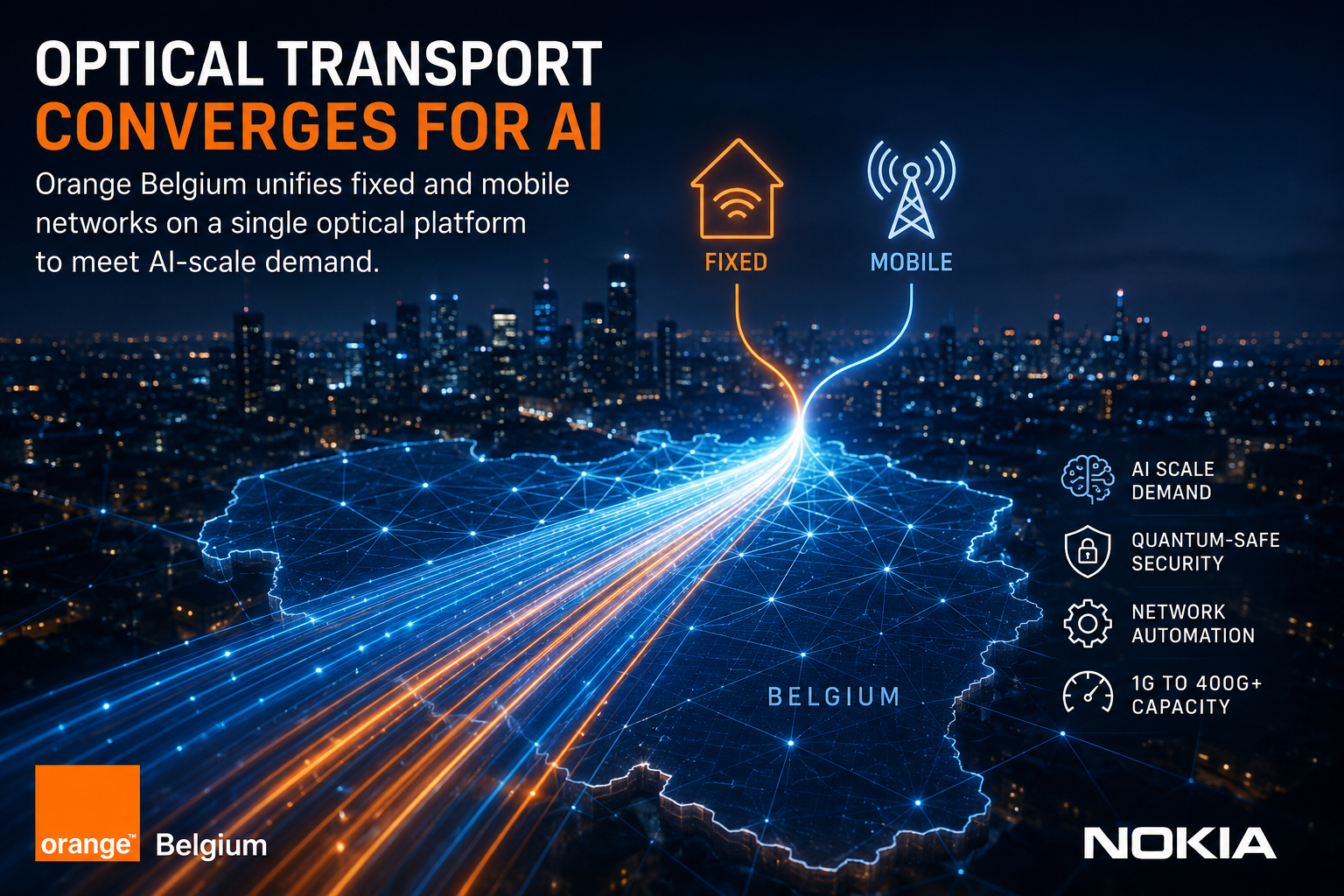
- Orange Belgium has selected Nokia to unify fixed and mobile transport on a single optical network
- The upgrade shows how growing AI and cloud traffic is driving operators towards converged transport infrastructure
The fact
Orange Belgium has selected Nokia as the sole supplier for a multi-year upgrade of its optical transport network. The project will consolidate the operator's fixed and mobile transport systems onto a single optical platform spanning metro access and backbone infrastructure across Belgium.
The upgraded network will support services from 1G to 400G and beyond, providing the capacity needed for growing broadband, mobile and enterprise traffic. It will also introduce greater network automation and operational control to simplify service delivery and network management.
Orange Belgium said the programme is designed to support increasing demand from 5G, AI applications, machine-to-machine communications and quantum-safe security. The operator expects the new transport architecture to improve resilience while providing a more scalable foundation for future digital services.
The assessment
Optical transport is becoming a strategic layer of telecom infrastructure. Fixed broadband, mobile services, enterprise traffic and AI workloads increasingly share the same optical backbone, making separate transport networks more costly and more difficult to operate efficiently.
Orange Belgium's programme reflects this shift. The significance lies less in the equipment than in the move towards a simpler, more scalable transport architecture that can support multiple services on a single network while improving operational efficiency.
For BTW readers, converged optical transport is becoming part of the infrastructure that underpins AI, cloud and next-generation connectivity. Operators that modernise this layer early will be better positioned to expand capacity and introduce new services without continually rebuilding separate transport networks.
What to watch
Watch how quickly Orange Belgium migrates fixed and mobile traffic onto its converged transport platform. Progress in network automation, service delivery and higher-capacity connectivity will indicate whether unified optical transport becomes the preferred model for AI-era telecom networks.