
Summary
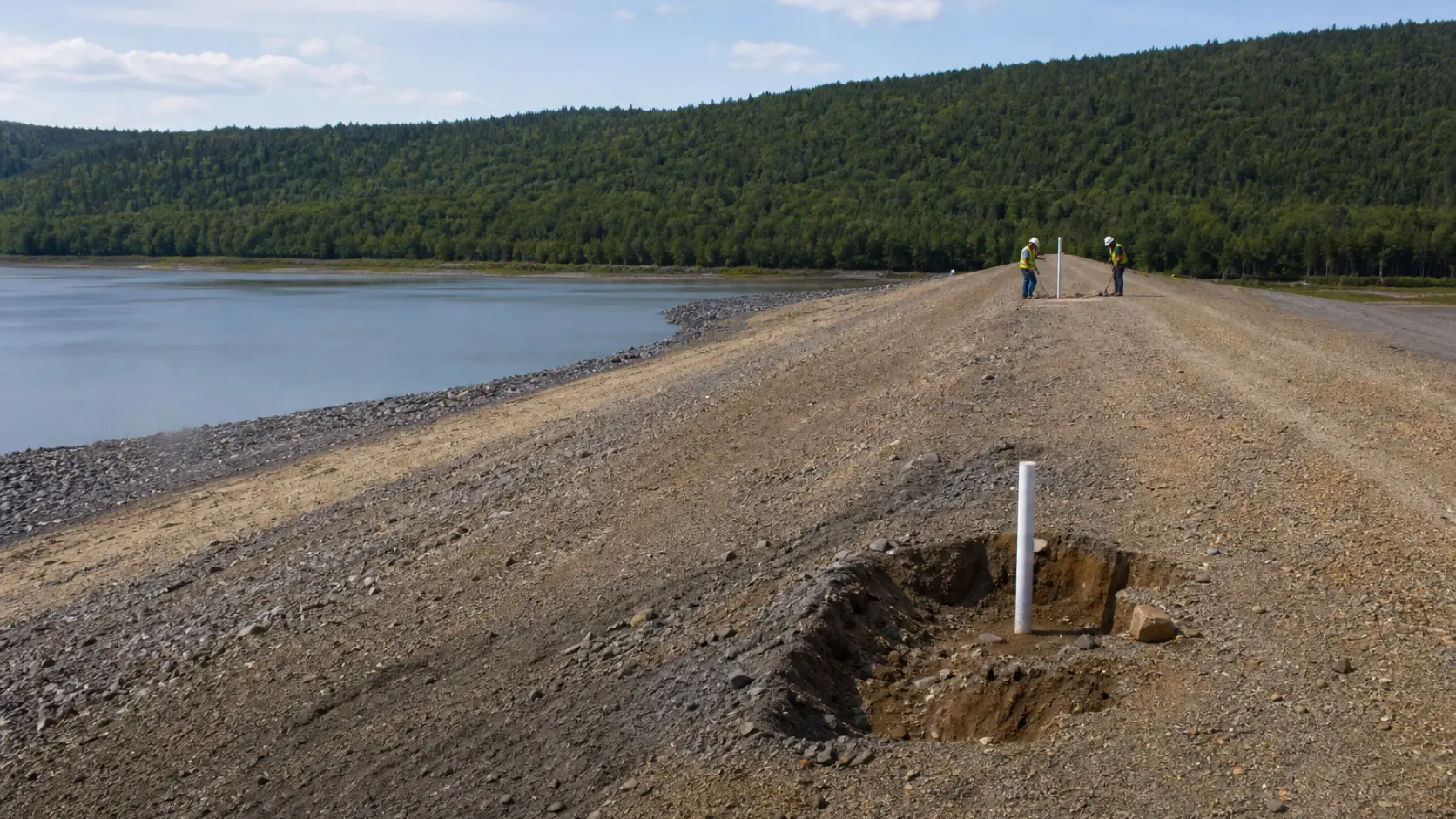
- On 4 August 2014, the perimeter embankment of the Mount Polley tailings storage facility failed after foundation movement through a weak glaciolacustrine layer. The independent panel did not find overtopping, internal erosion, or deliberate interference to be the initiating cause.
- The physical failure became a large release because foundation displacement lowered the crest and the pond supplied water that eroded and enlarged the breach. Water was therefore an amplifier and consequence-control issue, not the panel's initiating mechanism.
- The Chief Inspector identified three proximate structural factors—the uncharacterized weak layer, steepened embankment geometry, and an unfilled toe excavation—inside a broader system of inadequate foundation investigation, water planning, record continuity, corporate escalation, and professional reliance.
- The panel, Chief Inspector, and Auditor General had different mandates. Their findings should be reconciled at their proper level rather than blended into a fictitious single verdict.
- Environmental evidence is medium-, place-, depth-, species-, season-, and time-specific. Some later water results were reassuring at sampled locations, while sediment, biological, habitat, and baseline limitations prevent a universal conclusion of no long-term effect.
- Restart approvals and later production show that operations were authorized under new conditions; they do not erase the breach, prove that every remedial objective was achieved, or decide legal liability.
- British Columbia strengthened tailings requirements, including independent review boards and clearer qualified-professional roles. A later audit found substantial implementation but also ambiguity, inconsistent verification, and data-system weaknesses.
- Fifteen Fisheries Act charges announced in 2024 remain allegations in the reviewed record. No engineering report, regulatory audit, company filing, or prosecution announcement cited here establishes a conviction.
1. A tailings facility is a chain of decisions, not a static wall
The easiest mental model of a tailings dam is also the most misleading: a finished barrier designed once, built once, and then passively watched. Mount Polley was a staged facility. Its embankments rose as mining continued, tailings accumulated, water conditions changed, consultants changed, and the operating organization responded to short-term production and material constraints. The structure visible in August 2014 was therefore the physical record of years of assumptions, approvals, observations, design revisions, construction choices, and incomplete questions.
That operating reality changes the meaning of accountability. A design drawing may be correct for the information then available, yet unsafe if the subsurface model is wrong. A piezometer may work as specified, yet be incapable of detecting a failure mode that the designers never identified. An annual inspection may list apparently manageable deficiencies while missing how several deficiencies interact. A regulator may receive sealed reports but lack a disciplined way to test whether the reports address the highest-consequence uncertainties.
An independent reviewer may be technically excellent but ineffective if management treats recommendations as optional or if the reviewer is asked only to validate a narrow design question.
The Independent Expert Engineering Investigation and Review Panel's report is the central source for the initiating mechanism. It found that the perimeter embankment failed when a portion of the foundation and embankment moved outward and rotated along a weak layer of glaciolacustrine material below the original ground surface. The layer had been encountered in site investigations but had not been characterized in a way that revealed its controlling significance. Under the embankment load, previously overconsolidated soil became normally consolidated; the design strength model did not capture the relevant undrained behaviour.
This was not simply a calculation error that could be isolated from the information system around it. The calculation reflected a ground model. The ground model reflected the scope, spacing, interpretation, and continuity of site investigation. The investigation program reflected what the owner, engineers, and regulator considered sufficiently uncertain to test. The failure was physical, but the conditions for it were organizational.
2. What happened—and what did not initiate the breach
The panel tested several plausible hypotheses rather than choosing the most visually intuitive explanation. It considered overtopping, internal erosion or piping, cracking, deliberate human intervention, and foundation instability. It found no evidence that deliberate interference initiated the event. It did not find that the pond first overtopped an otherwise stable crest. Nor did it find evidence that piping or cracking was the initiating mechanism. Those exclusions matter because post-failure photographs of an eroded opening can make water erosion look like the first event when it was part of a later sequence.
The Chief Inspector's statutory investigation described that sequence in operational time. A structural slump began late on 3 August 2014. The crest dropped by several metres as the embankment and foundation displaced. Water then crossed the lowered crest and progressively eroded the damaged structure. By the early hours of 4 August, the opening had developed into the large breach through which pond water, tailings, and construction materials escaped. The Chief Inspector of Mines' investigation report estimated a total release on the order of 21 million to 25 million cubic metres.
The distinction between initiation and amplification does more than allocate technical precision. It prevents two accountability errors. The first is to say that high pond water “caused” the foundation to contain a weak layer or caused designers to use the wrong strength model. It did not. The second is to say that because water did not initiate the movement, water management was irrelevant. It was not. Once the crest dropped, stored water supplied the energy and volume that enlarged the opening and transported much of the released material.
Less water would not have repaired the deficient foundation model, but it could have reduced the consequence.
The panel and Chief Inspector thus describe compatible parts of a cascade. The first structural movement followed a weak-foundation mechanism. The movement lowered the crest. The pond overtopped the lowered section. Erosion converted a structural slump into a far larger release. Accountability controls must be able to interrupt more than one point in that cascade: prevent an unstable design, detect unexpected performance, maintain conservative geometry, limit water inventory, preserve adequate beach, and prepare for an emergency even when prevention is expected to work.
3. The buried layer was a knowledge failure before it was a strength failure
Glacial terrain is not uniform simply because several boreholes receive similar labels. Depositional environments can leave discontinuous lenses and layers whose strength, drainage response, and stress history differ sharply over short distances. The panel found that the critical glaciolacustrine unit lay roughly eight to ten metres below original ground in the breach area. Some investigations had identified glaciolacustrine materials, and questions about softer soil had surfaced, but the program did not trace and test the critical unit sufficiently to build the right failure mode into the design.
This is an important boundary on the phrase “unknown condition.” The layer was not unknown in the philosophical sense that no trace of it had ever appeared. It was unrecognized as a controlling design condition. Sparse or widely spaced information was generalized into a subsurface model that did not represent the breach zone. Once that model became embedded in stability analyses, later calculations could appear internally coherent while remaining externally wrong.
The panel emphasized that the design used drained strength where undrained strength was required for the material's condition under loading. In plain language, the analysis assumed the soil could dissipate pressure and mobilize strength in a way it could not during the relevant loading and deformation. That choice produced a factor-of-safety picture more favourable than the actual foundation provided. The foundation did not issue a clean, unmistakable warning that matched the assumed failure modes because the assumed failure modes were incomplete.
Accountability after such a failure should not be satisfied by asking whether a minimum number of boreholes had been drilled. The governance question is whether the investigation reduced uncertainty in proportion to consequence. A large tailings facility over complex glacial deposits requires a living geological model: explicit confidence limits, locations where continuity is assumed rather than demonstrated, tests selected for the stress path that matters, and decision rules for when construction observations contradict the model.
The record should also show who accepted residual uncertainty, on what technical basis, and at what organizational level.
This changes independent review too. A reviewer who checks arithmetic against the designer's ground model may reproduce the designer's blind spot. A high-consequence review must ask whether the model itself has been adequately challenged. That means tracing the chain from raw logs and samples to interpreted units, design parameters, failure modes, and construction sequencing—not merely confirming that a stability program ran and returned a number above a threshold.
4. Geometry and staged construction narrowed the margin
The weak foundation was the essential initiating condition, but geometry influenced whether that condition became unstable. The perimeter embankment had been steepened over successive raises. In the breach area, the downstream slope was approximately 1.3 horizontal to 1 vertical, unusually steep for a tailings embankment of this type. A flatter buttressed geometry elsewhere helped explain why comparable foundation materials did not fail in the same way at the main embankment.
The Chief Inspector identified the steepened slope and the increasing height as one of three proximate structural causes, along with the weak layer and an excavation at the downstream toe that had not been backfilled before the failure. The toe excavation was not a self-sufficient explanation, but it removed support where support mattered. This is a recurring pattern in complex failures: no single field decision must be catastrophic in isolation for the combination to become critical.
Staged construction also created scheduling pressure. The facility had to preserve freeboard while receiving tailings, and the mine had to source and place enough suitable material to complete planned raises and buttresses. The panel described planning that was too short-term and reactive, including a period in 2014 when the pond approached the crest more closely than intended. When construction materials or time are constrained, an organization can normalize temporary geometry, defer reinforcement, and then treat the unfinished state as part of ordinary operations.
The accountability control is not a promise that construction will eventually catch up. It is a hard linkage between operating rate, water balance, embankment geometry, and verified construction completion. If a downstream buttress is necessary for the design margin, production and deposition plans must be conditional on that buttress being in place. If a toe excavation changes the stability model, the excavation needs an engineered temporary condition, an owner, a deadline, and escalation if it remains open.
The facility cannot safely be managed through separate lists in which operations sees water, construction sees fill, and the engineer sees only the next raise.
5. Water was not the initiating mechanism, but it governed consequence
Mount Polley also demonstrates why technical accuracy can be abused rhetorically. Saying “the dam did not fail because of water” is accurate only if it means that overtopping of an intact crest was not the initiating failure identified by the panel. It becomes misleading if used to erase the pond's role after foundation displacement, the operational difficulty of maintaining beaches, or the consequences of storing more water than a more conservative plan would have required.
Tailings beaches separate pond water from embankments, support deposition management, and can affect seepage and erosion exposure. At Mount Polley, maintaining the intended beach configuration had been difficult. The Chief Inspector found that insufficient beach development and excessive supernatant water enabled progressive erosion after the structural slump. It also identified the absence of an adequate long-term water-management plan and the lack of a clearly qualified person responsible for water management. Those are governance findings even where the foundation mechanism remains primary.
Water management in a tailings facility is a multi-year balance, not a weekly pump decision. It must account for inflows, process-water demand, precipitation, snowmelt, evaporation, discharge constraints, contingency storage, treatment capacity, and the credible failure of pumps or pipelines. It also has to remain connected to the construction schedule: a planned raise that slips can reduce available freeboard at the same time the pond is growing. A plan that works only under average inputs or flawless equipment is not a control against a high-consequence event.
The most useful lesson is therefore two-dimensional. Prevent initiation by understanding the foundation and maintaining conservative design geometry. Limit consequence by minimizing the pond inventory consistent with safe operation, maintaining beaches and freeboard, and providing redundant water routes. One dimension cannot substitute for the other. A well-managed pond cannot legitimize an unstable embankment, while a sound embankment design does not justify uncontrolled water accumulation.
6. Instrumentation cannot detect the failure mode nobody has framed
The panel's discussion of the observational method is among its most transferable findings. The observational method is sometimes described as building while measuring and adjusting. Properly used, it requires a credible range of possible behaviour, instruments positioned to distinguish that behaviour, predetermined thresholds, and responses that can be implemented before the structure loses its margin. It is not permission to defer essential site characterization and hope instruments will reveal whatever was missed.
At Mount Polley, instruments were read and results were reviewed, but the system was not designed around the critical weak-layer mechanism because that mechanism had not been identified. Piezometers can measure pressure where they are installed. Survey monuments can record movement if the movement is large enough, occurs where they are located, and is read in time. Neither instrument can prove that an uninstrumented weak layer does not exist. An apparently stable trend can therefore be false reassurance when the conceptual model is incomplete.
Construction conditions compounded the problem. Steep, actively changing embankments limit ideal instrument placement and survival. Records must preserve installation elevations, screened intervals, calibration, damage, replacement, and the relationship between readings and each raise. A number without that lineage is not a safety signal; it is an orphaned observation. The Chief Inspector also found weaknesses in site observation, construction documentation, and the elevation of concerns from personnel who saw conditions in the field.
A defensible instrumentation program begins with failure modes. For each credible mode, it states what physical change should precede failure, which device should detect it, how often the device must be read, who reviews the result, which threshold triggers what response, and how a missed or broken reading is treated. Thresholds should include not only absolute values but rates of change and combinations—for example, increasing pore pressure plus unexpected settlement plus incomplete downstream fill.
The program must also create organizational friction at the right moment. A red threshold should not be negotiated through ordinary production meetings. It should automatically reach the engineer of record, the accountable executive, the independent review body, and the regulator when specified. The purpose of instrumentation is not to generate a reassuring archive. It is to force decisions while there is still time to make them.
7. Engineer-of-record continuity is an institutional control
An engineer of record is often treated as a named professional whose seal establishes responsibility. Mount Polley showed why the role must instead be designed as a continuity function. Different consulting firms and individuals held relevant engineering responsibilities over the facility's life. Transitions can lose site history, tacit knowledge, unresolved recommendations, design departures, and the rationale behind old assumptions even when formal files are transferred.
The Chief Inspector found that the engineer-of-record role was not sufficiently clear and that transitions created risk. It also found that the owner had not adequately identified or controlled that risk. The owner could retain consultants, but it could not delegate its statutory and operational responsibility for the mine. This is a central accountability boundary: professional reliance is a way to obtain competent advice, not a way for a corporation or regulator to transfer away the duty to ask whether the advice is complete, current, and acted upon.
Continuity requires a controlled design basis. That record should state the current geometry, subsurface model, parameters, water assumptions, construction specifications, accepted departures, active failure modes, instrumentation plan, trigger levels, unresolved recommendations, and upcoming decisions. At every transition, outgoing and incoming engineers should jointly attest to a reconciliation of those elements. The owner should attest that it has funded and scheduled required work. The regulator should be able to see not only the new name but the completed transfer.
The owner also needs an internal technical authority capable of understanding what consultants say. A board cannot discharge oversight merely by receiving a stamped annual report. It needs leading indicators: overdue investigation work, deferred buttresses, open toe excavations, water-balance exceedances, broken instruments, unresolved independent-review recommendations, and departures from approved design. Each indicator should have age, consequence, responsible executive, and closure evidence.
After the investigations, the provincial professional regulator separately examined conduct. Engineers and Geoscientists BC's discipline summary concerning three engineers describes admissions or findings related to foundation investigation recommendations, site observations, construction records, seepage, the toe excavation, design review, and assignment of engineer-of-record duties. Those proceedings addressed professional obligations. They did not transform a disciplinary panel into the breach-causation panel or a criminal court.
8. Three public inquiries asked three different questions
Public discussion often merges the independent panel, the Chief Inspector, and the Auditor General into a single “government report.” That erases the architecture of accountability. The bodies were differently constituted, gathered evidence for different purposes, applied different criteria, and had different authority over people and institutions.
| Body | Core question | Principal contribution | Boundary |
|---|---|---|---|
| Independent Expert Engineering Investigation and Review Panel | What technical factors caused the breach, and what engineering lessons should follow? | Identified the weak-foundation mechanism; tested and rejected other initiating hypotheses; distinguished initiation from erosion; proposed best available technology and practice, failure-mode review, qualified professional oversight, and independent review | Did not determine criminal guilt, civil liability, professional discipline, or the complete long-term environmental outcome |
| Chief Inspector of Mines | What root and contributing causes fell within the Mines Act investigation, including design, construction, operation, organization, and oversight? | Identified three proximate structural causes and broader weaknesses in water management, engineer-of-record transitions, owner responsibility, professional reliance, emergency planning, and regulatory practice | A conclusion about whether evidence warranted a Mines Act referral was not an acquittal under the Fisheries Act or other laws |
| Auditor General of British Columbia | Did provincial ministries operate an effective compliance-and-enforcement system that protected the public from significant environmental risk? | Found major system weaknesses in planning, resources, inspections, enforcement tools, professional reliance, design-deviation control, and institutional independence | Was a performance audit, not a geotechnical cause determination or prosecution |
The province's release accompanying the Chief Inspector's report said the investigation found insufficient evidence of a regulatory contravention to warrant referring charges under the Mines Act to Crown counsel. That statement is narrow. It does not mean that every actor met every professional, corporate, environmental, or common-law obligation. It does not preclude later evidence or enforcement under a different statute. And it cannot be read forward as a decision on federal charges laid almost nine years later.
The Auditor General's mining-sector report examined the Ministry of Energy and Mines and the Ministry of Environment against the expectations of a robust compliance-and-enforcement program. It found that almost all of those expectations were not fully met. The audit identified inadequate planning, incomplete risk-based approaches, resource constraints, inconsistent monitoring and inspection, weak use of enforcement tools, and overreliance on qualified professionals without sufficient verification.
For Mount Polley specifically, the audit criticized the ministry for not ensuring that construction and operation conformed to approved designs and for not effectively addressing departures. It also examined the absence of geotechnical inspections in some years. Crucially, the audit did not claim that an ordinary surface inspection would have discovered the hidden weak foundation layer. It argued that inspections and enforcement could address visible construction, operation, design-deviation, and long-term-planning issues. That is a different causal level.
9. The panel and Auditor General can both be right
The apparent contradiction is often framed this way: the panel said missed inspections did not cause the failure, while the Auditor General said regulatory oversight was deficient. The contradiction dissolves when the questions are stated precisely.
The panel asked whether the absence of Ministry of Energy and Mines inspections between 2009 and 2011 was material to the technical failure it identified. It concluded that the initiating weak-layer mechanism had no visible precursor that those inspections were likely to have found. It also observed that ministry reviewers had raised technically relevant questions, including questions about soft glaciolacustrine soils, beach conditions, and a low design factor of safety. The panel defended a bright line between the designer's duty to design and the regulator's duty to oversee; a regulator is not the substitute designer.
The Auditor General asked whether the oversight system reliably ensured compliance and controlled environmental risk. A system can fail that test even when one omitted inspection cannot be shown to have prevented one specific initiating mechanism. Failure to enforce approved geometry, track design departures, require long-term planning, verify professional work, or maintain complete risk information can reduce safety margins and increase consequences without becoming the panel's singular physical cause.
This distinction is vital for public-sector continuity. If government responds only to the hidden layer, it may fund more geotechnical drilling but leave weak enforcement and information systems intact. If it responds only to regulatory process, it may add forms without improving failure-mode analysis. Effective reform requires both: competent professionals with nondelegable design responsibility and a regulator capable of testing whether the system around those professionals is functioning.
The province's formal response to the Auditor General accepted a number of improvements but did not accept the recommendation to create a wholly independent compliance-and-enforcement unit outside the ministry. It instead established a mining compliance and enforcement board. That policy disagreement should remain visible. The audit recommendation, the government's chosen model, and later performance evidence are separate facts; one should not be rewritten as unanimous institutional consensus.
10. Environmental response began with an order, not a conclusion
The breach released pond water, tailings, and eroded material through Polley Lake and Hazeltine Creek toward Quesnel Lake. The province's current Mount Polley environmental information page describes the release as approximately 17 million cubic metres of water and eight million cubic metres of tailings and other material, while also noting the significant physical impact. Differences between reported volume ranges reflect estimate scope and method; they should not be forced into false precision.
On 5 August 2014, the Ministry of Environment issued a pollution abatement order. It required the company to stop and mitigate discharges, assess impacts, remove or manage pollution, submit plans, and carry out monitoring and remediation work under regulatory direction. An order of this kind is a response instrument. It defines duties and milestones; it does not certify at issuance that the full extent of harm is known.
The order was later cancelled after the ministry determined that required activities under that instrument had been completed, while monitoring and other obligations continued through permits and regulatory programs. Cancellation should therefore be read as closure of a particular order, not a declaration that every ecological process had returned to a hypothetical pre-breach state. Streams can be reconstructed while biological communities continue to change. Contaminant concentrations can decline in water while remaining relevant in sediment. A site can satisfy a permit requirement without resolving every scientific uncertainty.
The province's broader incident-information gateway preserves engineering, permitting, response, and follow-up materials. Its institutional value is continuity: a major failure should leave an accessible record after immediate news attention fades. But an archive is only as useful as its scope, link maintenance, metadata, and clarity about which documents are historical, superseded, or still operative.
11. Environmental evidence has coordinates
Statements about environmental effects need coordinates even when no map is shown. Which medium was sampled: surface water, porewater, groundwater, sediment, soil, benthic invertebrates, fish tissue, or habitat structure? At which station and depth? In which season? How soon after the breach? Against which baseline, reference site, or guideline? Was the guideline acute, chronic, human-health, aquatic-life, or another screening value? Without those coordinates, “safe,” “recovered,” and “no effect” are claims without a defined denominator.
A province-commissioned Quesnel Lake watershed database and assessment report assembled pre- and post-breach information across water, sediment, and biological media. It documented post-breach changes and guideline comparisons for substances including copper, aluminum, arsenic, and phosphorus, while also emphasizing major limitations. Pre-breach fish-tissue information was sparse. Biological observations were uneven across sites and years. Some benthic communities showed patterns consistent with physical disturbance or metal-tolerant taxa, but available data did not support a single uniform trajectory for every location.
The absence of a guideline exceedance is not the same as the absence of an effect. Guidelines are screening or management tools with defined endpoints and averaging periods. They do not directly measure every ecological function. Conversely, an exceedance does not by itself prove that the breach caused every measured concentration; source attribution requires baseline, reference, transport, and exposure analysis.
The disciplined conclusion is narrower: the breach created acute physical and chemical disturbance; monitoring provides heterogeneous evidence about subsequent conditions; and the strength of an inference varies by medium, location, and baseline quality.
The 2021 annual environmental report prepared for Mount Polley Mining Corporation reported that certain sampled Quesnel Lake water locations did not exceed acute provincial water-quality guidelines over the cited period. The report also noted that the sampling frequency was insufficient to calculate chronic guideline averages, so those results were used as a screening comparison. That caveat is not a footnote to discard; it defines what the result means.
A company-prepared permit report can supply valuable measured data and methods. Its authorship and regulatory purpose should remain visible, and its local results should not be generalized to all environmental media or all parts of the watershed. “No acute water-guideline exceedance at these sampled sites and times” is supportable where the data say so. “No long-term environmental impact” is not a logical consequence of that proposition.
12. Baseline scarcity is itself an accountability finding
Environmental accountability is weakened when baseline monitoring begins after a facility is already operating or when the pre-event program is too narrow to distinguish natural variability from operational effects. Mount Polley illustrates the cost. Researchers and regulators could compare some pre- and post-breach measures, but for important biological endpoints the baseline was limited or absent. That does not prove harm where none was measured, and it does not prove absence of harm. It reduces inferential power in both directions.
For a high-consequence tailings facility, baseline design should be linked to plausible release pathways before an emergency. If a breach could move material through creeks into a deep lake, the program should characterize water at relevant depths and seasons, depositional sediment zones, benthic communities, fish species and life stages, groundwater connections, riparian habitat, and the physical form of channels. It should preserve samples and data provenance so later analytical methods can be applied.
The province's public engagement page for the Mount Polley post-event environmental impact assessment describes a phased process spanning impact assessment, remediation, and continuing work. The existence of phases is a reminder that environmental closure is not a single sampling date. Scientific conclusions should change as data accumulate, and public reporting should distinguish completed field work, regulatory acceptance, unresolved hypotheses, and future monitoring commitments.
Institutional legitimacy depends on preserving that uncertainty without weaponizing it. Companies should not use data gaps to claim that effects did not occur. Critics should not use the same gaps to claim that every suspected effect has been established. Regulators should state what is known, how well it is known, what would change the conclusion, and who must collect the missing evidence.
13. Remediation and restart answer different questions
After a major failure, remediation, stabilization, and authorization to operate are related but distinct. Remediation addresses pollution and physical disturbance. Stabilization addresses the integrity of the damaged facility and temporary structures. Restart authorization asks whether proposed operations can proceed under specified conditions and controls. None of those decisions retroactively validates the pre-failure design.
Mount Polley first received amendments for modified operations using an alternative tailings-management arrangement. The company's 2015 announcement of the modified-operations permit amendments records the issuer's account of that authorization. It is useful for the chronology, but it is not an independent assessment of environmental recovery or a legal finding about the breach.
In June 2016, British Columbia issued a permit amendment authorizing return to full operations with a repaired and buttressed tailings storage facility. The amendment imposed engineering, operating, monitoring, and review conditions. The proper inference is that the regulator judged the approved configuration and conditions sufficient for the authorized phase—not that the original configuration had been safe, that every future failure mode was eliminated, or that environmental and legal processes were complete.
The mine later entered care and maintenance and resumed operations in 2022. Imperial Metals' first-quarter 2026 Mount Polley production update shows continuing production as a current corporate fact. Production data say what the mine produced. They do not measure whether the accountability system learned enough from 2014.
The durable restart question is whether new controls remain effective after attention declines. Are water-balance assumptions reconciled against actuals? Are independent-review recommendations closed with evidence? Does the engineer of record retain authority when schedule pressure rises? Does the regulator verify departures promptly? Are communities and First Nations able to see monitoring methods and results? Restart is where reform leaves paper and encounters the same economic pressures that shaped the facility before failure.
14. Independent review must challenge premises, not decorate approval
The panel recommended independent tailings review boards as part of a larger shift toward best available technology and best applicable practices. The most important word is not “board”; it is “independent.” Independence has financial, technical, informational, and behavioural dimensions. Members must be free of conflicts, capable of obtaining the underlying data, able to set an agenda around high-consequence uncertainty, and able to report unresolved concerns to decision-makers who cannot quietly suppress them.
Review also needs a defined relationship with the engineer of record. The review board should not become a shadow designer whose existence blurs responsibility. The engineer remains responsible for the design and for integrating site performance. The owner remains responsible for operating safely and funding necessary work. The regulator remains responsible for public oversight and enforcement. The independent board challenges the adequacy of failure modes, inputs, controls, and responses; it does not transfer those duties to itself.
A robust board receives raw and interpreted geotechnical data, design-basis updates, construction quality records, instrument dashboards, water balances, incident reports, deviations, and closure evidence from prior recommendations. It periodically visits the site and speaks with field personnel, not only executives and consultants. Its report distinguishes recommendations by consequence and urgency. Management responds in writing. Overdue high-priority items automatically escalate to the corporate board and regulator.
Independence also requires continuity. Rotating reviewers can refresh challenge, but excessive turnover recreates the same knowledge-loss risk seen in engineer-of-record transitions. Terms should overlap, and handovers should preserve why old recommendations were made. The review body should be capable of asking, years later, whether a supposedly temporary deviation became permanent.
15. Reform after Mount Polley was real—and still requires verification
British Columbia revised its mining code after the breach and after the panel's recommendations. The province's 2015–2017 code-review record describes changes that formalized roles for engineers of record and other qualified professionals, strengthened water-management and operations requirements, and required independent tailings review boards for mines with tailings storage facilities. The province chose a broad board requirement rather than limiting review to facilities selected through a narrower risk threshold.
Rules matter because they make expectations portable across companies and personnel. A requirement for an engineer of record means less if the role is undefined. A requirement for an independent board means less if recommendations can disappear without closure. Water-balance and operations requirements make the connection between infrastructure and daily decisions explicit. Training and qualification provisions recognize that a facility's safety depends on operators as well as designers.
But rule issuance is not outcome evidence. The Mine Audits and Effectiveness Unit's audit of tailings-storage-facility code requirements found that the revisions generally advanced their objectives and that reviewed mines showed substantial compliance in many areas. It also identified ambiguous terms, inconsistent verification or enforcement of some requirements, gaps concerning non-operating facilities, and weaknesses in ministry data systems. The audit made seven recommendations.
That mixed result is what credible reform assessment looks like. It neither declares failure because implementation is imperfect nor declares victory because boards and reports exist. It asks whether requirements produce observable behaviour, whether the ministry knows where gaps remain, whether ambiguity is corrected, and whether enforcement changes incentives before another incident.
Public-sector continuity is particularly important because tailings liabilities outlast political cycles, commodity cycles, management teams, and sometimes operating companies. The regulator's facility record should survive all of them. It should contain a versioned design basis, inspection and enforcement history, independent-review recommendations, status of financial security, closure obligations, and the responsible legal entity. Continuity is a safety control, not an administrative convenience.
16. The 2024 charges are allegations, not an epilogue already written
On 10 December 2024, Environment and Climate Change Canada announced that fifteen Fisheries Act charges had been laid by direct indictment against Imperial Metals Corporation, Mount Polley Mining Corporation, and Wood Canada Limited or its French-named legal counterpart. The federal enforcement notification identifies alleged contraventions under subsections 35(1) and 36(3) and states that the first court appearance was scheduled for 18 December 2024. The department appropriately declined further comment while the matter was before the court.
The Public Prosecution Service of Canada's 2024–2025 annual report describes a joint investigative and prosecutorial context involving federal and provincial agencies and says the case was being managed as a complex criminal matter. That procedural description is not proof of the allegations. Complexity, the number of charges, and the length of an investigation do not replace adjudication.
The most recent issuer filing in the reviewed record, Imperial Metals' financial statements for the quarter ended 31 March 2026, says no trial date had been set, interlocutory matters were continuing, and the company could not reasonably assess the outcome. A company filing is authoritative for what the issuer reported and how it treated the contingency; it is not an independent forecast of the court's decision.
Every defendant is entitled to the legal protections applicable to the proceeding, and the charges remain allegations unless and until established in court. Nothing in the public sources reviewed for this article establishes a conviction or final liability determination. If a later judgment changes that status, the article would need to be updated from the judgment itself rather than from commentary about it.
The engineering investigations cannot decide the prosecution. They can identify the breach sequence, design assumptions, operating conditions, and organizational controls. A court must apply the charged statutory provisions to admissible evidence, determine the legal and factual issues properly before it, and consider any available defences. Technical causation may be relevant evidence, but it is not a shortcut to guilt.
The reverse boundary also matters. The Chief Inspector's earlier conclusion that the evidence did not warrant a Mines Act charge referral did not resolve federal Fisheries Act allegations under different provisions, on a different evidentiary record, brought by different prosecutorial authorities. Treating the 2015 decision as an acquittal of 2024 charges would collapse statutes and mandates. Treating the charges as proof that the Chief Inspector was wrong would collapse allegation and judgment. Institutional legitimacy requires resisting both shortcuts.
17. A practical accountability architecture
Mount Polley supports a control architecture that follows the life of a tailings facility rather than the organization chart of a mine. Each control needs an owner, evidence, escalation path, and independent line of sight.
| Control layer | Evidence that should exist | Failure signal | Required escalation |
|---|---|---|---|
| Site and foundation model | Versioned three-dimensional model; borehole and test coverage; uncertainty map; parameter rationale; independent challenge | Critical unit inferred across wide gaps; design parameter not matched to stress path; field observation conflicts with model | Engineer of record, owner technical authority, review board, regulator before next raise |
| Design and staged construction | Current design basis; raise sequence; verified as-built geometry; temporary-condition analyses; material plan | Unapproved steepening; buttress or toe support incomplete; temporary condition persists | Stop or constrain deposition/production until engineered disposition |
| Water and beach management | Multi-year water balance; contingency capacity; beach targets; pump and discharge redundancy | Pond inventory above plan; insufficient freeboard or beach; construction schedule diverges from water plan | Accountable executive and regulator under predefined trigger protocol |
| Instrumentation | Failure-mode-linked devices; installation lineage; validated data; rate and combination thresholds | Missing, damaged, anomalous, or unexplained reading; critical mode uninstrumented | Immediate technical review; operational restriction where margin cannot be demonstrated |
| Engineer-of-record continuity | Formal role, authority, design-basis custody, transition certificate, open-item register | Firm or individual change without reconciled handover; advice fragmented among consultants | Owner board committee and regulator before responsibility transfers |
| Independent review | Conflict declarations; full-data access; site visits; risk-ranked recommendations; closure evidence | Agenda controlled by management; overdue high-consequence item; recommendation closed without evidence | Direct report to corporate board and regulator |
| Regulatory verification | Risk-ranked inspections; design-deviation register; professional-work checks; documented enforcement rationale | Repeated departure, missing submission, unclear owner, or enforcement delay | Independent compliance governance and public reporting consistent with law |
| Environmental evidence | Pre-event baseline; multi-media sampling; methods and QA/QC; public datasets; uncertainty statement | Claim exceeds sampled medium, place, duration, or guideline purpose | Corrective disclosure and revised monitoring plan |
| Emergency and consequence control | Inundation scenarios; notification tree; tested response plan; downstream coordination | Plan outdated, contacts stale, exercise failure, or consequence model inconsistent with pond inventory | Immediate plan update and operating constraint |
| Legal and public communication | Statute-specific status, dated court record, clear allegation language, separation from technical findings | Charge described as conviction; permit described as exoneration; local sample generalized | Legal and editorial correction with source-level citation |
This architecture avoids the false choice between individual and systemic responsibility. Individuals make engineering decisions and must meet professional duties. Corporations allocate money, authority, schedules, and risk appetite. Regulators set and enforce minimum conditions. Independent reviewers create challenge. Public auditors test whether institutions work as intended. Courts determine matters within their jurisdiction. A resilient system makes those responsibilities complementary and visible instead of allowing each actor to point to another.
18. What a board should ask before accepting assurance
Corporate boards rarely need to reproduce a geotechnical analysis. They do need to know whether assurance is designed to expose bad news. A concise dashboard should therefore begin with unresolved high-consequence uncertainty, not with the number of routine inspections completed. It should show which design assumptions have the least evidence, which construction elements are behind plan, which instruments are unavailable, which independent recommendations are overdue, and what operational constraint follows from each item.
Board questions should be concrete. Which foundation units control stability, and where is their continuity assumed rather than demonstrated? Which current geometry differs from the approved or analyzed geometry? How much pond inventory can be removed if the primary route fails? What is the oldest open high-priority review recommendation? When did the engineer of record last reconcile as-built conditions against the design basis? Which regulatory commitments lack closure evidence? What environmental conclusions are limited by baseline or sampling frequency?
The board should also separate assurance providers. Management reports whether work is complete. The engineer of record reports whether the facility conforms to the design basis and is performing as expected. The independent review board challenges the adequacy of that basis and performance interpretation. Internal audit tests whether controls and escalation operate. The regulator verifies compliance and public protection. If all five rely on the same summary prepared by the same project team, the appearance of multiple lines of assurance is an illusion.
Public disclosure should follow the same logic. A company need not publish security-sensitive operational detail to disclose the existence and status of its independent board, the number and age of high-priority recommendations, material departures and corrective actions, water-management performance, and the scope of environmental monitoring. Disclosing only that a board met or a report was filed measures activity, not control effectiveness.
19. What remains unresolved
The public engineering record provides a strong account of the physical initiation and major contributing conditions, but it cannot recreate every second of an unobserved subsurface failure. Reported release volumes remain estimates with different components and methods. Environmental data do not provide equal coverage across media, depths, locations, species, seasons, and pre-breach baselines. Later monitoring may narrow uncertainties, but it cannot manufacture a missing historical baseline.
The long-term effectiveness of regulatory reform also remains an empirical question. Code revisions, independent boards, audits, and new governance structures are inputs. Their value depends on implementation during ordinary years, at inactive sites, under commodity pressure, and when technical advice conflicts with production plans. A generally positive compliance snapshot cannot prove that every facility is safe, while an identified ambiguity does not prove that every operator is noncompliant.
The legal status is clearer but still open: charges have been laid, the matter remains before the court in the reviewed sources, and no trial outcome is reported there. This article makes no prediction about guilt, defence, penalty, or allocation of liability. It also does not infer a legal conclusion from an engineering finding, a professional-discipline result, a restart permit, or a financial-statement contingency note.
Finally, environmental recovery should not be treated as a binary label. Channel reconstruction, water chemistry, sediment distribution, biological community structure, fish exposure, and cultural or land-use effects can follow different trajectories. The accountable position is to report each trajectory with its evidence and uncertainty, not compress them into a slogan.
20. The accountability test
Mount Polley changed tailings governance because it exposed the limits of fragmented assurance. A facility can have professional engineers, formal reports, instruments, inspections, permits, and corporate systems while still carrying an unrecognized failure mode. The presence of controls is not the same as the integration of controls.
The technical lesson is to investigate the site deeply enough to identify the materials and stress paths that govern stability, then preserve that model through every raise. The operating lesson is to connect geometry, construction, water, beaches, and emergency consequence in one set of hard decision rules. The institutional lesson is to make ownership nondelegable, engineer-of-record continuity explicit, independent review genuinely challenging, and regulatory reliance verifiable. The environmental lesson is to build baseline and monitoring programs whose claims never outrun their coordinates.
The legal lesson is to keep technical findings, audits, discipline, permits, allegations, and judgments in their proper categories.
That is a demanding form of accountability because it does not end with naming a cause. It asks who was required to know, who could challenge, who had authority to stop, which evidence reached decision-makers, and what happened when uncertainty remained. It requires institutions to retain knowledge longer than personnel, projects, and governments normally do.
Mount Polley should therefore be remembered neither as proof that tailings failure is unpredictable nor as proof that one reform has solved the problem. Its record shows a technically intelligible failure emerging from a long chain of incomplete knowledge and weakly connected decisions. The test for mining accountability is whether that chain is now visible—and whether any actor can still allow a critical assumption, deviation, warning, or recommendation to fall between its links.
Source notes
The panel-hosted final-report gateway identifies the independent investigation, final report, appendices, and associated record; the report itself is used for technical findings rather than treating the gateway summary as a substitute. All institutional conclusions in this article are attributed to the body that made them. Numerical estimates are presented with their source context and are not harmonized beyond what the records support. Company materials are used for company-reported permit chronology, production, and legal-contingency status, not as independent proof of remediation or environmental outcome.
The source ledger records grades, intended uses, access checks, and the principal boundary for every cited URL.