
Summary
- Mauritel is still the central fixed, mobile and wholesale-capacity operator in Mauritania: Maroc Telecom's public subsidiary page says Mauritel had 2.6 million mostly prepaid mobile customers at the end of 2025 and a 52% mobile market share at the end of September 2025, while regulator and public-network evidence show Mauritel carrying the widest 4G and fixed-access burden in a country of sparse settlement.
- The investment case is not simply "more customers buy more data." A 100 MRU weekly prepaid pass must contribute to a cost stack made of radio sites, diesel or backup power, long backhaul, international capacity, field labour, licence obligations, quality-of-service penalties, rival SIM pressure, informal satellite substitutes and a regulator that wants national continuity rather than only profitable urban coverage.
A 100 MRU data pass has to pay for a very long road
Picture a trader outside the Rosso river market at the end of a hot day. She has sold vegetables, taken a mobile-money message from a cousin in Nouakchott, checked a wholesaler's photo on WhatsApp and waited for a shared taxi that may not leave until enough passengers arrive. The unit she buys is tiny: Mauritel's regulator-filed April 2023 tariff sheet lists a one-week "Pass 2,5 Go" at 100 MRU and a 24-hour 500 MB pass at 30 MRU, while the operator's own prepaid pages advertise 4G internet day, week and month products starting at 10 MRU, 75 MRU and 200 MRU (https://are.mr/pdfs/tarifs_mauritel_avril_2023.pdf, https://www.mauritel.mr/offres/details/forfaits-classique?change_language=fr). Her substitute is real. She can make a voice call, send SMS, borrow shop Wi-Fi, delay the transaction until she reaches a larger town, or keep a rival SIM for a place where Mattel or Chinguitel is stronger. A wealthier rural business, mining contractor or NGO can also ask whether a satellite terminal or fixed-wireless reseller gives a better answer.
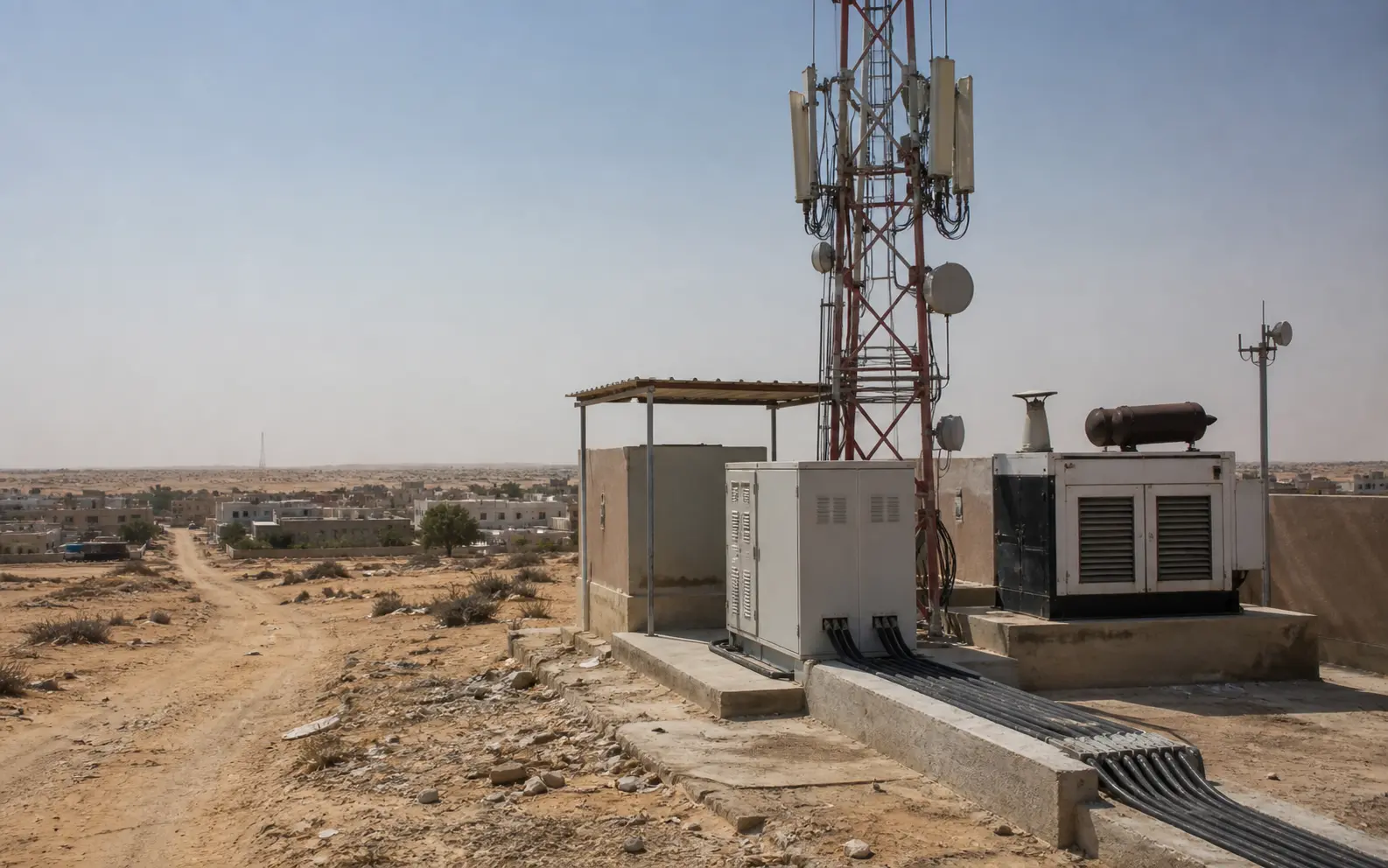
That is the economic puzzle behind Mauritel. The price feels like a retail convenience item, but the cost base is not retail-sized. A week's mobile data allowance sold in small denominations must help recover spectrum fees, core-network upgrades, imported radio equipment, fuel or backup power, security, spares, site leases, tower climbs, vehicle trips, backhaul links, submarine-cable capacity and customer support. In Nouakchott, a tower can serve a dense cluster of users and shops. On a road toward Atar, Zouerate, Bassiknou, Oualata or Bir Moghrein, the same design logic breaks.
Population thins out, distances expand, grid reliability changes, and each truck roll becomes a logistics event rather than a city errand.
Mauritel has scale, which is why it can attempt this at all. Maroc Telecom's Mauritel page says the Mauritanian mobile market had 5.0 million customers at the end of September 2025, equivalent to 97% penetration, and that Mauritel's mobile base, almost entirely prepaid, stood at 2.6 million at December 31, 2025; it also reports 59,000 fixed internet subscribers, mostly on FTTH, at the same date (https://www.iam.ma/w/groupe-maroc-telecom/mauritel). DataReportal's 2026 country report, using GSMA Intelligence and Kepios inputs, put Mauritania at 6.37 million cellular connections in late 2025 and only 2.00 million internet users, or 37.4% internet penetration (https://datareportal.com/reports/digital-2026-mauritania). The difference between connections and internet users says a lot. Mauritel is not selling into a fully monetised broadband society. It is coaxing data revenue out of prepaid behaviour, multiple SIM ownership, uneven device quality and households that may still choose between airtime, transport, food, electricity and school costs.
The useful question is therefore not whether Mauritel is the incumbent. It is. The useful question is whether its prepaid data engine can carry a national infrastructure promise across one of the world's least forgiving geographies. Mauritania is not a medium-density coastal market with a few rural gaps. The World Bank's country profile describes it as predominantly desert, with roughly 5.5 million people in 2026, average density around five people per square kilometre, and about 61% of the population living in urban areas in 2025-2026 (https://www.worldbank.org/ext/en/country/mauritania). OpenFactBook's World Factbook mirror describes vast central, northern and eastern areas as desert without sizeable population clusters, with half the population living in or around Nouakchott and smaller clusters near the southern borders (https://openfactbook.org/countries/mauritania/). That geography is the bill hidden inside the cheap megabyte.
Mauritel's edge is a coverage burden as much as a market lead
Mauritel's strategic asset is the same thing that makes its economics hard: it has to be visibly national. The operator's own public language says it offers fixed-line, 4G mobile and fibre internet services across the country, and the same phrase appears on its Moov Money/Mauritel page (https://www.mauritel.mr/?change_language=fr, https://www.moov-money.mr/en/moov-mauritel/about/). Official descriptions can sound promotional, but the regulator's numbers give the claim more weight. In the 2023 annual report, Mauritania's Autorité de Régulation said the main coverage development of the year was expansion of 4G by the three operators; Mauritel was listed at 328 towns and localities, including 13 regional capitals and 53 of 54 moughataas, compared with 48 towns and localities for Mattel and 27 for Chinguitel (https://are.mr/pdfs/Rapport2023FR.pdf).
Mauritel's own technology-coverage page is even more revealing because the map payload lists hundreds of named radio points. A direct extraction from the public page on July 5, 2026 showed 933 listed technology points, all carrying 2G and 3G markers and 859 carrying a 4G marker; the list includes remote or industrial references such as Bassiknou, Oualata, Tichitt, Chinguetti, Taziazt, SNIM El Galb, Zouerate and Bir Moghrein (https://www.mauritel.mr/couveture/technique?change_language=fr). That does not prove experienced coverage in every surrounding kilometre; a map marker is not an end-user guarantee. It does show the shape of the network Mauritel wants to claim publicly: not only downtown Nouakchott, but a mesh of localities, roads, mining zones, heritage towns and border-adjacent places where maintenance has a different cost structure.
The regulator's national-roaming consultation explains why coverage cannot be treated as a glossy map. In 2023, ARE wrote that no mobile operator in Mauritania offered 100% coverage of either territory or population, and that national roaming could help users maintain service where any network exists, while also warning that roaming should not replace each operator's own coverage obligations (https://are.mr/pdfs/cp_roam_2023_fr.pdf). Maroc Telecom's 9M 2025 "Key facts & figures" document later listed national roaming in single-operator voice areas among Moov Mauritel's 2025 highlights (https://www.iam.ma/documents/66341/0/Maroc%2BTelecom%2Ben%2Bbref%2B9M%2B2025%2B-%2BVersion%2Banglaise.pdf/18848d50-700c-da14-57a8-1e763930bf59?t=1767635528090). That is a policy clue. Mauritania is moving toward continuity mechanisms because full parallel coverage by every operator is economically awkward. For Mauritel, whose network is the broadest, that can mean both bargaining power and hosting cost.
Coverage leadership also attracts inspection. ARE's September 2025 QoS report describes drive tests from July 7 to August 23, 2025 across voice and mobile data, using tools such as Nemo Walker Air and measuring download of 50 MB files over FTP and HTTP (https://are.mr/pdfs/Rapport_QoS_Sept_2025.pdf). In the same report, Mauritel's download-success tables show failures above the 10% threshold in several locations, including remote or mid-sized places such as Kamour, Ouadane, Koubenni, Bir Moghrein, Zouerate, Barkeol, Tiguent, Tintane, Tidjikja, Chami and Rosso. The point is not that Mauritel is uniquely weak; the regulator tests all three operators. The point is that a national network creates many more places where service can disappoint and where the regulator can observe failure.
That turns coverage from a marketing advantage into an operating obligation. When Mauritel tells customers it is national, it has to make a tower in Nouakchott, a 4G cell in Atar and a backhaul-constrained site near a desert road feel like parts of one service. A prepaid customer does not price the network by distance. The customer asks whether the video opened, whether the remittance code arrived, whether the merchant's mobile-money confirmation came through, and whether the same SIM worked after a bus ride.
Mauritel has to price that expectation into a cheap pass without admitting to the customer that the marginal megabyte in one place is much more expensive than the marginal megabyte in another.
Fixed infrastructure gives Mauritel leverage, but not a free lunch
Mauritel's strongest economic protection is its fixed and backhaul position. Maroc Telecom's subsidiary page says Mauritel remains the only wired operator in Mauritania, even though Mattel and Chinguitel obtained fixed licences in 2009; it says Mattel had not developed fixed networks or offers and Chinguitel provided fixed services via CDMA, while Mauritel deployed ADSL and FTTH and had 59,000 internet subscribers, mostly FTTH, at year-end 2025 (https://www.iam.ma/w/groupe-maroc-telecom/mauritel). A 2022 backbone study for Mauritania's digital ministry described Mauritel as the historical operator, a Maroc Telecom subsidiary, and the provider of mobile, fixed, fixed internet, mobile internet and wholesale capacity services; it also said Mauritel had a 1,700 km fibre network connecting Nouadhibou, Nouakchott, Rosso and Aioun, giving it roughly half of the interurban capacity transport market with the public IMT grouping (https://mtnima.gov.mr/wp-content/uploads/2024/07/Reseau-dorsal-Mauritanie-Rapport-preliminaire-VFF.pdf).
That fixed position matters for desert-coverage economics because radio access is only the visible edge. A 4G tower still needs backhaul. If fibre reaches the site or a nearby aggregation point, capacity and latency can be better and marginal data cost can fall. If a site is microwave-fed across long hops, satellite-fed, or dependent on an expensive leased route, the prepaid data plan must absorb higher unit cost. The same ministry-backed study observed that internet access was still more pronouncedly deficient in rural areas, that coverage was limited to cities and wealthier households with home or mobile internet, and that Mauritania wanted backbone extensions to bring very-high-speed broadband into enclaved areas and open connectivity toward borders with Mali, Algeria and Senegal (https://mtnima.gov.mr/wp-content/uploads/2024/07/Reseau-dorsal-Mauritanie-Rapport-preliminaire-VFF.pdf).
The old voice monopoly is less important than the capacity bottleneck. Voice is declining across telecom markets, but backhaul remains scarce. The ministry's transit-commercialisation report said fixed broadband at end-2022 was still a small high-end market: 4,900 Mauritel FTTH subscribers and 2,600 Sahel Telecom fixed-wireless subscribers, serving mainly companies, health facilities, public administration and upper-market households (https://mtnima.gov.mr/wp-content/uploads/2024/05/Strategie-pour-la-commercialisation-des-capacites-excedantaires-de-connectivite-vers-les-payes-de-la-region.pdf). It also estimated fibre bandwidth per fixed subscription rising toward 5 Mbps by 2030 and noted that current FTTH ARPU derived from Mauritel data was not compatible with significant fibre development beyond the largest clients. That is a blunt economics signal: fibre can carry value, but broad household fibre is not yet a mass-market cash machine.
For Mauritel, the fixed network has three roles. First, it protects enterprise and public-sector relationships in Nouakchott, Nouadhibou and regional centres. Second, it lowers mobile backhaul cost where fibre is reachable. Third, it gives the company a wholesale and regulatory position in capacity markets. But it also brings duties. ARE's 2024 dominance decision designated Mauritel, among other operators, as significant on several wholesale markets; Mauritel was specifically declared dominant on terminal capacity access for the enterprise market, wired local loop access, and high-speed access for the general-public market (https://are.mr/pdfs/decision_n%C2%B0_185_2024.pdf). Dominance is not just rent. It brings interconnection, access, non-discrimination, cost-accounting and tariff-orientation obligations.
That is why Mauritel's apparent advantage should not be read as effortless monopoly profit. A company with fixed, mobile, capacity and international-gateway assets can cross-subsidise coverage better than a smaller mobile-only rival. It can also become the operator everyone blames when national connectivity is expensive, urban fibre is slow to reach ordinary homes, or remote service quality is poor. In a sparse country, the incumbent's advantage is partly a political assignment: be big enough to keep serving places a narrow urban competitor might skip.
International bandwidth is becoming more resilient, not necessarily cheaper at the edge
Mauritel's data economics begin outside the radio network. The company secures international bandwidth through the ACE submarine cable consortium, and Maroc Telecom's Mauritel page says all Mauritanian telecom operators and the national postal service participate in the ACE capacity consortium; the same page says Mauritel received government approval on June 26, 2020 for a West Africa Cable landing by the Maroc Telecom group in Nouadhibou (https://www.iam.ma/w/groupe-maroc-telecom/mauritel). The European Investment Bank's ACE project page says Mauritania's ACE participation involved a branching unit, a branch cable to shore and a Nouakchott landing station to improve international broadband connectivity (https://www.eib.org/en/projects/all/20100365). The ACE consortium's own page says ACE was the first international submarine cable to land in Mauritania, among several other West African countries (https://ace-submarinecable.com/en/submarine-cable/).
The newer story is diversity. Maroc Telecom's 9M 2025 document lists commissioning of the West Africa submarine cable landing station in Nouadhibou as a Moov Mauritel highlight (https://www.iam.ma/documents/66341/0/Maroc%2BTelecom%2Ben%2Bbref%2B9M%2B2025%2B-%2BVersion%2Banglaise.pdf/18848d50-700c-da14-57a8-1e763930bf59?t=1767635528090). ARE's 2025/2026 BU-WAC interconnection catalogue describes Moov Mauritel's Business Unit WAC as a strategic Mauritel entity dedicated to an international gateway, managing the Mauritanian branch of the West Africa Cable and the landing point at Nouadhibou terminal station; it also lists services such as dedicated point-to-point capacity, IP transit and optional colocation (https://are.mr/pdfs/BU-WACCatalogue2025-2026.pdf). That is important because Mauritania historically had limited direct submarine diversity, and any single-cable dependency can become a national risk.
The next cable reinforces the same point. In August 2025, the European External Action Service said a EUR 25 million EIB loan would help Mauritania deploy a second high-speed submarine cable through EllaLink, providing a backup to the existing ACE cable and additional capacity for Mauritania and landlocked neighbours (https://www.eeas.europa.eu/delegations/mauritania/deployment-second-high-speed-submarine-cable-mauritania_en). EllaLink's own July 2025 release said it would build a cable landing station in Nouadhibou and a more than 500 km branch to its existing system, with an initial 200 Gbps low-latency circuit from Nouadhibou to Madrid and projected readiness in early 2027 (https://ella.link/press-releases/mauritania-ellalink-international-submarine-cable-connection/). Data Center Dynamics reported the same project as a second subsea connection for a country where ACE was the only cable landing at the time of its article (https://www.datacenterdynamics.com/en/news/ellalink-to-expand-subsea-cable-to-mauritania/).
More international capacity can reduce national fragility and improve wholesale options. It does not automatically solve the prepaid desert problem. A submarine cable lands at a coastal city. The cheap rural data session still has to cross a national backbone, a regional aggregation link, a tower power system and a local radio sector. If the bottleneck is the international link, a new cable helps directly. If the bottleneck is a microwave hop, an overloaded sector, a diesel delivery run, a failing battery, a congested urban core, a field team shortage or a customer device, international capacity is only one part of the fix.
That distinction matters because Mauritel is simultaneously a buyer, seller and operator of capacity. As traffic grows, the company benefits from lower unit cost on international routes and from additional resilience it can package to enterprises and ISPs. But it also faces price pressure if new cables and public backbones reduce scarcity. A second cable can weaken an incumbent's ability to earn scarcity rents from international access while strengthening the national service by lowering outage risk. The better version for Mauritel is to turn cable diversity into a higher-quality national data product.
The weaker version is to lose wholesale pricing power while still paying to maintain the rural radio network.
Diesel, grid gaps and field labour sit inside the prepaid margin
The article's desert thesis depends on power, not only fibre. World Bank data put Mauritania's population access to electricity at 50.3% in 2023, while the World Bank country profile emphasises the country's low density and desert geography (https://data.worldbank.org/indicator/EG.ELC.ACCS.ZS?locations=MR, https://www.worldbank.org/ext/en/country/mauritania). World Bank business-environment data also show firms experiencing electrical outages as a live constraint, with the indicator defined as the percentage of firms that experienced outages in the last fiscal year (https://data.worldbank.org/indicator/IC.ELC.OUTG.ZS, https://databank.worldbank.org/metadataglossary/world-development-indicators/series/IC.ELC.OUTG.ZS). A telecom tower can have a commercial power connection in one city and a very different energy profile on a remote road or industrial spur.
Across Africa, diesel and backup power are a known tower-cost driver. Africanews reported in May 2026 that rising diesel prices were pushing operators toward solar-powered towers and said diesel powers many of Africa's cell-phone towers, while AP-syndicated reporting on the same trend noted that energy can account for up to 60% of operating costs for off-grid telecom towers (https://www.africanews.com/2026/05/04/africas-telecom-towers-turn-to-solar-as-diesel-costs-surge/, https://ny1.com/nyc/all-boroughs/ap-top-news/2026/05/02/africas-cellphone-towers-turn-to-solar-as-diesel-costs-surge). Those are continental figures, not Mauritel accounts. They are still relevant because Mauritel's public coverage map includes many places where grid quality, distance and maintenance logistics are obviously unlike central Nouakchott.
The maintenance cost is not abstract. A site at Bir Moghrein or Chegat on the coverage map is not just another spreadsheet row. It is a vehicle trip, a security check, a spare-parts choice, a battery replacement schedule, a possible generator refuelling route and a technician roster. A tower in a mining corridor such as Taziazt or around SNIM-linked locations can be commercially valuable because mining, logistics and public services need connectivity; it can also be demanding because industrial customers expect uptime and because the site may sit far from dense consumer demand.
A rural 4G site can be socially valuable because it supports payments, family contact, school administration and emergency calls; it can be financially thin because the population it reaches buys small prepaid bundles.
This is why the first 100 MRU pass matters. At face value, the buyer is paying for 2.5 GB for a week. In economic reality, the pass is a claim on a national cost pool. In dense areas, the pass contributes to a high-volume urban network where costs are spread across many users. In sparse areas, the same pass may barely cover the variable cost of serving a light user if one includes backhaul, energy, maintenance and the capital tied up in the site. Mauritel cannot charge a different national story for every locality. It has to manage a blended tariff structure while the cost curve varies sharply by place.
The labour component is easy to understate. The national network requires radio engineers, fibre splicers, GPON technicians, diesel and power specialists, customer-care staff, commercial agents, security contractors, drivers and regional supervisors. Public labour-market pages for Mauritania advertise telecom-network and fibre-technician recruitment categories, and individual public CV traces show Moov Mauritel GPON integration or supervision experience, but these are market signals rather than a full workforce census (https://www.emploimauritanie.com/recrutement-technicien-fibre-optique, https://www.africawork.com/fr/cabinet-recrutement/mauritanie/technicien-reseaux-telecoms, https://www.emploimauritanie.com/recrutement-mauritanie-cv/106716). The visible point is that national coverage creates local support labour, and local support labour is not optional when the regulator is measuring service and customers can switch SIMs.
Prepaid scale protects Mauritel, but prepaid behaviour weakens pricing power
Mauritel's mobile base is described by Maroc Telecom as "quasi-totalement prépayé" at year-end 2025 (https://www.iam.ma/w/groupe-maroc-telecom/mauritel). Prepaid scale is useful because it creates distribution reach, brand familiarity and cash collection without the full credit risk of postpaid billing. It also lets low-income or irregular-income users manage connectivity in small increments. That fits Mauritania's market structure. DataReportal counted more mobile connections than people in late 2025, but only 2.00 million internet users; multi-SIM ownership and voice/SMS-only connections mean the headline mobile base is not the same as a high-ARPU data base (https://datareportal.com/reports/digital-2026-mauritania).
Prepaid behaviour compresses pricing power because customers buy by need, not by contract. A rural customer may activate data for a market day, a remittance transfer, a school result, a family video call or a bus journey. A Nouakchott student may buy a night pass because it is cheaper. A merchant may hold two SIMs and move usage to the operator that works in a specific district. A household may ration mobile data when cash is tight and rely on voice, SMS or nearby Wi-Fi. The tariff sheet's structure reflects this: 125 MB for 10 MRU, 300 MB for 20 MRU, 500 MB for 30 MRU, 1 GB for 50 MRU, 1.5 GB weekly for 75 MRU, 2.5 GB weekly for 100 MRU, 6 GB monthly for 200 MRU, 10 GB monthly for 300 MRU and 20 GB monthly for 500 MRU (https://are.mr/pdfs/tarifs_mauritel_avril_2023.pdf). The product ladder is granular because the customer budget is granular.
Competition reinforces that discipline. Mauritel leads, but Mattel and Chinguitel remain active mobile competitors, and newer fixed-wireless or ISP entrants have been authorised in urban niches. The ministry-backed backbone report listed Mauritel, Mattel and Chinguitel as the three global operators and noted additional authorised ISPs such as Sahel Telecom, Conecty, CSS-Wigo, WiMex, Smart MS/Rimatel, Netcom, Patrienet, Global Technics and others, many focused on fixed internet in urban areas or radio-based services where traditional operators had not provided satisfactory fixed solutions (https://mtnima.gov.mr/wp-content/uploads/2024/07/Reseau-dorsal-Mauritanie-Rapport-preliminaire-VFF.pdf). That means Mauritel's retail customer can face local alternatives even if Mauritel remains strongest nationally.
Public performance signals cut both ways. nPerf's 2026 mobile barometer says Moov Mauritel subscribers enjoyed the best overall mobile internet performance in Mauritania over the April 2025-March 2026 measurement window, including best 4G performance and low latency in several categories, while nPerf's coverage maps present crowd-sourced Moov Mauritel, Mattel and Chinguitel coverage and bitrate views by location (https://media.nperf.com/files/publications/MR/MR-Barometre-Mobile-connections-nPerf-2026_7918.pdf, https://www.nperf.com/en/map/MR/-/171770.Moov-Mauritel-Mobile/signal). SpeedGeo's public statistics similarly place Moov Mauritel ahead on mobile download speed in its current Mauritania table, with Mattel and Chinguitel visible as alternatives (https://www.speedgeo.net/statistics/mauritania). These sources are not audits of every desert road. They are market signals that Mauritel's quality proposition is credible enough to matter, but also that customers compare networks through independent apps, travel pages and word of mouth.
The strongest pricing risk is not that Mauritel loses its national lead overnight. It is that the incremental data price keeps falling faster than the cost of hard-to-serve locations. If prepaid customers buy more gigabytes at lower unit prices, Mauritel needs falling backhaul and energy costs, better spectrum efficiency, higher utilisation, more fibre-fed sites, stronger urban ARPU, enterprise contracts or wholesale revenue to keep the rural promise affordable. Otherwise the cheap megabyte becomes a margin transfer from dense areas to sparse areas.
That transfer may be socially desirable and politically expected, but it is still a business fact.
Regulation is turning quality into a direct financial cost
Mauritel's coverage obligation would be easier if the regulator only measured licence paperwork. ARE is measuring service. The 2023 annual report said an August-September 2023 mission found shortcomings against operator commitments in several cities, localities and road axes for all three operators, and that ARE told them to conform within 30 calendar days before a follow-up evaluation from December 2023 to January 2024 (https://are.mr/pdfs/Rapport2023FR.pdf). The November 2024 QoS report then describes another evaluation from September 23 to November 6, 2024 across 2G/3G voice and 3G/4G data download tests (https://www.are.mr/pdfs/Rapport_QoS_nov_2024.pdf). The September 2025 report continued the same measurement path with voice and data tests including 50 MB file downloads (https://are.mr/pdfs/Rapport_QoS_Sept_2025.pdf).
That inspection sequence converted into sanctions. Hespress reported in November 2024 that ARE fined Mauritel more than 313 million ouguiyas, with Mattel fined more than 117 million and Chinguitel about 100 million, after service-quality shortcomings; it also reported temporary 2G licence restrictions and linked the penalties to network coverage and connection-quality deficiencies observed in inspections (https://fr.hespress.com/398396-mauritel-defis-et-opportunites-pour-la-filiale-de-maroc-telecom.html). Hespress is not the regulator, so the exact legal instrument belongs in ARE's documents, but the reported penalty scale is a useful public market signal. It shows that poor quality is not just reputational. It can become a cash cost and a licence risk.
The economic effect is subtle. A sanction is not only a fine; it changes the hurdle rate for maintenance. If a remote location produces small prepaid revenue but repeated poor service there contributes to a regulator finding, the site has to be maintained for reasons beyond direct local profit. The operator may have to send a field team sooner, replace power equipment earlier, add capacity before the local business case is obvious or negotiate national roaming terms that preserve continuity. That raises the value of preventive maintenance, monitoring and spares.
It also raises the value of good local teams who know which sites are difficult before a dashboard turns red.
Dominance obligations add another layer. ARE's 2024 significant-market-power decision requires dominant operators to meet interconnection and access duties, non-discrimination, cost control and separate accounting obligations on relevant wholesale markets (https://are.mr/pdfs/decision_n%C2%B0_185_2024.pdf). For Mauritel, those obligations touch mobile termination, capacity, dark fibre, terminal enterprise capacity, wired local loop and public high-speed access. The company therefore cannot treat its network only as a retail asset. Parts of it are regulated inputs for other providers, public institutions and enterprise connectivity.
The regulator's direction is understandable. A desert country cannot wait for pure urban economics to decide national coverage. But regulation does not eliminate cost; it reallocates it. Licence duties, universal-service contributions, roaming policy, QoS sanctions and access obligations all push Mauritel to maintain broader infrastructure than a narrow retail-margin model would choose. The company's challenge is to keep that regulated national role profitable enough that investment continues rather than turns into defensive compliance.
Backhaul competition can lower costs and attack Mauritel's scarcity rent
The backbone story is not only Mauritel's. The public WARCIP/IMT fibre network, SNIM's mining infrastructure, SOMELEC power-linked assets, SOGEM cross-border paths, new ISPs and future cable landings all matter because they can change the wholesale price of moving bits across Mauritania. The 2022 backbone study described WARCIP as part of the public infrastructure context and analysed how a new public backbone could use existing dark fibre from WARCIP, SOMELEC, SNIM and Mauritel on some links, while building civil works elsewhere (https://mtnima.gov.mr/wp-content/uploads/2024/07/Reseau-dorsal-Mauritanie-Rapport-intermediaire-VFF-1.pdf). The transit-commercialisation report says there was an IP transit offer in Mauritania from Ikasira using SOGEM fibre between Mali, Mauritania and Senegal, and it frames regional capacity exports as a possible business line (https://mtnima.gov.mr/wp-content/uploads/2024/05/Strategie-pour-la-commercialisation-des-capacites-excedantaires-de-connectivite-vers-les-payes-de-la-region.pdf).
For a customer, more backhaul competition is good. It can lower wholesale costs, increase route diversity and reduce dependence on a single operator. For Mauritel, it is mixed. Lower backhaul input cost helps its own rural sites and FTTH ambitions. But if public or third-party networks make interurban capacity cheaper, Mauritel loses some of the scarcity value attached to its 1,700 km fibre and historical fixed role. The company then has to win on service integration, coverage, enterprise relationships and retail brand rather than just on owning the path.
The same tension applies to local interconnection. Internet Society announced the launch of the Mauritania Internet Exchange Point, RIMIX, in 2015 and said three ISPs, Mauritel, Mattel and Chinguitel, had connected and would exchange traffic (https://www.internetsociety.org/wp-content/uploads/2017/08/Press20Release20-20IXP20Mauritania20Final20_0.pdf). But current public resilience signals still show a thin local-content environment. Internet Society Pulse's 2026 country report lists only 2% of the top 1000 websites in Mauritania accessible through an in-country server or cache, and its top-ISP share estimate places Mauritanian Telecommunication Company at 82%, Chinguitel at 11%, Rimatel at 7%, Mattel at 7% and SpaceX Starlink at 3% in the same country view (https://pulse.internetsociety.org/en/reports/mr/). These measurements are not retail-revenue shares, but they indicate both Mauritel's centrality and the limited degree to which popular content is locally cached.
Local cache weakness matters to prepaid economics. If popular video, social and app-update traffic must leave the country more often, international capacity and upstream routing remain more important to every gigabyte. If caches and peering improve, Mauritel can deliver some traffic at lower unit cost and better latency. But local caching is also a coordination problem. Content providers need enough user volume, reliable hosting, business terms and operational confidence. An incumbent can help create that ecosystem, but it cannot force every global platform to localise content in a small market.
The most attractive scenario for Mauritel is a lower-cost, higher-resilience national IP ecosystem in which it remains the best retail and enterprise service wrapper. The less attractive scenario is commoditised backhaul and cable capacity paired with regulatory pressure to maintain uneconomic coverage. The difference will show up in whether the company can convert infrastructure upgrades into ARPU, enterprise contracts, mobile-money use, public-sector continuity and lower fault costs.
Informal satellite and travel chatter show where terrestrial coverage is vulnerable
Unofficial market signals should not be promoted into verified facts, but they are useful when they reveal substitutes. A Reddit discussion from 2024 about Starlink in Mauritania described users accessing the service through roaming arrangements despite questions over local availability, with commenters saying government policy and roaming restrictions could change the situation (https://www.reddit.com/r/Starlink/comments/1c32nqo/starlink_in_mauritania_with_a_spanish_ip_hows/). TechAfrica News reported in January 2026 that Mauritania had launched a tender for satellite internet licences and that LEO providers such as Starlink and Amazon were not yet authorised for direct public service but were expected to seek licences, with Starlink planning a commercial launch in Mauritania in 2026 (https://techafricanews.com/2026/01/29/mauritania-launches-tender-for-satellite-internet-licenses-to-expand-connectivity/). These signals do not prove mass substitution. They show that users and policymakers are looking for ways around terrestrial gaps.
Travel and coverage chatter tells the same story in consumer language. A 2026 tourist SIM guide says Moov Mauritel has the best network coverage in Mauritania, but also warns that outside Nouakchott coverage becomes route-dependent and patchy quickly in remote desert areas (https://www.traveltomtom.net/destinations/africa/mauritania/best-sim-card-mauritania). That is not a regulator test. It is a traveller-facing synthesis, and it should be treated as a field signal. It reinforces the economic mechanism: in the city, customers compare price and speed; in the desert, they first ask whether any signal exists at all.
Satellite is the most important strategic substitute because it changes the value of remote coverage. For ordinary prepaid customers, a satellite terminal is too expensive and impractical. For mining sites, NGOs, border posts, remote businesses, hotels, logistics operators and wealthy households, LEO service can become a real alternative if licensed and reliably supported. That does not destroy Mauritel's mobile business. It can remove some of the highest-value remote users from the terrestrial network or force Mauritel to partner, bundle or improve dedicated enterprise services.
There is also a regulatory sovereignty angle. A national operator is visible to ARE, subject to licences, local obligations and national emergency expectations. A cross-border satellite workaround can be harder to tax, monitor, support or integrate into national service-continuity policy. That is why the satellite tender matters.
Once LEO becomes formally licensed, Mauritel's desert economics may change from "serve remote points because no one else can" to "serve remote points where mobile coverage, local support, billing, voice continuity and regulatory legitimacy beat a satellite link." The prepaid megabyte will still have a role, but the highest-value remote bits may become contested.
Mobile money and public services raise the value of continuity
Mauritel is not only selling entertainment data. Its network is part of a broader continuity surface for payments, public administration, emergency contact, merchant coordination, schools, health facilities and migration-linked family support. Moov Money's public page describes Moov Mauritel as offering fixed-line, 4G mobile and fibre internet nationwide and presents Moov Money as part of the same customer ecosystem (https://www.moov-money.mr/en/moov-mauritel/about/). The details of mobile-money market share need stronger public filings before a hard conclusion, but the strategic point is clear: when a prepaid data customer also relies on messaging, account codes, merchant calls and payment confirmations, coverage quality becomes part of the local economy.
The government side also matters. Mauritania's digital backbone documents were written around public policy goals: rural access, border connectivity, state digital services and national broadband infrastructure (https://mtnima.gov.mr/wp-content/uploads/2024/07/Reseau-dorsal-Mauritanie-Rapport-preliminaire-VFF.pdf). The European Commission's Global Gateway page says a new Nouakchott data centre and submarine-cable connection should help Mauritania manage growing data volumes, improve connectivity and strengthen digital sovereignty (https://international-partnerships.ec.europa.eu/policies/global-gateway/construction-data-center-nouakchott-and-submarine-cable-mauritania_en). Those goals are not Mauritel-specific, but Mauritel is one of the operators most exposed to them because of its fixed, mobile and international-gateway role.
Continuity has a different economic weight from browsing speed. A customer may tolerate slow video but not a failed payment confirmation. A district office may tolerate ordinary latency but not a day without administrative connectivity. A health worker may not need 500 Mbps but does need the link to work when a form, referral or supply message must move. In dense cities, redundancy can come from multiple networks, fibre, Wi-Fi, fixed wireless and office connectivity. In remote areas, redundancy may be one mobile network, a weak rival signal, a satellite link or a physical trip.
That is why national roaming, QoS measurement and cable diversity are part of the same story. The regulator wants user continuity. The government wants digital services and resilience. Customers want practical transactions. Mauritel wants enough revenue to keep the network expanding. The difficult part is that these goals do not always meet in the same tariff. A 10 MRU or 100 MRU prepaid data product is not priced like a public-service contract, but it increasingly supports public-service-like expectations.
The better business model would segment this cleanly. Mass prepaid users pay affordable data rates; enterprises, public agencies and high-value remote sites pay for service guarantees, fixed access, backup links, managed routers, mobile-money acceptance, priority support or dedicated capacity; wholesale users pay regulated but sustainable interconnection and transport rates; government and donors help finance backbone and rural extensions. The weaker model would ask ordinary prepaid data alone to carry too much of the national coverage bill.
Supplier exposure sits mostly outside Mauritania
Mauritel's costs are local in labour and logistics, but supplier exposure is heavily external. Radio equipment, optical gear, core-network software, batteries, generators, solar kits, vehicles, fuel-price exposure, submarine capacity systems and many specialised spares are imported or foreign-currency-linked. Maroc Telecom's parent scale helps because the group can coordinate procurement, engineering practices and capital planning across subsidiaries. The official group key-facts document records Maroc Telecom's acquisition of 54% of Mauritel in 2001 and describes group-wide preparation for 5G, FTTH and network upgrades in its broader footprint (https://www.iam.ma/documents/66341/0/Maroc%2BTelecom%2Ben%2Bbref%2B9M%2B2025%2B-%2BVersion%2Banglaise.pdf/18848d50-700c-da14-57a8-1e763930bf59?t=1767635528090). The Mauritel page itself says CMC held 51.527% of Mauritel SA's capital after a 2006 transaction and describes Maroc Telecom's exclusive control and full consolidation from July 1, 2004 (https://www.iam.ma/w/groupe-maroc-telecom/mauritel).
Group control can lower procurement risk, but it can also centralise investment decisions. A tower upgrade in a thin Mauritanian district competes for capital with FTTH in Morocco, mobile-data growth in Burkina Faso, 4G expansion in Niger, fibre migration in Mali and other Moov Africa priorities. Mauritel's local case must therefore be strong enough inside a group portfolio, not just inside Mauritania. If the group sees Mauritel as a high-share market with regulatory pressure and modest growth, capital may go to targeted QoS fixes, FTTH in profitable areas and international-cable resilience rather than blanket rural capacity.
If Mauritel can prove that broader 4G and fixed-wireless upgrades lift data revenue, mobile-money use and public-sector contracts, the case improves.
Foreign-currency exposure also enters through fuel and equipment. Even when customers pay in MRU, many capital and operating inputs reference external prices. Diesel price spikes, shipping costs, battery replacement cycles and exchange-rate changes can eat the margin on low-denomination prepaid products. The operator can respond with more efficient radio equipment, solar-hybrid power, better site sharing, national roaming, smarter capacity planning and fibre backhaul. But each response requires capital or coordination before it reduces cost.
This supplier exposure is one reason cheap data is not automatically a sign of easy economics. A 100 MRU pass is sold in local cash, through local shops and USSD menus. The equipment serving it may have been bought in euros, dollars or dirhams. The fuel may move through an imported petroleum chain. The submarine capacity may depend on international contracts. The handset and app ecosystem is global. Mauritel's job is to translate that imported cost stack into a local prepaid ladder without pricing out the very users whose volume it needs.
The same exposure affects service repair. A failed power module, microwave radio or optical part at a remote site is not only a technical fault. It is inventory management, customs timing, vendor support, field dispatch and replacement budgeting. The more the network stretches into thin places, the more Mauritel must hold spares and labour before the prepaid revenue from those places can justify them in isolation. That is why the desert network is a portfolio problem, not a site-by-site problem.
What would change the judgment
The bullish case for Mauritel is straightforward. It is the market leader in a country where mobile remains the main access path, it has the deepest fixed and capacity position, it has the broadest 4G footprint by regulator count, it is tied to a regional telecom group, it has ACE and WAC international assets, and Mauritania is adding cable diversity through EllaLink.
If data usage keeps growing, if FTTH and fixed wireless expand beyond elite users, if national roaming brings wholesale revenue rather than only obligation, and if Mauritel uses solar-hybrid power and fibre-fed backhaul to cut rural site costs, the prepaid megabyte can become more profitable even as unit prices remain low.
The bearish case is also clear. The company may be forced to maintain a national network whose expensive edge grows faster than its urban and enterprise profits. QoS sanctions can turn weak maintenance into direct penalties. New public backbones and new submarine routes can lower wholesale scarcity rents. Satellite providers can skim some high-value remote demand. Prepaid competition can keep data prices low. Local-content weakness can keep international capacity important for ordinary app use. Parent-company capital can be allocated elsewhere if Mauritel looks like a mature share leader with rising compliance cost.
The facts that would most change the assessment are not slogans. They are site-level and segment-level numbers: how many radio sites are grid-fed, diesel-fed or solar-hybrid; how much mobile data traffic is carried per rural site; how many sites are fibre-fed rather than microwave-fed; how much WAC capacity is lit and sold; what national roaming terms pay the host network; how many FTTH users are residential rather than enterprise; how much revenue comes from mobile money and public-sector accounts; how many high-value remote customers test or adopt LEO satellite; and whether QoS failures decline in the regulator's next drive tests.
For now, Mauritel looks less like a comfortable incumbent than a national operator running a difficult cross-subsidy. It has the scale and infrastructure to make Mauritania's mobile internet feel normal to millions of prepaid users. But the normality is costly. The cheap weekly pass bought by a Rosso trader, a Kiffa student, a Nouakchott delivery worker or a Zouerate technician is not just a retail product. It is a small contribution to a national system of towers, fuel, fibre, cable landings, field labour and regulatory obligations spread across desert distance.
That is why Mauritel matters. Its public story is not simply "leader in Mauritania." The more interesting story is whether a leader can keep selling affordable prepaid data while paying the desert coverage bill. If Mauritel can turn scale into lower energy cost, stronger backhaul, better local caching, resilient cable routes, practical national roaming and service quality that survives regulator measurement, the low-priced megabyte becomes a defensible national utility. If it cannot, each new data customer will bring traffic without enough margin, and the hardest kilometres will keep sending the bill back to the network.