
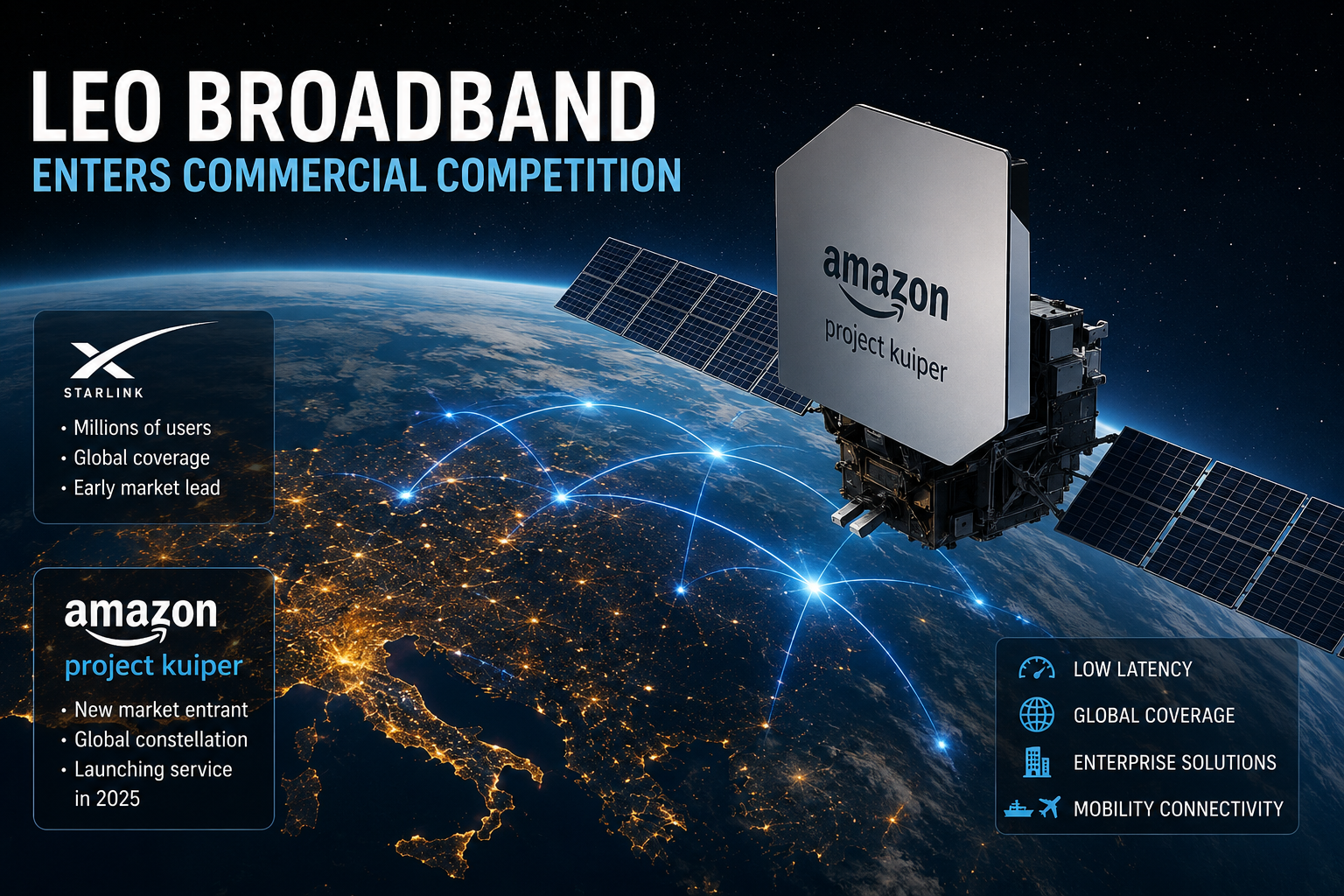
- Amazon will launch Project Kuiper's initial broadband service this year after deploying nearly 400 satellites
- The milestone marks a shift from constellation deployment to commercial competition in the LEO broadband market
The fact
Amazon will begin commercial internet service for Project Kuiper later this year after deploying nearly 400 low Earth orbit (LEO) satellites. The constellation has now reached the scale needed to support its first commercial coverage areas, with Amazon ultimately planning to deploy 3,236 satellites under its US Federal Communications Commission (FCC) licence.
The company has committed more than US$10 billion to Project Kuiper, making it one of the largest investments in satellite broadband. The network is intended to serve residential customers alongside enterprise, government, aviation and maritime markets, placing Amazon in direct competition with SpaceX's Starlink.
The launch marks Project Kuiper's transition from infrastructure deployment to commercial operations. Amazon must now expand customer availability while continuing satellite deployments to meet FCC milestones, shifting the focus from building the constellation to operating a competitive broadband business.
The Assessment
The challenge for LEO broadband is shifting from launching satellites to building sustainable connectivity businesses. As more constellations reach operational scale, continuous coverage is becoming the entry requirement rather than the competitive advantage. Success will increasingly depend on service quality, customer acquisition, enterprise partnerships and the economics of operating global satellite networks.
Amazon's commercial launch broadens competition in a market that has largely been shaped by Starlink's early lead. Deploying satellites remains essential for expanding coverage, but long-term differentiation will increasingly come from how effectively operators translate infrastructure investment into reliable, commercially viable connectivity services.
For BTW readers, LEO broadband is entering a more mature phase of market development. Operators that combine resilient networks with enterprise integration, cloud ecosystems and industry-specific connectivity solutions are likely to strengthen their competitive position as satellite broadband becomes an established component of global digital infrastructure. Commercial execution is becoming the sector's next competitive advantage.
What to watch
Watch how quickly Amazon expands commercial availability following its initial launch and whether it meets future FCC deployment milestones. Enterprise, government, aviation and maritime customer wins, together with pricing, service performance and partnership announcements, will provide early indicators of how competition evolves as the LEO broadband market moves from infrastructure deployment to commercial execution.