
Summary
- Lambda, founded in 2012 by Stephen and Michael Balaban, moved from GPU workstations and software to public cloud, managed clusters, Superclusters, and Private Cloud.
- Integrating NVIDIA systems, fast networks, storage, Kubernetes or Slurm, images, validation, and operations shifts a substantial part of the delivery work to Lambda.
- Announced funding includes $500 million in 2024, $480 million in February 2025, over $1.5 billion in November 2025, and $1 billion in May 2026; it demonstrates access to capital, not profitability.
- The test is converting announced megawatts into reliable, utilised clusters before suppliers, lenders, and large contracts constrain Lambda’s options.
Funding the Stack: Equity, Debt, and Customer Commitments
Large AI factories require more capital than a conventional software company. Accelerators, switches, optics, servers, cooling, and data centres are often financed before the associated revenue materialises. Lambda has used different instruments for different parts of that load.
Equity rounds provided corporate funding: $24.5 million in 2021, $44 million in 2023, $320 million in 2024, $480 million Series D in February 2025, and over $1.5 billion Series E in November 2025. They demonstrate investor appetite, not revenue, margins, cash burn, ownership percentages, or profitability.
Debt imposes another discipline. Reuters reported $500 million of GPU-backed financing in April 2024, proving accelerators could serve as collateral. Lambda established a $275 million secured line in August 2025 and closed a $1 billion senior line in May 2026. Debt accelerates purchases without issuing as much equity, but it creates fixed obligations and collateral restrictions.
Customer commitments form a third layer. The Microsoft deal of November 2025 was described as multi-year, multi-billion-dollar, for tens of thousands of NVIDIA GPUs, including GB300 NVL72 capacity. An anchor customer underpins planning and lender confidence. Contractual value does not equal immediately recognised revenue, and the full timeline is not public.
The instruments complement each other. Equity absorbs early risk, debt finances assets, and contracts reduce uncertainty. The model is powerful when hardware arrives on time and is heavily utilised; it is fragile when installations are delayed, a generation changes, the client alters plans, or financing tightens.
Private opacity limits analysis. Leverage, cash conversion, gross margin, concentration, and return on capital are not publicly known. The responsible conclusion is that access to capital is proven, while durability and operational profitability are not.
The Integration Problem Behind the AI Cloud
The most important product Lambda sells is not an individual graphics processor. It is the promise that several complex infrastructure layers will arrive as a usable production environment. Large artificial intelligence workloads do not become productive simply because a provider has purchased accelerators. They must be organised into systems, connected through a scale-up domain within the rack and a scale-out network between racks, fed data, scheduled according to topology and failures, cooled at high density, continuously monitored, and repaired before a costly job is lost. The customer who buys raw hardware inherits all those problems.
A generalist cloud can abstract some of them, but its broad model does not always expose the topology, tenancy, or operational control that specialised training and inference programmes need.
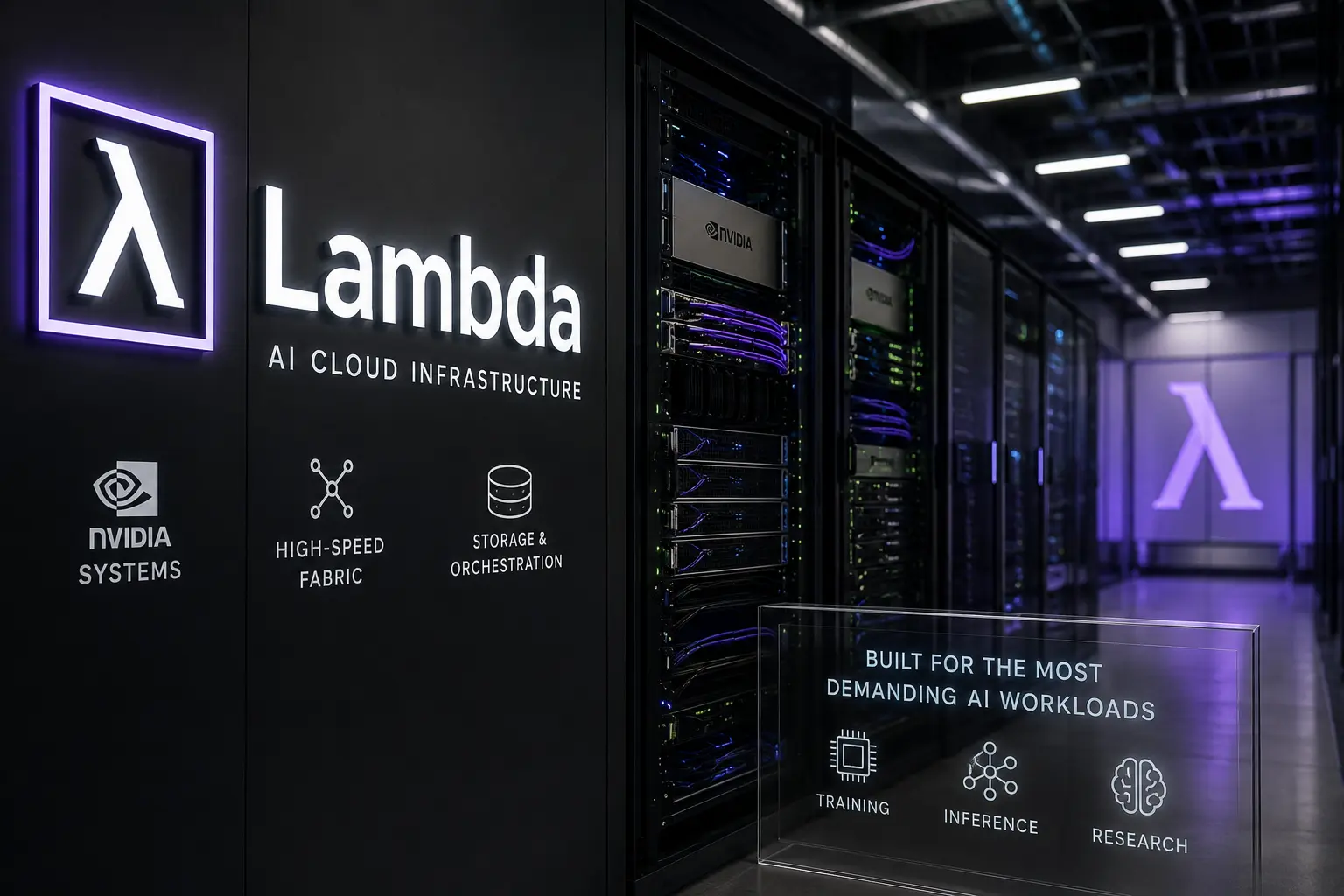
Lambda’s proposition is to assume a greater share of that burden. Its public materials present the AI factory as a coordinated system of bare metal servers, rack‑scale NVIDIA platforms, NVLink and NVSwitch, InfiniBand or RoCE, storage, managed Kubernetes or Slurm, curated software, validation, and operations. That is a much stronger commitment than offering a GPU instance through an API. It means the company not only buys accelerators but qualifies the relationships between components whose behaviour determines whether those accelerators stay busy.
The distinction matters because the economics of AI infrastructure are highly sensitive to idle time. A conventional application cluster can tolerate uneven utilisation or a brief failure without destroying the value of the entire environment. A distributed training job can be limited by the slowest path, a degraded link, a failed node, or a storage bottleneck that prevents thousands of expensive processors from moving forward together. The relevant unit of performance is not the advertised chip specification but the completion of the workload on the whole system.
Vertical integration is Lambda’s answer, but the term demands precision. The company does not manufacture NVIDIA processors, does not own all the buildings, does not generate its own electricity, does not control all the fibre, and does not fund growth solely from retained earnings. It integrates a large operational stack but depends on suppliers and external counterparties at critical boundaries.
The central question is not whether it is integrated in an absolute sense but whether it controls enough of the production path to improve deployment and utilisation without taking on more concentration, capital, and delivery risk than the model can sustain.
What Lambda Is — and What It Is Not
The canonical name of the company is Lambda. Historical references often use Lambda Labs, and that name remains useful when discussing earlier products or archives, but the current public brand and legal operator are Lambda and Lambda, Inc. It is a private Delaware corporation headquartered in San Jose, California. It is not AWS Lambda, a university lab, or an NVIDIA subsidiary. NVIDIA is its most important technology supplier and ecosystem partner, but public evidence does not identify it as an owner.
It is also necessary to separate the company from its products. Lambda Cloud is the public, managed platform. Lambda GPU Cloud is a historical label. 1-Click Clusters are pre-configured multi-node systems. Superclusters are large, dedicated offerings. Private Cloud is the managed, single-tenant infrastructure proposition. Lambda Stack is the legacy software environment from the machine-learning systems business. “Superintelligence Cloud” is brand positioning, not a separate legal entity or a formal market category.
This discipline avoids frequent mistakes. Lambda is not a simple GPU rental marketplace, because its portfolio includes physical systems, managed orchestration, dedicated infrastructure, and long-term capacity at facility scale. It does not own all the data centres, because many deployments rely on partners that supply buildings, power, and cooling. It is not a self-sufficient cloud, because it uses external silicon, networking products, utilities, fibre, and capital. Neither is it a public company whose profitability can be deduced from audited statements.
It has disclosed large rounds and contracts, but not audited consolidated revenue, profits, cash flows, customer concentration, or a complete active GPU inventory.
The difference between company and stack is equally important. A platform description can make it seem that every element belongs to and is controlled by a single organisation. In reality, Lambda’s value consists of selecting, qualifying, and operating components manufactured or delivered by others. Its integration work is real, but it must be distinguished from NVIDIA’s processor and networking architecture, from the open foundations of Kubernetes and Slurm, from physical delivery by its partners, and from the utility electrical system.
This is not a criticism but the correct way to understand a modern infrastructure company. The strategic asset is often the ability to coordinate dependencies, not to eliminate them. Lambda promises that the customer will deal with a single provider for an outcome that would otherwise require multiple vendors and a large internal team. The governance question is how much control the customer surrenders when that coordination is concentrated in a private provider.
From Machine-Learning Systems to Cloud Infrastructure
Lambda was founded in 2012 by brothers Stephen and Michael Balaban. Its initial activity focused on systems for machine-learning practitioners: GPU workstations, servers, and Lambda Stack. That origin matters because it did not start as a general hosting provider that later added accelerators; it was born simplifying the pairing of hardware, drivers, frameworks, and cooling for a specialised class of workloads.
During the 2010s, the hardware‑plus‑software model gave it direct experience with integration failures. A powerful GPU can be useless if the drivers, libraries, or frameworks do not fit. A server can perform well in a test and fail under thermal, storage, or deployment requirements. That is why curated images and validated combinations became part of the product.
The leap to the cloud changed the economic unit. A workstation or server is sold as a product; cloud capacity is operated continuously and monetised by access, reservation, or service commitments. The provider must manage availability, updates, failures, and allocation after installation. The 2021 and 2023 rounds accompanied the expansion of GPU cloud and clusters, while 1-Click Cluster turned multi-node infrastructure into a documented, purchasable configuration.
The next transition was deeper. In 2024 and 2025, Lambda was no longer growing just by adding instances. It used equity, GPU‑backed debt, and large customer commitments to support dedicated clusters and AI factories. It raised $320 million in equity in 2024 and obtained $500 million in accelerator‑backed financing. In February 2025 it raised $480 million Series D. In November 2025 it announced a multi-billion-dollar, multi-year deal with Microsoft and over $1.5 billion Series E.
Those facts show the move from product integration to infrastructure financing. Accelerators become collateral; contracts become demand anchors; data centre and electricity timelines become commercial execution. The risk changes. A workstation company manages inventory and demand; an AI factory operator also manages construction, utilities, optics, liquid cooling, hardware generations, long contracts, utilisation, and debt.
Lambda’s story is not a list of ever‑larger rounds but an expansion of control boundaries. First it integrated software and machines; then machines and cloud operations; then clusters, networks, and schedulers; finally, dedicated facilities, capital, and commitments. Each step opens more possibilities to optimise the whole and creates a larger obligation when a part is late, underused, or obsolete.
A Product Ladder That Shifts the Control Boundary
Lambda’s portfolio can be understood as a ladder from flexible access to dedicated infrastructure. At the entry end, public GPU instances allow capacity to be obtained without buying hardware or signing a facility contract. Workspaces, introduced in June 2026, adds team organisation and access controls. This is the layer closest to a classic cloud: the customer selects available capacity, organises users, and runs workloads within a shared service.
The next rung is 1-Click Cluster. It is no longer just a group of instances. Lambda documents a multi-node architecture with head nodes, a rail‑optimised NVIDIA Quantum‑2 InfiniBand network, separate Ethernet, and compatible GPU generations. The customer receives a selected and qualified compute and network topology. This reduces the need to procure switches, optics, and servers separately, but it limits choice and increases dependence on Lambda’s validated combination.
Managed Kubernetes adds operational responsibility. Lambda maintains the control plane and integrates GPU‑aware components, while continuous validation tests nodes, links, and accelerators and can withdraw degraded resources from scheduling. Managed Slurm serves a different model, common in HPC and batch work. The choice is not ideological: it depends on whether the workload is organised as containerised services, queued research jobs, or a mix.
Superclusters move toward dedicated scale. Lambda markets single‑tenant clusters with non‑blocking InfiniBand or RoCE and managed Kubernetes or Slurm, positioned from thousands to over one hundred thousand GPUs. That range describes an offering and architectural ambition, not a verified census of active clusters at every size. Private Cloud combines dedicated infrastructure and managed operations under a long‑term agreement.
Responsibility shifts at each rung. The public customer retains flexibility but shares more. The 1-Click customer receives a stronger topological commitment but a more prescriptive architecture. The Supercluster or Private Cloud customer gains tenancy and customisation but enters a longer, more capital‑intensive relationship. Lambda takes on more integration; the customer becomes more exposed to the provider’s timeline, operating model, and future hardware transition.
The ladder also creates a commercial journey: start with instances, organise through Workspaces, move to a pre‑configured cluster, and finally contract dedicated capacity. It reduces friction within the same provider but can raise switching costs. Data, tools, scheduling practices, and performance assumptions can adapt to Lambda. Value depends as much on ease of entry as on clarity of exit, portability, and ongoing control over data, software, and operations.
Public Cloud and Workspaces
The public cloud is the broadest access layer. It allows developers and organisations to use compatible GPUs without owning the systems. It is strategic because it offers a lower‑commitment on‑ramp and serves workloads that do not yet justify a dedicated cluster.
The model still depends on physical inventory. Self‑service does not mean permanent capacity in every region or generation. The portal only exposes systems that have been purchased, installed, connected, and made operational. Availability changes with supply, reservations, and regional deployment. The visible elasticity rests on a capital‑intensive fleet.
Workspaces adds organisational structure, not new physical isolation. It allows resources, access, and environments to be separated within Lambda Cloud. It is useful for teams and projects but does not equal single‑tenant Private Cloud. Logical organisation, accounts, segmentation, hardware tenancy, and facility isolation are different layers.
For small teams, this layer eliminates procurement, installation, driver management, some monitoring, and the direct relationship with a data centre. For large organisations, it can offer peak capacity, experimentation, or an evaluation step before a dedicated contract. Its value is operational speed, but there is no proof of universal cost superiority. Real economics depend on utilisation, data movement, storage, support, terms, and the internal alternative.
The public cloud also creates a tension distinct from dedicated capacity. Flexible customers expect availability and variety; large buyers can reserve much of the new hardware. Lambda must decide what portion remains fungible and what becomes committed. Too little reserved demand leaves idle assets; too much dedicated capacity can shrink the public product and the flexibility that attracts new users.
This tension defines the company’s identity. Lambda is both a cloud access provider and a builder of dedicated factories. Both businesses share hardware and expertise but have different economics, expectations, and relationships. Success will depend on maintaining the public cloud as a flexible entry point without allowing giant contracts to dominate all capacity and operational decisions.
1-Click Clusters: The Cluster as a Product
1-Click Cluster is the clearest expression of the attempt to turn a complex project into a standard product. The documentation describes configurations from 16 to 512 H100 or B200 GPUs. The architecture uses rail‑optimised NVIDIA Quantum‑2 InfiniBand at 400 gigabits per second, GPUDirect RDMA of up to 3,200 gigabits per second in the documented design, two 100‑gigabit Ethernet links, direct Internet access, and redundant head nodes.
Every figure requires context. It is specific to a generation and configuration, not a universal property of every Lambda cluster. “Up to” is an architectural maximum, not a sustained guarantee for the application. The Ethernet links serve management, external access, and other traffic; they are not the GPU fabric. Redundant nodes reduce one class of control failure but do not eliminate risk in compute nodes, switches, optics, storage, or power.
The real innovation is the packaging. The customer does not negotiate each server, switch, cable, image, and node separately. Lambda selects and qualifies a combination that can be bought as a unit. This shortens the path from ordering to useful compute and gives the provider a repeatable foundation.
Standardisation also constrains. A customer who wants a different switch, topology, storage, or configuration steps outside the standard product. Validated combinations reduce risk but make upgrades dependent on Lambda’s qualification timetable. A new generation can become available before drivers, network features, and schedulers are tested across the whole system.
The cluster functions as an architecture contract. Lambda promises a defined relationship between compute, network, management, and connectivity. The customer must still design the workload, choose parallelism, manage data, and understand the topology. A pre‑configured cluster does not automate distributed training; it removes much of the assembly so the customer can concentrate on the workload.
The commercial importance is also larger. A cluster is a bigger unit than an instance, suited to reservations and commitments. It also makes failure more expensive: a degraded component can limit an entire job and waste many accelerators. That is why continuous validation, topology‑aware scheduling, and repair are part of the economic product, not auxiliary features.
Rack‑scale NVLink and the Scale‑Up Domain
Large AI systems contain at least two network domains. Scale‑up connects accelerators within the system through NVLink and NVSwitch; scale‑out connects systems across racks via InfiniBand or RoCE. Calling both a “network” hides distinct performance, failure, and supplier boundaries.
Lambda’s recent direction is closely tied to NVIDIA platforms such as GB300 NVL72. In those, GPU, CPU, NVLink, switching, power, and liquid cooling are qualified as an integrated rack. The rack becomes the compute unit, not a collection of interchangeable servers. Model and tensor parallelism can use the high‑bandwidth domain with less overhead than conventional Ethernet.
This reinforces the integration thesis because facility design, layout, power, and cooling affect the ability to operate the system. It also deepens supplier dependence. Lambda integrates NVIDIA’s architecture; it does not create an independent scale‑up interconnect. Firmware, availability, and timelines remain heavily determined by NVIDIA.
The model changes operations. A failure is not always a replaceable server. Components can be liquid‑coupled, cabled, and switched together. Qualification must cover the rack, and repairs must preserve the behaviour expected by software and the scheduler. The GPU count alone does not reveal whether the rack is available, healthy, and assigned to productive work.
Material from GTC in March 2026 described bare metal systems with direct NVLink and Quantum‑X800 access and claimed that over 10,000 GB300 GPUs connected by Quantum‑X Photonics were in production. That is a company statement without full site, utilisation, customer, or distribution detail. It is evidence of direction and asserted deployment, not a total inventory.
The scale‑up domain is a performance asset and a dependency boundary. The customer gets an integrated system for large parallel workloads but inherits the cycle of one generation and its ecosystem. The question is whether Lambda’s expertise makes that dependency more manageable than the alternatives.
InfiniBand, RoCE, and the Scale‑Out Network
The scale‑out network carries traffic between nodes and racks. Lambda documents NVIDIA InfiniBand in 1-Click and markets non‑blocking InfiniBand or RoCE for Superclusters. They are not interchangeable labels. Each approach imposes distinct requirements on endpoints, switches, congestion, telemetry, and operations.
InfiniBand brings a specialised ecosystem for high‑performance RDMA and collective communications. The Quantum‑2 design uses 400‑gigabit links and optimised rails. More recent materials point to Quantum‑X800 and photonics for GB300. Its value lies in predictable low‑latency movement and integration with the NVIDIA stack.
RoCE brings RDMA over Ethernet. It leverages a broad ecosystem but demands end‑to‑end engineering. Queues, losses, congestion signals, topology, and telemetry are determinative. It is misleading to present the choice as a simple competition with a universal winner. The question is which fabric is qualified for the workload, scale, failure model, and team.
Offering both can reduce dependence and adapt to preferences, but it increases the validation burden. Knowledge, tooling, and failure modes do not transfer perfectly. Each generation of NIC, switch, firmware, optics, and driver requires system‑level testing.
Performance is sensitive to the tail of the distribution. One operation can wait for the slowest entity. A degraded link can waste more compute than a clean drop that triggers rescheduling. The fabric must be observed as part of service health, not as a passive pipe.
Here integration can add value: Lambda aligns topology, scheduling, validation, and repair. The customer does not coordinate vendors on every incident. The risk is asymmetric visibility. There are selected descriptions and benchmarks, but not a complete distribution of faults, outages, repair times, or congestion. The buyer must assess process and commitments, not just specifications.
GPUDirect RDMA, Rail Optimisation, and SHARP
Several mechanisms turn the fabric into more than a fast network. GPUDirect RDMA allows compatible adapters to access GPU memory without conventional CPU copies. It depends on the whole chain: GPU, NIC, drivers, memory and I/O configuration, network, and software. The provider must qualify the chain, not assume a brand name guarantees the outcome.
Rail optimisation aligns servers with multiple NICs and the fabric. Parallel rails can map GPUs and interfaces across switches, making collective paths predictable. It reduces contention and raises aggregate bandwidth, but it makes topology relevant to scheduling and failures. A degraded rail or poor placement creates asymmetry even when the cluster looks available.
NVIDIA SHARP offloads supported reductions into the network. Switches aggregate data for operations such as all‑reduce, reducing traffic and host work when the pattern is suitable. It does not accelerate every communication: it depends on libraries, operation, topology, and configuration.
These mechanisms explain why Lambda treats the cluster as a system. The scheduler must know the topology; validation must test links; the image must include compatible libraries; the network must expose features. A problem in one layer can render an expensive capability useless even if each component passes a basic test.
They also explain the caution with benchmarks. A result on GB300, B200, or H100 demonstrates capability under defined rules, not that every workload will have the same communication, data, or optimisation. The gap between supported capability and realised value is where operational skill is tested.
For the customer, the decision is whether to own this qualification problem. Building internally gives control; buying from Lambda concentrates integration and support. It requires trusting that the stack, telemetry, and repair will keep working through hardware and software changes.
Managed Kubernetes, Slurm, and Continuous Validation
Hardware is only useful when workloads can be scheduled, isolated, observed, and recovered. Lambda offers managed Kubernetes and Slurm because customers organise work in different ways. Kubernetes serves containerised services and cloud‑native patterns; Slurm serves batch queues and HPC. Both need accelerator‑ and topology‑aware extensions and practices.
Basic Kubernetes does not automatically solve GPU scheduling. Plugins, controllers, operators, labels, topology, storage, and health signals must align. A scheduler that only sees a count of free GPUs can place work in an inefficient or degraded topology. The managed value lies in the integration, not in installing Kubernetes.
Slurm offers another model. It schedules large jobs on dedicated clusters and is familiar to scientific teams. Queue policy, reservations, and fragmentation affect utilisation. There can be free GPUs that do not form the combination the job needs. The provider balances shape, topology, and priorities.
The continuous validation documentation describes automated testing of GPUs, links, and nodes to retire degraded components before jobs encounter them. It is important because a long‑running task can consume much before revealing a marginal fault. Early detection protects customer time and provider utilisation.
Public evidence demonstrates the mechanism, not its full effectiveness. Lambda does not publish sensitivity, false positives, repair distribution, or overall fault rate. It should be treated as a credible capability that still requires evaluation through service data, experience, and contract.
The combination of orchestration and validation distinguishes an operator from a reseller. Lambda decides when a resource is healthy, how to isolate faults, and how to coordinate software and hardware cycles. Those decisions directly determine the useful work obtained from installed capital.
Storage, Checkpoints, and the Forgotten Half of Utilisation
Lambda’s technical materials detail accelerators and networking more than storage. That imbalance reflects GPU marketing visibility, but storage is a critical part of the production path. Data must reach the cluster, checkpoints must be written and retrieved, and results must leave. A fast collective fabric does not compensate for a pipeline that starves processors of data.
Training systems read large datasets repeatedly, cache hot information, write checkpoints to protect long jobs, and move results. The architecture may combine local devices, high‑performance shared systems, and external services with different latency, durability, and cost characteristics. The exact design varies by deployment, so it must be treated as an open boundary, not an invented universal configuration.
Checkpointing connects storage and reliability. A job that restarts from a recent state loses less work when a node or link fails. However, frequent checkpoints consume bandwidth and capacity. Provider and customer must decide how much protection the workload duration and cost justify. It is a system decision, not merely a storage‑team decision.
Data movement also affects commercial flexibility. A dedicated cluster can be portable in theory because code can run elsewhere, but moving datasets and model states can be slow and expensive. Ingress and egress paths influence switching costs even without a contractual prohibition.
This is an important limitation of vertical integration. Lambda can integrate compute, fabric, orchestration, and operations, but value still depends on customer pipelines and external connectivity. Public materials offer less detail on global backbone, private connectivity, and per‑site storage than on the GPU network. These are legitimate diligence questions.
The strongest evaluation will measure useful throughput and recovery, not just GPU availability. It will ask whether data arrives at the needed rate, whether checkpoints are reliable, how failures affect recovery time, and how quickly data can be moved when the provider or architecture changes.
Bare Metal, Private Cloud, and Layered Security
Lambda’s dedicated systems include bare metal designs with no hypervisor. Removing that layer can expose hardware capabilities directly and avoid a class of overhead. It does not create an environment without control planes, privileged software, or shared dependencies. Firmware, BMC, network, schedulers, storage, and physical operations remain within the security boundary.
Private Cloud and Superclusters are presented as single‑tenant. Tenancy must be defined by layer. A customer may have dedicated compute and fabric and share the building, power, remote management platform, or staff. Segmentation and access reduce cross‑exposure without creating full physical independence. The contract must specify what is dedicated, what is logically separated, and what is shared.
Bare metal shifts the responsibility distribution. The customer can obtain low‑level control and direct access to hardware capabilities. It can also take on more responsibility for operating system, isolation, patching, and privileged software. A managed service still obliges Lambda to protect provisioning, firmware, management interfaces, remote access, and lifecycle.
The absence of a hypervisor should not be used as a synonym for security. It removes a layer with potential vulnerabilities and overhead but also a possible isolation boundary. The outcome depends on the whole architecture and operation.
Private Cloud materials support the existence of dedicated controls but do not equal an independent audit of each deployment. Regulated buyers need evidence on identity, logs, keys, incident response, staff access, supply chain, erasure, and responsibilities.
The strategic trade‑off repeats: integration can make security more coherent because one provider coordinates hardware, network, and orchestration. Concentration can magnify the impact of a provider failure or a privileged mistake. The question is not whether dedicated is automatically safer but whether the boundaries match the threat model and remain verifiable.
Data Centres, Power, and Liquid Cooling
At high rack densities, the facility becomes part of the compute product. Electrical delivery, liquid cooling, switch placement, cabling, and maintenance determine how much hardware can operate and how it is repaired. The stack cannot be separated from the building that supports it.
Lambda has announced or partnered on capacity in Kansas City, Chicago, Atlanta, and Southern California. Announcements have included an initial 24 MW plan in Kansas City with more than 10,000 Blackwell Ultra GPUs, a 23 MW single‑tenant project in Chicago, and more than 30 MW in EdgeConneX facilities in Chicago and Atlanta. These are dated plans and partner statements; they should not be summed as active capacity without commissioning evidence.
Ready‑for‑service dates are essential. A facility can be contracted before electrical work, cooling, connectivity, or all racks are complete. It can come online in phases. “Announced”, “contracted”, “under construction”, “ready”, “installed”, and “utilised” are distinct states.
The target of managing 3 GW of AI compute by 2030 is also a goal, not present scale. It shows the kind of company Lambda is trying to become and exposes dependencies it cannot fully integrate. Utilities decide deliverable power; partners execute construction; fibre providers determine routes; communities and permits affect timelines.
Liquid cooling deepens integration. High‑density NVIDIA systems are not conventional air‑cooled racks. Liquid distribution, heat rejection, and maintenance access must be designed alongside compute and network. A thermal delay can immobilise hardware that is otherwise ready.
The physical layer decides whether capital and contracts become productive capacity. GPUs can be secured and revenue lost if power or construction is late; a building can be finished and perform poorly if network, storage, or software are not qualified. The decisive metric is not the announced megawatt but the active, healthy, utilised systems delivered to the customer.
Microsoft, Hudson River Trading, and Demand Evidence
Named customers are more informative than general claims, but each relationship answers a different question. The Microsoft deal demonstrates large‑scale contractual demand and that a hyperscaler can use a specialist as part of its strategy. It does not prove that Lambda has replaced Microsoft’s own infrastructure or that all GPUs were active at announcement.
The deal included tens of thousands of GPUs and GB300 NVL72 capacity. This anchors demand and can underpin facilities and financing. It can also create concentration. The proportion of future capacity or revenue tied to Microsoft is not public, so it cannot be quantified.
Hudson River Trading selected Lambda in May 2026 for quantitative research. That is evidence of appeal beyond frontier‑model labs. Financial research needs compute, rapid experimentation, and predictable infrastructure. It does not prove broad sector adoption but does provide a concrete enterprise case.
MLPerf and STAC‑AI submissions add evidence on specific workloads. They show that named configurations achieved results under defined rules. They are stronger than a marketing claim but remain selected workloads, not a total measure of reliability, cost, or experience.
Contracts, customers, and benchmarks demonstrate three different things: buyers willing to commit, an ability to field high‑performance systems, and applicability to several workloads. They do not demonstrate market share, renewal, or a diversified base.
The next threshold is delivery. Watch how many announced sites come online, how capacity is allocated, whether other anchor customers appear, and whether existing ones expand or renew. Demand has more value when it is diverse, sustainable, and matched to infrastructure that can be delivered without excessive concentration.
Leadership Transition: From Founders to Infrastructure
In May 2026, Michel Combes was named CEO and Stephen Balaban moved from CEO to CTO. Michael Balaban continued as co‑founder and chief product officer. John Donovan was chairman, and the company had added Leonard Speiser as COO, Charles Fisher as CFO, and Jerry Hunter in senior leadership and advisory roles.
The change was presented as preparation for gigawatt‑scale AI infrastructure. It is not a founder departure: Stephen Balaban still leads technology and Michael Balaban product. The transition separates technical building from the responsibility of running a capital‑intensive infrastructure company.
Combes brings telecoms and large‑operations expertise. That is relevant because the next problems include financing, facilities, supplier coordination, enterprise contracts, and standardisation across sites, not just software.
The expanded structure resembles an infrastructure operator more than a hardware start‑up. It can improve execution with specialists but also introduce complexity. Product instincts, customer commitments, lender requirements, and physical timelines can compete.
Governance is publicly incomplete. Voting rights, investor protections, compensation, ownership, and a detailed division of authority are not known. A round does not prove that an investor controls day‑to‑day operations.
The test will be practical: site delivery, qualification of generations, reliability at scale, customer diversity, and preservation of technical coherence during professionalisation. Resumes and titles are inputs; outcomes will indicate whether the transition builds a durable institution.
Ecosystem Dependence and the Limits of Vertical Integration
Lambda’s stack is built within an ecosystem. NVIDIA supplies accelerators, scale‑up, and much of scale‑out. Partners such as EdgeConneX and Prime Data Centers provide facilities. Utilities supply power. Kubernetes and Slurm come from open communities. MLCommons and STAC offer testing frameworks. Investors and lenders supply capital; customers, demand.
This does not empty the meaning of integration. Lambda chooses architectures, qualifies systems, operates clusters, manages software, and takes responsibility to the customer. Integration reduces interfaces and makes it possible to coordinate topology, validation, scheduling, and repair.
The same model concentrates risks. NVIDIA’s roadmap determines systems and dates. A data centre delay blocks deployment even with hardware on hand. A utility constraint leaves contracted megawatts unused. A few large customers can shape the plan. Debt markets set the pace.
Integration shifts where complexity lives. The customer sees a simpler interface; Lambda absorbs a larger internal problem in which supplier, facility, software, capital, and customer must converge. The provider’s organisational capability is the product that connects the layers.
That is why “full stack” is an operational claim, not an ownership claim. Lambda is strong when it demonstrates faster deployment, higher utilisation, lower burden, or predictable service. It is weak when integration is a label that hides dependencies or reduces visibility.
The long‑term question is whether it can standardise enough to scale without losing specific expertise. Each customised cluster deepens the relationship but reduces repeatability; each standard improves operation but may not meet a need. That balance determines how effectively it converts capital into service.
Competition and the Real Differentiation Test
Lambda competes against several categories. The large clouds offer GPUs, Kubernetes, global regions, and adjacent services. Specialist clouds offer focused capacity and dedicated clusters. Oracle and others offer bare metal or RDMA. CoreWeave, Crusoe, and Nebius have their own combinations. The customer can build a private supercomputer or hire a colocation integrator.
The specialist argument is to optimise directly for accelerators, qualify hardware earlier, expose topology, and provide closer support. The hyperscaler advantage is breadth: regions, storage, identity, data, enterprise integration, and financial scale.
An in‑house system gives maximum control and avoids a vendor’s model, but it demands internal capital, engineering, procurement, facilities, and support. An integrator offers customisation, but the customer may still coordinate software and operations. Lambda sits between the two: more integrated than a pure purchase, more specialised than a general cloud, and less demanding than building everything.
Rounds and GPU counts are poor competition measures. They prove capital and ambition, not active capacity, quality, renewals, or profitable utilisation. Better indicators are delivered sites, diversity, workload‑tied tests, incidents, support, and generation migration.
The real test is whether the integrated design produces an outcome that alternatives cannot match for the same risk and cost: faster deployment, more useful utilisation, fewer staff, or dedicated topology. It must be proved.
The pressure can turn hardware into a commodity. When hyperscalers and specialists use the same NVIDIA systems, Lambda must differentiate through software, validation, operations, contracts, and trust. Its future value lies less in owning processors than in making them run as a reliable productive system.
Benchmarks: What MLPerf and STAC Can Prove
Lambda published MLPerf Inference v6.0 in April 2026 and MLPerf Training v6.0 in June for named configurations, including GB300 NVL72 and HGX B200. It also published STAC‑AI LANG6 on HGX B200 for a financial workload. They are relevant evidence because they follow defined rules and configurations.
A benchmark can prove that a specific combination of hardware, software, and optimisation achieved a result. It can prove engineering capability and enable generation‑on‑generation comparisons. It does not prove universal production economics.
Real workloads differ in model, data, precision, communication, checkpoints, reliability, and utilisation. Price, support, storage, data movement, and idle time affect cost. A leading result does not mean every customer trains faster or spends less.
Date and generation matter. Hardware changes quickly. A result loses value when a new generation arrives, but the ability to qualify successive platforms remains. Publications show an engineering process as well as a number.
Tests can also incentivise optimising for the test. Responsible use means stating the task, system, and date, and asking whether the customer’s workload resembles it and whether the provider can reproduce the result at scale.
The solid conclusion is limited: Lambda has demonstrated serious integration and optimisation capability on named systems. Public evidence does not fully measure fleet reliability, cost, or utilisation. The buyer should combine tests, references, service data, technical review, and contract.
The Strategic Meaning of Lambda
Lambda represents a wider shift: AI turns the data centre from a collection of servers into a production machine whose components must be designed and operated together. Compute, network, cooling, storage, software, and capital become interdependent at a scale where coordination is a strategic capability.
The company’s history gives it a credible claim on the problem. It started with machines and software, built a cloud, packaged clusters, and moved to dedicated factories. Its leadership, funding, and contracts show an attempt to scale that expertise.
The model has clear value. Customers avoid assembling the entire stack. Lambda can accelerate deployment and improve utilisation through repeatable architectures and specialised operations. Public cloud, 1‑Click, orchestration, Superclusters, and Private Cloud offer multiple entry points.
It also has clear limits. Lambda cannot remove power, construction, NVIDIA supply, or capital friction. Funding does not prove profitability, the GPU range is not active inventory, and a benchmark does not equal every workload.
Long‑term importance depends on conversion: announced megawatts into active racks; racks into healthy clusters; clusters into completed jobs; jobs into lasting relationships and returns. That is real vertical integration.
Lambda’s strongest position is not owning every layer but answering for the interfaces. Its greatest risk is that same concentration. When it promises a single outcome, external failures arrive at the customer as a Lambda problem. It will be durable only if it governs the dependencies as well as it describes the stack.
Watching the Pipeline Convert into Productive Capacity
The most useful framework starts with state transitions, not totals. Megawatts must be tracked from contracted power, construction, and ready‑for‑service through installed racks, qualified fabric, customer acceptance, and sustained utilisation. Each stage removes a risk. Announcement shows intent; active, healthy workloads show execution.
Inventory must be separated by generation, product, and tenancy. Public cloud, 1‑Click, Superclusters, and Microsoft‑reserved systems are not interchangeable. A count of purchased GPUs does not reveal how many are installed, available, allocated, or productive. The best disclosure would connect active capacity, customer mix, and service.
Link faults, retirement time, repair, interruptions, recovery, and validation efficacy also matter. Lambda does not publish a complete distribution, so references and contractual metrics are important. Growing without evidence of stable operations would weaken the thesis.
Capital must be read alongside delivery. New debt or equity enables expansion, but repeated financing without commissioning can indicate the model consumes faster than it produces. Terms, covenants, and advances would be more informative than the headline.
Concentration is decisive. Microsoft brings certainty but can shape priorities and negotiation. Other anchor customers, renewals, and enterprise cases would show the platform is not merely an extension of one hyperscaler.
The transition from GB300 and Quantum‑X to Vera Rubin must be followed as a process: availability, qualification, migration, network changes, density, cooling, and the utility of prior assets. Early access is only valuable when the whole stack is prepared.
Four Scenarios for the Next Phase
In the execution scenario, sites come online on time, utilisation is high, and Lambda adds customers beyond the anchor contracts. Standardised validation and operations maintain health across generations. The company becomes a durable, differentiated operator.
In the delay scenario, power, construction, cooling, or hardware miss dates. Contracts and obligations remain while assets wait. Lambda may renegotiate, deepen alliances, or prioritise contracts. Signals are repeated delays, low visibility, and funding that grows faster than delivered capacity.
In the concentration scenario, Microsoft or another large buyer absorbs much of the capacity. Visibility improves, but the roadmap and bargaining power depend on a few actors. The public cloud may narrow if the best hardware is reserved. Key evidence will be diversity and the maintenance of a meaningful self‑service product.
In the commoditisation scenario, large clouds and specialists deploy the same NVIDIA systems. Hardware stops differentiating. Lambda must compete on validation, software, support, contracts, and transparency. If those layers are strong, commoditisation increases the value of operations; if not, price and capital dominate.
Scenarios can coexist. One site can perform while another lags; an anchor customer can coexist with diversification. The framework prevents a single round, benchmark, or announcement from being the whole story.
Professional Implications for Buyers, Suppliers, and Operators
The buyer must evaluate Lambda as an operational counterparty, not just a GPU source. Diligence covers tenancy by layer, data, storage, checkpoints, hardware refresh, credits, failures, exit, and liabilities. A low hourly price is irrelevant if the system does not complete the job.
Network and platform teams must share responsibility. Topology, placement, storage, observability, and repair cannot be silos. Metrics must represent completed work, and escalations must consider the whole task.
Physical suppliers and partners receive concentrated demand for GPUs, switches, optics, cooling, power, and fibre, but they must also align releases, firmware, commissioning, and support, because a delay blocks a larger system.
For lenders and investors, the asset is not the GPU alone. It is the contracted, operating system: power, data centre, network, software, customer, and the ability to maintain productivity across generation changes. Collateral value and revenue value can diverge quickly.
For Lambda, professionalising must not cut technical feedback. The executive team can improve funding and delivery, but decisions must remain connected to those who understand topology, validation, and workloads. Differentiation lies in turning complexity into reliable service without hiding the evidence the customer needs.
Who Controls the Integrated Stack
The service creates a chain of control, not an absolute owner. NVIDIA controls key roadmaps. Partners and utilities control physical delivery. Lenders impose collateral and covenants. Large customers influence allocation. Lambda controls selection, qualification, orchestration, operations, and interface. The customer controls the workload and some software but can surrender influence on timelines, topology, and repair.
The distribution matters because the contract can hold Lambda responsible for outcomes it does not single‑handedly produce. It must convert supplier and facility commitments into service. Its power comes from that interface; its exposure, from the customer holding it accountable when an external dependency fails.
Founders, executives, chairman, board, investors, and lenders have different incentives. Founders may prioritise technical coherence; operators, standardisation and delivery; capital, growth and protection; large customers, preferential capacity and customisation. Governance must prevent one incentive from destroying repeatability.
The customer must ask not just who owns the hardware but who can change architecture, redirect capacity, approve refresh, suspend service, access management, and decide remedies. Control rights are operational facts.
Decision Options and Contractual Discipline
The buyer can use public cloud, reserve 1‑Click, contract Supercluster or Private Cloud, combine with hyperscalers, or build in‑house. The choice depends on duration, topological sensitivity, data gravity, internal capacity, capital preference, and consequences of provider failure.
Short commitments preserve flexibility but expose to scarcity and price. Long contracts secure topology and supply but increase technological and counterparty lock‑in. A hybrid strategy reduces concentration, though it demands engineering for portability.
The contract must turn promises into measurable states: distinguish announced from installed, define acceptance, name generation and fabric, specify health and repair, allocate storage and data, and address the arrival of a successor platform. It must include exit and the treatment of data, models, and images.
Benchmarks must be kept limited. MLPerf does not guarantee the customer’s workload; acceptance should rest on the workload or a representative test. “Single‑tenant” must be defined across compute, network, management, and facility.
The best discipline preserves options before infrastructure becomes embedded. When data, tools, security, and teams adapt to one provider, exit becomes expensive even without a prohibition.
Second‑ and Third‑Order Effects
If Lambda succeeds, specialist clouds could become a stable layer between silicon and customers. NVIDIA would sell to operators that package racks with facilities and operations, while enterprises consume dedicated factories without building them. This accelerates deployment and widens access.
The same success can increase provider concentration. Many competing clouds may depend on the same accelerator, interconnect, and software. Competition at the service layer does not imply diversity underneath.
Anchor contracts can reshape data centre markets. Facilities are designed for one customer and generation, raising demand for power, liquid, and fibre. Local infrastructure can be committed for years, with consequences for communities and utilities.
GPU‑backed debt can accelerate capacity and transmit obsolescence to credit. If a new generation reduces the value of older assets faster than expected, collateral and refinancing change. The risk reaches sector‑wide structures built on aggressive utilisation and residual‑value expectations.
Integration can also reduce visibility. The customer gets a simple product, but fewer organisations develop in‑house capability to understand the whole stack. Expertise concentrates in a few providers, raising efficiency and dependence on their disclosures and governance.
Irreversible Risks
The hardest risks are those that are expensive to reverse. Facilities, power contracts, cooling, and rack‑specific hardware are generation‑specific. A data centre designed for one generation may need significant work for the next. Debt and contracts can keep commitments in place even when the technical optimum changes.
Customer lock‑in can be just as durable. Data, checkpoints, controls, workflows, and assumptions adapt to the environment. Migration can be possible in principle and expensive in practice. Exit should be planned before becoming embedded.
Concentration on one supplier and one customer creates coupled risk. A roadmap shift, supply shortage, or renegotiation affects utilisation and funding. Diversifying only customers or only technology leaves one side exposed.
Operational opacity can also become irreversible because it delays corrections. If capacity, incidents, and concentration are difficult to assess, buyers, partners, and lenders discover weaknesses after committing. More transparency improves discipline before the problem becomes structural.
Finally, scale changes culture. Processes from a smaller founder‑company may not work with gigawatts, multiple data centres, and large contracts. Professionalising is necessary, but separating finance, operations, and engineering too far can weaken the system judgement that created the value.
The Leadership Test
The next phase will be judged by keeping the stack coherent as the company grows larger, better funded, and more concentrated on contracts. Technology must qualify generations without destabilising customers; operations must standardise commissioning, validation, and repair; sales must not promise before it can deliver; finance must align debt and investment with realistic utilisation.
The structure offers a plausible division. Michel Combes can focus on scale and execution; Stephen Balaban, preserve technical direction; Michael Balaban, connect architecture and product; operations and finance, build processes. It will only work if everyone shares a definition of a healthy, productive cluster.
The final decision is whether Lambda remains a specialist that solves hard integration or becomes a general capacity company whose main advantage is access to capital. The first path demands deep engineering, transparency, and selective standardisation. The second can grow fast but become more exposed to price and commoditisation.
The central thesis is credible: AI infrastructure must be operated as a system. The future depends on applying that principle to the company itself. Technology, facilities, customers, capital, and governance must be coordinated as a productive institution. If one layer grows without the others, vertical integration becomes vertical exposure. If they stay aligned, Lambda can be a significant independent AI‑factory operator.