
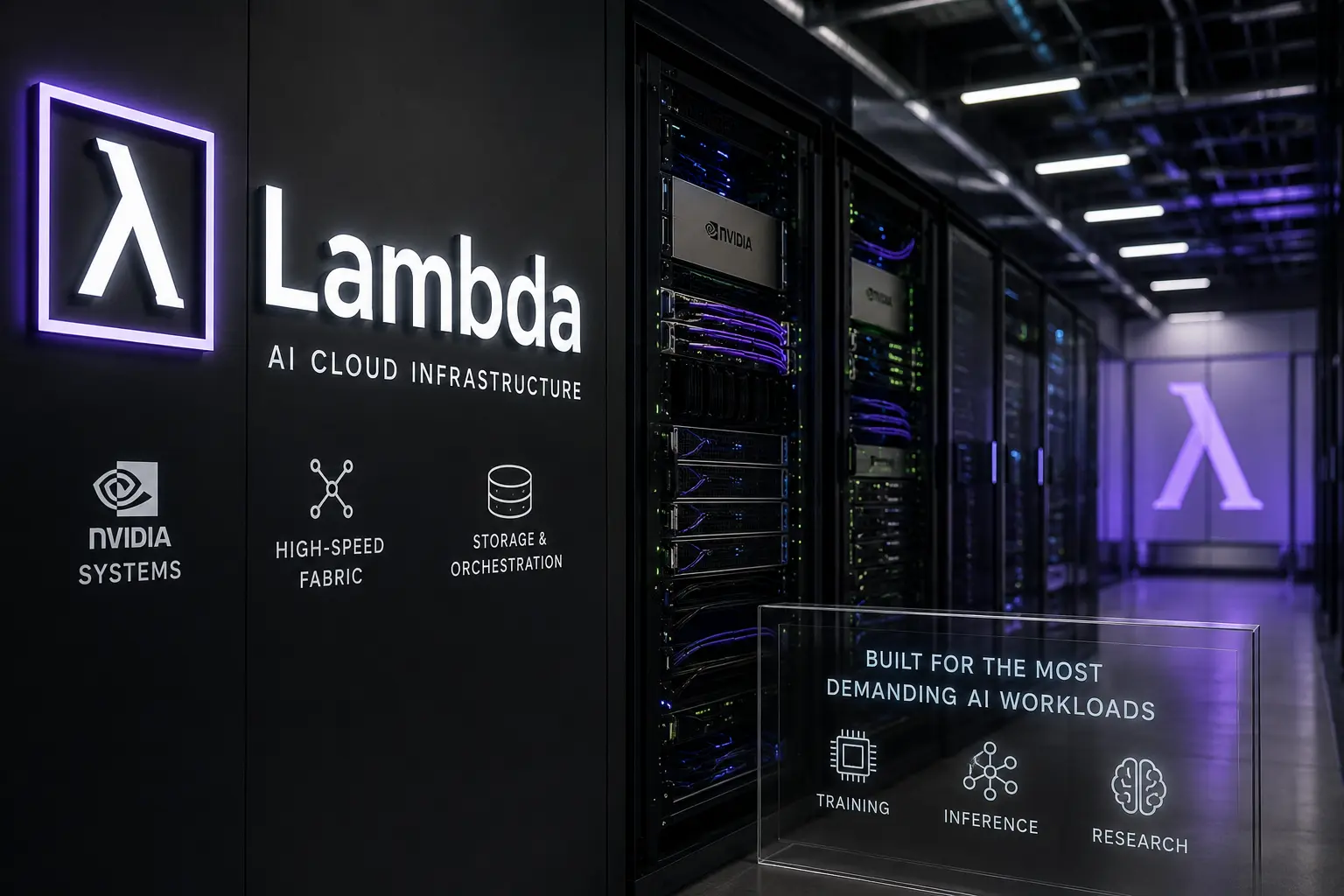
Summary
- Lambda was founded in 2012 by Stephen and Michael Balaban, and expanded from GPU workstations and software into public cloud, managed clusters, Supercluster and Private Cloud.
- It bundles NVIDIA systems, high-speed networking, storage, Kubernetes or Slurm, software images, validation and operations, shifting a large share of delivery work from customers to Lambda.
- Announced funding includes $500 million in 2024, $480 million in February 2025, more than $1.5 billion in November 2025 and $1 billion in May 2026; this proves fund-raising capability rather than profitability.
- The key test is whether announced megawatts can be converted into reliable, high-utilisation clusters before supplier dependencies, lender rights and large customer commitments compress the options.
Financing the technology stack: equity, debt and customer commitments
The capital required for large AI factories is far higher than for traditional software businesses. Accelerators, switches, optical modules, servers, cooling and datacentre capacity often must be paid for before the corresponding service revenue has been fully earned. Lambda uses different financing instruments to carry different parts of the capital burden.
Equity funding provides company-level growth capital: $24.5 million in 2021, $44 million in 2023, $320 million in 2024, a $480 million Series D in February 2025, and a Series E of more than $1.5 billion in November 2025. These transactions show that investors are willing to support expansion, but they do not disclose current revenue, gross margin, cash burn, ownership percentages or profitability.
Debt introduces another set of constraints. Reuters reported in April 2024 on a $500 million GPU-backed financing, illustrating that accelerator assets can support secured lending. Lambda established a $275 million secured facility in August 2025 and completed a $1 billion senior secured credit facility in May 2026. Debt can accelerate procurement without issuing equivalent equity, but it creates fixed repayment obligations and collateral constraints.
Customer commitments constitute a third layer of financing. The November 2025 agreement with Microsoft was described as multi-year and multibillion-dollar, involving tens of thousands of NVIDIA GPUs, including GB300 NVL72 capacity. A large anchor customer can reduce demand uncertainty and support facility planning and lender confidence. But the contract’s total value cannot be treated as recognised current revenue, and the full delivery schedule and commercial terms have not been made public.
These instruments work together: equity absorbs early-stage risk, secured debt finances assets, and long-term contracts reduce demand uncertainty. The model is powerful when hardware is delivered on schedule and kept at high utilisation; it becomes fragile when facilities slip, generations change quickly, customers change plans or financing tightens.
Opaqueness of private-company information limits outside judgement. Public evidence cannot establish Lambda’s leverage, cash conversion, gross margins, customer concentration or return on capital. The responsible conclusion is not that its economics are necessarily strong or weak, but that its ability to raise capital has been demonstrated, while the durability and profitability of its operating model have not been verified by public information.
The integration problem behind the AI cloud
Lambda’s most important product is not a particular GPU but the delivery of a multi-layer complex infrastructure as a usable production environment. Large AI workloads do not generate value simply because a supplier bought accelerators. Accelerators must be assembled into systems, connected within racks through scale-up domains and across racks through scale-out networks; data must keep flowing, jobs must be scheduled against topology and faults, equipment must be cooled at high density, components must be continuously monitored, and repairs must be completed before high-cost jobs fail.
Customers that only buy hardware inherit all these integration problems. General-purpose clouds can abstract part of it, but their broad service model does not necessarily expose the topology, tenant boundaries or underlying control that specialised training and inference require.
Lambda’s proposition is to take on more of the integration responsibility. Its public materials describe the AI factory as a coordinated system comprising bare-metal servers, NVIDIA rack-scale platforms, NVLink and NVSwitch, InfiniBand or RoCE, storage, managed Kubernetes or Slurm, curated software environments, continuous validation and customer operations. This is stronger than offering individual GPU instances through an API: the company is responsible not only for procuring accelerators but for verifying the relationships between components, because those relationships determine whether expensive accelerators are working or waiting.
This distinction matters because AI infrastructure is extremely sensitive to idle time. An ordinary application cluster may tolerate uneven utilisation or brief host failures; distributed training can be held back by the slowest path, a degraded link, failed node or storage bottleneck, leaving tens of thousands of expensive processors waiting at the same time. The real unit of performance is not the advertised specification of a chip, but whether the entire system can complete workloads.
Vertical integration is Lambda’s answer, but it must be understood accurately. The company does not manufacture NVIDIA processors, does not own every datacentre, does not generate all of its own power, does not control every fibre route, and is not expanding only from retained profits. It integrates a substantial number of operating layers while depending on external suppliers and counterparties at critical boundaries.
The core question, therefore, is not whether Lambda is absolutely self-sufficient, but whether it controls enough of the production path to improve deployment and utilisation, without taking on more concentration, capital and delivery risk than it can absorb.
What Lambda is, and what it is not
The company’s legal name is Lambda. Older materials often use Lambda Labs; that name can still be used when discussing older products or archived material, but the current brand and legal operating entity are Lambda and Lambda, Inc. It is a private Delaware company headquartered in San Jose, California. It is not AWS Lambda, not a university laboratory and not a NVIDIA subsidiary. NVIDIA is its most critical technology supplier and ecosystem partner, but public evidence does not show that NVIDIA owns the company.
The company must also be distinguished from its product names. Lambda Cloud is the public cloud and managed platform; Lambda GPU Cloud is a historical term; 1-Click Clusters are preconfigured multi-node clusters; Superclusters are large dedicated cluster services; Private Cloud is single-tenant managed infrastructure; Lambda Stack is a software environment that continues from the early machine learning systems business. “Superintelligence Cloud” is a current brand positioning, not a separate legal entity and not an already formally defined market category.
This identity control avoids common misjudgements. Lambda is not simply a GPU rental marketplace, because it also supplies physical systems, managed orchestration, dedicated infrastructure and long-term facility-scale capacity. It does not own datacentres in every market; many deployments depend on partners for buildings, power and cooling. It is not a fully self-sufficient cloud, relying instead on external chips, networking products, utilities, fibre and capital. It is also not a public company whose profitability can be judged from audited statements.
The company has disclosed large fundraises and customer agreements, but has not published audited consolidated revenue, profit, cash flow, customer concentration or a complete inventory of GPUs in service.
The distinction between company and technology stack is equally important. Platform marketing can make it seem as if all components are owned and designed by one organisation. In reality, Lambda’s value comes from selecting, validating and operating components manufactured or delivered by others. Its integration work is real, but it must be attributed separately from NVIDIA’s processors and network architectures, the open source foundations of Kubernetes and Slurm, the facility delivery of datacentre partners and the power systems of utilities.
This is not a criticism but the correct way to understand a modern infrastructure business. Strategic assets are often the ability to coordinate dependencies rather than to eliminate them. Lambda’s commercial promise is to let customers deal with a single accountable party instead of coordinating multiple vendors and a large in-house team. The corresponding governance question is how much real control customers surrender when this coordination is concentrated in one private supplier.
From machine learning systems to cloud infrastructure
Lambda was founded in 2012 by brothers Stephen Balaban and Michael Balaban. Its early business served machine learning practitioners with GPU workstations, servers and the Lambda Stack software. This origin is critical: it is not a general hosting company that added GPUs later, but a company that started by simplifying the combination of hardware, drivers, frameworks and cooling.
During the 2010s, the hardware-plus-software model put the company directly in contact with the integration failures of machine learning systems. Even a powerful GPU could be unusable if drivers, libraries or frameworks were mismatched; a server that performed well in benchmarks could fail a customer’s thermal, storage or deployment conditions. Curated software images and validated component combinations therefore became part of the product itself.
When the company entered the cloud business, the economic unit changed. Workstations and servers are one-time delivered products; cloud capacity requires continuous operation and is monetised through on-demand use, reservations or long-term service commitments. The provider must manage availability, upgrades, failures and capacity allocation after installation. Equity funding in 2021 and 2023 supported GPU cloud and cluster expansion, and 1-Click Cluster turned multi-node infrastructure into an orderable product with documentation and standard topologies.
The deeper shift occurred in 2024–2025. Lambda stopped simply adding instances to a public cloud and instead used equity, GPU-backed debt and large customer commitments to support dedicated clusters and facility-scale AI factories. The company raised $320 million in equity and $500 million in GPU-backed financing in 2024; it completed a $480 million Series D in February 2025; in November the same year it announced a multi-year, multibillion-dollar agreement with Microsoft and a Series E of more than $1.5 billion.
These events show the company moving from product integration into infrastructure finance. Accelerators become collateral, customer contracts become demand anchors, and datacentre and power delivery schedules become part of commercial execution. The risk structure changes accordingly: a workstation company mainly worries about inventory and product demand; an AI factory operator must also contend with construction, grids, optics, liquid cooling, hardware generations, long-term contracts, utilisation and debt obligations.
Lambda’s history should therefore not be read as a timeline of ever-larger funding rounds, but as a widening boundary of control: first software and machines, then machines and cloud operations, then clusters, networks and schedulers, and finally dedicated facilities, capital and customer commitments. Each step raises the possibility of overall optimisation, and also makes delay, low utilisation or technological obsolescence in any one layer a larger liability.
A product ladder that shifts the boundary of control
Lambda’s product portfolio can be seen as a ladder from flexible access to dedicated infrastructure. At the base are public cloud GPU instances, which let customers obtain compute without buying hardware or signing facility-level contracts. Workspaces, introduced in June 2026, adds organisational capabilities for teams, resources and access. This is the layer closest to a traditional cloud: customers choose available capacity, manage users and run workloads within shared service boundaries.
The next layer is 1-Click Cluster. It is not just a set of instances, but a multi-node architecture with head nodes, rail-optimised NVIDIA Quantum-2 InfiniBand, separate Ethernet connectivity and explicit GPU generations. Customers receive a compute and network topology that has already been selected and validated, reducing the need to procure switches, optics and servers separately, but also reducing component choice and relying on Lambda’s validated combination.
Managed Kubernetes adds operational responsibility. Lambda manages the cluster control environment and the GPU-related integrations; continuous validation tests nodes, links and accelerators and removes unhealthy resources from scheduling. Managed Slurm serves a different mode of working, suitable for high-performance computing and batch processing. The two are not an ideological choice but depend on whether workloads are organised around container services, queued research jobs, or a mixture of both.
Superclusters move to dedicated scale. Lambda markets single-tenant, non-blocking InfiniBand or RoCE, with managed Kubernetes or Slurm, positioned from a few thousand GPUs to more than 100,000 GPUs. This range represents product capability and architectural ambition, not an audited inventory of every scale actively deployed. Private Cloud goes further, combining dedicated infrastructure with long-term managed operations.
With each step up the product ladder the boundary of responsibility changes. Public cloud customers are more flexible but share more of the environment; 1-Click customers get stronger topology commitments and accept a more prescriptive architecture; Supercluster or Private Cloud customers get stronger tenant isolation and customisation, but enter longer, more capital-intensive relationships. Lambda takes on more integration responsibility, while customers become more dependent on its delivery timing, operational practices and future hardware migration.
The ladder also creates a land-and-expand commercial path: start with instances, organise teams with Workspaces, upgrade to preconfigured clusters, then commit to dedicated capacity. Customers remain in the same operating model, which makes expansion easier, but switching costs may rise. Data, tools, scheduling habits and performance assumptions gradually adapt to Lambda. Product value therefore depends not only on how easy it is to enter, but on exit, portability, and whether customers can retain control of their own data, software and workloads.
Public cloud and Workspaces
Lambda’s public cloud is the broadest entry point. Developers and enterprises can use supported GPUs without owning the underlying systems. It is strategically important because it lowers the initial commitment and suits workloads that do not yet need a dedicated cluster.
But the cloud model still depends on physical inventory. A self-service interface does not mean that every region and every GPU is always in stock. The portal can only expose equipment that has been purchased, installed, networked and put into service. Availability changes with supply, customer reservations and regional deployments. The apparent “elasticity” of the interface sits on top of a capital-intensive pool of assets.
Workspaces adds an organisational boundary, not new physical isolation. It helps teams separate resources, access and environments within Lambda Cloud, improving governance across multiple projects, but it should not be equated with single-tenant Private Cloud. Logical organisation, account boundaries, network segmentation, hardware tenancy and facility isolation are different layers.
For small teams this layer can remove procurement, installation, driver maintenance, basic monitoring and datacentre relationships; for large organisations it can be used for peak capacity, trials, or evaluating Lambda before signing a dedicated contract. The value is speed of operation, but public evidence does not prove that its cost is lower for every workload. Actual economics depend on utilisation, data movement, storage, support, contracts and the cost of a self-built alternative.
The public cloud also gives Lambda a different balance from dedicated capacity. Flexible customers want capacity available on demand with a wide choice; large contract customers may reserve substantial new hardware. The company must decide how much capacity remains fungible and how much is locked in for the long term. Reserving too little leaves expensive assets idle; allocating too much to dedicated use weakens the public cloud and its ability to attract new customers.
This tension defines Lambda’s dual identity: it is both a cloud access provider and a dedicated AI factory builder. The two businesses share hardware and skills, but they have different economics, service expectations and customer relationships. Success depends on whether Lambda can preserve the public cloud as a flexible entry point without allowing a few large contracts to dominate capacity and operational priorities.
1-Click Clusters: turning clusters into a product
The 1-Click Cluster is the clearest example of Lambda’s attempt to standardise a complex project. Official documentation describes configurations of 16–512 H100 or B200 GPUs using rail-optimised NVIDIA Quantum-2 400Gbps InfiniBand; the documented multi-rail design provides up to 3,200Gbps GPUDirect RDMA, together with two 100Gbps Ethernet connections and direct internet access, and redundant head nodes.
These figures need context. They apply to specific generations and configurations, not universal attributes of every Lambda cluster. “Up to” is an architectural ceiling and does not guarantee that applications continuously sustain the same rate. The separate Ethernet carries management, external and other traffic; it is not equivalent to the GPU network. Redundant head nodes reduce one class of control-plane failure but do not eliminate risks in compute nodes, switches, optics, storage or facility power.
The real innovation is packaging. Customers do not need to negotiate each server, switch, cable, system image and head node separately. Lambda selects and validates a combination that can be ordered as a whole, shortening the time from procurement to effective compute and creating a repeatable operational baseline.
Standardisation also creates limits. Customers that need different switches, topologies, storage or host configurations may move outside the standard product. Validated combinations reduce integration risk, but make upgrades dependent on Lambda’s validation cadence. A new GPU generation may be available before drivers, network features and schedulers have been proven in the full system.
The cluster is therefore like an architecture contract. Lambda promises a specific relationship between compute, networking, management and external connectivity; customers must still design model workloads, parallel strategies and data flows, and understand how jobs interact with topology. Preconfiguration does not automatically solve distributed training; it moves most of the infrastructure assembly work away from the customer.
The commercial unit is larger as well. Clusters are more suited than instances to reservations and long-term commitments, and failure becomes more expensive. A single degraded component can stall an entire job and waste many accelerators. Continuous validation, topology-aware scheduling and repair are therefore part of the economic product, not an add-on to support.
Rack-scale NVLink and scale-up domains
Large AI systems contain at least two different network domains. A scale-up domain connects accelerators within the same rack-scale system via NVLink and NVSwitch; a scale-out network connects racks via InfiniBand or RoCE. Describing both as “network” obscures their different performance, failure and vendor boundaries.
Lambda’s recent technical direction is closely tied to NVIDIA rack-scale platforms such as the GB300 NVL72. In these systems, GPUs, CPUs, NVLink, switching, power and liquid cooling are validated as a complete rack. The rack is no longer a collection of interchangeable servers; it becomes a single compute unit. Model parallel and tensor parallel workloads can exploit the high-bandwidth scale-up domain, reducing the overhead of ordinary datacentre Ethernet.
This strengthens Lambda’s integration argument, because facility design, rack layout, power and cooling directly determine whether the system can run; it also strengthens vendor dependence. Lambda is integrating NVIDIA’s architecture, not building an independent scale-up interconnect. Firmware, component availability and generation cadence remain strongly influenced by NVIDIA’s roadmap.
The rack-scale model also changes repair. A failure is not necessarily a simple server swap. Components may be tightly coupled through liquid cooling, cabling and switching; validation must cover the whole rack, and repair must preserve the behaviour that software and schedulers expect. A raw GPU count says nothing about whether a rack is available, healthy and actually allocated to production workloads.
At GTC materials in March 2026, Lambda described hypervisor-free bare-metal systems with direct access to NVLink and Quantum-X800, and said more than 10,000 GB300 GPUs connected through Quantum-X Photonics were in production. That statement comes from the company and does not disclose exact sites, utilisation, customer allocations or fleet-wide distribution. It is evidence of direction and deployment claims, not a complete inventory.
The scale-up domain is both a performance asset and a lock-in boundary. Customers receive tightly integrated systems suited to large-scale parallelism, while inheriting the lifecycle of a specific hardware generation and software ecosystem. The key question is not whether this dependency can be eliminated, but whether Lambda’s operational capability makes it easier to manage than the alternatives.
InfiniBand, RoCE and scale-out networks
The scale-out network carries traffic between nodes and racks. Lambda uses NVIDIA InfiniBand in its 1-Click documentation, and offers non-blocking InfiniBand or RoCE for large Superclusters. The two are not interchangeable labels; each imposes different requirements on endpoints, switching, congestion, telemetry and operations.
InfiniBand provides a specialised ecosystem oriented to high-performance RDMA and collective communications. The documented Quantum-2 uses 400Gbps links and rail-optimised topologies; newer materials point to Quantum-X800 and photonics on GB300 systems. Its value is in low-latency, predictable data movement and tight integration with NVIDIA’s accelerated software and network stack.
RoCE carries RDMA over Ethernet and can exploit a broad Ethernet ecosystem, but performance depends on meticulous end-to-end engineering. Queues, packet loss, congestion signalling, topology and telemetry all matter. The choice therefore cannot be reduced to “which is always better”. The real question is which network has been validated for a specific workload, scale, failure model and team.
Supporting both reduces dependence on a single scale-out path and accommodates customer preference, but it increases the validation burden. The knowledge, tooling and failure behaviour of InfiniBand and RoCE are not fully interchangeable. Every generation of NIC, switch, firmware, optics and driver needs system-level testing.
Scale-out performance is especially sensitive to tail behaviour. Distributed operations may wait for the slowest entity. A degraded but not fully broken link can waste more compute than an explicit failure, because the latter triggers rescheduling quickly. The network must be observed as part of service health, not treated as a passive pipe.
This is where the integration model may have value. Lambda can align topology, scheduling, validation and repair around a known architecture, so customers do not have to coordinate multiple vendors after every incident. The risk is information asymmetry: the company publishes product descriptions and selected benchmarks, but has not fully disclosed the fleet-wide distribution of link failures, job interruptions, repair times or congestion events. Buyers need to review operational processes and contractual evidence, not just network specifications.
GPUDirect RDMA, rail optimisation and SHARP
Several mechanisms make Lambda’s network more than just fast packet delivery. GPUDirect RDMA allows supported NICs to access GPU memory directly through compatible paths, reducing conventional CPU relay copies. It depends on the full chain: GPU, NIC, drivers, memory and I/O configuration, the network, and the software that uses it. The provider must validate the entire chain; it cannot assume a result simply because a branded component exists.
Rail optimisation handles the relationship between multi-NIC servers and the network. Parallel rails can align GPUs and network interfaces across switches, making collective communication paths more predictable, reducing contention and increasing total bandwidth; they also make topology part of scheduling and fault handling. A degraded rail or poor job placement can create performance asymmetry while the cluster still appears “available”.
NVIDIA SHARP moves supported reduction operations into the network. Switches can aggregate data for operations such as all-reduce, reducing network traffic and host work under suitable workloads and topologies. It is not a general accelerator for all communication patterns; the benefit depends on the collective library, operation type, topology and software configuration.
These mechanisms explain why Lambda treats a cluster as a system. Schedulers need to understand topology, validation systems need to test links and components, software images must include compatible libraries, and the network must expose the relevant features. A problem in one layer, even when every component passes a simple test, can make an expensive capability unusable.
They also explain why benchmark results should be read carefully. A named GB300, B200 or H100 configuration achieved a result under explicit rules, proving the system can deliver a certain capability, but not proving that every customer workload has the same communication patterns, data pipelines or optimisations. The gap between supported capability and actual application value is where the provider’s operational skill is tested.
The customer’s central decision is whether to take on this set of validation problems itself. A self-built environment gives more architectural control and component choice; buying Lambda’s service centralises integration and support, but requires trust that its validation stack, telemetry and repair processes remain effective across hardware and software changes.
Managed Kubernetes, Slurm and continuous validation
Compute and network hardware has value only when workloads can be scheduled, isolated, observed and recovered. Lambda offers both managed Kubernetes and Slurm because AI customers organise work differently. Kubernetes supports containerised services, operators and cloud-native patterns; Slurm supports batch queues and high-performance computing. Both require extending and operating practices that understand accelerators and topology.
Basic Kubernetes does not automatically solve GPU scheduling. Device plugins, drivers, operators, node labels, topology information, storage integration and health signals must all be coordinated. A scheduler that only sees “how many GPUs are free” may place jobs on inefficient or degraded topologies. The value of a managed service comes from the surrounding integration, not from installing Kubernetes itself.
Slurm is a different control model, suited to scheduling large batch jobs on dedicated clusters. Queue policies, reservations and fragmentation affect utilisation. A cluster may have idle GPUs that cannot form the shape a waiting job requires. The provider must balance job size, topology and customer priorities.
Lambda’s continuous validation documentation describes automated health checks of GPUs, links and nodes, intended to identify and take degraded components out of service before customer jobs encounter them. This is critical because long-running jobs can consume substantial compute before an edge failure surfaces. Early detection protects customer time and provider utilisation.
Public evidence proves the mechanism exists, but does not provide the sensitivity of all tests, false-positive rates, repair time distributions, or fleet-wide job failure rates. Continuous validation should be treated as a credible operational capability, but its effectiveness still needs to be assessed through service data, customer experience and contractual commitments.
The combination of orchestration and validation is a major reason to treat Lambda as an infrastructure operator rather than a hardware reseller. The company does not simply deliver components; it decides when resources are healthy enough to schedule, how failures are isolated, and how software and hardware lifecycles are coordinated. These decisions directly affect how much useful work the invested capital can produce.
Storage, checkpointing and the neglected half of utilisation
Lambda’s public technical materials say more about accelerators and networks than about storage. This reflects the market visibility of GPUs, but storage is equally critical to the production path. Datasets must reach the cluster, checkpoints must be written and restored, and model results must leave. However fast the fabric, it cannot compensate for a pipeline that keeps processors waiting for data.
Training systems repeatedly read large datasets, cache active data, write checkpoints for long-running jobs and transfer results to other systems. The architecture may include local devices, shared high-throughput systems and external services, each with different latency, durability and cost. Lambda’s exact storage design varies by deployment, so storage should be treated as an important boundary rather than imagined as a single uniform configuration across all sites.
Checkpoints tie storage directly to reliability. Jobs that can recover from a recent state lose less after a node or link failure; but frequent checkpointing consumes bandwidth and capacity. Providers and customers must decide how much protection is worth it based on job duration and cost. This is a whole-system decision, not a standalone storage decision.
Data movement also affects commercial flexibility. Dedicated clusters are theoretically portable because code can run in other environments, but transferring large datasets and model state can be slow and expensive. The network paths into and out of a datacentre create switching costs even without explicit exit restrictions.
This is an important limit when evaluating vertical integration. Lambda can integrate compute, networking, orchestration and operations, but value still depends on customers’ data pipelines and external connectivity. Public materials disclose less about global backbone, private connectivity and site-level storage than about GPU networks. These are not minor issues; they are legitimate due diligence items.
The strongest customer evaluation should measure effective job throughput and recovery, not just GPU availability. It would ask whether data can arrive at the required rate, whether checkpoints are reliable, how failures affect recovery time, and how quickly a customer can migrate data when changing vendor or architecture.
Bare metal, Private Cloud and layered security
Lambda’s dedicated systems include explicit hypervisor-free bare-metal designs. Removing this layer can expose hardware capability directly and reduce one class of virtualisation overhead; but it does not create an environment without a control plane, privileged software or shared dependencies. Firmware, BMCs, network devices, schedulers, storage and facility operations remain within the security boundary.
Private Cloud and Superclusters are positioned as single-tenant infrastructure, but tenancy must be defined by layer. Customers may have dedicated compute and networking while still sharing buildings, power, remote management platforms or operations teams. Network segmentation and access controls reduce cross-customer risk without creating complete physical independence. Contracts should make clear which components are dedicated, which are logically isolated and which remain shared.
Bare metal changes the division of responsibility. Customers may gain more underlying control and full hardware capabilities, but may also take on more responsibility for operating systems, workload isolation, patching and privileged software. Even with managed bare metal, Lambda must still protect configuration, firmware, management interfaces, remote access and infrastructure lifecycle.
“No hypervisor” therefore cannot be a synonym for “secure”. It removes one layer that can contain vulnerabilities and overhead, and removes a potential isolation boundary. The outcome depends on the full architecture and operational processes.
Lambda’s Private Cloud security materials support the existence of dedicated control, but they do not mean that every deployment has passed a full independent audit. Regulated or highly sensitive customers need to understand identity, logging, key management, incident response, personnel access, supply-chain control, data destruction, and the division of responsibility between customer and provider.
The strategic trade-off is the same as elsewhere. One supplier managing hardware, networking and orchestration can make security more consistent; concentration also enlarges the impact of a supplier-level failure or privileged error. The right question is not whether dedicated infrastructure is inherently more secure, but whether the control boundaries at each layer match the customer’s threat model and remain verifiable over the contract term.
Datacentres, power and liquid cooling
In high-density rack environments, the facility itself becomes part of the compute product. Power delivery, liquid cooling, switch locations, cabling and repair processes determine how much equipment can run and how reliably it can be fixed. The AI technology stack cannot be separated from the building that sustains it.
Lambda has announced or partnered on capacity in several North American markets, including Kansas City, Chicago, Atlanta and Southern California. The related announcements mention an initial 24MW in Kansas City with plans for more than 10,000 Blackwell Ultra GPUs; a 23MW single-tenant project in Chicago; and more than 30MW of capacity with EdgeConneX in Chicago and Atlanta. These are dated plans and partnership statements; they cannot simply be added together as active capacity without evidence that sites are in service.
The “ready for service” date matters especially. A datacentre can be contracted before utility engineering, liquid cooling, connectivity and full racking are complete, or it can come online in phases. “Announced”, “contracted”, “under construction”, “serviceable”, “installed” and “utilised” are different states.
The company’s stated goal of managing 3GW of AI compute by 2030 is likewise a target, not current scale. It indicates the kind of company Lambda wants to become and exposes the external dependencies that vertical integration cannot absorb: utilities determine how much power can be delivered, datacentre partners complete construction and operations, fibre suppliers determine external paths, and communities and permits affect timelines.
Liquid cooling deepens the integration further. High-density NVIDIA systems cannot be treated as ordinary air-cooled racks. Coolant distribution, heat rejection and maintenance access must be designed together with compute and networking. Even if hardware is ready, a cooling delay can prevent equipment from being placed in service.
The facility layer ultimately determines whether financing and contracts can become production capacity. A company may obtain GPUs but be unable to generate service revenue because of power or construction delays; or it may complete buildings but run them inefficiently because networking, storage or software are not validated. The real metric is not how many megawatts were announced, but how many active, healthy systems were delivered and are being used continuously by customers.
Microsoft, Hudson River Trading and evidence of demand
Named customers are more informative than general market interest, but each relationship answers a different question. Microsoft’s multi-year agreement proves hyperscale contract demand and shows that a hyperscaler may include a specialist AI infrastructure provider in its capacity strategy. It does not prove that Lambda replaces Microsoft’s own infrastructure, nor that all the agreed GPUs were live at the time of announcement.
The agreement involves tens of thousands of GPUs and includes GB300 NVL72 capacity. It gives Lambda a strong demand anchor that can support financing and datacentre commitments; it may also create customer concentration risk. Microsoft’s exact share of future capacity or revenue has not been disclosed, so the degree of dependence cannot be quantified.
Hudson River Trading selected Lambda for quantitative research infrastructure in May 2026. This shows the company’s stack is not only aimed at frontier model laboratories. Financial research requires high-performance computing, fast experimentation and predictable infrastructure. The relationship does not prove broad adoption across the financial industry, but it provides a concrete enterprise use case.
Lambda’s MLPerf and STAC-AI publications add workload-level evidence. They show that named hardware and software configurations achieved results under explicit rules, which is more verifiable than unstructured marketing claims; but they remain selected tasks, not a full measure of production reliability, cost or customer experience.
Taken together, contracts, customer announcements and benchmarks prove three different facts: buyers are willing to commit, the company can deliver or demonstrate high-performing configurations, and the stack suits different workloads. They do not prove market share, renewal rates or a sufficiently diversified customer base.
The next evidence threshold is actual delivery. The useful indicators are how many announced sites have come into service, how capacity is allocated, whether other anchor customers are added, and whether existing customers expand or renew. Contract value is most robust when demand is diversified, terms are sustainable, and the contract is matched to infrastructure that can be delivered on time.
From founder leadership to infrastructure operations leadership
In May 2026, Michel Combes became chief executive officer, and co-founder Stephen Balaban moved from CEO to CTO. Michael Balaban remains co-founder and chief product officer. John Donovan is chairman; the company also brought in Leonard Speiser as COO, Charles Fisher as CFO, and gave Jerry Hunter senior board and advisory responsibilities.
The company describes this change as preparation for gigawatt-scale AI infrastructure. It should not be written as a founder exit: Stephen Balaban still leads technical direction and Michael Balaban still leads product. The new division separates the responsibility for building technical architecture from the responsibility for operating a capital-intensive infrastructure company.
Michel Combes’s background includes telecommunications and large-scale infrastructure operations. Its relevance is that Lambda’s next-phase problems are not only about software and product, but also about financing, datacentre delivery, supplier coordination, enterprise contracts and standardisation across sites.
The expanded leadership structure makes Lambda look more like an infrastructure operator than an early machine learning hardware company. Specialist operations and finance talent may improve execution, but may also add organisational complexity. Competition may emerge between founders’ product judgement, customer commitments, lender requirements and facility timelines.
Because Lambda is private, public information does not cover board voting rights, investor protections, management compensation, ownership percentages, or the detailed allocation of authority among chairman, CEO, founders and major investors. Participation in a funding round cannot be converted into a conclusion that one investor controls day-to-day operations.
The leadership test must therefore focus on outcomes: whether sites come into service, whether hardware generations are validated on time, whether service reliability scales, whether customer concentration falls, and whether the company maintains technical coherence alongside professional management. CV lines and titles are inputs; operational results determine whether this transition built a durable institution.
Ecosystem dependence and the limits of vertical integration
Lambda’s technology stack comes from an ecosystem, not from a closed corporate boundary. NVIDIA provides the core accelerators, scale-up and much of the scale-out technology; partners such as EdgeConneX and Prime Data Centers provide facilities; utilities provide power; Kubernetes and Slurm come from open source communities; MLCommons and STAC provide benchmark frameworks; investors and lenders provide capital; and customers provide demand commitments.
That does not make vertical integration meaningless. Lambda still chooses architectures, validates systems, operates clusters, manages software and takes accountability for outcomes to customers. Integration reduces the number of interfaces customers must manage and allows the company to coordinate topology, validation, scheduling and repair.
The same model also creates concentration risk. NVIDIA’s roadmap influences when the company can offer which systems; facility delays can prevent deployment even when hardware has arrived; utility limits can make contracted megawatts unusable; a small number of large customers can shape capacity plans; and debt markets can affect the pace of expansion.
Vertical integration therefore does not eliminate complexity; it changes where complexity sits. Customers get a simpler commercial interface, while Lambda absorbs a larger internal coordination problem, bringing together supplier, facility, software, capital and customer timelines. The ability to organise is itself the product that connects the layers.
The term “full stack” should therefore be read as an operating promise, not an ownership claim. Integration is most powerful when Lambda can demonstrate faster deployment, higher utilisation, lower operational burden or more predictable service; it is weakest when it is a marketing label that hides dependencies or reduces customer visibility.
The long-term question is whether the company can standardise enough to scale while retaining the expertise for specific workloads. Each customised cluster may deepen a customer relationship but reduce repeatability; each standard product improves operations yet may fail to meet unusual needs. The balance between the two will determine how efficiently capital is converted into service.
Competition and the real differentiation test
Lambda does not face a single homogeneous competitor but several categories of alternatives. Large public clouds offer GPU instances, managed Kubernetes, global regions and a wide range of adjacent services; specialist AI clouds offer focused capacity and dedicated clusters; Oracle and others offer bare-metal or RDMA GPU systems; CoreWeave, Crusoe and Nebius combine cloud and facilities in their own ways; customers can also build supercomputers themselves or work with managed integrators.
The specialist cloud argument is that it can optimise for accelerator workloads more directly than a general-purpose cloud, may validate new hardware earlier, expose topology more clearly, and provide closer operational support. The hyperscaler advantage is breadth: regions, storage, identity, data services, enterprise integration and financial scale.
Customer-owned systems offer the most architectural control and avoid dependence on a single cloud’s operating model, but require in-house capital, engineering, procurement, facilities and support. Managed integrators can provide more tailored hardware and site relationships, but customers may still need to coordinate software and operations. Lambda sits between these options: more integrated than a pure hardware purchase, more specialised than a general-purpose cloud, and less demanding than fully building it yourself.
Funding news and GPU counts are not good competitive indicators. Funding proves capital availability, and marketed cluster scale proves product ambition, but neither proves active capacity, service quality, renewals or profitable utilisation. Stronger signals include site delivery, customer diversification, benchmarks tied to real workloads, incident performance, support quality and the ability to migrate across hardware generations.
The real differentiation test is whether Lambda’s integrated design can produce customer outcomes under the same risk and cost that alternatives cannot match, such as faster time-to-value, higher effective utilisation, fewer internal staff, or a dedicated topology that is usable. This outcome must be demonstrated; it does not follow automatically from listing more components.
Competition will also compress differentiation. When hyperscalers and other specialist clouds use the same NVIDIA rack-scale systems and similar networks, hardware itself is no longer distinctive. Lambda must rely on software, validation, operations, contract flexibility and customer trust. Future value lies not in owning the same processors as competitors, but in whether it can make those processors work reliably as production systems.
Benchmarks: what MLPerf and STAC can prove
Lambda published MLPerf Inference v6.0 results in April 2026, MLPerf Training v6.0 results in June, involving named configurations such as GB300 NVL72 and HGX B200; it also published STAC-AI LANG6 results for financial services workloads on HGX B200. These materials are valuable because the tests have explicit rules, configurations and comparison frameworks.
Benchmarks can prove that a particular combination of hardware, software and optimisation achieved a particular result under particular conditions, showing that the provider has tuning engineering capability and helping customers compare within the same generation. They cannot prove general production economics.
Real workloads differ in model architecture, data pipelines, numerical precision, communication patterns, checkpointing, reliability requirements and utilisation. Contract price, support, storage, data movement and idle capacity affect total cost. A leading training result does not mean every customer will be faster or cheaper.
Dates and hardware generations matter too. AI hardware changes quickly; once a new generation appears, the commercial meaning of results for the previous generation may decline, but the provider’s ability to validate multiple generations of platforms remains important. Lambda’s benchmark publications are therefore evidence both of a number and of its engineering process.
Benchmarks can also incentivise optimisation for the test rather than for production. This is not a problem unique to Lambda. The responsible approach is to state the task, system and date, then judge whether the customer workload is similar and whether the supplier can repeat the result at production scale.
The safest conclusion is that Lambda has demonstrated serious integration and optimisation capability on named systems. Public information still cannot fully measure fleet-wide reliability, cost or utilisation. Buyers should combine benchmarks with customer references, service data, architecture reviews and contract terms.
Lambda’s strategic significance
Lambda embodies a larger change in digital infrastructure. Artificial intelligence is turning datacentres from collections of servers into a single production machine, where compute, networking, cooling, storage, software and capital must be designed and operated together. Coordination itself is therefore becoming a strategic capability.
The company’s history gives it a plausible claim to understand this problem. It started with machines and software for practitioners, built a cloud service, productised clusters, and then moved into dedicated AI factories. The current leadership, funding and customer commitments show the company trying to extend that experience into a large infrastructure platform.
The value of the model is clear: customers do not have to assemble the full stack themselves; Lambda can accelerate deployment and raise utilisation through repeatable architecture and specialist operations; public cloud, 1-Click Clusters, managed orchestration, Superclusters and Private Cloud offer different entry points for different customers.
The limits of the model are equally clear. Lambda cannot make power, construction, NVIDIA supply or capital frictions disappear; fundraising announcements do not prove profitability; GPU ranges on a product page do not automatically become a live inventory; and benchmark results do not represent every production workload.
The company’s long-term significance will be determined by conversion: whether announced megawatts become active racks, active racks become healthy clusters, healthy clusters complete workloads, and completed workloads produce durable customer relationships and returns on capital. This chain is the true meaning of vertical integration.
Lambda’s strongest strategic position is not owning every layer, but being accountable for the interfaces between layers. The greatest risk comes from the same concentration of responsibility. When a supplier, utility or facility fails, customers will still treat it as Lambda’s problem. Only when the company’s ability to govern these dependencies is as strong as its ability to describe the technology stack will it become a durable independent AI factory operator.
Monitoring how the construction pipeline becomes production capacity
The most useful monitoring framework starts from state conversion rather than announced totals. Announced megawatts need to be tracked through the next steps: whether power contracts are secured, whether construction begins, whether a site is ready for service, whether racks are installed, whether the network is validated, whether customers accept delivery, and whether utilisation follows. Each step eliminates a different risk. Facility announcements prove intent; healthy, active customer workloads prove execution.
Hardware inventory should also be distinguished by generation, product and tenancy type. Public cloud, 1-Click Clusters, dedicated Superclusters and systems reserved for Microsoft cannot substitute for one another. How many GPUs were purchased does not say how many are installed, available, allocated or working efficiently. More valuable disclosures would connect active capacity to customer mix and service performance.
Network and reliability metrics are equally important. Customers should focus on how quickly degraded links are detected, how quickly unhealthy resources are taken out of service, repair times, job interruptions, checkpoint recovery, and the actual effect of continuous validation. Lambda has not published fleet-wide incident distributions, so customer references and contractual metrics remain important. If installed scale keeps growing without evidence of stable operations, the integration argument weakens.
Capital metrics must be read together with delivery. New equity or debt can support expansion, but if funding keeps increasing without visible facility delivery, it may also indicate that capital is being consumed faster than capacity is being converted. Future loan terms, collateral structures and customer prepayments are often more informative than the headline funding amount. Because the company is private, this information may remain incomplete.
Customer concentration is a decisive variable. The Microsoft agreement provides demand certainty, but may also make product direction and negotiating power dependent on a handful of customers. If more anchor customers, renewals and enterprise use cases appear in future, that would demonstrate the platform is not simply an extension of one hyperscaler’s capacity plan.
Finally, the migration from GB300 and Quantum-X to Vera Rubin should be treated as an operational process, not a product launch. The true indicators are real availability, validation time, customer migration, network changes, power density, liquid cooling requirements and whether previous-generation assets retain economic value. Having new hardware first means nothing until the full stack is ready.
Four scenarios for the next phase
In the execution-success scenario, announced sites come into service broadly on schedule, utilisation stays high, and Lambda adds customers beyond its largest anchor contracts. Continuous validation and standardised operations keep multiple hardware generations stable. The company would become a durable large-scale AI infrastructure operator, differentiated from hyperscalers by specialist integration capability.
In the pipeline-delay scenario, power, construction, cooling or hardware miss their delivery dates. Customer contracts and debt obligations remain, while assets wait to enter service. The company may strengthen partnerships, renegotiate timelines or prioritise the most valuable contracts. Warning signs include repeated changes to site timelines, limited disclosure of active capacity, and funding growing faster than delivery.
In the customer-concentration scenario, Microsoft or another hyperscale buyer absorbs most of the future capacity. Demand visibility rises, but Lambda’s roadmap and negotiating power become more dependent on a few counterparties. If the newest hardware is reserved for dedicated contracts first, public cloud flexibility may decline. The key evidence will be whether the company continues to add diverse customers and maintain a meaningful self-service product.
In the hardware-commoditisation scenario, hyperscalers and other specialist clouds deploy the same NVIDIA rack-scale systems and comparable networks. Access to hardware no longer distinguishes providers. Lambda would have to compete through validation, software, support, contracts and transparency. If those layers are strong, commoditisation raises the value of operational skill; if they are weak, price and cost of capital dominate.
These scenarios can happen at the same time. One site may come into service smoothly while another is delayed; a large anchor customer can coexist with broader enterprise demand. The value of the framework is in avoiding the mistake of treating one funding round, one benchmark or one site announcement as the whole story.
Professional implications for buyers, suppliers and operations teams
Buyers should treat Lambda as a long-term operating counterparty, not merely a source of GPUs. Due diligence needs to cover tenant isolation at each layer, data migration, storage, checkpointing, hardware refresh rights, service credits, failure handling, exit assistance, and the division of responsibility between customer and supplier. A low GPU-hour price is meaningless if the system cannot reliably complete tasks.
Network and platform teams need to share accountability. Network topology, scheduling placement, storage paths, observability and repair cannot be handled in silos. Teams should define metrics that represent “useful work completed” and design escalation around the whole job rather than a single device.
For hardware suppliers and datacentre partners, Lambda’s expansion will concentrate demand for GPUs, switches, optics, liquid cooling, power and fibre, and push more integration responsibility onto the cloud operator. Product launches, firmware, facility readiness and support must be coordinated, because a delay in one component can prevent a larger system from coming online.
For lenders and investors, the core asset is not the GPU itself but the contract and operating system around it: power, facilities, networking, software, customer commitments, and the provider’s ability to keep assets productive across generations. The collateral value and revenue value of hardware can diverge quickly when a new generation appears.
For Lambda, professional management must preserve technical feedback. An expanded executive team can improve financing and facility delivery, but operating decisions still need to be connected to engineers who understand topology, validation and workload behaviour. The company’s differentiation depends on converting complexity into reliable service, without hiding the evidence customers need to build trust.
Who controls the integrated stack
Lambda’s integrated services form a chain of control rather than a single absolute controller. NVIDIA controls key compute and network roadmaps; datacentre partners and utilities control physical delivery; lenders can impose collateral and covenant constraints; large customers influence capacity allocation; Lambda controls architecture choices, validation, orchestration, operations and the customer interface; and customers control workloads and part of the software, but may cede substantial influence over hardware timing, topology and repair.
This distribution matters because commercial contracts can make Lambda accountable for results it does not produce independently. The company must convert supplier and facility commitments into customer service levels. Its strategic power comes from owning that interface; its risk comes from the fact that when external dependencies fail, customers will still hold Lambda responsible.
Founders, professional managers, the chair, board, investors and lenders also have different incentives. Founders may value technical consistency and long-term architecture; executives responsible for gigawatt delivery may value standardisation, financing and contract execution; investors and lenders may value growth, collateral protection and cash; large customers may demand priority capacity and custom designs. Durable governance must prevent any one set of incentives from undermining the repeatability of the platform.
Customers should therefore ask not only who owns the hardware, but who can change the architecture, reallocate capacity, approve hardware upgrades, suspend service, access management systems, and decide remediation after a failure. Control is an operational fact, not just an abstract legal term.
Decision options and contract discipline
Buyers can use Lambda’s public cloud, reserve a 1-Click Cluster, sign a Supercluster or Private Cloud agreement, combine Lambda with hyperscalers, or build their own. The right choice depends on workload duration, topology sensitivity, data gravity, in-house skills, capital preferences, and the consequences of supplier failure.
Short-term commitments preserve flexibility but are more exposed to capacity shortages and price changes. Long-term dedicated contracts secure topology and supply while increasing technology and counterparty lock-in. A hybrid strategy reduces concentration but requires additional engineering to keep software, data and operational processes portable.
Contracts should convert technology-stack promises into measurable states. Agreements should distinguish announced from installed capacity, specify acceptance tests, define hardware and network generations, define health and repair obligations, allocate storage and data migration responsibilities, and explain what happens when the next-generation platform arrives. They should also specify exit support and the disposition of customer data, models and software images.
Benchmark language must remain narrow. Published MLPerf results cannot guarantee customer workloads; acceptance should be based on actual workloads or mutually agreed representative tests. “Single-tenant” must also be defined separately for compute, network, management and facility layers, rather than used as a blanket label.
The best commercial discipline is to preserve options before infrastructure becomes deeply embedded. Once large datasets, job tooling, security processes and operations teams are built around a single supplier, migration becomes more expensive even if the contract does not prohibit exit.
Second- and third-order effects
If Lambda succeeds, specialist AI clouds could become a durable infrastructure layer between semiconductor suppliers and end customers. NVIDIA sells rack-scale systems to operators, and operators package them with facilities and operations; enterprises can consume dedicated AI factories without having to build them. This could accelerate deployment and give more organisations access to advanced compute than could operate such systems internally.
The same success could also increase underlying supply concentration. Even if many clouds compete in the market, they may depend on the same accelerator, interconnect and software roadmap. Service-layer competition does not automatically create underlying diversity.
Large anchor contracts could also reshape the datacentre market. Providers may design facilities around one customer and one hardware generation, driving demand for high-density power, liquid cooling and fibre. Local infrastructure may be locked in years ahead, and communities and utilities still bear the planning impact even though the customer relationship itself is a private contract.
GPU-backed financing can expand capacity faster, but may also pass hardware obsolescence risk into credit markets. If new generations reduce the economic value of old assets faster than expected, collateral assumptions and refinancing needs will change. The risk is not only that one cloud owns old GPUs, but that the industry’s capital structure may be built on assumptions of high utilisation and relatively high residual values.
More integrated services may also reduce the visibility of technology choices. Customers receive a simpler product, but fewer organisations develop the in-house capability to understand and operate the full stack. Over time, expertise may concentrate in a small number of suppliers and platforms, improving efficiency while increasing reliance on their disclosure and governance.
Irreversible risks
The hardest risks to manage are those that are difficult to reverse after deployment. Facility commitments, power contracts, liquid cooling systems and rack-scale hardware are physically specialised. A site designed for one generation of equipment may require major retrofits to move to the next. Debt and long-term customer contracts keep commitments in place even when the optimal technical choice changes.
Customer lock-in can be equally durable. Large datasets, checkpoint formats, security controls, scheduling processes and performance assumptions become adapted to the Lambda environment. Migration is possible in principle, but in practice can be slow and expensive. Exit plans must be made before workloads become deeply embedded.
Concentration in a single supplier and a single anchor customer creates coupled risk. Roadmap changes, supply constraints or customer renegotiation can affect utilisation and financing at the same time. Diversifying customers without diversifying technology dependence, or diversifying networks without diversifying demand, still leaves exposure.
Limited public evidence operational transparency is also an irreversible risk because it can delay correction. If capacity, incidents and customer concentration are difficult to assess, lenders, buyers and partners may discover weaknesses only after contracts and facilities are locked in. Greater transparency raises discipline before problems become structural.
Finally, scale changes company culture. The processes that worked for a small hardware and cloud business under direct founder supervision may not fit gigawatt targets, multiple facilities and large enterprise contracts. Professional management is necessary, but if finance, operations and engineering separate too far, it may erode the system-level judgement that created value in the first place.
The leadership test
Lambda’s next phase will depend on whether it can keep the technology stack coherent at greater scale, with more funding and more concentrated contracts. The technical team must validate new generations without breaking existing customers; operations must standardise delivery, validation and repair across sites; commercial teams must not overcommit before dependencies are deliverable; and finance must match debt and investment to realistic utilisation.
The current leadership structure offers a reasonable division of labour. Michel Combes can focus on infrastructure scale, external relationships and corporate execution; Stephen Balaban can maintain technical direction; Michael Balaban can connect architecture and product; and operations and finance executives can build the processes large facilities and contracts require. But the division will only work if these functions share a single definition of a “healthy and productive cluster”.
The ultimate strategic choice is whether Lambda continues to be a specialist operator solving the hardest integration problems, or becomes a general-purpose compute company that mainly uses capital to acquire capacity. The first path requires deep engineering, transparency and selective standardisation; the second may expand faster, but is more exposed to price competition and hardware commoditisation.
Lambda’s core argument is credible: AI infrastructure must be operated as a system. The company’s future depends on whether it applies the same principle to itself, coordinating technology, facilities, customers, capital and governance into a producing institution. If one layer grows on its own, vertical integration becomes vertical exposure; if the layers remain aligned, Lambda can become an important independent operator of AI factories.