
Summary
- The operating unit is the Jawwal mobile subscriber account: a paid relationship that bundles identity, recharge, support, local reach, device access, roaming options and a share of a constrained radio and backhaul system.
- The strongest public evidence supports the idea that scarcity is structural, not merely a weak consumer experience. The World Bank documented spectrum, equipment import, Area C and international-link constraints in the Palestinian telecom sector, and SMEX/Access Now mapped Gaza disruptions that affected Paltel, Hadara and Jawwal.
- The thesis remains a hypothesis at account level. It would be settled by private metrics showing account survival through outages, top-up behavior, complaint resolution, churn to Ooredoo or Israeli/cross-border substitutes, and the share of merchants who keep Jawwal because the support and continuity burden is lower than managing workarounds alone.
The Account Is A Continuity Purchase Before It Is A Tariff
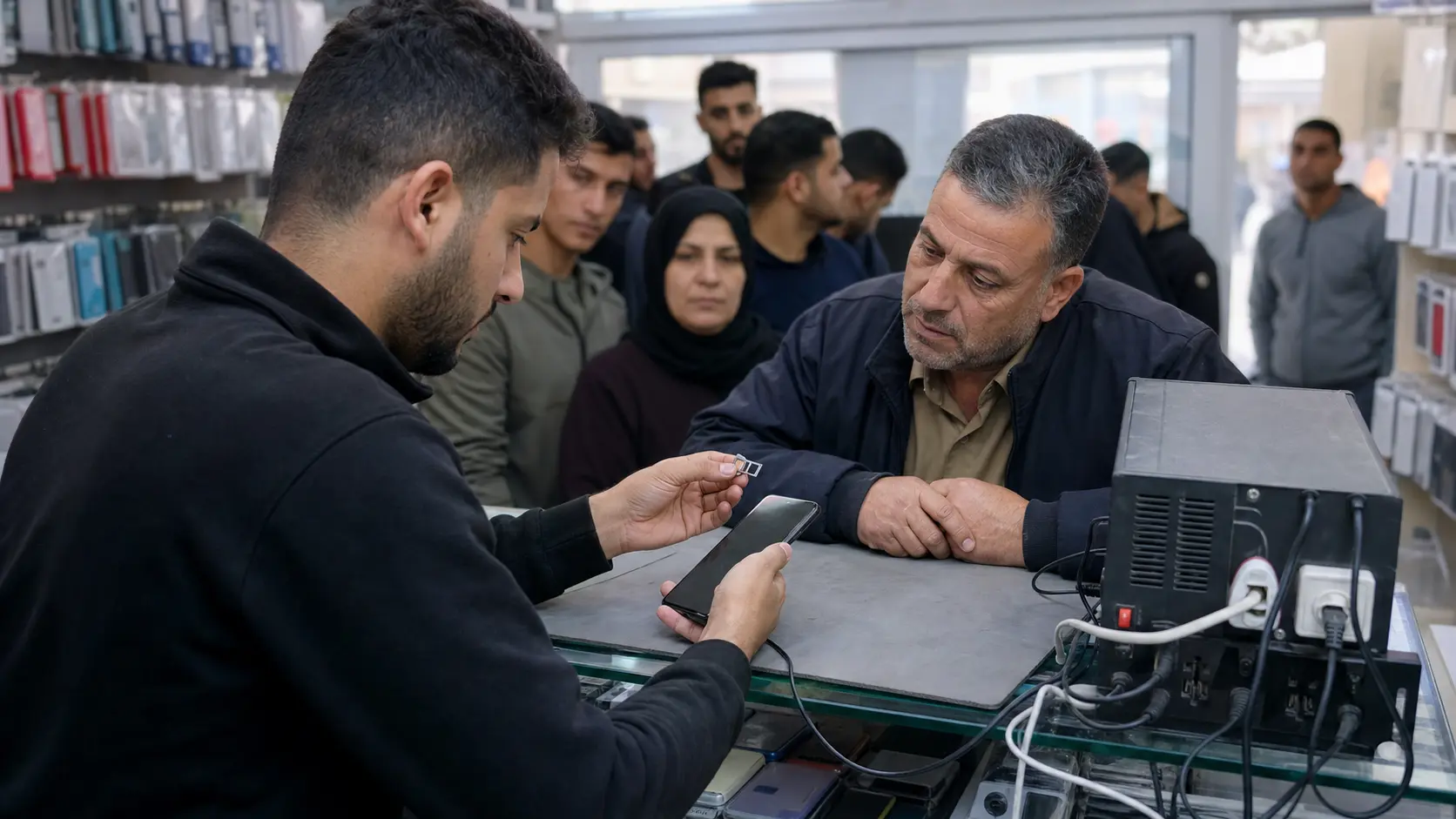
Start with a small merchant in Ramallah, Nablus, Hebron or Gaza City who receives orders through voice calls, WhatsApp messages, SMS confirmations, courier calls and family transfers. The phone number is not just a contact detail. It is where suppliers find the shop, where a customer checks whether stock arrived, where a bank or wallet service sends a code, where a relative asks whether the road is open, and where a driver calls when the fixed line is down. The unit being bought from Jawwal is therefore not the plastic SIM.
It is the mobile account: a recurring claim on numbering, airtime, data, recharge, service desks, roaming arrangements, device finance and whatever network continuity the operator can maintain under constraint.
The price is disciplined by substitutes, but the substitutes are imperfect in different ways. A Paltel fixed service can be cheaper or more stable at a home or office, but it does not follow a merchant to a checkpoint, a delivery van or a wholesale market. A competing Ooredoo SIM can discipline Jawwal where Ooredoo has coverage and sales reach, but both Palestinian mobile operators face the same high-level spectrum and import environment. Wi-Fi-first messaging lowers daily data spend, but it fails when the user leaves the home router, when power is out, or when an upstream fixed network is degraded. Satellite, eSIM and cross-border connectivity workarounds can matter in extreme blackouts, but they shift the burden to the buyer: device compatibility, foreign-number management, payment, activation, signal location and the risk that the workaround is unavailable when needed. Jawwal's own public product pages show why the account is broader than commodity airtime: Smart++ plans promise enterprise communication inside and outside the country, employee closed-group calling, bundles for local and international roaming, SMS and device installments (https://www.jawwal.ps/en/individuals/9662/9668/9723).
The burden transferred to the operator is therefore a portfolio of small frictions. Users ask the company to manage renewal reminders, recharge channels, support, number continuity, handset purchase options, local roaming, international roaming, bulk messaging and outage communication. Businesses ask it to absorb at least part of the compliance, equipment, interconnection, backhaul and customer-care machinery that would be impossible for a small merchant to recreate. The strongest public source proving that this is a constrained operating market is the World Bank's 2016 telecom sector note, which found that the Oslo telecom promise had not produced an independent sector, that spectrum delays and equipment restrictions harmed operators and consumers, and that Palestinian mobile operators lost substantial value from the absence of 3G during 2013-2015 (https://documents1.worldbank.org/curated/en/993031473856114803/pdf/104263-REVISED-title-a-little-different-WP-P150798-NOW-OUO-9.pdf). The private metric that would settle the thesis is account-level continuity: how many paid Jawwal accounts remain active during outage, cash stress and alternative availability, how many top up after disruption, how quickly unresolved support cases close, and how many high-value accounts split usage across Ooredoo, fixed broadband, eSIM, Israeli networks or satellite options.
The Name On The Account Matters Because Jawwal Is Paltel's Mobile Face
The assigned directory entity is Palestine Cellular Communication Company Private Limited. The public identity used by customers is Jawwal. The group identity used by investors and public relations is Paltel/Jawwal. Paltel Group's own home page describes "Palestine Telecommunications / Jawwal" as the leader of the Palestinian telecom sector, founded in 1995 as a public shareholding company providing fixed, cellular and internet services, and as a major private-sector employer (https://www.paltelgroup.ps/). Jawwal's English public site describes itself in metadata as "The first Palestinian provider of cellular communication service in Palestine" (https://www.jawwal.ps/en/individuals). Those two public surfaces do not prove every legal step in the corporate chain, but they do verify the commercial identity used by the market: Jawwal is the mobile brand sitting inside the Paltel/Jawwal operating universe.
That distinction matters because mobile-account economics cannot be read from a network-code row alone. Public numbering and mobile network code references identify Jawwal as a Palestinian mobile operator, and technical reports identify AS29310 as Jawwal in some internet measurements, but these are evidence of public network surface, not a full account economy. The account that a user buys is held inside a broader Paltel/Jawwal relationship with fixed services, enterprise services, data center offerings, local wholesale, international calling, roaming and customer support visible on the company's public navigation.
In other words, the account is part of a multi-service local platform, not a free-standing radio product.
The public Jawwal navigation is revealing in a mundane way. Alongside mobile plans it lists fixed enterprise services such as Cloud PABX, Managed PABX, SIP trunk and DIA, digital services including web hosting, domains, eShopsHub, Microsoft 365, point-of-sale management, backup, data center storage, security products, NOC as a Service and SOC as a Service (https://www.jawwal.ps/en/individuals). The article is not about those enterprise products as separate lines of business, and they should not be confused with the mobile account itself. But their public presence supports a commercial interpretation: Paltel/Jawwal tries to sell continuity and operating support, not merely minutes. A merchant deciding whether to keep a Jawwal account is also deciding whether to remain inside a local service stack with numbers, support, devices and business messaging in one familiar place.
The brand identity also affects customer trust under disruption. If a line stops working, users do not call an abstract "Palestine Cellular Communication Company Private Limited"; they look for Jawwal service channels, app links, shop counters, WhatsApp and live chat. The public Jawwal footer points users to the Jawwal app on Google Play, Huawei AppGallery and Apple's App Store, as well as WhatsApp and social channels (https://www.jawwal.ps/en/individuals). That visible support surface is weak evidence of actual resolution quality, but it is strong evidence that the account relationship is maintained through local consumer operations. In a constrained market, that local familiarity is an asset only if it reduces the buyer's repair burden when something breaks.
Scarcity Prices The Account, But Competition Still Caps The Story
The first temptation is to call Jawwal a scarcity winner. That is too simple. Scarcity raises the value of a working account, but it also raises the cost of maintaining one and attracts workarounds. The direct substitute that disciplines the account in ordinary times is Ooredoo Palestine, the second mobile operator. The World Bank described the award of a second mobile license to Wataniya, later Ooredoo Palestine, as a potentially important competitive step, while also noting that the second operator's West Bank launch and Gaza operation were constrained by spectrum and import restrictions (https://documents1.worldbank.org/curated/en/993031473856114803/pdf/104263-REVISED-title-a-little-different-WP-P150798-NOW-OUO-9.pdf). The Times of Israel's 2018 AFP report on the long-delayed 3G launch named Jawwal and Wataniya as the two mobile operators, and said service was available only in the West Bank while Gaza awaited Israeli approval for equipment (https://www.timesofisrael.com/palestinian-firms-plan-to-finally-offer-3g-mobile-service/).
That means Jawwal's pricing power is not the pricing power of a monopoly commodity. It is the pricing power of incumbency inside a constrained two-operator environment, moderated by fixed broadband, Wi-Fi, Ooredoo SIMs, Israeli network leakage in parts of the West Bank, and emergency workarounds. A consumer can carry two SIMs if the handset supports it. A merchant can move some messaging to Wi-Fi at the shop. A household can use Paltel fixed broadband and spend less on mobile data. A Gaza user in blackout can sometimes use an eSIM if the handset supports it and if a signal from outside the normal local network can be reached. The Guardian, The Markup and CNN have all covered eSIMs as a workaround for Gaza communications blackouts, with the reports describing donated digital SIMs as a way to connect to networks outside the normal local service in periods of severe disruption (https://www.theguardian.com/world/2023/dec/17/palestinians-gaza-esim-cards-communications-blackout, https://themarkup.org/technology/2023/11/07/let-me-tell-them-goodbye-before-they-get-killed-how-esim-cards-are-connecting-palestinian-families, https://www.cnn.com/2023/12/03/middleeast/gaza-esim-cards-blackout-palestinians/index.html).
Those substitutes do not eliminate Jawwal's role. They define it. If a service is cheap but requires a user to wait for power, find Wi-Fi, borrow a foreign eSIM, stand outdoors near a signal edge, maintain a second number, or teach every customer a new contact route, then the cheaper service is not a clean substitute for a continuity account. Conversely, if Jawwal cannot maintain coverage, cash recharge, device access or support in the periods that matter, the account becomes just another fragile point in the user's private continuity plan.
The commercial value lies in whether Jawwal reduces the number of things the buyer must remember, renew and repair.
The price frame also differs by user type. A student buying a bundle compares gigabytes, social media access and handset affordability. A merchant compares missed orders, delivery coordination, supplier calls and the cost of keeping multiple channels alive. A field worker compares route reachability and the ability to call colleagues when fixed connectivity is unavailable. An enterprise manager compares staff calling groups, bulk SMS, device installments and roaming. Jawwal's Smart++ page explicitly markets closed-group calling, local and international roaming minutes, SMS bundles and device installments for companies (https://www.jawwal.ps/en/individuals/9662/9668/9723). Its Bulk SMS page markets mass notification, promotion and customer messaging across numbers in Palestinian territories, 1948 Palestine and international destinations through an electronic portal (https://www.jawwal.ps/en/individuals/9662/9668/9735/9736). The account is priced against the cost of continuity, not only against the nominal price per gigabyte.
Spectrum Politics Turns Capacity Into A Product Feature
The core constraint in Palestinian mobile economics is radio capacity governed by politics. The World Bank note is explicit: lack of spectrum was a significant constraint, 3G frequency release was delayed for years, Israeli operators had 3G and 4G capabilities earlier, and unauthorized Israeli mobile activity in the West Bank competed against Palestinian operators with better data capabilities. The report estimated that Palestinian mobile operators lost between US$436 million and US$1.15 billion in revenue during 2013-2015 due to the absence of 3G and other bilateral and domestic issues, with revenue loss directly attributable to the absence of 3G between US$339 million and US$742 million (https://documents1.worldbank.org/curated/en/993031473856114803/pdf/104263-REVISED-title-a-little-different-WP-P150798-NOW-OUO-9.pdf). That is not a normal technology-lifecycle delay. It is a market-shaping delay.
For the Jawwal account, this changes the meaning of "capacity." In a normal market, 3G to 4G to 5G upgrades are partly about consumer speed, video quality and tariff segmentation. In Palestine, the upgrade path has also been about whether local operators can compete with external networks and whether users have to internalize the gap by buying second SIMs, using fixed Wi-Fi, or relying on foreign networks near coverage boundaries. When a capacity bottleneck is external to the operator, customer anger still falls on the operator, but the operator cannot fully fix the bottleneck through normal capital spending.
That is one reason a continuity thesis is more plausible than a simple speed thesis. The user is paying for the best attainable local account under constraints, not for a globally comparable data experience.
The 2018 3G reporting shows how late the mobile-broadband transition was. The Times of Israel/AFP article reported that Palestinian firms planned to offer 3G in the West Bank after years of delay, that Palestinian officials described the launch as "12 years late," and that the service was not yet available in Gaza because companies were waiting for Israeli approval to bring equipment into Gaza (https://www.timesofisrael.com/palestinian-firms-plan-to-finally-offer-3g-mobile-service/). The New Arab, summarizing World Bank pressure in 2022, reported that the West Bank had only recently gained 3G while Gaza remained on 2G, and that the World Bank linked telecom restrictions to digital-economy weakness (https://www.newarab.com/news/world-bank-urges-israel-allow-palestinians-access-4g). SMEX's 2023 infrastructure article said 3G had gone online in the West Bank in 2018 but remained prohibited in Gaza, where only 2G was allowed, and said Jawwal and Ooredoo together had nearly 4.3 million subscribers (https://smex.org/how-the-israeli-occupation-restricts-the-development-of-internet-infrastructure-in-palestine/).
The current 4G story should be treated with precision. Public search results and secondary pages indicate that Israeli approval for West Bank 4G equipment was reported in January 2026, but the direct article page was not usable for this review from the working environment because it was behind an access challenge. More importantly, approval is not the same thing as proven commercial quality. For account economics, the decisive evidence would not be a headline saying equipment may be delivered.
It would be public and private proof that Jawwal users have usable 4G coverage, that devices support it, that customer plans reflect it, that traffic shifts from Wi-Fi and second SIMs, and that churn falls. Without those facts, the long spectrum lag remains proven, while the 2026 account-level revenue effect remains unproven.
Spectrum politics also creates a compliance cost. Telecom equipment can be treated as sensitive, dual-use or approval-dependent. The World Bank described restrictions on importing equipment for telecom and ICT companies, movement restrictions in Area C that impede deployment and maintenance, and a requirement that Palestinian operators use Israeli-registered companies for international links (https://documents1.worldbank.org/curated/en/993031473856114803/pdf/104263-REVISED-title-a-little-different-WP-P150798-NOW-OUO-9.pdf). SMEX's 2023 article similarly described approval requirements for routers, towers and telecom tools and said equipment import rules are not transparent (https://smex.org/how-the-israeli-occupation-restricts-the-development-of-internet-infrastructure-in-palestine/). That is the compliance-pressure part of the account's price. The buyer does not see it as a line item, but it can appear as slower upgrades, fewer towers, more congestion and higher support demand.
Backhaul Is The Hidden Continuity Cost
Radio access is only the visible edge of the account. Backhaul decides whether a call, message or data session has somewhere to go. In a normal mobile market, users rarely think about fiber routes, upstream providers or international gateways. In Gaza and the West Bank, those dependencies are part of the public evidence because outages have made them visible. SMEX and Access Now's "Palestine unplugged" report mapped Gaza internet disruptions between October 4 and October 31, 2023, using IODA, Cloudflare Radar and RIPEstat data, and identified PalTel, Hadara, Jawwal and NetStream as part of a Paltel-related connectivity cluster with coverage across Gaza and the West Bank (https://smex.org/palestine-unplugged-how-israel-disrupts-gazas-internet/). The report recorded Jawwal's AS29310 as a Gaza Strip network experiencing mild disruption from October 8, while PalTel and Hadara saw moderate disruption and other providers saw full shutdowns.
The technical records in that report should not be overread. An ASN row does not prove customer experience for every mobile account, internal architecture, security governance or service quality. It proves a public connectivity surface and a dependency pattern. That is enough for the continuity thesis because the account holder does not need internal diagrams to experience the result. If upstream routes fall, if power is unavailable, if fiber is cut, or if international paths are disrupted, the account becomes less useful regardless of the plan name.
The user cares whether a message leaves the phone, whether a merchant receives an order, whether an ambulance can be called, and whether a support channel is reachable.
SMEX/Access Now's report says complete shutdowns affected many providers in Gaza, that 15 of 19 analyzed providers were in complete shutdown as of October 31, and that PalTel and its downstream providers Hadara, Jawwal and NetStream accounted for at least 62.8% of total market share across Palestine (https://smex.org/palestine-unplugged-how-israel-disrupts-gazas-internet/). It also said outages resulted from a combination of attacks on civilian telecommunications infrastructure, electricity restrictions, fuel restrictions and technical disruptions. The point for Jawwal is not that the company controls all those causes. It does not. The point is that the paid account is sold into a market where account utility depends on resources outside the account contract: power, fiber, equipment entry, safe repair access, upstream connectivity and field labor.
The same report highlighted a particular upstream asymmetry: many Gaza ISPs depend directly or indirectly on PalTel, DCC and SpeedClick, while six large providers rely on combinations of Israeli and other foreign upstream providers (https://smex.org/palestine-unplugged-how-israel-disrupts-gazas-internet/). The World Bank's earlier finding that Palestinian operators must use Israeli-registered companies for international links gives that pattern an economic history (https://documents1.worldbank.org/curated/en/993031473856114803/pdf/104263-REVISED-title-a-little-different-WP-P150798-NOW-OUO-9.pdf). For a Jawwal account, this means continuity is not only a matter of radio towers. It is a matter of international routing, commercial dependence, border control and repair access. That is why a mobile account can be worth more than a cheap SIM when it is working, and worth less than its tariff when those dependencies fail.
OCHA's crossings data adds the goods-and-fuel context. It states that restrictions on movement of people and goods to and from Gaza have undermined living conditions for years, intensified after 2007 and again after October 2023, and that monitoring of supplies, fuel and goods is difficult because of security, denial and access issues (https://www.ochaopt.org/data/crossings). Telecom continuity depends on fuel for generators, movement for field teams, and equipment access for repair. A user does not buy those inputs directly, but the account's actual value is exposed to them. That is why a continuity account is partly a bet on Paltel/Jawwal's ability to keep enough of the operating surface alive when ordinary logistics are stressed.
Cash, Handsets And Support Make The Account Local
Connectivity markets are often described as network markets, but in constrained geographies they are also cash and device markets. A buyer must be able to pay, renew, recharge, replace a handset, ask for help and keep a number recognized by customers. Jawwal's public pages show an account environment built around those tasks. The footer of the Jawwal site promotes the app for bill payment and usage tracking, with links to the Google Play, Huawei AppGallery and Apple App Store listings (https://www.jawwal.ps/en/individuals). The Smart++ page mentions device installments up to 36 months, special prices and discounts as part of company plans (https://www.jawwal.ps/en/individuals/9662/9668/9723). The public e-store links visible in the site data show phones, accessories and consumer electronics offered through an associated retail channel (https://estore.jawwal.ps/).
Device finance is not a side issue. In an economy where household cash is constrained and import channels can be disrupted, handset access affects the network's revenue base. A user with a 2G handset cannot consume 3G data. A user without a smartphone cannot rely on app-based support or eSIM workarounds. A merchant whose phone breaks during a cash squeeze may stop being reachable even if the network itself works. If Jawwal can attach device installments to accounts, it can convert network access into a broader relationship.
If those installments are unaffordable or unavailable in the areas where continuity matters most, the relationship weakens.
Cash collection matters for the same reason. Prepaid top-ups, postpaid bills, app payments, shop counters and family-to-family recharge habits determine whether accounts survive shocks. Public pages do not reveal Jawwal's collection performance, bad-debt rates or churn. But they do show that account maintenance is a visible part of the company's consumer proposition. The app is presented as a way to pay bills and monitor usage; the social and WhatsApp channels give reachable support endpoints; live chat appears on product pages (https://www.jawwal.ps/en/individuals/9662/9668/9735/9736). These are weak proxies for service quality, but they are meaningful indicators of the operational surface that a buyer compares with a workaround.
Support also changes the account's economics for businesses. A bulk SMS buyer is not just buying individual SMS messages. It is buying the ability to send promotions, updates or notifications to a large audience through a portal, control timing and sender name, and reach local and international targets (https://www.jawwal.ps/en/individuals/9662/9668/9735/9736). A Smart++ enterprise buyer is not just buying staff SIMs. It is buying closed-group calling, device installments, local roaming minutes, international roaming bundles and SMS bundles (https://www.jawwal.ps/en/individuals/9662/9668/9723). Each of these features reduces a private coordination burden if it works. Each becomes a frustration if support cannot resolve failures.
The account's localness is an economic advantage only if it produces trust. A cross-border eSIM can be valuable in a blackout, but it may not preserve a merchant's local number, may require foreign payment rails, may confuse customers and may not offer familiar Arabic support. Satellite can be valuable for organizations with equipment, permissions and technical skill, but it is not a mass-market substitute for every household. Wi-Fi-first messaging is cheap, but it is tied to power, fixed access and location.
A Jawwal account sits in the middle: less technically glamorous than satellite, less cheap than pure Wi-Fi, less globally flexible than eSIM, but more locally embedded and easier to explain to a customer who already knows the number.
Roaming And Cross-Border Reach Are Part Of The Same Continuity Equation
Palestinian mobility is not only domestic. Families, workers, students, aid staff, suppliers and merchants often need calls and messages across Jordan, Israel, Egypt, the Gulf, Europe and the wider diaspora. Jawwal's public menu includes international roaming and international calls under "Mobility and Voice" (https://www.jawwal.ps/en/9663/9910/9914, https://www.jawwal.ps/en/9663/9910/9911). The Smart++ plan page explicitly includes internet bundles usable while roaming on Zain Jordan and minutes/internet for international roaming (https://www.jawwal.ps/en/individuals/9662/9668/9723). That is not just a travel feature. It is part of the account's continuity logic because cross-border family and supplier communication can be economically essential.
Roaming also exposes the limits of local control. If a user depends on roaming, the value of the Jawwal account depends on foreign operators, interconnect agreements, settlement, compliance screening, handset compatibility and the user's ability to pay. The same is true in reverse for inbound reach: relatives abroad, traders in Jordan or suppliers in the Gulf need a stable way to reach a Palestinian number. A merchant who changes numbers every time a workaround is needed pays a reputation cost. A persistent Jawwal number lowers that cost if the network and account remain reachable enough.
The eSIM workaround in Gaza underlines this point. Reports by The Markup, The Guardian and CNN described donated eSIMs as a way for some Gazans to reconnect during local blackouts by using remote or cross-border networks (https://themarkup.org/technology/2023/11/07/let-me-tell-them-goodbye-before-they-get-killed-how-esim-cards-are-connecting-palestinian-families, https://www.theguardian.com/world/2023/dec/17/palestinians-gaza-esim-cards-communications-blackout, https://www.cnn.com/2023/12/03/middleeast/gaza-esim-cards-blackout-palestinians/index.html). Those accounts are powerful evidence of need, but they also show why a local mobile account remains commercially important. A workaround can restore a data path, but it does not necessarily restore local numbering, customer support, billing continuity or the relationship between a merchant and customers who know the Jawwal number.
The Financial Times reported in 2023 that Starlink could operate in Gaza only with Israeli approval, according to Israeli officials, a reminder that satellite connectivity is also politically mediated rather than a pure free-market escape (https://www.ft.com/content/10d77e17-c1d6-4d9e-8a0c-2d6109b1e4a1). Even when satellite is technically possible, it is not a mass retail substitute for every Palestinian mobile account. It requires equipment, authorization, power, location and payment. For institutions, satellite can be a resilience layer. For ordinary accounts, local mobile service remains the default continuity layer, with workarounds as exceptional tools.
That makes roaming a useful test of Jawwal's quality. A buyer who trusts the account will keep the local number as the anchor and add workarounds at the edge. A buyer who distrusts the account will move more core communication to foreign numbers, social-media handles, eSIMs, WhatsApp over Wi-Fi or another operator. The private evidence that would matter is the share of high-value users whose Jawwal account remains the primary identity even when they carry a second SIM or use Wi-Fi for data.
Local Labor Is A Cost Base And A Differentiator
Network continuity is labor. Engineers refuel generators, splice fiber, repair base stations, staff call centers, serve customers, approve device finance, manage enterprise portals and coordinate with public authorities. In Gaza, that labor can be dangerous. Public reporting during the war described repeated telecom blackouts, repair difficulty and harm to telecom workers. The SMEX/Access Now report said infrastructure damage, electricity restrictions and fuel shortages all contributed to disruptions, and it cited Jawwal and Paltel announcements of complete service shutdown due to infrastructure destruction (https://smex.org/palestine-unplugged-how-israel-disrupts-gazas-internet/). Wired reported in October 2023 that Paltel and Jawwal said services were interrupted after remaining international routes were destroyed, and that the blackout affected the ability of emergency and humanitarian actors to communicate (https://www.wired.com/story/gaza-internet-blackout-israel).
The labor dimension matters commercially because the user cannot buy it separately. A merchant cannot hire a personal radio engineer, negotiate international routes, refuel a generator at a cell site or obtain tower equipment approvals. The account price includes a share of that labor and its overhead. If Paltel/Jawwal can mobilize local crews and customer support faster than a workaround can be managed by the user, the account is worth more than the headline bundle. If field labor cannot access sites, if fuel is unavailable, or if support cannot answer, the account's value falls even if the tariff appears competitive.
Paltel Group's public statement that it is a large private-sector employer in Palestine is relevant but incomplete evidence (https://www.paltelgroup.ps/). It supports the idea that the group has local operating depth. It does not prove staffing levels for Jawwal, Gaza repair capacity, response times or safety. The stronger operational evidence comes from outage and infrastructure reports that show telecom services did not fail as isolated consumer products but as physical systems exposed to war, fuel scarcity and route disruption. That public record supports the thesis that local support labor is part of the account's value, while leaving the quality of that labor unproven without internal metrics.
The support labor is not only engineering. Jawwal's public pages include live chat, app downloads, social channels and enterprise product pages. The consumer sees a local company that can be contacted in Arabic through familiar channels. A bulk SMS buyer sees a portal-based service. A Smart++ buyer sees company-account features. A device buyer sees installment and retail options. These are all labor claims. They require sales staff, billing systems, customer-care scripts, dispute handling and field coordination. In a rich market those functions may be invisible. In a constrained market, they are the account.
The local-labor thesis has a risk. A company with a familiar local footprint can become the unavoidable target of frustration. If power fails, if import approvals stall, if mobile data is slow, if a repair crew cannot move, or if a customer cannot top up, the user still experiences the failure as "Jawwal." That creates political and reputational exposure that a cross-border eSIM provider or satellite vendor may avoid because those services are treated as exceptional workarounds. The local account carries the public service expectation even when the operator lacks full control of the constraint.
The Gaza Evidence Shows Both Value And Fragility
Gaza is the hardest test for the thesis. If a mobile account is a continuity tool, then Gaza should reveal its value. It also reveals its fragility. SMEX reported that after October 7, telecom infrastructure in Gaza was severely damaged and availability of telecom services dropped to less than 20%, while 15 of 19 ISPs operating in Gaza were facing complete shutdown of mobile and broadband services as of October 31, 2023 (https://smex.org/how-the-israeli-occupation-restricts-the-development-of-internet-infrastructure-in-palestine/). SMEX/Access Now's deeper mapping recorded widespread traffic drops and identified Jawwal as one of the affected networks (https://smex.org/palestine-unplugged-how-israel-disrupts-gazas-internet/).
That evidence is not a quality ranking of Jawwal versus peers. It is evidence that the continuity product is exposed to force majeure conditions beyond normal telecom competition. A buyer cannot infer from the public outage map whether Jawwal's internal decisions were good or bad. The map shows that mobile and broadband utility can collapse when infrastructure, fuel and backhaul are attacked or restricted. It also shows why users seek redundancy: eSIMs, Wi-Fi when available, radio broadcasts, satellite for institutions, and multiple local providers when possible.
A single account is valuable precisely because it is familiar and embedded; it is risky precisely because it is one layer in a contested physical system.
The blackout evidence also changes how to think about account retention. In a normal market, churn can reflect price, service quality or brand preference. In Gaza, churn may reflect handset loss, displacement, electricity loss, tower damage, payment breakdown, death, injury, evacuation, or the temporary necessity of an eSIM. If a Jawwal account survives through such conditions, that survival is stronger evidence of embedded value than ordinary low churn. If accounts lapse because users cannot pay or cannot access service, that lapse may say as much about the environment as about the brand.
OCHA's crossings data is important here because it reminds the reader that telecom inputs compete with broader humanitarian and commercial flows (https://www.ochaopt.org/data/crossings). Fuel, equipment and repair access are not simply procurement line items. They depend on crossings, approvals, safety and logistics. A mobile account cannot outrun the economy that supplies it. For an article about company economics, that means revenue resilience must be evaluated with operating continuity, not only subscriber count.
The Gaza case also shows why public communication from the operator matters. When outages occur, users need to know whether the failure is local, network-wide, fuel-related, backhaul-related or device-related. SMEX/Access Now noted Paltel and Jawwal public announcements of shutdowns and restorations, often through social platforms (https://smex.org/palestine-unplugged-how-israel-disrupts-gazas-internet/). Social statements are not audited service records, but they are part of the account relationship. The operator that can explain failures and restoration prospects reduces user uncertainty even when it cannot immediately restore service.
Unofficial Signals Point To Stickiness, Not Satisfaction
Unofficial market signals should be used narrowly. App-store listings, social channels, WhatsApp links, customer reviews and public chatter are not verified evidence of network quality. They are evidence of where the account relationship is fought. Jawwal's official site links to its app on Google Play and Apple's App Store, its WhatsApp support number, Facebook page, X account, YouTube and Instagram (https://www.jawwal.ps/en/individuals). Those surfaces show that the company maintains the account through consumer channels, but they cannot prove whether a complaint was resolved or whether a particular district has good signal.
The app listings are still useful as weak signals. A telecom account with an app becomes a renewal and support object. Users can check usage, pay bills and interact with the provider. If app reviews complain about login, balance, payment or support, those complaints may identify friction points. If reviews praise convenience, they may show stickiness. But neither praise nor complaints should be turned into audited performance. The more defensible conclusion is that Jawwal's account has a visible digital maintenance layer, and that this layer matters because users in constrained markets need to renew and troubleshoot quickly (https://play.google.com/store/apps/details?id=ac.Jawwal.info&hl=en&gl=US&pli=1, https://apps.apple.com/us/app/jawwal/id550875047).
Social channels also point to the account's public identity. A user who follows Jawwal on Facebook or X is not reading a network map; they are looking for offers, outage statements, public notices and ways to escalate frustration (https://www.facebook.com/Jawwal.059/, https://twitter.com/jawwalpal). That public arena can increase brand resilience if the company responds quickly and transparently. It can damage trust if users see silence, inconsistent claims or unresolved complaints. Without a structured sample of posts and outcomes, the signal remains directional: the account is socially embedded, and the cost of service failure is public.
Market chatter about Israeli SIMs, eSIM donations or Wi-Fi workarounds should be treated the same way. It shows demand for redundancy. It does not prove Jawwal is failing, and it does not prove Jawwal is indispensable. It suggests that users segment communication: Jawwal as the local identity, Wi-Fi for cheap data, Ooredoo as a second domestic option, eSIM for exceptional outage, and satellite for institutions or special cases. A strong Jawwal account would remain the anchor in that stack. A weak one would become a backup or a number maintained only because contacts know it.
What The Public Evidence Cannot Prove
The public record supports a constrained-market thesis, but it does not prove account-level profitability. It does not show Jawwal's average revenue per user, prepaid versus postpaid mix, account tenure, device-finance margins, bad debt, churn, complaint resolution, Gaza revenue impairment, tower count, capacity utilization or the cost of keeping repair crews operating under risk. It also does not isolate Palestine Cellular Communication Company Private Limited from the broader Paltel/Jawwal group with enough precision to allocate every group cost or service line to the mobile account.
Parent and group evidence must therefore be handled carefully. Paltel's home page proves the group identity and service mix. It does not prove Jawwal's stand-alone economics (https://www.paltelgroup.ps/). Jawwal's product pages prove public offers and account surfaces. They do not prove adoption, revenue or satisfaction (https://www.jawwal.ps/en/individuals/9662/9668/9723). SMEX and World Bank reports prove sector constraints and outage patterns. They do not prove internal decisions inside Jawwal. Technical records prove public routing and connectivity signals. They do not prove customer outcomes or security governance.
Three missing proof categories matter most. The first is economics: account-level ARPU, gross margin, collection rates, device-finance uptake, enterprise versus consumer mix, roaming revenue and churn. The second is reliability: cell-site availability, backhaul redundancy, outage minutes by district, generator fuel days, mean time to repair and complaint closure. The third is retention: how many users keep Jawwal as their primary number when carrying Ooredoo, using Paltel fixed broadband, relying on Wi-Fi-first messaging, borrowing an eSIM, or using cross-border connectivity.
Without those categories, the article can judge plausibility, not final value.
The 4G question belongs in the missing-proof category. If West Bank 4G approval leads to usable commercial service, the account proposition could change: more mobile data, less dependence on Wi-Fi, better enterprise use, and stronger competition with Israeli networks. If approval is slow, partial, device-limited or commercially expensive, the continuity thesis remains centered on constrained service rather than modern broadband. Public product pages and independent speed evidence would be needed to move that issue from watchpoint to conclusion.
Renewal Is The Account's Hardest Test
The most useful commercial test is renewal after stress. A Jawwal account can look valuable when a user first buys a plan, receives a device installment, sends a bulk campaign or activates roaming. The harder evidence is what happens after a disruption, a bad support experience, a week of power cuts, a period of congestion, a damaged handset, a family cash squeeze or a month when Wi-Fi carried most traffic. If the account is merely an interchangeable SIM, renewal will be fragile. If it is a continuity tool, renewal should survive moments when the user has a reason to experiment with substitutes.
That is why monthly top-up behavior would matter more than a headline subscriber number. A prepaid user who buys a smaller bundle but keeps the number active is sending a different signal from a user who abandons the account. A merchant who keeps the Jawwal number as the contact point while moving heavy data to fixed Wi-Fi is not rejecting the account; the merchant is assigning it a narrower but still important role. An enterprise that maintains Smart++ staff accounts because closed-group calling, roaming and device installments lower coordination burden is making a continuity decision rather than a speed decision (https://www.jawwal.ps/en/individuals/9662/9668/9723). A bulk SMS buyer who returns to the portal after an outage is also making a renewal decision, because the service is useful only if the audience still recognizes the sender and reachable number base (https://www.jawwal.ps/en/individuals/9662/9668/9735/9736).
Renewal evidence would also separate price sensitivity from trust. A user can complain about price and still renew because the number is embedded in family, work and commerce. Another user can accept a cheap offer and still shift primary communication to Ooredoo, Wi-Fi or eSIM because trust has broken. The price elasticity of a Jawwal account is therefore likely to differ from the price elasticity of a data bundle. The account includes switching costs: notifying customers, preserving two-factor authentication, keeping family groups current, preserving supplier contact lists and maintaining a known local identity. Those costs are not infinite.
They are strongest for merchants, staff accounts and long-held family numbers, and weaker for low-use data seekers.
The renewal test is also where handset access becomes measurable. If device installments pull users into longer account relationships, Jawwal gains a retention mechanism. If device installments mostly shift expensive handsets to customers who would have stayed anyway, the mechanism is weaker. If cash stress causes installment defaults or forces users to downgrade from smartphone data to basic voice, the network's upgrade path slows. Public product pages prove that device installments are part of the offer; they do not prove whether those installments create durable accounts, profitable accounts or support burdens (https://www.jawwal.ps/en/individuals/9662/9668/9723).
Finally, renewal evidence would show whether the account earns trust in Gaza and other high-risk settings. A user who returns after a blackout may be saying that the local number remains indispensable. A user who keeps a second SIM or eSIM but also keeps Jawwal may be saying that redundancy, not substitution, is the rational strategy. A user who stops renewing after repeated disruption may be saying that the operator no longer transfers enough burden. The public record proves why the test matters. It cannot answer the test.
That answer sits in account cohorts, recharge timing, complaint history, failed-payment records, device-finance behavior, roaming usage and churn between the local operator, the competitor and the workarounds.
The Commercial Hypothesis
The evidence supports a specific, limited judgement: a Jawwal mobile account is valuable when it reduces the private cost of staying reachable under Palestinian operating constraints. The World Bank supports the structural part of that judgement by documenting spectrum, equipment, Area C and international-link restrictions (https://documents1.worldbank.org/curated/en/993031473856114803/pdf/104263-REVISED-title-a-little-different-WP-P150798-NOW-OUO-9.pdf). SMEX and Access Now support the continuity-risk part by mapping Gaza disruptions and showing how PalTel, Hadara and Jawwal were exposed to infrastructure, fuel and route failures (https://smex.org/palestine-unplugged-how-israel-disrupts-gazas-internet/). Jawwal's own product pages support the account-breadth part by showing enterprise mobile plans, roaming, device installments, bulk SMS, app payment and support channels (https://www.jawwal.ps/en/individuals/9662/9668/9723, https://www.jawwal.ps/en/individuals/9662/9668/9735/9736, https://www.jawwal.ps/en/individuals).
The evidence suggests, but does not prove, that Jawwal's defensibility lies less in superior technology than in local embeddedness. The number is known, the brand is familiar, the account can be renewed locally, the app and support channels are visible, the group has fixed and enterprise adjacencies, and the operator carries the burden of a constrained telecom environment that individual users cannot manage alone. That is a real commercial role. It is also a hard role because every external constraint becomes a customer-facing failure.
The thesis would weaken if Ooredoo or another substitute could match local coverage, account support, roaming, device finance and enterprise services while offering better data capacity. It would weaken if 4G arrives in a way that commoditizes the mobile account and makes price-per-gigabyte the dominant comparison. It would weaken if users increasingly maintain foreign eSIMs or Wi-Fi-first identities as their primary communication layer.
It would strengthen if private data showed that merchants, field workers and households keep Jawwal as their primary number through disruptions, pay promptly after outages, use device installments, buy enterprise messaging and return to the app or store network when support is needed.
The conclusion is therefore not that Jawwal has an easy scarcity rent. It is that Palestine Cellular Communication Company Private Limited, through Jawwal, sells a mobile account whose price reflects continuity under constraint. Public evidence supports the presence of those constraints, supports the breadth of the account relationship, and supports the market need for local reachability. The final investment-style judgement remains unproven without account-level economics, reliability and retention data.
Until those data are public, the most defensible view is that a Jawwal account is not merely a SIM, but a locally embedded continuity contract whose value rises when it transfers operating burden from the user and falls when the user must build the backup plan alone.