
Summary
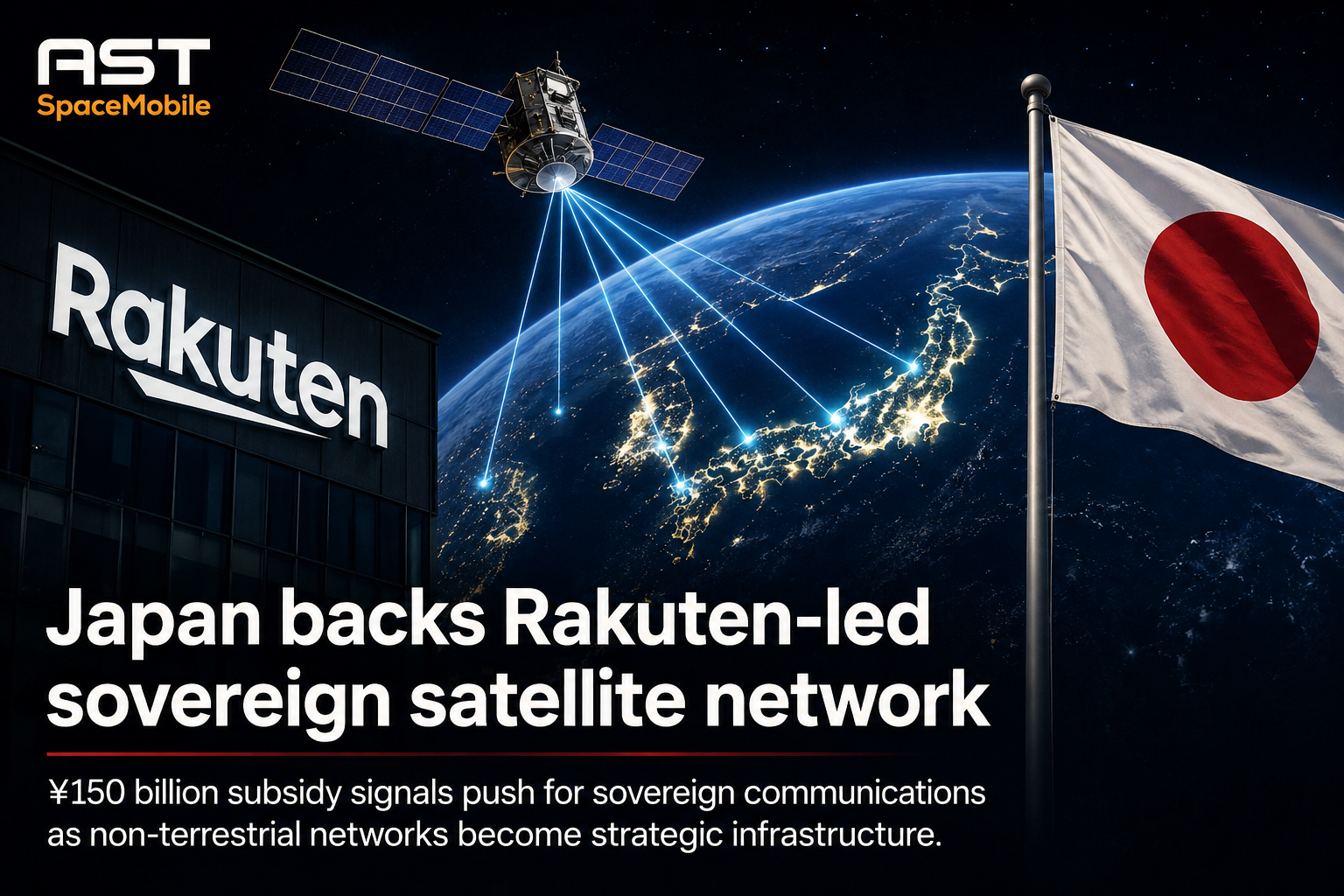
- What it says: Japan plans to support a Rakuten-led satellite network with a ¥150 billion subsidy, advancing sovereign communications infrastructure as non-terrestrial networks become increasingly strategic for telecom resilience.
- Main topic: Satellite connectivity
- Context: market / briefing / Asia Pacific
•Japan funds Rakuten-led LEO satellite network to build sovereign alternative to Starlink
•Builds Japan's first domestic satellite network, cutting reliance on SpaceX for critical connectivity
The fact
A Rakuten-led consortium is expected to receive up to ¥150 billion (approximately US$930 million) in Japanese government funding to develop a domestic low Earth orbit (LEO) satellite communications network. The proposed subsidy forms part of the Ministry of Internal Affairs and Communications' strategy to strengthen Japan's domestically controlled space communications capability and expand resilient national connectivity.
Rakuten intends to establish a joint venture with AST SpaceMobile to deploy and operate the service. The initial phase will use AST SpaceMobile's satellite infrastructure before gradually transitioning towards a dedicated Japanese satellite constellation. The network is designed to provide direct-to-device mobile connectivity, particularly across remote islands, mountainous regions and disaster-affected areas where conventional terrestrial networks are more difficult to deploy or restore.
The initiative comes as Japan's major mobile operators—including KDDI, NTT Docomo and SoftBank—already rely on partnerships with SpaceX's Starlink for satellite-enabled communications. Rakuten's proposal would create the country's first domestically controlled alternative, extending satellite capability while reinforcing communications resilience through nationally backed infrastructure. seperately, Japan's Ministry of Internal Affairs and Communications confirmed on 24 June that it will open the 700MHz band for direct-to-device satellite use, with rule changes expected by September 2026.
The assessment
The proposed subsidy illustrates how satellite communications are becoming part of national strategic infrastructure rather than simply another commercial telecommunications service. As governments increasingly treat non-terrestrial networks as an extension of national connectivity, ownership and operational control are becoming as important as network coverage itself.
For Rakuten, the project represents a strategic expansion beyond mobile network operations into sovereign communications infrastructure. Rather than depending primarily on foreign-operated satellite platforms, the company would participate directly in building and operating a nationally backed LEO network. For Japan, the investment strengthens domestic capability in an area that has become increasingly important for disaster resilience, remote connectivity and long-term digital sovereignty.
More broadly, the announcement reflects a wider shift in telecom infrastructure policy. Governments are no longer viewing satellite connectivity solely as a complement to terrestrial networks, but as an integral component of future communications architecture. For infrastructure operators, the direction of travel is clear: strategic control over non-terrestrial connectivity is becoming an increasingly important element of national digital infrastructure planning.
What to watch
Watch for formal confirmation of the subsidy, the establishment of Rakuten's joint venture with AST SpaceMobile and details of satellite deployment. It will also be important to monitor how Japan integrates non-terrestrial networks into future telecommunications policy—including how the 700MHz spectrum opening for direct-to-device service shapes operator strategy—and whether other domestic operators pursue sovereign satellite capabilities alongside existing partnerships with international providers.