
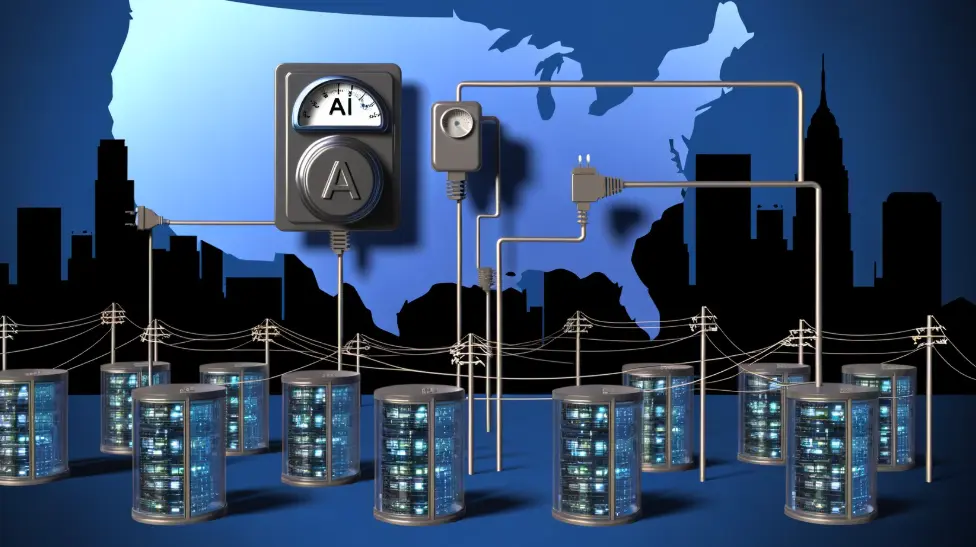
Investors are shifting their focus from high-profile AI stocks to infrastructure companies that support the underlying technology required for AI development. This shift is driven by concerns over valuations and a search for more stable investment opportunities.
- Reuters documented a shift by some US investors, including a higher infrastructure allocation at one BlackRock AI fund and new capital entering that fund; it did not establish a market-wide global rotation.
- A signed GPU-capacity contract is stronger evidence than a spending plan: IREN disclosed a $9.7 billion Microsoft agreement and a related $5.8 billion Dell purchase, both subject to delivery and acceptance conditions.
- Microsoft’s 2026 capital-expenditure figure and the IEA’s 2030 electricity outlook are forecasts. They support the infrastructure thesis, but they are not completed orders, fund flows or guaranteed returns.
What the investor evidence shows
Reuters reported on 19 February 2026 that some US investors were moving toward chipmakers, data-centre builders, power suppliers and other companies expected to receive AI capital spending. The scope matters: this was a selection of asset managers and products in the United States, not proof that investors everywhere had abandoned large AI technology companies.
The report supplied measurable allocation evidence. BlackRock’s iShares A.I. Innovation and Tech Active ETF had 74% of its $8.8 billion in assets in infrastructure-related holdings, up from 59% a year earlier, and had attracted $7.9 billion over the preceding twelve months, according to VettaFi data cited by Reuters. New infrastructure-focused ETFs and the relative performance of selected holdings reinforced the theme. Those figures demonstrate flows into particular products; they do not measure the whole equity market.
Contracts are different from budgets
Physical demand is not merely a narrative. In a US securities filing, IREN disclosed a definitive agreement to provide Microsoft with NVIDIA GB300 capacity across four Texas data centres. The contract was valued at about $9.7 billion through 2031, with phased 2026 delivery and a 20% prepayment for each tranche. IREN also agreed to buy about $5.8 billion of GPUs and related equipment from Dell. These are contractual commitments, although revenue still depends on delivery dates, service acceptance and performance.
By contrast, Microsoft’s April 2026 earnings call gave management guidance: roughly $190 billion of capital expenditure for calendar 2026, including about $25 billion attributed to higher component prices. Microsoft said demand exceeded supply and capacity would remain constrained. That is a company plan and demand statement, not evidence that the full amount has already been spent or that every supplier will receive an order.
Forecasts are not commitments
The International Energy Agency recorded that data-centre electricity consumption rose 17% in 2025 and consumption at AI-focused centres rose 50%. Those are observed historical changes. Its estimate that five large technology companies’ capital expenditure will rise 75% in 2026 and its projection that data-centre electricity use will increase from 485 TWh in 2025 to 950 TWh in 2030 are outlooks, not booked revenue.
The IEA also warns that buildout depends on capital-market sentiment, expected returns, financing conditions, chips, grid connections and equipment supply. Its analysis does not show a generalized valuation uplift for the entire energy sector. That boundary prevents an electricity-demand forecast from becoming an indiscriminate buy case for every utility or equipment company.
Valuation risk moves with the trade
Valuation concern helped create the rotation, but it does not disappear when capital moves downstream. Reuters quoted a warning that valuations for companies with AI exposure were becoming rich and recalled the overbuilding of fibre networks in the 1990s. Infrastructure businesses can face long construction periods, customer concentration, financing costs, delayed grid connections and low utilization if demand misses expectations.
The most defensible thesis is therefore narrower than “infrastructure is stable.” Some investors are seeking companies with direct exposure to spending on compute, networking, cooling and power. Their returns still depend on contract quality, delivery, capacity utilization, pricing and the customer’s ability to earn from AI services.
Why it matters
The shift broadens the AI investment map from model developers and large platforms to the physical systems that make computation possible. It also transfers attention to operators that control scarce power, approved sites, chips, network capacity and delivery schedules. Those control points can create bargaining power, but they also concentrate execution and regulatory risk.
What to watch
Track product-level inflows and portfolio weights rather than anecdotes; signed orders and prepayments rather than announced budgets; actual capital expenditure against guidance; capacity delivered and accepted; utilization, margins and customer concentration; grid and permitting delays; and valuations relative to contracted cash flow. Together, those measures can show whether the infrastructure trade is supported by durable economics or only by a new layer of AI enthusiasm.
Member Briefing
Deeper Trend Context
Sign in with the right membership level to unlock the full briefing and source notes.
Only for Strategic Circle
Strategic Circle
Open to all readers. Unlock trend briefings after joining and signing in.
Join Strategic CircleOnly for Leadership Alliance
Leadership Alliance
For operators, investors, and policy teams that need relationship evidence, failure paths, and source notes. Sign in to unlock.
Join Leadership AllianceSnapshot
Category
Global Cloud Services TrendsRegion
ASIA PacificSignal Focus
GovernanceContent Type
EventPrimary Domain
MarketTopic
GovernanceImpact
HighConfidence
Limited confidence (80%)Confidence score guide
Several public sources