Summary
- The economic unit is the supported local subscription or service account: a household, small business or institution pays for connectivity, television, installation, maintenance, local response and continuity. The customer benefits from a reachable local operator; the operator carries the downside when upstream capacity, field labour, equipment, regulation, abuse handling or churn costs more than the monthly price assumed.
- IMPULS IMPEX SRL is a Romanian limited company tied by official fiscal and RIPE records to CUI 2068932 and Fierbinti-Targ, Ialomita. The public record shows strong 2025 financial improvement, RIPE LIR status and several IPv4 allocations associated with the company, but AS60453 itself is registered to IMPULS CONSTRUCT SRL, a related local operating name that appears on the Impuls TV site.
- The infrastructure evidence is real but bounded. RIPE, BGP and IP intelligence pages show number-resource control, AS60453 routing, IPv4 prefixes, upstream dependence on larger networks and no visible IPv6 footprint. Those records do not prove subscriber count, service-level quality, owned plant, traffic revenue or that every network activity belongs economically to IMPULS IMPEX SRL.
- The investment question is a margin question. A local operator can earn durable returns when support, fiber service, television distribution, energy installation and address-resource governance are priced as recurring responsibility. It can also lose the economics if it sells low-friction access but absorbs unpaid truck rolls, compliance, abuse work, supplier increases and renewal capital.
The paid account carries the entire promise
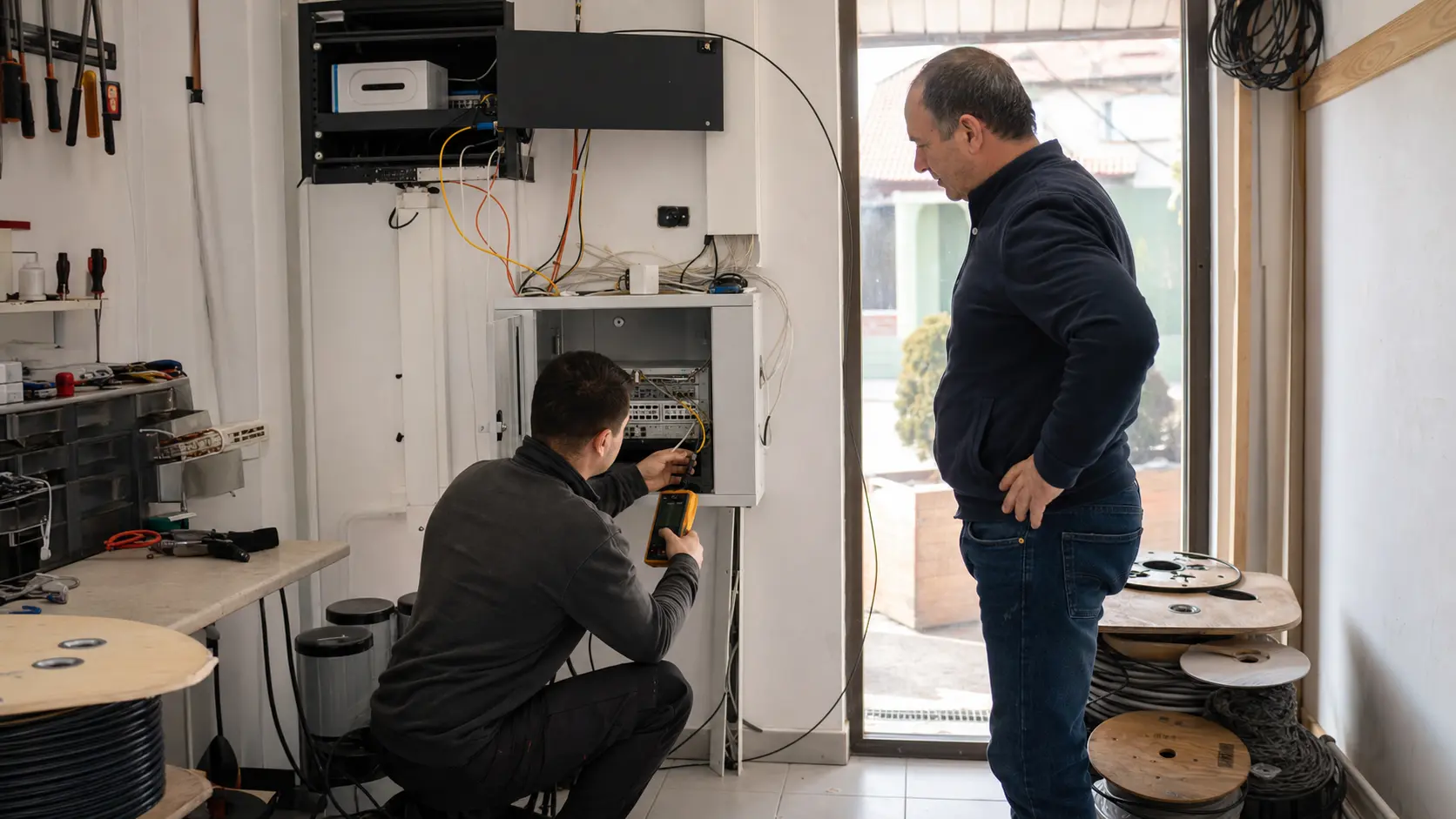
The paid unit is a supported local account. A household in or near Fierbinti-Targ, a small shop, a rural office, a local public institution or a homeowner buying a photovoltaic installation does not pay for an autonomous-system record. It pays a monthly bill, a service visit, an installation package or a managed relationship. The payer wants the connection to work, the television package to appear, the router to be understandable, the technician to answer, the bill to be clear and the provider to fix the problem when something fails.
The direct beneficiary is the local customer that receives a practical service without managing the supplier stack. The downside sits with the operator when the subscription price or project margin has to absorb supplier invoices, labour time, equipment replacement, compliance work, bad debt and customer churn.
That is the only useful way to read IMPULS IMPEX SRL. The company has public network-resource evidence, but the resource record is not the business model. A route, an allocation or a registry entry can support a service promise; it does not itself show how many customers pay, how often engineers visit premises, what uptime is achieved, how much gross margin remains after transit and backhaul, or how quickly equipment has to be replaced. The same caution applies to a consumer website that advertises fiber internet and television. It shows a public service proposition.
It does not disclose contract values, churn, support intensity or the corporate allocation of revenue between closely associated local companies.
The attractive version of the business is straightforward. A small local operator with number-resource discipline can sell trust where a national supplier may feel remote. It can keep contact details stable, maintain a local support identity, combine connectivity with television or adjacent technical services, and solve problems that are too small for a carrier account team but too important for the customer to ignore. When those services are recurring, standardized and priced with exclusions, the local provider can cover its suppliers and still earn a return on knowledge, response and relationship control.
The weak version is equally straightforward. A local provider can end up selling a cheap access product while carrying expensive human obligations. Every outage becomes a phone call. Every cable fault, set-top issue, router reset, channel complaint, abuse notice or payment dispute becomes an interruption. A rural footprint can require travel and spare equipment. A customer may expect around-the-clock help because the website promises support, even when the paid package does not fund that labour. If the operator grows by adding service lines without tightening scope, revenue can rise while operational risk rises faster.
The 2025 accounts make that tension worth examining. Official Romanian financial data show a sharp rise in turnover, net profit and balance-sheet scale. That is a positive signal, especially after a small loss in 2023 and a modest recovery in 2024. But high reported profit in one year does not settle the durability question. It could reflect stronger trading, a larger project, better procurement margins, energy-installation work, pricing repair or timing effects. The hard question is whether the recurring infrastructure account is paying for its own support burden across a normal replacement cycle.
IMPULS IMPEX SRL therefore deserves neither dismissal as a tiny resource holder nor promotion into a large carrier without proof. It is better described as a long-lived local Romanian company with public fiscal scale, address-resource responsibility and infrastructure-adjacent service evidence. The margin test is whether those pieces form a repeatable cash engine or a collection of local obligations that depend on supplier tolerance and hands-on response.
Identity and operating boundary
The company identity anchored in official Romanian fiscal records is IMPULS IMPEX SRL, CUI 2068932, registration number J21/474/1991, with an address at Calea Urziceni 10 in the Fierbinti-Targ area of Ialomita. The fiscal lookup used for this article shows the company as an active Romanian limited company, privately owned, registered for VAT since January 1996, enrolled in the national electronic invoicing system and not marked inactive. Public company-data sites present the same core identity, although they vary on the exact incorporation date because they draw from different registry conventions and update cycles.
The safe conclusion is that the company is a long-running early-1990s Romanian business, not a recently created shell.
The activity classification also needs care. Romanian finance and company-data pages associate the company with CAEN 4673. In older public wording that activity is wholesale of timber, construction materials and sanitary equipment. A newer 2025 fiscal rendering uses the same code in a different classification wording. The mismatch is a reminder that CAEN labels should be read as administrative context, not as a complete description of current services.
For the economic analysis, the important point is that IMPULS IMPEX SRL has a conventional trading and installation base as well as number-resource evidence, rather than a clean pure-play telecom classification.
The public evidence around local telecom service runs through the Impuls TV and eimpuls.ro footprint. The site presents fixed fiber internet and television subscriptions, including a 1000 Mbps fiber-internet claim, digital television over fiber, local support, a contact phone number and the same Calea Urziceni address. It describes Impuls TV as a local press television service founded in 2011 and serving several rural localities and towns in Romania. Its about page presents infrastructure and quality-management claims, including dedicated servers, performance, security, maintenance, technical assistance and ongoing development.
The boundary is not simple. The contact and privacy pages of the Impuls TV site name IMPULS CONSTRUCT SRL as the television owner, audiovisual licence holder or administrative operator. RIPE records also show AS60453 as IMPULS-CONSTRUCT-AS, registered to IMPULS CONSTRUCT SRL, while identifying IMPULS IMPEX SRL as the sponsoring LIR and as the organisation on several IPv4 allocations. The two names are tied by location, contact details, routing evidence and local service context, but they should not be collapsed into one economic entity without caution.
The article therefore treats IMPULS IMPEX SRL as the company being analysed and treats Impuls TV or IMPULS CONSTRUCT SRL evidence as related operating context, not as proof that every subscriber or media-service euro is booked in IMPULS IMPEX SRL.
That distinction matters because the public company accounts belong to IMPULS IMPEX SRL. If the telecom subscriber base is booked in another company, the IMPULS IMPEX SRL balance sheet may reflect wholesale, photovoltaic, resource-holder, supplier, property, installation or intercompany activity more than direct internet subscriptions. If IMPULS IMPEX SRL carries the resource costs and support responsibilities behind the scenes, the accounts may understate or blur the telecom operating exposure. The outside reader cannot settle that from public pages alone.
The renewable-energy listings add another layer. Third-party Casa Verde photovoltaic directories list SC IMPULS IMPEX SRL, CUI 2068932, at the same Ialomita address and phone numbers, as an authorised or validated photovoltaic installer for the Romanian Casa Verde programme. Those pages present services such as residential photovoltaic installation, business and industrial systems, technical consulting, funding assistance, maintenance and service. This is relevant because it shows a local technical-support business beyond retail trade.
It also means the 2025 financial jump could have been influenced by energy-installation demand, not only by telecom service.
The operating boundary is therefore a mixed local infrastructure perimeter: a legal company with trading and installation activities, a RIPE LIR identity, address-resource allocations, an adjacent local TV and fiber brand, and associated local support obligations. This is exactly the kind of company where an article must separate identity, resource control, customer-facing promises and financial proof. The public evidence is enough to justify a telecom-economics lens. It is not enough to declare a scaled ISP, an owned fiber network or a stand-alone cloud platform.
What the accounts say about scale
Official annual statement data for IMPULS IMPEX SRL show 2025 turnover of RON 8,643,668, total revenue of RON 8,651,092, total expenses of RON 6,460,012, gross profit of RON 2,191,080 and net profit of RON 1,839,707. The company reported 14 average employees. Fixed assets stood at RON 656,055, current assets at RON 4,083,697, inventories at RON 1,172,331, receivables at RON 1,497,502, cash and bank balances at RON 1,413,864, debts at RON 2,484,649 and equity at RON 2,255,103. For a small local operator, those figures are meaningful.
They show a business with real revenue, working capital and staff, not merely a dormant record around address resources.
The improvement from 2024 is large. In 2024, official data show turnover of RON 3,907,160, net profit of RON 290,898 and 14 average employees. Debts were RON 1,225,173, fixed assets RON 462,191, current assets RON 2,004,578 and equity RON 1,241,596. On the reported figures, turnover more than doubled in 2025, net profit rose more than sixfold and equity increased materially. The employee count did not rise, which points either to stronger productivity, a different revenue mix, project timing, subcontracted delivery, procurement pass-through, improved pricing, or a combination of these.
The preceding year provides the warning. In 2023, the company reported turnover of RON 3,384,632, total revenue of RON 3,400,025, total expenses of RON 3,416,908 and a net loss of RON 69,588, with 14 average employees. It was not a catastrophic loss, but it shows that the business can slip below break-even at a revenue level not far below 2024. In 2022, the company had turnover of RON 3,722,702, net profit of RON 190,149 and 13 employees. In 2021, turnover was RON 3,475,829 and net profit was RON 505,432, with 15 employees. The five-year pattern is not a smooth carrier-style annuity. It is a local business with volatile margins.
That volatility matters more than the absolute profit number. A 2025 net margin near 21 percent is excellent on the face of it. A 2024 margin near 7 percent and a 2023 loss show that the margin is not structurally guaranteed. If the revenue jump came from photovoltaic installations, construction-material trading or one-off equipment procurement, the profit may not repeat without the same project volume. If it came from recurring telecom accounts, the margin is more interesting but still needs evidence on churn, support time and capital requirements.
The balance sheet also shows the nature of the cost base. Current assets are much larger than fixed assets, and inventories are a major component. That fits a business with trading, equipment, installation or materials exposure. A pure fiber operator with extensive owned plant might show heavier fixed assets, though accounting choices and leased infrastructure can obscure that. The 2025 receivables number is also material. When receivables rise with revenue, the practical question is how quickly customers pay and how much working capital is trapped in installations or service contracts.
Debt rose from RON 1.23 million in 2024 to RON 2.48 million in 2025. That increase is not automatically negative because current assets and equity also rose. It does, however, show that growth consumed or required financing. If the business bought inventory, installed systems before reimbursement, extended customer credit or carried supplier bills while awaiting payments, the economics depend on cash conversion. A local infrastructure company can report profit and still feel pressure if receivables are slow and supplier terms are short.
The staff figure is a useful discipline check. Fourteen average employees can support a real local operation. It is not the one-person fragility seen in some micro-operators. But 14 employees still impose a hard capacity limit if the company is simultaneously handling wholesale trade, photovoltaic installation, local telecom support, television service, network governance and field maintenance. Payroll, subcontractors, vehicles, tools, spare equipment, insurance and administration all have to be paid before profit becomes investable cash.
For the recurring account, the accounts say this: IMPULS IMPEX SRL has enough scale to be operationally relevant in its locality, and the 2025 result gives it more room than the prior two years. But the revenue mix is not disclosed. The most important missing split is between recurring subscription or maintenance income and project, trading or installation income. The former supports durability; the latter can create impressive annual revenue but weaker visibility.
Network evidence and its limits
The strongest technical evidence around the company is RIPE. The RIPE organisation record ORG-IIS75-RIPE identifies IMPULS IMPEX SRL, country RO, registration number 2068932, organisation type LIR, and the Calea Urziceni address in Fierbinti-Targ. RIPE's Romanian member list includes IMPULS IMPEX SRL among Local Internet Registries offering services in Romania. Several RIPE inetnum records for IPv4 space also point to ORG-IIS75-RIPE, including 185.128.96.0/22, 213.170.208.0/22, 89.42.108.0/23, 89.43.79.0/24 and 195.62.51.0/24. Those records establish real number-resource responsibility.
AS60453 is where the boundary becomes more precise. The aut-num record names IMPULS-CONSTRUCT-AS and points to IMPULS CONSTRUCT SRL as the organisation, while listing IMPULS IMPEX SRL as sponsoring LIR. Public BGP pages show AS60453 as active in Romania. Hurricane Electric, bgp.tools, IPinfo and IPIP present slightly different counts because routing views and classifications vary, but the broad pattern is consistent: AS60453 originates a modest IPv4 footprint, has no visible IPv6 address space, and is connected to larger upstream or peer networks including Orange Romania and Next Level Business in public views.
The prefix scale is useful for local service but not proof of a large carrier. Depending on the routing view, AS60453 is shown with roughly eight or nine IPv4 prefixes and about 3,840 to 4,096 IPv4 addresses. The largest visible blocks include two /22s and one /23, with several /24s. That is meaningful capacity for a rural or small-town access and service network. It is not national-carrier scale. It also does not tell the reader how addresses are used: residential subscribers, business customers, network infrastructure, leased resources, equipment, public services, temporary assignments or adjacent companies could all be present.
RPKI and routing hygiene provide a positive but narrow signal. IP intelligence pages and BGP tools report valid route-origin material for several or all visible prefixes, depending on the view. The absence of visible invalids in those views is helpful. It suggests that the routing posture is not casual. For a local operator, valid route-origin data reduces avoidable ambiguity and can make upstream changes less risky. It still does not prove uptime, redundancy, DDoS absorption, abuse-response quality, circuit diversity or customer satisfaction.
Upstream dependence is central. Public views show AS60453 relying on larger networks, notably Orange Romania and Next Level Business, with RIPE import/export policy also referencing AS41496. A small operator should use larger suppliers. Buying transit, backhaul, facilities or upstream reach is normally more rational than building national infrastructure. The economic question is whether the customer price includes a sufficient spread above those supplier costs and whether the operator has enough redundancy to keep the service promise when one supplier changes terms or suffers an outage.
The absence of visible IPv6 is a drawback for a network that presents itself as modern fiber infrastructure. It may not be commercially fatal in a local access context because many customers still judge service through speed, reliability and support rather than protocol completeness. But over time, IPv6 readiness matters for engineering hygiene, customer equipment, upstream flexibility and reputation with more technical buyers. If IPv6 is absent rather than merely not visible in the sources reviewed, it is a capability gap.
Cloud and locality claims should be treated separately from address evidence. The Impuls site mentions dedicated servers, performance and security. RIPE and BGP evidence can support the idea that the local group has infrastructure capability. It does not prove that IMPULS IMPEX SRL sells cloud services, operates a data centre, has a material hosting customer base or earns recurring cloud revenue. The correct reading is narrower: the company is part of a local operating environment that controls number resources and presents internet and TV services to customers.
This matters because number-resource evidence can be seductive. Analysts often jump from an ASN to a business model. That is wrong here. AS60453 shows operational network control in the Impuls local environment. It does not allocate revenue between IMPULS IMPEX SRL and IMPULS CONSTRUCT SRL. It does not show subscriber count. It does not show the terms under which prefixes are used. It does not show whether the paid customer is buying internet, television, solar installation, construction materials, support labour or some mix. The evidence is strong enough to support the infrastructure-support question; it is too narrow to answer it by itself.
The business model is local responsibility, not raw bandwidth
For a local customer, the value proposition is less about internet access in the abstract and more about responsibility. Romania has a highly competitive fixed-broadband market, and national measurements show fast fixed connections among major providers. A household or small business can often buy access from a large supplier. The reason to pay a local operator is that the local operator can be present, familiar and accountable in a way that a distant call centre cannot.
The Impuls service proposition, as publicly presented, combines fiber internet, television, local media identity and support. The photovoltaic listings add installation, technical consulting, funding assistance, maintenance and service. The company accounts and CAEN context add trading, inventory and materials. These are not random adjacencies. They all rely on local trust, field execution, supplier coordination and after-sale response. They are also all labour-intensive if not tightly scoped.
That creates both pricing power and risk. Pricing power comes from bundling. A customer may prefer one local point of contact for connectivity, television, installation, equipment and follow-up. The operator can know the location, the cable run, the roof, the router, the local power reliability and the customer history. That knowledge reduces coordination cost for the customer. A national provider can sell a lower headline price, but it may not be as willing to solve the messy local problem.
Risk comes from the same bundle. Every added service line expands the promise. Fiber support needs technicians, network monitoring, routers, spares and upstream coordination. Television distribution needs content compliance, channel management and customer equipment. Photovoltaic installation needs site assessment, panels, inverters, safety, grid paperwork, financing documentation and maintenance. Wholesale or construction-material trade needs inventory, supplier credit and receivable discipline.
If the operator does not price each obligation separately, the customer sees a helpful local provider while the company sees a growing queue of unpaid work.
Recurring revenue is therefore the key missing evidence. If fiber and TV subscriptions are numerous, sticky and priced for support, they can fund a base of technicians and administration. If photovoltaic installations create maintenance contracts, they can add repeat work after the initial project. If construction-material relationships create regular trade accounts, they can support inventory turnover. But if revenue is mostly project-based, the company has to keep replacing one-off work, and the infrastructure obligation becomes less predictable.
The 2025 accounts are compatible with several stories. One story is successful recurring scale: the company increased revenue while keeping staff flat and converted more of each sale into profit. Another is project timing: a surge in installation or materials work lifted revenue and profit in a year when demand was strong. Another is supplier or accounting timing: receivables, inventories and debts expanded around a large operating cycle. The public record does not allow one answer. It does allow a disciplined question: what portion of the 2025 profit repeats without another exceptional project year?
The local support model works when contracts are written in service units. A fiber account should have a defined speed, contention assumptions, router responsibility, support hours, fault process and installation charge. A television account should specify equipment, channel package, regulatory responsibilities and service exclusions. A solar account should distinguish installation, warranty handling, monitoring and maintenance. A resource-governance or business-connectivity account should price abuse handling, route security and upstream coordination.
Without those boundaries, a local provider's reputation becomes an open-ended liability.
The company appears to have enough operating history to understand this. It has survived for decades, maintained official filings, appeared in RIPE records and developed a public service identity. Survival itself is not proof of margin quality, but it is evidence against a purely opportunistic operation. The open question is whether the recent financial improvement reflects durable service design or a favourable period in several local markets at once.
Cost, capital and the renewal cycle
Infrastructure support is costly because it repeats. A one-time sale can be priced around inventory and installation. A recurring service account has to fund everything that happens after the invoice: monitoring, faults, replacements, security, customer education, billing, taxes, compliance and the next capital cycle. The smaller the operator, the more visible each unpriced obligation becomes.
The cost stack starts with suppliers. Transit, backhaul, access to larger networks, television inputs, equipment vendors, domain and hosting services, energy hardware, inverters, panels, mounts, vehicles and subcontractors all sit ahead of profit. A national carrier can dilute some of those costs across millions of customers. A local company in Ialomita has to recover them from a much smaller base. Supplier price increases pass through only if customer contracts allow it or if churn risk is manageable.
Labour is the second cost stack. The company reported 14 average employees in both 2024 and 2025. That is enough to support real operations, but it is not enough to ignore scheduling. Field work, installation, billing, procurement, administration, management, network support and customer calls compete for the same human capacity. If support is advertised as continuous, staffing has to cover absence, weekends, holidays and simultaneous faults. If that coverage is informal, the business may look profitable until several incidents arrive together.
Capital is the third stack. Fixed assets rose to RON 656,055 in 2025, but current assets were much larger. The fixed-asset base is not high enough to suggest a massive owned network build, though it may include vehicles, equipment, tools or technical assets. For a local provider using leased facilities or upstream infrastructure, that is not necessarily bad. Asset-light operations can earn good returns if suppliers are stable and customer relationships are sticky. But asset-light does not mean capital-free. Routers, switches, optical equipment, customer premises equipment, spares, servers, installation tools and vehicles wear out.
Working capital is just as important. Inventories of RON 1.17 million and receivables of RON 1.50 million in 2025 show that cash can be tied up before profit is realized. In photovoltaic installation or construction-material trade, inventory and receivables are normal. In telecom service, customer arrears and equipment advances can also matter. If the customer pays slowly but suppliers demand timely settlement, the operator finances the service. The 2025 cash balance was healthy, but the debt increase shows that growth required balance-sheet management.
Compliance adds a fourth stack. A provider of public electronic communications networks or services in Romania must fit within ANCOM's general authorisation regime where applicable. Television distribution and local media carry CNA-related obligations. Cookie, privacy and user-data practices create data-protection exposure. Network-resource governance requires accurate records, abuse contacts, route security and response. Photovoltaic installation linked to a public funding programme carries eligibility and documentation expectations. None of these costs are huge in isolation. Together they create a fixed administrative burden.
The renewal cycle is where underpricing shows up. A customer may accept a monthly price that covers today's upstream bill but not tomorrow's optical equipment replacement, pole work, router refresh, cyber incident, legal update or staff retention. The operator can defer renewal for a while by patching around failures. Eventually the quality decline appears as churn, complaints, emergency spending or supplier dependence. The strong version of the business prices replacement capital into the account before the asset breaks.
For IMPULS IMPEX SRL, the 2025 margin creates an opportunity. A profitable year can fund spares, documentation, route hygiene, customer equipment refresh and clearer contracts. If the profit is distributed or absorbed by unrelated trading needs, the infrastructure side may remain exposed. The practical question is not whether the company earned money in 2025. It is whether the money is being retained in the parts of the operation that keep customers connected.
Supplier dependence is manageable only when visible
Supplier dependence is not a weakness by itself. Small operators depend on larger networks because larger networks have scale. The public routing views show dependence on Orange Romania and Next Level Business, while RIPE policy fields reference additional accepted upstream paths. That is a rational structure for a local provider. It can buy national and international reach, then compete on local access, customer intimacy and field response.
The problem appears when supplier dependence is hidden from pricing. If a local account is priced as though the operator controls the entire stack, but the actual service depends on upstreams, wholesale address arrangements, third-party content, leased facilities and equipment vendors, the operator carries risks it cannot fully control. An upstream outage, price increase, routing change or contract dispute becomes a customer-facing failure. The customer calls the local provider, not the supplier.
The BGP evidence shows no visible downstream customer cone. That does not mean there are no customers; residential and small-business customers normally do not appear as downstream autonomous systems. But it does mean the public network view looks like a local access or service network, not a transit provider selling reach to other networks. That matters for pricing. The revenue driver is likely end-user service, installation, local technical support or related trade, not wholesale transit.
The no-IPv6 signal also interacts with suppliers. If upstream arrangements are IPv4-heavy and the local network has no visible IPv6, the company remains more dependent on scarce IPv4 and legacy configurations. IPv4 address scarcity can create asset value, but it also creates operational pressure. Customers may not care in the short term, yet supplier and device ecosystems move gradually toward dual-stack expectations. A future requirement for IPv6 support would be easier if planned than if forced.
Television supply is another dependency. The Impuls TV site presents a local television service and digital TV through fiber. Television distribution requires content rights, channel management, technical distribution and compliance with audiovisual rules. A small local operator can use television as a retention product because households often value one bill for internet and TV. But television can also compress margin if content costs or regulatory requirements rise faster than package prices.
Photovoltaic supply dependence is different but economically similar. Panels, inverters, mounting systems, grid connection, funding paperwork and warranties rely on vendors and public-programme timing. If IMPULS IMPEX SRL participates in Casa Verde-related installation, it benefits from demand created by public subsidies. It also faces timing risk, reimbursement documentation, equipment availability and warranty follow-up. A strong installation year can lift revenue, but the support tail continues after installation.
The best local operator makes supplier dependence explicit in service design. It knows which failures it owns, which failures it escalates, how quickly it can replace customer equipment, which upstream routes are critical, which suppliers can be substituted and how much margin is reserved for renewal. The weak operator simply promises to handle everything and hopes the supplier stack remains quiet. The public record cannot prove which description fits IMPULS IMPEX SRL, but the company's mix of network, television and installation evidence makes the question central.
Customer concentration and churn are the hidden downside
The public accounts do not disclose customer concentration. That is the largest unknown. A RON 8.64 million turnover company with 14 employees can be healthier than it looks if revenue is spread across hundreds or thousands of recurring accounts. It can be riskier than it looks if one installation programme, one institution, one supplier relationship or one project drove the year. The same net profit has different quality depending on concentration.
Residential connectivity can be sticky, but only if service is reliable and alternatives are inconvenient. Rural customers may value a local provider because switching involves scheduling, equipment changes and uncertainty. Television bundles can raise retention if the family sees both internet and channels as one household service. Local reputation also matters; customers may remain with a provider they can call directly. That is the good version of churn economics.
The bad version is price-sensitive churn. Romania's fixed-broadband market has strong national providers and high speed benchmarks. If a large operator expands in a locality, the local provider may face lower advertised prices, larger promotional budgets or bundles with mobile service. Customers who mainly value speed and price can switch. The local provider then has to defend the account with support, reliability, installation knowledge, faster response and perhaps community presence.
Business accounts have a different concentration profile. A small business may pay more for continuity if the provider understands its premises and needs. A local shop, office, workshop or public institution can value one contact for connectivity, TV, local cabling, cameras, power backup or solar support. But if a few business accounts dominate revenue, the operator becomes exposed to each customer's budget and payment discipline. A delayed receivable can matter.
Photovoltaic customers add another form of churn risk. Installation revenue may not repeat with the same customer, but warranty and maintenance obligations can. A good installer can build referrals and recurring monitoring service. A poorly priced installer can inherit a long support tail after the initial margin is gone. The 2025 receivables and inventory figures make it important to know how much revenue came from equipment-heavy projects and how much converted quickly to cash.
Local media adds reputation risk. A television service tied to community information can strengthen customer loyalty because the service is not just a commodity connection. It can also expose the operator to public criticism if editorial, technical or regulatory problems occur. The Impuls TV conduct page suggests awareness of editorial standards and regulatory context. That is positive as a governance signal, but it adds another discipline for a small local operation.
The facts that would clarify concentration are basic: number of active internet and TV subscribers, average revenue per account, top-customer share, monthly recurring revenue, churn rate, customer-acquisition cost, field visits per subscriber, receivable ageing and the split between installation projects and retained service accounts. None of those are public. Without them, the article should not convert the company's 2025 profit into a durable valuation claim.
Still, concentration risk is not a reason to dismiss the business. Many good local operators are built on dense local relationships rather than disclosed segment accounts. The test is whether those relationships are contractual and repeatable. If subscriptions, maintenance agreements and retained support cover payroll and supplier base costs, project work becomes upside. If project work is needed to cover ordinary support, the model is more fragile.
Regulation, locality and trust
Local infrastructure support increasingly depends on regulatory competence. ANCOM's general authorisation regime governs the provision of public electronic communications networks and services in Romania where the activity falls within the regime. The regulator's own guidance makes clear that providers must notify before beginning relevant public network or service activity, while some activities such as own-use networks, certain hosting, colocation or construction work are treated differently. For a company that appears across connectivity, address resources, television context and installation work, classification matters.
The Impuls TV site also points to audiovisual regulation. Its contact page identifies CNA as the audiovisual regulator, and official CNA communications have named IMPULS CONSTRUCT SRL among distributors or local providers in regulatory proceedings. This is not a finding against IMPULS IMPEX SRL's accounts. It is context for the local operating environment. Television distribution and local media are regulated activities. A company around that environment needs document discipline, retransmission permissions, public disclosures, complaints handling and compliance with content or distribution rules.
Data protection is unavoidable. The eimpuls.ro privacy and cookie page is basic, but it shows awareness that website operations involve cookies, visitor data and user consent. A network and TV provider also handles customer identity, addresses, billing, service history and sometimes usage-related operational records. A photovoltaic installer handles household site details, financing information and equipment records. Those are not exotic data sets, but they are enough to require controls and retention discipline.
Security obligations are also moving upward. Even if a small local operator is not classified like a large cloud or national infrastructure provider, customers increasingly expect secure configuration, backup, incident handling and transparent support. Network-resource records create an abuse contact and route-security obligation. The public presence of RPKI-valid routes is a positive sign, but security governance extends beyond route origins. It includes passwords, access control, firmware updates, customer-equipment management, logging, supplier access and recovery procedures.
Locality can be a sales advantage. Romanian customers in smaller localities may prefer a provider that knows the geography, speaks directly, can send a technician and understands local constraints. Data sovereignty and locality are not only about where a server sits. They are also about who receives the call, which legal environment applies, how quickly records can be retrieved and whether a customer has recourse to a known local company. IMPULS IMPEX SRL's long operating history and local address support that trust argument.
Locality can also become a burden. A customer who buys from a local provider may expect personal attention even when the contract is cheap. Local reputation travels quickly. A single repeated fault, dispute or poor installation can affect word of mouth in a small service area. The provider has less ability to hide behind scale. The same familiarity that wins the account can intensify support expectations.
The geopolitical context is indirect but relevant. Romania sits in an EU and NATO environment near a region of heightened cyber risk. Small providers can be part of the local digital resilience layer. They may connect households, public bodies, farms, small businesses and community media. They are unlikely to be strategic in the way a national carrier is strategic, but their failure can still matter locally. That increases the value of sober network hygiene, supplier diversity and incident readiness.
The regulatory verdict is that compliance is a cost floor, not merely a legal footnote. A provider that sells recurring infrastructure support must price the staff time required to stay authorised, reachable, secure and responsive. The better the company gets at documentation and routine controls, the less each new account strains the organisation. The worse it gets, the more every added customer becomes an unpriced promise.
Substitutes limit pricing
The main substitute is not another small company with the same local character. It is the customer's ability to buy a simpler service from a larger provider or to assemble the stack directly. Romania's fixed-internet benchmarks and coverage studies show a market where high-speed fixed service is widely available across localities, even though coverage gaps remain. That makes raw bandwidth a weak basis for long-term pricing power.
A household that only wants a fast line can compare offers. A business that only wants a circuit can ask a national provider. A customer that only wants cloud hosting can buy from a data-centre or cloud operator. A homeowner that only wants solar panels can compare Casa Verde installers. A public body can run a procurement. The local provider's price must survive those comparisons.
IMPULS IMPEX SRL's defensible position is therefore not commodity access. It is bundled local responsibility. A customer may pay for a provider that can install, explain, repair and coordinate. In rural and small-town infrastructure, the hardest problem is often not the headline speed. It is fault isolation: is the problem in the customer equipment, the local drop, the upstream route, the television box, the power system, the billing record, the Wi-Fi environment, the roof installation or the supplier's platform? A local provider that answers that question quickly can earn a premium.
The premium has a ceiling. If the monthly price rises too far above national offers, customers will tolerate less personal service and switch. If a photovoltaic maintenance package is too expensive, customers may rely on warranties or another electrician. If local television content is not valued, the bundle weakens. If the provider cannot prove uptime and response, the trust argument erodes.
Supplier names in the routing record also remind customers that large networks sit underneath the service. If Orange Romania, Next Level Business or another upstream supplies reach, a sophisticated customer may ask why it should not buy directly from a larger provider. The answer has to be support and integration, not pretending the supplier does not exist. The local operator should be paid for managing the complexity, not for claiming sole control over it.
Mobile broadband and fixed wireless are additional substitutes in some localities. They may not match fiber reliability, but they can cap prices for lower-intensity customers. Satellite broadband may also matter at the edges, especially for customers outside strong fixed coverage. Those options do not eliminate a local fiber-and-TV proposition, but they reduce tolerance for repeated failures.
Substitution risk is lower when the provider owns customer knowledge. A business whose cabling, routers, cameras, solar equipment and local service history are all known by one provider faces real switching cost. A household that receives quick local response may stay even if a cheaper offer appears. The provider earns that loyalty every month. It cannot bank it once and assume it lasts.
The pricing verdict is disciplined: the company can charge for local reliability only if it makes reliability visible. That means clear packages, fault response, customer education, renewal planning and honest boundaries around upstream dependence. If the service feels like a thin resale of larger infrastructure, substitutes will set the price. If it feels like accountable local operations, substitutes set only the floor.
Unofficial signals and what would change the view
Unofficial signals are useful only as questions. IP intelligence pages classify AS60453 in different ways, sometimes as ISP, hosting, eyeball or activity-bearing network, and show small sets of pingable addresses or traffic observations. Cloudflare Radar estimates a small customer population. IPinfo shows no hosted domains on the ASN in one view and no visible downstreams. These are measurements, not audited operating data. They suggest a real but modest network footprint. They do not prove customer count or revenue.
Abuse and reputation signals should also be handled carefully. Public IP-address pages sometimes show abuse reports or traffic classifications. A local access network can receive abuse reports because compromised customer devices send bad traffic. A hosting network can receive reports because servers are misused. A single address reputation signal does not establish company culture or service quality. The relevant question is whether the operator has responsive abuse handling, customer notification and route control.
The website itself is a soft signal. It presents a clear local service promise but does not provide detailed tariffs, coverage maps, service-level terms, ownership structure across IMPULS IMPEX SRL and IMPULS CONSTRUCT SRL, or operational statistics. That is common among small local operators. It does not mean the business is weak. It does mean public analysis should not fill the gaps with confident claims.
The photovoltaic listings are another soft signal. They show participation in a local installation market, customer-review context on one directory and programme validation claims on third-party pages. They also raise diligence questions: how many installations were completed, what warranties apply, who carries after-sale service, and how much of 2025 revenue came from this line? If solar work drove the financial improvement, telecom-account economics may be less central than the category suggests.
The strongest positive facts are official and technical: active fiscal status, long operating history, VAT registration, 2025 profit, 14 average employees, RIPE LIR identity, IPv4 allocations, AS60453 sponsorship and public local service presence. The strongest limiting facts are also clear: corporate-boundary ambiguity with IMPULS CONSTRUCT SRL, no disclosed subscriber count, no public recurring-revenue split, no visible IPv6 footprint, different routing views on prefix scale, and no audited service-quality or churn metrics.
Several facts would change the judgment materially. The first is a subscriber and revenue split showing that recurring internet, television or maintenance accounts cover fixed labour and supplier costs before project work. That would make the business more durable. The second is proof of multi-upstream resilience, documented outage process, route-security coverage and customer support capacity. That would strengthen the infrastructure claim. The third is a cash-conversion record showing that receivables from installations or service contracts are collected quickly. That would reduce the working-capital concern.
Negative facts would change it the other way. If one customer, one public programme, one supplier or one installation wave produced most of 2025 profit, the year would be less repeatable. If telecom subscribers sit mainly in IMPULS CONSTRUCT SRL while IMPULS IMPEX SRL carries only resource or trading activity, the article's telecom lens would need narrowing. If support is informal, contracts are vague or replacement capital is deferred, the local-service promise would be underfunded.
The correct stance is therefore conditional. IMPULS IMPEX SRL has more substance than a bare registry entry. It also has more ambiguity than a clean public-company case study. The company belongs on a watchlist for local infrastructure support because its accounts, RIPE footprint and local service context intersect. It does not yet deserve a strong conclusion about recurring telecom margin without more operating disclosure.
The margin verdict
IMPULS IMPEX SRL looks like a local infrastructure-support company with a stronger 2025 financial year, meaningful number-resource responsibilities and a practical service environment around connectivity, television and installation. It does not look like a scaled national network. It also does not look like an empty registration. The evidence sits in the middle, where operational discipline matters more than promotional scale.
The company can turn local support into recurring value if three conditions hold. First, the customer relationship must be retained and priced. The customer should pay not only for access or equipment, but for response, continuity and the provider's knowledge of the local setup. Second, suppliers must be treated as pass-through risk. Upstream capacity, equipment, television inputs and solar hardware need contractual coverage and margin buffers. Third, renewal capital must be reserved before the network or equipment ages into emergency spending.
The 2025 accounts give management room to do this. High reported net profit, higher equity and larger cash balances can fund spares, documentation, support systems, IPv6 planning, supplier redundancy and clearer service packages. But the same accounts also show larger debts, receivables and inventories. Growth is useful only if cash follows profit and if the service base does not expand faster than support capacity.
The operating-boundary caveat remains decisive. IMPULS IMPEX SRL is the RIPE LIR and company under review. AS60453 and the public Impuls TV service sit around IMPULS CONSTRUCT SRL as well. That overlap is relevant but not interchangeable. A careful reader should demand contracts, intercompany arrangements or segment reporting before assigning all network revenue or risk to IMPULS IMPEX SRL.
The best public judgment is cautiously constructive. The company has the ingredients of a defensible local model: place, history, technical registration, supplier relationships, staff, profitable recent accounts and adjacent installation services. The durability of that model depends on whether each paid unit is priced to fund the whole promise. If customers are paying only for access or installation while expecting unlimited support, the margin will erode. If they are paying for accountable local infrastructure, IMPULS IMPEX SRL can be more valuable than its small public profile suggests.
The watchpoints are practical rather than dramatic: recurring revenue share, top-customer exposure, receivable ageing, supplier concentration, route and IPv6 hygiene, service-level clarity, support staffing, capital refresh and the split between telecom, television, solar and trading revenue. Those facts would decide whether 2025 was a step change or a good year in a lumpy local business. Until they are visible, the company should be treated as a real local infrastructure actor whose strongest asset is not an address block, but the ability to price responsibility without underfunding the people and suppliers that make it work.