
Summary
- ICANN’s Articles and Bylaws establish a California nonprofit with a bounded identifier-coordination mission, not a general governmental regulator.
- Its strongest practical leverage comes through registry and registrar contracts, while IANA operations are separated from policy development through PTI and community-specific arrangements.
ICANN’s authority is easiest to misunderstand when corporate purpose, operational responsibility and contractual enforcement are treated as one thing. They are not. The institution’s Articles of Incorporation describe a California nonprofit public benefit corporation organised for charitable and public purposes. The Articles connect that purpose to the mission set out in the Bylaws, but they do not themselves create the detailed obligations that govern registry operators, registrars or IANA services.
The Bylaws are the first boundary. They centre ICANN’s mission on coordinating Internet unique identifiers and restrict action outside that mission. They also limit regulation of services that use identifiers, and of the content those services carry, except within the mission and specified exceptions. That distinction matters: ICANN can have substantial effects on domain-name market participants without being a general regulator of online speech, applications or Internet users.
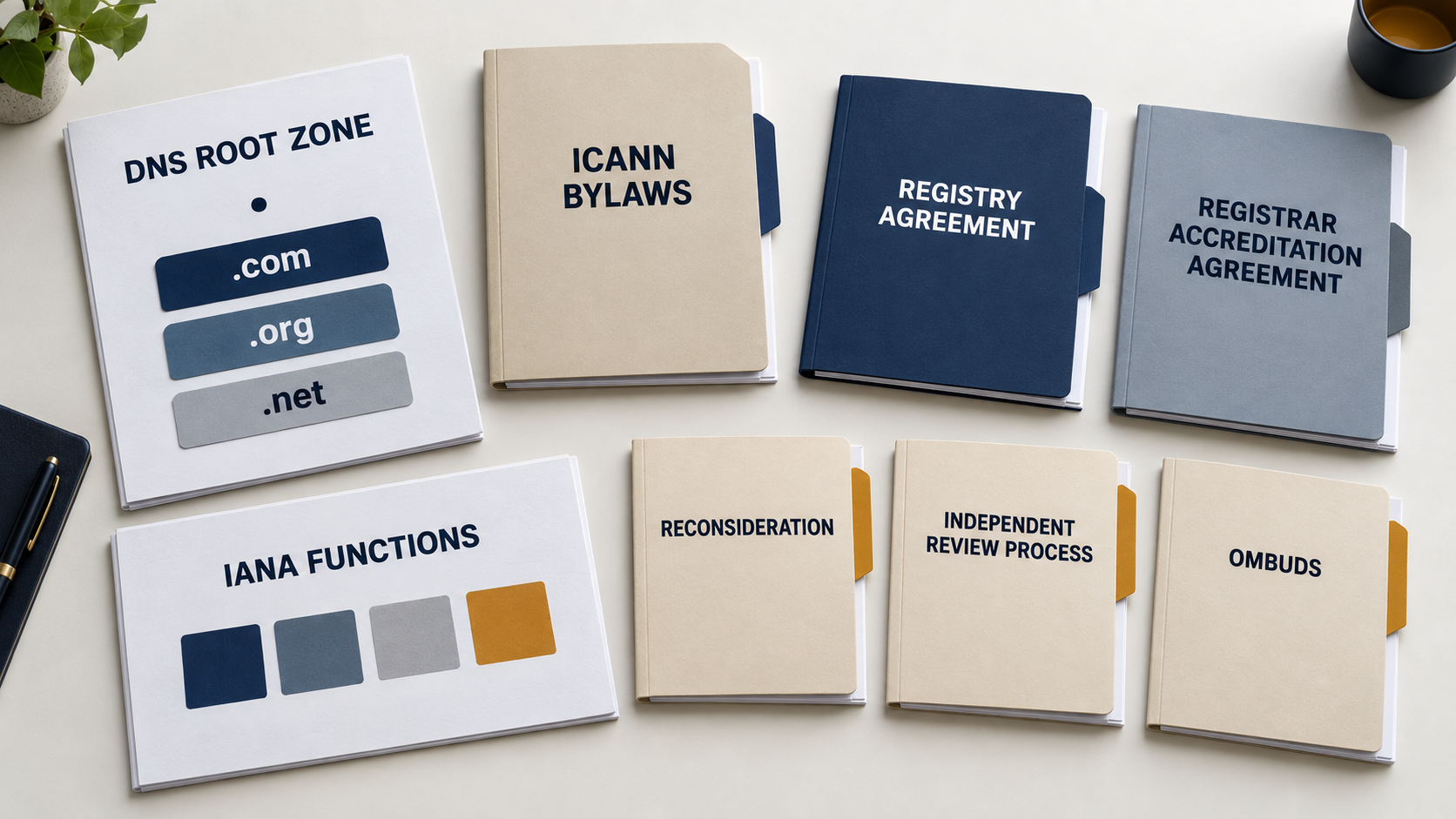
The accountability architecture is part of the same boundary. The Bylaws establish the Board, Supporting Organizations, Advisory Committees, the Empowered Community, Reconsideration and the Independent Review Process. These mechanisms give participants structured ways to contest institutional action, but they do not turn every disagreement into a merits appeal with unlimited remedial power.
The historical transition changed the accountability frame
The 2009 Affirmation of Commitments was a bilateral instrument between ICANN and the U.S. Department of Commerce. It committed the parties to recurring reviews involving accountability and transparency, security and stability, competition and consumer trust, and registration-directory services. It was historically important, but it was not ICANN’s corporate charter and it was not a universal contract with registry operators.
The United States and ICANN later terminated the Affirmation after the stewardship transition, with relevant accountability and review commitments incorporated into revised Bylaws. The change should not be described as the disappearance of accountability. It moved important commitments from a bilateral governmental instrument into ICANN’s post-transition governance structure.
In 2014, NTIA announced its intention to transition stewardship of key IANA functions. The announcement required protection of the multistakeholder model, DNS security, stability, resiliency and openness. It did not transfer ownership of the Internet or confer general regulatory jurisdiction on ICANN. By 2016, the end of NTIA’s contractual stewardship role left operation and accountability to arrangements involving ICANN, PTI and the relevant operational communities.
The transition proposal separated policy development from operational performance across naming, numbering and protocol parameters. It contemplated a legally separate affiliate for naming operations and a system of contracts, service levels, customer oversight, reviews and possible separation. The transition proposal and the CCWG-Accountability recommendations explain the design rationale, but they are not substitutes for the adopted Bylaws and executed agreements.
Contracts are the main control surface
The practical question is often not whether ICANN possesses abstract authority, but what a particular contract permits it to require, audit or enforce.
IANA’s operational role illustrates the separation. IANA’s public description covers DNS root-zone coordination, Internet number-resource allocation and protocol-parameter registries. Those functions are performed by Public Technical Identifiers, an ICANN affiliate. The IANA Naming Function Contract delegates naming operations to PTI and specifies reporting, service-level, audit, escalation and subcontracting obligations. It does not itself create domain-name policy authority.
The division is also visible in protocol parameters. RFC 2860 distinguishes registry administration from policy development through the IETF process. For number resources, the NRO service-level arrangement places global policy with the regional Internet registry community while governing operational performance through service commitments and review. The result is a set of linked but non-identical authority channels, not one institution exercising the same power over every identifier system.
For generic top-level domains, the registry-agreement inventory shows that obligations arise from individual contracts whose terms vary. The Base Registry Agreement is a major control surface for many new-gTLD operators. It addresses policies, data escrow, technical and security requirements, audits, breach, suspension, termination and dispute resolution. It also limits the subjects on which consensus and temporary policies may bind an operator. ICANN’s leverage is therefore substantial, but bounded by the agreement, incorporated policies, the Bylaws mission and dispute provisions.
The registrar relationship works similarly. The Registrar Accreditation Agreement contains duties concerning policy compliance, registration-data services, escrow, retention, abuse contacts, reseller oversight, audits and compliance investigations, including possible suspension or termination. Registrants ordinarily contract with registrars or resellers rather than directly with ICANN. That limits ICANN’s direct contractual remedies against end users and makes the chain of responsibility important in any dispute.
Country-code operators require separate caution. The ccTLD materials describe heterogeneous relationships, including sponsorship agreements, accountability frameworks and exchanges of letters. The generic Base Registry Agreement should not be treated as the universal source of authority over every TLD operator.
A remedy is not necessarily a reversal
ICANN’s public materials describe several accountability channels: compliance, Reconsideration, the Independent Review Process, its supplementary procedures, the Ombudsman and periodic reviews.
These mechanisms should not be collapsed into a single appeal. Reconsideration addresses specified Board or staff actions under defined requirements. Independent Review examines defined governance questions under its procedures; it is not a general rehearing of every contractual or policy disagreement. Ombudsman review is an institutional-fairness mechanism, not a court judgment. Compliance action may enforce contractual obligations, but its availability and remedy depend on the relevant agreement and facts.
That scope produces the central institutional tension. ICANN’s practical authority depends on relationships that can be enforced—especially contracts and incorporated policies—while its governing documents deny it a general mandate to regulate the Internet. Legitimacy therefore turns on traceability. A decision should be explainable by reference to a mission, a contract or a delegated operational obligation. The challenger’s further question is whether the available process can change the outcome in time, rather than merely preserve a record of disagreement.
The evidence also imposes a temporal discipline. Historical instruments, transition proposals and current agreements should not be treated as interchangeable. Current versions, amendments, effective dates and quotations require verification before a contested decision is assessed. The same caution applies across gTLDs, ccTLDs, numbering and protocol parameters: the existence of ICANN at the centre of the identifier ecosystem does not make its authority identical across those domains.
For operators, registrars, registries and policy participants, the practical map is therefore four-part: identify the governing mission, locate the contract or delegated function, determine which body made the decision, and select the remedy whose scope reaches that act. The institutional question is not whether ICANN governs “the Internet.” It is which instrument grants which power, against whom, and with what possibility of correction.
Sources: Articles; Bylaws; Affirmation of Commitments; NTIA termination notice; 2014 NTIA transition announcement; 2016 NTIA statement; transition proposal; accountability proposal; IANA; PTI; IANA naming contract; RFC 2860; NRO SLA; registry agreements; Base Registry Agreement; Registrar Accreditation Agreement; ccTLD materials; compliance; Reconsideration; Independent Review; supplementary procedures; Ombudsman; reviews. Directory: ICANN.
Member Briefing
Deeper Profile Context
Sign in with the right membership level to unlock the full briefing and source notes.
Only for Strategic Circle
Strategic Circle
Open to all readers. Unlock profile briefings after joining and signing in.
Join Strategic CircleOnly for Leadership Alliance
Leadership Alliance
For qualified IP-asset owners and management; sign in to unlock alliance briefings.
Join Leadership Alliance