
Summary
- Holy Cross Energy is best understood through the winter peak in a mountain community, when heat, lighting, resort activity, electric-vehicle charging, outage response, wildfire settings and customer communications all meet the same wires.
- The cooperative's cost structure is not just wholesale power. It is also local distribution maintenance, wildfire mitigation, control systems, outage communications, field crews, account support, power-supply contracts, clean-energy integration and the financing discipline of a not-for-profit utility.
- Public evidence supports a real operating footprint: HCE reports more than 45,000 members, about 60,000 meters, 2,980 miles of distribution lines, 120 miles of transmission lines, a 2025 system peak of 277 MW, $162.2 million of operating revenue and $151.7 million of operating expenses.
- The judgement turns on whether HCE can keep winter-peak costs visible and fair while adding renewable resources, demand response, batteries, fire-safety settings, system automation and local labour without making members feel that clean power or safety has become an unexplained surcharge.
Established. Holy Cross Energy is a member-owned, not-for-profit electric cooperative founded in 1939 and serving western Colorado communities around the Roaring Fork and Eagle River valleys, Aspen, Vail and nearby rural areas. Its own history page says the first lines were energised in 1941, that resort-area growth reshaped demand from the 1960s onward, and that the cooperative now serves more than 45,000 members with about 60,000 meters and 167 employees (https://www.holycross.com/about-us/our-story/history). Its 2025 annual report says the cooperative kept rates in the lowest third of Colorado electric utilities, returned more than $4.6 million of member equity in 2025, delivered roughly 85% clean energy through the year, recorded a 277 MW system peak, and produced $162.2 million of operating revenue against $151.7 million of operating expenses (https://www.holycross.com/about-us/library/annual-report-2025).
Reasonable inference. The winter peak is the best unit for pricing the cooperative because HCE's rate page, demand-charge guidance, annual report, power-supply disclosures and outage pages all point to the same constraint. A member's highest 15-minute demand, the cooperative's system peak, the cost of contracted capacity, the maintenance of wires across steep terrain, and the staffing of outage and fire-safety communications are different expressions of one problem: the system must be built for the hour when many members want power at once, not for the average hour when clean energy looks abundant (https://www.holycross.com/current-rates and https://www.holycross.com/blog/top-5-easy-ways-to-save-on-the-demand-charge).
Still missing. Public sources do not disclose every feeder-level load shape, wholesale contract price, outage-management vendor, battery dispatch curve, data-centre interconnection request, or member complaint pattern. Colorado utility filings and HCE's own Clean Energy Plan references establish important regulatory context, but the most granular economics of peak procurement and grid upgrades remain inside contracts, internal planning records and meeting materials.
This article therefore treats public evidence conservatively: official HCE sources show the footprint and cost categories, public DNS and RDAP records show the internet edge around member service and outage communications, and outside news mentions show how local clean-energy and resort-community demand shape public perception.
The winter peak is the bill hiding in plain sight
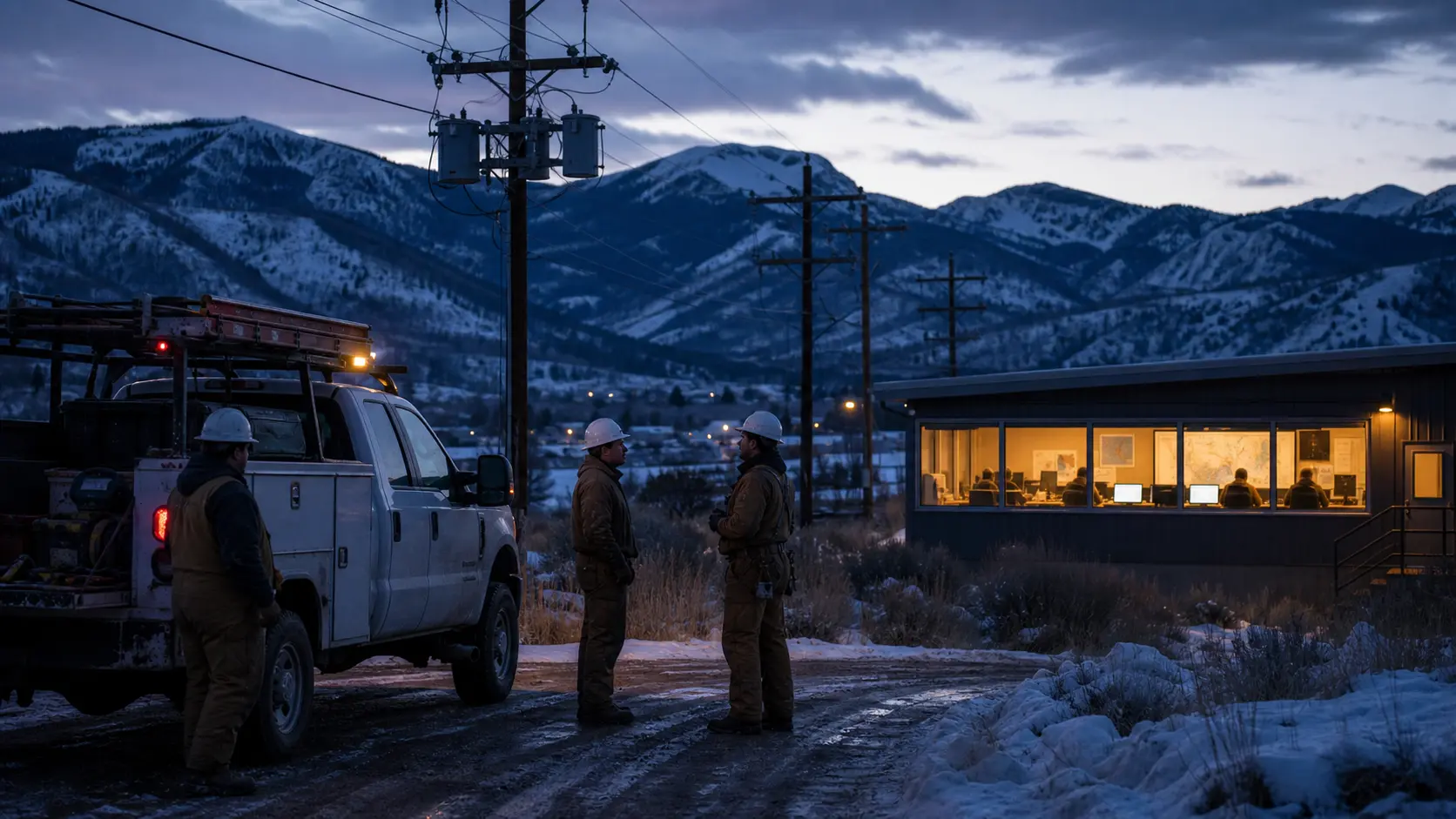
The useful scene is not a sunny summer hour when local solar is high and a dashboard can show a flattering clean-energy percentage. It is an early winter evening in a mountain town. Vacation homes are occupied. Restaurants and hotels are running. A family is cooking dinner. A heat pump comes on. Someone plugs in an electric vehicle after work. A lift terminal, a school, a clinic, a wastewater pump, a public-works garage and a remote cabin all expect the same quiet guarantee.
The grid must be ready before anyone knows which transformer will be stressed, which road will be icy, which line will trip, or whether high wind has forced wildfire settings to make automatic restoration slower.
That winter hour explains why Holy Cross Energy is an infrastructure-economics story rather than a generic utility profile. The cooperative sells kilowatt-hours, but its harder product is readiness. A kilowatt-hour measures energy over time. A winter peak measures obligation at one moment. The system has to be sized for that moment.
If the peak rises, costs arrive in several places: purchased power and capacity, transmission access, substation headroom, conductor sizing, transformer replacement, field crews, vegetation work, control-room readiness, member-service staffing and the software surface that tells customers what is happening when a circuit fails.
HCE's own public rate material makes that point unusually plain. Small residential members pay a $16 monthly customer charge and $0.110 per kWh energy charge, with no demand charge, while large residential members pay a $45 customer charge, $0.082 per kWh energy charge and $5.32 per kW demand charge. Small commercial members pay $20 per month and $0.10 per kWh, while large commercial and irrigation members pay $62 per month, $0.078 per kWh and $6.11 per kW demand charge. The Electric Cost Adjustment was $0.00525 per kWh in March 2026. HCE says 99% of residential members fall into the small residential category, and explains demand as the highest average demand in any 15-minute period during the month (https://www.holycross.com/current-rates).
That is a quiet but important pricing admission. Average usage matters, but coincidence matters more. A cooperative can have an attractive annual clean-energy percentage and still face expensive peak hours when wind, solar, hydro, batteries, wholesale partners and local wires do not line up perfectly. HCE's demand-charge education tells members that the charge exists because infrastructure must be built and maintained to meet everyone's peak needs, especially during busy times of day (https://www.holycross.com/blog/top-5-easy-ways-to-save-on-the-demand-charge). In other words, the winter peak is a shared cost, even when it appears on individual bills only for larger accounts.
The same logic sits behind HCE's system statistics. The cooperative lists 60,000 meters, 2,980 miles of overhead and underground distribution lines, and 120 miles of transmission lines. It reported 1.329 billion kWh purchased in 2023, a January 2023 system peak of 260,879 kW, and average monthly residential use of 1,157 kWh. It also listed 2023 reliability at 99.988% availability, an average 0.864 outages per member, and 61 average outage minutes, compared with a nationwide SAIDI average of 90 minutes (https://www.holycross.com/our-system/distribution-and-system-specs). The 2025 annual report then updates the peak frame: 277 MW system peak, 1.12 average outages per member, 71 average outage minutes, top-quartile outage numbers, more automation for faster outage detection and restoration, and vegetation work using drones and other techniques (https://www.holycross.com/about-us/library/annual-report-2025).
These numbers should not be read as a promise that every member's circuit is equally reliable. Mountain utility averages can hide very different experiences by valley, elevation, access road, subdivision age and exposure to wind. But they do show why the cooperative's economics are more severe than the simple phrase "rural electric co-op" suggests. HCE is not only serving remote ranches or dense town centres. It serves ski communities, second homes, public facilities, all-electric buildings, farms, ranches, hotels, service workers, schools and old rural line extensions.
Its peak is built by a local economy whose load can be seasonal, weather-sensitive and politically demanding.
The winter peak therefore prices a bargain. Members want low rates, local accountability, clean energy, fast restoration, wildfire caution, human support and grid capacity for electrification. HCE wants enough revenue to pay for power supply, distribution, transmission, member service, administration, depreciation and interest, while preserving the cooperative promise that margins are returned or reinvested rather than sent to outside shareholders. The bill is the settlement. The peak is the test.
Cooperative identity changes the politics, not the physics
Holy Cross Energy's cooperative identity matters because it changes the claim on surplus. It does not make transformers cheaper, contracts simpler or winter peaks smaller. HCE's history describes a utility created because private power companies had failed to bring service to rural parts of the Roaring Fork and Eagle River valleys. A $119,000 Rural Electrification Administration loan helped build the first lines, which were energised in 1941 for about 175 families. The service area grew through purchases and resort development, including the Vail and Snowmass era that began in the 1960s. HCE's current story is therefore not only clean-energy transition. It is the continuation of a local access institution that became a resort-region utility (https://www.holycross.com/about-us/our-story/history).
That history gives the cooperative a local trust premium. The 2025 annual report stresses that the board lives and works in the communities served, that decisions are made close to home, and that the cooperative reinvests locally rather than paying shareholder profits. The financial evidence is material: more than $4.6 million of member equity returned in 2025 and nearly $183 million since 1963. The report also says the average residential bill was $139.95 and that the 11-cent small residential energy rate was below a national average of 18 cents at the end of 2025 (https://www.holycross.com/about-us/library/annual-report-2025).
Yet member ownership does not remove cross-subsidy questions. A cooperative can return equity and still ask who pays for a new line, a battery programme, a wildfire project, a large commercial load, a ski-town peak, or a clean-energy contract that helps long-run emissions but increases near-term complexity. The absence of outside shareholders can make those questions more transparent, but it does not make them disappear. It may even sharpen them, because members are both customers and economic owners. A member angry about an outage or a rate change is not only complaining to a vendor.
That member is challenging a local institution that claims to act in the community's name.
HCE's rate structure tries to divide fixed, energy and peak costs. The customer charge covers the cost of maintaining active accounts, including metering, data processing and billing. The energy charge varies with kWh use. The demand charge, where it applies, prices the high point of usage. The Electric Cost Adjustment is used to achieve a uniform annual rate of return as actual monthly revenue and expenses become available. The WE CARE surcharge is 2% of eligible electric charges and funds efficiency, conservation and renewable-energy measures (https://www.holycross.com/current-rates). This is not just tariff detail. It is the cooperative's answer to the question of who pays for readiness.
The answer will be contested because HCE's members do not all use the grid in the same way. A small apartment, a large second home, an all-electric public building, a restaurant, a ranch pump, a resort facility, a school and a prospective data-centre load each create different costs. A flat energy charge can make high coincident demand look cheaper than it is. A demand charge can make electrification feel punitive if members do not understand the 15-minute peak logic. A monthly customer charge can feel regressive to low-usage households.
A surcharge for efficiency and renewable work can be defended as a system investment, but only if the benefits are visible beyond the members who can afford batteries, solar or heat pumps first.
This is why local support labour belongs in the economics. HCE's annual report emphasises local people across operations, engineering, member services, billing, accounting and community relations, and says members can talk to a real local person during business hours (https://www.holycross.com/about-us/library/annual-report-2025). That human support is not sentimental decoration. It is a cost centre and a legitimacy tool. When rate design changes, wildfire settings lengthen an outage, or a member is confused by demand charges, HCE needs people who can explain the bill and the operating trade-off in local terms.
The cooperative structure therefore changes the politics of the winter peak. An investor-owned utility can point to a regulator and an allowed return. A municipal utility can point to a city council. HCE has to point to its members, board, rates, equity returns, annual meeting, newsletters and public programme results. The physics are the same: voltage, current, power factor, line loading, device settings and outage restoration do not care about governance form. But member ownership changes the burden of proof.
If HCE says the winter peak requires a demand charge, local batteries, a new transmission segment or more wildfire automation, the explanation has to sound like a shared-cost argument rather than a corporate defence.
Power procurement makes clean energy a timing problem
HCE's clean-energy record is unusually strong for a local electric cooperative. The 2025 annual report says HCE purchased an average of 85% clean, carbon-free electricity during the year and reached a 97% monthly clean-energy level in May. Its home page reported that through May 2026 it had delivered an average of 94% clean energy to members, with March 2026 at 100%, April at 97% and May at 96% (https://www.holycross.com/). A June 2026 HCE release said March 2026 was the first month in which renewable electricity was equivalent to 100% of member needs, driven by lower demand and strong wind and solar output (https://www.holycross.com/blog/holy-cross-energy-provides-100-renewable-electricity-to-members-in-march).
The achievement is real, but the same release explains why the winter peak remains hard. HCE said the March result reflected Bronco Plains II wind, the Hunter solar array, three solar-plus-storage facilities connected to the HCE distribution system, distributed solar and hydro resources, and the role of The Energy Authority in analytics for renewable procurement. It also said residual energy supply and capacity needs are met through HCE's wholesale power supply agreement with Xcel Energy, and that some hours surpass 100% renewable supply while others dip below and require supplemental non-renewable generation. Roughly 60% of 2026 clean energy came from projects built specifically for and contracted to HCE, while the remaining 40% was supplied by wholesale partners and was not time-matched (https://www.holycross.com/blog/holy-cross-energy-provides-100-renewable-electricity-to-members-in-march).
That is the key distinction. Annual clean-energy percentages are important for climate accountability. Winter-peak economics are about time, capacity and deliverability. HCE can be highly renewable over a month and still need firm supply or market purchases when a cold evening arrives with low local solar output, mismatched wind, storage limits and heavy household demand. The cooperative's own power-supply page shows the portfolio complexity. It has long-term commitments with Public Service Company of Colorado, a subsidiary of Xcel Energy, Guzman Energy and the Western Area Power Administration. It has long-term purchase agreements with clean and renewable generators, including a 200 MW wind farm, 31 commercial solar arrays and seven small hydroelectric generators, and owns 2.7 MW of solar (https://www.holycross.com/our-system/our-power-supply).
The legacy supply story is also complicated. HCE owns an 8% share of Unit 3 at the Comanche Generating Station in Pueblo, Colorado, a coal-fired generating unit that became operational in 2010. HCE says Guzman Energy began purchasing that energy from the cooperative in February 2019 (https://www.holycross.com/our-system/our-power-supply). This matters because the public brand of the cooperative is moving rapidly toward clean energy, while the historical balance sheet and contract stack still contain older resource commitments. Selling or contracting around legacy output can reduce emissions exposure for members, but it does not erase the complexity of power procurement.
The 2024 fuel mix shows the transition in numbers: 76% clean and renewable, made up of 61% wind, 11% solar, 3% hydro and 1% biomass, with the remaining 24% non-renewable divided among coal, gas and market purchases. HCE also reported that members bought 56,781 MWh through a voluntary fuel-source programme in 2024, that members installed 209 additional small renewable generators during the year, bringing the local renewable-installation count to 2,927, and that 28.5 MW of net-metered renewable capacity delivered about 15,498 MWh to the HCE distribution system (https://www.holycross.com/our-system/our-power-supply).
The cooperative has therefore moved beyond symbolic green tariffs. Its clean-energy share is high, distributed resources are visible, and local solar-plus-storage projects are not abstract. The annual report says local solar and storage projects in Parachute, Rifle and Glenwood Springs are increasing clean-energy numbers and helping keep costs low. It also describes Bronco Plains II wind as a fixed-price resource that accounted for 31% of the power supply purchased for members in 2025 (https://www.holycross.com/about-us/library/annual-report-2025). Fixed-price renewable contracts can be valuable hedges against fuel volatility. They also create a new management problem: the cooperative must match variable production, member demand and wholesale residual supply without turning every mismatch into a customer-rate shock.
The Colorado regulatory frame gives HCE a formal clean-energy path. The power-supply page says HCE filed a Clean Energy Plan with the Colorado Public Utilities Commission, approved in 2022, outlining a route above the statutory threshold of 80% emissions reductions from 2005 levels and aligned with HCE's 100X30 goal. HCE reported 2024 emissions of about 279,082 metric tons of CO2 equivalent, 70% lower than 2005 levels while sales were 18% higher, and 51% lower than 2023 levels. Average delivered emissions intensity was 0.484 pounds CO2 equivalent per kWh after accounting for line losses and voluntary green-pricing sales (https://www.holycross.com/our-system/our-power-supply).
This makes HCE an instructive case because clean energy and peak affordability are not separate projects. A cooperative that gets to 90% clean energy by buying poorly timed power at high cost would lose member trust. A cooperative that keeps rates low by postponing clean-resource integration would lose climate credibility in a community whose local governments and resort economy increasingly market sustainability. The winter peak forces the compromise into the open. Clean energy must be procured not only in annual volume but in a form that reduces peak exposure, stabilises costs and supports outage recovery.
The grid cost is local, steep and labour-heavy
The physical system is not a spreadsheet. HCE operates across mountain valleys where a mile of line can be expensive to inspect, maintain and repair. The distribution page's 2,980 miles of overhead and underground distribution lines and 120 miles of transmission lines are not equivalent to the same length on flat suburban streets (https://www.holycross.com/our-system/distribution-and-system-specs). Some lines sit near resort communities with high expectations and heavy winter load. Others serve rural or isolated areas where access is limited. In the annual report, HCE singled out Colorado River Road north of Dotsero, where crews used helicopter support over two days in February and July 2025 to replace aging poles and power lines in rugged terrain (https://www.holycross.com/about-us/library/annual-report-2025).
That project captures the cost base. A pole replacement in such territory is not only a pole. It is design work, traffic control, land access, equipment, skilled line labour, safety planning, helicopter support, materials, weather risk and outage coordination. If the work succeeds, the benefit is often invisible: a future outage does not happen, or a difficult repair is avoided. If the work is deferred, the cost may return as a long outage during a storm or as a wildfire ignition risk. This asymmetry is the hardest part of local grid economics. Preventive spending looks optional until it is too late.
HCE's operating expenses make the same point in financial form. In 2025, power supply was $73.5 million, the largest expense. Transmission was $5.4 million. Distribution was $21.1 million. Member service was $7.2 million. Administrative expense was $19.1 million. Depreciation and interest were $25.3 million. Total operating expenses were $151.7 million, against $162.2 million of operating revenue and $12.9 million of total margins (https://www.holycross.com/about-us/library/annual-report-2025). Power procurement dominates, but the local grid and the institutional apparatus around it are material.
The 2025 system peak of 277 MW should be read against those expenses. A single peak does not explain all spending, but it determines how much capacity the system must be ready to deliver. Distribution spending must keep lines, transformers and substations fit for the highest local load, not merely for the annual average. Member service must be ready when a rate change or outage produces calls. Administrative and finance costs rise when capital projects, clean-energy contracts and risk management become more complex. Depreciation and interest are the shadow of earlier investments that members now pay over time.
HCE's system-improvement page shows how local infrastructure also doubles as communications infrastructure. It says the cooperative completed two phases of a middle-mile network project, installing fibre in the Roaring Fork and Eagle River valleys to enhance system communications and to create an opportunity for third-party broadband internet companies to reach remote areas lacking high-speed service (https://www.holycross.com/our-system/power-line-projects). That fibre is not a consumer amenity first. For the cooperative, it supports control, monitoring and operational visibility. For the region, it can also help broadband reach places where commercial internet economics are weak.
This is where data-centre power and permitting enter the analysis, even without a public record of a large HCE-specific data-centre load. The service territory contains communities where land, power, fibre and climate could attract power-hungry digital infrastructure, but the winter-peak logic is unforgiving. Any large load that arrives as a constant or coincident peak must pay for interconnection, local capacity, backup risk and system studies in a way that does not socialise costs across ordinary members. A cooperative with 60,000 meters cannot absorb speculative large-load risk casually.
The fibre evidence says the grid has a communications layer; the rate and peak evidence says power capacity is scarce enough to price carefully.
HCE's contractor and preferred-partner pages, member programmes and local workforce language point to another cost: skilled labour availability. The annual report says HCE invests in ongoing training and professional development, safety culture, scholarships and local workforce development. It also says the cooperative uses operations, engineering, member services, billing, accounting and community-relations staff to deliver better member service (https://www.holycross.com/about-us/library/annual-report-2025). A mountain cooperative does not only buy labour in a generic national market. It competes in high-cost local communities where housing, travel time and winter conditions affect the ability to staff crews and member support.
Local labour also matters during outages. A utility can buy software, automation and outsourced platforms, but someone still has to assess damage, switch circuits, repair equipment, answer calls, coordinate with local officials and communicate with members whose circumstances vary. A resort worker, a retiree, a school facility manager and a hotel engineer experience the same outage differently. The cooperative has to translate a technical restoration plan into local trust. That translation is labour.
Wildfire settings turn reliability into a safety trade-off
Wildfire risk changes the meaning of reliability. The old utility ideal is simple: keep power on whenever possible and restore it quickly when it fails. In fire-prone terrain, that ideal becomes conditional. Sometimes the safer action is to make the system trip faster, re-energise less aggressively, or even turn power off in targeted areas when the risk is extreme. That choice can make outages more frequent or longer. It can also prevent a catastrophe.
HCE says wildfire risk in its service territory is influenced by drought, vegetation conditions, terrain accessibility and extreme weather. Its mitigation strategy combines vegetation management, inspection and maintenance, system safety settings and community engagement (https://www.holycross.com/community/safety/wildfire-mitigation). The official page lists regular trimming cycles, mid-cycle inspections, targeted work on high-risk trees, satellite imagery, GIS mapping and field inspections. It also describes pole management, substation inspections, infrared inspections, aerial and drone inspections, digital tracking of inspection data, and hardening steps such as replacing outdated reclosers with electronic smart devices, updating construction standards, reducing expulsion fuses and replacing porcelain cutouts with polymer versions (https://www.holycross.com/community/safety/wildfire-mitigation).
Those details matter because wildfire mitigation is often discussed as if it were a moral decision rather than an engineering and cost decision. HCE's work costs money before it proves its value. A drone inspection must be paid for before a defect is found. A smart device must be installed before a high-wind day. Vegetation work must be scheduled before the public knows whether a branch would have contacted a line. A polymer replacement or covered jumper may prevent an ignition that will never be counted by a customer as a benefit. Yet these hidden avoided harms are precisely what members are being asked to fund.
Fire Safety Settings make the trade-off explicit. HCE describes them as Enhanced Powerline Safety Settings, temporary adjustments used during high wind to reduce ignition potential if debris contacts an energised line. The settings shut power to the line faster than normal and reduce automatic re-energising, and HCE warns that they may result in more frequent, longer-lasting outages. HCE says Public Safety Power Shutoffs are used only as a last resort, targeted to high-risk areas, coordinated with emergency agencies and preceded by advanced communication where possible (https://www.holycross.com/community/safety/wildfire-mitigation).
For a member, this can feel like the utility has made reliability worse. For the cooperative, it is a risk transfer from ignition probability to outage burden. The economic challenge is to price and explain that transfer. A short outage caused by sensitive settings may avoid a much larger public cost. But the member with medical equipment, a freezer, a remote work obligation or an electric heating load experiences the actual outage, not the avoided fire. The cooperative has to invest in communications, backup planning, member education and critical-needs awareness if the trade-off is to be accepted.
HCE's home page made the issue live in July 2026, showing "Fire Settings: On" and warning that high fire danger had activated Fire Safety Settings across much of the system, which may cause more frequent and longer-lasting outages (https://www.holycross.com/). Its outage center says the system is set up so HCE is aware of most outages right when they happen, that the map displays most but not all confirmed outages, and that members should be prepared to cope for at least 72 hours during an outage (https://www.holycross.com/our-system/outage-center). The combination is sobering. The cooperative can invest in awareness and still tell members that not every outage will appear perfectly on the public map, and that self-preparation remains necessary.
The WARN project adds scale to this fire-risk story. HCE says it is leading a consortium of 38 electric cooperatives and other rural utilities selected for federal funding through the Wildfire Assessment and Resilience for Networks project, created by the Infrastructure Investment and Jobs Act. It says WARN projects will modernise and strengthen the grid, protect customer access to electricity during wildfires and mitigate fire risk from ageing transmission and distribution infrastructure (https://www.holycross.com/our-system/power-line-projects). For HCE, the project is both operational and reputational. It presents the cooperative as a leader in rural wildfire resilience, not merely a local utility reacting to local risk.
The fire setting is also a rate-design problem. If members pay for wildfire mitigation through general rates, the benefits may be system-wide but the outages may be localised. If high-risk areas require more spending, members in lower-risk areas may ask why they should pay. If costs are recovered too narrowly, rural or edge-of-system members may face unaffordable bills. The cooperative model can help because members share ownership, but it cannot eliminate the distribution question. The winter peak and wildfire setting meet at the same point: a shared grid built for rare but expensive conditions.
Outage communications are part of the grid
The public outage map is not the grid, but it is now part of the service. HCE's outage center tells members to check the map for known outages, says the map shows real-time information about most current outages, and sends members to an online form if the outage is not visible after checking breakers and fuses (https://www.holycross.com/our-system/outage-center). That description creates a careful promise. HCE is not saying the map is complete. It is saying the map is timely enough to be the first public reference for most confirmed outages.
That promise has economics behind it. The cooperative needs meters, communications, outage-management logic, member account systems, website hosting, map hosting, alert tooling and call handling to make the public interface credible. It must also decide what not to show. A map can inform members, but it can also mislead if data is preliminary, expose sensitive infrastructure if too granular, or create anger if restoration estimates change. The better the control system, the more useful the public interface can become. The more wildfire settings and automation alter restoration patterns, the more important the explanation becomes.
Network evidence supports the view that HCE's public service depends on ordinary cloud and enterprise infrastructure. DNS lookups on July 5, 2026 showed holycross.com resolving to 162.159.135.42, and ARIN RDAP identifies the surrounding 162.158.0.0/15 network as Cloudflare (https://rdap.arin.net/registry/ip/162.159.135.42). The public outage-map host holycross.outagemap.coop resolved to Amazon-addressed IPs in 216.137.52.0/24, and ARIN RDAP identifies the surrounding 216.137.32.0/19 network as Amazon.com (https://rdap.arin.net/registry/ip/216.137.52.42). HCE's SmartHub account host resolved to 3.33.226.79 and 15.197.224.196, with ARIN RDAP for 3.33.226.79 showing Amazon Technologies (https://rdap.arin.net/registry/ip/3.33.226.79).
Mail records show the same outsourced trust surface. DNS showed holycross.com mail routed to holycross-com.mail.protection.outlook.com, with TXT records referencing Microsoft, Cisco, Adobe, Palo Alto Networks, SolarWinds service-desk verification, Mailchimp, Amazon SES and Freshservice. The SPF record included Microsoft 365 protection, Mailchimp, Amazon SES, Freshservice and a specific IPv4 sender. The DMARC record published a quarantine policy at 10% with aggregate and forensic reports to cybersecurity@holycross.com. These records are normal for a modern mid-sized institution, but they matter because a utility bill, outage alert, scam warning or wildfire notice depends on trusted digital communication.
This evidence should not be overread. Public DNS does not reveal the full architecture of HCE's control systems, and public RDAP does not prove operational dependency on any single vendor. It does show that the member-facing edge of a mountain cooperative is a cloud-mediated service. If a member cannot log into SmartHub, cannot trust an email, cannot load the outage map, or receives a fake shutoff notice, HCE's physical-grid reliability is not enough. The cooperative's continuity obligation includes account access, message integrity and abuse response.
HCE recognises part of that risk through member-facing scam alerts and account-service material. Its navigation places scam alerts with member resources, SmartHub as the account channel, and outage notifications through SmartHub sign-up paths (https://www.holycross.com/ and https://www.holycross.com/community/safety/wildfire-mitigation). The economic point is that cybersecurity and abuse response are not optional office costs. They protect the trust needed for restoration notices, fire warnings, demand-charge education and payment instructions.
Outage communications also have a labour cost. A map cannot comfort a member who needs medical power, explain why fire settings extended an outage, or answer whether a commercial freezer should be moved to backup. HCE's annual report says local member-service staff are part of the cooperative's workforce model and that members can reach a real local person during business hours (https://www.holycross.com/about-us/library/annual-report-2025). The winter peak and outage map therefore share a logic: technology scales information, but local labour converts information into trust.
Member programmes are small peaks sold back to the system
HCE's member programmes are best understood as peak resources, not only customer benefits. The annual report says Power+, Power+ Flex and Peak Time Payback provided 7.5 MW of demand reduction in 2025. It also says 368 residential battery systems participated in Power+ and Power+FLEX, with total capacity above 6.4 MW, while 3,966 members participated in Peak Time Payback and earned more than $78,000 in bill credits. Another 1,802 members received rebates for energy efficiency and electrification upgrades, and 249 members received free or reduced-cost home energy audits through Energy Smart Colorado partners (https://www.holycross.com/about-us/library/annual-report-2025).
The headline number is 7.5 MW. Against a 277 MW system peak, it is modest but meaningful. It is not enough to replace the need for wholesale capacity, distribution upgrades or wildfire hardening. But it is enough to shape the marginal hour if dispatchable batteries and voluntary reductions arrive reliably when needed. The value of such programmes rises if winter peaks are sharp, if wholesale prices spike, if local circuits are constrained, or if clean-energy matching becomes more important than annual energy totals.
This is why HCE's demand-charge education and member programmes belong in the same story. A demand charge tells larger members that their peak behaviour has system cost. Peak Time Payback and battery programmes pay members to change system conditions when the cooperative needs help. Rebates and audits reduce inefficient load. On-bill repayment for heat pumps can make electrification more accessible, but it also requires care because electrification may raise winter peaks if poorly managed. The cooperative must sell electrification and peak discipline at the same time.
The annual report's on-bill repayment example illustrates the balance. HCE said 46 residential members signed up in 2025 for 0% USDA-backed loans repaid through electric bills to install high-efficiency heat pumps. The programme helps members improve home comfort and efficiency while supporting long-term goals of reducing peak demand and building a cleaner, more flexible grid (https://www.holycross.com/about-us/library/annual-report-2025). That is the right framing, but the economics depend on controls, building shells and usage behaviour. A heat pump in a well-weatherised home can reduce total energy and emissions. A poorly timed electric load during a cold peak can increase grid cost.
The same caution applies to electric vehicles. HCE's demand-charge guidance tells members not to stack EV charging on top of cooking, laundry and showers, and recommends overnight charging or reducing charging amperage where practical (https://www.holycross.com/blog/top-5-easy-ways-to-save-on-the-demand-charge). For a cooperative with a winter evening peak, unmanaged EV charging can turn a climate-friendly device into a local capacity cost. Managed charging can turn the same device into a flexible load that avoids expensive infrastructure. The technology is not the thesis. Timing is.
Member programmes also create equity questions. Batteries, smart thermostats, solar and heat pumps are easier for higher-income homeowners to adopt. HCE's income-qualified, Sustainable Solar and community programmes are attempts to spread benefits more widely. The annual report says the cooperative enrolled 107 income-qualified members in Evergreen Solar in late 2025 with a Colorado Energy Office grant, and that member contributions through the Round-Up Foundation and income-qualified assistance expand access to affordable energy (https://www.holycross.com/about-us/library/annual-report-2025). These details matter because a cooperative cannot build long-term support for peak pricing if only wealthier members can avoid peaks or earn credits.
In the winter-peak lens, member programmes are a kind of distributed procurement. HCE can buy power from a supplier, build a line, upgrade a substation, dispatch batteries, ask members to reduce use, or design rates so members avoid stacking loads. Each option has a cost and a confidence level. A signed power contract is predictable but may be expensive or mismatched. A local battery can be targeted but needs participation. A voluntary reduction is cheap but uncertain. A demand charge is efficient but politically sensitive. The cooperative's job is to combine them without losing the simplicity members expect from a monthly bill.
Upstream dependence is not weakness; unmanaged pass-through is
HCE is local, but its power supply is not self-contained. It depends on Public Service Company of Colorado, Guzman Energy, Western Area Power Administration, renewable developers, The Energy Authority, wholesale markets and transmission access. That is not a flaw. No cooperative of this size should be expected to vertically integrate every generation and market function. The risk is unmanaged pass-through: a cost, outage, market spike or contract exposure that members experience as a bill increase without understanding why it happened.
The 2025 financial statement shows power supply as the dominant expense at $73.5 million, about 48.5% of operating expenses. Transmission, distribution, member service, administration, depreciation and interest make up the rest (https://www.holycross.com/about-us/library/annual-report-2025). The cooperative's affordability claim therefore depends heavily on power-supply strategy. Long-term renewable contracts can stabilise costs, as HCE argues in its annual report, but the residual supply and capacity needs still matter. When a cold peak arrives, the portfolio has to deliver energy and capacity, not just annual environmental attributes.
The Energy Authority's role is instructive. HCE says TEA acts as an extension of staff, using advanced analytics to maximise renewable procurement while maintaining reliability and affordability (https://www.holycross.com/blog/holy-cross-energy-provides-100-renewable-electricity-to-members-in-march). That phrase points to a real capacity gap: a local cooperative may need external market expertise to optimise a complex portfolio. Outsourcing analytics can be prudent. It also means the cooperative must retain enough internal competence to challenge forecasts, explain decisions and prevent the vendor layer from becoming a black box to members.
Western Area Power Administration and Xcel-related supply also show that federal and investor-owned utility systems sit inside the local bill. WAPA hydropower can provide valuable public-power supply characteristics, but hydrology and allocation rules matter. Xcel residual supply can support reliability, but it can also expose HCE to broader Colorado power-system costs and policy choices. Guzman arrangements can reshape legacy coal exposure, but they are still contract dependencies. Members see one cooperative bill. The cost base is a web of upstream commitments.
This is where data-centre or other large-load requests would test governance. A data-centre project can promise local tax revenue, construction work and steady load. It can also require interconnection studies, transformer capacity, transmission upgrades, backup arrangements, water and land-use scrutiny, and a clear answer on who pays if the project does not materialise or if its peak coincides with existing demand. HCE's evidence base does not show a major public data-centre interconnection case, so any specific claim would be speculative.
The right point is structural: a small cooperative serving resort and rural communities has to treat large digital loads as financial exposures, not merely new sales.
The rate page already contains the tool for that conversation. Demand charges for larger residential, commercial and irrigation classes make peak use visible. Construction and engineering service processes, tariffs and system studies should then ensure that unusually large loads pay the cost they impose. If HCE underprices peak demand to win growth, ordinary members may subsidise capacity. If it overprices or delays every large load, local economic development may move elsewhere. The cooperative has to strike a narrow balance because its member base is small compared with the possible size of modern digital loads.
Upstream dependence is acceptable if HCE can show that each layer reduces member risk. A wind contract should lower cost volatility or emissions. A solar-plus-storage project should help local capacity or energy matching. TEA analytics should improve dispatch economics. Xcel residual supply should be a bridge, not a blank cheque. WAPA supply should be valued and integrated carefully. A large-load agreement should protect existing members. The winter peak is the common audit, because that is when all upstream promises either fit or fail.
Regulation and geography make the cooperative a public-continuity utility
Holy Cross Energy is not a state agency, but it performs public-continuity work. Its lines serve homes, schools, clinics, water systems, public works, resorts, farms, communications equipment and emergency needs across mountain terrain. Its power-supply page references Colorado renewable-energy standards for cooperatives and the Clean Energy Plan approved by the Colorado Public Utilities Commission in 2022 (https://www.holycross.com/our-system/our-power-supply). Its wildfire page references coordination with emergency agencies for last-resort public-safety shutoffs (https://www.holycross.com/community/safety/wildfire-mitigation). Its annual report highlights support for an all-electric public works garage in Avon, with 24 kW of rooftop solar, 30 kW of battery energy storage and electric heating (https://www.holycross.com/about-us/library/annual-report-2025).
Those facts place HCE in the public-sector continuity topic even though it is a cooperative. A winter outage in a mountain town is not only a private inconvenience. It affects roads, heat, communications, schools, emergency response, water, tourism and small businesses. A wildfire setting is not only a utility protection device. It changes how a community prepares for high-risk days. A clean-energy target is not only environmental branding. It affects public commitments by resort towns, counties and local institutions that want lower-emissions electricity.
Geography amplifies every operational risk. HCE serves resort communities with high expectations, rural extensions with difficult access, and valleys where weather and terrain can make a short line fault time-consuming. The Gilman to Avon transmission project is a good example. HCE says the proposed 8.65-mile, 115 kV line connecting the Avon and Gilman substations would increase resilience and minimise substantial outage risk for Vail, Eagle Vail, Avon, Edwards and parts of Eagle, while providing backup transmission service for Minturn, Red Cliff and Xcel customers in that area (https://www.holycross.com/our-system/power-line-projects). One line segment therefore carries a public-continuity argument across several communities.
Permitting and public acceptance are implicit in that argument. Mountain residents often value views, open space, fire safety, affordability and reliability at the same time. New lines, vegetation work, drone inspections and fire settings can each generate local concerns. HCE's May 2026 statement on a nest removal, described on its newsroom page as following member concern about work affecting power lines in the Eagle Valley, is a small but revealing signal: even routine reliability or safety work can become a local legitimacy issue (https://www.holycross.com/community/engagement/in-the-news). The specific wildlife matter is less important than the governance lesson. Infrastructure maintenance in a visible landscape needs explanation before, during and after the work.
Regulation also shapes HCE's clean-energy economics. The power-supply page says Colorado's renewable standard required electric cooperatives like HCE to supply 10% of retail sales from renewable sources by 2020, while HCE's 2024 eligible renewable sales were far above that requirement: 1,023,188 MWh against a requirement of 127,720 MWh, excluding voluntary programme sales, with renewable energy credits retired annually under the standards and not used for any other purpose (https://www.holycross.com/our-system/our-power-supply). That evidence supports HCE's claim that its clean-energy push is not merely compliance. It is strategic positioning.
The public-continuity challenge is that strategic positioning still has to be cheap enough and reliable enough for members. HCE says rates remain in the lowest third of Colorado electric utilities and that renewable contracts stabilise costs (https://www.holycross.com/about-us/library/annual-report-2025). If that remains true through the next several winter peaks, the cooperative will have a strong case that clean energy and affordability can align. If rates rise sharply or outages worsen, members may reinterpret clean-energy spending as a cause, even when wildfire risk, labour, interest, materials and legacy infrastructure are also driving costs.
This is why HCE's best public argument is not "clean, local, reliable" as separate virtues. It is an integrated infrastructure thesis: local clean resources, member batteries, peak incentives, wildfire hardening, automation, fibre communications and disciplined procurement reduce the cost of the winter peak over time. That thesis is plausible. It is not guaranteed. It needs repeated evidence.
Unofficial signals show trust pressure around rates, demand and visibility
The unofficial evidence is mixed but useful. HCE's own newsroom is heavy with member education: demand-charge tips, rate updates, board elections, annual report messaging, fire settings, renewable milestones and member newsletters (https://www.holycross.com/community/engagement/in-the-news). A cooperative does not publish that volume of explanatory material unless it knows the bill and grid are becoming harder to understand. The April 2026 demand-charge article is especially telling. It does not present demand as an obscure tariff. It tells members not to stack high-energy uses, to schedule EV charging and to understand the one highest 15-minute peak in a billing cycle (https://www.holycross.com/blog/top-5-easy-ways-to-save-on-the-demand-charge).
That member-education tone is a strength if it makes the system legible. It is a weakness if it becomes a substitute for clear rate design. The difference is measurable. Members should be able to see whether demand charges change behaviour, whether Peak Time Payback reduces system cost, whether local batteries dispatch during the right hours, and whether clean-energy contracts are holding down costs compared with market alternatives. Without that evidence, demand education can feel like shifting responsibility onto households.
Local media signals also point to clean-energy reputational value. HCE's "In the News" page lists 9News coverage of a solar installation on the Colorado Mountain College Spring Valley campus and ABC News coverage of Aspen ski-resort clean-energy concerns (https://www.holycross.com/community/engagement/in-the-news). The external pages were not reliably retrievable in this review because of access restrictions, so the article uses HCE's own summary conservatively. The signal is still relevant: local clean power is part of the region's public identity, especially where tourism, ski operations and climate messaging overlap.
Member sentiment is harder to quantify from public sources. HCE reports 5,035 members enrolled to round up bills for local community support, nearly $400,000 in donations to local nonprofit organisations through its giving fund, and more than $209,000 in grants to local energy projects with community benefit (https://www.holycross.com/about-us/library/annual-report-2025). These numbers suggest a cooperative culture with real local participation. They do not prove satisfaction with rates or outages. They show that HCE has a reservoir of local legitimacy that can be drawn down if bills, fire settings or outages are poorly explained.
The board-election material is another signal. HCE held its 2026 annual meeting and board election, according to its newsroom listing, and its annual report repeatedly frames the board as local leadership (https://www.holycross.com/community/engagement/in-the-news and https://www.holycross.com/about-us/library/annual-report-2025). Elections create accountability but also require that complex infrastructure choices be communicated in terms members can evaluate. A board candidate cannot campaign on line impedance and power-market settlement alone. The cooperative must turn those facts into choices about affordability, reliability, safety and clean energy.
Network-resource evidence adds one more unofficial signal: HCE's public interface is professionally outsourced, not home-spun. Cloudflare, Microsoft mail protection, Amazon-hosted outage-map endpoints and SmartHub account infrastructure are normal choices. They imply a vendor ecosystem that helps a small cooperative deliver digital services at scale. They also create vendor, security and abuse-reporting dependencies that members rarely see. If account access, outage maps or email authentication fails during a peak or fire-risk period, the failure will be perceived as HCE's failure regardless of the vendor boundary.
The market-chatter equivalent for HCE is not a stock price, because it is a cooperative. It is the regional conversation about rates, clean energy, resort sustainability, outage visibility, wildfire preparedness and local broadband opportunity. The strongest positive chatter is that HCE can claim high renewable penetration while maintaining rates in the lower third of Colorado utilities. The strongest negative chatter would be any member view that demand charges, fire settings or clean-energy programmes are becoming opaque. The evidence today supports the positive claim more than the negative one, but the next winter peak is the test.
What would change the judgement
The first swing factor is winter-peak transparency. HCE already reports a 277 MW system peak and explains demand charges. The view would improve if the cooperative published more regular peak-shape evidence in member-friendly form: which hours drive system cost, how much member battery capacity was dispatched, how many MW Peak Time Payback delivered during actual peaks, and how much local solar-plus-storage reduced wholesale purchases. The view would weaken if demand charges rose without showing lower system cost or better load management.
The second factor is clean-energy time matching. HCE's clean-energy percentages are impressive, and its 100% March 2026 renewable claim is credible within the terms HCE states. But the article's winter-peak lens asks whether clean energy is available when demand is highest. More hourly matching, storage dispatch data and residual market exposure would strengthen the case. If annual clean percentages keep rising while winter-peak procurement costs rise faster, the clean-energy strategy would look less complete.
The third factor is wildfire-outage evidence. Fire Safety Settings are defensible, but they ask members to accept more or longer outages for risk reduction. The view would improve if HCE can show how often settings were active, which outage patterns they produced, how communications performed, and which hardening work reduced ignition risk or outage duration. The view would weaken if members experience longer outages without clear warnings, restoration explanations or targeted mitigation.
The fourth factor is large-load discipline. No public evidence reviewed here proves that a major data-centre load is currently reshaping HCE's grid. But the cooperative's fibre, peak, rate and power-supply facts make it important to watch. The view would improve if HCE maintains tariff and interconnection rules that protect existing members from speculative large-load costs. It would weaken if large commercial power users receive capacity at prices that understate winter-peak and upgrade risk.
The fifth factor is local labour resilience. HCE's annual report says the cooperative has a strong safety culture, training, local support and a decade-long downward trend in its safety incident rate, with a 2025 Total Recordable Case Incident Rate of 1.8 (https://www.holycross.com/about-us/library/annual-report-2025). The view improves if HCE keeps crews, engineers and member-service staff available in a high-cost resort region. It weakens if labour shortages, housing costs or contractor dependence slow restoration, inspections or member communication.
The sixth factor is digital trust. DNS and RDAP evidence shows a member-facing ecosystem that relies on Cloudflare, Microsoft, Amazon-hosted services and SmartHub infrastructure. That is reasonable, but it means outage communications and account services are only as trusted as the vendor stack and HCE's security controls. Stronger DMARC enforcement, clear scam alerts, tested outage-notification processes and resilient map hosting would improve the view. Weak account security or unreliable outage-map performance during fire settings would damage trust quickly.
On today's record, Holy Cross Energy looks like a serious cooperative utility with a credible clean-energy strategy, a real mountain-grid cost base, strong public evidence of member programmes and a clear need to price peak demand honestly. Its strongest claim is not that it has escaped the economics of power supply. It is that local governance, fixed-price renewable contracts, member flexibility, wildfire hardening and field labour can make those economics more manageable for western Colorado communities. The winter peak is where that claim becomes real.
If members see lower long-run costs, reliable service, clear outage communication and fair treatment of large loads, HCE's cooperative model will look stronger. If they see only a more complicated bill and more caveats, the winter peak will price not just the grid, but the limits of local trust.