
Summary
- Hollywood Connect sells a local access account, not a bare speed number. Its public pages show residential fibre tariffs, 24/7 support claims, month-to-month account language, address-based coverage checks, installation workflows, VoIP, static-IP availability, LTE and wireless alternatives, and a KwaZulu-Natal office footprint.
- The network proof is stronger than a thin web listing would suggest. AFRINIC RDAP confirms AS329479 for Hollywood Connect (Pty) Ltd; RIPEstat shows current announcements for 196.2.160.0/19 and related /24s; PeeringDB and INX records show 10Gbps exchange entries in Durban. The grade is strong for routed resources and exchange presence, but only medium for local last-mile control because customer-facing fibre still depends heavily on third-party fibre-network operators.
- The tariff evidence puts Hollywood Connect into a crowded South African fibre market. Its homepage shows four local plans from R635 to R1,035 per month, while its broader fibre page describes packages from R359 to R1,339 per month, speeds from 15Mbps to 1Gbps, and pricing that varies by fibre-network operator.
- The investment case turns on installation quality, support response, router and ONT handling, upstream resilience, provider coordination, and churn resistance. Public pages give useful service promises, but they do not disclose active subscriber count, ARPU, gross margin, fault volumes, uptime history, support staffing, net adds, or churn.
- The facts that would change the judgement are private operating facts: homes passed or serviceable by FNO partner, active lines, install lead-time distribution, mean time to repair, support first-response time, wholesale cost per access line, Net Promoter Score, monthly churn, bad-debt rate, and how much traffic actually stays local through Durban peering.
The decision begins when the address checker becomes a commitment
The most important Hollywood Connect moment does not happen on a speed-test page. It happens when a customer enters a street address, sees a package, and has to decide whether to turn a broadband intention into a monthly account. That customer may be a family in Umhlanga trying to reduce mobile-data spend, a remote worker in Durban North who needs stable video calls, a small office on the Dolphin Coast that has outgrown backup LTE, or a landlord trying to make an apartment easier to rent. The choice is practical. Is fibre available at this address? Who comes to install it? How long will activation take after the line is live?
Who answers when the router fails? What happens during load shedding? Can the customer leave without a contract fight?
Hollywood Connect's public site frames the offer around fibre-to-the-home in Durban and nearby areas. The homepage at hollywoodconnect.co.za presents FTTH fibre deals, business connectivity, FTTB, wireless, LTE, outages, support, coverage checking, and local pages for Durban North, Dolphin Coast, Umhlanga, Windermere and Morningside. It also lists an Umhlanga address, phone support and sales numbers, account queries, WhatsApp, and social links. That is enough to treat the company as a real local broadband provider, but it is not enough to treat every service claim as proven. In access markets, the advertised package is only the front door. The actual product is the continuing relationship among customer, ISP, fibre-network operator, router, ONT, upstream provider, exchange fabric, billing system and support desk.
That is why the article title uses the word "prove." South African households have many ways to obtain usable connectivity. Afrihost markets national fibre on open-access networks, with data and line rental bundled into uncapped, unshaped and unthrottled packages at afrihost.com/fibre. Rain sells month-to-month unlimited 5G home Wi-Fi from R679 per month on rain.co.za. Large mobile operators, building-managed ISPs, fixed-wireless providers and local resellers all compete for the same budget. A smaller regional ISP can still win, but it must win in the places where national scale is less visible: installation coordination, local responsiveness, escalation, practical advice, and continuity during ordinary household failures.
The buyer does not experience "regional_access" as a category. The buyer experiences a calendar. The line is ordered, documents are uploaded, an installation is scheduled, the fibre-network operator arrives or fails to arrive, the optical terminal is powered, the router is configured, billing starts, the first outage arrives, and the support desk either solves the problem or teaches the customer to regret the choice. A speed claim helps attract the click. It does not protect the renewal.
What Hollywood Connect is selling
Hollywood Connect's paid unit is a recurring local broadband access subscription, with installation, equipment and support wrapped around it. The homepage lists four visible local fibre tiers: R635 per month for 50Mbps down and 25Mbps up, R745 per month for 50Mbps symmetrical, R945 per month for 100Mbps symmetrical, and R1,035 per month for 200Mbps down and 100Mbps up. Each card is presented with uncapped internet connectivity, a 24/7 support team, month-to-month payments and a free-to-use router. The wider fibre page at hollywoodconnect.co.za/fibredeals expands the range, saying Hollywood Connect packages run from 15Mbps to 1Gbps and from R359 to R1,339 per month, with pricing dependent on the fibre-network operator in the customer's area.
That range is important because it shows the company is not simply selling one local plan. It is trying to aggregate offers across fibre-network operators. The site names Link Layer, MetroFibre, Openserve and Zoom/Vox in the navigation and provider pages. The Link Layer page describes Link Layer as a smaller South African FNO serving communities in KwaZulu-Natal and operating on an open-access basis, with Hollywood Connect as one ISP available over that infrastructure at hollywoodconnect.co.za/fibre-home-deals/fno/linklayer. The Openserve page describes Openserve as a national fibre supplier with broad reach at hollywoodconnect.co.za/fibre-home-deals/fno/openserve. The MetroFibre and Zoom/Vox pages tell a similar story: the customer-facing Hollywood Connect account is often built on another operator's physical network.
This is normal in South African fibre. Open-access networks separate last-mile infrastructure from retail ISP service. The customer may think they are buying Hollywood Connect fibre, but the physical line may be installed and activated by Openserve, MetroFibre, Link Layer, Zoom Fibre, or another fibre-network operator in the address checker. That makes Hollywood Connect's economics different from the economics of an integrated network owner.
The company can enter covered areas without trenching every street, but it must pay wholesale access charges, coordinate installation through another party, and absorb customer frustration when the FNO is slow.
The public terms at hollywoodconnect.co.za/terms-conditions identify Hollywood Connect (Pty) Ltd as a South African private company with registration number 2015/131681/07 and describe the services as including electronic communications network services, electronic communications services and ancillary support. The terms also define monthly recurring charges, installation costs, early termination fees, customer equipment, suppliers, faults, and the Hollywood Connect network. This legal framing matters because it shows the company is not marketing only a lifestyle product. It is taking on the obligations and risks of a communications account.
The site footer says "Hollywood Connect by Hollywoodbets." That is a useful brand-context signal, but public pages reviewed for this article do not by themselves disclose a complete ownership chain, intercompany funding model, or how shared brand trust translates into broadband customer acquisition. A local ISP attached to a familiar consumer brand can reduce initial trust friction, especially in Durban and KwaZulu-Natal. It can also inherit expectations from a much larger brand. If the broadband service feels small, delayed or opaque, brand familiarity will not protect churn.
Price is only the visible part of the account
Hollywood Connect's published residential price points sit in a middle market. They are not ultra-low-income fibre. They are not enterprise leased lines. The R635 entry plan on the homepage looks like a household broadband replacement for mobile bundles or older fixed access. The R745 and R945 plans put symmetrical fibre into the everyday remote-work and streaming bracket. The R1,035 plan for 200Mbps down and 100Mbps up offers more headroom for heavy households but still relies on the same installation and support promise.
The broader R359 to R1,339 range on the fibre-deals page changes the reading. Hollywood Connect is not asserting one uniform tariff across one owned footprint. It is saying the available package depends on the FNO operating at the address. That dependency is the heart of the business model. A local ISP can present one brand and one support relationship, but its cost base and service quality are partly inherited from the infrastructure below it. A customer on Link Layer may face a different installation lead time, activation workflow, wholesale cost and fault path than a customer on Openserve or MetroFibre.
The provider pages disclose some of that friction. Hollywood Connect's Link Layer, Openserve, MetroFibre and Zoom/Vox pages say that if no physical line is installed, the process can take around two to six weeks depending on the FNO; if a line already exists, the FNO may take up to five days to activate it; once active, Hollywood Connect says it can have the customer ready within 24 hours. Those numbers are commercially important. They turn a monthly tariff into a waiting-time product. A price advantage is easy to lose if the customer waits weeks while a neighbour's mobile router works immediately.
The set-up fee structure also matters. The FAQ at hollywoodconnect.co.za/faqs says customers can opt for free installation, connection and a fibre-ready Wi-Fi router with a total value of up to R2,750, subject to specific providers and terms. Provider pages add the clawback logic: a customer can choose free installation with a free router, but if they cancel within the first 12 months after taking that option, they may pay a clawback fee on the initial setup cost. Alternatively, the customer can pay the R2,750 one-off cost and avoid the same clawback exposure. That is a classic retention trade. The ISP lowers upfront friction, but creates an economic reason for the customer to stay through the first year.
For Hollywood Connect, the clawback is not just a legal footnote. It is part of cash conversion. Routers, installation coordination, activation work and account setup all cost money before a full year's margin arrives. If a customer churns in month three, the account may never pay back its acquisition and installation cost unless the clawback is enforceable and collectable. If the clawback is too harsh or poorly explained, it can damage trust and create complaints.
The right balance is local execution: clear sales language, realistic installation expectations, accurate provider selection, and support that makes the customer want to stay rather than feel trapped.
Installation is the first proof of local advantage
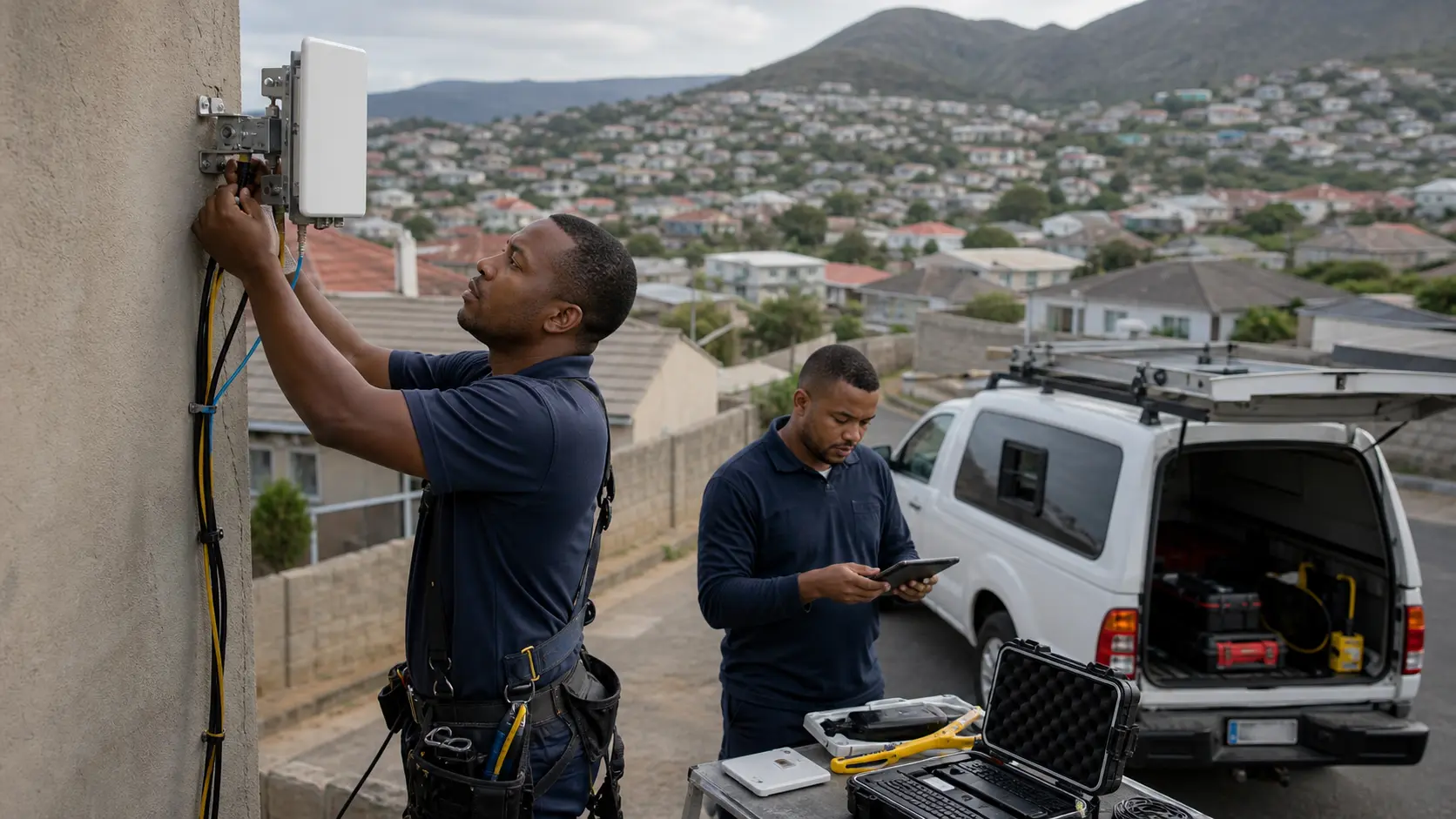
The strongest local-ISP advantage should appear before the first invoice is boring. Hollywood Connect's public pages repeatedly promise help through the installation process. The coverage page at hollywoodconnect.co.za/fibre-coverage asks the user to enter an address, compare deals and sign up. The location pages for Umhlanga, Durban North, Dolphin Coast, Windermere and Morningside walk through the same sequence: check coverage, choose an available package, complete a form, wait for installation if a fibre line is needed, and connect a pre-configured router to the ONT once the line is active.
That sequence is where a regional provider can beat a larger national competitor. A large ISP may have better advertising, automated ordering and scale economics. A local provider can win if it knows which building has a difficult body corporate, which street has repeated trenching delays, which FNO has an activation backlog, which estate needs access permission, and which customers need a technician to explain the router rather than just courier a box. None of those advantages is visible in public tariff cards. They are visible in lower failed-install rates, shorter repeat-visit cycles and fewer cancellation threats before activation.
Hollywood Connect's location pages create a proof claim. In Durban North, the company says a customer with an active fibre line could be up and running in about 24 hours, while a customer needing a fibre line waits for the FNO to schedule installation and may then wait up to five days for line activation. The Umhlanga and Dolphin Coast pages use similar language. A careful reader should not treat those statements as universal guarantees, but they do define the service promise the company must manage. If the actual activation experience often takes longer, the local-access proposition weakens quickly.
Load shedding adds another installation test. Hollywood Connect markets a micro UPS that keeps the router and ONT powered during power outages, and a Wi-Fi extender or mesh device that can cover up to 300 square metres on the homepage. These are not side products. They are part of the South African broadband experience. A fibre line that survives a local power outage is useless if the household router and ONT lose power. A fast line is also disappointing if poor indoor coverage leaves bedrooms, home offices or outbuildings with weak Wi-Fi. Selling and supporting UPS and mesh equipment can lift ARPU, but it also increases support complexity.
A customer whose UPS is undersized, misconnected or left uncharged will still call the ISP.
The article's central test follows from this installation logic: Hollywood Connect matters if it converts local service knowledge into fewer failed installs, fewer first-month faults, better power-resilience advice, and enough router support to keep customers from testing national substitutes. The public record shows the company knows these issues are part of the product. It does not prove the company wins them at scale.
Network proof is strong for routing, medium for local access independence
Hollywood Connect's network evidence deserves a split grade. The routed-resource evidence is strong. AFRINIC RDAP at rdap.afrinic.net/rdap/autnum/329479 confirms AS329479 and lists Hollywood Connect (Pty) Ltd as the registrant. AFRINIC RDAP for 196.2.160.0 shows the range 196.2.160.0 to 196.2.191.255 as allocated PA in South Africa to the same registrant, with a last-changed date in August 2024. RIPEstat's announced-prefixes view for AS329479 shows announcements covering 196.2.160.0/19 and the component /24s through July 9, 2026.
PeeringDB adds exchange evidence. The public API record at peeringdb.com/api/net?asn=329479 identifies Hollywood Connect, the website, open peering policy, 33 IPv4 prefixes, zero IPv6 prefixes in the profile, AS-HOLLYWOOD-CONNECT, one facility count and two IX count. PeeringDB's netixlan data at peeringdb.com/api/netixlan?net_id=37130 shows 10Gbps entries at DINX and NAPAfrica IX Durban. The INX member export at portal.inx.net.za/api/v4/member-export/ixf/1.0 lists Hollywood Connect as AS329479, member since 2023-05-08, with active Durban Internet Exchange connections and route-server participation.
This is not the evidence profile of a mere reseller website with no network footprint. It shows a current autonomous system, current address resources, exchange presence in Durban and at least one visible upstream. Bgp.tools at bgp.tools/as/329479 lists Network Platforms (AS37497) as upstream and shows peers including Cloudflare, Hurricane Electric, Angola Cables, WIOCC, Web Squad, ICTGlobe and Vodacom. Those routing views should not be read as a full resilience audit, but they do show a live network operating surface.
The local-access independence grade is medium, not strong. Hollywood Connect's own customer pages repeatedly depend on FNO availability. The fibre-deals page says prices depend on the fibre-network operator in the area. The provider pages describe Link Layer, Openserve, MetroFibre and Zoom Fibre as infrastructure providers, while Hollywood Connect is the ISP or service provider over them. That model can work well, but it means the customer's installation, physical fault repair and address availability are not fully controlled by Hollywood Connect.
The split grade matters. A customer with a Hollywood Connect IP path may benefit from local peering and a routed network with Durban exchange presence. But a customer waiting for fibre to be installed is still subject to FNO scheduling. A customer whose aerial drop is damaged or whose ONT is offline may need a physical intervention that depends on the underlying network owner. A local ISP's job is to make that dependence feel managed. If it cannot, strong routing proof will not rescue weak access proof.
Upstream dependence is a cost and a resilience question
Hollywood Connect's public routing record suggests a network that is real but still reliant on upstream and peering choices. Bgp.tools lists one upstream, Network Platforms, while PeeringDB and INX show local exchange connections. A single listed upstream does not automatically mean single-path fragility; route collectors are partial, and networks may have private interconnects not visible in one tool. But from public evidence alone, the upstream picture is concentrated enough to be a watchpoint.
For a local access ISP, upstream cost and quality show up in three places. The first is gross margin. The ISP collects a monthly retail price, pays the FNO or access supplier, pays upstream transit or capacity, pays for colocation or exchange presence, pays support and billing labour, and covers router/equipment cost. If upstream or wholesale access is expensive, the apparent retail margin can disappear. The second is user experience. Poor upstream performance can make an otherwise functional fibre line feel slow during peak hours. The third is fault isolation.
When a user says "the internet is down," support has to determine whether the problem is Wi-Fi, router, ONT power, FNO access, authentication, DNS, upstream, peering, destination outage, or customer device.
Local peering helps where traffic is local or cached. DINX and NAPAfrica Durban presence can reduce dependence on long backhaul for some destinations, especially if content networks and local networks exchange traffic nearby. The INX export lists route-server participation at DINX, and PeeringDB lists NAPAfrica IX Durban entries. That is positive. It supports a thesis that Hollywood Connect is not simply hauling every customer bit through a distant generic transit path. But peering also creates operational work: prefix filtering, route-server sessions, monitoring, capacity upgrades, peering policy, IRR/RPKI hygiene, and incident response.
The absence of IPv6 originated prefixes in PeeringDB and bgp.tools is another watchpoint. Many retail customers may not notice today, but modern access networks increasingly need IPv6 readiness for scale, gaming, content delivery, mobile integration and future-proofing. PeeringDB reports zero IPv6 prefixes in the Hollywood Connect profile, while the IX entries include IPv6 addresses on exchange LANs. That combination suggests the network can appear on IPv6 exchange fabric but does not publicly show IPv6 customer prefix origination in the same evidence. This is not a fatal weakness, but it is a practical marker for network maturity.
The facts that would sharpen the upstream analysis are private: transit commit size, peak utilization, upstream redundancy, packet-loss history, DNS resolver performance, RPKI invalid rejection policy, IPv6 rollout plan, and how many customer lines ride each access partner. Without those, the public conclusion should be balanced. Hollywood Connect has credible network resources and local exchange presence. It still has to prove that this translates into stable household experience.
Support labour is not overhead; it is the product
Hollywood Connect's public site leans hard on support. The homepage says expert support teams are available 24/7. The contact page at hollywoodconnect.co.za/get-in-touch gives one number for sales, support and account queries, a WhatsApp number, an email path, and a call-back form. The FAQ explains how to change Wi-Fi passwords, what to do when the customer cannot connect, how to reset the router, how to handle streaming-app problems, how to approach slow connection, and how to request invoices or statements. The code of conduct at hollywoodconnect.co.za/code-of-conduct says complaints are acknowledged within 48 hours and resolved within 14 days, and it repeats minimum service standards drawn from ICASA service-charter expectations.
This labour is economically central. A local access account can be priced only if the support load is understood. A household plan at R635 per month cannot absorb unlimited hand-holding if the same few customers call repeatedly because their mesh system is mispositioned, their ONT loses power, their debit order fails, or the FNO misses an appointment. On the other hand, strong support can be the main reason a customer stays with a smaller ISP. People remember who answered during an outage. A WhatsApp channel can be cheaper than a call centre and more convenient for customers, but only if it is staffed, measured and integrated into ticketing.
The code of conduct also exposes a tension. It cites fixed-service standards such as high service availability averaged over six months, installation within 30 days for residential fixed services, fault clearance within five days for fixed services, and broader performance metrics. Hollywood Connect says it will adhere to those parameters insofar as they apply and subject to events and conduct beyond its reasonable control. It also says services may be wholly or partly dependent on third-party network and other services, and that Hollywood Connect cannot be held liable for failures arising from third-party acts or omissions.
That caveat is realistic, but it shifts the customer-management burden back onto Hollywood Connect. The customer still bought from Hollywood Connect.
The public terms limit liability in several ways, including for service access delays, interruptions, data non-delivery, force majeure, unauthorized account use, errors, third-party issues and interruption. They also say services are provided on an "as is, as available" basis and cannot be guaranteed to be error-free, secure or uninterrupted. This is ordinary telecoms legal drafting, but it matters to the thesis.
If the commercial pitch is "local support and reliable fibre," while the legal text emphasizes third-party dependence and limited liability, the real differentiator must be operational behaviour, not contract language.
Support labour is therefore part of the investment case. Hollywood Connect does not merely list a generic contact form. It publishes support channels, 24/7 claims, complaint processes, activation timing, router troubleshooting steps, billing flows and policy documents. What remains missing is measurement. Public pages do not show ticket volume, first-contact resolution, average speed to answer, after-hours staffing, escalation success with FNOs, install reschedule rate, refund volume, complaint rate per thousand customers, or churn after first fault.
Those facts would determine whether local support is a profit centre, a churn shield, or a hidden cost sink.
Customer chatter is positive but thin
Hollywood Connect's homepage includes three customer reviews naming Vijayan Chetty, Jaq Leonard and Thashvir Rajcoomar. They praise speed, reliability, fast support, quick turnaround and seamless service. These testimonials are directionally useful because they show the company wants the market to judge it on support and installation, not just price. They are not enough to prove broad customer satisfaction. The site does not disclose the review platform, date, sample size, negative-review rate, or whether the comments are representative.
The public Facebook link at facebook.com/hlwconnect and Instagram link at instagram.com/hlwconnect show social presence, but accessible public data reviewed here did not provide a reliable independent review corpus. Afrihost's fibre page, by contrast, makes a large public claim about more than 66,000 Google ratings and an eight-time ISP-of-the-Year positioning. That does not prove Afrihost is better for a particular Durban address, but it shows the kind of reputation scale a local provider competes against.
For Hollywood Connect, the customer signal should be treated as an early market clue rather than a verified outcome. If local customers genuinely experience quick installs, stable throughput and helpful support, the company has an angle. If the visible testimonials are a thin layer over inconsistent operations, the first outage will erase the brand story. Broadband customers often tolerate ordinary pricing when service is calm. They are far less patient when the provider cannot explain whether the fault sits inside the house, on the FNO network, or upstream.
The most valuable unofficial signals would be patterned rather than anecdotal: repeated praise or complaints in local community groups, estate WhatsApp forums, Google reviews, Hellopeter entries, Reddit or MyBroadband forum mentions, and building-specific body-corporate discussions. Those signals require caution because they are noisy and can be manipulated. But for a regional ISP, they often predict churn earlier than formal financials. Local access is a trust business. A handful of bad installation stories in a neighbourhood can raise the cost of every new sale.
The substitute set is broad and unforgiving
Hollywood Connect's substitutes are not only other Durban fibre ISPs. They include national fibre ISPs using the same open-access networks, mobile data, 5G home Wi-Fi, fixed wireless, building-managed internet, satellite where available or legal, and delayed connectivity spend. Each substitute attacks a different part of Hollywood Connect's value proposition.
National fibre ISPs attack trust and automation. Afrihost's fibre page explains that open-access FNOs allow different ISPs to provide service over the same Vumatel, Openserve or MetroFibre network. That means a household may be choosing between Hollywood Connect and a national ISP on the same physical line. If the FNO is the same, the customer's comparison narrows to monthly price, router, installation fee, support quality, billing, cancellation friction, and brand trust. A national ISP may have stronger automation and reputation. Hollywood Connect must answer with local knowledge and practical support.
Mobile and 5G home access attack speed of setup. Rain's homepage sells unlimited 5G home Wi-Fi at R679 per month, month-to-month. Hollywood Connect's own LTE page at hollywoodconnect.co.za/long-term-evolution acknowledges the substitute by offering LTE and 5G wireless broadband using major carrier networks including MTN, Vodacom, Telkom and Rain, with fast setup in 24 to 72 hours and no wait for fibre installation. That is a defensive product as much as an upsell. If fibre installation drags, LTE or 5G can keep the customer from abandoning the provider entirely.
Fixed wireless attacks difficult addresses and businesses that need a fast alternative. Hollywood Connect's wireless page at hollywoodconnect.co.za/wireless markets uncapped wireless connectivity from 10Mbps, starting at R999 per month. For a small business, this can be backup, primary access where fibre is unavailable, or a temporary bridge. But fixed wireless brings its own proof burden: line-of-sight, weather sensitivity, contention, installation quality and support.
Building ISPs attack distribution. A residential building, estate or business park may have a preferred provider or pre-wired network. In those cases, a local ISP has to win not only the end user but also the building owner, managing representative or body corporate. The cheapest customer acquisition is the one embedded in a building process. The most expensive is the one where a resident wants Hollywood Connect but the building's fibre access or permission process pushes them toward another provider.
Satellite attacks the edge case and the future story. Starlink has been a major global broadband story, but formal South African availability has been caught in licensing and empowerment-policy debates. AP reported in early 2026 that South Africa had revised rules to ease requirements for foreign satellite providers such as Starlink, at apnews.com/article/91c9289d2d4f13d5c20decda3c896875. For Hollywood Connect's core Durban-area household, satellite is not the default substitute today. It remains a watchpoint for farms, remote sites, temporary operations and high-income users who value independence from local fixed networks.
Finally, delayed spend attacks every provider. A household can keep using mobile data, borrow a neighbour's Wi-Fi, share a router, return to the office more often, or postpone the installation until moving house. In an inflation-sensitive market, the competitor may be "not yet." Hollywood Connect's micro-UPS, mesh and support bundle can make fibre feel like a household utility rather than a discretionary upgrade. If it cannot, the customer may wait.
Business connectivity can raise ARPU but also raises standards
Hollywood Connect does not present itself only as a home-fibre retailer. The fibre-to-business page at hollywoodconnect.co.za/fibre-to-business describes business fibre for SMEs through large enterprises, remote and hybrid teams, cloud services, VoIP, VPNs, data backups, retail outlets, call centres and corporate offices. It says business fibre can include symmetrical speeds, guaranteed uptime, 24/7 monitoring with SLAs and priority support, low latency, scalable bandwidths from 10Mbps to 1Gbps-plus, nationwide reach through FNO partners, site assessment and installation handling.
This is a higher-ARPU opportunity, but the proof burden is higher too. A household may accept occasional inconvenience if support is friendly and the price is fair. A business using cloud applications, VoIP, payments or backups needs predictable escalation. If Hollywood Connect sells guaranteed uptime or priority support, it needs monitoring, ticket discipline, after-hours escalation, backup access options, supplier SLAs and service-credit logic. Public copy does not disclose the actual SLA terms, uptime history or business customer base.
The business offer also interacts with the company's routed network. AS329479, local exchange participation and prefix resources matter more to business customers than to casual households, especially if static IPs, VPNs, VoIP and cloud applications are part of the package. Hollywood Connect's FAQ says static IP addresses are available on request and VoIP is offered as a cloud-hosted service through Hollywood Connect VoIP and the Holly Voice App. That broadens the account from "internet pipe" to communications service. It also expands compliance, support and abuse-handling responsibilities.
Business connectivity can improve economics if customers pay more, churn less and buy backup products. It can damage economics if small business customers demand enterprise-grade response on consumer-grade margins. The question is segmentation. Hollywood Connect needs to know which accounts deserve priority support, which are profitable after FNO and upstream costs, and which require custom design. A small retail customer at R999 wireless or a fibre business customer on an SLA is not the same economic unit as a R635 household plan.
Regulation and policy make the service legible
Hollywood Connect's public policy documents make the service more legible. The terms, acceptable-use policy, privacy policy, code of conduct and outages page all show that the company is operating inside the South African electronic-communications framework. The acceptable-use policy at hollywoodconnect.co.za/policies/acceptable-usage says Hollywood Connect provides ECNS, ECS and associated support services, and that the AUP exists to protect service integrity, customers, network infrastructure and compliance with South African law. It lists unlawful content, spam, security abuse, network attacks, malware, privacy violations, excessive use controls, suspension and termination.
This policy surface matters because broadband providers inherit customer behaviour. Abuse complaints, copyright takedowns, botnet traffic, hacked routers, spam and fraud all create operating work. A small ISP with its own ASN and address resources cannot ignore abuse handling. Poor abuse hygiene can lead to blacklisting, upstream tension or support cost. The public AUP does not prove Hollywood Connect handles abuse well, but it gives the contractual basis for doing so.
The outages page at hollywoodconnect.co.za/outages is also worth noting. When reviewed, it displayed "All Networks are Stable" and no current network issues. A public status page is valuable only if it is kept current. If customers trust it, it can reduce repeated support contacts during incidents. If it is stale, it becomes a source of frustration. The page should be watched over time for whether it records real maintenance and outages or simply remains a calm marketing panel.
Billing and complaints are another part of the public contract. The FAQ says debit order is the preferred payment method and that customers can pay via EFT or credit card through the client zone. The terms say monthly recurring charges are payable monthly in advance and discuss non-payment, suspension, reconnection fees and billing disputes. The code of conduct says billing complaints follow a structured process, while ICASA escalation is available after the provider has a chance to resolve the issue. These details affect churn and cash collection.
Broadband margins can be damaged by bad debt, failed debit orders and repeated billing disputes just as much as by upstream cost.
What the public record does not show
The public record is strong enough to identify Hollywood Connect's surface, but not strong enough to value the business. There is no public subscriber count. There is no disclosed revenue. There is no ARPU. There is no wholesale cost per FNO. There is no line-count split by Openserve, MetroFibre, Link Layer, Zoom, wireless and LTE. There is no churn. There is no installation success rate. There is no mean time to repair. There is no support staffing or queue data. There is no traffic peak, capacity graph, route leak history, DDoS handling story or customer NPS.
Those missing facts are not minor. They decide whether a local access account is profitable. A R635 residential plan may look attractive until the first-year router, installation, wholesale access, payment failure, support calls and cancellation clawback are considered. A R1,035 plan may look stronger, but heavy users may consume more support and capacity. Business fibre can lift ARPU, but only if SLA costs are priced correctly. LTE backup can reduce churn, but only if carrier wholesale terms leave margin.
The public record also does not show whether Hollywood Connect's local brand has enough independent pull. The site footer ties the service to Hollywoodbets, but the broadband pages do not disclose acquisition economics. If customers arrive through brand trust and local promotion, customer-acquisition cost may be low. If the brand merely creates curiosity and paid search still does the work, the economics may look different. A familiar brand can open the door, but broadband retention is earned after installation.
The strongest version of the Hollywood Connect thesis is this: a Durban-region ISP with its own ASN, local exchange presence, public fibre tariffs, FNO partnerships, 24/7 support posture and local contact channels can defend a niche if it manages the messy work between address check and renewal better than national substitutes. The weakest version is this: a small retail layer over open-access FNOs, exposed to large ISP competition, mobile substitution, concentrated upstream evidence, unknown churn and support-cost risk, with speed claims that any competitor can match.
Watchpoints that would change the judgement
The first watchpoint is installation proof. Hollywood Connect should be judged on time from order to activation, failed appointments, first-month tickets, and the proportion of customers live within the promised windows. A provider that consistently connects active-line customers within 24 hours and handles new-line customers cleanly can justify local trust. A provider that repeatedly misses the first installation experience will lose the renewal before month two.
The second watchpoint is support response. Public 24/7 claims are valuable only if they map to staffed channels. The useful facts are median time to first response, after-hours resolution share, repeat-contact rate, WhatsApp backlog, ticket escalation time to FNO partners, and fault closure within ICASA-style service windows. Local support labour is a moat only when it is measured and managed.
The third watchpoint is upstream resilience. Public routing data is positive, but investors and sophisticated customers would want upstream redundancy, peak utilization, DDoS protection, routing-security posture, IPv6 plan and local cache/peering strategy. Durban exchange presence is a real asset if traffic engineering uses it well. It is less valuable if customer traffic routinely leaves the region because of capacity, policy or upstream constraints.
The fourth watchpoint is churn after clawback expiry. Free installation and router offers can hold customers through the first year, but the real retention test begins when the clawback concern fades. If customers stay because support is good and performance is stable, Hollywood Connect has durable value. If churn rises as soon as the first-year friction drops, the account is less defensible.
The fifth watchpoint is the substitute mix. Rain's R679 5G home price sits close to Hollywood Connect's entry fibre plan. National fibre ISPs can sell on the same FNOs. LTE can be activated faster. Business wireless can bridge sites. Satellite could become more relevant if licensing changes. A regional ISP must know which substitute is beating it in each neighbourhood and why.
The sixth watchpoint is product discipline. Micro UPS, mesh, VoIP, static IP, business fibre, wireless and LTE can all raise ARPU and reduce churn. They can also create support complexity and inventory risk. The right bundle depends on customer segment. A remote worker may need UPS and static IP. A streaming household may need mesh. A small business may need LTE failover. Selling all of these without segment discipline can make support expensive.
The final judgement
Hollywood Connect is more credible than a thin web listing. It has a public South African company identity, consumer-facing tariffs, local pages, support channels, terms and policy documents, active ASN proof, current announced prefixes, AFRINIC registration, PeeringDB profile data, Durban exchange presence and an outage/status page. The network-resource evidence grade is strong for routed resources and exchange participation. The access-control grade remains medium because the customer-facing fibre product depends heavily on third-party FNOs and address-level availability.
That split should guide the investment and editorial view. Hollywood Connect should not be dismissed as a generic reseller, because AS329479 and the Durban exchange evidence show real network operating surface. It should not be promoted as a fully proven local infrastructure owner either, because its own pages describe an open-access FNO model and supplier dependence. The company sits in the middle: a regional access account with real network resources, real local service promises, and real exposure to installation and support execution.
The speed claim is the easiest part to copy. The harder part is making the account uneventful. If Hollywood Connect can make activation predictable, keep routers and ONTs powered through ordinary outages, answer WhatsApp and phone channels fast, escalate FNO faults with authority, use Durban peering well, price business support properly and keep customers after the first-year clawback period, it can hold a defensible local niche. If it cannot, the same customer can choose a national fibre ISP, a 5G home router, fixed wireless, a building provider, a future satellite option, or no new spend at all.
For now, the public record supports a cautious positive reading. Hollywood Connect is worth tracking because it shows the modern regional-ISP problem in one small account: local trust and support have value, but only when they convert the messy parts of broadband into a stable monthly relationship.
Sources
- Hollywood Connect homepage: https://www.hollywoodconnect.co.za/
- Hollywood Connect fibre deals: https://www.hollywoodconnect.co.za/fibredeals
- Hollywood Connect coverage checker: https://www.hollywoodconnect.co.za/fibre-coverage
- Hollywood Connect FAQ: https://www.hollywoodconnect.co.za/faqs
- Hollywood Connect contact page: https://www.hollywoodconnect.co.za/get-in-touch
- Hollywood Connect terms: https://www.hollywoodconnect.co.za/terms-conditions
- Hollywood Connect acceptable-use policy: https://www.hollywoodconnect.co.za/policies/acceptable-usage
- Hollywood Connect code of conduct and service charter: https://www.hollywoodconnect.co.za/code-of-conduct
- Hollywood Connect outages page: https://www.hollywoodconnect.co.za/outages
- Hollywood Connect Link Layer package page: https://www.hollywoodconnect.co.za/fibre-home-deals/fno/linklayer
- Hollywood Connect Openserve package page: https://www.hollywoodconnect.co.za/fibre-home-deals/fno/openserve
- Hollywood Connect MetroFibre package page: https://www.hollywoodconnect.co.za/fibre-home-deals/fno/metrofibre
- Hollywood Connect Zoom/Vox package page: https://www.hollywoodconnect.co.za/fibre-home-deals/fno/zoomfibre
- Hollywood Connect fibre-to-business page: https://www.hollywoodconnect.co.za/fibre-to-business
- Hollywood Connect wireless page: https://www.hollywoodconnect.co.za/wireless
- Hollywood Connect LTE page: https://www.hollywoodconnect.co.za/long-term-evolution
- Umhlanga location page: https://www.hollywoodconnect.co.za/locations/umhlanga
- Durban North location page: https://www.hollywoodconnect.co.za/locations/durban-north
- Dolphin Coast location page: https://www.hollywoodconnect.co.za/locations/dolphin-coast
- Windermere location page: https://www.hollywoodconnect.co.za/locations/windermere
- Morningside location page: https://www.hollywoodconnect.co.za/locations/morningside
- AFRINIC RDAP AS329479: https://rdap.afrinic.net/rdap/autnum/329479
- AFRINIC RDAP 196.2.160.0/19 allocation: https://rdap.afrinic.net/rdap/ip/196.2.160.0
- RIPEstat announced prefixes for AS329479: https://stat.ripe.net/data/announced-prefixes/data.json?resource=AS329479
- PeeringDB network API for AS329479: https://www.peeringdb.com/api/net?asn=329479
- PeeringDB IX-LAN entries for Hollywood Connect: https://www.peeringdb.com/api/netixlan?net_id=37130
- INX member export: https://portal.inx.net.za/api/v4/member-export/ixf/1.0
- Bgp.tools AS329479 page: https://bgp.tools/as/329479
- Afrihost fibre page: https://www.afrihost.com/fibre
- Rain homepage: https://www.rain.co.za/
- DataReportal Digital 2026 South Africa: https://datareportal.com/reports/digital-2026-south-africa
- AP report on South Africa satellite-provider rules: https://apnews.com/article/91c9289d2d4f13d5c20decda3c896875