
Summary
- Hispamar's defensible role is not generic satellite broadband; it is the Brazilian operating and regulatory surface through which Hispasat turns 61 West and 74 West geostationary capacity, ground-control redundancy, spectrum rights and enterprise support into usable links for remote schools, mobile backhaul, offshore sites, mobility and resilient corporate networks.
- The evidence supports durable remote-demand economics where fibre buildout is slow, too expensive or too fragile, but it also shows why Hispamar must keep proving its premium against fast-growing fibre, 4G, 5G fixed wireless, Starlink-style low-earth-orbit service, SES-backed public programs and other satellite capacity authorized by Anatel.
- The investment case is clearest when satellite megahertz is priced as availability, policy reach and operational assurance rather than as cheap retail bandwidth. The risk is that customers treat that same capacity as a stopgap once terrestrial alternatives or lower-latency LEO offers become good enough.
The site that cannot wait for fibre
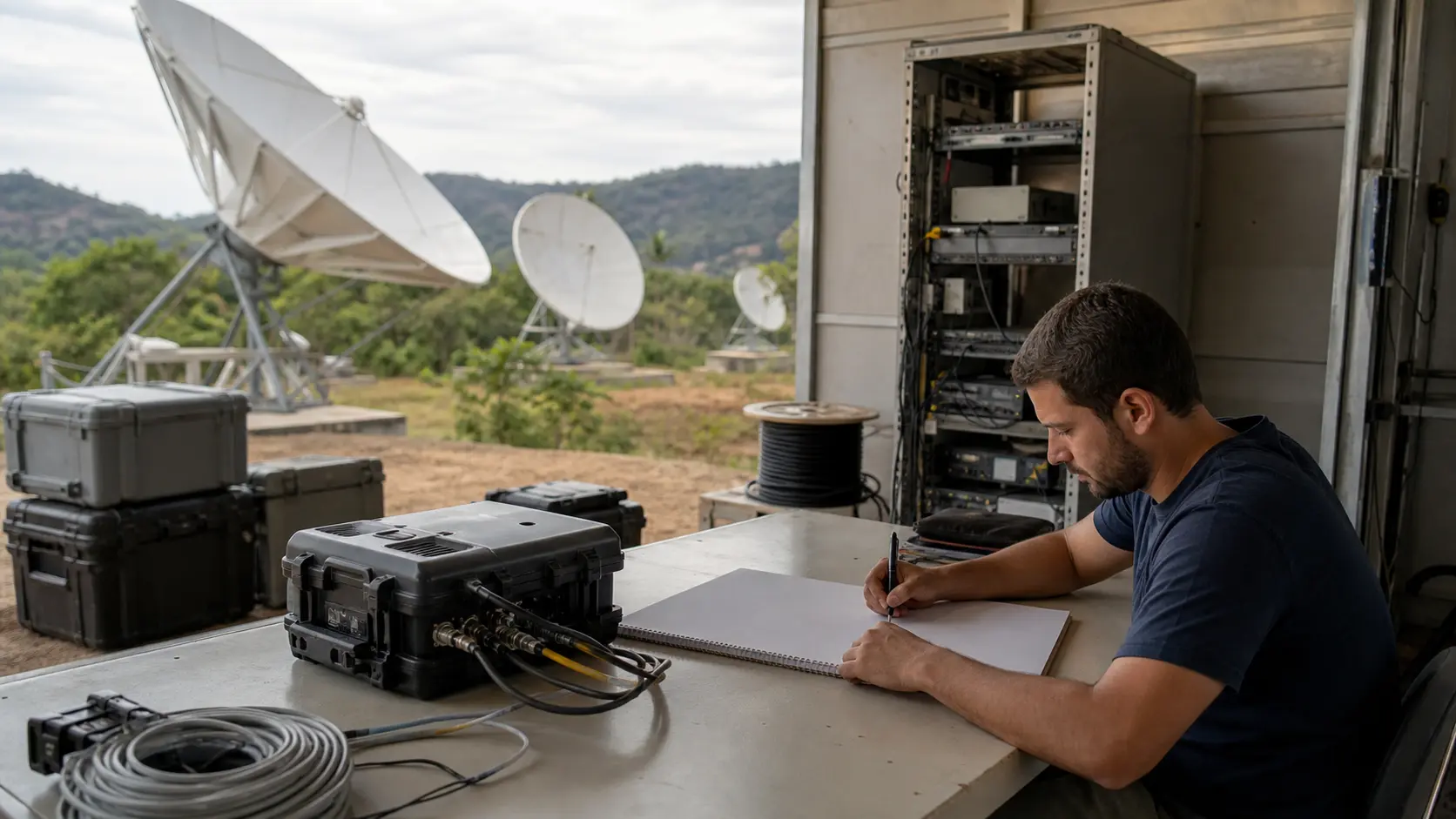
The useful way to understand Hispamar Satelites S/A is to start far from a satellite industry conference. Imagine a clinic on a river route in the North, a rural school that needs a national learning platform, a mobile tower serving a thin road corridor, an offshore energy platform, a border post, a television contribution point, or a corporate camp that only becomes visible to the rest of Brazil through a dish, power system, local installer and service desk. The buyer is not asking whether space is impressive.
The buyer is asking whether the monthly bill buys enough certainty to justify capacity that is usually more expensive than terrestrial broadband and still exposed to weather, equipment logistics and service discipline.
That buyer has three choices. The first is to wait for fibre. Waiting can be rational if a regional ISP, a utility corridor or a mobile operator is already nearby and the site can tolerate delay. The second is to buy a mobile or fixed wireless alternative and accept whatever coverage, contention and power reality exists. The third is to buy satellite capacity because the site needs connectivity before the terrestrial business case matures. Hispamar's economics sit in the narrow but important space where the third choice is not romantic. It is the price of making a remote operating unit usable.
Brazil has plenty of evidence that the terrestrial alternative is expanding. TeleSintese, citing Anatel, reported that Brazil ended 2025 with about 53.9 million fixed-broadband accesses, up from roughly 52.5 million in 2024, and that fibre represented about 79% of fixed-broadband connections (https://telesintese.com.br/quem-lidera-a-banda-larga-no-brasil-segundo-a-anatel/). That is the pressure on every satellite operator serving ordinary broadband demand. Fibre is not a future slogan in Brazil; it is the dominant access technology in the measured fixed market. Any Hispamar sales argument that assumes rural or enterprise demand will remain captive is too weak.
The counterpoint is that national averages hide the places where the economics of trenching, poles, backhaul, power and maintenance still break. The 2024 ICT Households survey by Cetic.br and NIC.br found that the highest level of meaningful connectivity was much less prevalent in rural areas than in urban areas, and that the North and Northeast remained weaker than the South and Southeast on the same scale (https://cetic.br/media/docs/publicacoes/2/20250512115121/e-book_ict_households_2024.pdf). ITU's account of Brazil's school-connectivity strategy said the country was trying to connect about 140,000 state-run schools by the end of 2026, while about 8,000 still lacked any internet access when the strategy was launched and many more missed quality targets, with Amazon and rural challenges specifically called out (https://www.itu.int/hub/2023/11/brazils-new-strategy-aims-for-internet-in-all-schools-2/). These are not Hispamar customers by default, but they define the terrain in which satellite remains economically relevant.
The article's question is therefore not whether satellite can technically connect Brazil. That is settled. Hispasat's Amazonas fleet and rival systems can cover vast regions. The better question is whether public filings, fleet records, regulator decisions and customer signals show that remote demand is durable enough to support a specialist Brazilian satellite operator even as fibre, 4G, 5G fixed wireless and LEO constellations improve. The answer is mixed but not empty. Hispamar has a real operating surface in Brazil, anchored by regulatory rights, control facilities, Ka/Ku/C-band fleet resources and commercial examples.
It also has to sell against substitutes that have become more credible than they were when geostationary satellite was the obvious rural answer.
This makes Hispamar a pricing story. A buyer does not only buy megahertz. The buyer pays for a chain: space-segment capacity, gateway reach, local dish and modem logistics, network operations, field maintenance, rain-fade planning, spectrum coordination, Brazilian regulatory permissions, backhaul into a usable terrestrial core, billing, service support and contract accountability. If any link in that chain is weak, the satellite link becomes an expensive disappointment.
If the chain works, the link can be cheaper than waiting years for a terrestrial project that may not arrive, or cheaper than losing revenue, learning time, safety coverage or operational continuity during an outage.
What Hispamar actually controls
The company should be understood as the Brazil-facing operating company, not as a proxy for every satellite, spectrum filing or ground facility around it. Hispasat describes HISPAMAR as its Brazilian subsidiary and says it operates satellites at the Brazilian 61 West and 74 West orbital positions while also marketing Hispasat's system over the Atlantic (https://www.hispasat.com/en/press-room/press-releases/archivo-2019/367/hispamar-starts-operating-from-its-new-teleport-and-satellite-control-centre-in-serviente-rio-de-janeiro). That description is the important starting point. Hispamar is the local institutional surface through which a Spanish-led satellite group participates in Brazilian regulation, customers and operations.
The company's roots also matter. A 2016 Hispasat release described HISPAMAR Satelites as a joint venture formed by Hispasat and Oi (https://www.hispasat.com/en/press-room/press-releases/archivo-2016/218/clovis-jose-baptista-neto-appointed-as-chairman-of-hispamar-satelites). Later trade reporting said Oi sold its Hispamar stake to Hispasat, while noting a fleet around Amazonas 2, 3 and 5 and the planned Amazonas Nexus (https://www.telecompaper.com/news/oi-sells-hispamar-stake-to-hispasat--1410600). For a buyer, the ownership story is less important than the commercial effect: Hispamar has long operated as a Brazil-facing satellite capacity provider rather than as a local ISP that happens to resell one dish package.
The operational centrepiece is Serviente, Rio de Janeiro. Hispasat said in 2019 that Hispamar's new teleport and satellite control centre at Serviente would monitor and operate satellites at 74 West and 61 West, with connections to Arganda del Rey in Spain and Guaratiba as backup for redundancy and security (https://www.hispasat.com/en/press-room/press-releases/archivo-2019/367/hispamar-starts-operating-from-its-new-teleport-and-satellite-control-centre-in-serviente-rio-de-janeiro). The same release linked that facility to remote education, corporate networks, mobile backhaul and high-performance connectivity through Amazonas 5 Ka HTS capacity. This is more than branding. A satellite operator without a credible ground-control and customer-support surface is selling a promise from orbit; Hispamar's claim is that it can make the orbit usable from Brazil.
Regulatory control is the next part of the surface. Anatel's satellite authorization page points users to panels for authorized satellites and rights of exploitation in Brazil, including launch dates, right-expiry dates, legal representatives and documents for spectrum and orbital resources (https://www.gov.br/anatel/pt-br/regulado/satelite/satelites-autorizados). In 2017, Anatel said Hispamar would pay R$63,625,223.36 to renew for 15 more years a national satellite exploitation right first obtained in 2000, with the extension running to 2 October 2030 (https://www.gov.br/anatel/pt-br/assuntos/noticias/hispamar-devera-pagar-r-63-milhoes-para-renovar-exploracao-de-satelite). That number is a useful economic signal. Before a remote site sees a signal, the operator has paid for the right to make Brazilian orbital and spectrum resources commercial.
Older Anatel documents for foreign satellite exploitation show how detailed those permissions can be. A 2011 Anatel term for Amazonas 2 identified Hispasat S/A with Hispamar Satelites S/A as its Brazilian legal representative, listed frequency ranges for the 61 West satellite, set a term ending in October 2024 and stated a monetary value for the right and associated frequencies (https://www.anatel.gov.br/Portal/verificaDocumentos/documento.asp?assuntoPublicacao=TERMO+DE+DIREITO+DE+EXPLORA%C3%87%C3%83O+DE+SAT%C3%89LITE+PVSS%2FSPV%2FN.+02%2F2011&caminhoRel=Cidadao-Biblioteca-Acervo+Documental&do=&filtro=1&numeroPublicacao=260086). The point is not that a 2011 document defines today's commercial opportunity. The point is that satellite economics in Brazil are a regulated rights business before they are a customer-acquisition business.
Hispamar's product surface is therefore a bundle. Hispasat's own backhaul page presents satellite cellular backhaul as a way to extend mobile network coverage where fibre or microwave is unavailable or too expensive, with business models ranging from space capacity to managed capacity and turnkey models (https://www.hispasat.com/en/products-and-solutions/telecommunications/backhaul-celular). That language maps directly to Hispamar's economic problem in Brazil. The company can sell raw capacity, managed capacity or a complete project. The higher the wrapper, the more labour, equipment and support risk it absorbs; the lower the wrapper, the easier it is for customers to compare capacity by price.
The fleet is capacity evidence, not the company
The satellites themselves are evidence about Hispamar's addressable service surface, not separate company subjects. The 61 West orbital position is central because it carries multiple Amazonas resources aimed at the Americas and Brazil. Hispasat says Amazonas 2 launched in 2009 and carried 64 transponders, 54 in Ku band and 10 in C band, with pan-American coverage and a 15-year design life (https://www.hispasat.com/en/fleet-and-infrastructure/satellite-fleet/amazonas-2). Amazonas 3, launched in 2013, is listed at 61 West with 33 Ku-band transponders, 19 C-band transponders and 9 Ka-band spot beams; Hispasat says it was the first satellite to provide Ka band to Latin America and linked that capability to broadband and universalization in difficult-to-access areas (https://www.hispasat.com/en/fleet-and-infrastructure/satellite-fleet/amazonas-3).
Amazonas 5 added a sharper broadband angle. Hispasat's fleet page says Amazonas 5, also at 61 West, was built by SSL with a 15-plus-year life, 24 Ku-band transponders for Brazil and the rest of Latin America, and 34 Ka-band spot beams across the region (https://www.hispasat.com/en/fleet-and-infrastructure/satellite-fleet/amazonas-5). In 2018, Hispasat and Gilat announced a Brazil-focused partnership under which Hispamar would use Amazonas 5 multi-spot-beam Ka capacity, as well as Amazonas 3 Ka capacity, while leveraging Gilat's SkyEdge II-c platform, VSAT equipment, network operations centre and field support services (https://www.hispasat.com/en/press-room/press-releases/archivo-2018/341/hispasat-and-gilat-partner-to-commercialize-high-throughput-satellite-hts-capacity-of-amazonas-3-and-5-satellites-over-brazil). That release is valuable because it reveals the true cost stack. Capacity without terminals, NOC capability and field support is not a service.
Amazonas Nexus is the more recent capacity bet. Redeia's 2023 launch release described it as a high-performance geostationary satellite for air and maritime mobility, high-speed internet across the Americas and the North-South Atlantic corridors, and remote places including Greenland and the Amazon rainforest (https://www.redeia.com/en/press-office/news/press-release/2023/02/hispasat-inaugurates-a-new-era-in-satellite-communications-with-amazonas-nexus). The same release placed the satellite at 61 West after orbit raising and in-orbit testing, cited a roughly EUR300 million project cost, and said Hispasat had reached long-term lease agreements for 60% of capacity with operators and service providers in government, aviation connectivity and remote environments. Redeia later said Amazonas Nexus became operational in July 2023 (https://www.redeia.com/en/press-office/news/pres-release/2023/07/amazonas-nexus-is-already-operational-hispasat-has-begun-a-new-era-in-communications).
This is the strongest evidence that Hispamar's addressable market is not only village broadband. Hispasat and Intelsat announced in 2023 an expanded agreement under which Intelsat would lease the entire Amazonas Nexus capacity available over the United States and Brazil, plus significant North Atlantic corridor capacity, for inflight connectivity and related services (https://www.hispasat.com/en/press-room/press-releases/archivo-2023/467/hispasat-and-intelsat-expand-their-strategic-agreement-to-provide-inflight-connectivity-through-amazonas-nexus). A remote Brazilian site may be the article's opening buyer, but the satellite economics also depend on aviation, maritime, government, cellular backhaul and integrator demand sharing the same capital burden.
The 74 West position adds a second Brazilian orbital surface. Hispasat says Hispasat 74W-1, built on Orbital Sciences' Geostar 2.4 platform and launched in 2014, has 24 Ku-band transponders and provides additional space capacity in Latin America for television and communications services (https://www.hispasat.com/en/fleet-and-infrastructure/satellite-fleet/hispasat-74w-1). Hispasat also said in 2015 that, through Hispamar, it had gained the right to exploit Ku band at the Brazilian 74 West orbital position (https://www.hispasat.com/en/press-room/press-releases/archivo-2015/175/hispasat-gains-rights-to-exploit-new-orbital-position-in-brazil). Again, the useful interpretation is not that a satellite is a company. The useful interpretation is that Hispamar's local regulatory and commercial position is tied to a portfolio of orbital and frequency assets that can be matched to different demand types.
The economic limitation is just as clear. Geostationary capacity has a different latency profile than terrestrial fibre or LEO broadband. Ka-band spot beams can create more efficient frequency reuse, but they also need careful gateway, weather and terminal planning. Ku and C bands remain relevant for broadcast, enterprise and resilience, but a buyer comparing a remote link in 2026 is also comparing Starlink, SES-17, O3b/mPOWER-style MEO service, fixed wireless and future Kuiper or SpaceSail offers. Hispamar's fleet evidence proves capacity and coverage; it does not by itself prove pricing power.
Ground operations are where the margin is earned
A satellite link looks simple from the customer side because the visible object is often a dish. The hidden cost is everything around that dish. Hispamar's Serviente operation, the Arganda and Guaratiba redundancy claims, the Gilat NOC and field-support partnership, and Hispasat's product pages all point to the same margin reality: the operator earns trust by making the remote link feel boring. The customer wants a working connection when rain hits, a modem fails, a school term begins, a mobile tower needs more capacity, or a corporate site moves equipment across a poor road.
Rain resilience is not an abstract issue in tropical Brazil. Ka-band capacity is attractive because spot beams can offer high throughput and frequency reuse, but higher-frequency links require disciplined planning around fade, power, antenna size, site engineering and service-level expectations. A buyer using satellite for a school lab can accept a different service envelope from an offshore energy operation, a border post or an emergency command site.
The same megahertz may have very different economic value depending on whether the customer's alternative is a slow ADSL line, a microwave hop, a riverboat maintenance trip, a mobile cell with congested backhaul, or no service at all.
That is why managed and turnkey models matter. Hispasat's cellular backhaul page explicitly separates space capacity, managed capacity and turnkey models (https://www.hispasat.com/en/products-and-solutions/telecommunications/backhaul-celular). The difference is commercial risk allocation. In a raw-capacity sale, the buyer or integrator owns much of the terminal and service outcome. In a managed model, Hispamar and its partners must coordinate capacity, quality, equipment, field labour and escalation. In a turnkey model, the operator's selling point is speed and accountability, but its cost base includes more people and logistics.
The 2018 Gilat partnership is therefore more important than it first appears. It named a multi-service platform, VSAT equipment, a network operations centre and field support services, not just a satellite beam (https://www.hispasat.com/en/press-room/press-releases/archivo-2018/341/hispasat-and-gilat-partner-to-commercialize-high-throughput-satellite-hts-capacity-of-amazonas-3-and-5-satellites-over-brazil). That is exactly the chain a Brazilian remote-site buyer needs. A municipal customer, ISP, enterprise or mobile operator rarely wants to become a satellite systems integrator. It wants service delivered at a known cost and under a known operating model.
The Serviente control centre also changes the trust calculation. Hispasat said the centre would monitor and operate 61 West and 74 West satellites, with backup through Guaratiba and a connection to Arganda del Rey (https://www.hispasat.com/en/press-room/press-releases/archivo-2019/367/hispamar-starts-operating-from-its-new-teleport-and-satellite-control-centre-in-serviente-rio-de-janeiro). For a buyer of critical links, redundancy is not decoration. It is part of why a service has a premium. It reduces the fear that a single local site failure becomes a national customer failure. The article does not assume the redundancy performs perfectly; it treats the public architecture as evidence that Hispamar understands the operational promise it is selling.
The ground segment is also where competitors can attack. SES said its Telebras project uses SES-17 through a new gateway in Hortolandia, Brazil, with SES responsible for network operation and maintenance including satellite, gateways and remote sites (https://www.ses.com/press-release/telebras-and-ses-implemented-more-1500-internet-access-points-brazils-northern-region). That is a direct lesson for Hispamar. Brazil's remote-connectivity market rewards not only orbital coverage, but ground infrastructure, installed-base management and local execution. Customers do not care which operator has the most elegant fleet slide if another provider can install faster, monitor better and keep service running with less friction.
Demand signals point to a real but segmented market
The strongest demand signals for Hispamar are not ordinary household broadband ads. They are public programs, school connectivity, mobility, offshore oil and gas, cellular backhaul, broadcast distribution, corporate resilience and integrator contracts. Hispasat's 2024 annual report says that in Brazil it signed a partnership with the Brazilian government to collaborate on connectivity for rural schools and health centers, which would result in several hundred connected sites (https://www.hispasat.com/informe-anual-2024/actividades/?lang=en). The report also says capacity from various Hispasat satellites in C and Ku bands leased to Brazilian ISPs and integrators for offshore oil and gas connectivity increased significantly. These are concrete market signals because they align with the sites where terrestrial economics are least forgiving.
The same annual report says Hispasat signed memoranda of understanding in 2024 with Brazil, Colombia and Paraguay to explore different cooperation models for bridging the digital divide through satellite use, and that the Brazilian work considered satellite infrastructure to reduce digital, educational and healthcare gaps in remote and disadvantaged areas, including the possibility of connecting 140,000 rural schools (https://www.hispasat.com/informe-anual-2024/actividades/?lang=en). That is not the same as booked revenue. It is a government-facing opportunity signal. It shows that Hispasat and Hispamar are trying to position geostationary satellite as an infrastructure tool for state policy, not only as a retail broadband product.
There are smaller but revealing customer signals. In 2020, Hispasat and EasyTV announced the first 50 WiFi satellite hotspots in Brazilian communities lacking connectivity, using Facebook Connectivity's Express WiFi platform and Amazonas 5 Ka-band coverage; the release said another 50 hotspots were underway in the North and Northeast interior and named a goal of expanding toward 3,000 hotspots (https://www.hispasat.com/en/press-room/press-releases/archivo-2020/396/hispasat-rolls-out-the-first-50-wifi-satellite-hotspots-together-with-easytv-to-bring-internet-access-to-remote-areas-in-brazil). The scale of the first phase was modest. The value is that it shows how satellite can enter through a partner and local access layer rather than through a direct household sale.
Education has been another recurring theme. Hispasat said in 2019 it distributed remote-learning content to more than 700 points in Kroton's educational network in Brazil, again using the satellite link as a service mechanism rather than as a standalone consumer proposition (https://www.hispasat.com/en/press-room/press-releases/archivo-2019/363/hispasat-distribuye-contenidos-de-tele-ensenanza-a-mas-de-700-puntos-de-la-red-educativa-de-kroton-en-brasil). This matters because education sites can justify satellite when synchronized content, platform access or administrative systems need reach across locations that do not all have equal fibre options. The economics are not the same as a household streaming plan.
The competitor evidence actually strengthens the demand case while weakening Hispamar's exclusivity. SES and Telebras said in November 2024 that they had implemented more than 1,500 sites across public institutions, schools, libraries, telecentres, health units, Indigenous villages and rural settlements in Brazil's Northern Region, and that the GESAC program had more than 15,000 free internet points in operation since its creation in 2002 (https://www.ses.com/press-release/telebras-and-ses-implemented-more-1500-internet-access-points-brazils-northern-region). This proves there is demand for satellite-backed public connectivity in the exact geographies Hispamar cares about. It also proves that Hispamar is not the only credible supplier.
The demand picture is therefore segmented. Ordinary households and small businesses may choose fibre or Starlink if available and affordable. Schools, public sites and health centers may choose a state-backed program or procurement package. Mobile operators may buy backhaul if a site needs coverage before terrestrial backhaul can be justified. Offshore and energy customers may pay for resilience and support because downtime is expensive. Aviation and maritime customers may buy through global integrators such as Intelsat.
Hispamar's opportunity is to match its capacity and local rights to the segments where a managed satellite link solves a time, geography or resilience problem that cheaper connectivity does not solve.
The substitutes are no longer theoretical
Every durable satellite thesis in Brazil has to confront substitution. Fibre is the first substitute because it wins on latency, capacity and long-term unit cost wherever deployment economics work. TeleSintese's Anatel-based fixed-broadband article shows the size of that market and the dominance of fibre (https://telesintese.com.br/quem-lidera-a-banda-larga-no-brasil-segundo-a-anatel/). Mobile networks and fixed wireless are the second substitute. A rural school or enterprise may not need satellite if a mobile operator can deliver a usable 4G/5G fixed wireless link with local maintenance and enough backhaul.
LEO is the third and most visible substitute. In April 2025, Anatel approved an alteration to Starlink's Brazilian satellite exploitation right, allowing Starlink to add 7,500 satellites to operate in Brazil while maintaining the original term to 2027; the same decision issued a regulatory alert about competition, space sustainability and digital sovereignty risks that current rules did not fully address (https://www.gov.br/anatel/pt-br/assuntos/noticias/anatel-aprova-alteracao-do-direito-de-exploracao-do-sistema-starlink-e-emite-alerta-regulatorio). That single decision changes the psychological market. A customer comparing satellite service now thinks about low-earth-orbit latency, user-terminal availability and retail activation speed, not only about geostationary capacity.
Anatel's 2026 act on priority and protection criteria for non-geostationary satellite systems lists O3b, Kepler, OneWeb, Kuiper, Telesat Lightspeed, Starlink, SpaceSail and AST across Ku/Ka and Q/V bands (https://informacoes.anatel.gov.br/legislacao/component/content/article/173-atos-complementares-de-regulacao/2129-ato-3084). The details are technical, but the business signal is straightforward: Brazil is regulating a crowded non-geostationary future. Hispamar cannot assume that the remote-connectivity shelf will be empty. It has to compete in a market where customers may combine GEO, MEO, LEO, fibre and wireless depending on site and use case.
That does not make Hispamar obsolete. LEO systems can be powerful but may raise questions about national policy, enterprise support, bulk procurement, service control, terminal supply, data routing, bandwidth management and long-term regulatory posture. GEO systems can be weaker on latency but stronger where customers need managed capacity, broadcast reach, predictable coverage, established integrator relationships, government procurement wrappers or compatibility with existing VSAT fleets. Hispasat's 2024 report says the group has already deployed multi-orbit GEO-LEO services in maritime and other corporate verticals such as oil and gas and energy (https://www.hispasat.com/informe-anual-2024/actividades/?lang=en). That is an implicit admission that the winning product may be a managed mix, not a single-orbit doctrine.
The competitive question is how much price premium remains for Hispamar when alternatives improve. A remote school that needs basic internet may prefer the cheapest compliant service. A mobile operator may prefer satellite backhaul only until traffic volumes justify fibre or microwave. An offshore customer may value specialized service more than headline throughput. An aviation customer may buy through Intelsat's long-term arrangement rather than through a Brazil-specific channel. A government buyer may care about sovereignty, resilience and program accountability in ways that change the ranking.
The same satellite capacity can be commodity bandwidth in one segment and high-value assurance in another.
The cleanest conclusion is that Hispamar's moat is not universal coverage. Many providers can claim coverage. Its moat, if it has one, is the combination of Brazilian orbital rights, established Hispasat fleet resources, local control infrastructure, experience with Brazilian public and enterprise demand, and the ability to package GEO capacity into managed, partner-led services. That moat is defensible in complex institutional and enterprise use cases. It is much less defensible in simple retail broadband where Starlink, fibre or fixed wireless can sell a cleaner user experience.
Regulation prices more than paperwork
Brazilian satellite regulation is part of Hispamar's margin because it governs who can use which orbital and frequency resources, under what terms, and with what coordination obligations. Anatel's public satellite authorization page makes clear that rights of exploitation and associated spectrum-orbit documents are tracked by the regulator (https://www.gov.br/anatel/pt-br/regulado/satelite/satelites-autorizados). The 2017 Anatel decision requiring Hispamar to pay more than R$63 million for a 15-year renewal of a national satellite right is a blunt reminder that regulatory access has a price before customer revenue is earned (https://www.gov.br/anatel/pt-br/assuntos/noticias/hispamar-devera-pagar-r-63-milhoes-para-renovar-exploracao-de-satelite).
The regulatory burden also shapes competitive timing. A satellite operator can have orbital capacity, but the Brazilian market depends on local authorization, legal representation, frequency coordination and compliance with evolving satellite rules. This is one reason Hispamar's local company status matters. It gives Hispasat a Brazil-facing operating and regulatory vehicle rather than a purely foreign sales desk. It also makes the business exposed to Brazilian policy priorities: digital inclusion, school connectivity, sovereignty, competition, cybersecurity and the treatment of non-geostationary systems.
The Starlink decision shows how fast the regulatory backdrop can move. Anatel approved additional Starlink satellites and frequency ranges but paired the approval with an alert about the current framework's limits in a transformed market (https://www.gov.br/anatel/pt-br/assuntos/noticias/anatel-aprova-alteracao-do-direito-de-exploracao-do-sistema-starlink-e-emite-alerta-regulatorio). For Hispamar, that is both threat and opportunity. It is a threat because LEO scale can compress prices and reset expectations. It is an opportunity because policymakers may value a more diversified supplier base and may prefer not to rely on one constellation for remote public sites.
The Indra-Hispasat transaction adds another regulatory layer. Indra announced an agreement to buy Redeia's 89.68% stake in Hispasat for EUR725 million, including Hisdesat exposure, to strengthen its aerospace and defence position (https://www.indragroup.com/en/news/indra-group-reaches-agreement-redeia-purchase-897-hispasat-including-stake-hisdesat). Redeia likewise said the transaction valued all of Hispasat at an enterprise value of EUR966 million and supported Redeia's shift toward energy transition investment (https://www.redeia.com/en/press-office/news/press-release/2025/02/redeia-strengthens-financial-position-drive-energy-transition-after-selling-hispasat). Brazilian competition reporting said CADE cleared the acquisition without restrictions in April 2025 (https://telesintese.com.br/cade-libera-compra-da-hispasat-pela-indra/), and later trade reporting said Indra completed the Hispasat takeover at the end of 2025 (https://www.broadbandtvnews.com/2026/01/05/indra-completes-hispasat-takeover-as-redeia-exits-satellite-operator/).
The change does not alter the immediate site-level economics of a dish in Brazil, but it may change strategic posture. Indra brings a stronger defence and aerospace frame around Hispasat. That can help government and secure-communications opportunities. It can also make customers ask whether management attention, investment priorities and risk appetite will shift toward European strategic programs, defence-linked services or multi-orbit architectures. Hispamar's Brazilian role remains valuable only if the larger group continues funding and prioritizing local execution.
Regulation also affects the evidence standard. A satellite right is not the same as utilization. An authorization does not prove that capacity is sold, that service is good, or that customers renew. It proves that the operator has legal permission and an orbital-frequency position from which to compete. The article's judgment therefore treats Anatel records as evidence of operating permission and sunk cost, not proof of business success.
The group financials make the cost base visible
Hispamar-specific financials are not broadly visible in the public sources used here, so the best public financial lens is Hispasat Group. The 2024 annual report says Hispasat's total operating revenues reached EUR253.4 million on a like-for-like basis, with book revenues of EUR238.7 million after adjusting for insolvency proceedings involving significant telco customers (https://www.hispasat.com/informe-anual-2024/cifras/?lang=en). It says the group recorded a negative result of EUR92.8 million because of customer restructuring effects and a revision to the valuation of non-financial assets, while comparable operating result would have reached EUR42.6 million.
Those figures matter because they show the sector's pressure. Hispasat itself says the aerospace industry is going through a disruptive period, with new competitors integrating manufacturing, launch and operation, expanded GEO and non-GEO capacity, and changing customer needs (https://www.hispasat.com/informe-anual-2024/cifras/?lang=en). That is exactly the market Hispamar faces in Brazil. It sells into a country where terrestrial broadband is expanding and LEO competition is becoming normal, while its parent group is adapting to a more complex capacity environment.
The cost side is equally revealing. Hispasat's 2024 report says operating expenses excluding personnel were subject to an efficiency plan, that insurance expense rose by almost 69%, or EUR3.4 million, partly due to insurance coverage for Amazonas Nexus, and that consolidated operating expenses were EUR117.4 million on a like-for-like basis (https://www.hispasat.com/informe-anual-2024/cifras/?lang=en). Insurance may sound like a group accounting detail, but it is a direct reminder that satellite capacity is capital-intensive, risk-insured infrastructure. The megahertz sold to a Brazilian site has launch, insurance, orbital, ground and financing costs behind it.
Investment numbers add another layer. Hispasat reported EUR23.9 million of 2024 investment in property, plant, equipment and intangibles, excluding IFRS-16 effects, with operational investment mainly for monitoring and broadband systems plus actions to improve or expand ground-segment infrastructure (https://www.hispasat.com/informe-anual-2024/cifras/?lang=en). The report also says long-term leases classified as investments included leases of satellite capacity and housing sites where ground-segment equipment is located. That language fits Hispamar's economics: the visible service depends on monitoring systems, broadband systems, housing sites and ground equipment, not only on spacecraft.
The balance-sheet context is not all negative. Hispasat reported adjusted EBITDA of EUR142.4 million, nominal EBITDA of EUR125.4 million, cash flow from operating activities of EUR137.8 million in comparable terms, net financial debt of EUR157.7 million including guarantees, and liquidity of EUR315.5 million at year-end 2024 (https://www.hispasat.com/informe-anual-2024/cifras/?lang=en). The group also said it had a portfolio of contracts that ensured a substantial part of future revenues. This supports the view that the company can continue to be relevant while restructuring around a tougher market. It does not prove that Brazilian capacity is underpriced or fully utilized.
The financial hinge for Hispamar is utilization quality. If remote schools, public programs, aviation, offshore energy, mobile backhaul and corporate resilience contracts fill capacity under multi-year commitments, the satellite megahertz can carry its fixed cost. If demand is mainly opportunistic, short-term or price-sensitive, the same fixed cost becomes heavy. The group financials show why Hispamar cannot be evaluated like a software reseller. It is a local commercial and regulatory face for infrastructure that must be financed, insured, controlled and refreshed over long asset lives.
There is also a working-capital dimension that is easy to miss. A remote-site contract can require imported terminals, spares, trained installers, travel time, customs handling, preventive maintenance, local power work, customer training and support escalation before it produces stable monthly revenue. A fibre provider may face civil-construction delays, but once the line is built the incremental bandwidth cost can fall sharply. A satellite operator faces a different curve: it can deploy faster, yet it has to keep capacity, ground systems, equipment stock and field partners available for many small sites that may be far apart.
That makes contract design important. The best Hispamar revenue is likely committed, aggregated and service-wrapped: a government program, an integrator block, a mobile backhaul estate, an offshore customer or a mobility lease. The weakest revenue is likely one-site-at-a-time demand where installation friction is high and the customer can churn as soon as fibre, fixed wireless or LEO service becomes acceptable.
This distinction explains why the company's public story repeatedly pairs capacity with partners. Gilat brings terminals, platform and field support. EasyTV brings a local access proposition. Intelsat aggregates aviation demand. Brazilian ISPs and integrators can package offshore or remote enterprise service. Government partnerships aggregate schools and health sites into programs. In each case, the commercial problem is not merely finding a user under the beam.
It is turning scattered remote demand into enough volume, duration and operational repeatability that satellite capacity behaves like infrastructure revenue rather than emergency rental.
The buyer's answer is conditional
For the remote Brazilian site in the opening scene, Hispamar can be expensive insurance, a temporary bridge or the only credible connection. The answer depends on the site. A school with a near-term fibre project should not pay a long satellite premium if it only needs a few months of service. A health unit, border post, offshore platform, emergency service, mobile tower or corporate facility may pay because delay has a real operational cost. A public program may need satellite not because it is cheapest per megabit, but because it is the only way to meet a universal-service target across hard geographies within a political time frame.
The public evidence supports a serious Hispamar role. Hispasat identifies the company as its Brazilian subsidiary operating 61 West and 74 West satellites and marketing Hispasat's Atlantic system (https://www.hispasat.com/en/press-room/press-releases/archivo-2019/367/hispamar-starts-operating-from-its-new-teleport-and-satellite-control-centre-in-serviente-rio-de-janeiro). Anatel's R$63 million renewal decision shows that Brazilian satellite rights have meaningful cost and duration (https://www.gov.br/anatel/pt-br/assuntos/noticias/hispamar-devera-pagar-r-63-milhoes-para-renovar-exploracao-de-satelite). Fleet pages show C, Ku and Ka capacity over the Americas and Brazil. Partnership records show Gilat, EasyTV, Intelsat and government-facing activity. Hispasat's 2024 report shows Brazil-specific school, health, offshore oil and gas, ISP and integrator signals.
The evidence also supports caution. Brazil's fibre base is massive and still growing. LEO regulation and Starlink expansion are no longer speculative. SES and Telebras show that other GEO capacity can serve the same public-inclusion demand. Future Kuiper, SpaceSail, OneWeb, O3b and other non-geostationary systems may further crowd procurement conversations. Hispasat's own annual report acknowledges disruptive competition and customer stress in the telco segment. None of that invalidates Hispamar's business; it removes any lazy assumption that coverage equals moat.
The most defensible version of Hispamar is a specialist institutional satellite operator for Brazil and the broader Americas. It should win where customers need regulated Brazilian access, GEO capacity tied to established orbital positions, local control and backup arrangements, integrator support, mobile backhaul, public-site deployment, offshore and energy connectivity, mobility capacity, broadcast distribution, or resilient backup. It should be more careful in markets where the buyer wants simple consumer broadband and can obtain fibre, 5G fixed wireless or LEO at acceptable quality.
The watchpoints are concrete. First, does the Brazilian government partnership convert into connected schools and health centers with published scale, service quality and renewal evidence? Second, do offshore oil and gas, energy, ISP and integrator leases keep growing as Hispasat reported for 2024? Third, does Amazonas Nexus capacity remain meaningfully contracted after the first wave of long-term deals, including Intelsat's Brazil and U.S. lease? Fourth, does Anatel's evolving LEO and spectrum framework make GEO capacity more complementary or more exposed?
Fifth, does Indra's ownership strengthen Hispasat investment in Brazil or pull attention toward other strategic priorities?
For now, the judgment is that Hispamar matters because it prices time, reach and assurance where terrestrial patience has a cost. The remote site does not pay for a satellite story. It pays to avoid being disconnected while the rest of the country waits for infrastructure economics to catch up. That is a durable need in Brazil, but not an unlimited one. Hispamar's task is to keep proving that its megahertz arrive with enough operational discipline, regulatory certainty and customer support to be worth more than waiting for fibre or clicking on a cheaper constellation terminal.
Evidence register
The company identity, Brazil-facing role, Serviente control centre, 61 West and 74 West operating surface and redundancy claims are supported by Hispasat's 2019 Hispamar control-centre release: https://www.hispasat.com/en/press-room/press-releases/archivo-2019/367/hispamar-starts-operating-from-its-new-teleport-and-satellite-control-centre-in-serviente-rio-de-janeiro. The older joint-venture context is supported by Hispasat's 2016 Hispamar board release and the later Oi stake-sale report: https://www.hispasat.com/en/press-room/press-releases/archivo-2016/218/clovis-jose-baptista-neto-appointed-as-chairman-of-hispamar-satelites, https://www.telecompaper.com/news/oi-sells-hispamar-stake-to-hispasat--1410600.
The regulatory foundation is supported by Anatel's authorized-satellites page, Anatel's 2017 Hispamar renewal decision and the Amazonas 2 exploitation term: https://www.gov.br/anatel/pt-br/regulado/satelite/satelites-autorizados, https://www.gov.br/anatel/pt-br/assuntos/noticias/hispamar-devera-pagar-r-63-milhoes-para-renovar-exploracao-de-satelite, https://www.anatel.gov.br/Portal/verificaDocumentos/documento.asp?assuntoPublicacao=TERMO+DE+DIREITO+DE+EXPLORA%C3%87%C3%83O+DE+SAT%C3%89LITE+PVSS%2FSPV%2FN.+02%2F2011&caminhoRel=Cidadao-Biblioteca-Acervo+Documental&do=&filtro=1&numeroPublicacao=260086. The LEO and spectrum-substitution context is supported by Anatel's Starlink decision and its 2026 non-geostationary priority act: https://www.gov.br/anatel/pt-br/assuntos/noticias/anatel-aprova-alteracao-do-direito-de-exploracao-do-sistema-starlink-e-emite-alerta-regulatorio, https://informacoes.anatel.gov.br/legislacao/component/content/article/173-atos-complementares-de-regulacao/2129-ato-3084.
The fleet evidence is supported by Hispasat's pages for Amazonas 2, Amazonas 3, Amazonas 5, Amazonas Nexus and Hispasat 74W-1: https://www.hispasat.com/en/fleet-and-infrastructure/satellite-fleet/amazonas-2, https://www.hispasat.com/en/fleet-and-infrastructure/satellite-fleet/amazonas-3, https://www.hispasat.com/en/fleet-and-infrastructure/satellite-fleet/amazonas-5, https://www.hispasat.com/en/fleet-and-infrastructure/satellite-fleet/amazonas-nexus, https://www.hispasat.com/en/fleet-and-infrastructure/satellite-fleet/hispasat-74w-1. The Amazonas Nexus launch, service-entry, commercial-lease and technology context is supported by Redeia and Hispasat/Intelsat releases: https://www.redeia.com/en/press-office/news/press-release/2023/02/hispasat-inaugurates-a-new-era-in-satellite-communications-with-amazonas-nexus, https://www.redeia.com/en/press-office/news/pres-release/2023/07/amazonas-nexus-is-already-operational-hispasat-has-begun-a-new-era-in-communications, https://www.hispasat.com/en/press-room/press-releases/archivo-2023/467/hispasat-and-intelsat-expand-their-strategic-agreement-to-provide-inflight-connectivity-through-amazonas-nexus.
The demand and service evidence is supported by Hispasat's backhaul product page, the Gilat capacity partnership, the EasyTV Brazilian hotspot release, the Kroton remote-learning release, Hispasat's 2024 annual report activities page, ITU's school-connectivity account, the Cetic.br ICT Households 2024 report, SES-Telebras remote-site evidence and TeleSintese's Anatel-based broadband market reporting: https://www.hispasat.com/en/products-and-solutions/telecommunications/backhaul-celular, https://www.hispasat.com/en/press-room/press-releases/archivo-2018/341/hispasat-and-gilat-partner-to-commercialize-high-throughput-satellite-hts-capacity-of-amazonas-3-and-5-satellites-over-brazil, https://www.hispasat.com/en/press-room/press-releases/archivo-2020/396/hispasat-rolls-out-the-first-50-wifi-satellite-hotspots-together-with-easytv-to-bring-internet-access-to-remote-areas-in-brazil, https://www.hispasat.com/en/press-room/press-releases/archivo-2019/363/hispasat-distribuye-contenidos-de-tele-ensenanza-a-mas-de-700-puntos-de-la-red-educativa-de-kroton-en-brasil, https://www.hispasat.com/informe-anual-2024/actividades/?lang=en, https://www.itu.int/hub/2023/11/brazils-new-strategy-aims-for-internet-in-all-schools-2/, https://cetic.br/media/docs/publicacoes/2/20250512115121/e-book_ict_households_2024.pdf, https://www.ses.com/press-release/telebras-and-ses-implemented-more-1500-internet-access-points-brazils-northern-region, https://telesintese.com.br/quem-lidera-a-banda-larga-no-brasil-segundo-a-anatel/.
The financial and ownership context is supported by Hispasat's 2024 annual report figures page, Indra's acquisition announcement, Redeia's sale announcement, Brazilian competition reporting and closing coverage: https://www.hispasat.com/informe-anual-2024/cifras/?lang=en, https://www.indragroup.com/en/news/indra-group-reaches-agreement-redeia-purchase-897-hispasat-including-stake-hisdesat, https://www.redeia.com/en/press-office/news/press-release/2025/02/redeia-strengthens-financial-position-drive-energy-transition-after-selling-hispasat, https://telesintese.com.br/cade-libera-compra-da-hispasat-pela-indra/, https://www.broadbandtvnews.com/2026/01/05/indra-completes-hispasat-takeover-as-redeia-exits-satellite-operator/.