
Summary
The physical venue and the operating arrangements formed one safety system. The West Terrace at the Leppings Lane end had too few turnstiles for the allocation, central pens reached through a prominent tunnel, weak routes to side pens, radial fencing that constrained lateral movement, narrow perimeter exits, and barriers and capacities that did not meet the recommended standards of the day. A safety certificate existed, but major changes and prior crushing incidents did not trigger a sufficiently rigorous reissue and capacity review. Certification therefore conveyed assurance that the underlying control record did not justify.
Police planning did not assign essential crowd-safety ownership. The operational order did not provide a workable plan for the known approach bottleneck, define who would monitor the central pens, specify occupancy thresholds, or preserve the previous tactic of closing the central tunnel when the pens were full. South Yorkshire Police had authority over match policing and practical control of spectator distribution, yet important tasks were left to assumed common sense. An assumption shared by several roles is not an assigned control.
Gate C was part of a coupled decision, not an isolated cause. Pressure outside the turnstiles had become dangerous. Opening wide exit gates could relieve that immediate threat, but it greatly increased the rate of entry. The 2025 investigation could not establish that the physical opening of Gate C at about 2:52 p.m. resulted directly from the match commander's instruction. It did establish that communication failed, the central tunnel was not closed, incoming supporters were not redirected, and the centre pens were not protected from the new inflow.
Precision about the uncertain act of opening the gate does not reduce accountability for the uncontrolled system around it.
Supporter conduct did not cause or contribute to the dangerous situation. This is not a matter of balancing rival impressions. The Independent Panel, the 2016 inquest jury and the later IOPC and Operation Resolve work found no basis for the narrative that drunkenness, ticketlessness or disorder caused the disaster. Supporters entered through a gate opened by stadium personnel and followed the obvious route presented to them. Many then became the first rescuers.
Emergency recognition was distorted by a public-order frame. Officers initially interpreted people reaching the track as a pitch invasion or disorder. Requests for police reinforcement carried little explanation. A police major incident was not declared in the required way, information to the ambulance service was incomplete, and no effective joint command immediately coordinated rescue, triage, treatment and evacuation. Individual officers, supporters, St John Ambulance volunteers, ambulance personnel and clinicians acted with urgency, but courageous local action did not replace command.
The medical record must not be overstated in either direction. The 2012 Panel rejected the premise that all who died had necessarily suffered irreversible fatal injury by 3:15 p.m. It identified people who may have retained potential for survival after that point. That finding demonstrates why the original time cut-off excluded material evidence. It does not prove that a named person would certainly have lived if a particular ambulance or treatment decision had changed.
The aftermath imposed additional harm on people already bereaved or traumatised. Relatives moved among hospitals and police locations seeking reliable information. Identification arrangements, questioning, blood-alcohol testing, checks on those who died, and the way some families were addressed placed institutional procedure ahead of compassion. Survivors were questioned about alcohol and tickets while their accounts of crushing, command and rescue competed with an emerging blame narrative.
Evidence handling affected what later bodies could see. South Yorkshire Police gathered officers' recollections, reviewed and amended many before sending them onward, and retained both original and changed versions. The later IOPC investigation found a larger amendment process than the Panel had identified, including changes that removed or softened criticism of command, communications and previous tunnel-closing practice. Some changes were minor. The existence of benign edits does not neutralise material edits; nor does proof of an amendment by itself prove the criminal intent required for a particular offence.
The proceedings performed different legal functions. The Panel was a disclosure and analytical body. The 2016 inquests determined how the then 96 people died and returned unlawful-killing conclusions, but did not convict a named defendant. Criminal juries and judges later dealt with specified charges under criminal procedure. A health-and-safety conviction, a not-guilty verdict, a discontinued prosecution and a no-case-to-answer ruling must each be stated on its own terms. They cannot be merged into either "nobody was accountable" or "the inquests convicted the police."
Police conduct findings are also a separate category. The IOPC assessed historical complaints and conduct matters against the standards and legal powers applicable to them. Its views that officers would have had cases to answer if still serving are serious regulatory outcomes, but they are not disciplinary-panel findings and not criminal convictions. Retirement rules, lost evidence, unavailable witnesses and the absence of a specific historic candour duty limited available remedies.
Candour reform is a control question, not a slogan. Bishop James Jones placed families' experiences at the centre of recommendations on truthful public conduct, equal participation and support after tragedy. The government later signed a charter and introduced wider proposals. As of 17 July 2026, the Public Office (Accountability) Bill had passed the Commons and received its first reading in the Lords; it had not received Royal Assent. Proposed duties must not be described as current law, and enacted duties will still need records, training, independent enforcement and consequences to become effective controls.
The evidence categories cannot be collapsed
The starting authority for the broad reconstruction is the Hillsborough Independent Panel report. The Panel was created to oversee disclosure, explain how newly disclosed records changed public understanding and preserve an archive. It compared material from police forces, public bodies, emergency services, the club, professional advisers and earlier proceedings. Its conclusions transformed the public record, but it was not a criminal court and did not return verdicts against defendants.
The most recent official synthesis is the IOPC Hillsborough investigation hub, which links the December 2025 report of the IOPC and Operation Resolve investigations. Operation Resolve examined the disaster itself and supplied evidence to the fresh inquests and prosecutors. The IOPC examined police complaints and conduct, including the aftermath. The 2025 report says its new evidence does not displace the core account established by the Panel and the fresh inquests, while adding detail and uncertainty at specific points. Its findings belong to investigative and regulatory mandates, not to a criminal sentence.
The official 2016 jury determinations answer a structured set of coronial questions. They record an unlawful-killing conclusion for each of the 96 people then included and findings on police planning, policing on the day, command, gate decisions, stadium design, certification, club and engineering responsibilities, supporter conduct and emergency response. Question 6 asked whether jurors were satisfied "so that you are sure." It is therefore wrong to explain the later criminal acquittal by claiming the 2016 jury used a lower proof threshold.
It is equally wrong to turn that coronial answer into a criminal conviction. The Home Secretary's statement on the determinations expressly separated the jury's findings from criminal liability. An inquest establishes who died and how, when, where and in what circumstances; it does not try a named accused or impose punishment. A later criminal trial asks whether the prosecution proves the elements of a specified charge against a named defendant under criminal rules. The proceedings can address overlapping facts without being legally interchangeable.
This analysis uses five labels. A confirmed event is supported by a contemporaneous or official record. An authorised finding is a conclusion within the mandate of the Panel, a coroner and jury, a court, the IOPC or another identified body. A criminal outcome is the actual verdict, ruling or discontinuance in a named prosecution. A supported inference connects evidence for a governance purpose without attributing that conclusion to an official body. An unresolved point is one that the available evidence could not establish, such as the exact authority that caused the second physical opening of Gate C.
Stadium design and certification created latent operating risk
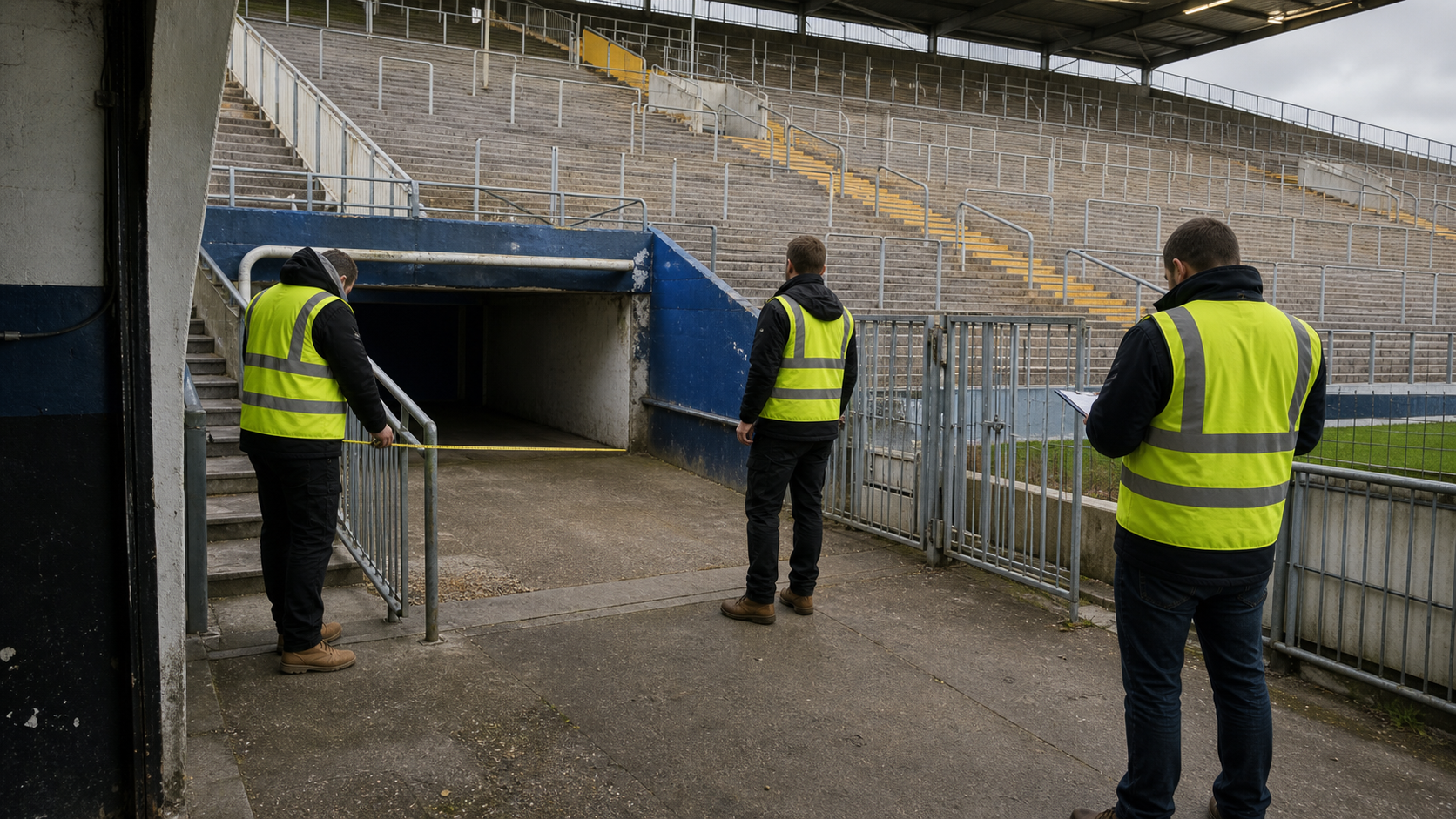
The West Terrace was not simply a large open standing area. By 1989, fencing divided it into pens. The centre pens, 3 and 4, were reached by the central tunnel beneath the West Stand. Side pens could be reached by less obvious routes. Lateral movement after entering a pen was restricted by radial fences and narrow openings. The perimeter fence at the front separated supporters from the pitch and provided only small gates for escape. This arrangement made distribution an active safety function: safe total terrace capacity did not guarantee safe loading of each compartment.
Earlier warning history mattered. Crushing had occurred at the Leppings Lane end before 1989, including at high-profile matches. Changes made after earlier incidents altered fences, barriers and routes. Yet the assurance process did not consistently ask whether every alteration changed the capacity, entry rate, emergency egress or division of responsibilities. A venue can remain familiar to officials while the interaction of its parts becomes less safe.
The 2025 report's assessment of the standards in force identifies too few turnstiles, a shared entrance and exit for the central pens, excessive distances to some crush barriers, barriers of unsuitable height, a steep tunnel, narrow emergency gates and permitted capacities above what the recommended Green Guide approach supported. Those are not merely later preferences imposed on an older ground. They are assessed against the safety guidance of the period.
Certification did not correct those weaknesses. The safety certificate was issued years before the disaster and was not adequately updated after significant alterations and incidents. The club owned the ground and held the primary responsibility for keeping its certificate current. The local licensing authorities had oversight powers and did not insist on the necessary review. Engineers advised on layout and certificate issues. Police had practical knowledge from match operations and a responsibility to raise and mitigate safety concerns they perceived.
The IOPC report's allocation of stadium-safety responsibilities therefore describes overlapping but distinct duties, not a transfer of all responsibility to one organisation.
The control failure was deeper than an old document. The certificate did not function as a live configuration record. It did not reliably link each pen's safe capacity to its barriers, entry path, exit geometry and turnstile allocation. Changes were treated as local works rather than changes to an integrated crowd system. Previous crushing did not trigger a formal hazard review with assigned corrective actions. A signed certificate can reduce safety if users treat it as proof while its assumptions have ceased to match the site.
This distinction also limits retrospective claims. The later investigation found no evidence that parties selecting Hillsborough for the 1989 semi-final believed the stadium was unsafe. Absence of that belief is not evidence that the ground met standards. It shows why safety assurance must rely on documented tests rather than institutional familiarity or the fact that previous events ended without mass fatalities.
Match planning left decisive tasks unowned
The police operation had to connect transport arrivals, roads, turnstiles, internal routes, pen occupancy and kick-off time. Instead, planning was divided into locations and duties without a complete control chain. The Leppings Lane approach was a known bottleneck, but the operational order did not define a staged queue plan or a robust contingency for a late build-up. It did not state who would obtain and use turnstile counts. It did not give anyone a quantified duty to monitor each pen or authority to stop filling one. It did not specify when the central tunnel should be closed.
The IOPC analysis of gaps in the operational orders also shows a loss of organisational memory. Officers had closed the central tunnel at earlier matches when the centre pens filled, but the tactic was not captured in the 1988 or 1989 order. Debriefs did not reliably preserve earlier crushing and tunnel closure as risks for the next commander. Senior officers later described uneven knowledge of the practice. Experience remained personal and local when it needed to become a mandatory, rehearsed control.
Command continuity was also weak. David Duckenfield took the match-command role shortly before the semi-final and had not previously commanded a major football match. The accountability point is not that a new commander is automatically unsafe. It is that appointment risk should have caused stronger handover, venue familiarisation, scenario testing and support from experienced officers. The organisation instead relied heavily on rank and local initiative.
The phrase "find your own level" captured another unsupported assumption. Supporters entering the terrace were expected to distribute themselves. But the obvious route led straight down the tunnel to the centre pens, alternative routes were less visible, and radial fences limited redistribution after entry. People cannot balance a compartmented system when they cannot see relative occupancy, cannot easily move sideways and receive no direction. The policy converted a control duty into an expectation placed on people who lacked the necessary information.
The planning failure therefore had four linked elements: no reliable demand forecast at each entrance, no rate control matched to turnstile capacity, no live view of pen occupancy, and no pre-authorised redirection when a pen reached its limit. Each omission might appear manageable in isolation. Together they allowed a safe response to one hazard outside the ground to intensify a lethal hazard inside it.
The approach crowd became dangerous before kick-off
Supporters arrived through different routes and at different times. Some came by special train, some by coach or car, and some left nearby premises after police action directed them toward the ground. The evidence does not support an extraordinary wave of drunken or violent people. It shows a growing flow reaching an entrance whose available turnstiles could not process that flow quickly enough as kick-off approached.
By about 2:15 p.m., the build-up outside Leppings Lane was visible. Officers and supporters described lost queues, restricted movement and increasing pressure. Inside the ground, there was a different imbalance: the centre pens were becoming full while side areas retained space. The police control box was the location able to observe the terrace directly and view the external approach on closed-circuit screens. Yet information about outside pressure, internal distribution and turnstile counts was not combined into one operational picture.
At about 2:30 p.m., the match commander considered delaying kick-off and decided against it. A delay was not a complete solution; without managed queues and redirection, it could not by itself remove either crush. But the decision point should have triggered a coordinated plan. Instead, the outside crowd continued to grow faster than entry through turnstiles, while the central pens remained the default destination for those who did enter.
The 2025 report's reconstruction of 15 April 1989 draws on synchronised footage, photographs, radio traffic, telephone records and witness evidence. It confirms that requests to open exit gates were made as officers outside feared the increasing crush. Relieving that pressure was a real safety need. The fatal control failure was not choosing between caring about people outside and caring about people inside. Command had to protect both groups as one system.
This is why descriptions such as "fans rushed an open gate" are analytically false even before considering their accusatory effect. Wide exit gates had no turnstile rate control. Once opened for entry, they changed the flow rate by design. People moving through the available opening were responding to police and steward actions during an external crush. The accountable question is what the authorities controlling that opening did to protect the route and destination.
Gate C, the tunnel and the pens were one coupled control
Gate C opened more than once. The detailed 2025 reconstruction adds an important qualification to older summaries. At roughly 2:52 p.m., the gate was physically opened by stewards while police outside were trying to admit small groups and reduce pressure. Duckenfield had also issued an instruction to open gates, but Operation Resolve could not establish that this instruction caused that physical opening. The second-opening analysis records that those operating the gate did not say they received the command-room instruction and that radio evidence did not resolve the link.
The uncertainty is narrow. Gate C remained open for several minutes and the commonly accepted estimate is that more than 2,000 supporters entered. Outside controls then failed and the inflow accelerated. No effective notice reached officers on the inner concourse. No line redirected people. No one closed the central tunnel. The route straight ahead was the obvious route and led directly to pens 3 and 4.
The internal state was also foreseeable to the system even if it was not understood by each person. The evidence on the pens shows the centre areas visibly fuller than side areas before the gate opening. No officer had a documented and quantified occupancy responsibility. Club instructions and police assumptions conflicted over whether stewards or police controlled crowd distribution. Several officers said monitoring was common sense, but common sense supplied neither a count nor a threshold nor a required action.
Once the inflow reached the tunnel, the compartment geometry prevented easy self-correction. People behind could not see the pressure at the front. People in the pens could not simply spread across radial fences. The arrival of more people increased compression in a location that had no safe reserve. At approximately 2:55 p.m., accounts describe a sudden increase in pressure consistent with the Gate C inflow reaching the centre pens.
The first response at the perimeter illustrates how the public-order frame delayed recognition. When a small gate in the front fence opened under pressure and supporters emerged, an officer initially tried to close it because he believed a pitch invasion was beginning. Other officers, including personnel less accustomed to the ground, recognised distress and opened gates. Supporters climbed barriers and helped one another. These actions happened within seconds, but at such density seconds were material.
The command failure is therefore not reduced to a single lever or order. It is the absence of a transaction around the gate: confirm why entry is changing; identify the downstream destination; block any full compartment; provide a safe alternative route; communicate to every relevant post; monitor the result; and stop the action if the internal condition worsens. Gate opening without those controls transferred pressure rather than resolving it.
Emergency recognition and rescue lacked a common command
The match was stopped after officers and others closer to the terrace recognised the emergency and got the referee's attention. In the control box, however, the initial interpretation of people on the track remained associated with disorder. A call for dog handlers and the activation of a police reinforcement arrangement reflected that frame. Responding officers were not told clearly that they were entering a mass-casualty event, so many arrived expecting crowd trouble.
The official emergency-response reconstruction finds that South Yorkshire Police and the ambulance service did not implement their emergency arrangements as required. No police officer made the necessary major-incident declaration at the critical early stage. The police control room could not give the ambulance service a clear account of scale and access. Senior command in the stadium did not establish an effective joint structure for rescue, triage and evacuation.
At ground level, there was intense action. Supporters pulled people from the pens, carried them across the pitch and used advertising boards as stretchers. Police officers, St John Ambulance volunteers, clinicians and other spectators attempted resuscitation and treatment. A later-arriving senior police officer organised chains at the perimeter gates, making extraction more orderly. Those facts matter because "the emergency response failed" should not erase people who acted decisively. The failure was that their effort was not rapidly organised and supplied by the command arrangements designed for exactly such an event.
Ambulance deployment was affected by poor information and access. The timeline for ambulance arrival records incomplete early messages, an initial limited dispatch, vehicles reaching different sides of the ground, and ambulance personnel receiving little direction from police at entrances. Medical resources were present, but there was no early common view of where casualties were, which routes were usable, who controlled triage or where additional crews should report.
Responsibility must be allocated by task. Police command held the stated coordinating role under its major-incident arrangements. Ambulance command had to assess and mobilise medical resources and declare its own emergency status. Stadium and club personnel controlled physical access and facilities. Individual clinicians had patient-care duties. Failure at one interface could delay the others, but interface failure does not make ownership disappear.
The medical evidence later exposed the damage caused by the 3:15 p.m. cut-off used in the original inquests. The Panel's pathology review found that the record did not support a universal conclusion that every fatal process was irreversible by then. It identified a group who may have had potential for survival after that time. "Potential" is essential. It means rescue and treatment evidence after 3:15 was relevant and should not have been excluded. It does not establish with certainty the counterfactual outcome for any individual.
The fresh inquests corrected the time frame. For all but one of the 96, the jury recorded a possible time of death extending beyond 3:15. This finding restored evidential attention to rescue and medical response. It should not be used to rank lives by supposed rescuability or to place on individual rescuers a burden created by failed command.
Relatives and survivors encountered a second control failure
After rescue, information was scattered among the stadium gymnasium, hospitals, police locations, a casualty bureau and reception centres. Relatives and friends travelled between sites, waited without reliable news and were sometimes directed elsewhere. Hospitals were treating an exceptional influx, including people too ill to provide names. The police casualty-information structure was overwhelmed and did not create a dependable link among treatment, identification and family contact.
The IOPC chapter on concerns raised by relatives and friends records complaints about the physical settings, delays, the identification process, insensitive language, questioning and handling of those who died. Families have described being shown unsorted photographs, asked questions about alcohol, and treated as though procedure displaced their relationship with the person they had lost. These were not merely poor customer interactions. They shaped evidence, trust and the ability to participate in later proceedings.
Survivors also occupied several roles at once. They were injured people, rescuers, eyewitnesses and, later, subjects of police interviews and public allegations. Some were children or young adults. A competent post-disaster system should protect wellbeing while preserving testimony: provide medical and psychological support, explain the purpose of questions, avoid accusatory assumptions, record accounts accurately, and allow appropriate adults and legal help where needed.
Bereaved relatives did not passively wait for institutions to correct themselves. They sought records, challenged the first inquests, supported a private prosecution, pressed for disclosure, gave evidence to Bishop James Jones and participated through years of fresh inquests and investigations. The institutional legitimacy restored in 2012 and 2016 was produced in substantial part by that sustained work. It should not be credited only to the authorities that eventually responded.
Andrew Devine's death in July 2021 also requires chronological care. The IOPC's about-the-investigations record states that he died on 27 July 2021 as a direct result of the injuries he sustained at Hillsborough and that the coroner found it more likely than not that he was unlawfully killed, making him the 97th fatality. The 2016 jury determinations still concern the 96 people before those inquests; later references to 97 include Devine and his separate coronial conclusion.
Public narratives redirected scrutiny from controls to supporters
Within the first hours, a false account was given to football officials that supporters had forced an exit gate. The chief constable corrected the gate claim publicly that evening, but versions of forced entry continued. In the following days, media reports alleged drunkenness, ticketlessness, attacks, theft and interference with rescue. These claims offered a familiar public-order explanation at the very moment that stadium and command decisions required examination.
The 2025 report on South Yorkshire Police interaction with the media found little or no evidence for the central allegations and no evidence that supporter behaviour caused or contributed to the disaster. It traced police contact with journalists and the circulation of claims while also preserving a limit: investigators did not prove that every report arose from one centrally directed media plan. The evidence supports police contribution to false and damaging narratives; it should not be embellished into a criminal conspiracy finding that no court made.
The narrative mattered operationally and legally. If disorder is treated as the initiating cause, fencing becomes protection rather than an escape barrier, gate entry becomes trespass rather than an authorised safety response, rescue movement becomes misbehaviour, and police control becomes reaction to an unruly crowd. That frame influenced what questions were asked, which evidence seemed relevant, and how institutions defended themselves.
The correct account does not require idealising every individual in a crowd. At an event involving thousands of people, some people may drink, arrive late or behave badly. The causal question is whether such conduct created or contributed to the dangerous situation. The authorised findings answer no. Aggregate anecdotes cannot be used to reverse that conclusion.
Public communication after a disaster should therefore be treated as a safety-critical control. Early statements must separate verified facts, provisional information and unresolved questions. Institutions under scrutiny should not be the sole validators of accounts that protect their reputation. Corrections must be as visible and durable as the original claim. Records of sources, approvals and changes should be preserved for later review.
Officer accounts were evidence and institutional assets
South Yorkshire Police first collected many officers' recollections on plain paper rather than as formal witness statements. Accounts were then reviewed before submission to West Midlands Police and the Taylor Inquiry. Legal advisers and police teams proposed or made changes, and officers were asked to sign revised versions. Original and revised documents survived, enabling later comparison.
The IOPC's investigation of South Yorkshire Police evidence collection found that 327 officers' accounts were amended, substantially more than earlier reviews had identified. Some changes corrected spelling, grammar or style. Others removed or softened references to communication failures, absent command, criticism of senior officers, previous monitoring of pens and earlier tunnel-closing practice. The pattern was significant because those subjects bore directly on police responsibility.
Two analytical errors must be avoided. First, saying "all statements were falsified" would be false: not every account was changed, not every change was material, and officers had differing levels of knowledge and agreement. Second, saying "the officers signed the final versions" does not answer whether institutional review selected evidence in a way that deprived an inquiry of relevant criticism. Evidential integrity concerns provenance, completeness and preserved differences, not only the signature at the end.
West Midlands Police was responsible for major parts of the original external investigation and support to the Taylor Inquiry. The later IOPC review of its work for the inquiry found an exceptionally large witness effort but serious limits. More than 3,800 supporters were interviewed in difficult circumstances. Many interviews were handled professionally, while some witnesses, including minors, experienced insensitive questioning or excessive focus on alcohol. Senior West Midlands officers became aware that South Yorkshire accounts were being amended but did not adequately test or stop the process.
Evidence governance should have required immutable originals, a visible change log, the author's reason and consent for each edit, separate legal comment, and disclosure of every version to the investigating body. An institution may seek legal advice and correct error. It should not convert a first-hand account into a corporate submission without making the transformation transparent.
The same principle applies to missing and degraded evidence. Passage of time affected memories; some witnesses died or could not be traced; records were lost or difficult to recover; older digital media required restoration. A later inability to meet a criminal or conduct threshold may reflect those limitations. It must not be represented as affirmative proof that the underlying event did not occur. Conversely, missing evidence cannot be filled with speculation simply because institutional handling was poor.
The Panel and fresh inquests repaired the public record
The Taylor Inquiry began quickly in 1989 and identified failure of police control as the main cause. Yet its findings did not settle the public account. The first coronial process imposed a 3:15 cut-off, returned accidental-death conclusions for the 95 people then included, and gave supporter alcohol and conduct continuing prominence. Tony Bland died in 1993 from injuries sustained at Hillsborough and was not part of that original generic hearing.
Families pursued reviews, access to records and legal challenges for years. A private prosecution reached trial in 2000: Bernard Murray was acquitted, and the jury did not reach a verdict in David Duckenfield's case. That outcome must be recorded without treating the private prosecution as a substitute for the later disclosure exercise.
The Panel's work changed what could be tested. It assembled records held across institutions, compared versions, re-examined pathology, reviewed media and parliamentary communication, and showed how the supporter-blame account lacked evidential foundation. Disclosure enabled the Attorney General to seek the quashing of the original inquests. The High Court ordered fresh inquests in December 2012.
The new inquests ran from 2014 to 2016 and heard a much broader record. The jury answered yes to unlawful killing by a seven-to-two majority and no to both formulations asking whether supporter behaviour caused or may have contributed to the danger at the turnstiles. It identified errors or omissions in police planning, policing, command and the opening of gates. It also identified causative or contributory defects in design, certification and club management, and shortcomings in the emergency response.
That result was a profound legal correction for each person who died and for relatives who had challenged accidental-death conclusions. It did not erase the need for criminal decisions, and it did not guarantee those decisions would produce convictions. It established the coronial answer on a complete public record, not a general licence to attach criminal guilt to anyone discussed in the evidence.
Criminal outcomes must be stated charge by charge
Operation Resolve and the IOPC referred evidence to the Crown Prosecution Service, which made charging decisions. The official summary of resulting criminal trials records several distinct outcomes.
David Duckenfield was charged with gross-negligence manslaughter. The first 2019 jury could not reach a verdict. At retrial, a jury found him not guilty on 95 counts. No count was brought for Tony Bland because the law applicable in 1989 included the then "year and a day" restriction. The recorded outcome is not guilty and must not be described as a technical conviction, a partial conviction or an inquest verdict overridden by a lower court.
Graham Mackrell, Sheffield Wednesday Football Club's former secretary and safety officer, was convicted of an offence under the Health and Safety at Work etc. Act concerning admission arrangements and was fined. Other safety-certificate charges did not proceed after the judge found insufficient evidence. His conviction is a real criminal outcome, but it is not a manslaughter conviction and does not adjudicate every stadium-safety failure.
Norman Bettison faced misconduct-in-public-office charges concerning alleged statements about his role and supporters. The prosecution was discontinued in 2018 after review of the evidence. Discontinuance is neither conviction nor acquittal after trial; it records that the prosecution did not continue.
Peter Metcalf, Donald Denton and Alan Foster were tried for perverting the course of justice in connection with amended officer accounts. The judge's no-case-to-answer ruling ended the case in May 2021. The Taylor Inquiry was a non-statutory departmental inquiry and was held not to be a course of public justice for the charged offence. The prosecution therefore had to show the alleged conduct was intended to affect the original inquests or criminal investigation, and the judge found the evidence could not establish that required link.
The ruling did not find that no accounts were amended. It did not endorse every change or decide that selective evidence was consistent with the public interest. It decided that the prosecution evidence could not satisfy the legal elements of the charged offence. Calling the result a collapse caused by a loophole may express a political view, but it is not a substitute for the court's reasoning.
The divergence between the 2016 unlawful-killing conclusion and the 2019 acquittal should be explained honestly. The inquest and criminal trial had different legal purposes, parties, admissibility decisions and directions. The 2016 jury was itself asked to be sure, so a simple "civil versus criminal standard" explanation is unavailable for that proceeding. A criminal acquittal means the prosecution did not secure proof of the named charges to the required standard; it does not reverse the separate findings on stadium, planning, supporter conduct or institutional response.
Conduct findings used historical standards and limited remedies
The IOPC and Operation Resolve investigations also addressed complaints and police conduct outside criminal prosecution. The published outcome summary records 352 complaints and conduct matters involving 138 officers and 98 complainants. Of 260 complaints, 92 were upheld or would have produced a case to answer; of 92 conduct matters, 18 produced a case-to-answer opinion. The IOPC said 12 officers would have had a case to answer for gross misconduct if still serving.
Those numbers need their qualifiers. A complaint outcome and a conduct matter follow different routes. "Case to answer" means evidence justified putting an allegation before the next disciplinary stage; it is not a finding by a disciplinary panel that misconduct occurred. Because the officers concerned had retired before the relevant legal date, proceedings could not be brought. The IOPC expressed counterfactual opinions about what would have happened had they remained in service.
The historic discipline code also lacked a specific duty of candour. Investigators concluded that South Yorkshire Police could defend its interests and present its best case within the legal and professional framework then applicable, provided it did not cross other prohibitions. That limit affected findings about selective disclosure. It does not make the resulting institutional behaviour desirable, and it does not convert a gap in the code into a positive public duty to withhold adverse evidence.
Time imposed further constraints. Witnesses were unavailable, memories differed and documents were missing. The IOPC did not uphold matters where the legal threshold could not be met. That restraint is part of credible accountability: the investigation can identify widespread institutional failure while declining to make unsupported findings about a particular officer.
Bishop James Jones reframed accountability around the people affected
After the fresh inquests, Bishop James Jones gathered relatives' experiences of the disaster and the decades that followed. The evidence package preserves a frozen official publication route; the same report is available through the current GOV.UK page for the 2017 review and its 25 points of learning.
The report did not retell families' evidence merely to illustrate an already settled institutional narrative. It treated their encounters with identification, pathology, inquests, inquiries, legal funding, police investigation and disclosure as evidence about how public power behaves when its own conduct is under scrutiny. Its central concern was that authority can become defensive, patronising and self-protective while requiring bereaved people to prove what institutions already hold in their records.
The 25 points included a charter for families bereaved through public tragedy, proper participation at inquests, support and counselling, careful interviewing of relatives and minors, disclosure, review of pathology and coronial practice, and a duty requiring police officers, including former officers, to cooperate fully with investigations. The recommendations are proposals grounded in experience. Publication did not itself implement them.
The government's 2023 response accepted the need for cultural and practical change, signed the Hillsborough Charter and described actions on family support, coronial practice, pathology, policing and an independent public advocate. It also acknowledged that the response had taken too long. A charter is a public commitment and can supply an audit benchmark, but it is not the same as a statutory offence or an enforceable disclosure order.
The delay illustrates the reform problem. Institutions often describe ongoing litigation as a reason to limit comment, and protection of fair trials is legitimate. But a legal-risk hold must have a named owner, a narrow scope, periodic review and a deadline for publishing everything that can safely be released. Otherwise temporary caution becomes indefinite withholding.
Candour reform was still in Parliament on 17 July 2026
The government introduced the Public Office (Accountability) Bill in September 2025. The official Hillsborough Law Bill publication describes proposed duties of candour and assistance for public authorities and officials, related enforcement, changes to misconduct-in-public-office law, and measures intended to improve participation and legal support where state conduct is examined.
Current status is legally decisive. The UK Parliament bill record was updated on 16 July 2026 and shows the current Lords version after the Bill completed its Commons stages. The House of Lords Hansard record for 16 July 2026 records that the Bill was brought from the Commons and read a first time. As of this article's publication date, further Lords stages, consideration of amendments and Royal Assent had not been completed. The proposal must therefore be described as a Bill, not as an enacted general Hillsborough Law.
Even enactment would be a beginning. A duty of candour must identify when it activates, which inquiries and investigations it covers, who must preserve and disclose records, how legal privilege and personal data are handled, what happens when accounts conflict, and which independent body can compel compliance. Officials need a protected route to disclose adverse facts. Leaders need an obligation to correct public statements. Investigators need access to former as well as serving personnel within lawful limits. Sanctions need fair procedures and actual use.
Parity also matters. Public bodies can retain teams of lawyers and experts while bereaved people are trying to understand unfamiliar proceedings during grief. Equal participation is not achieved by identical formal rights where resources and document access are radically unequal. Funding, early disclosure, plain explanations and an independent advocate are controls against that imbalance.
The reform test should remain empirical. Count how quickly a major-incident plan is activated; whether relatives receive a named contact; whether original evidence is preserved; how long disclosure takes; whether adverse documents reach the inquiry without repeated requests; how quickly false public claims are corrected; and whether recommendations close on verified evidence. Values become institutional controls only when performance can be examined.
Practical ownership across the public-safety chain
Hillsborough involved the club, engineers, licensing bodies, police, ambulance personnel, coronial authorities, investigators, prosecutors and government. Multiple actors do not make ownership unknowable. They require explicit interfaces.
| Control domain | Accountable function | Evidence required before and during an event | Failure exposed at Hillsborough |
|---|---|---|---|
| Ground configuration and safety certificate | Ground owner and designated safety officer, with licensing oversight and competent engineering advice | Current drawings, compartment capacities, barrier and exit checks, change history, signed review after alterations and incidents | The certificate did not keep pace with layout changes, prior crushing or safe capacity analysis |
| Event selection and readiness | Event organiser, ground operator, licensing partners and police planning command | Venue-risk review for the actual allocation, previous incident actions, unresolved defects and readiness sign-off | Familiar use of the ground displaced a fresh whole-system challenge |
| Arrival and turnstile demand | Police and club operations under a named ingress lead | Arrival forecasts, route observation, queue density, turnstile throughput and delay thresholds | A known bottleneck had no adequate staged queue and escalation plan |
| Pen occupancy | Named terrace-safety controller with police and steward inputs | Pen-specific counts or defensible estimates, visible thresholds and authority to stop admission | Monitoring was assumed, not assigned; centre and side pens filled unevenly |
| Gate opening and redirection | Match commander for the coupled decision, implemented by identified gate and concourse leads | Reason for opening, downstream capacity, tunnel status, alternate routes, radio confirmation and stop criteria | Gate entry changed rate without closing the tunnel or directing people away from full pens |
| Emergency recognition | Senior command with authority to replace a public-order frame | Distress indicators, direct reports, video, explicit emergency classification and rapid command transfer | People escaping onto the track were initially interpreted through disorder assumptions |
| Multi-agency response | Police strategic coordination and each service's operational command | Major-incident declaration, shared location and scale report, access routes, triage lead, casualty-clearing plan | Rescuers acted without an early common command or reliable medical deployment picture |
| Family information and identification | Casualty-bureau and family-liaison command | Reconciled casualty record, named contacts, private facilities, humane identification procedure and protected interviews | Relatives searched fragmented sites and encountered delay, confusion and insensitive treatment |
| Evidence integrity | Independent investigation lead and each source institution's records officer | Immutable originals, version history, author approval, legal comments kept separate and complete transfer | Officer accounts were altered through institutional review before external submission |
| Public communication | Independent incident communications lead with evidential approval | Source register, confidence labels, correction log and separation of fact from allegation | Unsupported claims about supporters redirected attention and persisted after correction |
| Legal participation | Coroner, inquiry chair, government funding authority and independent advocate | Timely disclosure, adequate representation, accessible explanations and protected family participation | Relatives carried a long and unequal burden to obtain records and correct findings |
| Candour and institutional learning | Head of each public authority, independently overseen | Disclosure certification, adverse-evidence register, recommendation owners, deadlines and effectiveness tests | Reputation protection could dominate truth-seeking without a specific enforceable duty |
This table does not assign retrospective criminal or civil liability. It translates the record into present control ownership. The person accountable for an interface need not perform every task, but must know its state, resolve conflicts and stop unsafe action.
What effective assurance would have to prove
A stadium-safety inspection should begin with the physical route a person experiences: approach space, queue, turnstile, concourse, tunnel, compartment, barrier and emergency exit. Inspectors should test the full route under the event's actual ticket allocation and arrival profile. A total capacity number is inadequate if one obvious path can overload a smaller pen while adjacent space remains unused.
Live control should use independent indicators. Turnstile counts alone show entry to a broad area, not distribution within pens. Visual observation alone can miss pressure within a dense crowd. A credible arrangement combines counts, trained observers, camera views, reports from the terrace and conservative thresholds. Any gate used contrary to its ordinary purpose should require positive confirmation that the receiving route is safe.
Evidence assurance should start before a disaster. Officers and staff should know that original notes are preserved, corrections are appended rather than silently substituted, and institutional lawyers advise without becoming invisible editors of witness memory. After an event, an external evidence custodian should obtain complete versions early.
Finally, disclosure should be verified against people outside the institution. Families and survivors often know which questions remain unanswered because they have followed the record across proceedings. Structured participation is not a concession; it is a detection control. An authority that marks its own disclosure complete without testing it against those questions recreates the conditions that delayed the Hillsborough record.
Conclusion
Hillsborough became an accountability test because failure continued across time. Unsafe configuration and stale certification set conditions. Planning failed to connect arrival rate to compartment capacity. Gate entry was not coupled to tunnel closure and redirection. Emergency command did not rapidly organise rescue and medicine. Evidence review and false narratives then made institutional reputation part of the hazard.
The later record is equally layered. The Panel disclosed and analysed. The inquests determined unlawful killing and rejected supporter blame. Criminal proceedings produced one health-and-safety conviction, a manslaughter acquittal, a discontinued case and a no-case-to-answer ruling. Conduct investigations reached serious but legally bounded opinions. Bishop James Jones converted relatives' experiences into reforms, some adopted and some still before Parliament.
Accountability does not require forcing those outcomes into one verdict. It requires preserving each boundary while making sure no boundary becomes an excuse for inaction. The enduring control question is whether public bodies can protect life, preserve evidence, tell the truth when their own conduct is at issue, and give bereaved people and survivors a fair route to answers without requiring another decades-long campaign.