Summary
- What it says: Hexatronic Group is expanding submarine fibre-optic cable manufacturing capacity in Sweden through a new production line at its Hudiksvall facility, strengthening long-term supply commitments linked to offshore and subsea infrastructure demand.
- Main topic: Regional ISP economics; Submarine cable infrastructure; Registry governance
- Context: market / briefing / Europe & Middle East
•New Hudiksvall line to more than double subsea cable output
•NKT deal locks in pre-allocated production share through 2032
The fact
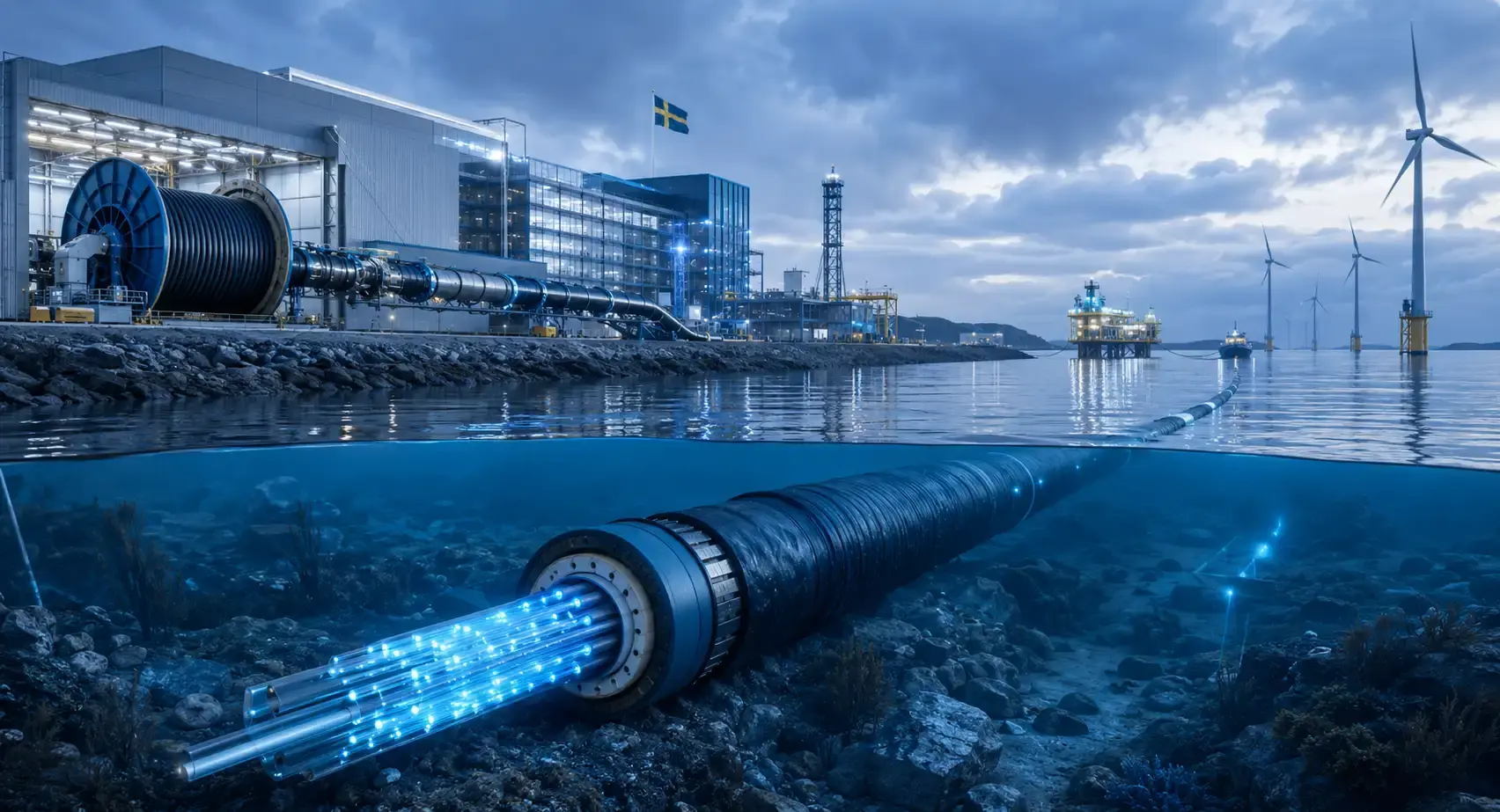
Hexatronic Group is investing in a new submarine fibre-optic cable production line at its Hudiksvall facility in Sweden. The site is the company's largest manufacturing base and already operates a submarine cable production line, serving as a centre for fibre cable and microduct production. The new line will more than double subsea cable capacity, increasing annual output from approximately SEK 150-200 million to over SEK 500 million, depending on product mix.
The investment is linked to a long-term supply agreement with NKT A/S, a Danish cable manufacturer listed on Nasdaq Copenhagen (source: NKT FY2025 results), under which a significant portion of future production capacity is allocated through 2032. The production line is scheduled for commissioning in 2028.
The Assessment
Europe's subsea cable supply chain is shifting towards long-term capacity expansion combined with pre-allocated production, driven by simultaneous growth in offshore wind development and subsea communications infrastructure demand. Capacity is increasingly secured through long-term agreements before facilities become operational, tightening alignment between infrastructure investment and confirmed downstream project pipelines.
Hexatronic's capacity expansion and its long-term arrangement with NKT reflect this shift, where production output is partially reserved in advance, increasing delivery certainty for large-scale offshore and subsea projects while reducing reliance on spot-based procurement. This strengthens Europe's position in energy and digital infrastructure build-out, while reducing exposure to non-European supply sources.
From a BTW perspective, subsea fibre-optic cable is the physical layer of cross-ocean and regional data channels. Manufacturing capacity expansion at this tier of the supply chain directly constrains or enables the pace of subsea network deployment — making it an infrastructure-layer signal worth tracking.
At a market level, subsea cable capacity is becoming a strategic constraint rather than a flexible input. Competitive dynamics are gradually moving away from price and delivery efficiency towards early access to manufacturing capacity and long-term supply control, with contract structure increasingly determining market access.
What to Watch
Whether NKT fully absorbs its pre-allocated capacity through 2032, and whether similar long-term capacity reservation models expand across other subsea cable suppliers in Europe.