
Summary
- Herald of Free Enterprise left Zeebrugge's No. 12 berth at 18:05 GMT on 6 March 1987 with both inner and outer bow doors fully open. After the ferry passed the outer mole at about 18:24 and accelerated, water rose over the bow spade, spread across the undivided main vehicle deck and rapidly destroyed stability. The ship capsized at about 18:28 and stopped on its port side only because it grounded in shallow water.
- The final accepted death toll is 193. The 1987 formal investigation could then confirm at least 188 deaths, while later Marine Accident Investigation Branch and International Maritime Organization records use 193. The figures reflect the maturity of the casualty record, not competing accounts of the event.
- A designated assistant bosun was asleep and did not close the doors. That is confirmed. Why he fell asleep is not established as a causal finding. The loading officer had a separate duty to ensure closure, the master sailed without a positive report, and the bridge could not see the clam-type doors. Operational accountability therefore cannot defensibly stop with the last person assigned to move the controls.
- Zeebrugge's single-level berth required the ferry to be trimmed by the head to load the upper vehicle deck. Ballast was still being pumped out when the vessel sailed. The investigation found likely overloading but expressly held that overloading did not cause the casualty. Forward trim and high acceleration mattered because they raised the bow wave relative to the open door aperture and increased inflow.
- The company had evidence of earlier open-door departures and repeated proposals for bridge indicators. Its orders contained no adequate bow-door closure rule, used a dangerous negative-reporting assumption, left duties in conflict, and did not convert warnings into a fleet-wide verified control. The formal court found causative fault throughout Townsend Car Ferries' management. That safety and disciplinary finding is distinct from a criminal conviction.
- Rescue began immediately. Nearby ships, Belgian authorities, divers, helicopters, emergency services, hospitals, crew and passengers saved hundreds of people. The shallow seabed prevented total sinking. The same evidence also shows why consequence controls were inadequate: the capsize was too fast for lifeboat launching, normal escape geometry disappeared at a 90-degree heel, lighting and communications were poor, and survival depended heavily on improvised access and external help.
- The legal record changed over time. The formal court suspended the master's and chief officer's competency certificates. An inquest later returned unlawful-killing verdicts, and prosecutors brought manslaughter charges against the company and seven people. The criminal judge ultimately directed acquittals where the prosecution could not identify a sufficiently senior individual whose guilt could be attributed to the company. That outcome did not erase the formal court's management findings; it reflected the criminal law and evidence required in that proceeding.
- UK regulations introduced closed-at-berth and positive-reporting duties, bridge indication, surveillance, emergency lighting, stability assessment, draught controls and other measures. IMO amendments added fail-safe door indicators, leakage monitoring, cargo-door closure and stronger stability rules. The later ISM Code made a company safety-management system auditable. These are strong repair signals, but rules and certificates alone do not prove day-to-day control effectiveness on every ferry.
The evidence boundary comes before blame
The central technical authority is the Department of Transport's 1987 Formal Investigation Report, Court No. 8074. The modern MAIB casualty page preserves the report and reconciles the historical record: the report detailed 188 confirmed fatalities at publication, while the final loss was 193 lives. Unless another source is expressly identified, ship condition, timing, duty allocation, hydrodynamics, rescue facts and formal findings in this analysis come from that report.
Several evidentiary categories must remain separate. A confirmed fact is an event, condition or measurement documented by the investigation. A formal finding is the Wreck Commissioner's conclusion under the Merchant Shipping inquiry regime, including findings of serious negligence and company fault. A supported inference is an analytical conclusion that follows from documented controls but was not itself adjudicated. A disputed claim is evidence the court did not accept or could not resolve. An unknown is a material gap that survives the record. A criminal disposition concerns specified defendants, charges and the criminal burden of proof.
A later rule is repair evidence, not a retroactive duty.
That discipline matters because the public record contains unusually strong corporate criticism alongside acquittals in a later criminal case. It would be wrong to convert the formal report into a conviction that it was not. It would be equally wrong to treat directed criminal acquittals as a finding that the documented operating and management failures did not exist. Different institutions asked different questions.
The relevant accountability test is practical control. Who could close the doors? Who had to verify closure? What information reached the bridge? Who designed the roles and sailing routine? Who received warnings and could fund a technical safeguard? Who defined the regulatory minimum? Who owned rescue after capsize? And what later evidence shows that each failed control became more than an instruction on paper?
The ship turned speed into a narrow safety margin
Herald of Free Enterprise was a 7,951 gross-ton roll-on/roll-off passenger and vehicle ferry, built in 1980 for the short Dover-Calais service. Three engines and controllable-pitch propellers gave it a service speed of 22 knots and rapid acceleration. Its commercial advantage was a fast cycle: vehicles could drive through a large vehicle space, the ferry could unload and reload quickly, and the next crossing could begin with little dwell time.
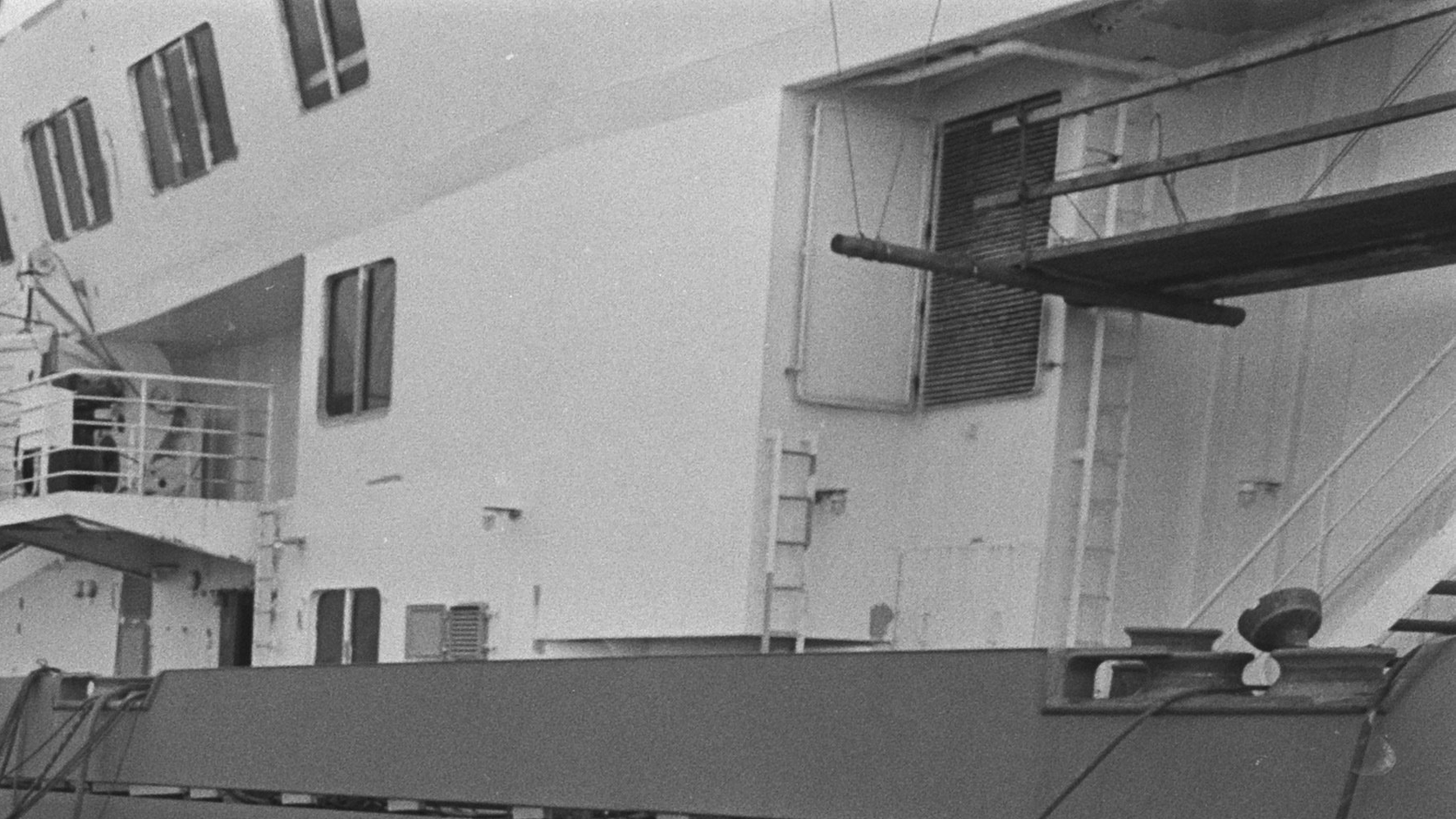
That efficiency depended on the integrity of G deck, the main vehicle deck. The deck ran through the ship and was enclosed by the superstructure. At the bow it had outer clam-type doors and inner lock-gate doors; at the stern it had another loading door. When closed and secured, those boundaries made the superstructure weathertight and allowed it to contribute to intact stability. When the bow aperture was open, the broad deck became a path for seawater.
The distinction between a compartment below the bulkhead deck and the vehicle deck above it is critical. The ship complied with the applicable 1980 construction rules and possessed a passenger safety certificate. It could survive prescribed compartment damage below the bulkhead deck. But a large volume of water free to move across the wide vehicle deck created a severe free-surface effect: as water shifted to one side, its weight increased heel and rapidly reduced the ship's righting ability. Certification against the then-applicable standard did not make an open bow survivable.
The doors were hydraulically operable and the court found no mechanical defect that would have prevented closure. Their position could not be seen from the bridge. Unlike a raised bow visor that obstructed forward view, clam doors opened sideways and disappeared from the bridge team's line of sight. The bridge therefore depended on an organizational sensor: someone had to close them, someone had to ensure that closure occurred, and someone had to report the safe state.
There was no bridge indication on Herald. There was no mandatory positive message before sailing. Company standing orders instead allowed the master, at sailing time, to assume readiness if no department reported a deficiency. In control terms, silence was interpreted as proof. That is a detection design defect, not merely poor communication on one night.
Zeebrugge coupled loading, ballast and departure
The Spirit-class ferries were designed for berths at Dover and Calais that could handle upper and lower vehicle decks efficiently. Zeebrugge's No. 12 berth had one loading level. At high spring tide, its ramp could not reach the upper E deck unless the ferry was trimmed down by the bow. The crew therefore filled forward ballast tanks before arrival, loaded E deck first, then loaded G deck while pumping ballast out for sea.
The arrangement made ballast control part of the turnaround. Tank No. 14 alone held 268 cubic metres and the system could fill or empty it at about 115 to 120 tonnes an hour. Pumping the relevant forward tanks could consume much of the passage time. A chief engineer had warned management in 1984 that the practice was slow, effectively blind and left the ship down by the head for prolonged periods. A proposed high-capacity pump was estimated at GBP25,000 and was not installed because the cost was treated as prohibitive.
On 6 March, stripping No. 14 tank began at about 17:40. The investigation estimated that about 50 tonnes had been removed by departure and about 100 tonnes by capsize. The ferry thus remained trimmed by the head. The court placed mean draught between 5.68 and 5.85 metres, forward draught between about 6.06 and 6.26 metres, and trim near 0.8 metre by the head. Because actual vehicle weights and accumulated lightship weight were uncertain, the upper estimate indicated significant overloading.
The court was explicit: probable overloading was not causative. That boundary must be preserved. Weight uncertainty, fictitious routine draught entries and the absence of reliable draught readings were serious management and compliance problems. They did not explain why water crossed G deck. Forward trim did, however, reduce bow clearance and formed part of the physical condition in which speed generated a high bow wave at the open doors. The correct reconstruction is therefore: open doors enabled flooding; trim and acceleration made the inflow severe; broad-deck free surface converted inflow into rapid capsize.
This is also why saying that the vessel was safe until the crew forgot a task is incomplete. The berth required a variant operating mode. That mode changed officer availability, loading sequence, ballast state, door timing and the interval between departure and open water. The company did not redesign duties around those differences.
Warning evidence accumulated before March 1987
The event was foreseeable in the operational sense that matters for control design. The report documented at least five previous occasions on which company ferries had gone to sea with bow or stern doors open. In October 1983 an assistant bosun on Pride of Free Enterprise fell asleep and both bow and stern doors remained open at departure. A 1984 circular recorded that Pride had sailed twice with an open bow or stern door after moving to the Zeebrugge run.
Those events did not make the 1987 capsize inevitable. They did invalidate reliance on a single person's presence and on the assumption that failure would be reported. A near miss is not only a warning about individual performance; it tests whether the system detects predictable absence, confusion and delay.
Masters also asked for a direct engineering check. A June 1985 memorandum proposed bridge indicators because the doors were critical and the distance from berth to open sea was short. The suggestion was circulated among shore managers. Their replies, reproduced in the report, treated an indicator as unnecessary because someone was already paid to close the doors. Captain John Kirby raised bridge duplication again in May 1986. Another master renewed the proposal in October 1986 after a further incident, explaining that visual checking by a crew member did not remove the need for bridge indication.
Management considered and rejected the proposal. By autumn 1986, the court concluded, shore staff knew both that open-door sailing could occur and that a simple indicator had been proposed. Within days of the disaster, indicators were fitted in sister ships and elsewhere in the fleet. That fast implementation is strong counterfactual evidence that the measure was technically feasible. It does not prove with certainty that an indicator would have prevented departure; it supports the narrower inference that the bridge would have received a direct warning while there was still time to stop or slow.
Written duties were also unstable. A 1984 instruction said the officer loading G deck was to ensure that bow and stern doors were secure when leaving port. In practice, officers interpreted this as checking that a crew member was present or approaching the controls. The instruction was not enforced as a requirement to observe closure. Company standing orders did not mention opening and closing these doors at all. Another order told department heads to report deficiencies, allowing the master to infer readiness from no report.
The Zeebrugge duty pattern created conflict. The loading officer was expected on the bridge before sailing, but also had to ensure door closure at the vehicle deck. The order for harbour stations was often given before loading ended. A 1986 local management memorandum pressed for sailings up to 15 minutes early and instructed staff to pressure the first officer if work appeared too slow. The formal court did not find a direct order to sail unsafely. It found that officers felt there was no time to waste and that the company had not ensured the loading officer remained until closure.
Officer continuity was weak as well. The senior master reported that 36 deck officers had been attached to Herald between September 1986 and January 1987, with repeated schedule and personnel changes affecting maintenance, safety checks, training and smooth operation. The company was legally entitled to operate the Zeebrugge service with the master and two deck officers. The court did not find that number inherently unsafe; it found that the duties had not been properly organized for that service.
These distinctions prevent inflation. There is evidence of schedule pressure, role conflict, turnover, unresolved warnings and rejected indication. There is no formal finding that an executive ordered a ferry to sail with doors open. The accountability failure is that management left a safety-critical departure condition dependent on assumptions even after those assumptions had failed before.
Chronology of 6 March 1987
Before loading completed. Herald arrived at Zeebrugge bow first and used forward ballast to reach the upper-deck ramp. E deck was loaded first. Pumping out forward ballast began at approximately 17:40. The assistant bosun assigned to close the bow doors had opened them on arrival, then worked on maintenance and cleaning. After being released by the bosun, he went to his cabin and fell asleep.
That sleep is a confirmed event. Fatigue as its cause is not. The report did not determine whether work hours, sleep debt, illness or another factor caused it. It is therefore appropriate to assess the system's tolerance of a missing operator, but not to diagnose the individual or invent a fatigue finding.
Loading officer changed. The second officer initially relieved the chief officer on G deck. Near departure the chief officer returned, issued loading directions and took over. The officers did not clearly discuss bow-door closure. The second officer understood that the loading role and its associated responsibility had transferred. The chief officer accepted that ensuring closure was then his duty.
Harbour stations. The chief officer called harbour stations before the doors were closed. The assistant bosun did not hear the announcement. The bosun placed the chain across the vehicle deck after the last car but did not close the doors because closure was not assigned to him. The court criticized that narrow view while also recording his exemplary rescue leadership after capsize. That balanced finding matters: failure to intervene before departure does not erase later courage, and later courage does not repair the missed control.
The chief officer left G deck. He later recalled seeing a man he believed was approaching to close the doors. The court did not accept that recollection as reliable and thought he probably left when no deck crew member was there, expecting the assistant bosun to arrive. Either version left the same verified state absent: he did not see the doors closed and did not report closure.
18:05, departure. Herald left No. 12 berth five minutes late with about 459 passengers, 80 crew, 81 cars, 47 freight vehicles and three other vehicles. Weather was good, with a light easterly breeze and little sea or swell. The master saw the chief officer reach the bridge. Neither asked nor stated whether the bow was secure. The bridge had no indicator and could not see the clam doors.
Inner harbour transit. The ferry reversed from the berth, turned and proceeded through the harbour. Witnesses on the dredger Sanderus later confirmed that the bow doors were open. No effective detection reached the bridge. The vessel's open-door status was externally visible but operationally absent from the team with authority over speed and voyage continuation.
About 18:24, outer mole. After passing the harbour entrance, the master set all three engine combinators to setting 6. Full-scale trials on the sister ship later showed that the class accelerated quickly and could produce a bow wave well above the bow spade at that setting when trimmed forward. The report estimated acceleration from about 14 knots toward 18 knots.
18:24 to 18:28, flooding and capsize. Dynamic sinkage and the rising bow wave brought water over the spade and through the open aperture. Inflow increased as the bow settled and forward freeboard reduced. Water moving across G deck caused a rapid initial lurch, probably toward 30 degrees to port, then collected on that side. Continued inflow drove the ferry beyond 90 degrees. The bridge clock stopped at 18:28. The court could not determine every angle and second precisely, but concluded that capsize occurred roughly four minutes after the outer mole.
Grounding. The port side struck the shallow seabed, leaving the starboard side above water. This was not a designed survival feature. It was a geographical contingency. Had the vessel capsized in deeper water, the report and later House of Commons debate on the Merchant Shipping Bill recognized that the loss could have been much greater.
Causal classification: what failed and how
The formal report identified the immediate cause in direct terms: the ferry went to sea with both bow doors open. A modern accountability analysis needs finer categories without pretending they are new judicial findings.
| Category | Evidence-sensitive assessment |
|---|---|
| Trigger | As speed increased beyond the outer mole, the bow wave rose over the spade and seawater entered through the fully open inner and outer bow doors. |
| Operational root cause | Departure authority was not conditioned on positive, independently visible proof that safety-critical loading doors were closed and secured. This is a supported systems inference from the report's duty, order and indicator findings. |
| Direct human omissions | The assigned operator did not attend and close the doors; the chief officer did not ensure closure; the master sailed without requiring confirmation. The formal court found serious negligence in these omissions. |
| Contributing operating conditions | Zeebrugge-specific role conflict, early harbour-stations practice, schedule pressure, forward trim, slow ballast stripping, rapid acceleration, officer discontinuity, unclear orders and unenforced instructions reduced margin. |
| Detection failure | The bridge could not see the clam doors, had no indicator, received no positive report and relied on silence. Earlier open-door incidents and repeated indicator requests did not become a fleet control before the casualty. |
| Response failure | Before capsize, no bridge response occurred because the unsafe condition was not detected. Once large inflow began, the time available was too short for a normal corrective or abandonment sequence. |
| Consequence amplification | An undivided, broad vehicle deck allowed rapid free-surface loss of stability; normal escape routes and life-saving arrangements became unusable at extreme heel; power and lighting were lost. |
| Recovery enablers | Shallow grounding kept part of the hull above water; immediate nearby-vessel response, breakable windows, crew and passenger action, divers, helicopters, port services and hospitals saved lives. |
| Serious but non-causal evidence | Probable overloading, inaccurate cargo weights, false routine draught entries, passenger-count history and other management deficiencies showed weak assurance but were not found to have caused this capsize. |
The strongest root-cause statement is therefore not “someone slept.” A robust system assumes that people can sleep, misunderstand, become distracted or fail to arrive. The root problem was a departure gate that could pass without a verified safe state. The assistant bosun's absence mattered because the organization gave one omission a direct path to open water.
Confirmed facts, supported inference, disputes and unknowns
Confirmed facts. The doors were open; the hydraulic equipment could have closed them; the assigned assistant bosun was asleep; the loading officer did not verify closure; no positive report reached the master; the bridge lacked door indication; the vessel remained trimmed forward; setting 6 produced rapid acceleration; water entered G deck; the ferry capsized; and the shallow seabed prevented total sinking. Earlier open-door incidents and bridge-indicator proposals are documented in company memoranda reproduced in the report.
Supported inference. A positive closure report or fail-safe bridge indication probably would have interrupted departure or acceleration. This is strongly supported because closure was mechanically available, the unsafe state existed for more than the final flooding interval, and indicators were installed quickly after the disaster. The inference is probabilistic: it assumes the bridge team would have acted on a warning.
Another supported inference is that shore management owned the integrated failure. Individual officers could issue shipboard instructions, but only company management could standardize practices across ships and crews, resolve Zeebrugge role conflicts, respond to fleet incidents, install indicators, change manning, fund ballast improvements and audit compliance. The formal court went further than inference and expressly found the company's management fault causative.
Disputed or rejected evidence. A freight driver recalled a metallic noise that suggested difficulty closing the doors; the court was not persuaded that his memory was accurate. The chief officer recalled a person approaching the controls; the court considered that account unreliable. Witness estimates of speed varied, so model tests and full-scale sister-ship trials bounded the mechanism. The exact sequence at very large heel could not be reconstructed to the second.
Unknowns. The record does not establish why the assistant bosun fell asleep. It cannot establish the precise actual cargo weight or exact lightship growth on the casualty voyage, only a range. It cannot say exactly when the ship exceeded 90 degrees while floating rather than after contacting the seabed. It does not provide a claimant-level audit of every later compensation payment. Nor can historical reform documents prove that every operator in 2026 implements each control with equal quality.
These unknowns could refine individual and organizational assessment. None supplies a plausible alternative to the confirmed flooding mechanism.
Operational control allocation
The assistant bosun controlled the hydraulic closure task assigned for departure. His omission was immediate but not exclusive. The court recorded that he accepted the duty and also recorded that, after capsize, he re-entered the hull to rescue passengers until cold and blood loss overcame him.
The bosun was the last known person near the bow after loading and could physically have acted. His narrow understanding that closure was not his duty removed an informal recovery layer. A safe system should not rely on discretionary rescue by someone outside the formal allocation, but good seamanship could have broken the chain.
The chief officer, as loading officer, had to ensure the doors were secure. He controlled the handoff between loading and harbour stations and was the person best placed to withhold readiness. The formal court found his failure the most immediate of the faults and suspended his certificate for two years.
The master controlled departure and acceleration. He was entitled to expect qualified subordinates but not to assume completion. The court found that sailing without a positive report was serious negligence contributing to the casualty and suspended his certificate for one year. This was a certificate and professional finding, not a criminal sentence.
The senior master controlled uniform shipboard practice across rotating masters and crews. The court found that he did not enforce the existing loading instruction, accepted ambiguous company orders and failed to introduce a fail-safe system. His role demonstrates that “the master” was not a single stable point in a ferry operated by several masters and changing officers.
Townsend Car Ferries management controlled standing orders, fleet learning, shore organization, technical investment, crewing patterns, timetable pressure and response to masters' warnings. It also had the cross-vessel visibility needed to recognize recurrence. The company, not any deck officer, could have turned the earlier incidents into a common positive-reporting rule and bridge indication standard.
The port and berth operator controlled ramp geometry and berth infrastructure. The formal report recommended alterations so ships could close doors before leaving. That does not transfer responsibility for sailing condition from owner and master to the port; it identifies an interface owner whose design can either support or frustrate the safe operating sequence.
The Department of Transport and international regulators controlled statutory baselines, certification and enforcement. Herald complied with the then-relevant construction requirements. The gap was that those requirements had not yet made bridge indication, positive closure or survival with water on the vehicle deck universal. Regulatory compliance therefore explains the minimum in force, not whether the operator had responded adequately to its own incident evidence.
Corporate management was a causative finding, not background color
The formal court did not limit company criticism to culture language. It found that the underlying or cardinal faults lay higher in the company; the board had not understood its responsibility for safe management; shore management had not issued proper directions; and that failure contributed to the disaster. Its final answer assigned fault to Townsend Car Ferries from the board through marine managers to junior superintendents.
Four management mechanisms support that conclusion.
First, orders failed to define a safe state. The company had no adequate bow-door provision in its standing orders. The negative-reporting assumption converted absence of bad news into readiness. Different officers interpreted “ensure” as checking that a person was present rather than checking the outcome.
Second, roles conflicted at a known variant port. Zeebrugge differed from Calais in deck-officer availability, sequential loading, ballast trim and door timing. Management did not redesign duties. It allowed the loading officer's bridge station to compete with closure verification.
Third, warning channels did not produce control change. Masters raised open-door events, indicators, draught readings, ballast limitations and continuity concerns. The shore organization did not reliably listen, investigate or close the loop. The issue was not lack of information but failure to convert it into action and verify completion.
Fourth, commercial tempo occupied the same decision space as safety. Management urged earlier departures and local staff pressure on officers while the closure system depended on waiting for a final task. The evidence does not establish an instruction to disregard safety. It establishes that management created urgency without a hard interlock preventing urgency from defeating verification.
The report also separated causative from symptomatic failures. Passenger-count problems, false draught entries, underdeclared freight weights, weak marine expertise ashore and poor disciplinary support did not all cause the capsize. They mattered because they revealed the quality of management assurance. Accountability analysis should neither omit them nor falsely add them to the hydrodynamic chain.
Legal posture: four records, four different questions
The formal investigation. The court sat under merchant-shipping legislation to establish cause, identify fault, protect future safety and address professional certificates. It found serious negligence by the master, chief officer and assistant bosun and fault by the owner. It suspended two competency certificates. It also concluded that, under the statutes then argued, taking the ferry to sea with open doors had not constituted the specific statutory offence proposed to it. The court emphasized that neither owner nor master had been prosecuted on that theory and declined to manufacture liability through a hypothetical charge.
The Government's 24 July 1987 statement to the Commons accepted the report's immediate mechanism and management findings, announced research and said the law should be strengthened. An earlier 29 June answer recorded the controversial initial policy not to bring criminal charges on matters exposed through that type of public inquiry, pending review of procedure. These are executive and parliamentary records, not determinations of guilt.
The inquest and prosecution. An inquest jury later returned unlawful-killing verdicts in 187 cases. In June 1989 the Director of Public Prosecutions brought manslaughter proceedings against P&O European Ferries (Dover) Ltd, the renamed operating company, and seven individuals. The most authoritative publicly accessible reconstruction found in this review is the Law Commission's official 1996 report on involuntary manslaughter, which uses the case to explain a structural limit in corporate criminal liability.
The trial judge directed acquittals for the company and the five most senior individual defendants because the evidence could not support their manslaughter conviction. Under the identification principle then applied, corporate guilt required a sufficiently senior individual who embodied the company to be personally guilty. The court rejected aggregating the faults of multiple people into the company's criminal mind. The prosecution therefore failed even though the formal inquiry had found distributed management fault.
The current Crown Prosecution Service corporate-manslaughter guidance cites R v P&O European Ferries (Dover) Ltd as an example of that former identification requirement. The later Corporate Manslaughter and Corporate Homicide Act 2007 focuses the corporate offence on how activities were managed or organized by senior management. That Act came into force long after the disaster and is not applied retroactively here. Its relevance is institutional: the Herald prosecution became evidence in the case for changing how organizational fault could be tried.
An unlawful-killing inquest verdict is not a corporate conviction. A directed acquittal is not proof that every safety criticism was wrong. A post-2007 statute is not the law that governed 1987. Preserving those boundaries is the only reliable way to describe legal accountability.
Compensation. Parliamentary discussion in 1989 recorded a prompt admission of civil liability and offer of settlement after the disaster, while also highlighting the restrictive and uneven value of bereavement damages; see the Citizens' Compensation Bill debate. A government contribution to the disaster fund and other measures were also mentioned in 1987. These records establish that payment and support mechanisms existed. They do not provide a complete ledger of recipients, settlement terms, dependency calculations or long-term loss.
Civil payment must not be treated as proof of a criminal charge, and a prompt offer must not be described as complete repair.
Rescue was immediate, but ordinary abandonment was impossible
The capsize produced no normal interval for mustering and launching. Not one lifeboat was launched. At extreme heel, decks became walls, transverse passages became shafts, doors and stairs changed orientation, and water and darkness isolated compartments. Lifejackets designed to be donned in an orderly abandonment were difficult to secure in cold water and confusion. The ship carried life-saving equipment meeting or exceeding the statutory requirement, yet the accident invalidated the upright-ship assumptions under which much of it was meant to work.
Rescue began within minutes. The dredger Sanderus notified Zeebrugge port control and moved toward the casualty. Tugs, small vessels, fishing boats and ferries arrived. Belgian Sea King helicopters and diving teams joined, followed by British, Dutch and German naval personnel. Crew members and passengers broke toughened windows, lowered ropes and ladders, and pulled people from the hull. Three survivors were found in forward accommodation at 01:15, the last recorded alive.
The formal court found a proper rescue operation and praised the Belgian response. It also recorded operational limitations: helicopter lights and downwash hindered people on the exposed hull, noise made communication difficult, plans arrived late, hand lighting failed, and diving had to pause in dark flooded spaces. These are not grounds to reassign causation to rescuers. They are evidence for consequence controls such as emergency lighting, external access, escape routes, ship plans, communication and equipment stowage.
On shore, police, firefighters, port services, ambulances and six hospitals mobilized. The United Kingdom set up an advice center at Zeebrugge, sent staff to Gatwick and Dover and undertook to meet victims' Belgian medical costs, according to the 13 May 1987 Lords record. That is recovery evidence, not evidence that psychological, financial and family harm ended.
The most important recovery fact was uncontrolled: the ship hit shallow ground. Rescue capacity mattered because part of the hull remained above water. Accountability requires recognizing both. A system that survives only when geography supplies a platform has not demonstrated adequate onboard consequence control.
Immediate UK repair: make the safe state positive
The first reform layer attacked the exact departure failure. The Merchant Shipping (Closing of Openings in Enclosed Superstructures and in Bulkheads above the Bulkhead Deck) Regulations 1988 required relevant doors on UK ships to be closed before departure, with limited provision for designs that could not close at the berth. An officer had to verify that loading doors were closed and locked and report that fact to the bridge. The companion application regulations extended the requirements to non-UK ships in UK waters.
The minister's 22 March 1988 explanation described four linked defences: closed-at-berth operation, officer verification and positive reporting, bridge indicator lights, and closed-circuit monitoring. This matters because the reform was not “tell the same person to be more careful.” It added an outcome check, a bridge information channel and an engineering monitor.
Other measures addressed the broader assurance evidence. The 1988 cargo-weighing regulations required specified heavy cargo to be weighed for covered operations. The 1989 loading and stability assessment regulations required draught and stability assessment before departure. A March 1989 Lords explanation tied draught gauges, accurate cargo information and recorded stability to the post-report program. The Emergency Equipment Lockers for Ro/Ro Passenger Ships Regulations 1988 addressed access to axes, lights, ropes, ladders and other rescue equipment when normal stowage became unreachable.
The Merchant Shipping Act 1988 strengthened duties relating to ship safety and created the statutory basis for independent marine-accident inspectors. MAIB identifies its formation in 1989 as an outcome of the Herald investigation. Investigation independence is an accountability control because operators and the public need a route to technical findings that is distinct from prosecution strategy.
Some early measures later changed. The 1988 cargo-weighing rules were revoked in 2015 after government concluded that later cargo-information, construction and stability requirements had superseded them. The official 2015 explanatory memorandum records both the rationale and objections from unions, disaster groups and families. A later revocation does not mean the original control lacked value. It means repair evidence must follow the control objective through replacement law, not treat every first-generation instrument as permanent.
International repair: doors, leakage, stability and management
The United Kingdom took the casualty to IMO. Resolution A.596(15), adopted in November 1987, gave passenger ro-ro safety priority, urged early SOLAS amendments and asked for shipboard and shore-management guidance. The resolution is important because it linked equipment and operating practice rather than treating human fallibility as an alternative to engineering.
The first amendment package, MSC.11(55), was adopted on 21 April 1988 and entered into force on 22 October 1989. It required navigating-bridge indicators for doors whose open or insecure state could cause major flooding. The indicator had to be fail-safe and independently powered from the door operating system. It also required a means such as television or leakage detection to reveal water entry and monitoring of ro-ro spaces. Supplementary emergency lighting had to remain available under loss of other power and heel.
The second package, MSC.12(56), was adopted on 28 October 1988 and entered into force on 29 April 1990. It strengthened residual damage stability, required stability information to reflect trim, required reliable draught indication where marks were hard to read, required the master to determine and record trim and stability before departure, and required cargo loading doors to be closed and locked for the voyage subject to tightly defined berth exceptions.
The distinction between these packages matters. An indicator prevents an undetected open-door departure. Damage-stability criteria reduce vulnerability after defined flooding or damage. Neither can substitute for the other. A closed door is the primary prevention layer; monitoring detects failure; stability and evacuation provisions limit consequence when prevention does not hold.
IMO's ro-ro ferry safety history describes these packages and the later SOLAS 90 standard, while warning that the reform line also included work begun after the 1982 European Gateway casualty and later accelerated by Herald. Safety history is cumulative. It would be inaccurate to attribute every modern ro-ro rule to one disaster.
Management reform followed the formal court's deeper finding. IMO's A.647(16) guidelines, adopted in 1989, called for explicit responsibilities, concise instructions, resources, accident learning and direct management involvement. They stated that commitment from the top was the cornerstone of good management. Those voluntary guidelines evolved into the International Safety Management Code, adopted in 1993 and made mandatory through SOLAS Chapter IX from 1 July 1998.
The current IMO ISM Code history and SOLAS overview show the resulting architecture: the operating company must establish a safety management system, define responsibility, provide resources and shore support, document procedures, report non-conformities and maintain auditable certification. This institutionalizes the point the Herald report made in concrete terms: safe operation is a company responsibility, not only a collection of crew tasks.
Repair evidence as of 2026
Durable repair should be tested at three levels: rule existence, auditable implementation and outcome evidence.
Rule existence is strong. Door closure, bridge indication, leakage detection, positive reporting, emergency lighting, documented stability, damage survivability and safety-management systems entered UK and international frameworks. The UK maintains specific ro-ro stability guidance through MSN 1790, and the MCA's stability and load-line guidance requires masters of ro-ro passenger vessels to record draught, freeboard and stability data.
The management control remains current and auditable. The MCA's March 2026 MGN 708(M) explains that the 2026 UK ISM regulations preserve safety-management systems, company and ship audits, certification and MCA oversight, and expressly clarify coverage for ro-ro passenger ferries in categorized waters. This is current repair evidence, not proof about one operator's daily practice.
Stability standards continue to evolve. UK regulations and guidance implement specific survivability requirements, including water-on-deck considerations, through the Merchant Shipping (Ro-Ro Passenger Ships) (Stability) Regulations 2004. The European Union's Directive (EU) 2023/946 aligned parts of the regional regime with SOLAS 2020 probabilistic stability while preserving defined requirements for existing ships and certificates. Continued revision is evidence that regulators treat survivability as a changing engineering problem rather than a lesson completed in 1988.
Outcome evidence is less complete. The cited sources establish laws, guidance, audit architecture and a traceable reform lineage. They do not contain a global longitudinal evaluation isolating how many casualties each measure prevented, how often indicators or reporting systems caught unsafe states, or how consistently port-state inspections test actual departure practice. The absence of another identical loss in this source set would not by itself prove control effectiveness.
A proper assurance case would include inspection findings, non-conformity trends, near-miss reports, indicator test records, audit closure evidence and drills across representative operators.
The repair verdict is therefore strong on design and institutionalization, moderate on publicly demonstrated field effectiveness. That is not a reason to discount the reforms. It is a reason to demand evidence beyond certification.
Counterfactuals and accountability tests
The best counterfactual is layered, not heroic.
- Close at the berth. If both bow doors had been closed before departure, the documented flooding path would not have existed. This is the strongest preventive counterfactual.
- Positive officer report. If departure authority had required a named officer to verify closed and locked status, silence could not have been treated as readiness. The missing operator should have been discovered.
- Fail-safe bridge indication. If the bridge had shown an open or insecure state, the master could have stopped departure or at least avoided acceleration while closure was completed.
- Independent leakage or camera detection. If a primary position sensor failed, visual or water detection could have revealed the hazard before large free-surface accumulation.
- Port-specific role design. If the loading officer had no competing bridge duty until closure was seen and reported, the handoff gap would have narrowed.
- Trim and speed limits. If forward ballast had been stripped further, or acceleration had remained below the bow-wave threshold until safe trim, inflow would likely have been reduced. This is consequence mitigation, not an acceptable alternative to closed doors.
- Survivability and escape layers. Better water-on-deck resistance, subdivision, emergency lighting, access, equipment lockers and extreme-heel escape design could have increased time and rescue options after prevention failed.
- Company assurance. If earlier open-door incidents and indicator requests had been investigated as recurring control failures, a fleet-wide corrective action could have preceded the casualty.
These counterfactuals also define ownership. Crew own execution and immediate verification. The master owns departure. Company management owns procedure, staffing, investment, learning and audit. Ports own compatible interfaces. Flag and port states own enforceable minimums and inspection. International bodies own harmonized standards. Rescue agencies own emergency response after notification. Shared accountability does not mean diluted accountability; it means each owner must show evidence at the layer it controls.
Final accountability conclusion
Herald of Free Enterprise was a ferry-operations accountability test because the decisive question was not whether someone had been told to close a door. It was whether the operating system could prove a life-critical boundary was closed before speed made failure unrecoverable. On 6 March 1987 it could not. The bridge relied on silence, the loading officer left without verification, the assigned operator was absent, management had not resolved a known port-specific conflict, and earlier open-door events and indicator requests had not produced a hard control.
The formal court found immediate negligence aboard and causative failure throughout company management. Later criminal acquittals preserved a different legal conclusion: the prosecution could not satisfy the identification-based corporate manslaughter test on the evidence against senior individuals. Both records must stand in their own procedural lanes. Rescue performance was extraordinary, but shallow grounding and improvised access carried a burden that prevention and survivability controls should have borne.
The repair record is substantial. Positive reporting, bridge indicators, leakage monitoring, door-locking rules, stability assessment, emergency provisions, damage-survival standards and auditable company safety management directly address the failure chain. The evidence still needed for a stronger 2026 conclusion is operational: representative inspection and audit results, open-door or indicator near-miss data, corrective-action closure rates, extreme-heel drill performance, and a complete compensation record. Such evidence could change the assessment of reform effectiveness and remedy completeness.
It would not change the confirmed mechanism: an unverified open bow, forward-trimmed high-speed departure and rapid water-on-deck instability turned a routine ferry sailing into a preventable mass-fatality disaster.