
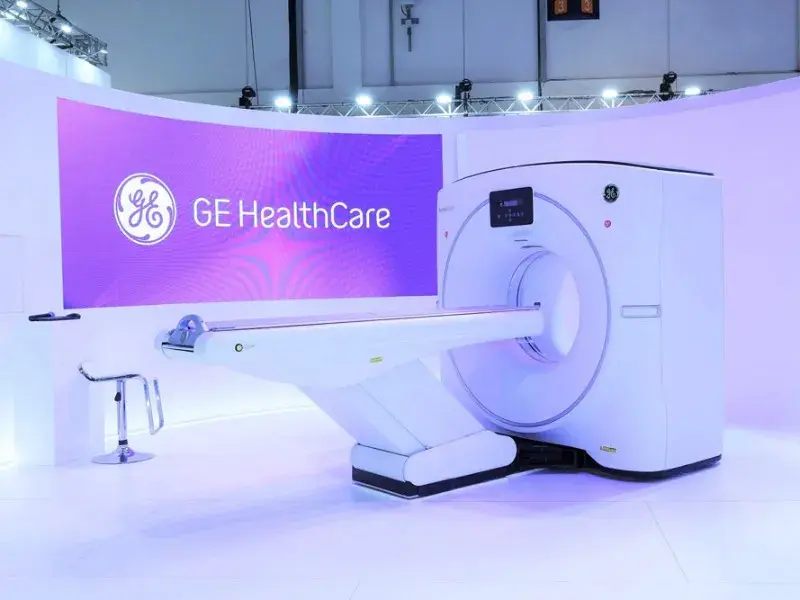
- GE HealthCare is collaborating with Amazon Web Services (AWS) to build generative AI models and tools for analysing complex medical data across screening, diagnosis, decision support and workflow management.
- With up to 97% of hospital data going unused, the pair are betting that reading the landfill is a bigger business than adding to it.
OUR TAKE
Every cloud giant wants a piece of healthcare, because healthcare is the last industry sitting on petabytes it has never monetised. GE HealthCare brings the installed base — scanners humming in thousands of hospitals — and AWS brings the compute and the sales channel. The interesting part is not the model; it is the meter attached to it. If AI hands a radiologist back twenty minutes a scan, somebody will invoice for those twenty minutes. The only open question is whose name is on the invoice: GE HealthCare's, AWS's, or the hospital's already-bruised IT budget.
–Miurio huang, BTW reporter
What happened: GE HealthCare bets on Bedrock and SageMaker
GE HealthCare has announced a collaboration with Amazon Web Services (AWS) to develop generative AI models and tools for analysing complex medical data — the scans, waveforms, notes and test results that pile up faster than any clinician can read them. The stated target is the whole clinical chain: screening, diagnosis, decision support and workflow management.
AWS supplies the plumbing, chiefly Amazon Bedrock for foundation models and Amazon SageMaker for building, training and running them. The practical payoff GE HealthCare is promising is speed: web-based medical imaging applications developed and deployed faster, putting analytics in front of clinicians who currently wait for a report, a queue, or a colleague with a free afternoon.
The numbers behind the pitch are stark. Healthcare generates close to one-third of the world's data, and by the companies' own framing up to 97% of hospital data is never used. GE HealthCare — which already sells imaging, ultrasound, patient monitoring and diagnostics into the hospitals it is now pitching — is betting generative AI can turn that surplus into something billable.
Also read: SoftBank sets up AI healthcare joint venture with Tempus AI
Also read: 10 AI-powered apps for self-diagnosing health conditions
Follow the compute: who actually pays for the 97%
Read the announcement the way a CFO does and the interesting details are the ones missing: no contract value, no revenue split, no exclusivity, no timeline with numbers attached. That is standard for a partnership release, and it is also the tell. What has actually been agreed is that one company's models will run on another company's infrastructure, in front of a customer base that mostly already buys from the first one.
For AWS, healthcare is the most attractive unconquered workload left. It is sticky, regulated, and paid for out of operating budgets that do not vanish in a downturn — and it arrives with a buyer who has already cleared the regulatory path. Bedrock and SageMaker are the picks and shovels of this gold rush: AWS does not need to own the diagnostic model, it needs the inference to happen on its meters.
For GE HealthCare, the trade is equally unsentimental. Building frontier models is a capital sport with a short memory; renting them from a hyperscaler is cheaper than losing to one. What GE HealthCare genuinely owns is the installed base, the clearances and the service contracts — the unglamorous assets that decide whether an AI feature ever reaches a scanner in a hospital basement.
Why it matters: the workflow is the moat, not the model
The 97% figure is usually quoted as a tragedy. It is better read as an inventory problem. Clinicians spend their days sifting records and results instead of sitting with patients, and radiology backlogs are measured in weeks, not hours. If a model can pre-read a study, draft the summary and flag the anomaly, the saving is counted in minutes per clinician per day — which is precisely where healthcare economics actually live.
The strategic consequence is stickier than the productivity gain. Once a hospital's imaging pipeline, reporting templates and quality checks are wired into a hyperscaler's model endpoints, switching is a migration project, not a purchasing decision. That is how cloud relationships compound: not by winning the RFP, but by becoming the plumbing.
The unresolved questions are the ones that decide whether this is a product or a pilot. Who owns the derived insight when a model trained on one health system's data improves a tool sold to its competitor? Who carries liability when the summary misses the nodule? And who keeps paying the subscription once the innovation budget runs dry — the vendor, the hospital, or the insurer quietly banking the downstream savings?
GE HealthCare and AWS have not so much announced a product as installed a meter. The pitch is that AI gives doctors their time back. The business model is that it gives the cloud a permanent seat in the reading room — and, eventually, a line item on the invoice.




