
Summary
- Gazprom Space Systems is a Russian satellite operator built around the Yamal communications fleet, a ground control and teleport estate, and the industrial communications needs of Gazprom Group and other customers. Its economic unit is not an abstract satellite. It is a recurring account for capacity, earth-station access, terminal equipment, integration and remote-site continuity.
- The strongest commercial case is where terrestrial fibre, microwave relay and mobile extension are too expensive, too slow or too fragile, and where no redundant link would expose an energy, public-sector, transport or media operation to a larger outage cost than the satellite bill.
- The public record supports an installed Yamal base: official fleet pages list Yamal-601 at 49E, Yamal-402 at 55E, Yamal-401 at 90E and Yamal-300K at 183E, while independent satellite records and launch sources show a replacement cycle that is already visible in the 2012-2019 fleet age profile.
- The risk side is unusually important. Yamal-601 used Thales Alenia Space hardware and Gilat supplied a ground-segment broadband platform before the 2022-2024 sanctions environment hardened. OFAC listed Joint Stock Company Gazprom Space Systems in February 2024, so future procurement, insurance, financing, payments, western technology access and cross-border customer trust all sit under higher friction.
- The final judgement is conditional. Gazprom Space Systems matters if its orbital capacity and ground network remain the least-bad continuity option for remote Russian and Eurasian customers. It loses pricing power if replacement satellites slip, domestic supply substitution raises cost without matching performance, fibre/mobile reach improves at the margin, or a sovereign low Earth orbit rival becomes a reliable substitute.
The continuity bill starts beyond the last good terrestrial route
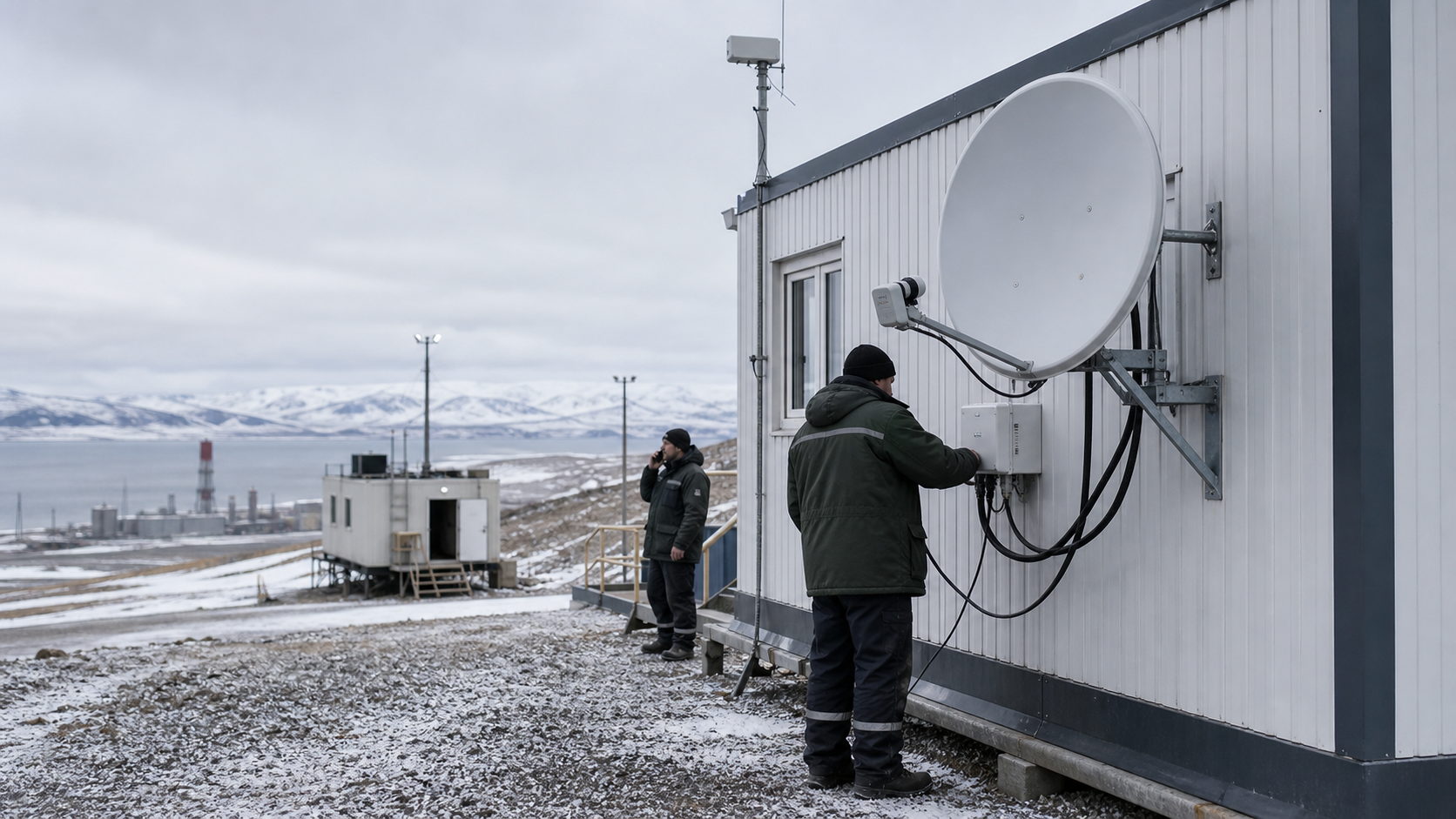
The most useful way to understand Gazprom Space Systems is to begin at the edge of a terrestrial network. Imagine a compressor station on a gas transmission corridor, a logistics office serving a northern mineral project, a government post in a thinly populated district, or a rail maintenance site whose work cannot wait for a consumer broadband upgrade. The site still needs monitoring data, voice service, video, corporate applications, emergency reachability and often television or public information distribution. Its alternative menu is limited.
A fibre route can be buried or strung over long distances, but the civil works, rights of way, weather exposure and repair time can exceed the value of the traffic. A microwave relay can work when towers, power and line of sight are available, but terrain and distance break the model quickly. A mobile extension can serve workers and nearby settlements, but it still needs backhaul. A low Earth orbit service can reduce latency, but inside Russia it faces authorization, terminal supply, spectrum and sovereignty questions. A site with no redundant link is not really saving money; it is accepting a hidden outage liability.
Gazprom Space Systems sells into that liability. Its public pages describe a company that has created and operates the Yamal satellite communication system and provides telecommunications and geo-information services for Gazprom Group companies and other customers (https://www.gazprom-spacesystems.ru/en/about/). The company also presents the Yamal fleet and infrastructure as the hard asset base behind those services (https://www.gazprom-spacesystems.ru/en/infrastructure/). That matters because the buyer is not buying romance about space. The buyer is buying a budget line that turns orbit, an earth station, terminal hardware, installation work and support into a continuity service.
This makes the paid unit a remote-site account. It can show up as leased satellite capacity, managed satellite Internet, trunk links, engineering communications, television distribution, mobile backhaul support, aviation or rail connectivity, or a packaged VSAT service. The company says its main service is provision of Yamal satellite capacity, while its modern ground infrastructure allows use of the orbital constellation for satellite telecommunication services, backbone channels, engineering communications and satellite Internet access (https://www.gazprom-spacesystems.ru/en/m/services_and_solutions/). A separate company page for satellite Internet access puts the offer in plain commercial terms: companies can buy Internet access over direct satellite channels or shared-access network designs (https://www.gazprom-spacesystems.ru/en/services_and_solutions/satellite-internet-access/).
The opening economic question is therefore not whether satellites are more expensive than terrestrial networks on a per-megabit basis. In dense cities, they usually are. The question is whether Gazprom Space Systems can charge less than the avoided cost of a remote communications failure. A remote energy site may value telemetry and dispatch continuity more than cheap bandwidth. A public office may need a stable link because the alternative is in-person travel, delayed records and administrative isolation.
A transport operator may buy a satellite path because passengers, crews and control systems expect service in places where fixed networks do not follow the route. In those settings, terrestrial fibre, microwave relay, mobile extension, a low Earth orbit competitor and no redundant link are not abstract substitutes. They set the ceiling on what the Yamal account can charge.
That is why this company should be read as an infrastructure economics case, not only as a satellite catalogue. Its space assets create coverage. Its ground segment creates a service. Its customer base converts coverage into recurring demand. Its replacement cycle sets the long-run capital bill. Its sanctions exposure determines whether the next generation can be procured, launched, insured and maintained without the same western inputs that supported previous Yamal satellites.
The economic spine is the continuity premium: the price a buyer is willing to pay so a remote Russian or Eurasian operation does not depend on one fragile terrestrial path.
Identity, ownership and why Gazprom demand matters
Joint Stock Company Gazprom Space Systems is not an independent start-up searching for its first anchor customer. The investor-relations page on the company's mobile site lists shareholders as Gazprom with 79.80 percent, RSC Energia with 16.16 percent and Gazprombank with 4.04 percent (https://www.gazprom-spacesystems.ru/en/m/about/investor_relations/). That ownership structure is commercially important. Gazprom Group's production, transportation, processing, storage and sales footprint gives the satellite company a built-in industrial demand map: remote fields, compressor stations, gas transmission corridors, regional depots and corporate sites that need communications even where conventional networks are thin.
The shareholder mix also shapes risk. A Gazprom-linked operator can have strategic demand that a private satellite reseller would not command, but it can also inherit geopolitical and financing pressure from its parent ecosystem. Gazprom's core gas business has been under severe commercial pressure since the loss of much of its European market, and western sanctions have affected parts of the broader Russian energy and finance system. For Gazprom Space Systems, this means the demand base may remain strategically sticky while external financing, western supplier access and international commercial expansion become more difficult.
The same state-industrial anchor that supports continuity demand can narrow the foreign market.
The company identity also explains why public-sector and industrial demand belong in the same analysis. Satellite communications for a Gazprom site, a ministry-linked customer, a regional authority and a remote broadcaster are not identical contracts. They do, however, share the same underlying scarcity: they need reach beyond ordinary last-mile economics. Public company descriptions and industry profiles regularly frame Gazprom Space Systems as one of Russia's two national satellite operators and as part of a small global set of fleet operators. Skybrokers, a commercial satellite brokerage profile, describes Gazprom Space Systems as one of two Russian national satellite operators and reports that it provides about 30 percent of satellite capacity available in Russia (https://sky-brokers.com/supplier/gazprom-space-systems-gss/). The company's own strategy page also says its share of the Russian satellite capacity market is about 30 percent (https://www.gazprom-spacesystems.ru/en/about/strategy_and_mission/).
Those share claims should not be treated like audited current revenue. They are useful because they describe market position and strategic relevance. If a company controls a material share of domestic satellite capacity in a large, sparsely populated country, then the business model is linked to the cost of serving distance. Russia's geography makes that cost visible: high latitudes, long gas and rail corridors, remote settlements, resource sites and public institutions outside dense fibre economics. The point is not that every remote customer must choose Gazprom Space Systems.
The point is that a domestic geostationary fleet with ground infrastructure can remain economically relevant even when consumer broadband and city fibre improve.
The legal identity therefore turns into a pricing story. A fully private satellite operator with no industrial anchor has to chase every megahertz of demand in the open market. Gazprom Space Systems has a different base case: a strategic parent, a domestic industrial footprint and public-sector relevance. That can support utilization, but it can also reduce transparency. The public record does not disclose contract-by-contract revenue, average price per megahertz, utilization by beam, customer concentration or the margin split between capacity leasing and managed services.
The investor should therefore test the thesis through assets, demand signals, network records, supplier history and replacement needs rather than through a simple published tariff.
The orbital account is capacity, coverage and fleet age
The Yamal fleet is the first layer of the account. The current official fleet page presents Yamal-601 at 49E, Yamal-402 at 55E, Yamal-401 at 90E and Yamal-300K at 183E (https://www.gazprom-spacesystems.ru/en/infrastructure/). Each orbital slot and band mix implies a different commercial surface. Yamal-601 is the major 49E replacement and Ka-band broadband asset. Yamal-402 gives Ku-band coverage across Russia, CIS countries, Europe, parts of the Middle East and Africa. Yamal-401 is centered on 90E and is heavily oriented to the Russian market. Yamal-300K adds C- and Ku-band capacity after its relocation to 183E. The fleet is not just a list of satellites; it is a map of where Gazprom Space Systems can sell continuity.
Yamal-601 is the clearest case of replacement economics. Thales Alenia Space announced the Yamal-601 contract in 2014 and described a satellite based on the Spacebus 4000C4 platform, with C-, Ku- and Ka-band payload capacity, a mass above five metric tons, 11 kilowatts of payload power and a design life exceeding 15 years (https://www.thalesaleniaspace.com/en/press-releases/thales-alenia-space-build-yamal-601-satellite-gazprom-space-systems). The same release said the satellite would replace Yamal-202 at 49E and extend coverage across Europe, the Middle East, North Africa, South and Southeast Asia. RussianSpaceWeb's Yamal-601 launch account similarly frames the spacecraft as a 15-year replacement for Yamal-202, launched on Proton-M/Briz-M in May 2019 and intended for fixed communications and transmission services from 49E (https://www.russianspaceweb.com/yamal601.html).
The commercial significance is twofold. First, Yamal-601 added Ka-band broadband economics to a fleet that had historically depended heavily on C- and Ku-band fixed satellite capacity. Second, it put a long-life spacecraft into service just before sanctions and supplier access became much more difficult. Independent satellite catalogues such as Gunter's Space Page list Yamal-601 as a Thales Alenia Space spacecraft with C- and Ka-band payload details and more than 15 years design life (https://space.skyrocket.de/doc_sdat/yamal-601.htm). SatBeams records Yamal 601 as active at 49E, with Gazprom Space Systems as operator and a May 2019 launch date (https://www.satbeams.com/satellites?id=2550). The exact transponder representation varies across sources, but the key economic point is stable: a high-value replacement satellite began service in 2019 and should define a large part of Gazprom Space Systems' capacity account into the 2030s if it remains healthy.
Yamal-401 and Yamal-402 show the older side of the fleet. Yamal-401 was launched in December 2014. Leonardo's release on the satellite says it formed part of the Yamal-400 program, had a service life of over 15 years and would be managed by a ground control center in Russia built by Thales Alenia Space as part of the Yamal 402/401 contract (https://www.leonardo.com/en/news-and-stories-detail/-/detail/satellite-yamal-401-in-orbit). Gunter's Space Page describes Yamal-401 at 90E with 36 Ku-band and 17 C-band transponders for Russia and nearby coverage (https://space.skyrocket.de/doc_sdat/yamal-401.htm). Yamal-402, launched in 2012, is a Thales Alenia Space Ku-band spacecraft at 55E; Gunter's Space Page and other records note its 46 Ku-band transponders and service area (https://space.skyrocket.de/doc_sdat/yamal-402.htm).
The replacement clock is visible. A 2012 satellite, a 2014 satellite and a 2019 satellite do not create an immediate crisis if they remain healthy, but they do create a staggered capital schedule. Geostationary capacity is not replaced with a quick software purchase. It requires design, payload procurement, manufacturing, launch, insurance, ground testing, regulatory coordination, orbital transfer, in-orbit testing and customer migration. If a replacement is late, the operator either stretches aging assets, buys or leases third-party capacity, moves customers, accepts service constraints or loses accounts.
The economics of today's Yamal capacity therefore depend on tomorrow's procurement and launch path.
The company has discussed future projects and domestic spacecraft production for years. Its new-projects page describes a spacecraft assembly, integration and testing project at the Gazprom Space Systems site in Shchelkovo, adjacent to the company's Telecommunication Center (https://www.gazprom-spacesystems.ru/en/new_projects/). RussianSpaceWeb's broader Yamal page records Yamal-501 as a planned communications satellite, with plans changing over time and a planned date around 2026 in some earlier references (https://www.russianspaceweb.com/yamal.html). These future references are not proof that replacement capacity will arrive on schedule. They are proof that fleet renewal is a standing strategic requirement.
For a buyer at a remote site, fleet age matters only if it affects continuity, price or migration. For Gazprom Space Systems, it affects all three. An operator can charge for continuity when customers believe the orbital resource will be there for the contract term. If sanctions delay replacement or raise domestic manufacturing cost, the operator may need higher prices, stronger anchor commitments or state support. If the fleet ages without credible replacement, the continuity premium becomes harder to defend. The satellite account is therefore a depreciation account as much as a revenue account.
Ground segment turns orbit into a paid service
Orbital capacity is unusable without ground infrastructure. The company repeatedly ties Yamal capacity to a ground control complex, telecommunication center and networks operating across Russian regions. Viasat's 2021 announcement of a strategic memorandum with Gazprom Space Systems and TMC includes a compact description of the Yamal system: an orbital constellation of Yamal-202, Yamal-300K, Yamal-402, Yamal-401 and Yamal-601, plus a ground control complex and telecommunication center with networks operating across Russian regions (https://www.prnewswire.com/news-releases/viasat-gazprom-space-systems-tmc-sign-strategic-mou-establishing-a-multi-year-roadmap-of-cooperation-to-bring-in-flight-connectivity-services-to-russia-301225558.html). Even though that memorandum predates the harder sanctions environment, it shows how outside partners saw Gazprom Space Systems: not only as a space asset owner, but as a ground-enabled service operator.
Ground segment is where capacity becomes billable. A satellite beam can cover a region, but the revenue is made through teleports, antennas, hub equipment, network management systems, user terminals, installation, maintenance and customer support. Gazprom Space Systems' own services pages say the company lets out Yamal orbital capacity for lease and uses its ground infrastructure to provide satellite telecommunication services (https://www.gazprom-spacesystems.ru/en/m/services_and_solutions/satellite_capacity/). That distinction matters because capacity leasing and managed service have different economics. Leasing capacity can be a wholesale business with large blocks and fewer customer touchpoints. Managed service can capture more value but requires more equipment, field operations, support and integration.
The 2018 Gilat contract makes that ground-segment layer visible. Gilat announced an 18 million dollar agreement with Gazprom Space Systems to provide broadband connectivity across Russia over the new Yamal-601 Ka satellite, including a multiservice platform and VSAT terminals (https://www.gilat.com/wp-content/uploads/Gilat-GSS-PR-2018-08-29-Business-Win-Sign-18M-Contract-to-Provide-Broadband-Connectivity-Across-Russia.pdf). The release described consumer broadband for remote locations, corporate connectivity and shared access for rural regions, as well as cooperation for fixed and mobile platforms, in-flight connectivity and railway passenger services. This is a useful commercial proof point because it shows how a spacecraft translates into a kit of services: platform, terminals, satellite capacity, mobile applications and future cooperation.
The same proof point exposes procurement risk. Gilat is an Israeli satellite networking company. Thales Alenia Space is a European satellite manufacturer. The Yamal-400 and Yamal-601 generations relied significantly on non-Russian technology, integration and expertise. If similar inputs become restricted, unavailable or reputationally difficult under the post-2022 sanctions environment, the next ground-segment or satellite procurement cycle may require domestic replacement, third-country sourcing or degraded scope. The continuity account can still be valuable, but its cost base changes.
The official Gazprom AIT Facility page shows Russia's domestic assembly response. Gazprom AIT Facility LLC says it was established in 2015 to implement a spacecraft assembly production facility for PJSC Gazprom and other potential customers, with construction starting in November 2019 and commissioning in 2024 (https://www.gazprom-spka.ru/en/company/). It describes capacity for assembly and testing of at least four medium and large satellites at the same time, as well as serial production of small spacecraft for multi-satellite systems. That is relevant to Gazprom Space Systems because domestic assembly and testing capacity can reduce dependence on foreign prime contractors. It does not automatically solve payload electronics, radiation-hardened components, launch insurance, software assurance, ground terminal supply or export-controlled subsystems.
Ground infrastructure also defines resilience. A geostationary satellite can cover a large region, but the service can still fail at the hub, teleport, terrestrial backhaul, power, control center, terminal or customer premises. A remote-site buyer wants a continuity account, not a satellite brochure. That means the operator must show that the dish, modem, bandwidth allocation, network operations center, terrestrial interconnect and maintenance arrangements are all strong enough to carry critical traffic.
The public record gives evidence of ground control and teleport capability but not enough detail to audit actual redundancy, service-level performance or spare-parts depth.
For economics, this is decisive. If Gazprom Space Systems mostly sells raw capacity, the price is tied to regional bandwidth supply, transponder scarcity and wholesale competition. If it sells managed services into industrial and public-sector accounts, it can charge for integration, uptime, equipment and support. The Gilat contract, satellite Internet pages and ground-infrastructure descriptions point toward the second model being meaningful. The remote-site continuity account is therefore a bundle: spectrum resource, orbital asset, ground hub, terminal fleet, installation and service operations.
The bundle can be more defensible than capacity alone, but it is also more exposed to equipment and sanctions friction.
A useful way to test that bundle is to ask what the customer would still need to buy if the satellite capacity were free. The site would still need a terminal, a trained installer, mounting hardware, power, field maintenance, network addressing, traffic routing, security controls, help-desk procedures, weather planning and a service contact who can decide what happens when the link degrades. Those items are not decorations around capacity. They are the work that turns spectrum into an operational communications line.
Gazprom Space Systems can defend price when it owns or coordinates enough of that work to reduce the customer's operational burden. It is more exposed when the buyer can assemble the same stack from a commodity terminal, a local integrator and a cheaper capacity source. The value of the ground segment is therefore not only technical. It is commercial control over the messy boundary between a spacecraft and a remote site that wants a working connection on bad days, not only during a demonstration.
Industrial and public-sector demand set the base load
Gazprom Space Systems' demand is best understood as three overlapping markets: internal and Gazprom-adjacent industrial connectivity, Russian public and enterprise continuity, and international or cross-border satellite capacity. The first is the most strategic. Gazprom Group's gas production and transportation geography is exactly the kind of geography that makes satellite useful. The second turns a strategic asset into a broader domestic service. The third gives the fleet a way to monetize footprints beyond Russia, but it is also the most sensitive to sanctions, customer reputational risk and payment restrictions.
The company and industry profiles repeatedly emphasize services for Gazprom Group companies and other customers. The About Company page says Gazprom Space Systems carries out space activities in the development and operation of telecommunication and geo-information systems in the interests of Gazprom Group companies and other customers (https://www.gazprom-spacesystems.ru/en/about/). Conference and partner profiles add a more detailed service catalogue: satellite capacity, trunk communication links, satellite television broadcasting, satellite Internet access for corporate and individual customers, and geo-information services. ComNews' Satellite Russia and CIS partner text, for example, describes telecommunications and geo-information systems across Russia and CIS, Europe, the Middle East, Africa, Southeast Asia and the Pacific Ocean, and identifies satellite capacity as the main service (https://www.comnews-conferences.ru/en/conference/satellite2020/partner).
The paid unit in the industrial market is reliability. A gas field, processing plant, transmission segment or storage facility does not buy satellite capacity because it is fashionable. It buys it because monitoring, dispatch, security, corporate data and emergency communications can be worth more than the bandwidth tariff. If a remote site loses its only terrestrial path, the operational cost can include delayed maintenance, lower safety visibility, disrupted worker communications and slower incident response. A satellite backup path can look expensive until the alternative is an unplanned outage with no redundant link.
Public-sector demand has a different but related logic. A district office, school network, health outpost, emergency service, border-area facility or regional broadcaster may not generate high commercial traffic volumes. It may still need connectivity because public access, administrative continuity and information distribution have policy value. Russia's universal-service and digital-divide programs show the broader pressure to extend connectivity into small and hard-to-reach settlements. The World Bank's broadband-in-Russia report described Rostelecom's universal-service role and a planned 200,000 kilometer fibre build-out to connect settlements, showing that terrestrial extension is a major policy objective but also a large civil-works burden (https://openknowledge.worldbank.org/bitstreams/3e724fc6-e414-565c-a462-2104478c2633/download). Rostelecom's own universal-service reporting described obligations to install Wi-Fi access points in almost 14,000 communities with populations between 250 and 500 people (https://csr2018.rostelecom.ru/en/60/30).
Those terrestrial programs are not a reason to dismiss satellite. They define the substitute boundary. Where fibre reaches, satellite must justify itself as backup, mobility, broadcast, rapid deployment or niche coverage. Where fibre does not reach or is too expensive to duplicate, satellite can be the primary continuity layer. Mobile extension can improve access, but base stations still need backhaul. Microwave can work but is geography-dependent. Low Earth orbit can offer lower latency, but it requires a dense constellation, terminal availability, regulatory permission and network integration.
For Gazprom Space Systems, public-sector demand remains strongest where at least one of those terrestrial alternatives is missing or fragile.
Cross-border demand adds another dimension. Yamal-402's footprints and Yamal-601's C-band coverage have historically supported capacity sales beyond Russia. SatellitePro Middle East's 2019 coverage of Gazprom Space Systems' CABSAT promotion said the Yamal fleet spanned positions between 49E and 183E and that Yamal-402 provided Ku-band coverage over Russia, CIS countries, Europe, part of the Middle East and Sub-Saharan Africa (https://satelliteprome.com/products/gazprom-space-systems-promotes-yamal/). The article also noted more than 250 companies in the customer base and use in more than 100 countries, which should be treated as a promotional market signal rather than a current audited figure. Still, it shows why cross-border connectivity is part of the business model: a geostationary footprint can be sold outside the operator's domestic political market if customers can contract, pay and accept the supplier risk.
The post-2022 environment makes that international layer harder. Some customers will avoid sanctioned Russian suppliers even if the beam is technically attractive. Banks and insurers may complicate payment and service contracts. Western equipment vendors may not support network expansions. The result is a split demand picture: domestic industrial and public-sector continuity may become more captive and strategic, while international commercial sales may become more selective, lower trust or more dependent on third-country channels.
For a continuity operator, that can keep utilization stable but reduce pricing flexibility and customer diversity.
Network records show a service edge, not a separate story
Gazprom Space Systems also appears in Internet routing records, but those records should be read as supporting evidence, not as the business itself. PeeringDB lists Joint Stock Company Gazprom Space Systems as AS15757, with the website gazprom-spacesystems.ru and network type NSP (https://www.peeringdb.com/net/15302). RIPEstat records AS15757 under the RIPE NCC registry, with Russia as the country and an allocation date in 2000 (https://stat.ripe.net/resource/AS15757). Public BGP records show AS15757 with announced IPv4 prefixes, including descriptions tied to Gazprom Space Systems, end users via Yamal-600 and teleport labels.
Those records are useful because they confirm that the satellite operator has an Internet-facing network footprint consistent with managed connectivity. They also show where satellite capacity touches the public Internet: prefixes, upstream carriers, exchange presence and routing relationships. Hurricane Electric's BGP view for AS15757 similarly lists prefixes and peers, including large Russian and international network names (https://bgp.he.net/AS15757). In the economics of a remote-site account, this is one part of the ground segment. A customer may not care which autonomous system carries the traffic, but it cares whether the satellite service can hand traffic into usable terrestrial networks.
The records should not be overinterpreted. An autonomous system is not a customer list. A prefix is not a satellite. A route description is not proof of service quality, revenue or criticality. Some route labels may lag actual commercial arrangements. The point is narrower: Gazprom Space Systems is not only leasing capacity in isolation; it has public network infrastructure that supports Internet and data services. That helps explain why the company can sell a continuity account rather than only megahertz.
The network evidence also helps separate the business from pure broadcast. Yamal satellites have long carried television and radio distribution, but AS15757 and satellite Internet product pages point to corporate data and Internet services as part of the offer. That matters because broadcast capacity and remote broadband have different demand curves. Broadcast can be sticky but may face compression, platform substitution and political content risk. Remote broadband and industrial data depend more on terminal economics, application demand and backhaul alternatives.
A balanced capacity operator wants both, but the growth and risk profile differs.
For sanctions analysis, the Internet-facing layer also matters. A sanctioned operator with network services may face problems in transit purchasing, equipment upgrades, support contracts, software updates and foreign interconnection trust. Russian domestic upstreams can keep the network connected, but cross-border partners may become cautious. This does not make AS15757 a separate entity or a relationship endpoint; it is a set of public technical records that support the conclusion that Gazprom Space Systems operates a managed telecom surface around its satellites.
Unofficial market signals add texture but not proof. Public satellite forums, LyngSat-style channel listings, broker pages and routing records show that Yamal capacity is visible to users, resellers and technical observers. LyngSat's Yamal-401 page, for example, shows active television transponder use and Gazprom Space Systems entries in the broadcast layer (https://www.lyngsat.com/Yamal-401.html). Such records are useful for seeing that capacity is not theoretical, but they are not a clean measure of revenue. The article's judgement therefore treats network and broadcast records as evidence of service surface, not as standalone business claims.
Sanctions make inputs the central risk
The February 2024 OFAC listing is the sharpest legal risk marker. OFAC's sanctions-search detail page identifies "JOINT STOCK COMPANY GAZPROM SPACE SYSTEMS" as an SDN under the Russia-related EO 14024 program, with tax ID 5018035691 and registration number 1025002045177 (https://sanctionssearch.ofac.treas.gov/Details.aspx?id=47574). Treasury's February 23, 2024 press release described a broader package of sanctions against more than 500 Russia-related targets, with the stated purpose of imposing costs on Russia's war effort and disrupting military-industrial and related support networks (https://home.treasury.gov/news/press-releases/jy2117). OpenSanctions aggregates the company across sanctions and export-control sources, including the OFAC listing and procurement exclusions (https://www.opensanctions.org/entities/NK-cS6fQi2LkYhjpiToPjdZvd/).
The sanctions matter because satellite systems are input-heavy. A communications satellite depends on payload electronics, travelling-wave tube amplifiers, antennas, power systems, propulsion, flight software, ground-control equipment, test facilities, launch arrangements, insurance and engineering support. The existing Yamal fleet shows deep foreign input history. Thales Alenia Space built Yamal-402 and Yamal-601, supplied payloads for Yamal-401, and was involved in ground-control systems. Gilat supplied Yamal-601 Ka-band ground-segment equipment. Viasat signed an in-flight connectivity cooperation memorandum in 2021.
Each of those facts predates the current sanctions intensity, and each illustrates a technology pathway that may be harder to replicate under restrictions.
This is not only a legal compliance point. It changes the capital cycle. If an operator can buy a proven western payload, proven VSAT platform and internationally supported ground system, replacement risk is lower. If it must source domestically or through a smaller set of permissible suppliers, the same replacement may take longer, cost more, carry more technical risk or offer less capacity. A domestic AIT facility helps with assembly and test, but payload capability and component supply are separate constraints.
The difference between "assembled in Russia" and "all critical inputs domestically available at competitive performance" is large.
Sanctions also affect financing and insurance. A geostationary communications satellite is a long-lived capital asset. It usually needs financing, launch risk coverage, in-orbit insurance or state balance-sheet support, and it monetizes over many years. If counterparties cannot transact, premiums rise or financing has to come from state-linked sources, the required utilization and price per unit of capacity may rise. That can be viable for captive industrial and public-sector demand, but it can weaken competitiveness in international markets where buyers can choose non-Russian capacity.
The immediate counterargument is that Russia has a strategic reason to maintain domestic satellite communications. That is true. State support, Roscosmos cooperation, domestic manufacturing initiatives and captive demand can offset some market pressure. The official Gazprom AIT Facility page and Gazprom Space Systems' new-projects page point to an industrial policy response: build more domestic assembly and test capability near the existing telecommunications center (https://www.gazprom-spka.ru/en/company/ and https://www.gazprom-spacesystems.ru/en/new_projects/). Space industry reporting in 2024 also described Russian satellite-sector efforts to replace unavailable imports after sanctions, with Russia's largest telecom satellite fleet operator saying import substitution was partway through the process (https://www.spaceintelreport.com/russian-satellite-industry-were-60-through-our-sanctions-forced-import-substitution-program/).
The strategic response does not remove the economic risk. It changes who bears it. If the state or Gazprom Group absorbs higher replacement cost, the continuity account can continue but with lower transparency and perhaps weaker return on capital. If Gazprom Space Systems has to pass the cost to customers, price sensitivity rises and substitutes become more attractive. If replacement slips, customers may seek RSCC capacity, terrestrial backup, local microwave, fibre where available or LEO alternatives. Sanctions inputs are therefore not a side issue.
They sit at the center of the pricing model because they determine whether the next satellite can be as capable, timely and financeable as the last one.
Low Earth orbit and terrestrial substitutes set the ceiling
Gazprom Space Systems' most important substitute is still terrestrial infrastructure. Fibre is the best long-term solution where routes are justified by population, industrial density or policy funding. It has lower latency, high capacity and familiar operations. Microwave can be cheaper and faster where line of sight and power are available. Mobile extension can serve settlements and workers when a base station can be built and backhauled. The problem is that Russia and Eurasia contain many places where those options are partial. A remote site may get fibre eventually but need service now.
It may have mobile coverage for handheld users but not enough backhaul for industrial traffic. It may have one terrestrial path but need redundancy. In that case satellite remains a priced continuity layer.
The more disruptive substitute is low Earth orbit broadband. Low Earth orbit constellations can reduce latency and offer user terminals that are easier to deploy than many traditional VSAT systems. Globally, Starlink has reshaped expectations about remote broadband. Inside Russia, however, the relevant competitor is complicated. Starlink is not a normal authorized domestic retail substitute. Reports in 2024-2026 described Russian military use of unofficial Starlink terminals in occupied Ukraine and later efforts to deactivate or restrict that use, but that is not the same as a lawful mass-market Russian enterprise product.
The result is that foreign LEO pressure affects expectations and military lessons, while domestic LEO deployment determines the practical Russian substitute.
Bureau 1440 is the domestic LEO project to watch. Its English site says its software-hardware complex enables data exchange between orbital satellite constellations and ground-based public networks (https://1440.space/en/). Data Center Dynamics reported that Russia launched the first 16 satellites of the Rassvet LEO broadband constellation on March 23, 2026, designed by Bureau 1440 as a homegrown Starlink competitor (https://www.datacenterdynamics.com/en/news/572bn-russian-leo-constellation-launches-first-satellites-to-build-starlink-competitor/). Wired's 2026 coverage similarly framed Rassvet as Russia's answer to Starlink, with ambitious funding and deployment goals but early-stage scale compared with Starlink's mature network (https://www.wired.com/story/meet-rassvet-russias-answer-to-starlink/).
For Gazprom Space Systems, Rassvet is not yet a direct one-for-one replacement for the Yamal business. A few dozen early LEO satellites cannot deliver the same continuous enterprise-grade coverage and service assurance as a mature geostationary operator with existing customers. But the direction matters. If Bureau 1440 or another sovereign LEO system reaches scale, it can compete for some remote broadband accounts, mobility use cases and public-sector continuity budgets.
It may not replace C-band fixed satellite service, broadcast distribution or every industrial VSAT link, but it can cap pricing for sites that primarily need Internet access and lower latency.
This creates a tiered pricing ceiling. For a site that can get fibre at reasonable cost, satellite is backup and must be priced like backup. For a site that can use microwave, satellite must price against tower and maintenance economics. For a site that can extend mobile service with backhaul, satellite may become part of the backhaul rather than the end-user service. For a site that can use a mature LEO network, geostationary service must defend itself through reliability, domestic control, existing integration, coverage, capacity availability or bundled support.
For a site with no redundant link, Gazprom Space Systems can price against the avoided cost of isolation.
The company is therefore not protected by remoteness alone. Remoteness is the reason demand exists, but substitutes determine the margin. The best accounts are those where satellite is not only a convenience but a required continuity layer. The weakest accounts are those where the customer merely wants cheaper broadband and can switch to a terrestrial or LEO option when it arrives. A serious analysis of Gazprom Space Systems has to keep those substitutes visible from beginning to end because they decide whether orbital capacity is a premium service or a declining backstop.
Competition is domestic, regional and political
The obvious domestic competitor is the Russian Satellite Communications Company, commonly associated with the Express satellite fleet. Yamal and Express capacity have long formed the backbone of Russia's domestic satellite communications market. RSCC can compete for government, broadcast, maritime, remote enterprise and international capacity accounts. It may also receive strategic support as Russia reorganizes satellite supply under sanctions. Gazprom Space Systems' advantage is its Gazprom-linked industrial anchor, Yamal fleet positions and existing managed service base.
Its disadvantage is scale and the difficulty of renewing a fleet that has used foreign technology.
International competitors are more complicated. Operators such as Eutelsat, SES, Intelsat and regional satellite companies can provide capacity over parts of Eurasia, the Middle East and Africa. In ordinary market conditions, they would be important alternatives for cross-border customers. In the current sanctions environment, western operators may not be available to Russian customers in the same way, and non-Russian customers may not want a sanctioned Russian supplier. That can create a domestic protected pocket for Gazprom Space Systems while weakening international growth. Protection and isolation can coexist.
The market itself is large enough to remain relevant. Mordor Intelligence estimated the Russia satellite communications market at 1.17 billion dollars in 2025 and projected 2.15 billion dollars by 2030, with a 12.91 percent compound annual growth rate (https://www.mordorintelligence.com/industry-reports/russia-satellite-communications-market). Forecasts from commercial research firms should be treated as directional rather than definitive, especially under wartime sanctions and Russian data opacity. Still, the estimate reflects a plausible demand backdrop: remote connectivity, satellite imagery, natural-resource management, maritime and public-sector uses are not disappearing.
The Arctic and high-latitude context strengthens that backdrop. The European Space Agency's Arctic communications page notes that both Canada and Russia have strong reasons to improve Arctic communications and that Gazprom's space systems subsidiary had worked on Arctic broadband ideas such as PolarStar for its own communications needs (https://www.esa.int/Enabling_Support/Preparing_for_the_Future/Space_for_Earth/Arctic/Arctic_poses_communications_challenges). RussianSpaceWeb's Arktika page similarly explains that traditional geostationary satellites over the equator are ill-suited for the highest latitudes, which is why high-elliptical and specialized Arctic systems become relevant (https://www.russianspaceweb.com/arktika.html). That is a useful caveat for Yamal economics: geostationary assets are powerful over broad Eurasian footprints, but high-latitude performance is not a universal solution.
Competition is also political. A public-sector buyer may prefer domestic, sovereign capacity even when a foreign service is technically superior. A commercial buyer outside Russia may prefer non-Russian capacity even when Yamal is technically adequate. A Russian industrial buyer may be instructed or incentivized to use domestic providers. A foreign aviation or maritime buyer may avoid sanctioned suppliers because the payment, insurance or reputational burden is too high. Gazprom Space Systems' pricing power therefore depends not only on bandwidth and coverage, but also on who is allowed, willing and required to buy.
This political market structure is not automatically bad for the company. Captive demand can keep assets utilized and justify replacement investment. But it can narrow the customer pool and reduce the discipline of open competition. If domestic buyers have few alternatives, prices can remain high enough to support continuity. If they have state-backed alternatives or are pushed toward a newer sovereign LEO provider, Gazprom Space Systems could become a legacy capacity holder.
The best outcome for the company is a complementary role: geostationary capacity for fixed, broadcast, industrial and resilience accounts, with LEO used for latency-sensitive and mobile broadband where it matures.
What would change the judgement
The first fact that would change the judgement is a credible Yamal replacement order with visible payload capability, launch path, financing and ground-segment plan. Yamal-401 and Yamal-402 are aging, and Yamal-601 will eventually need replacement even if it remains healthy through its design life. A new satellite program that proves domestic or permissible-supplier capability would support the continuity thesis. A delayed, underpowered or opaque replacement would weaken it.
The second fact is customer-level demand. Public statements about market share and strategic importance are useful, but the strongest evidence would be contracts or disclosures showing renewal of Gazprom Group service accounts, public-sector continuity accounts, transport connectivity, remote broadband and international capacity. A large anchor commitment for replacement capacity would matter more than promotional coverage maps. It would show that customers are willing to fund the next orbital account, not only consume legacy Yamal capacity.
The third fact is ground-segment independence. If Gazprom Space Systems or its domestic partners can demonstrate replacement terminal supply, hub equipment, network-management software, field support and spares without restricted suppliers, sanctions risk falls. If the company remains dependent on pre-2022 imported equipment with limited support, service continuity may remain acceptable in the near term but capital renewal becomes harder.
The fourth fact is Bureau 1440's practical progress. If Rassvet reaches hundreds of operational satellites, obtains stable domestic authorization, produces affordable terminals, integrates with public networks and signs major industrial or public-sector customers, it becomes a real price ceiling. If it remains a slow, state-backed deployment with limited coverage and costly terminals, Yamal's geostationary continuity role remains safer. The relevant question is not whether LEO is better in theory. It is whether a Russian customer can buy a reliable, authorized, supported LEO service for the same remote account.
The fifth fact is terrestrial build-out. Fibre, microwave and mobile extension do not need to cover all of Russia to weaken satellite pricing. They only need to reach the marginal profitable accounts. If public subsidy and industrial civil works extend terrestrial routes to more remote settlements and resource sites, satellite shifts from primary connectivity to backup. That can still be valuable, but the price changes. Backup capacity is often bought for resilience, not full-time traffic, and may be negotiated more aggressively.
The sixth fact is sanctions escalation or relief. Further restrictions on Russian space, finance, insurance, electronics or telecom equipment would raise replacement and support costs. Relief or stable permissible channels would reduce uncertainty. Because Gazprom Space Systems was named on OFAC's SDN list, counterparties already face a hard compliance marker. Any change in that status would materially change the international side of the business.
Final judgement
Gazprom Space Systems matters because it sits at the junction of orbit, ground segment and remote continuity demand. Its Yamal fleet gives it coverage. Its Shchelkovo-linked infrastructure and network footprint let it turn that coverage into services. Its Gazprom ownership and public-sector relevance give it a demand base that is not purely discretionary. Its commercial unit is the remote-site account: capacity, terminal, earth-station access, network handoff, support and continuity. That is a stronger business than selling abstract space capacity into a price-only market.
The company also carries a heavy replacement and sanctions burden. The most important Yamal assets were built or supplied with significant foreign technology before the sanctions environment hardened. Yamal-601 is a strong 2019 asset, but the older 2012 and 2014 satellites make fleet renewal a visible issue. OFAC's 2024 designation raises the cost and complexity of international procurement, payments, insurance and customer trust. Domestic assembly and test capacity can help, but it does not automatically reproduce the full supplier ecosystem that made the existing fleet possible.
The thesis is therefore conditional rather than celebratory. Gazprom Space Systems can price continuity where the substitute is a long fibre build, a fragile microwave chain, a mobile extension that still needs backhaul, an immature or unauthorized low Earth orbit service, or no redundant link at all. It should be strongest in industrial, public-sector, remote broadband, broadcast and transport accounts where outage cost is high and domestic control matters.
It is weakest where fibre arrives, mobile backhaul improves, microwave is cheap, international customers avoid sanctioned suppliers, or a sovereign LEO competitor becomes reliable enough to cap the price.
The final test is not whether satellites remain useful in Russia. They do. The test is whether Gazprom Space Systems can renew the orbital and ground assets needed to keep selling a premium continuity account after the easy foreign-input era has ended. If it can, the company remains a meaningful Russian/Eurasian infrastructure operator. If it cannot, the Yamal account becomes a legacy asset pool: still useful, still strategic, but increasingly priced by aging capacity, procurement friction and substitutes that no longer leave remote customers with only a dish or silence.